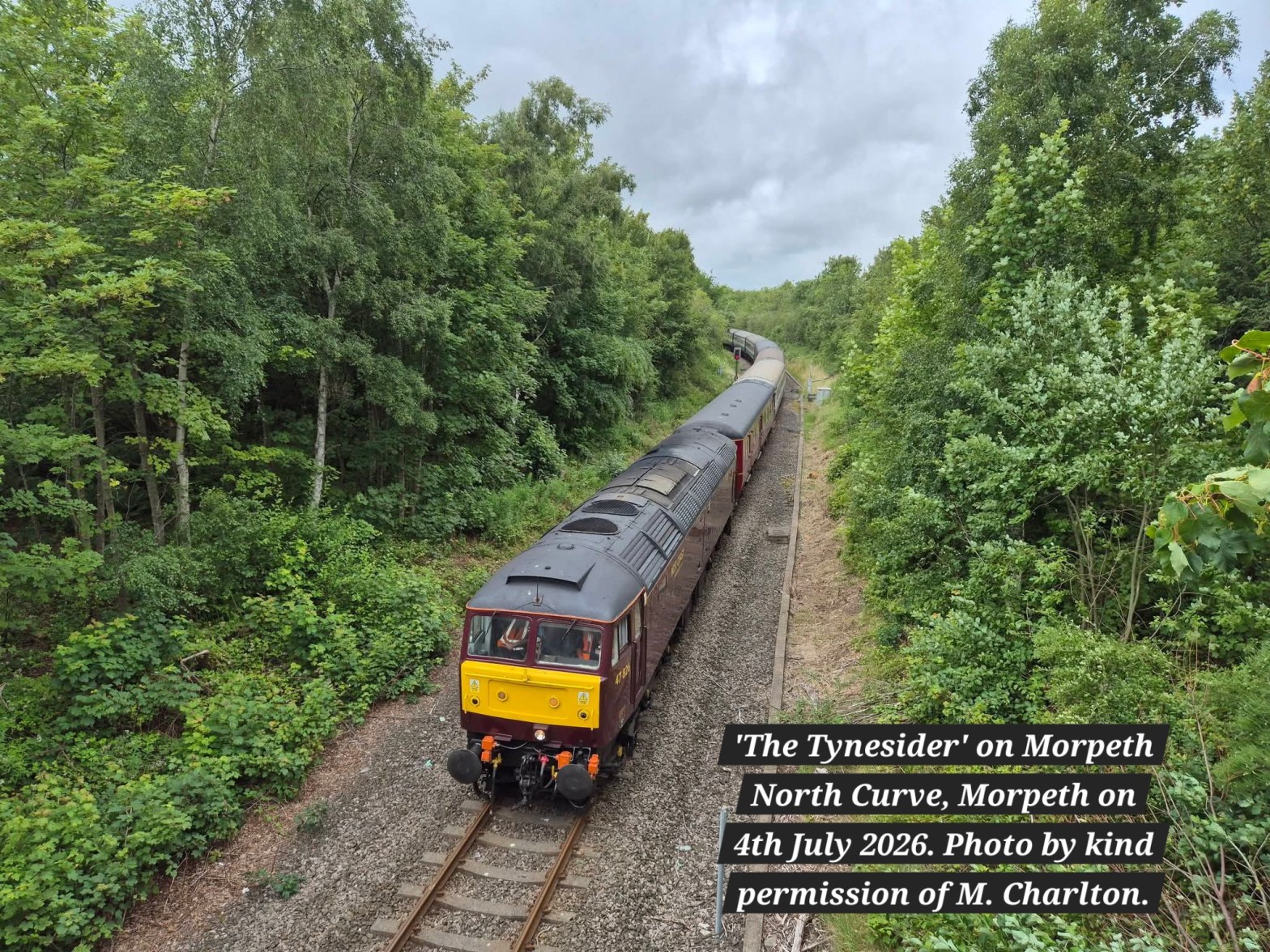
Northumberland Branch of NEPTUG June 2026 Meeting in Morpeth

The Northumberland Branch of North East Public Transport User Group (NEPTUG), formed in March 2026 exists to promote integrated bus and rail transport across Northumberland, as well as promoting active travel (walking, cycling etc) routes too.

Membership is FREE to everyone, with online meetings during the Autumn, Winter and early Spring, and our first in-person meeting due next month in June 2026, in Morpeth, Northumberland.

Please visit the NEPTUG website for details of the next Northumberland Branch of NEPTUG meeting, due to be held in Morpeth

Link here: https://neptug.org.uk/nladjun26/

Blyth Bebside to Berwick-Upon-Tweed in just 50 MINUTES by rail: c.40 mins faster than going via Newcastle or Morpeth.

The Northumberland Line now complete, with all six stations now open and bustling, it is time to really set the sights on the next steps for the line, and in my view, it should be to make use of the existing connection from Bedlington headed west, not only to Morpeth, as put forward by SENRUG, but to also take advantage of the potential direct route from Blyth to Berwick and beyond.

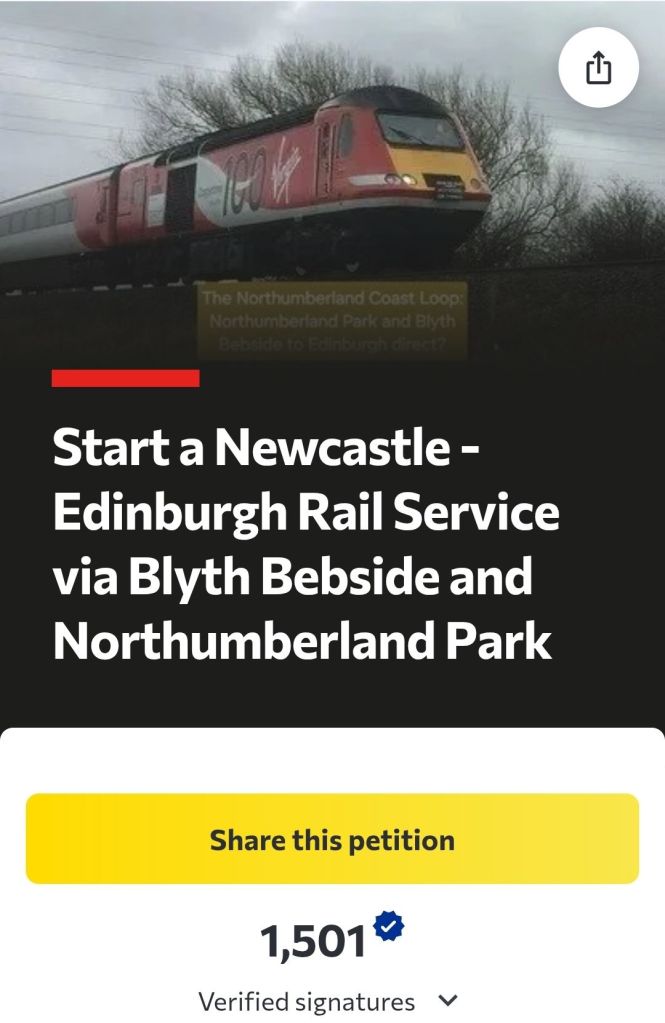
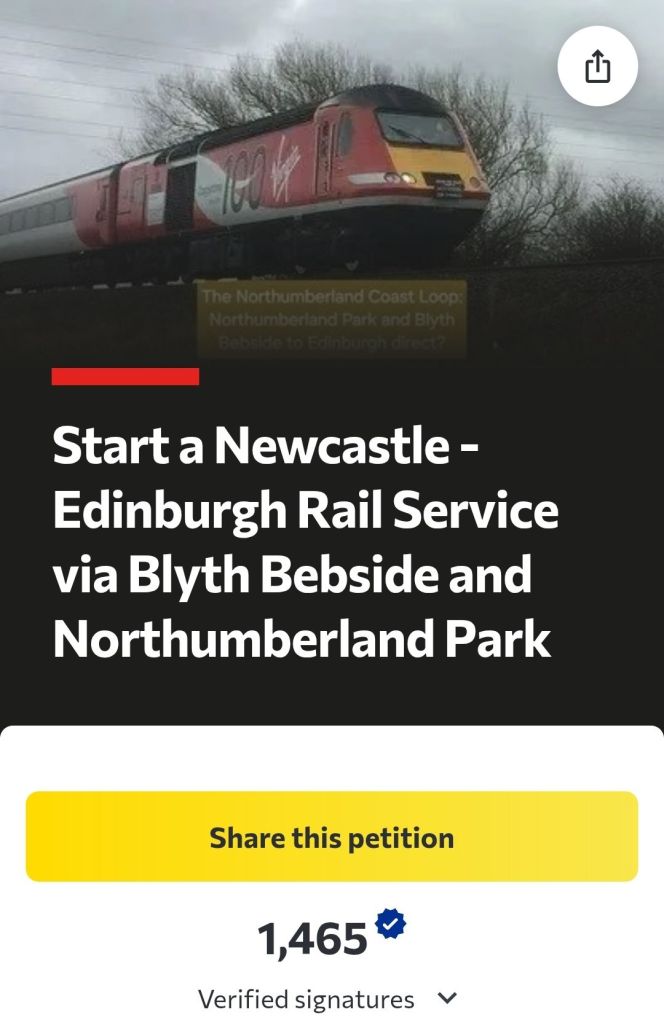
The petition that I launched back in February 2025 now has 1162 signatures to support expansion of the Northumberland Line into North Northumberland and Scotland, and you can view it here: https://www.change.org/p/start-a-newcastle-edinburgh-rail-service-via-blyth-bebside-and-northumberland-park

Petition as of 2nd May 2026

Faster, direct journeys compared to via Newcastle or changing at Morpeth

As can be seen below from this table compiled back in 2024, the approximate direct rail journey time from Blyth Bebside to Berwick via Pegswood would be just 44min to 50min.

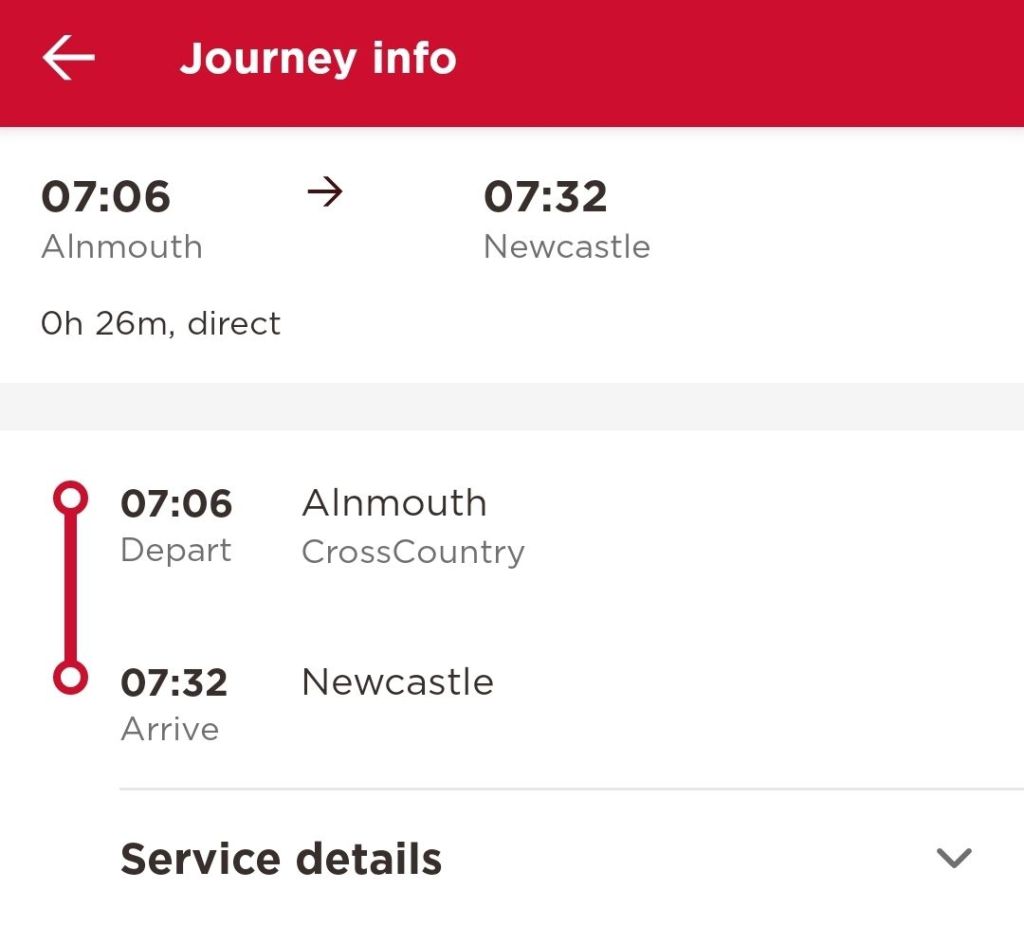
Taking the more conservative figure of 50mins, it would still be 40mins less than the fastest current connections at Newcastle (1hr 30mins via Northern and LNER) as can be seen below from the LNER app taken on 2nd May 2026.

The fastest journey time of 1hr 30mins is outlined further below, where a 20minute wait between trains is required at Newcastle Central station, so whilst this might be possible to reduce if trains were better timed to connect, it would at most reduce by only c.15mins as at least 5 minutes would be needed to allow a passenger to transfer from one train to another at Newcastle.

This means that even in the best case scenario, a trip from Blyth Bebside to Berwick via Central Station will take at least 25 minutes longer than the direct service would be able to provide, without any upgrades in terms of running speeds on the still quite slow route between Bedlington and Morpeth North Junction.

Blyth Bebside – Bedlington – Morpeth – Berwick

There is a counter argument that a connection via Morpeth could also be made, but again this route would have issues.

The first issue is that there are no clear proposals for a direct train running between Blyth and Morpeth; the SENRUG proposal would see the trains reversing at Bedlington to then head back to Morpeth.

This means that starting from a station such as Blyth Bebside, a prospective passenger would need to travel to Bedlington, change trains to reach Morpeth, then change again onto a northbound service. This is further compounded by the fact that the proposed extension of the current Newcastle to Morpeth trains onto Bedlington only run approximately hourly, meaning that depending on the connections, the journey time from Blyth Bebside to Morpeth by rail might be excessively long for a few miles long journey, and to arrive in ample time to make a northbound connection towards Alnmouth, Berwick, Edinburgh, etc. may mean leaving far earlier.

Northumberland Coast Loop route: Newcastle Central – Blyth Bebside – Pegswood – Berwick-Upon-Tweed and beyond

In contrast, a direct route between Newcastle and Berwick, which is possible using the existing track layout, allows for a single seat trip from Blyth Bebside to Berwick, running via Pegswood, Alnmouth and more. 

For the proposed semi-fast service via the N.C.L. route, it would mean zero changes at Northumberland Park and Blyth Bebside, to Pegswood, Alnmouth, Berwick, and Edinburgh, and from Ashington, Bedlington, Newsham, and Seaton Delaval, only one change of train would be required at either Blyth Bebside or Northumberland Park.

For the proposed all stations local service via the N.C.L route, connections between Northumberland Park, Seaton Delaval, Newsham, Blyth Bebside, and Bedlington to Pegswood, Widdrington, Acklington, Alnmouth, Chathill, and Berwick Upon Tweed would be zero changes of train, with only Ashington, and the proposed stations at Woodhorn and Newbiggin requiring just one change of train.

Choppington Station

The above N.C.L. route also holds advantages in that it would run via the proposed new station at Choppington, which would surely help further the case for this station, especially given recent and upcoming major housing developments in both west Bedlington and around Scotland Gate and Guide Post.

The alternative route: The Butterwell Line (Ashington to  Alnmouth)

A similar rail connection to the Northumberland Coast Loop, touted by SENRUG is the ‘Butterwell Line‘ which would see a section of the long-disused Ashington collieries and Butterwell/Potland opencast railway reopened to traffic, as well as a new connection from this line created to connect to the ECML headed north (the current disused connection faces south towards Pegswood). For clarity, we’ll call this new junction Butterwell North Junction.

Whilst this route would also take in Ashington, which would add the benefit of a further large town en-route, it does come with the cost associated of constructing an essentially new railway from Ashington to the ECML near Ulgham, which would be around four miles long.

The old mineral line, especially just north of Ashington has been disused since c.2000, and the section through Ashington Community Woods has become heavily overgrown during the last 20 years, with many mature trees growing on the former trackbed.

Further north, the line was more recently used (c.2015), but again is becoming heavily overgrown, and would need some significant civil engineering to ease the tight curves near Linton Colliery (to allow reasonable speeds and safer operation), as well as the new route and junction to join this line to the ECML to allow direct access to and from the north.

Near identical Blyth to Berwick routes, aside from the Bedlington to Widdrington stretch

These two routes between Blyth and Berwick-Upon-Tweed are almost identical; Newcastle to Bedlington would be the same under both proposals, as would Widdrington to Berwick-Upon-Tweed and Edinburgh.

The key difference between both routes is the section from the newly opened Bedlington station to Widdrington station; the Northumberland Coast Loop (N.C.L.) route uses the existing line (open since c.1980) via Pegswood, which whilst missing Ashington offers an opporunity to serve Morpeth via a second railway station there at either Hepscott or near the Coopies Lane industrial estate. Pegswood would also act to serve both Morpeth and Ashington, much like Alnmouth station works to serve Alnwick and Amble.

The SENRUG proposal would instead run via Ashington, allowing that town to also be served, but it would also require the rehabilitation of the old ‘Butterwell Line’ as well as a new section of track and a new junction onto the East Coast Main Line (ECML) near to Ulgham. There would also be no opportunity to serve Morpeth.

N.C.L. Route is cheaper and potentially faster to implement

The N.C.L. route between Bedlington and the ECML at Morpeth North should be a relatively low-cost/high reward route to use; it already is in regular but infrequent use (around twice per week in each direction). The route is also already available to use, it being a known diversionary route, and even occasionally used by passenger trains such as rail charters, a clear example being my own trip over the route aboard ‘The Seven Counties Rambler’ back on 8th March 2025.

As can be seen in the clip below from 2024, regular railfreight from Bedlington going directly to Scotland is long established via Morpeth North, having run over this route since the 1980’s taking alumina from the Port of Blyth to Fort William.

66740 on the ‘Alcan’ at Morpeth North Junction in 2024.

Why wasn’t the Butterwell Line directly connected towards Widdrington in the 1970’s and 1980’s?

At the time the Morpeth North Curve was planned and built (mid to late 1970’s), the Butterwell Line from Butterwell Junction (joining the line to the ECML) to Ashington was also fully open and operational, so it raises the question of why a north-south link from Butterwell towards Widdrington was not built at that time?
Coal flows at that time from North Northumberland such as from Widdrington Disposal Point to Blyth Power Station were significant, and presumably was part of the reason behind building the Morpeth North Curve to avoid these trains having to be reversed in Morpeth station, but given the Butterwell Line was open, then why did they not not build the exit the ECML near to Ulgham, and also avoid the run-round at Bedlington sidings?
It would, to me, suggest that whilst flows of coal, as well as the smaller but still significant flows of Alumina to Fort William were significant, it probably didn’t justify the engineering costs of building such a link; despite it significantly reducing the distance and time for coal trains to access Blyth Power Station directly, rather than them running via Bedlington and reversing at Furnaceway Sidings, and running to and fro via Morpeth North.

In my view, it suggests that the Hepscott route is probably the most likely candidate of the two routes to be successful; it has survived the loss of coal traffic which was a key reason for the survival of the ‘Blyth and Tyne’ as a whole into the 21st Century, whilst the Butterwell Line has gradually fallen into disuse and is steadily returning to nature.

A full cost:benefit and engineering analysis of both routes may give further insight into the best way forward, but it seems illogical to exclude the Hepscott route from discussions of the expansion of the Northumberland Line given that it has survived for 46 years in continuous use, whilst the touted route via Linton Colliery has steadily closed and become abandoned in recent decades.

If anyone has any insight into why the Morpeth North Curve was selected over the Butterwell Line, please leave a comment on this blog post or reach out via Social Media.

Keswick’s ‘Virtual’ Station: A lesson in bus & rail integration for Alnwick and beyond?

A very interesting trial of a ‘virtual railway station’ in Keswick, Cumbria, UK has shown some FANTASTIC results in the past two years that it has run during the summer seasons of 2024 and 2025, and now is being introduced from 27th April 2026 as a year-round service.

As part of the newly formed Northumberland Branch of NEPTUG, I believe this trial is a great demonstration of what could be achieved quickly and relatively easily on this side of the Cheviots by mirroring the success of a proven project over in Cumbria.

History of ‘Keswick Virtual Station’

Starting in 2024, a collaboration between Cumbria Tourism, Avanti West Coast, and Stagecoach offered an integrated bus and rail ticket as part of a ‘Go Car Free’ means of accessing the Lake District.

2024, the first year of Keswick’s ‘virtual station’ in train ticketing systems, with the Penrith to Keswick leg of the trip operated by the Stagecoach X5 bus.

Keswick lost its ‘real’ railway station back on the 6th March 1972, when the then truncated branchline from Penrith finally closed, so the Stagecoach bus service is effectively providing a ‘rail replacement’ service for this long-lost branchline.

This virtual station called ‘Keswick Bus’ allowed for a direct sale of an integrated through ticket from a wide range of Avanti stations through to Keswick bus station, a simple concept but one that makes huge sense to make public transport simpler and more user friendly from a customer perspective.

Repeated in 2025, after a successful 2024 season with 750 integrated tickets sold during the first five months trial, the scheme was once again repeated, with Keswick again listed as a ‘virtual station’ by Avanti West Coast on their ticket sales platform.

2025 repeat of the ‘virtual station’ in Keswick

I covered this a little over a  year ago in April 2025 in a previous blog post.

Third time the charm, this highly successful scheme is now, from 27th April 2026, set to be retained as a year-round option to put Keswick back on the railway map, albeit connected by bus and not by trains.

Likely to be even greater success in 2026?

The figures from the above Rail Advent article are astonishing, with it stating that ‘In 2025, Avanti West Coast recorded 205,000 journeys to or from Penrith between mid-June and mid-September, up 17% year-on-year and 48% on 2019. TransPennine Express saw 115,000 journeys, up 11% year-on-year and 58% on 2019.

Stagecoach carried nearly 442,000 passengers between April and November, a 14% increase on 2023.

Research from Cumbria Tourism shows rail’s share of visitors rose from 7% in 2022 to 12% in 2025.’

Clear success, but room to improve?

Whilst this is clearly a massive success and one to be lauded, there are a few simple but key elements that I feel would work to make this scheme even more successful.

  1. ‘Keswick Bus’ should be listed as a National Rail station: a ticket to this ‘station’ should be available from all train operators (for example LNER on the East Coast). This would allow for an ‘Alnmouth to Keswick Bus’ trip for example (my local station to Keswick) if I wished to purchase such a ticket.
  2. This scheme needs even more publicity than it has at present, as aside from the Rail Advent articles I happened to read, I have otherwise seen or heard very little about it.
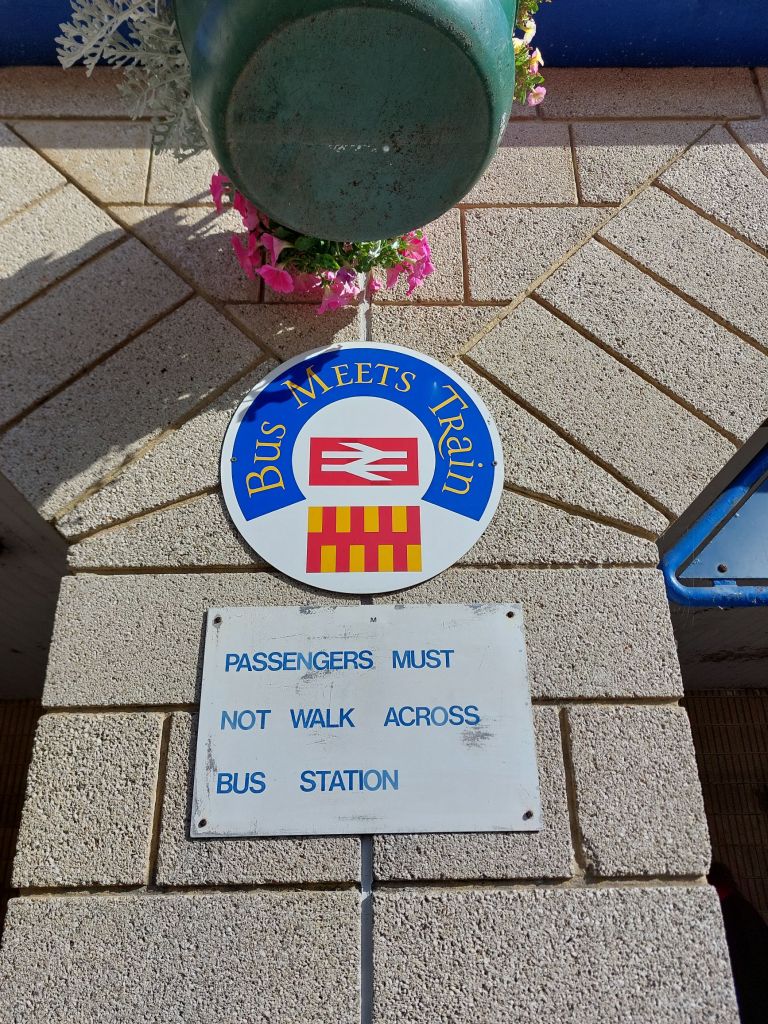
  3. As this trial seems to be transitioning into a state permanance by being a year-round offering, then should Keswick Bus Station, as well as the Penrith – Keswick buses, be given rail branding such as the double arrow logo?
Modified image of Bedlington station sign, but an idea of what could be quickly and cheaply added to Keswick Bus Station? (Edited from my own image by Gemini AI)

Just those two changes could make a HUGE improvement to the scheme as it stands today, and surely it wouldn’t take much to roll-out ‘Keswick Bus’ to other train operators and ticket vendors such as LNER or Trainline?

Keswick a model for elsewhere?

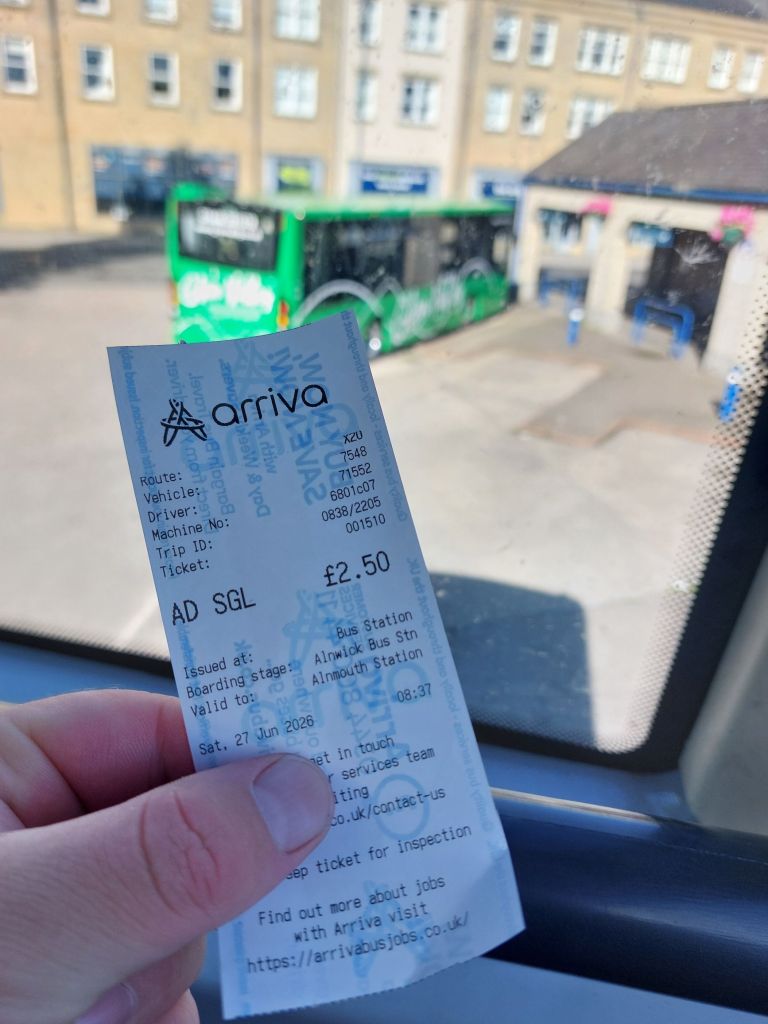
To me, this trial of integrated ticketing and co-ordination is clearly one that would have a lot of merit elsewhere, and a good example could be Alnwick, Northumberland, UK.

AI generated image of possible signage for Alnwick Bus Station if adopted as a ‘virtual station’

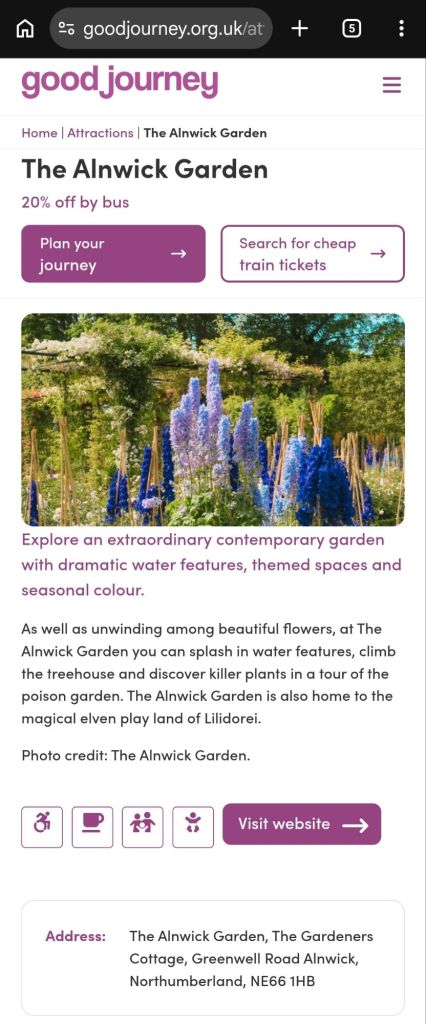
Similar to Keswick, Cumbria, Alnwick in Northumberland is a major tourism destination in its own right; the town being home to world famous attractions such as Alnwick Castle, The Alnwick Garden, itself home to the well-known The Poison Garden and Lilidorei, as well as Barter Books and many other attractions within the town which collectively draw hundreds of thousands of visitors each year. 

Alnwick is also arguably also a gateway town to Northumberland more broadly, with other nearby attractions like Ad Gefrin in Wooler, or Cragside in Rothbury for example.

Like Keswick, Alnwick lost its rail link decades ago, with the station (now partially reused as Barter Books) closing to passengers on 29th January 1968, and finally to freight too in October that year.

Whilst Alnwick is seeing its branchline being rebuilt as the relatively fledging but excellent Aln Valley Railway (AVR), this line is a heritage line, not a mainline reopening like the Borders Railway or the Northumberland Line, so trains run just a handful of times per day mainly at weekends and during school holidays, and only over a short stretch of line from the edge of Alnwick to Eden Hill Bridge about halfway to Almmouth station.

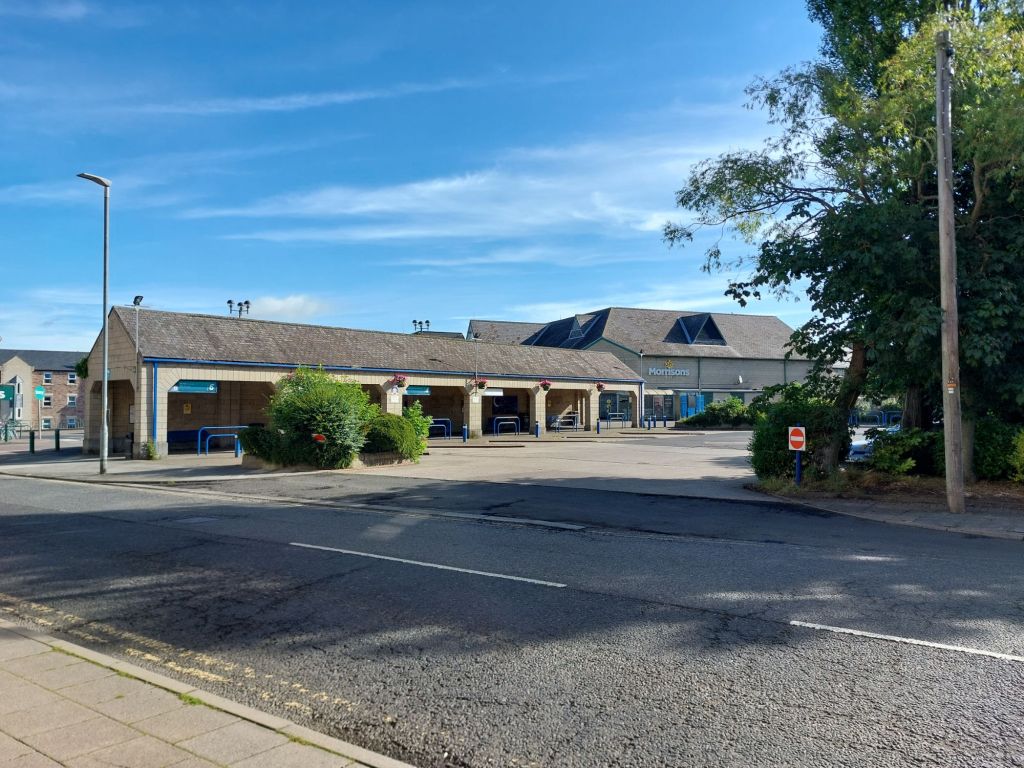
Therefore, a more pragmatic solution could be to create a second ‘virtual railway station’ at Alnwick Bus Station; it has a very central location within the town of Alnwick (only a short distance from the ancient Marketplace in the town), unlike the current Lionheart terminus of the AVR which is some distance east of the original Alnwick station, limited by the construction in the early 1970’s of thd A1 Alnwick Bypass and the subsequent loss of trackbed into Alnwick itself such as the Alnwick Lidl supermarket on the station throat.

If a ‘virtual station’ concept like that at Keswick was copied in Alnwick, that could mean easily integrated tickets from operators such as LNER, meaning a single ticket could cover the trip from Kings Cross in London or Edinburgh Waverley station in  Edinburgh through to the heart of Alnwick.

This would serve the large market for ‘Potter’ fans coming from far and wide to visit ‘Hogwarts Castle’ in the first few Harry Potter films, or for the multitude of other films recorded there over the years, or for keen visitors to Alnwick Garden; those curious about poisonous plants too, or those having an adventure in Lilidorei.

Better bus services AND easier ticketing

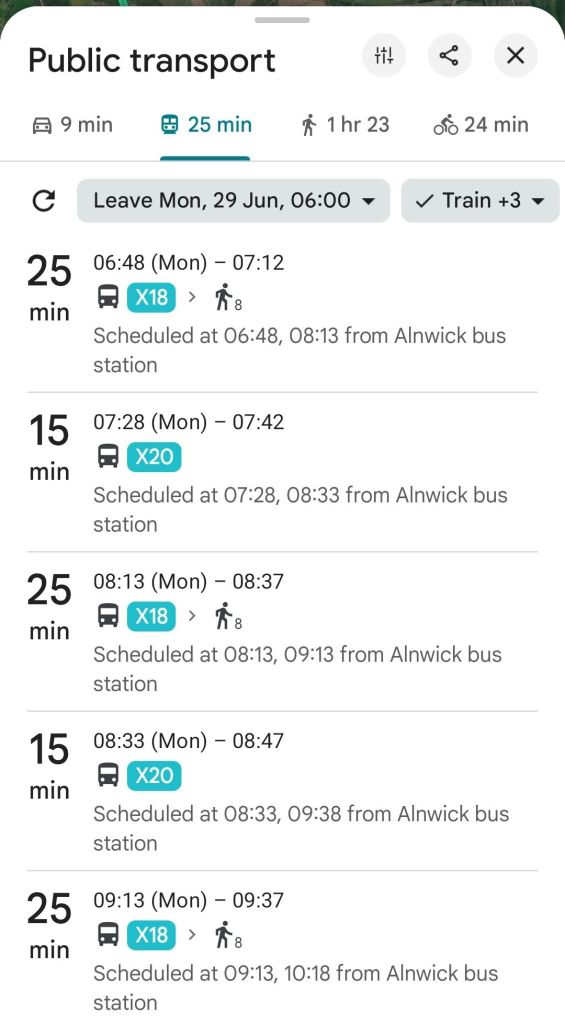
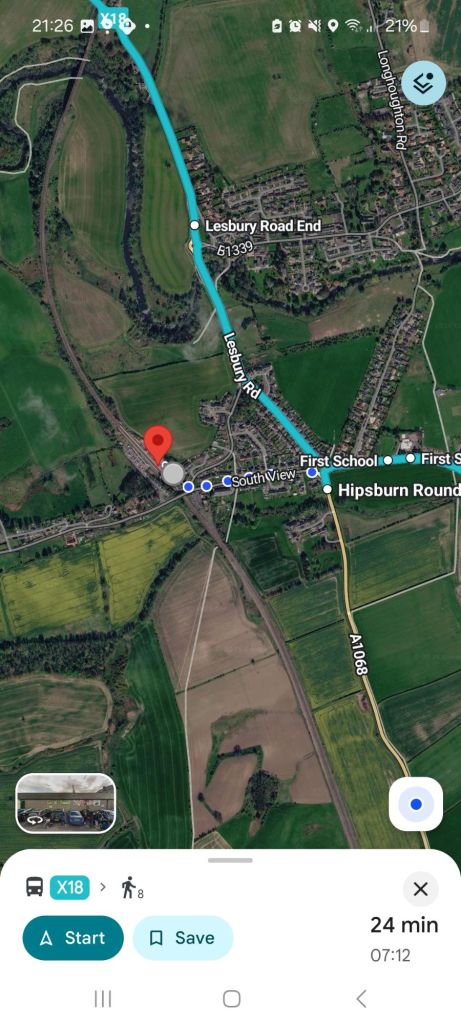
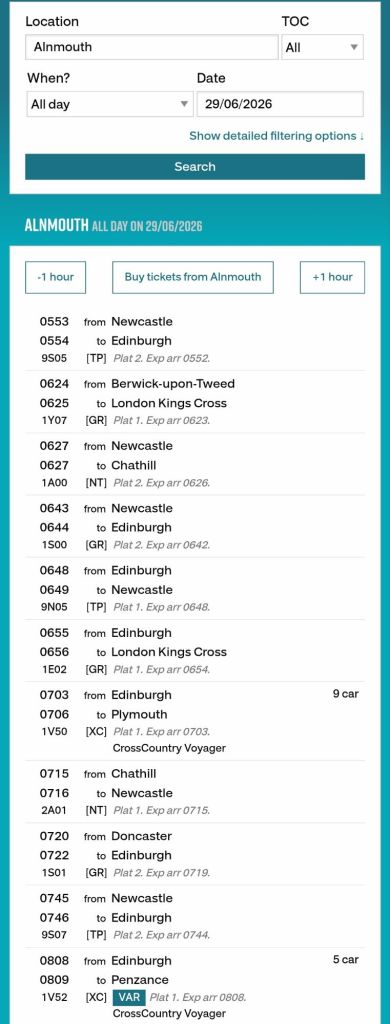
I have long campaigned for better buses to link Alnwick to Alnmouth Railway Station, and beyond to Amble (a rapidly growing town similarly now devoid of a rail connection it once enjoyed), but done in combination with a ‘virtual station’ in Alnwick, it could see sufficient passenger growth to make extra buses sustainable, and drive modal shift towards greater use of public transport; reducing the adverse impacts of heavy vehicle traffic in these quaint and picturesque Northumberland towns, while bringing more tourists in to enjoy them and benefit the local economy.

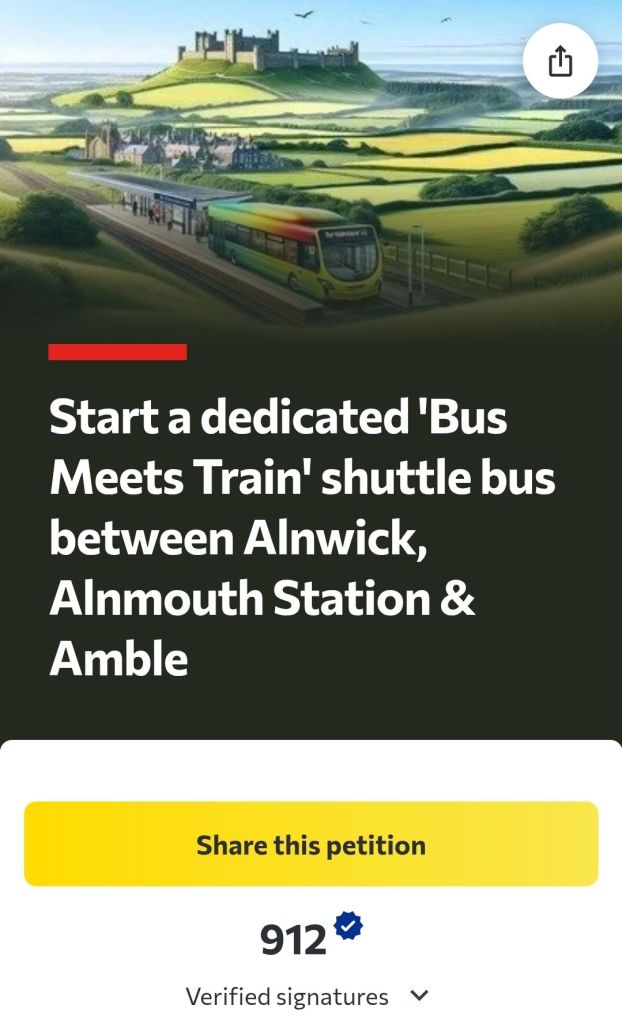
Current signatures of the ‘Bus Meets Train’ petition to better connect Alnwick, Alnmouth Railway Station, and Amble together.

Lets hope that a ‘virtual station for Alnwick’, amongst other places may be considered strongly for the future, especially given the proposed upgrades to Alnwick Bus Station that is coming during 2026.

If you’d like to sign the petition, please do so here: https://www.change.org/p/start-a-dedicated-bus-meets-train-shuttle-bus-between-alnwick-alnmouth-station-amble

Peak over the ECML (Linlithgow to Keithley via Newcastle)

On Wednesday 17th June, the SRPS is operating a one-way special train over the ECML behind 45118 ‘The Royal Artilleryman’ for its attendance at the KWVR Diesel Gala that weekend. 

To book tickets, please visit the SRPS website here: https://srpsrailtours.digitickets.co.uk/event-tickets/77003?catID=72311&fbclid=IwT01FWAROs-JleHRuA2FlbQIxMABzcnRjBmFwcF9pZAwzNTA2ODU1MzE3MjgAAR6pgodboUo8JKLHJbVHSAWDO5jvdOJMin-wPJcA4Pfd-HiylWl0VH7YHYNhAA_aem_o0Hl1_0YnyZUNHWCNI7PRQ

Mini Switzerland for Northumberland?

A very interesting video from transport campaigner and rail engineer Gareth Dennis  on the ‘Mini Switzerland’ trial in the Hope Valley, UK.

#Railnatter 304: This cheap fix with SOLVE rural travel.

Much of the same lessons can be applied to Northumberland, using existing railway stations and buses, but operating them as a cohesive, intergrated system and not as a bus system that is separate to the rail system as is currently done (the obvious example of this being the new Newsham station on the Northumberland Line, but also the long standing problem of running co-ordinated buses and trains to stations such as Alnmouth, Morpeth and many more.

Lots of lessons to be learnt from this ‘Mini Switzerland’, and of course the Swiss nation more generally and applied here in Northumberland, North Tyneside and Newcastle more generally.

Something we once had a glimpse of under the Tyne and Wear PTE; but needed much more broadly now.

EDIT: Green Signals Interview on Episode 132

Please see video below for the interview with Thomas Abelman of the ‘Mini Switzerland’ trial in the Hope Valley below.

Green Signals Ep. 132

Again a lot more information on the trial and definately one to watch develop!

Green Signals episode 131: Integrated public transport and Northumberland Line extra carriages

Some interesting items in this weeks Green signals episode (No. 131), with comments on the new Integrated Transport Strategy, as well as new carriages for the Northumberland Line.

Please watch the video below for more!

Green Signal episode 131 – April 2026

Thoughts on this will be shared in a later blog post.

Northumberland Branch of NEPTUG: Campaigning together for better bus, rail, and active travel routes and services in Northumberland.

On Wednesday 1st April 2026 at 18:30, the first ordinary meeting of the Northumberland Branch of NEPTUG took place following the founding AGM on 4th March 2026. Please read below for more information about the meetings and what the group intends to do, but if you’d like to get involved, please feel welcome to join using the information below!

The speaker at the meeting, Geoff Wade, Community Bus Engagement Lead at the North East Combined Authority (NECA) gave a presentation on the work NECA is doing primarily on the bus network that carries around 70 million people each year to make the system better such as realtime information systems that are so good, you can see a bus negotiate a roundabout such is the clarity of the data, and making major improvements to thing such as bus stops too.

Public Transport and Active Travel as a holistic system, not just one mode in isolation.

As a wider organisation intending to cover the whole of the North East, ‘NEPTUG campaigns for an integrated, sustainable, publicly-accountable transport system connecting Tyne and Wear, Northumberland and County Durham.
It also supports walking, wheeling and cycling.

The Northumberland Branch of NEPTUG, at the last meeting on Wednesday 1st April 2026, decided to take forward a list of projects which included a mix of rail and bus proposals, with a few examples below:

Rail campaigns included but were not limited to:

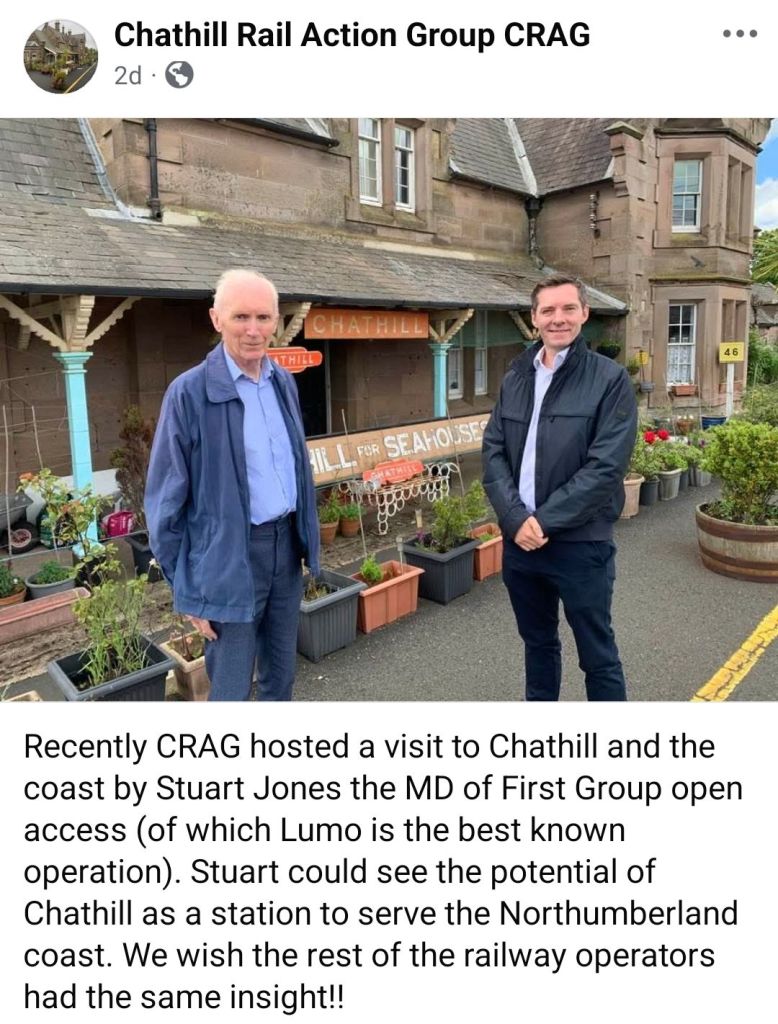
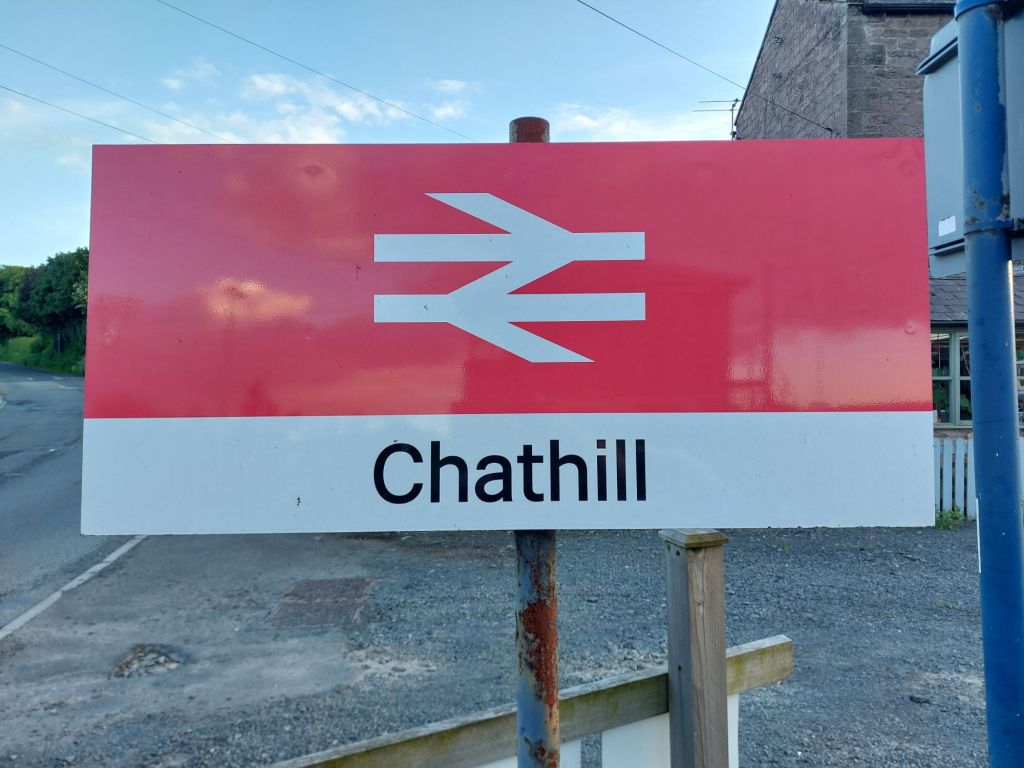
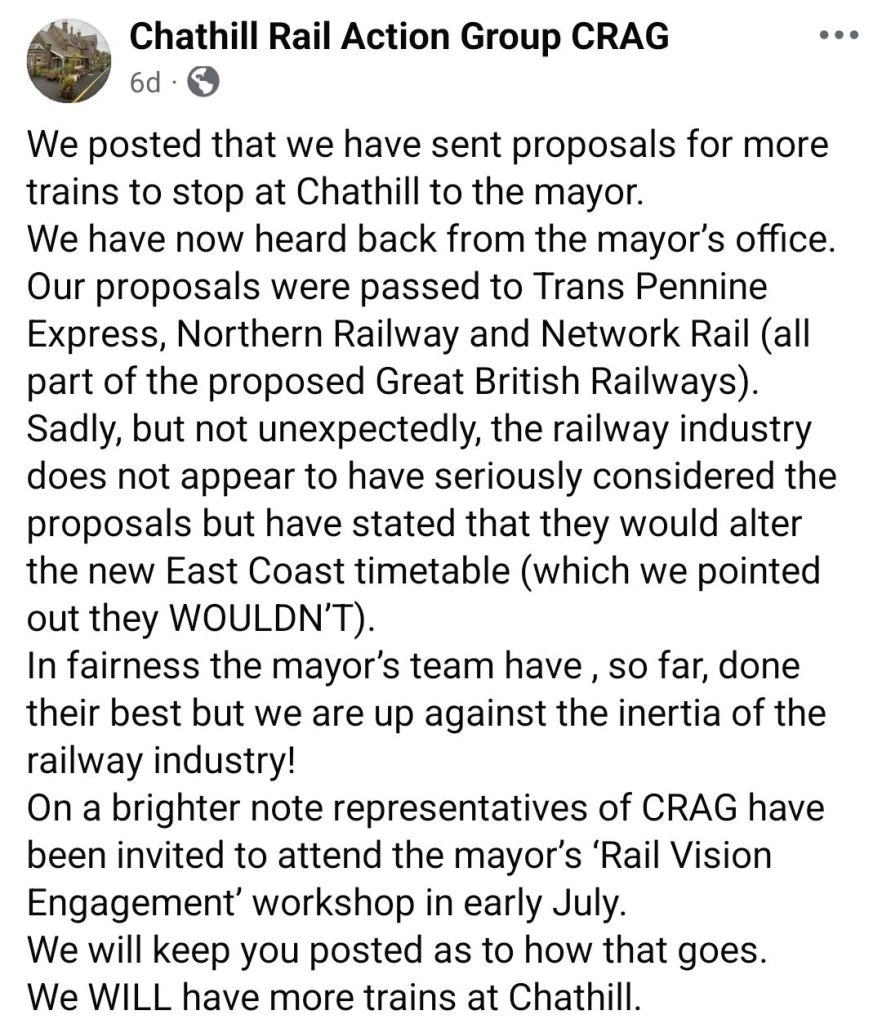
  • Improved services to Chathill Station.
  • Local rail service on the ECML.
  • Development of the new N.C.L. rail route (Newcastle to Berwick/Edinburgh via Bedlington).

Bus campaigns included but were not limited to:

  • Improved bus rail integration at railway stations.
  • Improving reliability of buses across Northumberland.
  • Support the roll-out of real-time information for bus passengers.
  • Meeting with the Northumberland Local Bus Board.

These campaigns dovetail nicely into existing ones such as this campaign for the new Northumberland Coast Loop north-south rail route along the Northumberland Coast and into North Tyneside, but also the campaign to improve bus services between Alnwick, Alnmouth Station, Warkworth, and Amble.

Want to get involved?

If you’d like to get yourself involved with the work of the Northumberland Branch (or indeed other North East Branches!) membership is FREE, and can be done via the Join NEPTUG page on their website.

At present, the group intends to meet monthly, with meetings held on the first Wednesday of the month as a general rule. Meetings are a proposed to be a mix of online and in-person, with the next meeting on Wednesday 6th May 2026 proposed to be online via Zoom, then the next one on Wednesday 3rd June 2026 proposed as an in-person meeting (location yet to be set).

Hope to see you soon!

Bedlington Station opening: The end of the beginning?

Yesterday evening, Sunday 29th March, I travelled down to Bedlington station to see the final Northumberland Line station for myself, and one close to my heart as a born and bred Bedlingtonian!

At long last, Bedlington has rejoined the national rail network!

It is fantastic to see the town I grew up in once again reconnected to national network, but as the title suggests, I and many others feel that this is the ‘end of the beginning’ for the Northumberland Line; with further expansions already publically tabled by NCC and others, including this campaign for the Northumberland Coast Loop.

Bedlington, a brief history.

Bedlington station, closed on 2nd November 1964, was reopened on Sunday 29th March 2026, after a hiatus of 22,427 days, and 64,157 days (175 years, 7 months, and 27 days) since it originally opened on 3rd August 1850.

This means for a little over ⅓ of its life that the station has existed as a structure, it has been closed to passengers.

Happily that closure has now been fully reversed, and the station also has a much different layout than it did originally.

The original station was just a single platform, where platform 1 is now, as the opposite side of the line was a junction amd sidings for the two of the many collieries in Bedlington at the time, the ‘Doctor Pit’ located roughly where the current Bedlington Police Station is now, and the ‘A’ pit, a short distance SW of the railway station.

National Library of Scotland mapping showing a side by side view of a 1900’s 1.1 million to 1:2500 map and modern satellite image of Bedlington Station.

These pits closed after the railway went to freight only operation, the Doctor Pit closing in 1968, and the ‘A’ pit closing in 1971, with the sidings and junctions likely to have disappeared not long afterwards, so the new Platform 2 had to be built completely from scratch.

The station is quite a functional and utilitarian design, but unlike other stations on the Northumberland Line, there is quite a lot of railway heritage surviving at Bedlington giving it perhaps a bit more atmosphere than many of the totally new stations on the line where little, if any historic fabric survived at all, and sole stations are also on new sites entirely (for example Newsham).

The 1850 era station building has been saved, and hopefully will be repurposed soon to become an attractive part of the revived station, and the signalboxes (Bedlington North at the junction end, and Bedlington South near to the Clayton pub) are also likely to remain part of the station scene for many years to come.

Bedlington station: Opening Day

Below are a few photos of Bedlington station from my visit yesterday, which marks the completion of the first phase of the Northumberland Line.

Bedlington North Signalbox and Bedlington Junction.

The line to the right here heads to Ashington, and could be extended to Woodhorn, Newbiggin and Lynemouth in the future, whilst the line to the left heads towards the former station at Choppington, then Hepscott, where another junction spilts the line again.

The left branch at Hepscott takes trains towards Morpeth Station, and back towards Newcastle Upon Tyne, whilst the right branch at Hepscott heads north towards Pegswood, Berwick Upon Tweed and Edinburgh
158815 waits at Platform 1 to head to MetroCentre via Central Station.
The 1850 built station building at Bedlington.
Closer view of Bedlington station.
The opposite end of the station building.
View of the station from the ‘pit sidings’ side of the line and the brand new platform.
What an asset this building could become!
Bedlington South signalbox
X21 showing the excellent interchange potential at Bedlington between buses and trains.
Tbe same X21 from closer to Platform 1.
Decent size car park at Bedlington station.

With the line having already carried 1.4m passengers in just 15 months (an average of 2,978 passengers per day, every day as a simple average of 1.4m ÷ 470 days (15.12.24 to 29.3.26), there is a clear case to expand the line further, with plans already announced for funding to explore expansion to Newbiggin by the Sea in the late 2020’s.

Northumberland Gazette article

The Next Chapters

As stated above, the end-on expansion of the Northumberland Line towards Newbiggin by the Sea is already a clear contender, and one that this campaign supports, but there is a route that I strongly feel is being overlooked by local politicians and other rail campaigners, and is seen clearly in the photo below; the route from Bedlington, through Choppington to Pegswood, then north up the East Coast Main Line (ECML) to Edinburgh… The Northumberland Coast Loop.

A Class 158 bound for Newcastle coming from Ashington and joining what could become the Northumberland Coast Loop.

Three routes between Newcastle and Edinburgh by rail

The Forth, Blyth and Tyne, a route linking the Edinburgh to Newcastle and North Tyneside via the Blyth Valley area.

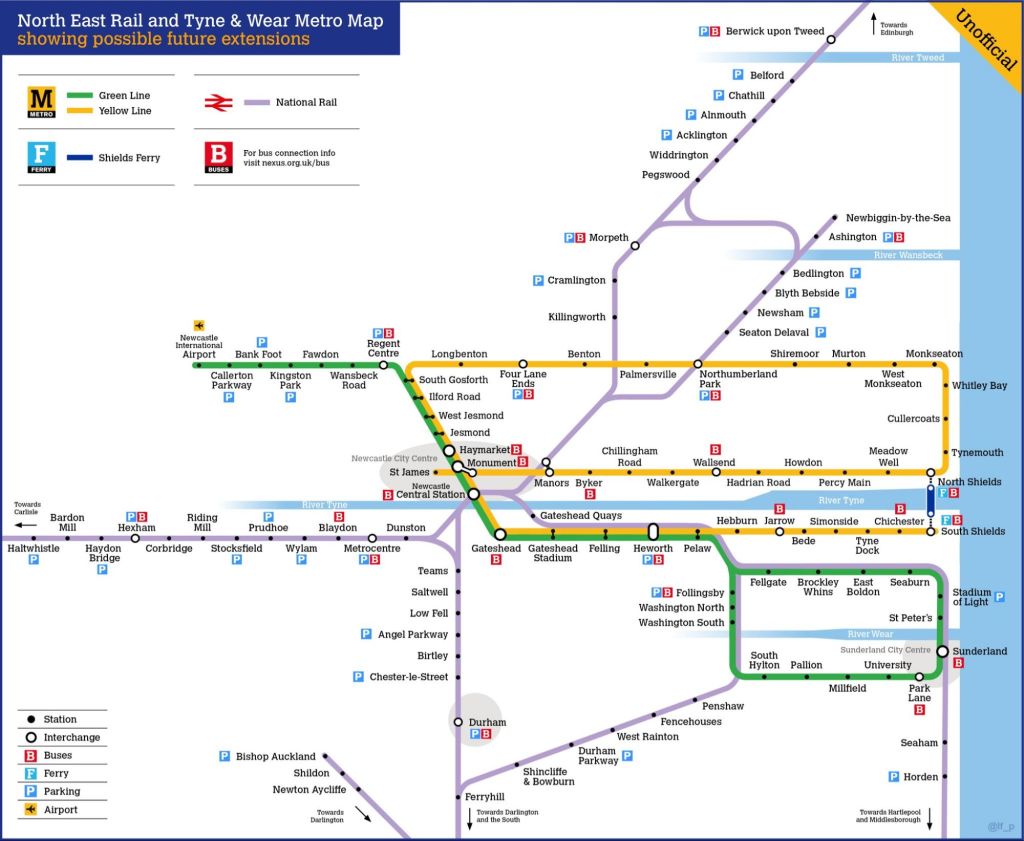
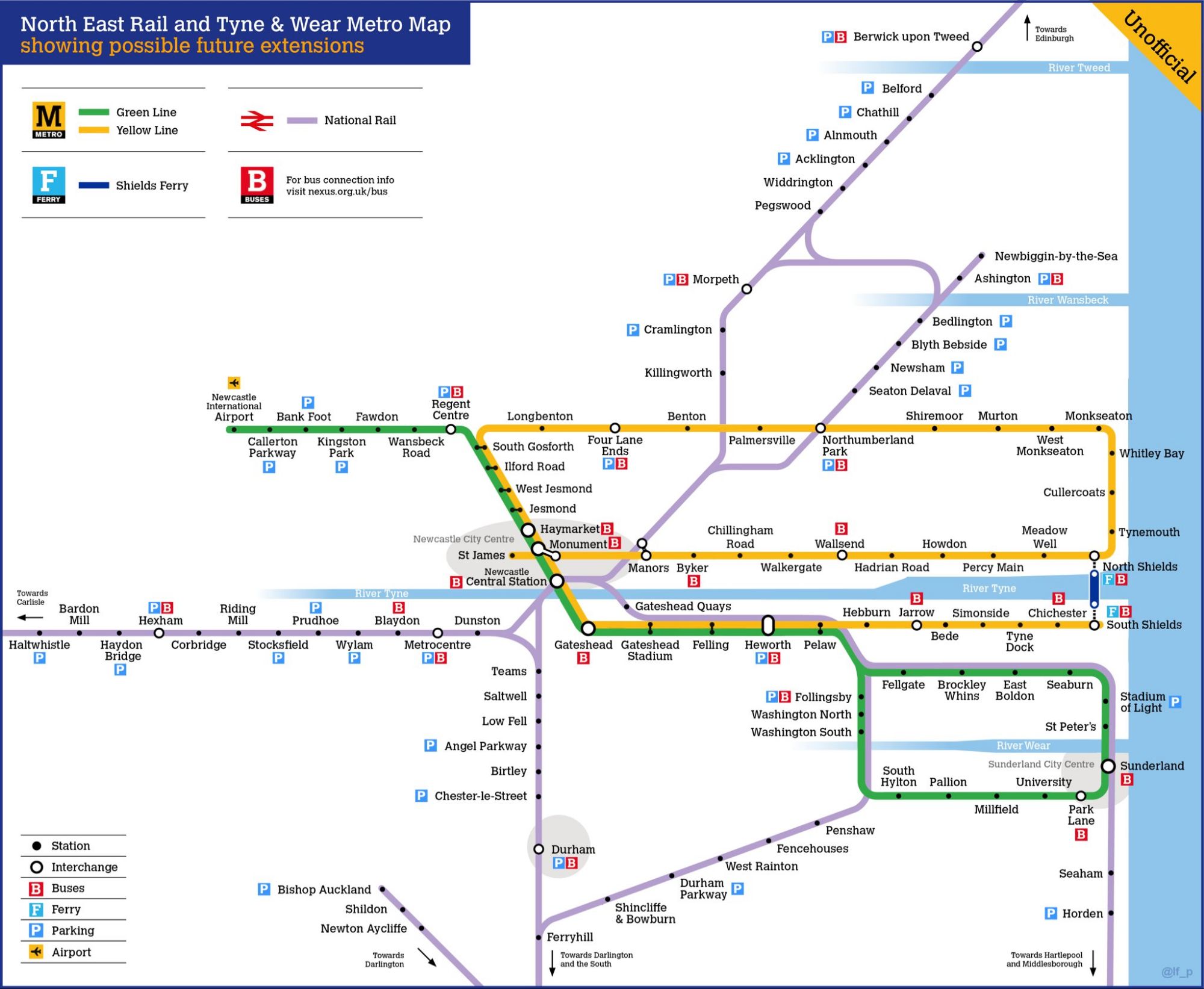
As can be seen from this map below, which shows some (not all) potential rail expansions in the North East of England, with Newcastle Central station in the centre,  there are two existing routes that can be taken today between Newcastle and Edinburgh, and a third as yet unbuilt route proposed by SENRUG.

The current ECML route via Morpeth

The long established East Coast Main Line (ECML) route runs out of Newcastle, through Cramlington and Morpeth, then Pegswood, Alnmouth and Berwick Upon Tweed towards Edinburgh; dozens of trains per day and has been an established passenger route for well over a century.

The Northumberland Coast Loop route via Bedlington

As can again be seen on the above map, following the same path north from Newcastle, the alternative option via the Northumberland Line is clearly shown, passing through Northumberland Park, Seaton Delaval, Newsham, Blyth Bebside, and Bedlington, then cuts across westwards, back to rejoin the ECML, with one route into Morpeth and back to Newcastle, the other curving north to Pegswood, Alnmouth, Berwick Upon Tweed and Edinburgh.

This route has existed since 1980, when the Morpeth North Curve, first touted in 1882 was finally opened to traffic, built to avoid coal trains bound for Blyth Power Station and the Port of Blyth needing to reverse within Morpeth Station.

Unofficial ‘Metro’ style map of the regions’ railways sent to me by Paul.

‘The Seven Counties Rambler’: Riding the Northumberland Coast Loop on the 8th March 2025

I have actually travelled by train on this proposed route just over a year ago on an SRPS railtour called ‘The Seven Counties Rambler‘ which ran on Saturday 8th March 2025 as circular tour of southern Scotland and Northern England, with the final leg of the tour from Newcastle Central to Linlithgow going via Bedlington, rather than Morpeth.

A more geographically true to layout map was included with the souvenir brochure of the trip, as can be seen below.

Map drawn by Stephen Philips inside the SRPS ‘The Seven Counties Rambler’ souvenir brochure given to passengers on the train.

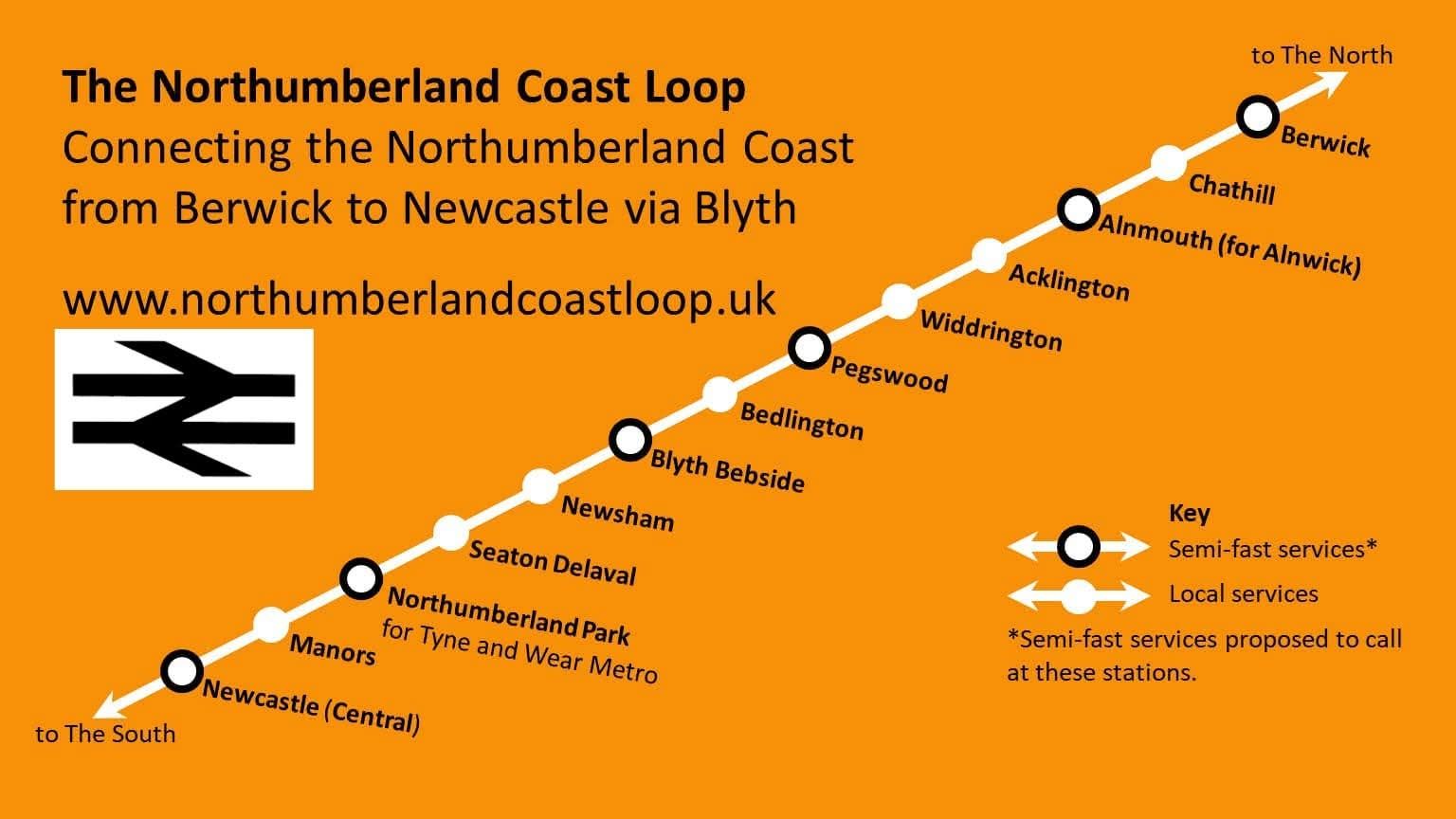
The route map below shows the stations in the order that they would be passed through by a service working the route; Ashington and Morpeth stations do not feature as they are not possible to serve via this route, but Pegswood is substituted in lieu of a call at Morpeth or Ashington.

Using this route would bring a wider range of trains, added capacity and new connections onto the ‘core’ section of the Northumberland Line; for example, if a TPE ‘Nova 1’ bi-mode was to work alongside the current Class 156 and 158 units, it would add extra seating capacity to/from Newcastle to stations such as Northumberland Park and Blyth Bebside; helping carry the many thousands of people using the line, but it would also offer a direct link to places in North Northumberland and Scotland.

The SENRUG route: Newcastle to Alnmouth and beyond via Ashington

The SENRUG campaign for Ashington – Butterwell – Alnmouth is very similar to that of the Northumberland Coast Loop, indeed the southern section from Newcastle Central Station to Bedlington Junction, and the northern section from Widdrington Station to Alnmouth (and possibly as far as Edinburgh) are both identical.

Screenshot from the SENRUG webpage

The fundamental difference between the two proposed routes is just the section between the stations at Bedlington and Widdrington, the N.C.L. route using the working and long established route via Morpeth North Curve, and SENRUG proposing a new line to connect Ashington to Widdrington directly.

This new line would likely use some of the former ‘Butterwell Line’ which dates in parts back to the 1890’s and the Ashington Colliery Railway system, parts of it actually having colliery operated miners passenger trains between Hirst station (not far from current Ashington station but separate from the mainline), and Linton Colliery.

That being said, the northern end of the line would need to be substantially new; as the curves would need to be realigned to get sufficiently good speeds, but also a new alignment is needed to create a new north-south connection, as the present link curves south towards Pegswood only, it has never had a direct northward link.

The building of this new link could have a few significant, but not insurmountable hurdles to overcome, which would make such a route likely to be both significantly expensive but also very time consuming to build.

Use the existing network better before new build lines?

The N.C.L. campaign was started as the above Ashington to Alnmouth connection would require a very substantial upfront investment to make it happen; whereas the very similar and already existing route from Bedlington to Pegswood achieves many of the same direct connections (i.e. Blyth Bebside to Berwick Upon Tweed, or Northumberland Park to Edinburgh Waverley) as the new route via Ashington would provide.

In the short-term, using the Bedlington to Pegswood route could allow the benefits of direct long-distance services to be brought to the area sooner as the route already exists and just needs to utilised.

In the longer-term, the route via Ashington could be built and services diverted over it, but using the existing link is perhaps the more pragmatic option, and also allows the market for such services to build up over time.

Bedlington to Alnmouth: via Newcastle (for now).

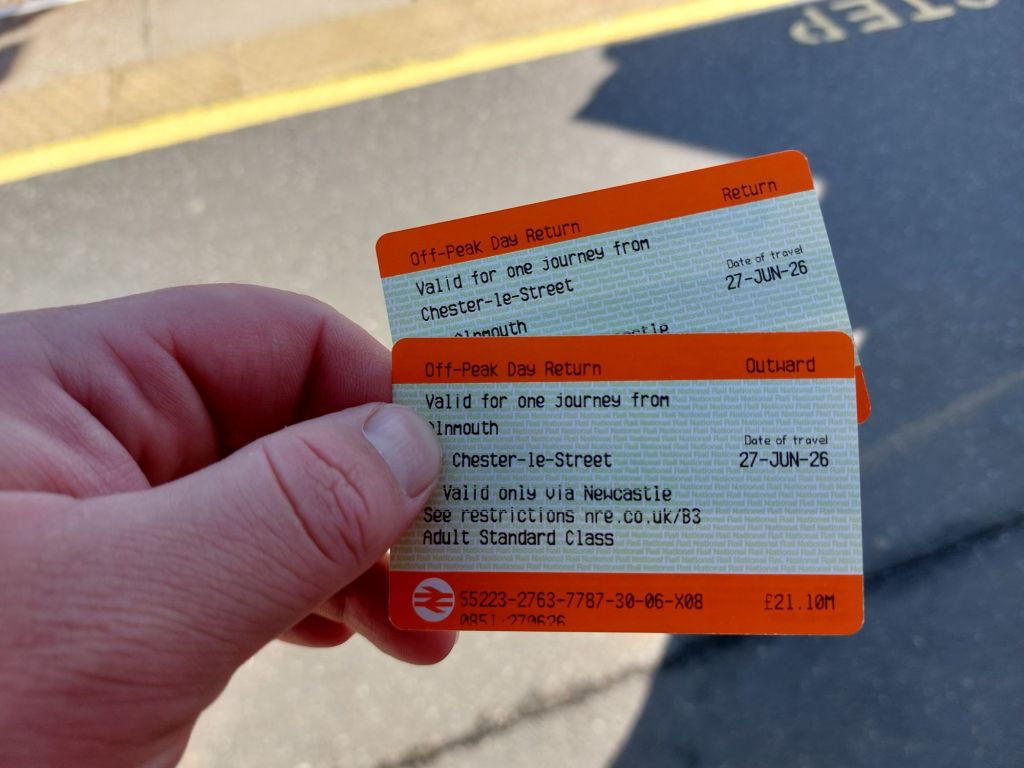
When I visited yesterday, a purchased a ticket from the Platform 1 ticket machine from Bedlington to Alnmouth, which can be seen to be clearly worded as ‘Valid only via Newcastle’.

At present, that is the only possible route by rail between the two stations, BUT, given that just over a year ago ‘The Seven Counties Rambler’ took the direct route, perhaps now is the time to implement a regular timetabled service making these connections more direct?

As outlined above, the route is possible to take a train over today, and has been since 1980; and with 1.4m passenger journeys on the Northumberland Line so far, it is likely that a very substantial number of people would also use direct services heading into North Northumberland and Scotland too, given the opportunity to do so.

At the time of writing, the petition to ‘Start a Newcastle – Edinburgh Rail Service via Blyth Bebside and Northumberland Park‘ stands at an astonishing 1,159 signatures, hopefully this route can also be considered alongside the expansions to Newbiggin by the Sea, and implemented sooner rather than later?

Northumberland Line nearing completion; lets see Newbiggin, the N.C.L., and Choppington station next!

On Sunday coming (29th March 2026), the final Northumberland Line station at Bedlington will finally open to passengers and mark the completion of this hugely successful but unfortunately much delayed project.

The opening date of 15th December 2024 was much revised from original forecasts, and only two stations (Ashington, and Seaton Delaval) opened on that date, joined progressively by Newsham (17th March 2025), Blyth Bebside (19th October 2025), and Northumberland Park (22nd February 2026).

Despite only opening with two stations, passenger numbers started very strong, and jumped significantly with each successive station opening; to the point where reputedly people cannot board at stations such as Seaton Delaval as the trains are full upon leaving towns such as Blyth.

There have even been some extraordinary remarks made that stations such as Bedlington ‘shouldn’t be opened until more carriages come’ due to how busy the line is! 

As a lifelong advocate for the line to be reopened, I’ll freely admit to feeling full of joy, and doing a James May style ‘victory dance’ at how successful the line has been over the last 15 months!

James May and his ‘victory dance’ on Top Gear

Anyway, back to trains!

With this astounding start, it is clearly a good time to build on this success and deliver even more:

Newbiggin-by-the-Sea extension

Extending the Northumberland Line north beyond Ashington, and around to Woodhorn and Newbiggin-by-the-Sea has been announced multiple times by Northumberland County Council as their intended next phase, subject to a feasibility study, planning permission, and funding and is much welcomed by myself.

I personally feel that rebuilding the branch into Newbiggin itself might be less preferable than a station at the Church of St. Mary, Woodhorn (where the existing line to Lynemouth Power Station crosses the A197), as this could allow for a terminus station within Lynefield Park (former smelter site) serving this growing business park, as well as a future extension to Lynemouth itself when the power station ceases operation at some point in the future, and a new station could be built nearby to the Lynemouth Miners Welfare Institute, which would serve Lynemouth directly, but also offer a fair connection for Ellington and Cresswell too.

Those are just my own thoughts on the extension, and a feasibility study process might identify which option is the better one.

The Northumberland Coast Loop

This campaign began around nine years ago; long before the Northumberland Line opened in 2024, but was inspired by the long running campaign to reopen the then ‘Ashington, Blyth, and Tyne Line’, coupled with the 2017 ‘Bound for  Craigy’ railtour which ran on 18th March 2017 operated by Virgin Trains East Coast (VTEC) and the Branch Line Society (BLS) for the 40th anniversary of the Class 43 HST sets, and raised £50,000 for The Railway Children charity.

Led by power car 43300, and with 43082 on the rear, this tour took the proposed Northumberland Coast Loop route from Newcastle towards Edinburgh via Bedlington, I took the photo below of it passing Barrington Road, which is between Bedlington railway station and the site of Choppington station.

43300 on the ‘Bound for Craigy’ railtour, 18th March 2017

Over the ensuing years, and with the Northumberland Line scheme clearly making progress, the Northumberland Coast Loop proposal started to take shape, as it showed the benefit of using the route to connect SE Northumberland to North Northumberland in a way that wasn’t possible until the 1980’s, well after the stations had closed in 1964.

I travelled the route personally just shy of eight years later aboard ‘The Seven Counties Rambler’ on 8th March 2025.

Morpeth North Curve: A century too late?

What is now known as the Morpeth North Curve was noted by C.R. Warn (1976 p. 35 & 36 in his book ‘Main Line Railways of Northumberland’, where it was authorised in 1882 ‘to avoid reversing coal trains travelling from Widdrington to Blyth‘ but strangely was not built until almost a century later despite the vast growth of Blyth as a coal shipping port driven by the NER itself, becoming one of the busiest coal exporting ports in Europe in the 1960’s.

Had this curve opened pre-WW1, I would speculate that Blyth, as an important industrial town with coal mining and shipbuilding would almost certainly have commanded a long-distance service to serve the town, and possibly would have retained it even through through the postwar era through to today.

Similarly, areas such as North Tyneside, another thriving industrial area, and the coast from Whitley Bay to Tynemouth as a once major tourism hotspot would similarly have likely commanded enough of a market for long-distance services for passenger trains to have survived and possibly thrived again.

Whitley Bay to Glasgow

An example such as this 1962 special train from Whitley Bay to Glasgow Queen Street might have survived longer if the direct connection from Bedlington towards Scotland had then existed, avoiding the awkward reversal at Morpeth and therefore the potential need for two locomotives (steam & diesel), and thus the reduced costs and operational complexity involved.

Post shared on ‘Everything North Eastern Railway’ Facebook Group by John M Scott

Sadly, history didn’t happen that way; the curve wasn’t opened until 1980, long after most of the stations on the potential route had closed and been demolished (only Bedlington remained intact) so the opportunities of what might have been were unfortunately lost.

Still an opportunity today.

Blyth does howver, remain as an important industrial town; as despite closures of mines and shipyards, a new future as a major centre for green energy infrastructure beckons; businesses like JDR cables in Cambois for example supplying cables for offshore wind farms for example.

Similarly, while Whitley Bay, Cullercoats, and Tynemouth may not be the ‘resort’ that they once were bring hordes of Glaswegians to the area, they are still popular places to visit from far and wide.

The route map below shows the potential of connections along this route; Northumberland Park, now open as an interchange between trains and the Tunr and Wear Metro is ideally placed to distribute people around North Tyneside wherever their intended final destination is.

Blyth Bebside would give easy access by rail, bus, car, bike or walking to a wide area of SE Northumberland, boosting the local economy by making access to education, training, employment and leisure easier.

For example, students from Berwick wishing to access Ashington College would only need to change train at Blyth Bebside and travel up to Ashington then have a short walk to campus, whereas currently it is a bus transfer from Morpeth (with notable problems of reliability on the 35 bus), or travelling into Newcastle and back again which adds unnecessary time to journeys when a shorter link is possible.

Leisure opportuntities are also significant; year round attractions like Seaton Delaval Hall or seasonal ones like Blyth Battery (World War 1 and 2 coastal fortification) have significant tourist draw, and major but short events such as the highly successful Tall Ships Regatta of 2016, which brought an estimated 500,000 visitors to the town, and £13.5m boost to the local economy could be made even greater with a long distance rail link to make reaching Blyth even easier should the event be repeated or something similar be hosted again in the port.

All of the above is a strong economic case to go beyond ‘just’ the Northumberland Line as it stands today, and use the existing link from Bedlington back to the East Coast Main Line (ECML) as soon as possible.

Petition for the Northumberland Coast Loop

At the time of writing, the petition to support a rail service between Newcastle to Edinburgh via Blyth Bebside and Northumberland Park stands at 1,149 signatures.

Choppington Station: A clear candidate for reopening

Petition for reopening Choppington Station

With the huge success of the Northumberland Line, a clear candidate to be reopened would be Choppington station, which sits on two potential routes; the Northumberland Coast Loop route between Newcastle and Edinburgh via Bedlington, as well as the Bedlington to Newcastle via Morpeth route as advocated for by SENRUG.

SENRUG webpage

As stated on the SENRUG page, the route appears to be already cleared for passenger use, and rolling stock such as the LNER Azumas for diversionary purposes, so the barriers to both the InterCity N.C.L. route and Newcastle to Bedlington local trains would appear to be minimal.

A new station at Choppington, if sited close to the A1068 would provide a great interchange between rail and local buses using that road, and is within easy walking/cycling distance from large parts of Bedlington, Scotland Gate, Guide Post, and Choppington.

If you can, please support both the N.C.L route plus the new station at Choppington by signing both petitions!