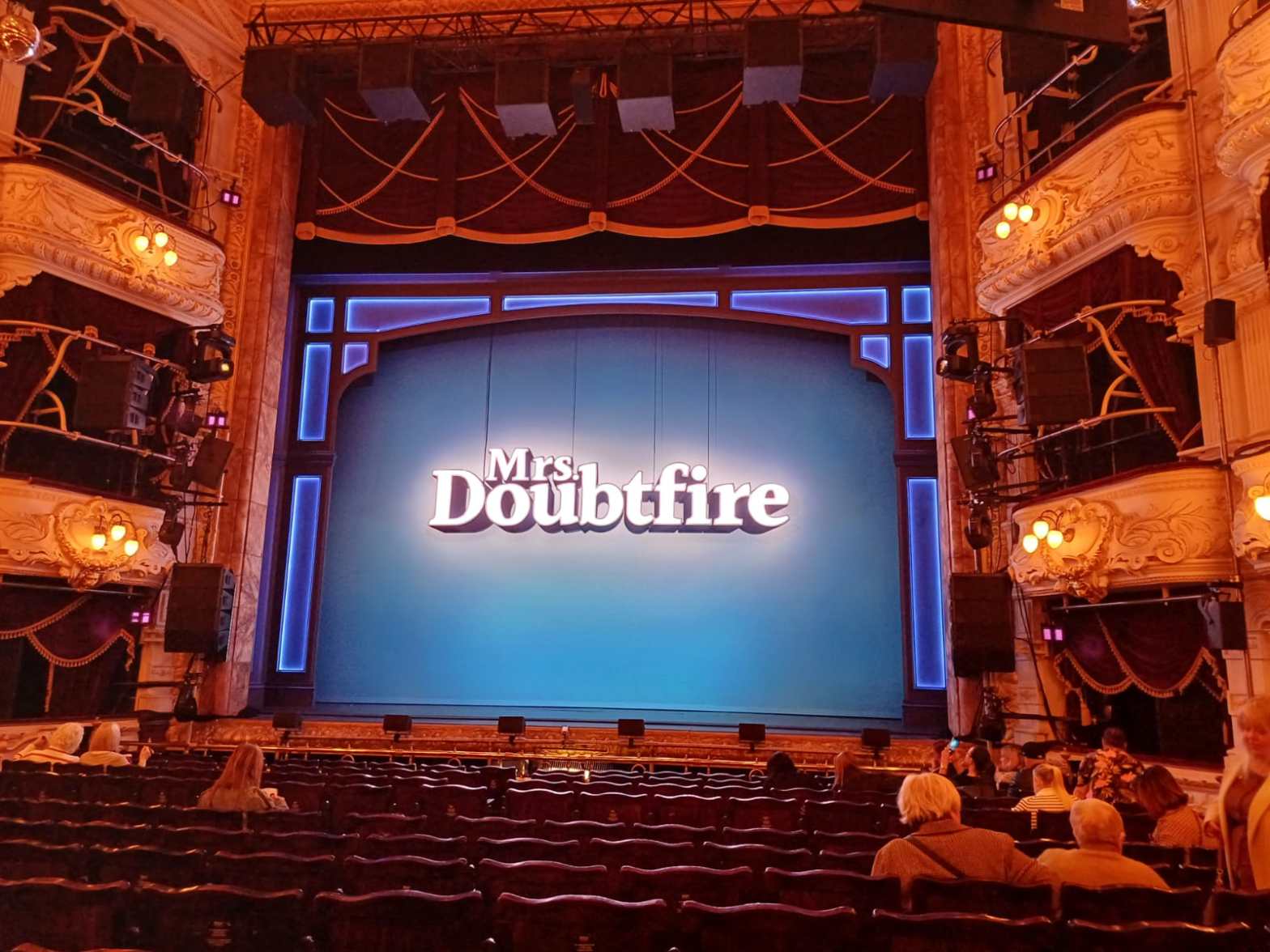
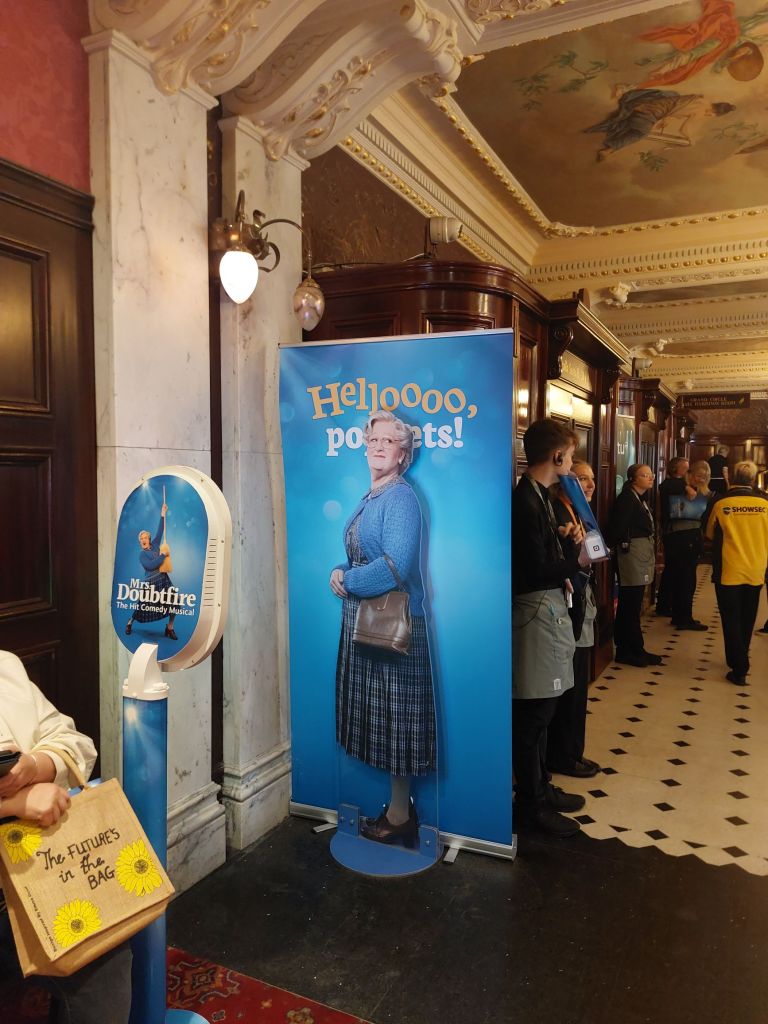
A trip to Newcastle by rail was made today as a family to see what turned out to be an EXCELLENT live performance of Mrs Doubtfire at the Theatre Royal.
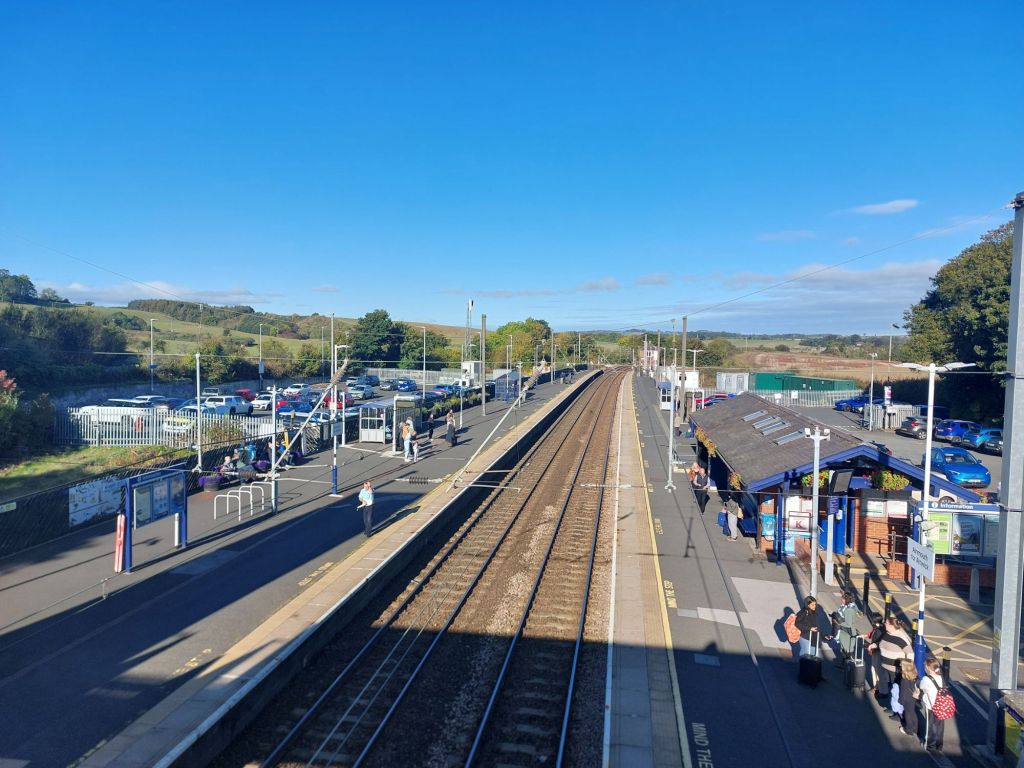
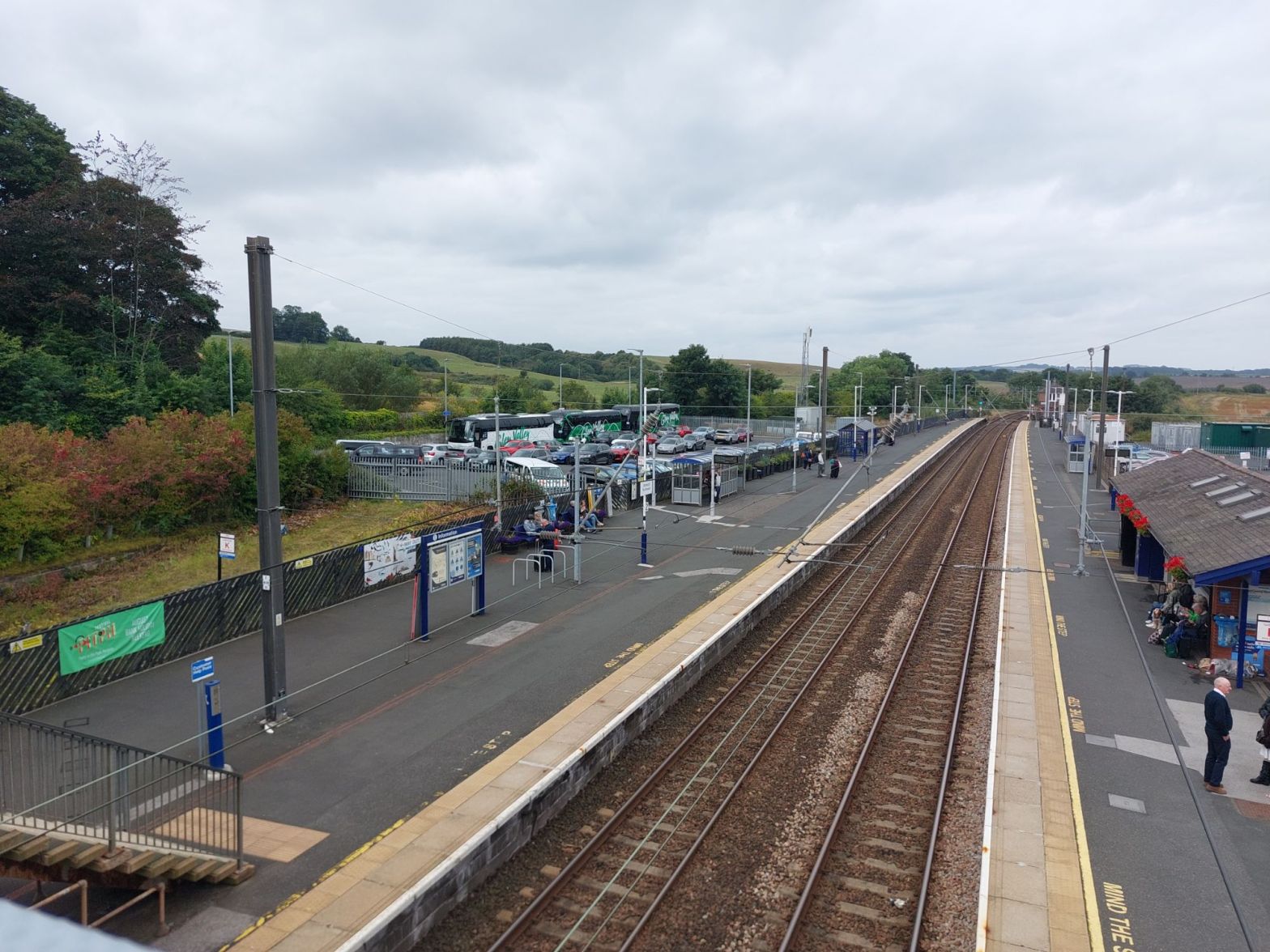
A very sunny and busy Alnmouth station ahead of departure towards Newcastle.
It was another day for the railway at its best; all went very smoothly despite the unusual presence of Police at Alnmouth for an unknown reason on arrival, but our train (TPE 802 209 on 9N09) was running just a minute or so down, and whilst fairly well filled, our table of four was reserved as it should have been and we took our seats for the journey into Newcastle on this spectacular stretch of line.
The train was clean and well-presented, and the on-board staff were very friendly when checking tickets, and encouragingly this was done in both directions with digital tickets and railcard being scanned.
Arrival into Newcastle was timely (did not note exact arrival time) and to assist my other half in finding a venue in the Stephenson Quarter, a trip out of Central via the Western exit (adjacent to the former Platform 12) was required.
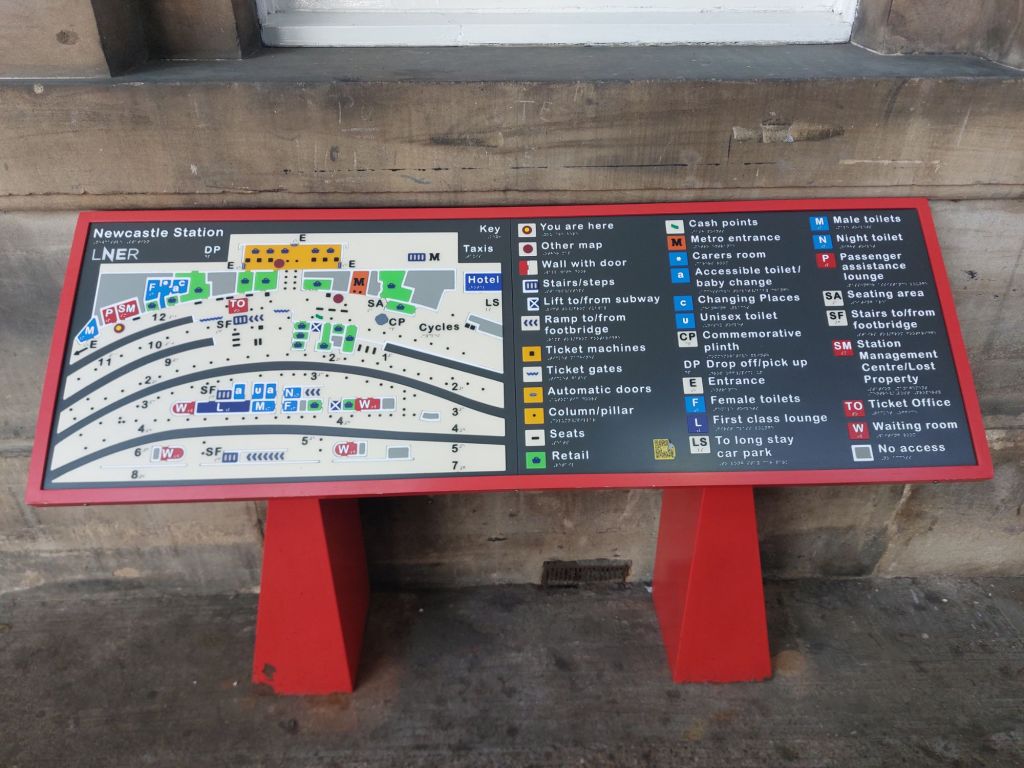
En-route the station map was found; it is somewhat (in my opinion) unhelpfully positioned well away from the main thoroughfare in/out of the station, near to the currently closed male toilets, that are undergoing a much needed refurbishment.
If this map could be more centrally placed such as in the Portico or similar it could be much more accessible for those unfamiliar with the layout of Central Station?
Map of Central Station, helpful, but poorly located within the station.
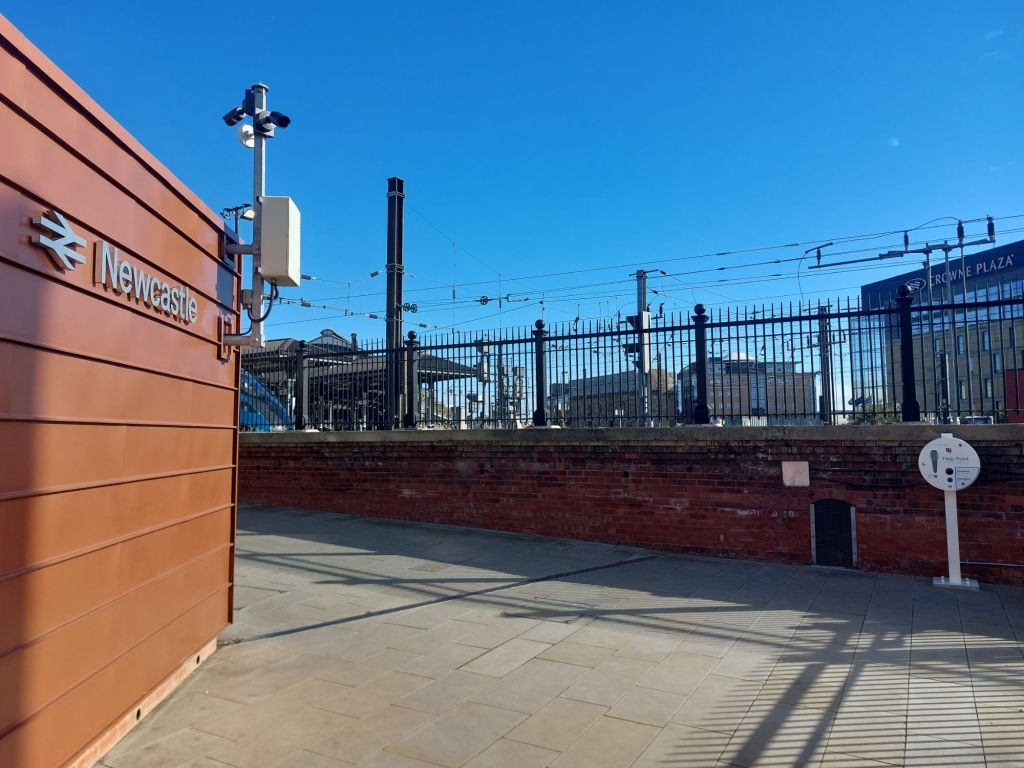
Western Entrance – Good, but a southern entrance much needed.
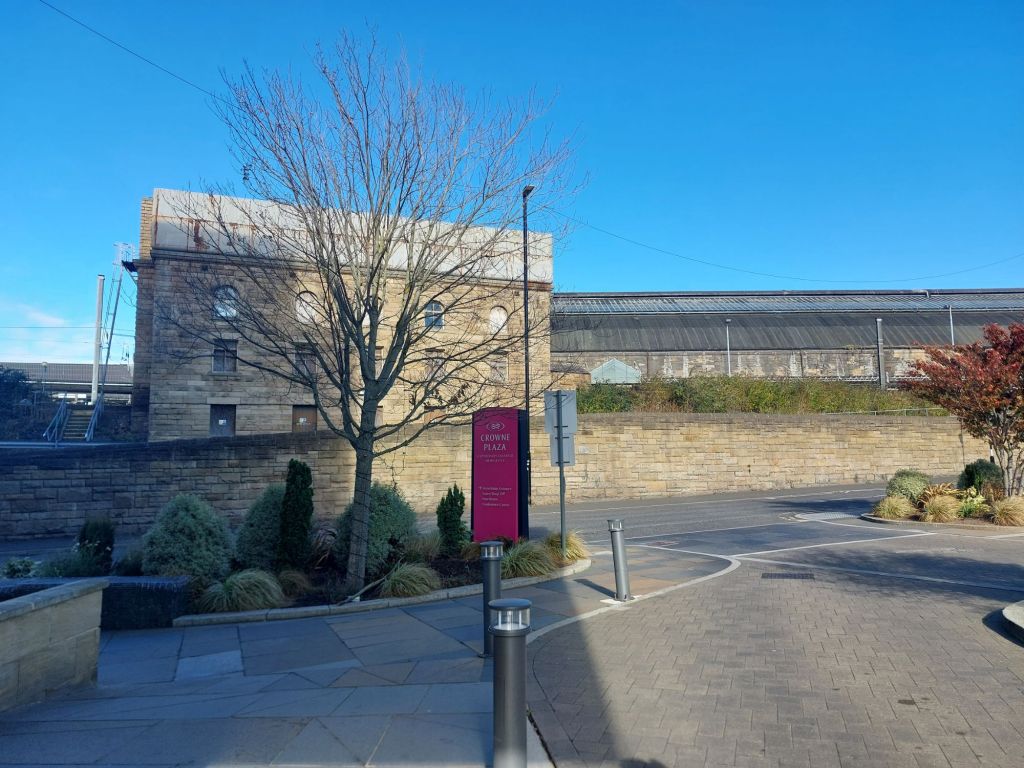
This is the view looking into Central Station from outside of the western entrance (with the Centre of Life behind me as photographer). This new entrance is a significantly shorter route to venues to the south of Central Station in the revived ‘Stephenson Quarter’, our destination being the Crowne Plaza hotel visible to the right of the image below compared to the ‘long way round’ via the Portico.
The western entrance to Central Station and the Crowne Plaza hotel to the right of the image.
This area of Newcastle, once the home of locomotive building under Robert Stephenson and Hawthorn, is now redeveloped into hotels and other businesses; and therefore, a southern entrance to Central Station could boost this area further, and especially provide more routes down onto the Quayside, as well as potentially finding a new use for the NER water tower to the rear of Central Station.
The disused water tower at Central Station from the Crowne Plaza – a new route into Central station in the future?
There is a clip of railway historian Tim Dunn exploring inside the water tower included below:
Tim Dunn, railway historian exploring inside the NER water tower at Newcastle Central station.
To the Theatre!
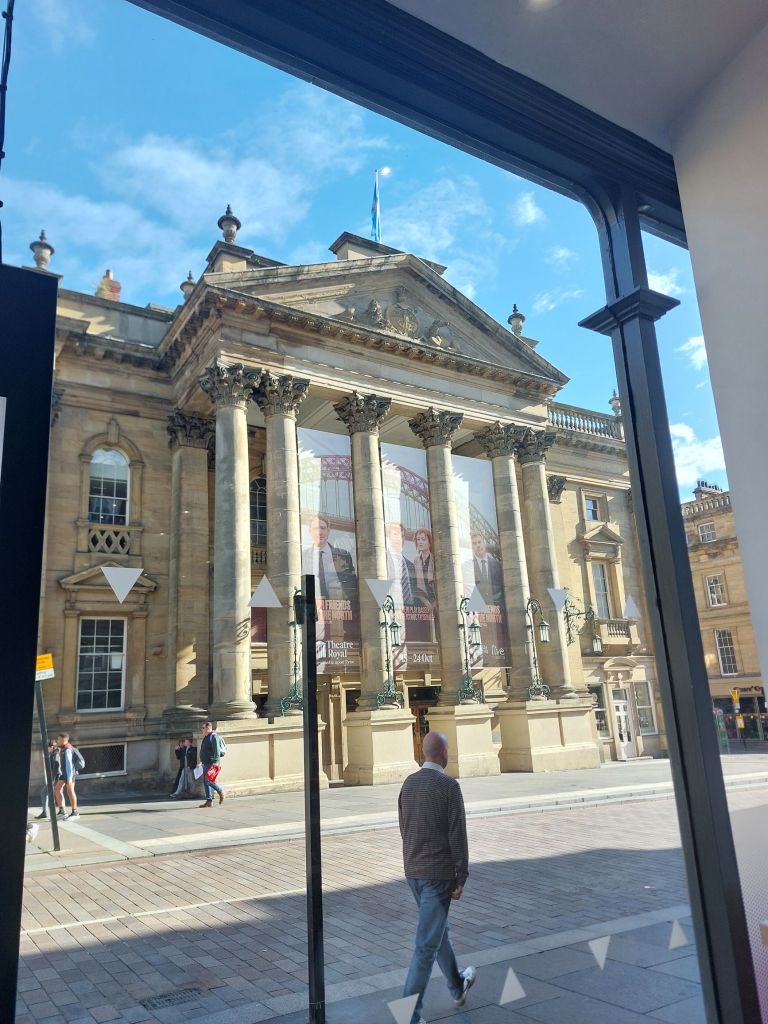
After a bit of time exploring Newcastle with the kids, a spot of lunch as a pre-show cuppa, it was time to head into the Theatre Royal for the 2pm start of Mrs Doubtfire.
The Theatre Royal from the Costa Coffee opposite.
All in all it was a BRILLIANT show and one I would thoroughly recommend to anyone who enjoys the iconic Mrs Doubtfire film from 1993! I would like to give my personal thanks to all involved in it, you’re all amazing and well done on such a great performance!
The train home
After a good number of hours in Newcastle, with two hours ahead of the show to make a day of it, and the show itself, it was all too quickly time to head home again.
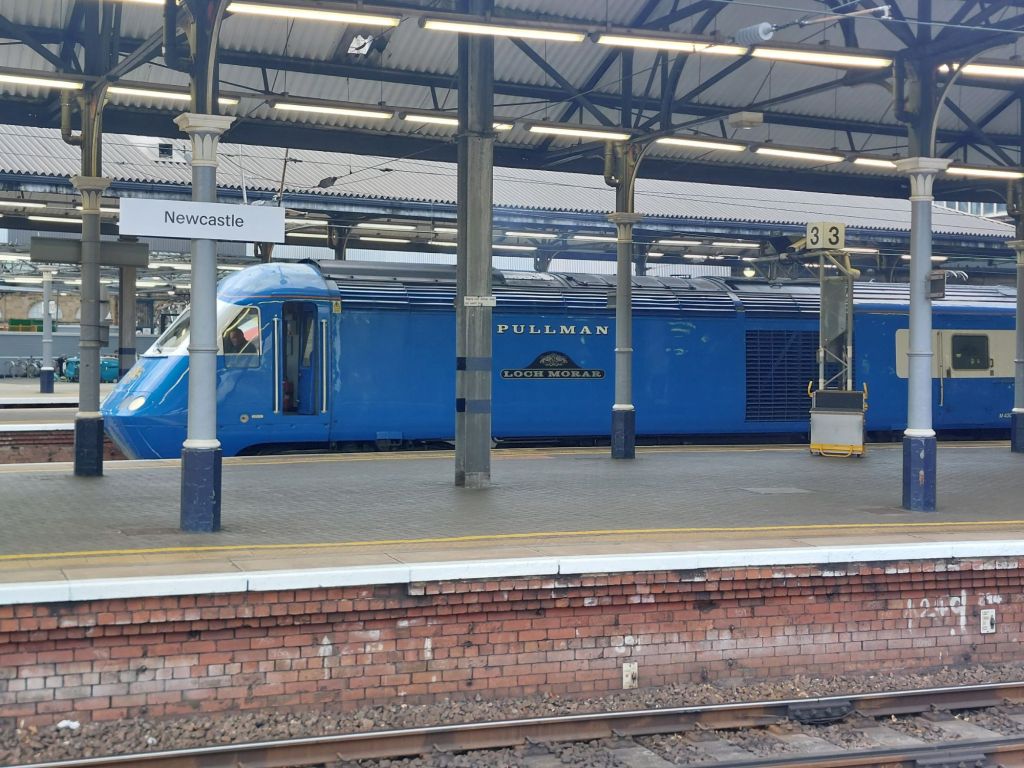
An unusual site at Central Station was the ‘Blue Pullman’ HST set from Fort William to Leicester standing briefly in Platform 3.
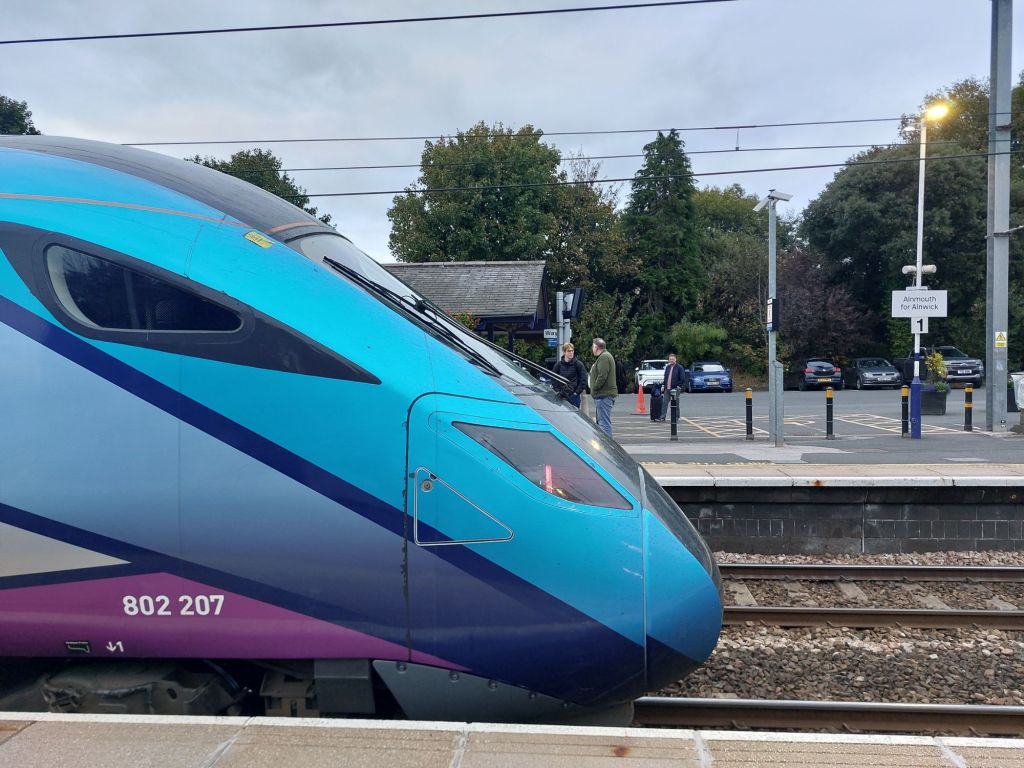
The train home was again using TPE, this time being 802 207 on 9S17 which ran bang on time, and arrived back into Alnmouth for the final leg home by car.
A thoroughly enjoyable day, with two enjoyable and fault free trips to the Toon and back courtesy of Transpennine Express – well done to all involved!
A great little article exploring charming Cresswell, situated between Newbiggin-by-the-Sea and Alnmouth on the spectacular Northumberland Coast. Please click the link below to read it for yourself.
Of note to this campaign is the mention of poor rail access to this area of the coast, something that could be rectified by a better rail service to the currently lesser served stations between Morpeth and Alnmouth, with Widdrington station being a particularly good candidate for serving this area of the coast, but bus links such as the X22 (which might ideally be extended northwards to Alnmouth Railway Station and Alnwick Bus Station to create better road/rail links for the coast) are a helpful way to access Cresswell car-free.
In the last few hours, Gareth Dennis has uploaded a short segment of his interesting Railnatter 322 about the ECML between Newcastle and Edinburgh, if you’d like to view the full episode, drop back to our previous blog post covering it here.
The short segment from Newcastle Central Station to Cramlington can be viewed below.
I’ve put together some of my thoughts on this short section of the ECML.
Newcastle Central Station, and Newcastle East Junction.
I would agree with Gareth about the need for additional bay platforms at the east end of Newcastle to act as a terminus for ‘North of Newcastle’ services such as the Northumberland Line to Ashington, and in future Newbiggin-by-the-Sea, the Northumberland Coast Loop to Edinburgh via Northumberland Park and Blyth Bebside, as well as local & regional services shuttling up and down the East Coast Main Line (ECML).
I also agree that these platforms would be unlikely to need a connection across the High Level Bridge, which then would then act to simplify the Newcastle East Junction and make operations easier.
It would need to be added that some services would be desirable to extend beyond Newcastle, and therefore would need access to some through platforms for these operations; so perhaps the current Platforms 2 & 3 would be used for through services, whilst Platform 1 (alongside a new Platform 0??) might serve terminating trains.
For example, it would clearly be desirable for services starting in Newbiggin to perhaps run beyond Central Station to destinations like the Team Valley or the Tyne Valley Line (MetroCentre etc).
A wider rethink of how Central Station operates might also be worthwhile; would an additional through platform, perhaps on the south side of the station near the water column be desirable for example? This could help in the long awaited desire for a southern entrance to Central Station from Forth Street?
Overhead AC NOT DC
This does raise a point that Gareth mentions when talking about Benton Junction that it might be ‘…possible to put up DC overheads…’ which I would strongly oppose, the reason being that 1500v DC as used by the Class 555 Metro units is non-standard and, in my view should be limited in any future expansion to ‘Metro only’ sections of the network, such as if a branch was built to Ponteland, or the line extended underground beyond St James into west Newcastle.
In an ideal world, I think the Class 555 fleet should be altered to become a dual voltage fleet of 1500v DC & 25kV AC capable units, which would allow routes such as the Durham Coast, Northumberland Line/Coast Loop, Tyne Valley Line, and even Leamside line to have the standard 25kV AC overhead system to decarbonise the network further, and open up routes such as Sunderland – Central Station – MetroCentre up to the Class 555 fleet to finally enable Metro to MetroCentre, or Metro to Ashington/Newbiggin or Morpeth.
If the Class 399 tram-trains used in Sheffield can run on 750v DC and 25kV AC, then it shouldn’t be impossible to convert the Class 555 fleet to a similar standard, indeed Vossloh, the builder of the Class 399 trams was absorbed by Stadler who built the Class 555 fleet.
The ‘Metro Only’ sections of the network such as to Airport or around the coast via Tynemouth would remain exclusively 1500v DC, but wiring all of the ‘shared’ network to 25kV AC would mean the Class 555 fleet (or similar variants) could work alongside other electric trains, and there would be nothing to stop these other trains from being branded inline with the ‘Calvert’ brand, possibly making use of the purple ‘Rail’ brand?
Quadruple track to Benton Junction, and through Manors station.
I totally agree too with once again quadrupling the line northwards from Newcastle to Benton Junction through Manors station, although as hinted at, this may need more substantial works to deliver it.
Gareth suggests that this would take the form of two pairs of lines, and from north to south would be orientated as follow (Down is to Berwick, and Up towards Newcastle, with arrows to indicate train direction)
DOWN SLOW LINE >>>
<<< UP SLOW LINE
DOWN FAST LINE >>>
<<< UP FAST LINE
Again, all four of these lines lines would ideally be wired to 25kV AC standards, not a mix of two AC & two DC which would limit use in the event of engineering works (i.e. fast line closed for a repair and trains diverted onto the slow lines for example.
Manors station.
I totally agree with Gareth in regards to Manors having two platform faces adjacent to the slow lines, either as flanking platforms on each side, or as an island, but with separation from the fast lines.
Reopening Heaton and more?
Another interesting suggestion was opening additional stations along this stretch of line, especially places poorly served by the Tyne and Wear Metro lines if these additional segregated slow lines were to be built.
My suggestion would be for a station to straddle the Coast Road adjacent to The Wills Building, as this section of the Coast Road is a major bus route, and buses running below the platforms could be connected by lifts directly to the platform
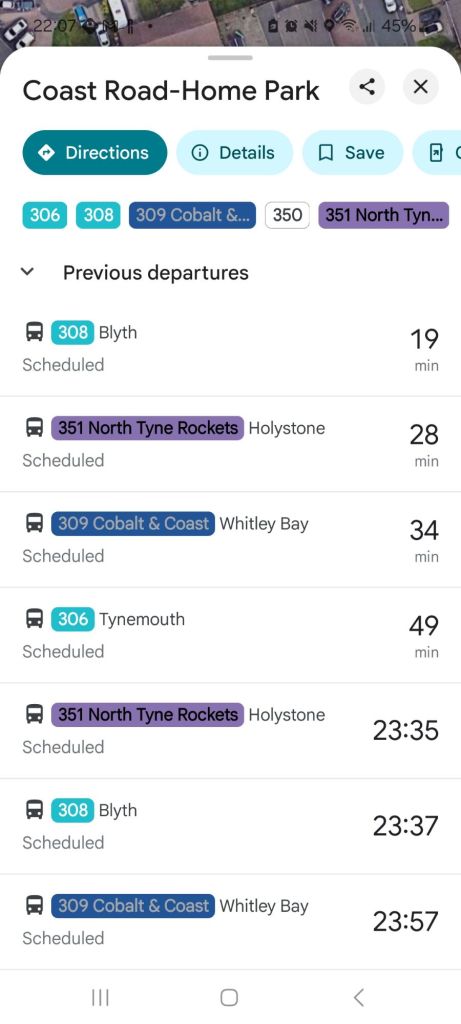
Services calling at a bus stop on the A1058 Coast Road near to the ECML bridge.
The Heaton Hop-over.
In the Heaton/Coast Road area, the pair of slow lines would need to cross over to the east side of the ECML to head off as the Northumberland Line; this means the slow lines would need to ‘hop over’ the mainline via a grade separated junction; but the design of this should also allow for a northbound slow line train to rejoin the the mainline, or conversely for a southbound train on the mainline from Cramlington to be able to join the slow lines into Newcastle.
Benton Junction
Here Gareth suggests that the slow lines from Newcastle part company with the ECML to form the Northumberland Line, and is where the mention of DC overheads is made for the Northumberland Line, but as stated earlier, I feel that would be a major mistake, as the route is used by freight, has the potential to act for diversions, and for the campaign here, it is intended for a large part of the route to act as an alternative route between Newcastle and Edinburgh via Northumberland Park and Blyth Bebside, rejoining the ECML at Morpeth North Junction.
North of Benton Junction, there is possible scope for at least some sections of quadruple track, if not fully quadrupled, and it would probably be set out in a more typical configuration as seen below,
DOWN SLOW >>>
DOWN FAST >>>
<<< UP FAST
<<< UP SLOW
This is why it is relevant to design the Heaton Hop-over in such a way that the UP SLOW line crosses over to the west/north side of the ECML approaching Newcastle, and for the DOWN SLOW to remain on the north/west side when heading away, so even if it merges with the DOWN FAST to become a singular DOWN MAIN there wouldn’t be conflicting movements.
Killingworth Station
One of the big suggestions is a station serving the Killingworth area of Tyneside; which if a section of quadruple track can be squeezed in sounds a fair proposal, and again a site over/adjacent to a major thoroughfare like Great Lime Road could be an ideal candidate, fittingly next to The George Stephenson Bar and Kitchen, as the Great Lime Road at this location has buses headed all over Tyneside and into Northumberland.
Cramlington Station on a new site?
The final section of this clip concerns Cramlington station, which would likely need to be relocated either to the north or south of its current location as a new station could be built whilst the old remains open and working before it closes and is replaced by a newer one.
The location outlined in the video to move it north near Nelson Village is in contrast to previous SENRUG proposal that suggested a move south nearer to Manor Walks, but SENRUG was probably not planning to quadruple a section of the ECML.
Personally, I feel that either site could work, and I feel that quadrupling the line at minimum through the station is likely vital for it to have capacity, but my preference would be for the quadrupled section to be to the south nearer Manor Walks shopping centre as it is a focal point for Cramlington, and could make for an excellent bus/rail interchange within easy walking distance of this busy shopping area.
Conclusion
All welcome development ideas for the ECML, perhaps only with the exception of the 1500v DC network being expanded as suggested, rather than a more future-proof use of 25kV AC, and to convert the Class 555’s to work on standard overhead wires rather than only the unique system they currently use.
Looking forwards to seeing the next segment, especially the proposed Morpeth Rail Bypass (Morpeth Diversion) which was set out in greater detail in the full episode!
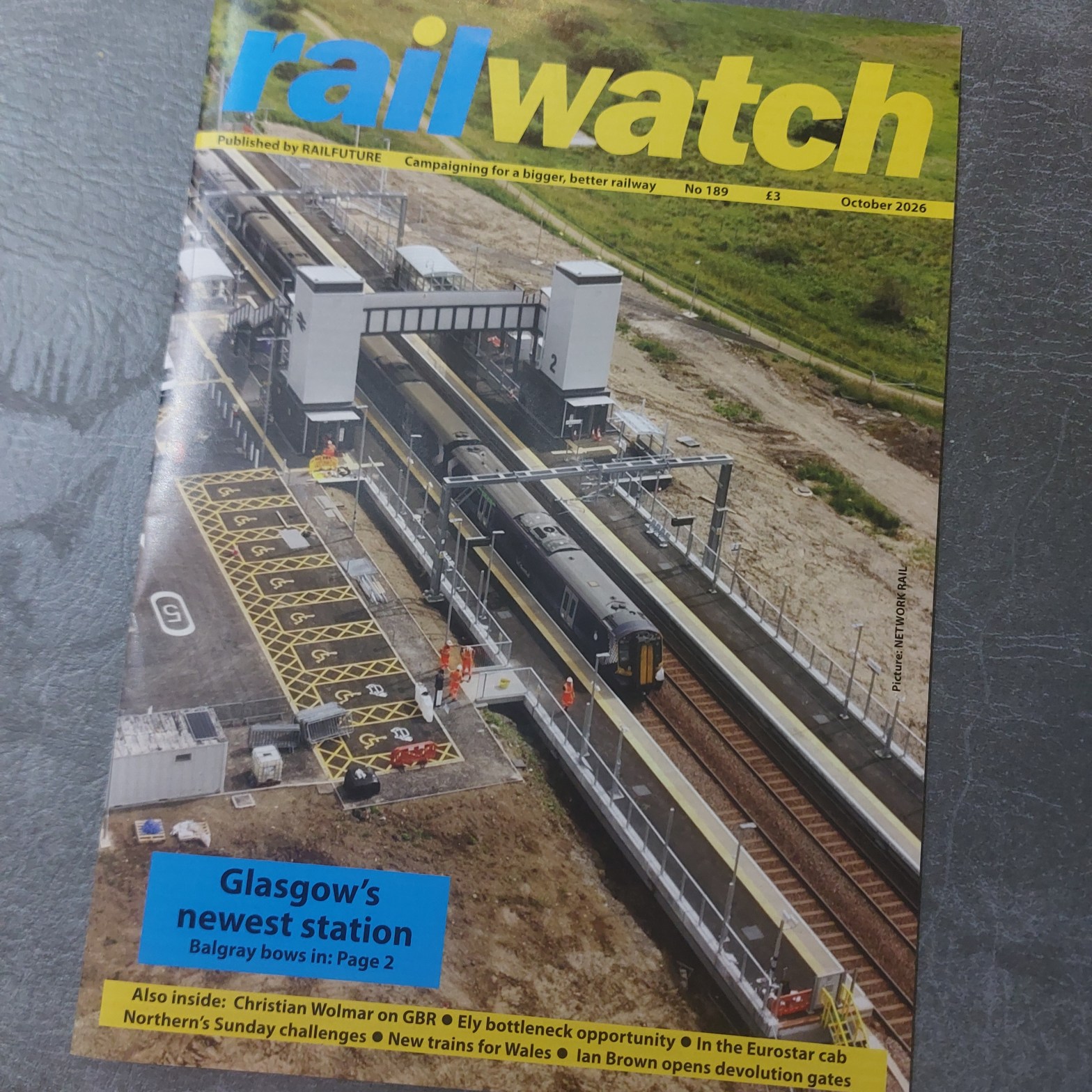
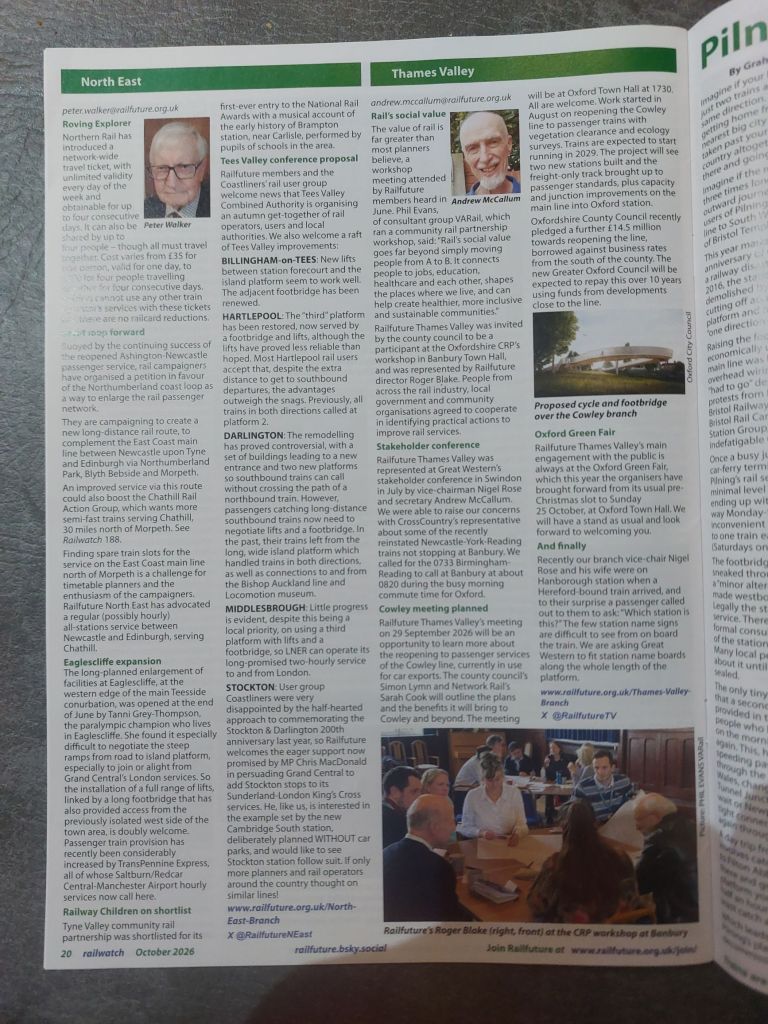
In this months (October 2026) edition of ‘railwatch’, No. 189 by national campaign organisation Railfuture, the Northumberland Coast Loop campaign has got a short mention on Page 20 as part of the North East region compiled by Peter Walker.
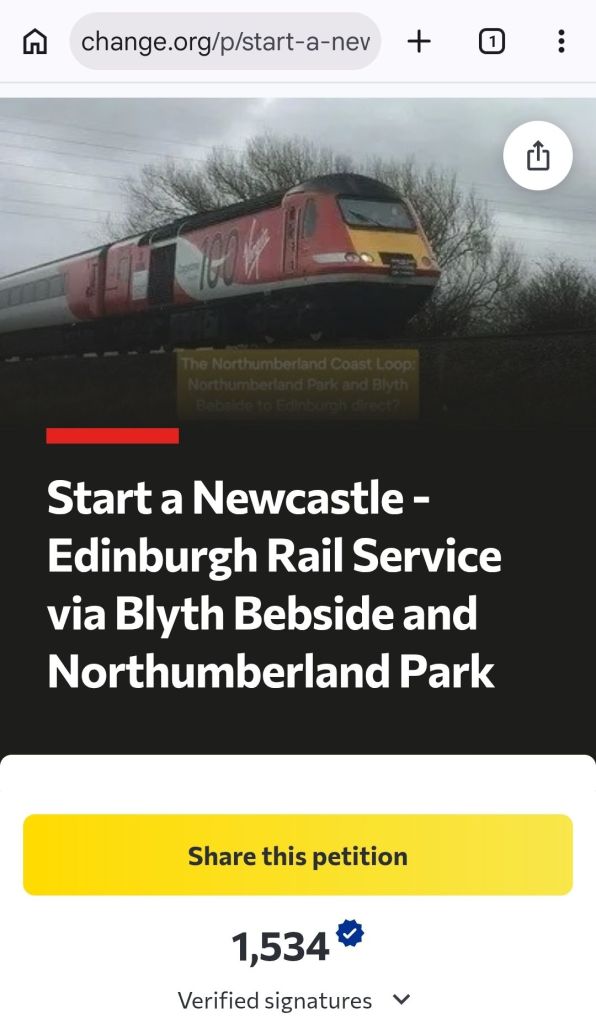
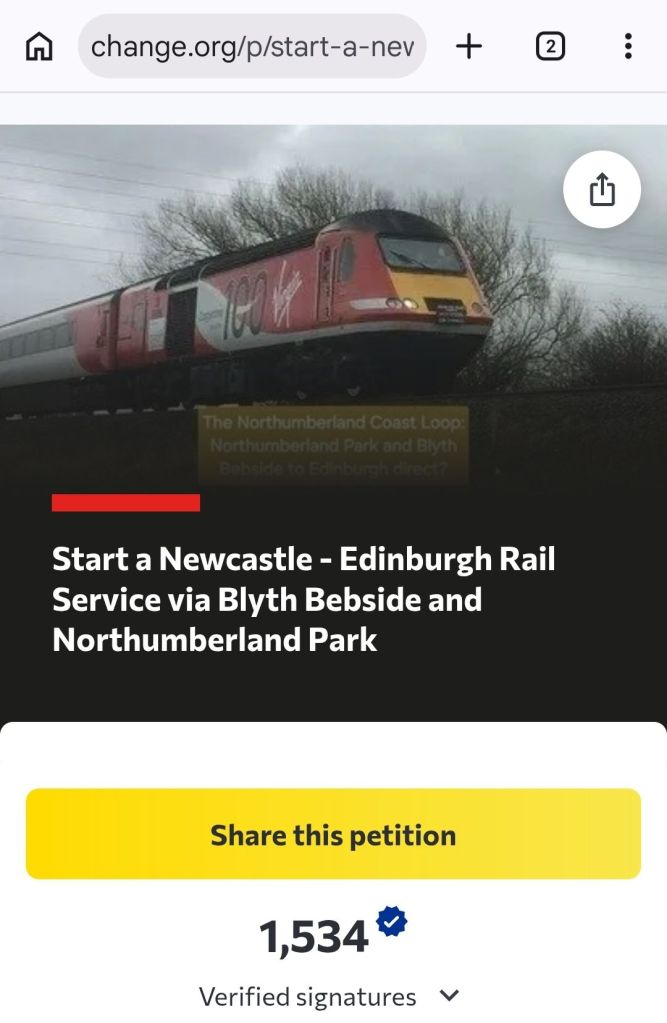
Thank you very much to Peter for including us in the North East news section, and as of today, the Northumberland Coast Loop petition stands at 1534 signatures.
Thank you to everyone who has supported it so far, and if you haven’t already, please sign it here: https://c.org/LPBD8vhjMb
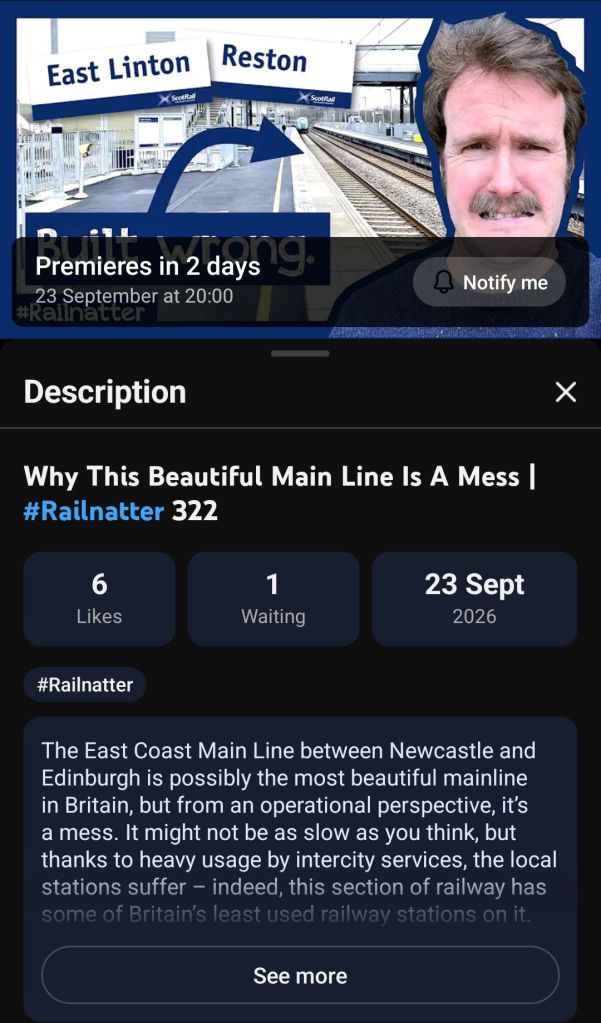
Coming on Wednesday 23rd September 2026 at 8pm is Episode 322 of the Railnatter series by rail engineer and author Gareth Dennis, and the topic of the night is the East Coast Main Line (ECML) between Newcastle and Edinburgh; with the episode title of ‘Why This Beautiful Mainline Is A Mess’
Screenshot of the video on Monday 21st September 2026
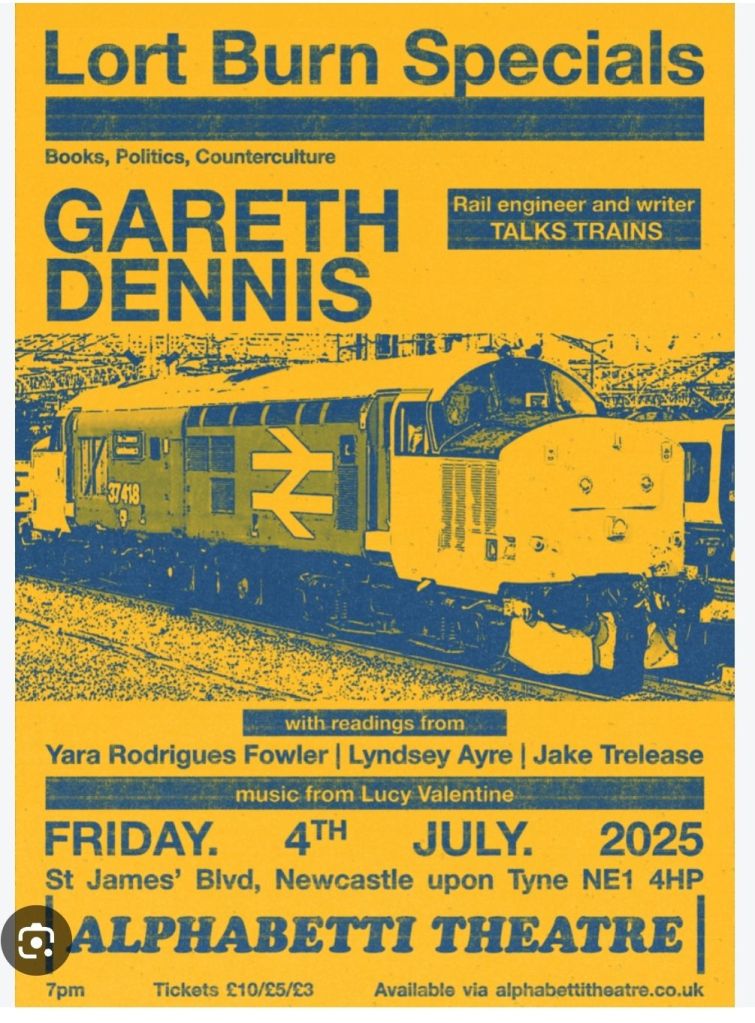
As a long term follower and Patreon supporter of the Railnatter series, as well as having having met Gareth personally at the Lort Burn Specials back on 4th July 2025, it’ll be great to see what he puts forward in this upcoming episode, and perhaps may hopefully even cover the Northumberland Coast Loop proposal too as part of the episode? (Newcastle to Edinburgh via Blyth Bebside using the Hepscott Line), with the petition now standing at 1,534 signatures.
It is very likely to be a live show; so if you are watching live on the day, you can post questions in the chat via YouTube and perhaps give your views on what is being said.
On 1st September 2026, I emailed a number of local politicians and other local campaign groups with regards to the Northumberland Coast Loop; which would be a new rail route connecting Newcastle Upon Tyne to Edinburgh via North Tyneside and South East Northumberland.
This email was circulated as a group to:
Mr A. Ford, NEPTUG,
Cllr B. Erskine, Blyth Town Council,
Mr D. Smith, MP for North Northumberland and his assistant Mr. T. Hunt,
Ms E. Foody, MP for Cramlington and Killingworth,
Cllr H.G.H. Sanderson, Leader of Northumberland County Council,
Mr I. Lavery, MP for Blyth and Ashington,
Mr I. Walker, Railfuture North East Branch,
Mayor K. Clark, North Tyneside Council,
Mayor K. McGuinness, North East Mayor.
The proposed route
This rail route would use the existing and active rail network to create this new route; which is in three key sections:
Section 1:Newcastle Central to Bedlington Junction (The Northumberland Line), which would pass through Manors, Northumberland Park, Seaton Delaval, Newsham, Blyth Bebside, and Bedlington stations. After an absence of 60 years, the reopened passenger line has been a huge success, with trains often packed and overcrowded. One solution to the overcrowding would be to run some Newcastle – Edinburgh services via Blyth which would add more seats quite quickly as well as more direct routes.
In the Victorian era, the then North British Railway, in co-operation with the then Blyth and Tyne Railway was proposing a Newcastle to Edinburgh route via Blyth, then Morpeth, Scots Gap, Reedsmouth, Kielder, and Riccarton Junction, which was a key part in ‘The Wannie Line’ being built in the first place so that the North British Railway had its own route into Newcastle from Scotland. Needless to say this didn’t actually happen in the end, but Blyth to Edinburgh via Berwick is a much more realistic option!
Section 2: Bedlington Junction to Morpeth North Junction (The Hepscott Line), this section is currently a freight only line connecting the Northumberland Line to the East Coast Main Line (ECML). It is used most regularly by the North Blyth to Fort William ‘Alcan’ trains which ply to and from the Port of Blyth to the west coast of Scotland, using the siding at Bedlington to reverse (change direction), but use the direct line from Bedlington to Pegswood to head towards Berwick and Edinburgh.
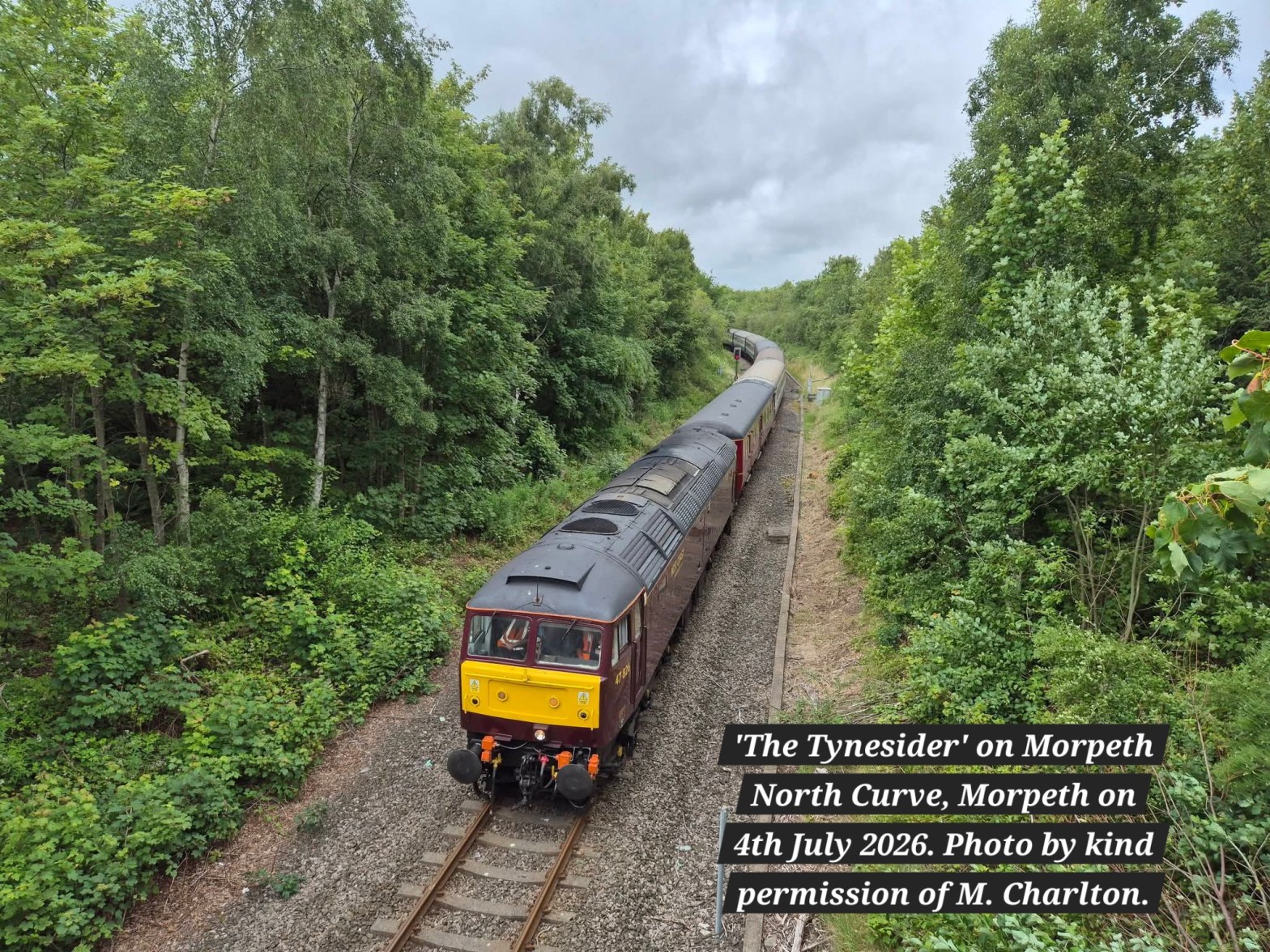
The ‘Morpeth North Curve’ than connects Hepscott to Pegswood direct was only built in the late 1970’s and opened in c.1980, largely to avoid the need for freight trains to reverse in Morpeth station, particularly coal traffic from places like Widdrington to reach the Port of Blyth and Blyth Power Station, but it has been used for occasional diversions around Morpeth in the past, as well as by railtours in the years since, but to me, would be a sensible route to bring into daily use for passenger trains to create new direct links in Northumberland.
This section is the key to unlocking direct travel from SE Northumberland to North Northumberland and Scotland or vice versa, as unless the SENRUG proposed ‘Butterwell Line’ is built, there is no alternative direct route, and using the existing line via Hepscott should be both faster, and less expensive than developing the Butterwell Line between Ashington and Widdrington, which needs to both rehabilitate a long disused colliery/opencast line, as well as need a new chord to link it northwards onto the ECML near the River Lyne and the village of Ulgham.
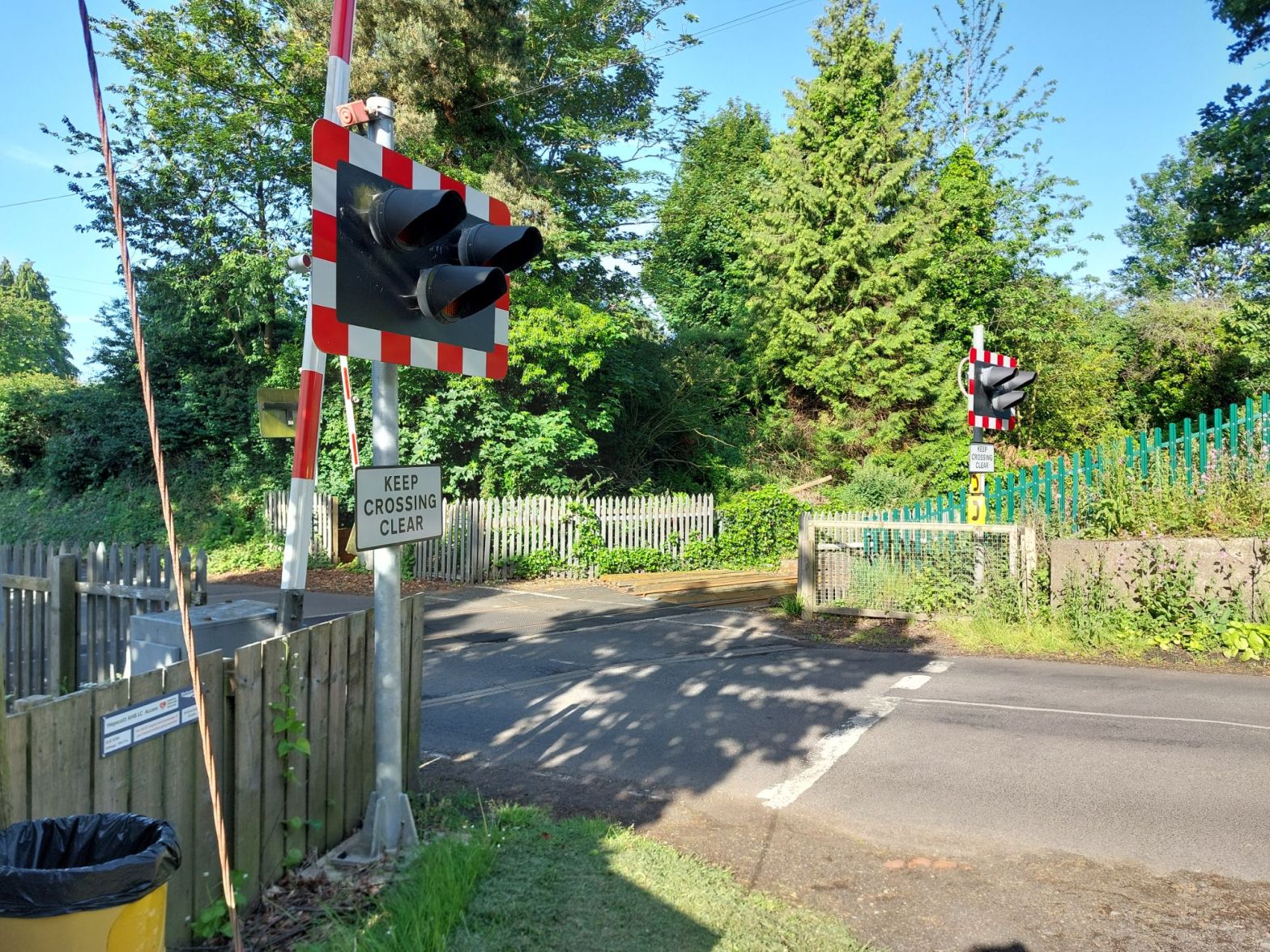
In contrast, I personally have travelled over the Northumberland Coast Loop route aboard ‘The Seven Counties Rambler‘ railtour on Saturday 8th March 2025, which shows how relatively easily this route could be utilised to create more direct rail links to, from, and within the area. It may require some upgrades, but it is a working railway in regular use, not a derelict line needing revived and needing new heavily engineered sections built onto it.
It wouldn’t require any stations built on it initially, as it would function as a ‘link line’ between stations on the Northumberland Line and the ECML, but, services running via this route could enable the reopening of Choppington station to better serve the west Bedlington and Guide Post/Stakeford areas.
Section 3: Morpeth North Junction to Edinburgh Waverley (The ECML), this route has been in constant passenger use since it opened in the 1840’s, and whilst there may need to be some capacity improvements, it would clearly benefit from additional services, both local ‘all stations’ and semi-fast ‘limited stop’ trains.
Proposed rail services
The primary proposal at present is for a semi-fast service (limited stops) running via this route, which would potentially call at the following stations:
Newcastle Central, Northumberland Park, Blyth Bebside, Pegswood, Alnmouth, Chathill, Berwick-Upon-Tweed, Reston, Dunbar, East Linton, Edinburgh Waverley.
This is based essentially on an amended version of the Transpennine Express stopping pattern to run via Blyth and North Tyneside, rather than Morpeth and Cramlington as at present.
Existing section of the TPE route map from Newcastle to Edinburgh via Morpeth and Cramlington
Additional semi-fast services are likely to be more easily accomodated into the busy ECML schedule than a slower local service could be, and a semi-fast would also offer a good balance of overall journey times from places like Blyth or Northumberland Park to Edinburgh with stopping at intermediate stations to offer a wider range of connections.
In the longer term, a local ‘all stations’ service from Newcastle to Berwick via Blyth is also desirable, but a priority will be for the long awaited ECML local service (Newcastle to Berwick via Morpeth and Cramlington) which needs 25kV electric trains, a local train via Blyth may therefore need to await electrification of the line via Blyth.
Replies recieved
To date, I have recieved three replies from the offices of:
Mayor Kim McGuinness,
David Smith MP for North Northumberland,
Ian Lavery MP for Blyth and Ashington.
I am very grateful for their replies, but at present the route is not committed to, which is hopefully something that’ll change soon with the growing support for the route.
On Wednesday 2nd September 2026, episode 319 of the long-running Railnatter series by rail engineer Gareth Dennis aired on YouTube (also available where you get your podcasts).
Railnatter 319
As ever, it was a very interesting episode, covering a brief history of the system from its origins as the Tyneside electrics running on third rail (a live power rail on the ground, a technology still used predominantly in SE England around London).
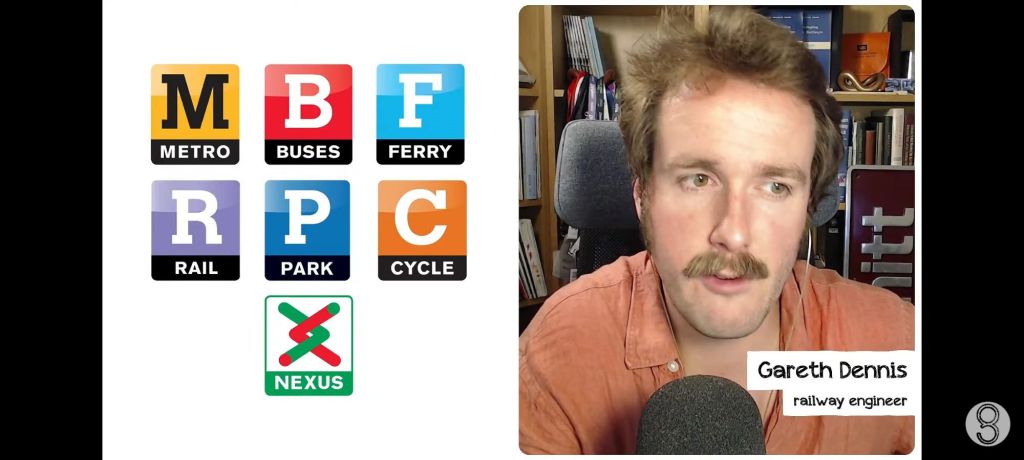
At around 14 minutes in, we come to the ‘big three’ brands currently, consisting of ‘Metro’, ‘Buses’, and ‘Ferry’, giving a strong regional identity based around the ‘Calvert‘ design language, which gives the Nexus operated system a very strong identity mostly on Tyneside and Wearside, but one hopefully due to roll out more broadly across Northumberland and Co. Durham soon too.
A short while later, we come to the full six ‘brands’ which include Metro, Buses, and Ferry mentioned before, alongside, ‘Cycle’, ‘Park’, and ‘Rail’.
Screenshot from Railnatter 319, showing the Nexus network ‘brands’.
In the podcast, Gareth refers to the ‘Rail’ brand being redundant, and advocates that all rail based transport should be grouped under the ‘Metro’ identity, but on this I would disagree.
‘Metro’ branding for the 1500v DC network, and ‘Rail’ for mixed and higher speed networks.
To me as a lifelong Northumbrian, the ‘Metro’ branding is synonymous with the former Class 599 Metrocars, and now the Class 555 Stadler built replacements.
That, to me, is a clear identity for the Airport to South Hylton ‘Green Line’ and the St James to South Shields ‘Yellow Line’, we know what a Metro is going to look like and where it can, and cannot go, and for the unique 1500v DC system, that is a major limitation on expansions to the network.
However, converting existing Class 555’s to dual voltage AC/DC capability, could be a fix to this, which is explained further down.
The Northumberland Line: Should have been wired, but at 25kV AC not 1500v DC.
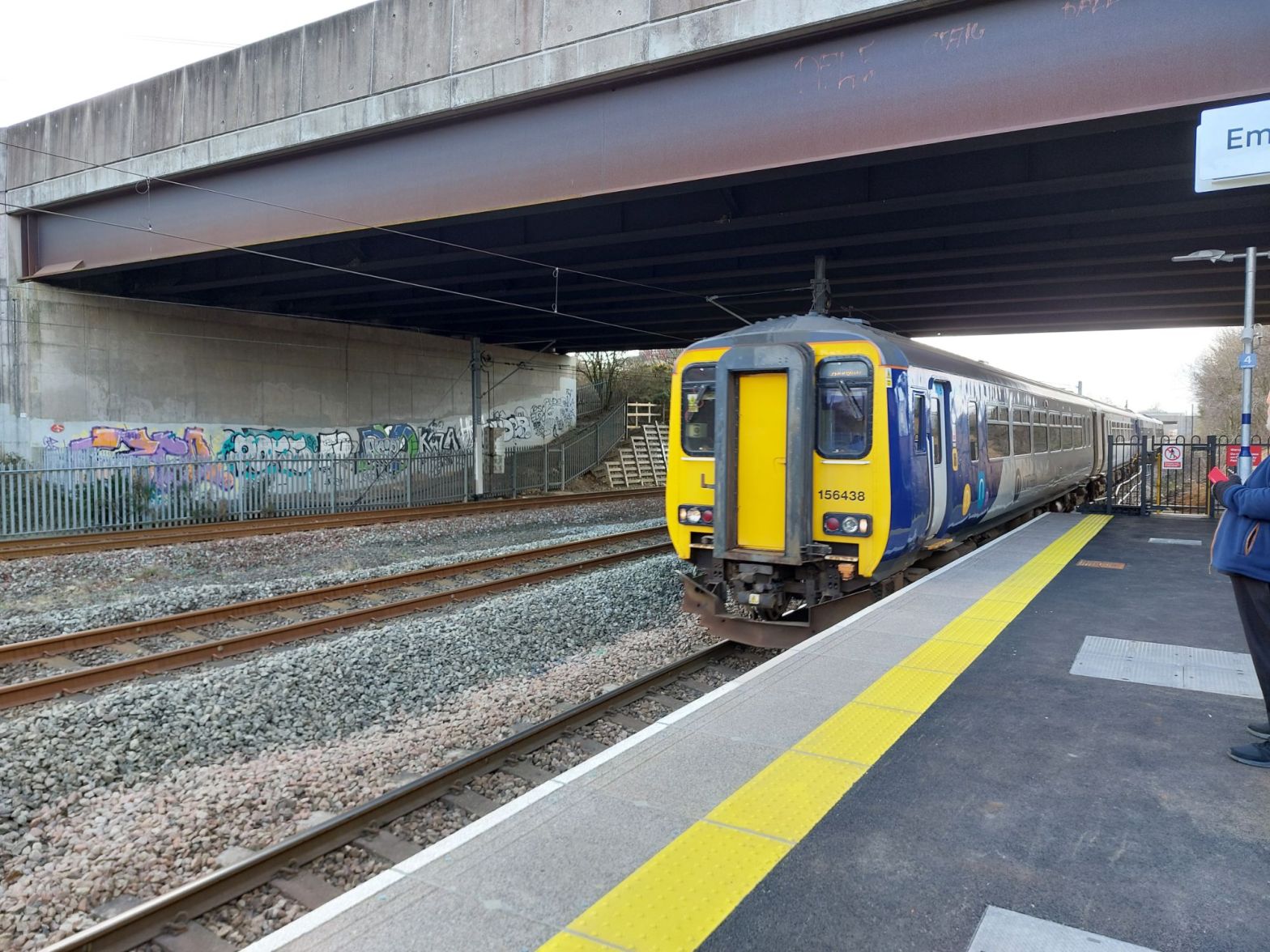
This is an important factor for the opening of the Northumberland Line; which was very much not the Metro in concept; it was developed as a conventional railway running between Newcastle Central station and Ashington, from opening in 2024 to the present using ageing diesel Sprinter units (Class 156 and 158 operated by Northern).
There was a clear logic to this, in that development of the route as a branch off the ‘Metro’ near Northumberland Park station up to Ashington, operated by Class 599 Metrocars/Class 555 Stadlers would have been substantially (around 10mins) slower overall as it would have run ‘all stops to Newcastle’ via South Gosforth and not the faster route via the ECML.
There is a trade-off with this in that as a Metro line it almost certainly would have crossed the Tyne, terminating somewhere like Pelaw, or running all the way to South Shields or South Hylton, and with the new Class 555 trains, would have meant four car trains as standard, not the often two-car Sprinters fielded by Northern.
The problem with that though is that wiring the line to Ashington with 1500v DC overheads would have locked in a non-standard electrical system on what would have been a shared Metro and Rail line like as on Pelaw to Sunderland, which would have complicated use of other electric trains on the line, especially given its potential for a diversionary route for the ECML (which this campaigns argues should be a regularly operated route to boost connectivity and maintain a broad driver knowledge base), with most mainline electrics running on 25kV AC overhead power.
Obviously the wires would have been set high enough for diesel trains to work underneath them so freight trains would have still run, but changing from 1500v DC to 25kV AC would incur significant costs if changed in future.
In my own view, the Northumberland Line (as well as the line linking Bedlington to Morpeth/Pegswood, and possibly the lines to Port of Blyth, and Lynemouth Power Station) should instead have been wired at 25kV AC (the same as the East Coast Main Line (ECML)); this would mean that electric units could have plied between Ashington and Newcastle, as well as offering a bigger fleet for working local services on routes such as the ECML between Newcastle and Berwick (both via Cramlington and via Blyth as proposed here), as well as from Newcastle southwards to Chester-Le-Street, Durham, and Darlington, with the option for a new station serving Team Valley en-route.
It is understandable that to keep costs down, electrification wasn’t considered, and in some ways may have been a good thing to have avoided 1500v DC ‘Metro’ wiring being installed, but the costs to go back in future, as well as the disruption caused will be signicant, and is a major drawback of not ‘going the whole hog’ the first time around.
There should also, again in my own view, be a push to wire other routes radiating out from Newcastle at 25kV AC standard, such as the Tyne Valley Line to Carlisle, and the Durham Coast Line to Sunderland then down to Teesside, though the latter does face an issue with the 1500v DC section between Sunderland and Pelaw, and potentially a large part of the Washington Extension too.
Wiring these routes at 25kV AC would allow for long-distance trains such as CrossCountry, Grand Central, and many more operators including railfreight to move to electric trains, and offer better performance as a result, and would make diversions easier too, not relying on bi-mode units leaving electric only trains stranded.
Rail branding for mainline services.
Used cleverly, the ‘Rail’ branding, if used across the North East, could an expansion of the Nexus network (possibly to be renamed ‘Angel Rail’?), and could be used to create a wider fixed fare network which has been so successful on the Northumberland Line, but would indicate a ‘shared system’ where other operators might operate alongside with different ticketing.
This could cover stations such as Morpeth, where local services, currently under Northern could be changed to ‘Angel Rail’ branded services; hopefully purple trains with the Calvert ‘R’ on the side similar to the Yellow with ‘M’ of the Class 555’s? Higher speed electric local trains for use on routes like the ECML would be ideal candidates for such branding.
The ‘Brian Johnson’ upgrade: dual voltage capability for the Class 555 fleet?
As mentioned earlier, the Pelaw to Sunderland stretch of the Durham Coast Line having existing overhead wires at 1500v DC is an obstacle to wiring the rest of it at 25kV AC; and will also be an issue if the Washington Extension becomes a shared Metro/Rail route too.
Therefore, I would put forward that conversion/upgrades of the Class 555 to dual voltage AC/DC capability (both 1500v DC and 25kV AC) is undertaken if possible.
That would allow for the Sunderland – Pelaw stretch to be adapted to 25kV AC, making it standardised and joined up to the rest of the national wired network, allowing almost standard electric train to run via Sunderland, but also would retain the 1500v DC system where Metro trains are the only ones running (such as through the tunnels under Newcastle which are too small for other trains).
A similar issue could arise on the Washington extension, where opening the southern part of the route towards Ferryhill has long been advocated for, and having 25kV AC throughout would be an advantage.
For a ‘Metro’ train, this would mean swapping between DC and AC electric depending if it was on exclusively Metro infastructure or shared ‘Rail’ respectively, but since the Sheffield Tram-trains (Class 399) has done this for years, there surely shouldn’t be too many obstacles to the Stadler Class 555 fleet managing it too?
Metro to MetroCentre
This AC/DC conversion of the Metro Class 555’s would also enable greater reach of them around the Tyneside rail network, for example, if even just a short section of the Tyne Valley Line was wired (say to Prudhoe), then Class 555’s could at last reach the MetroCentre, where ironically the Metro network has never reached!
Fittingly, such an option for would take these AC/DC units through Dunston, birthplace of the band AC/DC’s lead singer Brian Johnson in 1947.
There is further advantage in that then the Class 555’s could work into the main platforms at Newcastle Central Station, allowing new options for the Metro network as a whole; could a new junction between Manors and Heaton between Rail and Metro for example could be used to create a Tynemouth to Prudhoe route, or get Metro down into the Team Valley.
Metro to Morpeth: Mix of Rail and Metro on the Northumberland Line?
A final example could be taking an AC/DC capable Metro Class 555 to Morpeth, obviously it would be too slow to run along the ECML, but with the Northumberland Line wired at 25kV AC, it could make its way via a connecting junction at Northumberland Park then along the line to Bedlington and branch off through Choppington to terminate at a new platform in Morpeth (either adjacent to current station or elsewhere in/around Coopies Lane) where it would terminate, then reverse and head back towards Newcastle, possibly to Airport using the depot avoiding line to give east-west connections between the Green and Yellow lines without changing at South Gosforth.
Serving Cramlington
A key part of the rationale behind the the Northumberland Coast Loop campaign is to use the loop between Morpeth North Junction and Benton Junction as effectively an existing set of ECML slow lines, as this stretch of the ECML could be seen as being 3/4 track if the loop via Bedlington is seen as the ECML slow line through SE Northumberland and North Tyneside.
A fast, dedicated bus connection to Blyth Bebside via the A189 Spine Road could connect Cramlington easily to long distance rail services calling Blyth Bebside could be fairly easily done, especially if a direct slip road exiting the northbound A189 onto Errington Street, staying west of railway was to be built to bring buses directly into the station bus stop rather than the existing routes via Bebside Front Street. A clear connection this bus service would make would be to/from NSECH at Cramlington, and possibly also extended up to Wansbeck General Hospital in Ashington too.
Conclusions:
Top things that the Nexus network could do going forward:
1. Keep it Calvert: This existing brand is BRILLIANT, and should be widely rolled out across Bus and Rail services around the North East from Berwick to Darlington, and Haltwhistle to Hartlepool.
2. Electrify the railways at 25kV AC: Wire up routes like the Tyne Valley Line, Northumberland Line, and Durham Coast Line at the 25kV AC standard, and make sure the Washington Extension is either done to this standard, or could be converted easily. Leave the Metro only sections at 1500v DC.
3. Convert the Class 555 ‘Metro’ trains to dual voltage AC/DC capability: Convert the existing fleet to be able to operate on 25kV AC overhead power as well as 1500v DC; which enables conversion of Pelaw – Sunderland to 25kV AC, as well as allowing the Class 555 fleet to operate more widely, as electrification expands, with room to expand the fleet too.
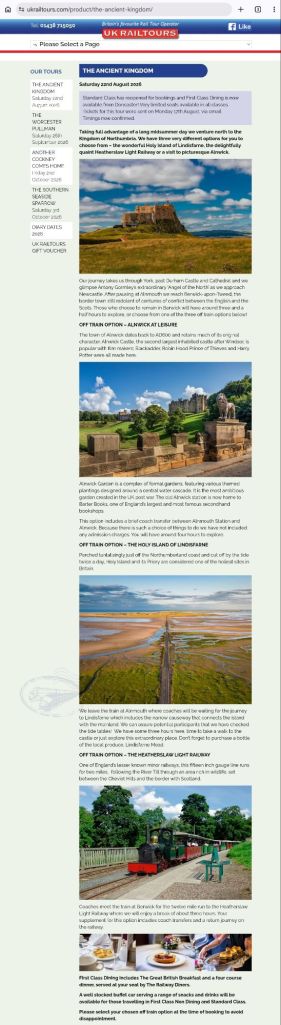
In just a few minutes from the time of posting on Saturday 22nd August 2026, ‘The Ancient Kingdom’ railtour, operated by UK Railtours will depart from London King’s Cross towards Berwick-Upon-Tweed, calling to pick-up passengers at Potters Bar, Stevenage, Peterborough, and Doncaster, and setting down at Alnmouth for Alnwick is due to run, and from the website seems that it will be very well filled with few available seats in any class of travel.
Off train options to Alnwick, Lindisfarne, and the Heatherslaw Light Railway
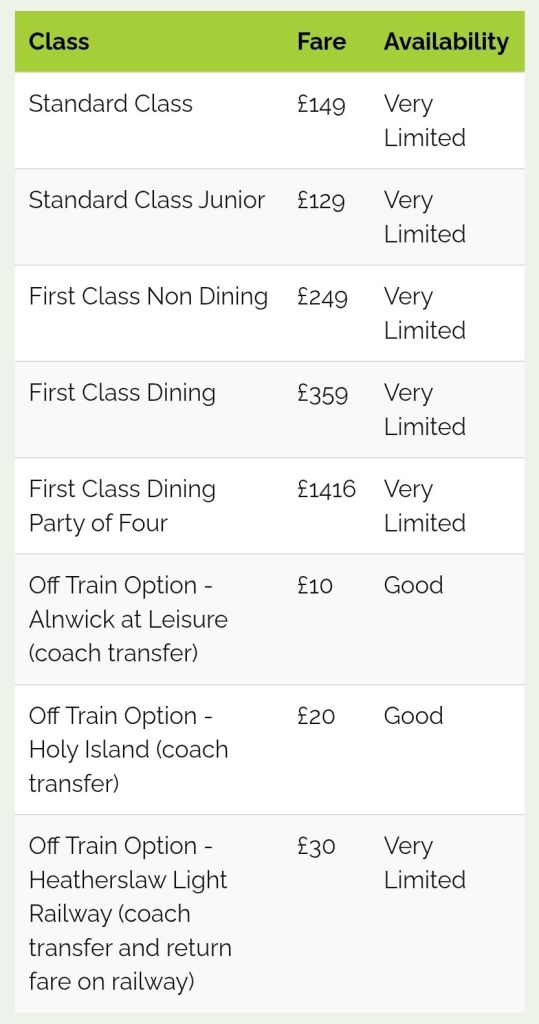
Ticket options plus coach transfer options.
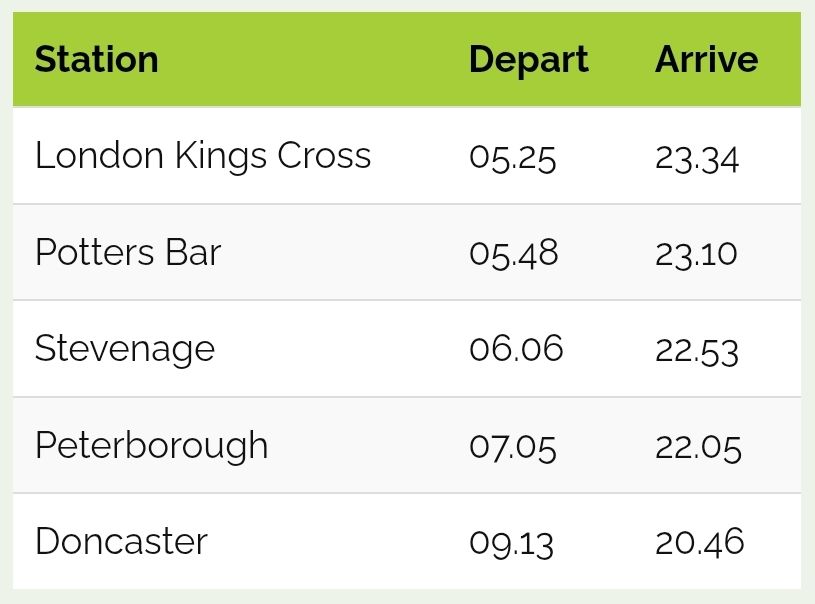
Morning departure and evening arrival timings from London Kings Cross
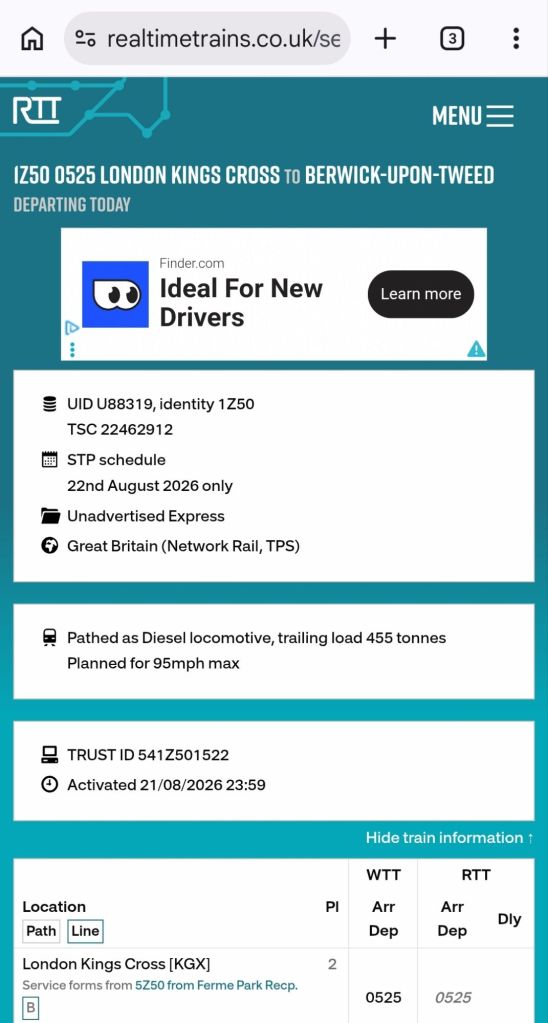
1Z50 from London King’s Cross to Berwick-Upon-Tweed, with onward coach connections.
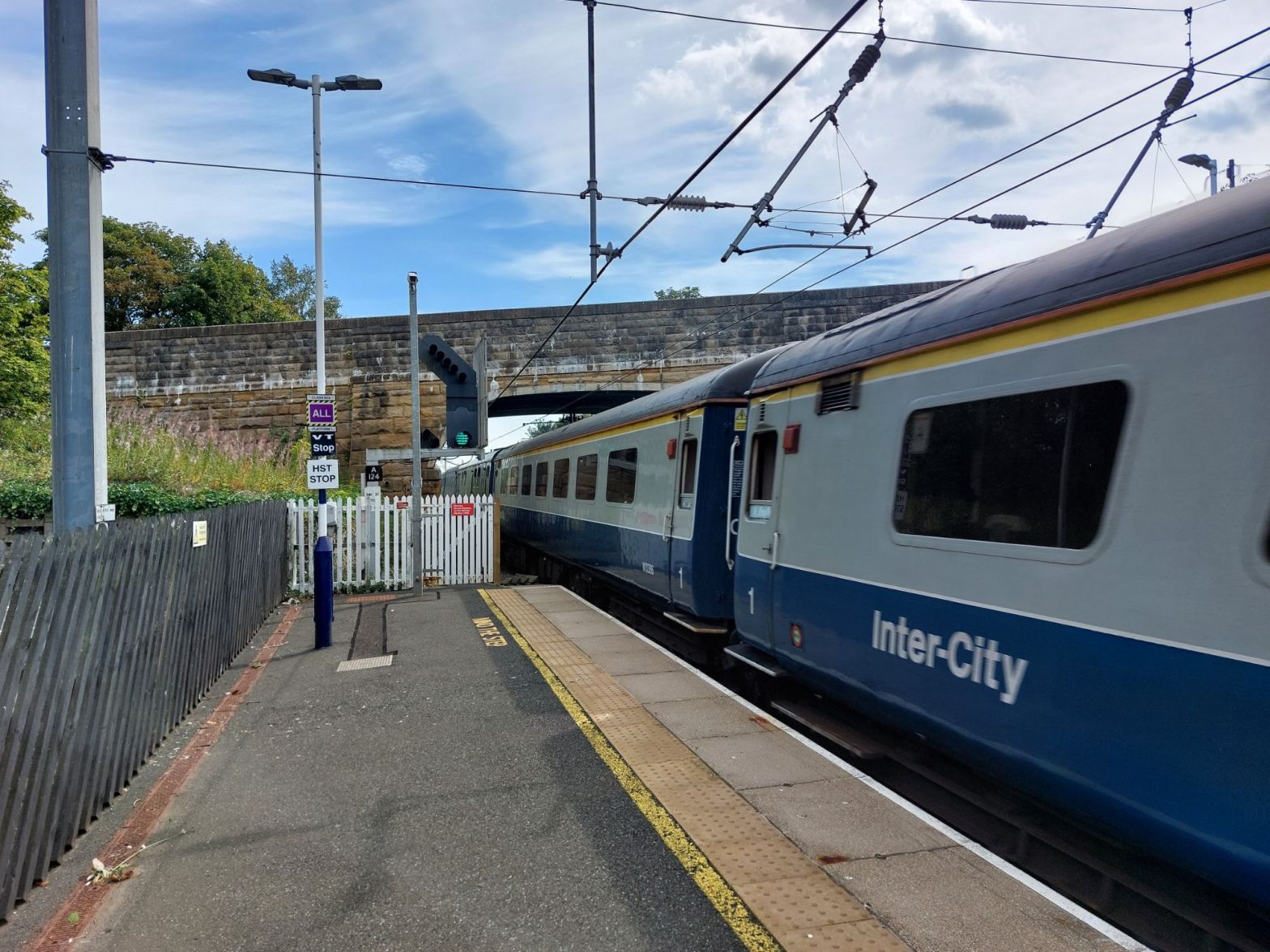
The train taking passengers from Kings Cross in London up here to Northumberland is the 1Z50, a diesel locomotive with a 455 tonne train in tow, at a maximum speed of 95mph (locomotive not yet announced).
At Alnmouth, road coaches will take passengers on to Alnwick, and at Berwick, will take them on to Lindisfarne, or the Heatherslaw Light Railway, but a little dive into the railway timetable raises some interesting possibilities…
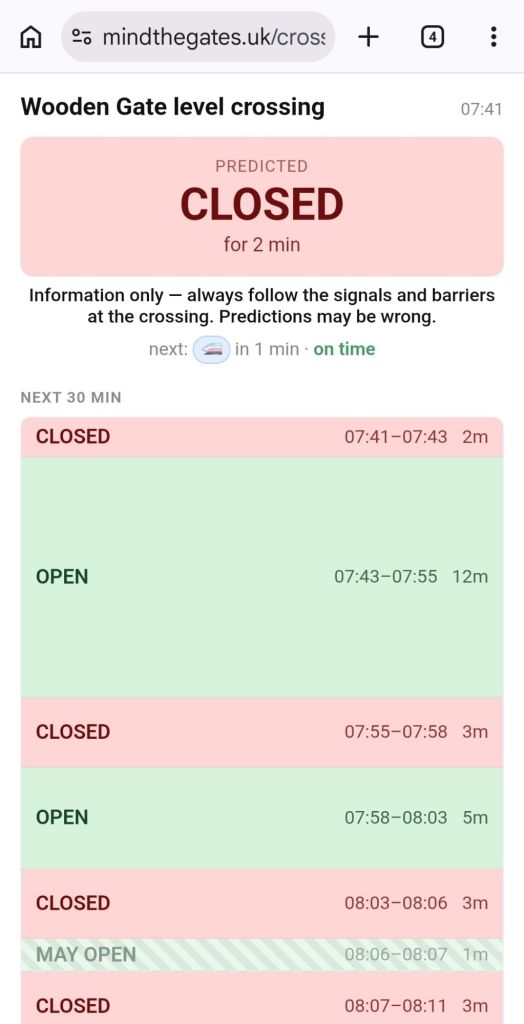
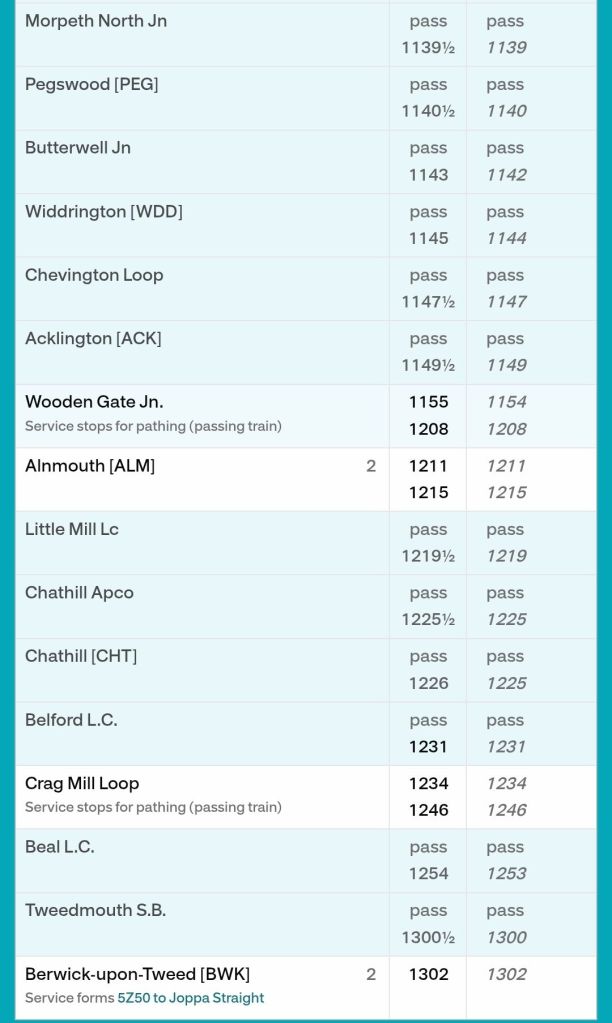
Arrival at Alnmouth is due at 12:11, after standing in the loops at Wooden Gate for about 13 minutes, then the train proceeds to Berwick Upon Tweed, arriving at 13:02, having waited in Crag Mill Loop for around 12 minutes between Alnmouth and Berwick.
These stops in loops are usually part of being on a railtour; usually they use heritage or freight locomotives and heritage carriages that cannot reach 125mph, and so need to be ‘looped’ to allow a faster train behind them to overtake, much like a tractor driver pulling into a layby so that faster vehicles behind can overtake.
(Fittingly, Class 37 locomotives from the 1960’s get nicknamed ‘tractors’ by some on account of their engine sound, and would be an example of a heritage loco commonly used on railtours).
However, does this suggest an opportunity to develop these into more routine stops for passenger trains?
Expanding or relocating Alnmouth station to Wooden Gate Loops, and a reopening of Crag Mill/Belford station?
Post being progressed, a link will be posted here once ready; check back soon!
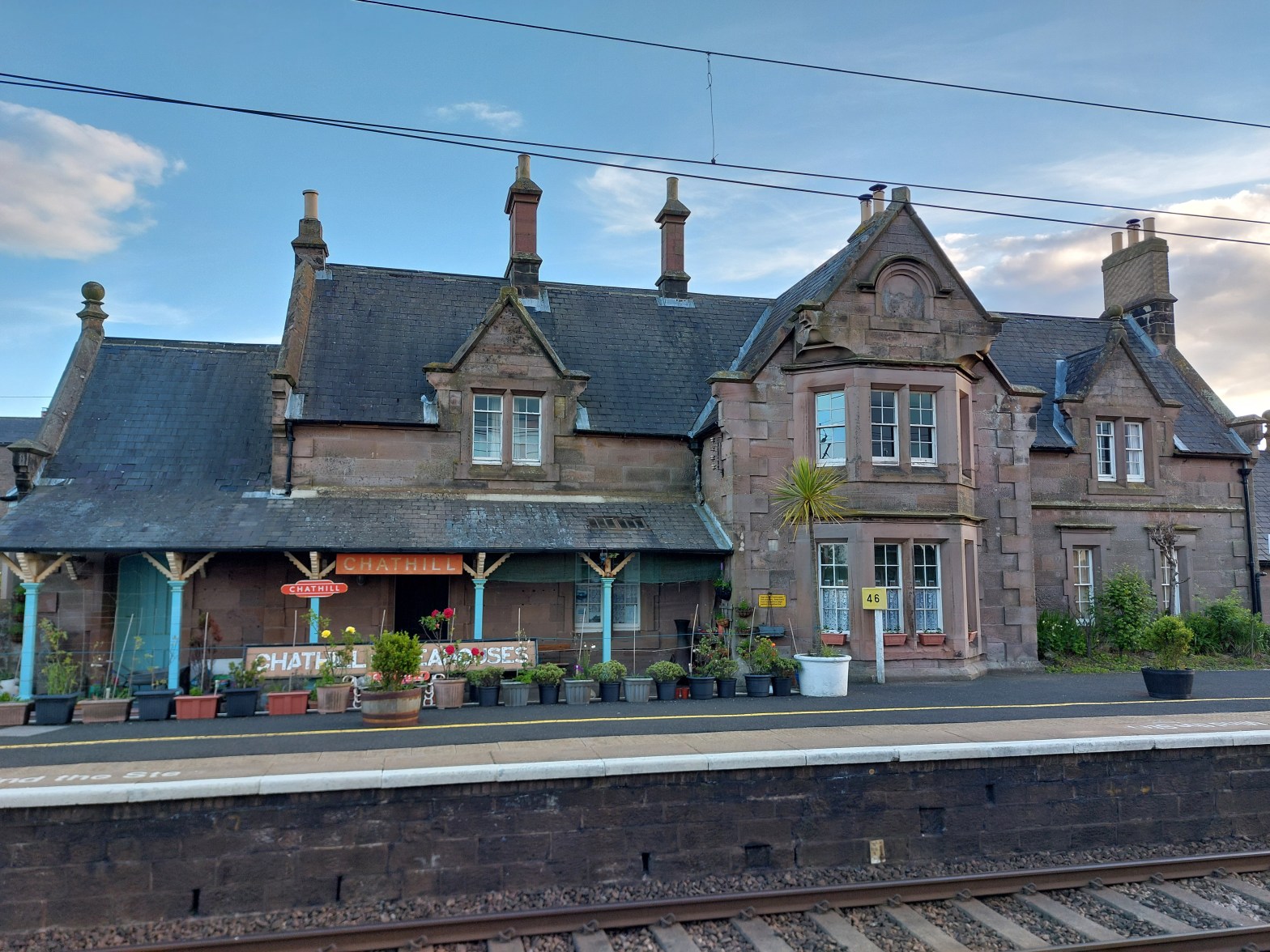
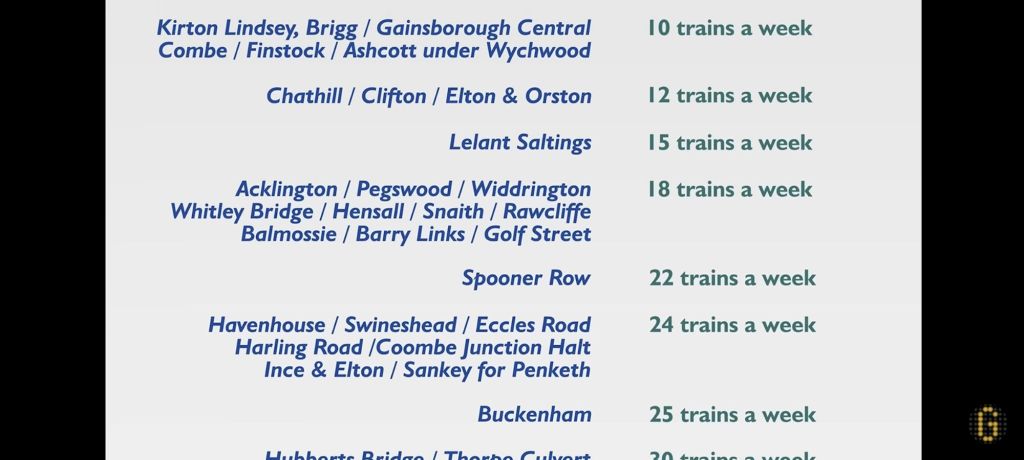
A recent video by the excellent Geoff Marshall (below) details some of the UK’s least served stations (fewest trains per week), which includes the famous four on the Northumberland Coast part of the East Coast Main Line (ECML) of Chathill, Acklington, Widdrington, and Pegswood; but is Chathill in the wrong location on the list?
Geoff Marshall – Least Served Stations video
Chathill error?
One thing that caught the eye was the position of Chathill in the list having fewer services than Pegswood, Widdrington, and Acklington.
If based on passenger carrying departures, then the list is correct, however Chathill is different to the other three in that it is possible to travel northbound and arrive at the station in the morning, whereas the ‘Chathill Flyer’ simply whizzes through Pegswood, Widdrington, and Acklington.
This is purely an unusual quirk of Chathill acting as a terminus; the ‘Chathill Flyer’ terminates for passengers at Chathill, whilst the train itself continues north to a siding at Belford, then reverses, and heads back to Chathill bound for Newcastle once again.
For the stations at Acklington, Widdrington, and Pegswood, the arrivals and departures are one and the same, thrice daily Monday to Saturday giving the correct 18 per week, but for Chathill, there are two arrivals per day, plus two depatures per day giving a total of four trains per day, multiplied by six days giving 24 trains per week.
This would then place Chathill in the same bracket as Havenhouse, Swineshead, Eccles Road, Harling Road, Coombe Junction Halt, Ince and Elton, Sankey for Penketh.
I’ve tried dropping a comment for Geoff on the video itself too, hopefully it’ll be an easy one to correct!
Otherwise another brilliant video from Geoff Marshall, a channel on YouTube well worth subscribing to!