The Northumberland Line now complete, with all six stations now open and bustling, it is time to really set the sights on the next steps for the line, and in my view, it should be to make use of the existing connection from Bedlington headed west, not only to Morpeth, as put forward by SENRUG, but to also take advantage of the potential direct route from Blyth to Berwick and beyond.
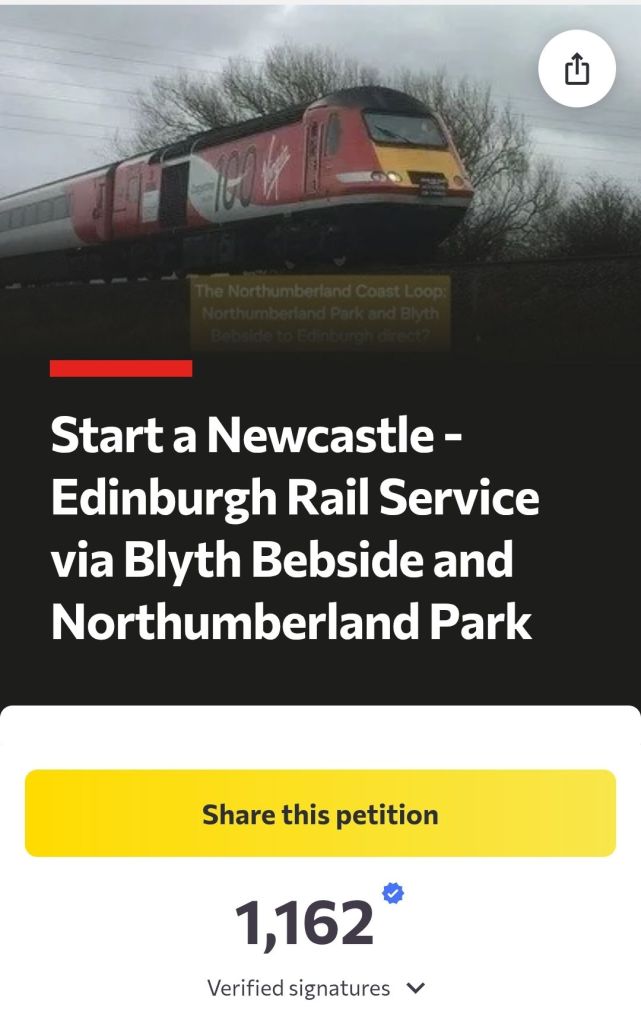
The petition that I launched back in February 2025 now has 1162 signatures to support expansion of the Northumberland Line into North Northumberland and Scotland, and you can view it here: https://www.change.org/p/start-a-newcastle-edinburgh-rail-service-via-blyth-bebside-and-northumberland-park
Faster, direct journeys compared to via Newcastle or changing at Morpeth
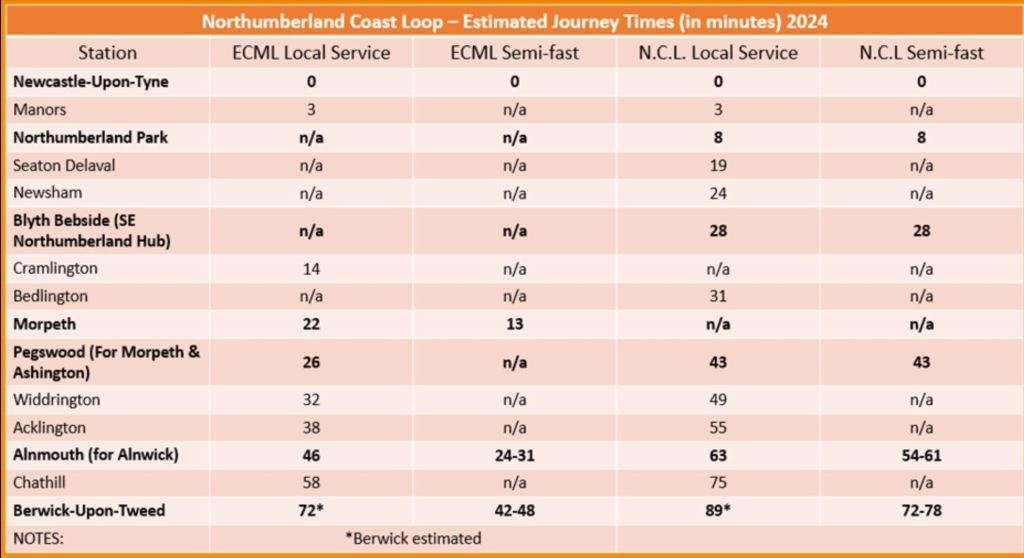
As can be seen below from this table compiled back in 2024, the approximate direct rail journey time from Blyth Bebside to Berwick via Pegswood would be just 44min to 50min.
Taking the more conservative figure of 50mins, it would still be 40mins less than the fastest current connections at Newcastle (1hr 30mins via Northern and LNER) as can be seen below from the LNER app taken on 2nd May 2026.
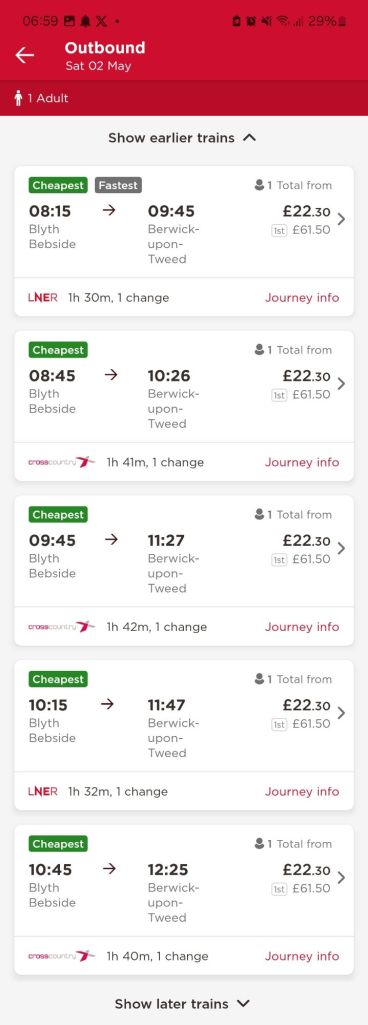
The fastest journey time of 1hr 30mins is outlined further below, where a 20minute wait between trains is required at Newcastle Central station, so whilst this might be possible to reduce if trains were better timed to connect, it would at most reduce by only c.15mins as at least 5 minutes would be needed to allow a passenger to transfer from one train to another at Newcastle.
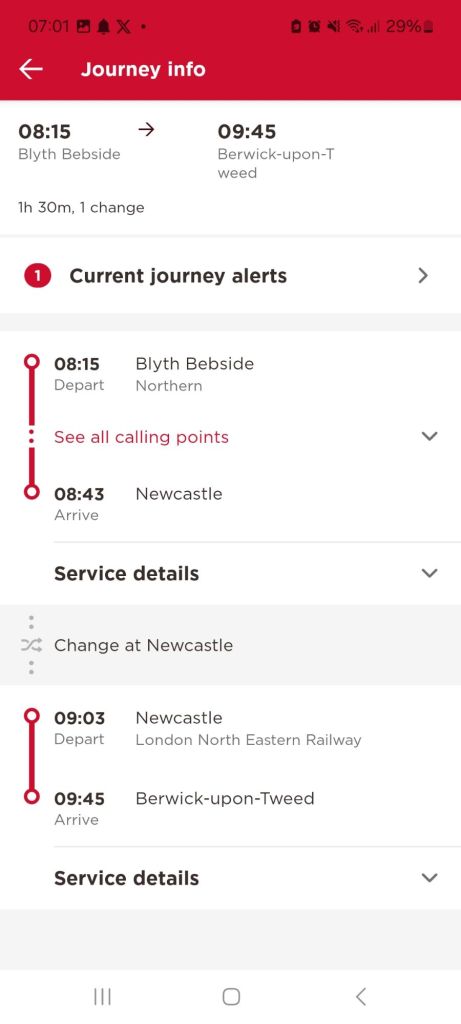
This means that even in the best case scenario, a trip from Blyth Bebside to Berwick via Central Station will take at least 25 minutes longer than the direct service would be able to provide, without any upgrades in terms of running speeds on the still quite slow route between Bedlington and Morpeth North Junction.
Blyth Bebside – Bedlington – Morpeth – Berwick
There is a counter argument that a connection via Morpeth could also be made, but again this route would have issues.
The first issue is that there are no clear proposals for a direct train running between Blyth and Morpeth; the SENRUG proposal would see the trains reversing at Bedlington to then head back to Morpeth.
This means that starting from a station such as Blyth Bebside, a prospective passenger would need to travel to Bedlington, change trains to reach Morpeth, then change again onto a northbound service. This is further compounded by the fact that the proposed extension of the current Newcastle to Morpeth trains onto Bedlington only run approximately hourly, meaning that depending on the connections, the journey time from Blyth Bebside to Morpeth by rail might be excessively long for a few miles long journey, and to arrive in ample time to make a northbound connection towards Alnmouth, Berwick, Edinburgh, etc. may mean leaving far earlier.
Northumberland Coast Loop route: Newcastle Central – Blyth Bebside – Pegswood – Berwick-Upon-Tweed and beyond
In contrast, a direct route between Newcastle and Berwick, which is possible using the existing track layout, allows for a single seat trip from Blyth Bebside to Berwick, running via Pegswood, Alnmouth and more.
For the proposed semi-fast service via the N.C.L. route, it would mean zero changes at Northumberland Park and Blyth Bebside, to Pegswood, Alnmouth, Berwick, and Edinburgh, and from Ashington, Bedlington, Newsham, and Seaton Delaval, only one change of train would be required at either Blyth Bebside or Northumberland Park.
For the proposed all stations local service via the N.C.L route, connections between Northumberland Park, Seaton Delaval, Newsham, Blyth Bebside, and Bedlington to Pegswood, Widdrington, Acklington, Alnmouth, Chathill, and Berwick Upon Tweed would be zero changes of train, with only Ashington, and the proposed stations at Woodhorn and Newbiggin requiring just one change of train.
Choppington Station
The above N.C.L. route also holds advantages in that it would run via the proposed new station at Choppington, which would surely help further the case for this station, especially given recent and upcoming major housing developments in both west Bedlington and around Scotland Gate and Guide Post.
The alternative route: The Butterwell Line (Ashington to Alnmouth)
A similar rail connection to the Northumberland Coast Loop, touted by SENRUG is the ‘Butterwell Line‘ which would see a section of the long-disused Ashington collieries and Butterwell/Potland opencast railway reopened to traffic, as well as a new connection from this line created to connect to the ECML headed north (the current disused connection faces south towards Pegswood). For clarity, we’ll call this new junction Butterwell North Junction.
Whilst this route would also take in Ashington, which would add the benefit of a further large town en-route, it does come with the cost associated of constructing an essentially new railway from Ashington to the ECML near Ulgham, which would be around four miles long.
The old mineral line, especially just north of Ashington has been disused since c.2000, and the section through Ashington Community Woods has become heavily overgrown during the last 20 years, with many mature trees growing on the former trackbed.
Further north, the line was more recently used (c.2015), but again is becoming heavily overgrown, and would need some significant civil engineering to ease the tight curves near Linton Colliery (to allow reasonable speeds and safer operation), as well as the new route and junction to join this line to the ECML to allow direct access to and from the north.
Near identical Blyth to Berwick routes, aside from the Bedlington to Widdrington stretch
These two routes between Blyth and Berwick-Upon-Tweed are almost identical; Newcastle to Bedlington would be the same under both proposals, as would Widdrington to Berwick-Upon-Tweed and Edinburgh.
The key difference between both routes is the section from the newly opened Bedlington station to Widdrington station; the Northumberland Coast Loop (N.C.L.) route uses the existing line (open since c.1980) via Pegswood, which whilst missing Ashington offers an opporunity to serve Morpeth via a second railway station there at either Hepscott or near the Coopies Lane industrial estate. Pegswood would also act to serve both Morpeth and Ashington, much like Alnmouth station works to serve Alnwick and Amble.
The SENRUG proposal would instead run via Ashington, allowing that town to also be served, but it would also require the rehabilitation of the old ‘Butterwell Line’ as well as a new section of track and a new junction onto the East Coast Main Line (ECML) near to Ulgham. There would also be no opportunity to serve Morpeth.
N.C.L. Route is cheaper and potentially faster to implement
The N.C.L. route between Bedlington and the ECML at Morpeth North should be a relatively low-cost/high reward route to use; it already is in regular but infrequent use (around twice per week in each direction). The route is also already available to use, it being a known diversionary route, and even occasionally used by passenger trains such as rail charters, a clear example being my own trip over the route aboard ‘The Seven Counties Rambler’ back on 8th March 2025.
As can be seen in the clip below from 2024, regular railfreight from Bedlington going directly to Scotland is long established via Morpeth North, having run over this route since the 1980’s taking alumina from the Port of Blyth to Fort William.
Why wasn’t the Butterwell Line directly connected towards Widdrington in the 1970’s and 1980’s?
At the time the Morpeth North Curve was planned and built (mid to late 1970’s), the Butterwell Line from Butterwell Junction (joining the line to the ECML) to Ashington was also fully open and operational, so it raises the question of why a north-south link from Butterwell towards Widdrington was not built at that time?
Coal flows at that time from North Northumberland such as from Widdrington Disposal Point to Blyth Power Station were significant, and presumably was part of the reason behind building the Morpeth North Curve to avoid these trains having to be reversed in Morpeth station, but given the Butterwell Line was open, then why did they not not build the exit the ECML near to Ulgham, and also avoid the run-round at Bedlington sidings?
It would, to me, suggest that whilst flows of coal, as well as the smaller but still significant flows of Alumina to Fort William were significant, it probably didn’t justify the engineering costs of building such a link; despite it significantly reducing the distance and time for coal trains to access Blyth Power Station directly, rather than them running via Bedlington and reversing at Furnaceway Sidings, and running to and fro via Morpeth North.
In my view, it suggests that the Hepscott route is probably the most likely candidate of the two routes to be successful; it has survived the loss of coal traffic which was a key reason for the survival of the ‘Blyth and Tyne’ as a whole into the 21st Century, whilst the Butterwell Line has gradually fallen into disuse and is steadily returning to nature.
A full cost:benefit and engineering analysis of both routes may give further insight into the best way forward, but it seems illogical to exclude the Hepscott route from discussions of the expansion of the Northumberland Line given that it has survived for 46 years in continuous use, whilst the touted route via Linton Colliery has steadily closed and become abandoned in recent decades.
If anyone has any insight into why the Morpeth North Curve was selected over the Butterwell Line, please leave a comment on this blog post or reach out via Social Media.

