The success of the Northumberland Line keeps being proven: passenger numbers pass 1,000,000 since opening!
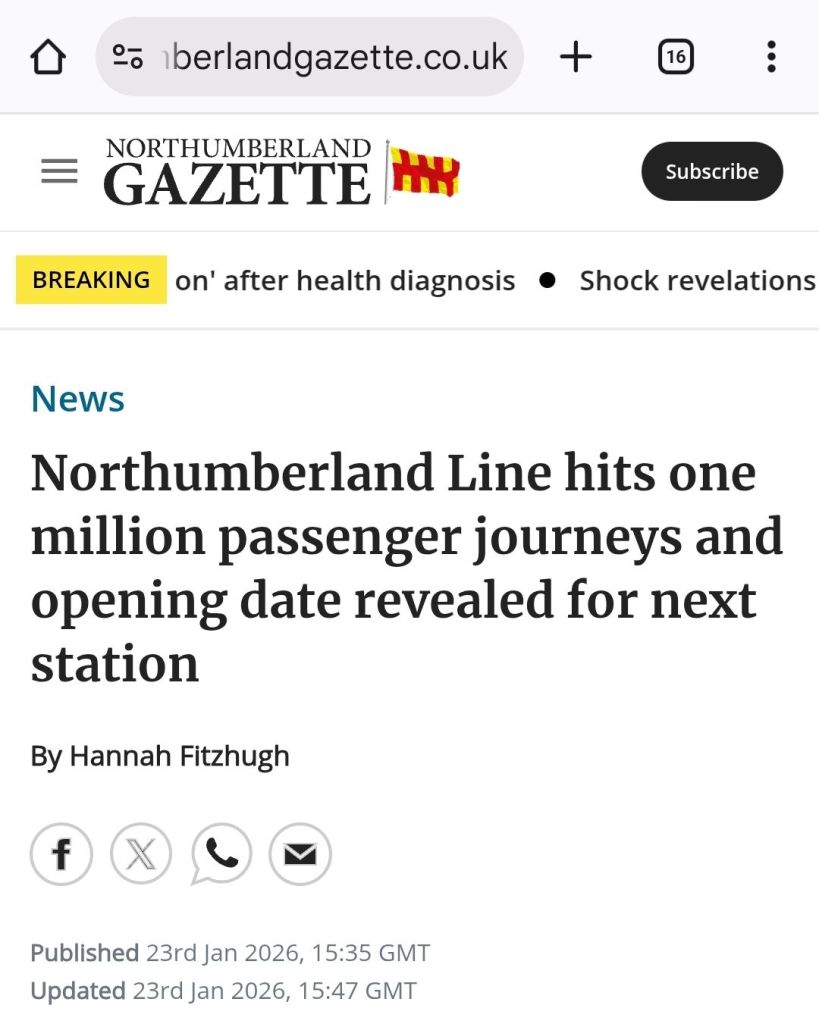
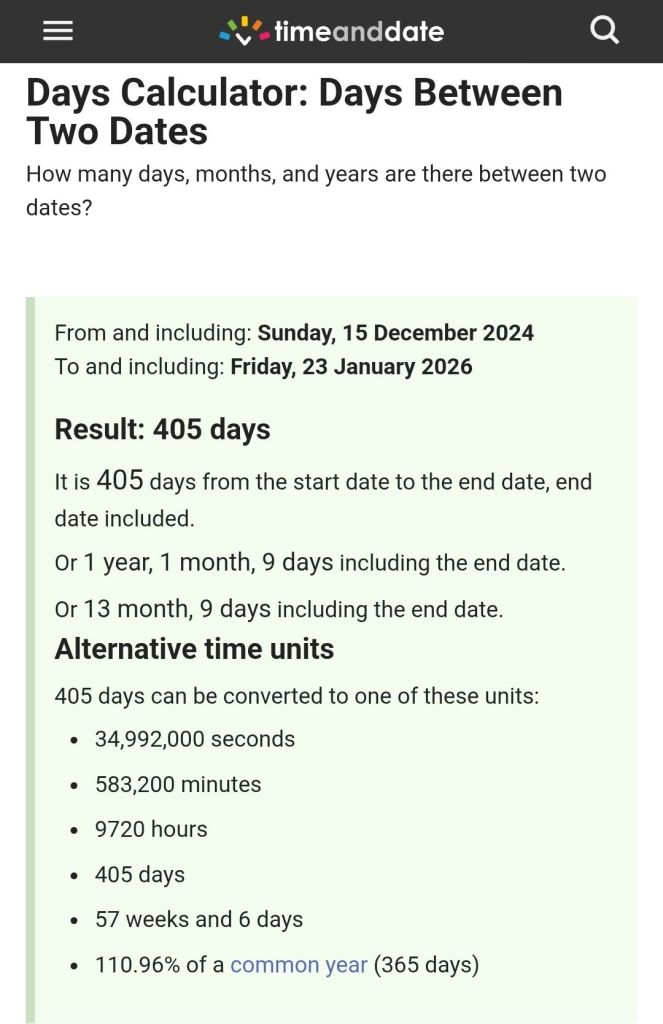
On Friday 23rd January 2026, an event was held at Blyth Bebside station to mark the millionth passenger journey on the Northumberland Line since opening just 405 days before on Sunday 15th December 2024, as shown in this article from the Northumberland Gazette.
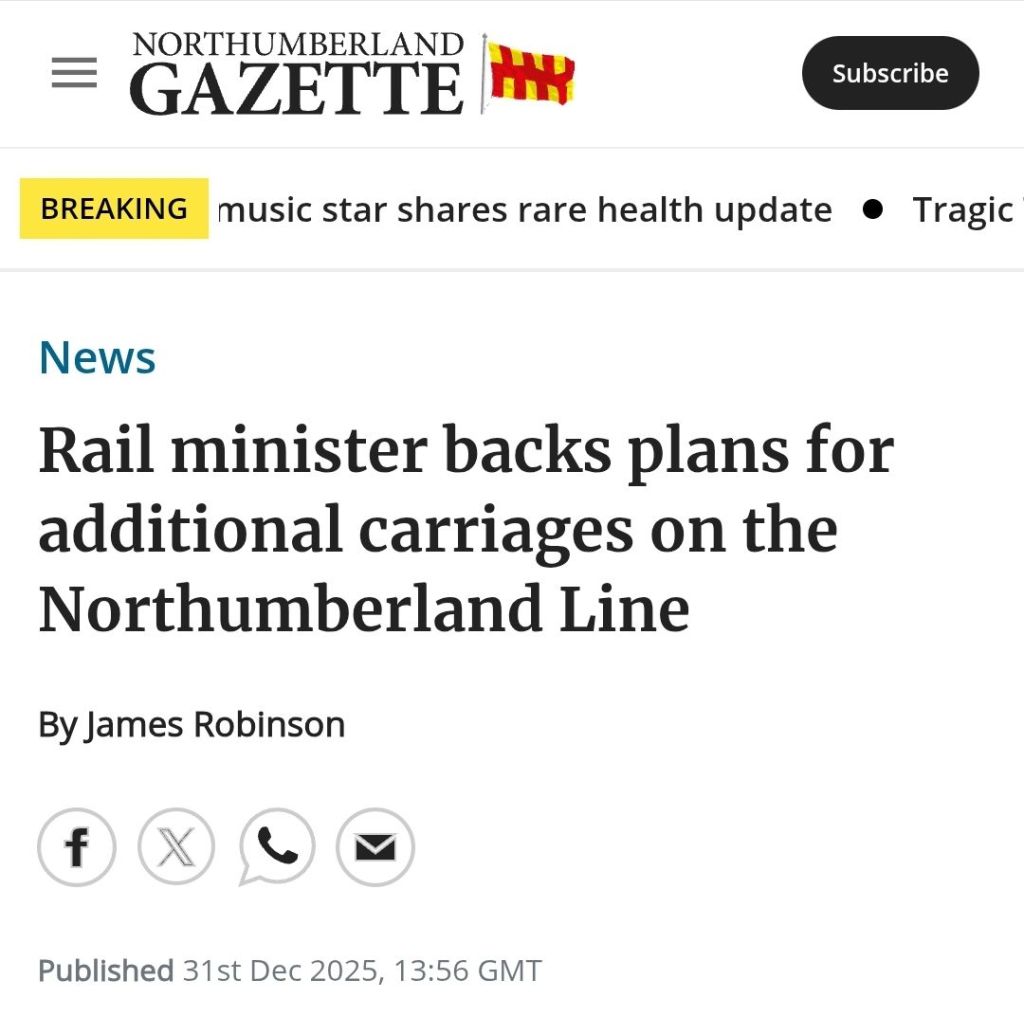
Headline of the article from the Northumberland GazetteImage from the article, showing the oversized ticket held by Cllr Sanderson and Alex Hornby, Commercial and Customer Director of Northern
Taking a simple average of dividing the million passengers by the number of days since opening (1,000,000 ÷ 405), the line has carried approximately 2,469 passengers/day over the route on average (rounded to nearest whole number).
This is very strong usage considering it was until recently a line only really used for railfreight, and so journeys have either switched from other modes of transport such as driving, or the line is generating totally new trips entirely.
The Northumberland Line may have cut 625,000 car journeys on the Spine Road in its first year?
Assuming a 100% driving to 100% rail switch, and using the national average for vehicle occupancy of 1.6 persons per vehicle (most vehicles having just the driver, with some vehicles having 2 or more), this may represent 1,543 fewer car trips per day, or 625,000 over the course of those 405 days.
This could mean that congested roads such as the A189 ‘Spine Road’, which runs on a very similar corridor the Northumberland Line from the Woodhorn Roundabout in Ashington, to the Redheugh Bridge in Newcastle.
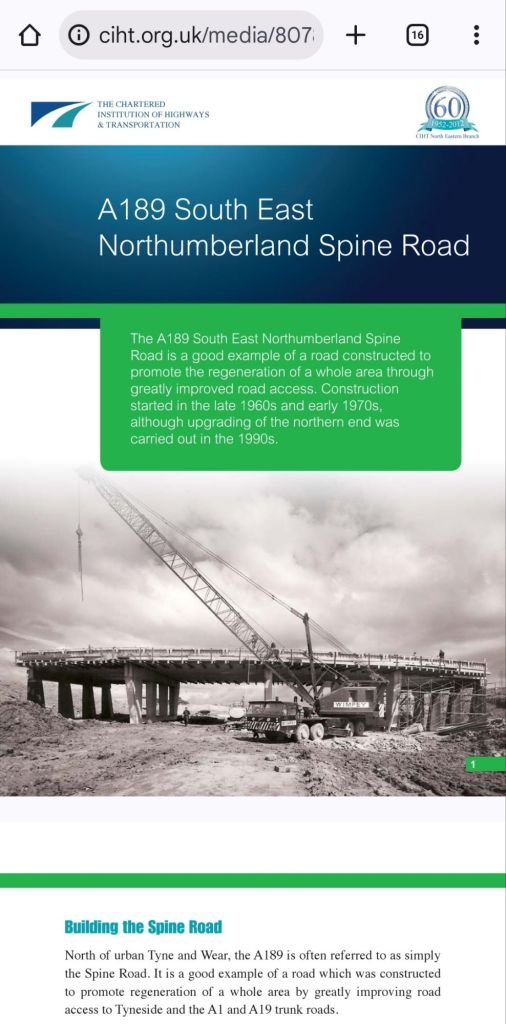
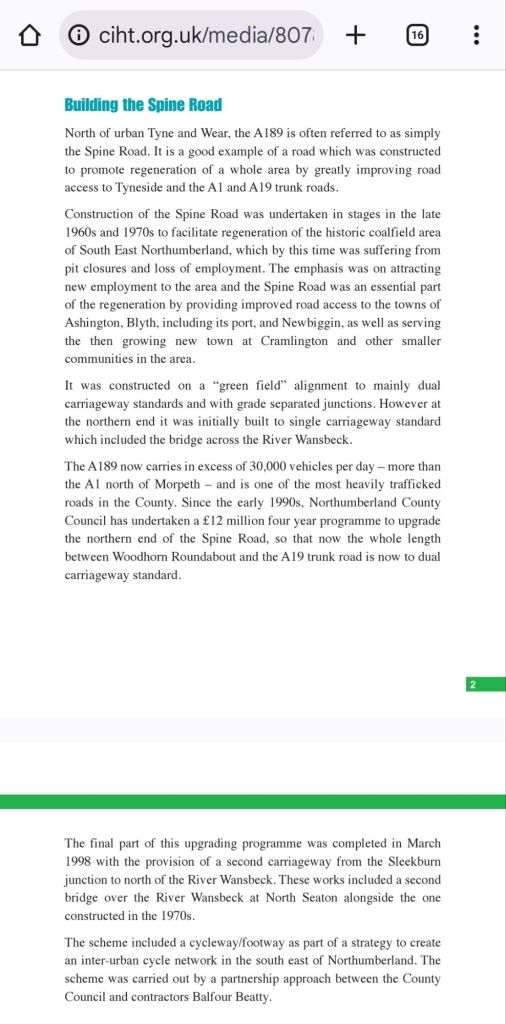
Information from CIHT, shown below states that the A189 carries over 30,000 vehicles per day, so assuming a modal shift of around 1543 car trips by the Northumberland Line, this would represent around a 5% drop in road traffic. This will be helping to ease issues such as congestion, especially on roundabouts like Moor Farm; it would be interesting to see if data before and after the Northumberland Line shows a fall in road traffic at Moor Farm and on the A189 more broadly?
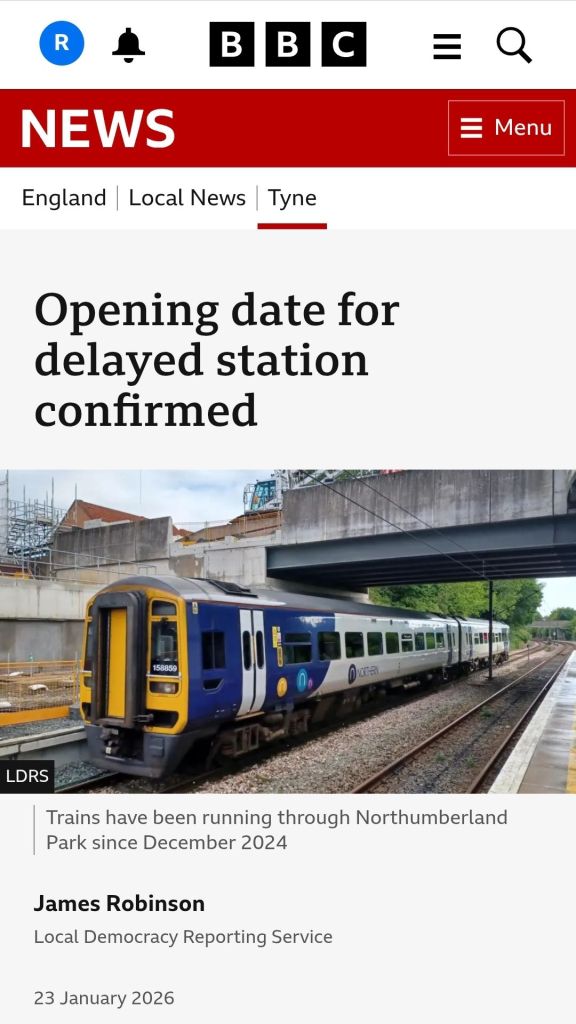
Northumberland Park station due to open on 22nd February 2026
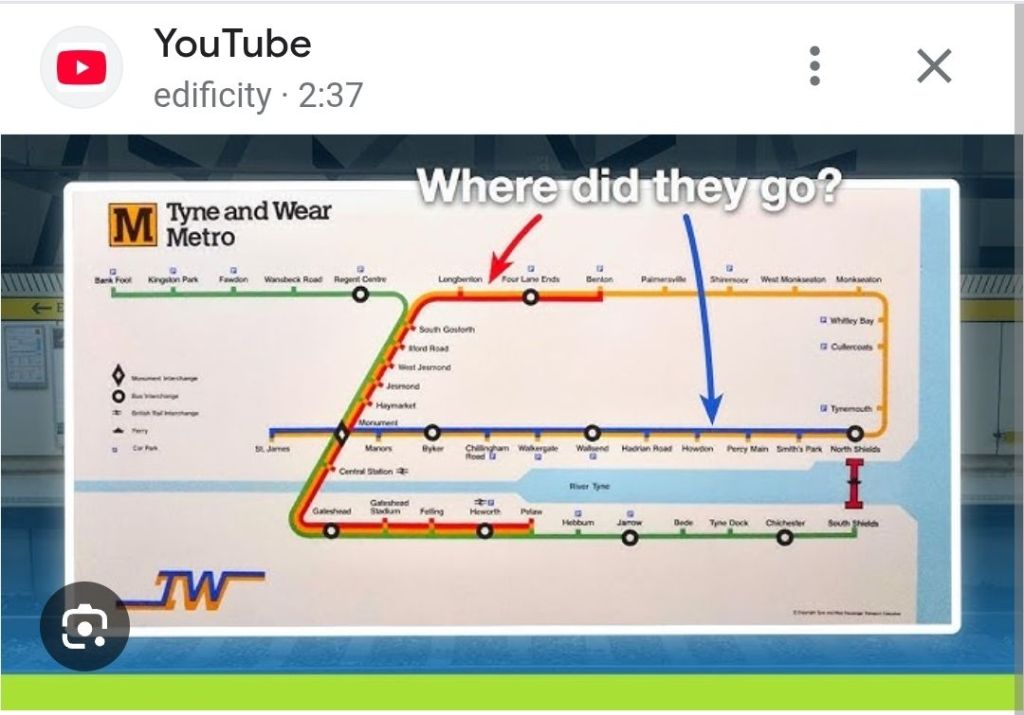
This station is likely to be very busy right from the start, with it forming a key connection between the Northumberland Line and the North Tyneside Loop, which is the Yellow line of the Tyne and Wear Metro.
Starting at St James, the North Tyneside Loop runs along the north bank of the River Tyne to North Shields, curves north through Tynemouth, and Whitley Bay, then back east through Northumberland Park to South Gosforth, where it turns south towards Central Station and across into Gateshead and away towards Pelaw, and South Shields.
This new interchange will make transferring from rail to the Metro more attractive for a great many journeys, as it avoids the current requirement to travel all the way to Central Station to interchange between rail and Metro north of the Tyne, which will save significant time on many current journeys.
The Northumberland Coast Loop would offer direct rail links between Northumberland Park, Alnmouth, Berwick Upon Tweed, and Edinburgh.
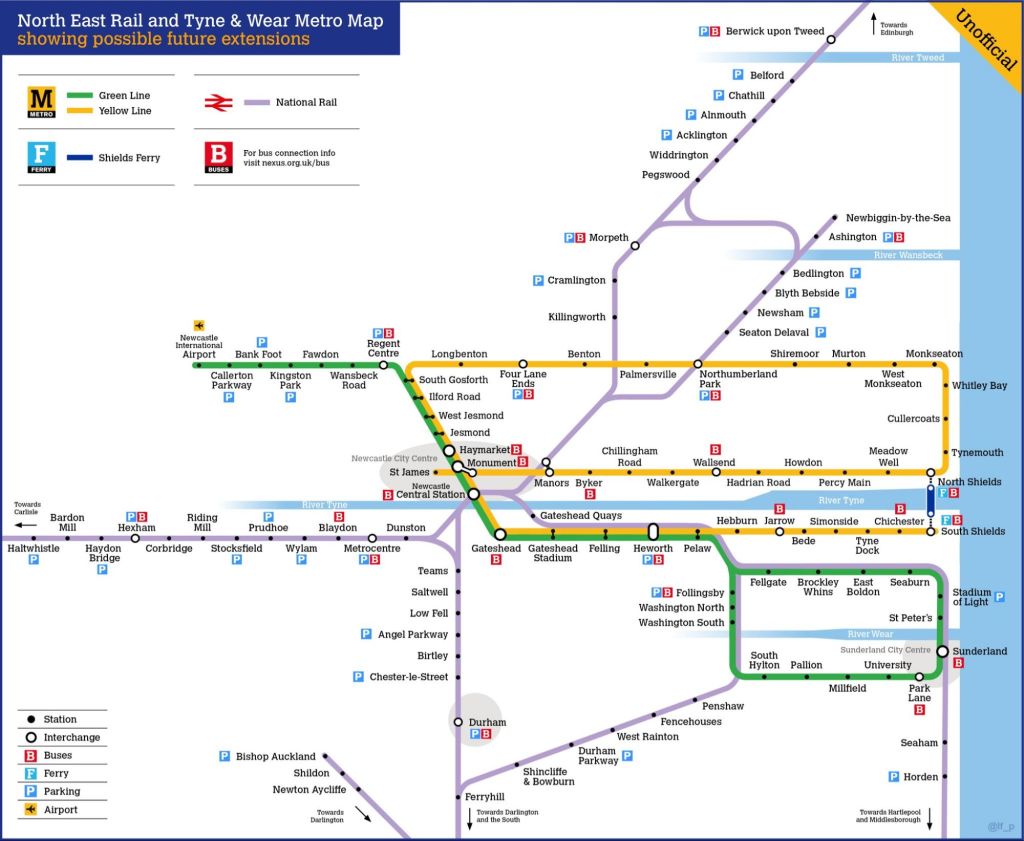
If the proposed Northumberland Coast Loop service (petition link here) was to be implemented, Northumberland Park could be directly accessed from a much wider area of Northumberland; as the map below shows, it is possible for trains between Newcastle and Berwick/Edinburgh to take two different routes between Manors and Pegswood.
The current ‘mainline’ runs via Cramlington and Morpeth, but a second route, via Bedlington, Blyth Bebside, Newsham, Seaton Delaval, and Northumberland Park is possible using existing track that is traversed regularly by railfreight; this would be a very modest expansion of the Northumberland Line that would also offer additional trains and seats on this busy line between Bedlington and Newcastle, easing current constrained capacity due to shortages of suitable units such as the Class 156/158 ‘Spinters’ used by Northern.
Rail and Metro Map of North East England
This latter route would make areas such as Cobalt Business Park, Silverlink, and North Tyneside generally much more accessible from North Northumberland and Scotland, which could promote both existing and new businesses to develop in North Tyneside, bringing more jobs and opportunities for local people.
Northumberland Park for Port of Tyne Passenger Links (DFDS Ferry and Cruise Terminals)?
Whilst not on the riverside itself, another important aspect of Northumberland Park would be it being potentially a much easier station to use to reach the Port of Tyne ferry terminal for the daily sailings to/from Amsterdam aboard DFDS ships King Seaways and Princess Seaways, with King having capacity for 1325 passengers, with the smaller Princess having capacity for 1250.
Presently, foot passengers (those travelling without a car), may currently use Central Station if travelling from places such as Scotland (for which Newcastle is the nearest port offering European ferry connections) as detailed in the video below from YouTuber Steve Marsh.
YouTuber Steve Marsh travels from Edinburgh to Port of Tyne via Central Station in early 2023.
In the video, it shows that a good number of passengers were using the DFDS special bus from near Central Station to reach the Newcastle Terminal for the ferry (approx 3 min into the above video), and a similar service from Northumberland Park to the ferry terminal should be even easier given the shorter distances involved in doing so.
For Europeans visiting the North East or wider UK via the ferries Newcastle, a quick and easy connection onto a regional train at Northumberland Park could make accessing the region without a car much easier and more convenient.
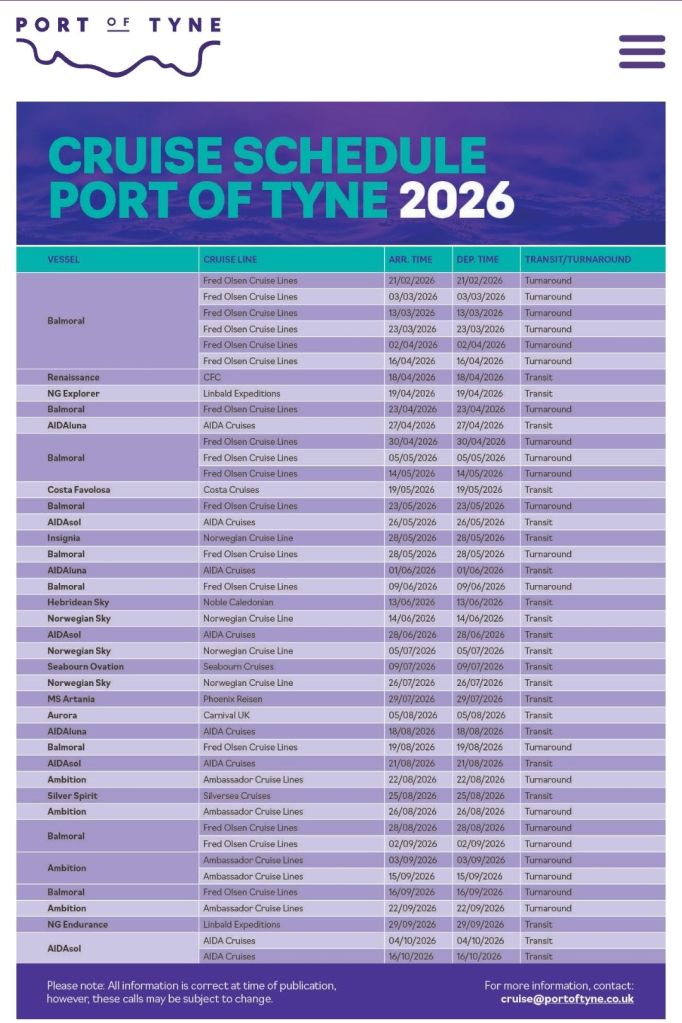
Cruises could similarly use Northumberland Park as ‘local’ mainline station for access to the North East more broadly; many, if not all cruises using the Port of Tyne in 2026 are calling for just a single day, presumably arriving early morning and departing in late evening, giving a limited ‘ashore time’ from departing the ship to getting back and boarding again bound for the next port of call.
Therefore, time spent travelling needs to ideally be minimised, and direct rail services from Northumberland Park could make a big difference; not just north into North Northumberland and even the Scottish Borders, but also west along the Tyne Valley, or south on the East Coast Main Line or down the Durham Coast.
For example, cruise passengers frequently visit attractions to the north such as Alnwick Castle, The Alnwick Garden, and Bamburgh Castle, and a rail journey from Northumberland Park to Alnmouth via Bedlington would likely be far faster than road coaches, with the option of using local coach operators for the ‘final mile’ for travel from railway stations such as Alnmouth to Alnwick.
Closer, smaller, and simpler station for easier connections?
Whilst Northumberland Park may first be advantageous from firstly being physically closer to the Port of Tyne terminals for both ferries and cruises, another factor could be its smaller size and simplicity being an advantage; with a single platform and smaller number of trains and routes (just the Northumberland Line at present, with Northumberland Coast Loop a potential second) it should be a far simpler station to use for those who perhaps are less familiar with rail travel or perhaps struggle in busy, noisy environments, especially those travelling ‘encumbered’ perhaps with luggage and/or children where simplicity and ease of use might assist using rail travel.
This compares well to the relative complexity of the twelve platforms at Newcastle Central and trains running on five different routes out of the city (ECML to Berwick, the Northumberland Line to Ashington, the Durham Coast to Sunderland, the ECML to the city of Durham, and the Tyne Valley Line to Hexham).
It is certainly possible that a Northumberland Coast Loop service may not terminate in Newcastle and could be extended on routes beyond the city, such as along the Tyne Valley (a precedent is the Northumberland Line trains now running direct to the MetroCentre on Sundays, with potential for Ashington to Hexham/Carlisle in the future perhaps?), but direct links onto the Durham Coast or ECML could be considered.
Northumberland Park for Newcastle Airport?
A long touted aspiration for change to the Tyne and Wear Metro has been a relatively simple one; to connect the Airport line to the North Tyneside Loop across South Gosforth Depot.
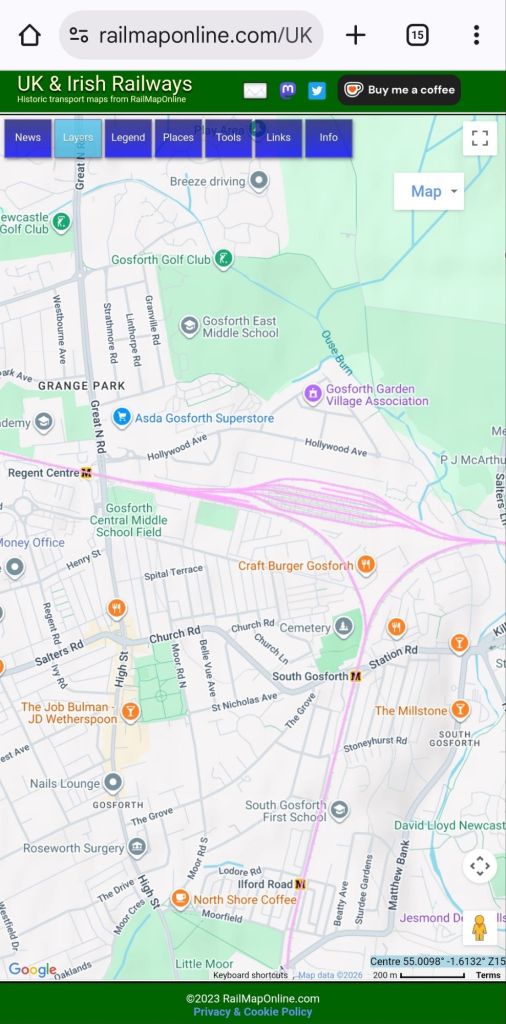
Rail Map Online image of South Gosforth Depot on the Tyne and Wear Metro showing the avoiding line
A triangular junction already exists at South Gosforth; there are the two main routes coming from the Airport and from Northumberland Park that both curve south and head towards Jesmond, and Central Station. The lesser known third side of this triangle of lines goes east-west across the northern edge of the depot; the Avoiding Line.
This east-west line allows a train departing from the Airport to travel easy directly to Whitley Bay, or vice versa go from the coast at Tynemouth through to the Airport directly. At present, this line is not in regular passenger use, but presumably could be with some relatively modest investment.
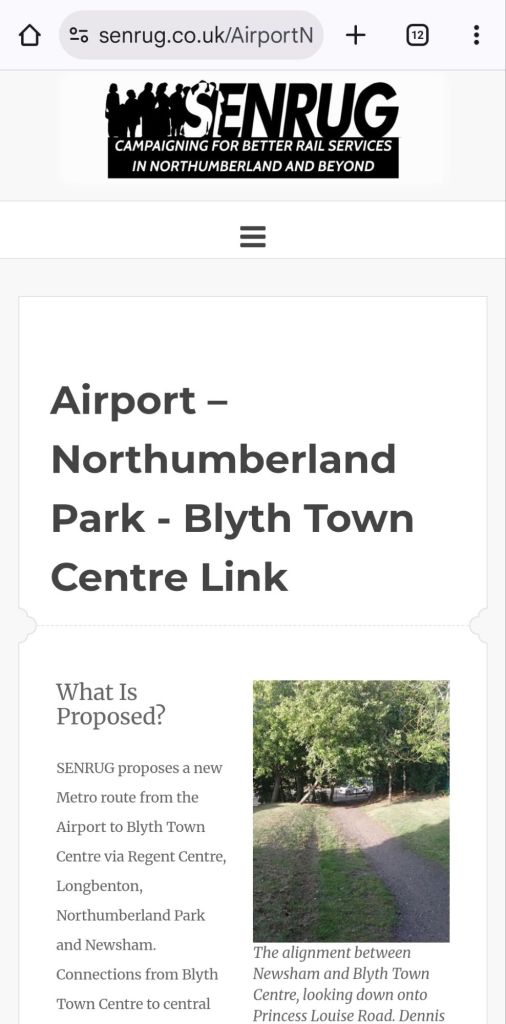
The main campaign calling for this is the SENRUG ‘Airport to Blyth Town Centre’, which would aim to rebuild the Blyth Branch into central Blyth, and then use Class 555 Metro vehicles from Newcastle Airport to Blyth Town Centre, presumably under battery power between Northumberland Park and Blyth.
In my view, wiring at the 1500v DC used by Metro on the Northumberland Line shouldn’t be done (as suggested in post below, hence the mention).
ONLY electrification at 25kV AC (mainline standard) should be carried out, which would allow a much wider variety of trains to operate over the routeunder electric power, and not constrain use of electric power to 1500v DC units such as T&W Metro Class 555’s.
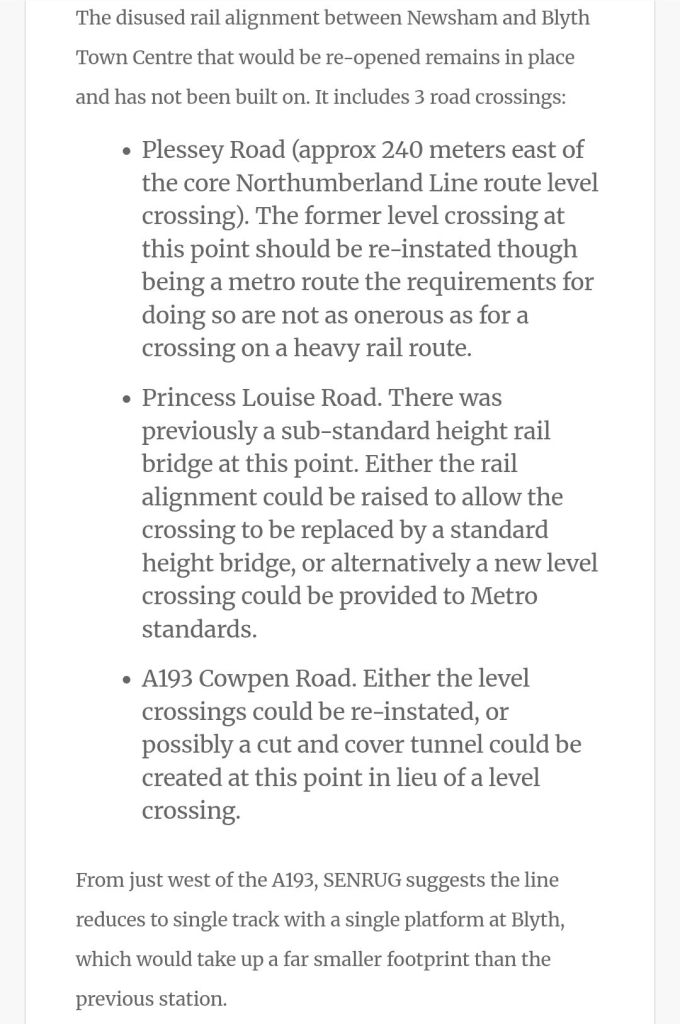
The three road crossings as identified on the SENRUG page.
In my own view, a branch into Blyth from Newsham is now highly unlikely to be rebuilt due to the three road crossings that this route would require, as well as massive disruption to active travel corridors linking several schools adjacent to the route. Rebuilding the railway would mean several foot crossings or bridges being needed to keep active travel routes crossing the old trackbed open and coupled to the major disruption to traffic that three level crossings in the town could cause both in building and in operation, I don’t think such a link is the correct course of action.
The Class 555 Metro units could, with sufficiently large batteries (or transformed into ‘Brian Johnson’ AC/DC dual voltage units with both 1500v DC ‘Metro’ (as currently, pardon the pun) + the addition of 25kV AC ‘Mainline’ power capability, if the line was wired to the 25kV AC standard of most other lines in the UK such as the ECML) work somewhere else on the former B&T routes, perhaps North Blyth/Cambois with a revival of the Blyth Ferry similar to the Shields Ferry on the Tyne, or maybe to/from Morpeth, but this would come with the drawback of using up limited line capacity that might be better placed being used by longer distance passenger services via Bedlington, or by railfreight if demand is required.
Keep the Metro’s on the Metty?
That being said, I fully back the proposal for the Airport to Northumberland Park connection, with my own suggestion being a new route being a direct St James to Airport via Tynemouth, which possibly could be a revival and extension of the Blue Metro line shown on old maps of the system back in the 1980’s (pre Airport line), which was done to highlight peak time shuttles on the St James to North Shields section of the North Tyneside Loop, but could easily wrap around Whitley Bay, then through Longbenton to Airport if this route becomes implemented?
With the relatively small change of a St James to Airport route, and with the Northumberland Coast Loop, Northumberland Park station could become an even more significant interchange between rail and Metro services, again offering a simpler connection than the present situation of either changing at Newcastle Central station, or changing Metro at South Gosforth station (with the need to cross the bridge there between platforms.
In summary, a new link on the Metro across the depot, plus the Northumberland Coast Loop could make Northumberland Park station a major connection in the rail network for access to international ferries, plus an easier link to Newcastle Airport?
Please watch the video below from Green Signals about the digital pay as you go trial by East Midlands Railway, but a system that could have clear potential in places like Northumberland where many smaller stations are unlikely to get the infrastructure seen at major stations like Newcastle Central.
Green Signals special on the Digital PAYG ticketing trial
An interesting aspect of the app based system as detailed in the Green Signals video is the lack of need to make investments into ‘ticket validators’, and as stated in the video, this trial was rolled out in just 10 weeks or so, thereby offering a quick AND cost effective solution for passengers?
It also states that this system is complimentary to other ticketing systems, including paper tickets, not a 100% replacement, but the more options available the better!
The N.B.A.B.E. is an acronym for the proposed Northumberland Coast Loop rail route, and is derived from the stations it will pass through en-route, the three letter station code is included in brackets after the station name.
Newcastle Central (NCL)
Bedlington (BEJ)
Alnmouth (for Alnwick) (ALM)
Berwick Upon Tweed (BWK)
Edinburgh Waverley (EDB)
The first section from Newcastle to Bedlington section is a large part of the highly successful Northumberland Line, passing through Manors, Northumberland Park, Seaton Delaval, Newsham, Blyth Bebside, and Bedlington stations.
The second section between Bedlington and Alnmouth has two variations of route that can be considered:
Option A: The preferred option for this campaign, is to use the existing and available route between Bedlington and Alnmouth via Pegswood. This is used regularly by railfreight carrying Alumina between the Port of Blyth and Fort William, and empty waggons coming back, as well as by occasional railtours, and some historical use for diversions too. This route could also serve a widely proposed new station at Choppington, which could better serve areas such as West Bedlington and Guide Post, Stakeford etc. A large part of this route would also be shared with proposed Newcastle – Morpeth – Bedlington rail services, so only the short section of line comprising of the Morpeth North Curve (Hepscott Junction to Morpeth North Junction) would be unique to this proposed route, every other section would be shared with other passenger services.
Option B: Put forward by others, would see new link created via Potland (the Butterwell Line) north of Ashington, which would join the East Coast Main Line (ECML) somewhere near the village of Ulgham, Northumberland by using some sections of old mineral line, now long disused, as well as some new alignments to create a link facing in the right direction, as well as improving linespeeds. This section has no firm proposals for any intermediate stations between Ashington and Widdrington as far as can be ascertained.
Challenges on this route would include a disused level crossing over the A1068 at New Moor to be re-activated or replaced by a bridge, and heavy engineering, particularly on the northern end to create a wholly new junction onto the ECML, as well as easing of very tight curves in an area constrained by a nature reserve, local roads and paths (again with level crossings), and a landfill site.
North of Widdrington, and south of Bedlington both proposals are otherwise identical, it is only the section between Bedlington and Widdrington that varies.
The third and final section from Alnmouth to Edinburgh is the existing and familar ECML route passing through Berwick Upon Tweed.
Route map showing the Bedlington to Pegswood route (Option A), whilst the ‘Butterwell Line’ from Ashington to Widdrington (Option B) is not shown. Map by P.
The case for linking the Northumberland Line to Edinburgh?
The Northumberland Line, from Newcastle Upon Tyne to Ashington, Northumberland has been a huge success since it opened in December 2024, in some respects almost too successful with some trains being so full that they are leaving passengers on the platforms, and some complaints from those aboard that trains are too full, many of which are two-car Class 156 or Class 158 trains.
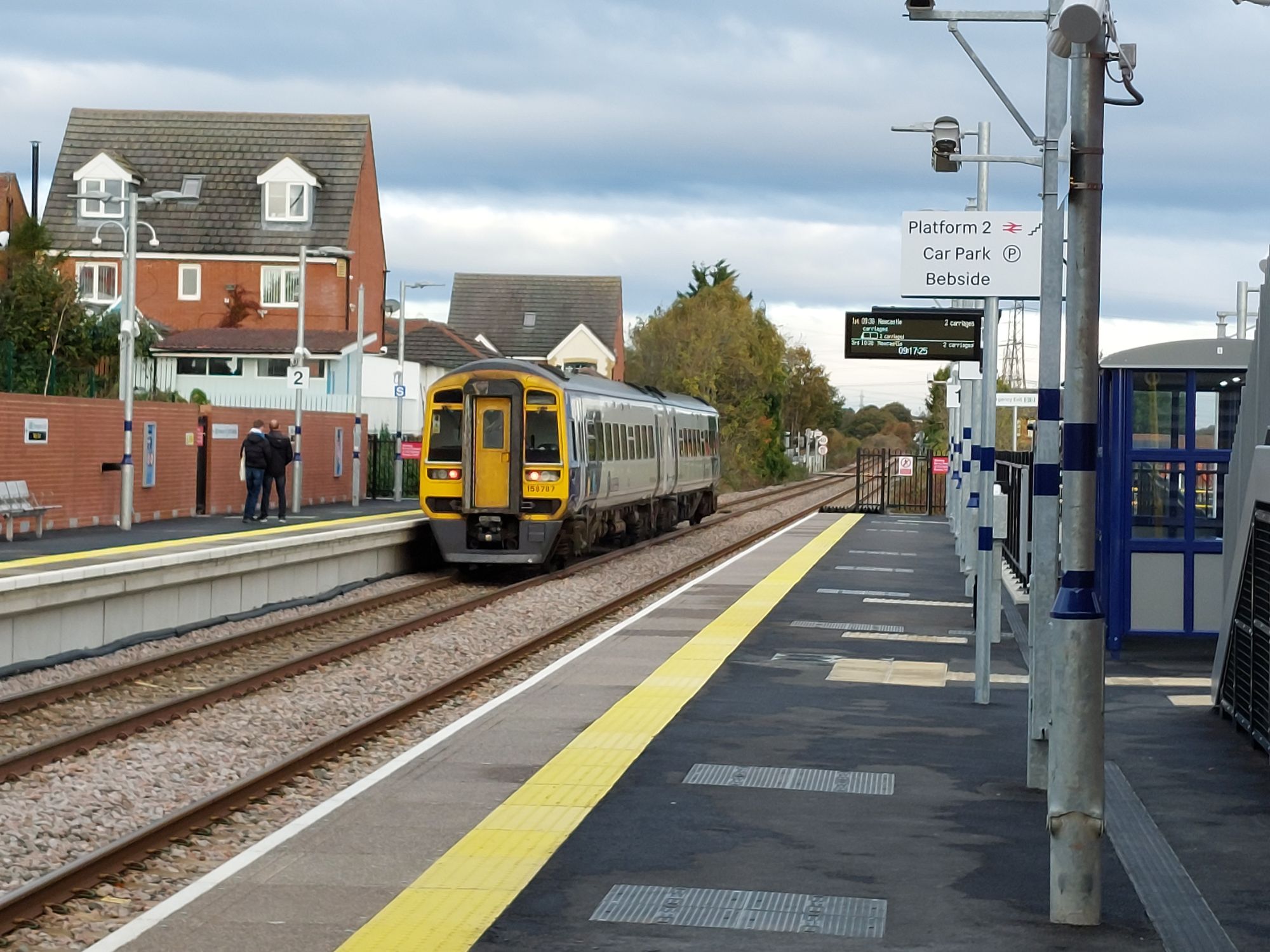
A typical Northumberland Line train of a two-car Class 158 at Blyth Bebside. (My photo).
These ageing British Rail ‘Sprinters’; Class 156 and Class 158 trains built in the late 1980’s and early 1990’s, are used all over the UK, means that not only they are in constant high demand, but they are also in short supply. Many other routes would like more of these units to operate longer trains, but with an old fleet, there won’t be any new carriages built now, and new trains to replace them will be several years away.
With the sourcing of additional ‘Sprinters’ or similar units very challenging, the solution this campaign is offering is to widen the range of rolling stock regularly running over the majority of the route.
There is a much broader range of trains running between Newcastle and Edinburgh via Cramlington and Morpeth, and potentially some of these could run via the Northumberland Line to boost seating capacity between Bedlington and Newcastle if using the N.C.L route via Pegswood (Option A), and also via Ashington if the new Potland link was built (Option B)
High speed diesel and bi-modes via Bedlington?
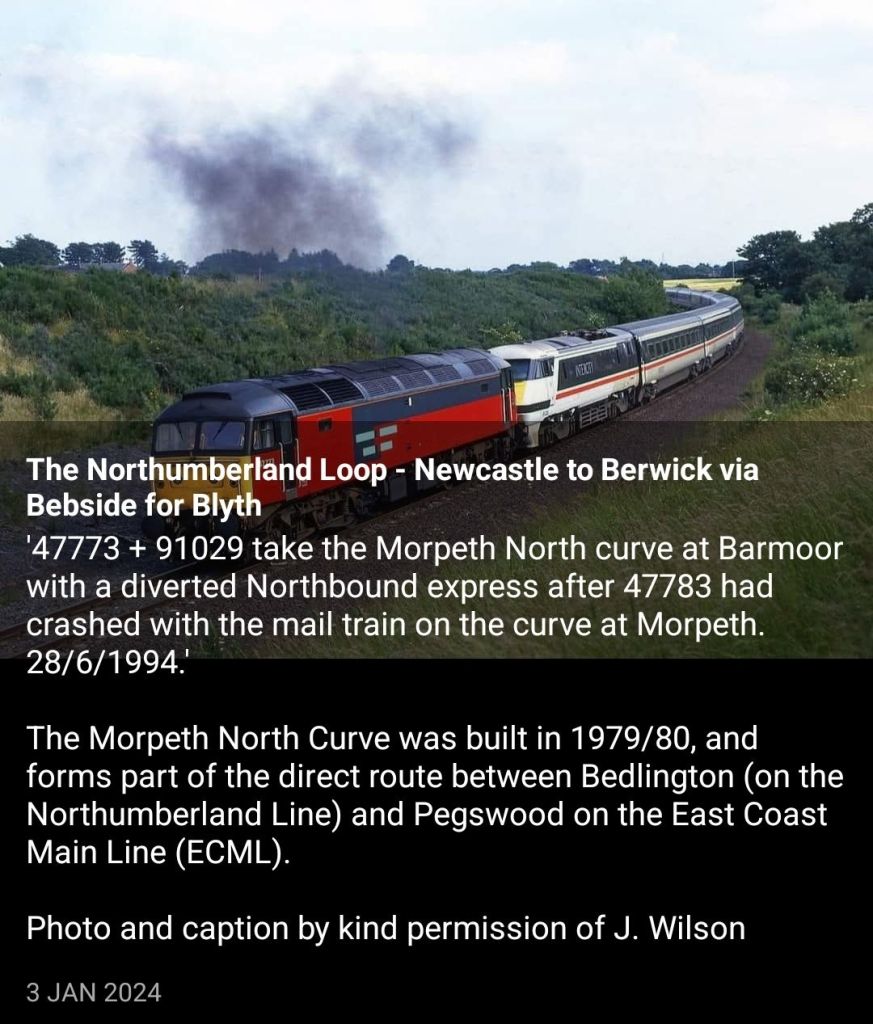
An obvious constraint of the old ‘Blyth and Tyne’ lines that makes up Northumberland Line and the connection via Choppington is the lack of overhead wires preventing 100% electric trains from working over the line without a ‘Thunderbird’ locomotive dragging them along the unwired section, as seen below in June 1994, where the red ‘Thunderbird’ diesel loco Class 47 ‘47773’ is dragging the Class 91 ‘Electra’ 91029 and carriages around the Morpeth North Curve at Barmoor.
Photo and caption by kind permission of J. Wilson
However, there are still many trains on the ECML that are running on diesel, either totally in the case of CrossCountry Voyagers Class 220), or partially for some bi-mode trains such as the TPE ‘Nova 1’ sets (Class 80x).
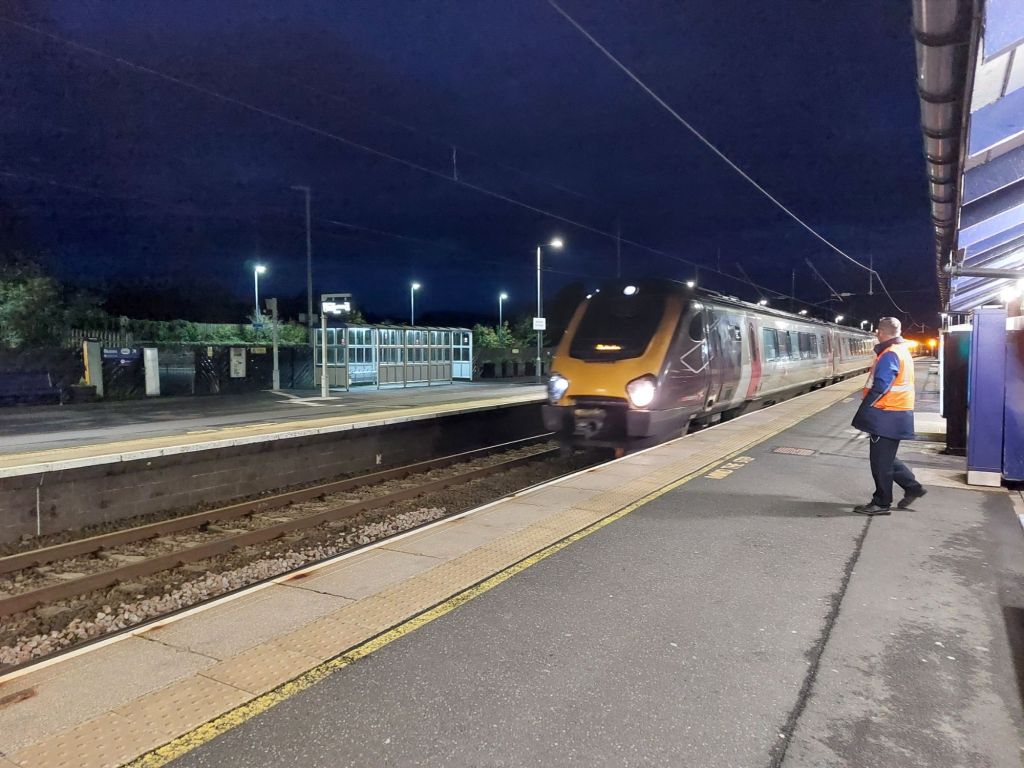
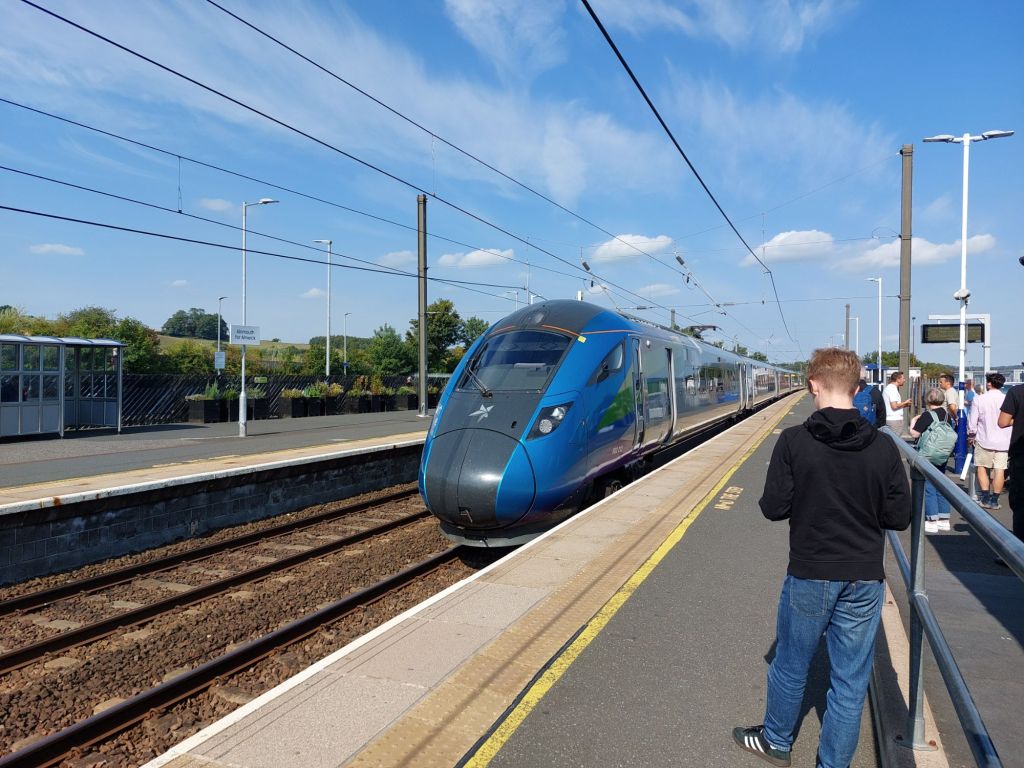
Diesel under the wires, a CrossCountry Voyager at Alnmouth statiom, a train easily capable of running via Bedlington on its own power. (My photo).TPE ‘Nova 1’ bi-mode at Alnmouth; part electric, part diesel = equally at home on both wired and unwired lines. (My photo).
The two types of train above tend to be relatively compact at four or five carriage lengths, so likely able to still fit the fairly short platforms on the Northumberland Line, but are also capable of much higher speeds (up to 125mph) than the somewhat ironically named ‘Sprinters’ that are amongst the slowest trains operating on the Newcastle – Edinburgh route, with a top speed of about 90mph, much slower than the Voyagers or Nova 1’s.
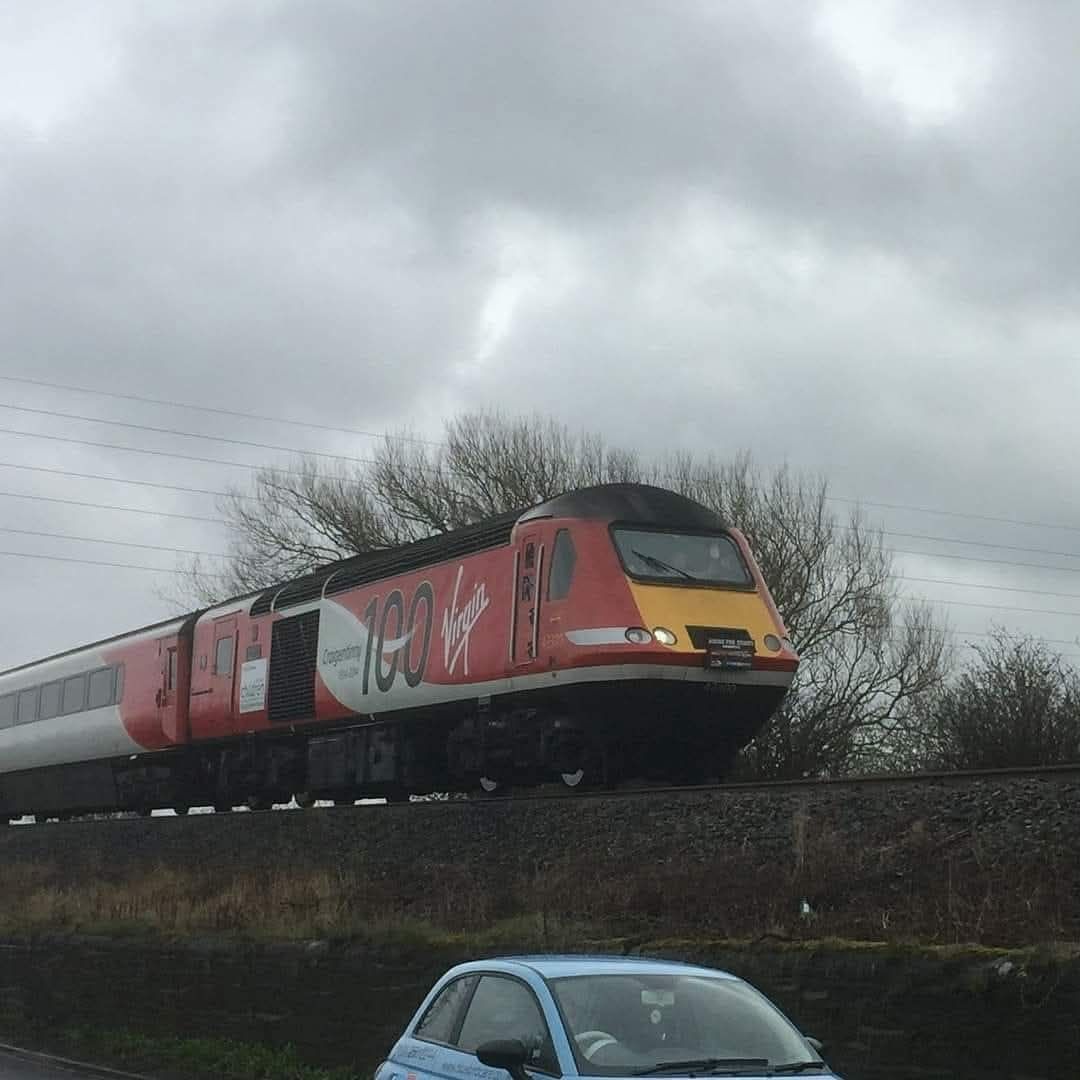
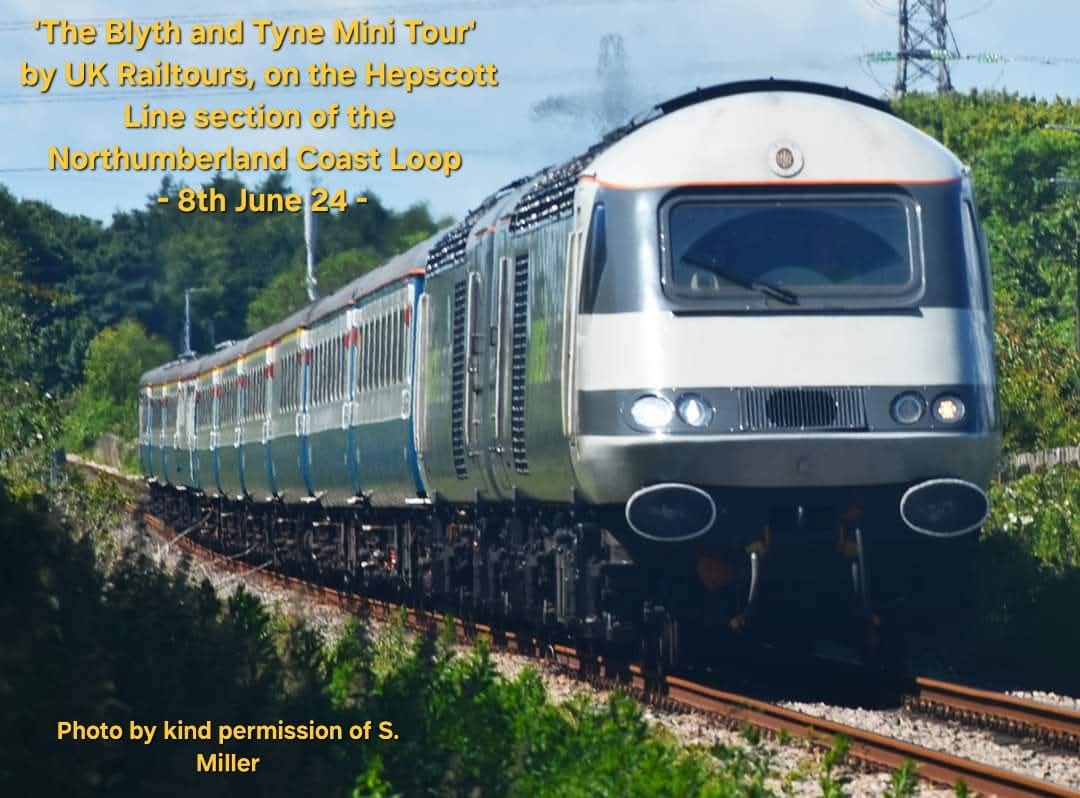
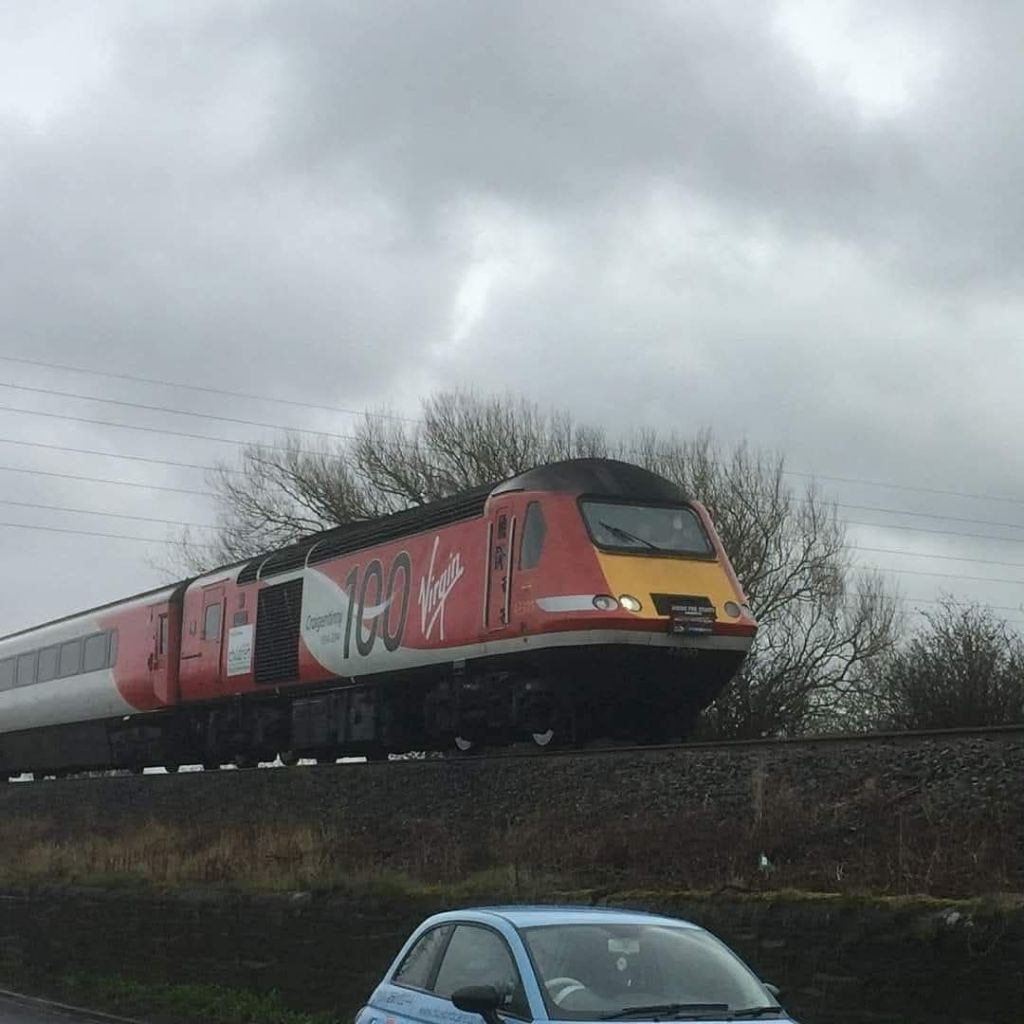
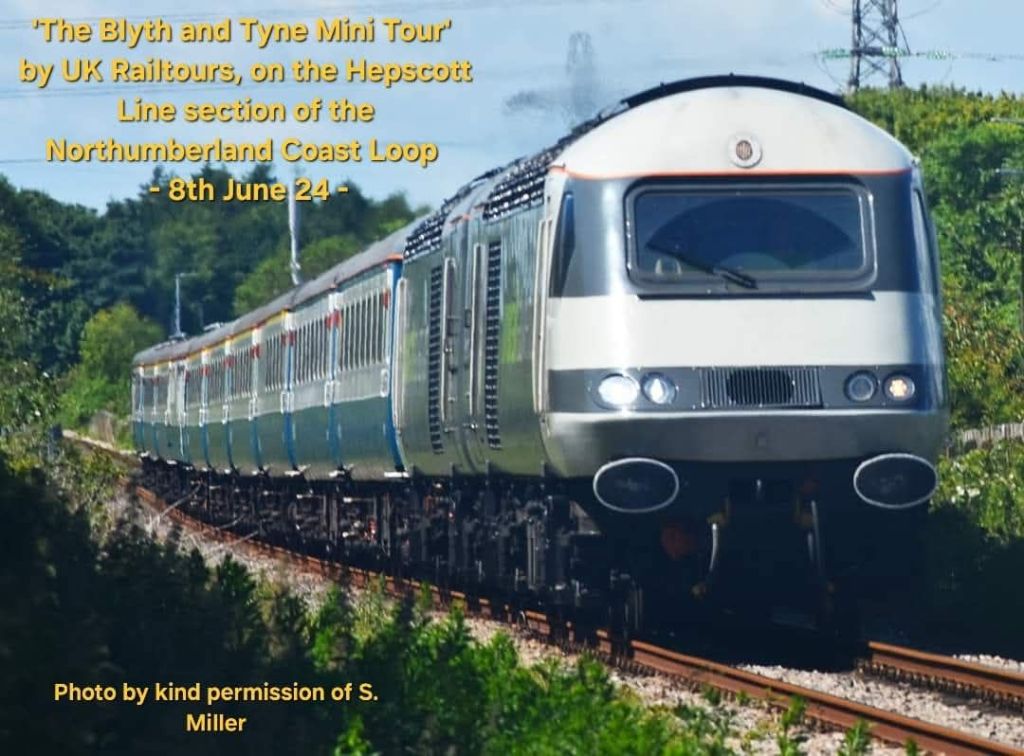
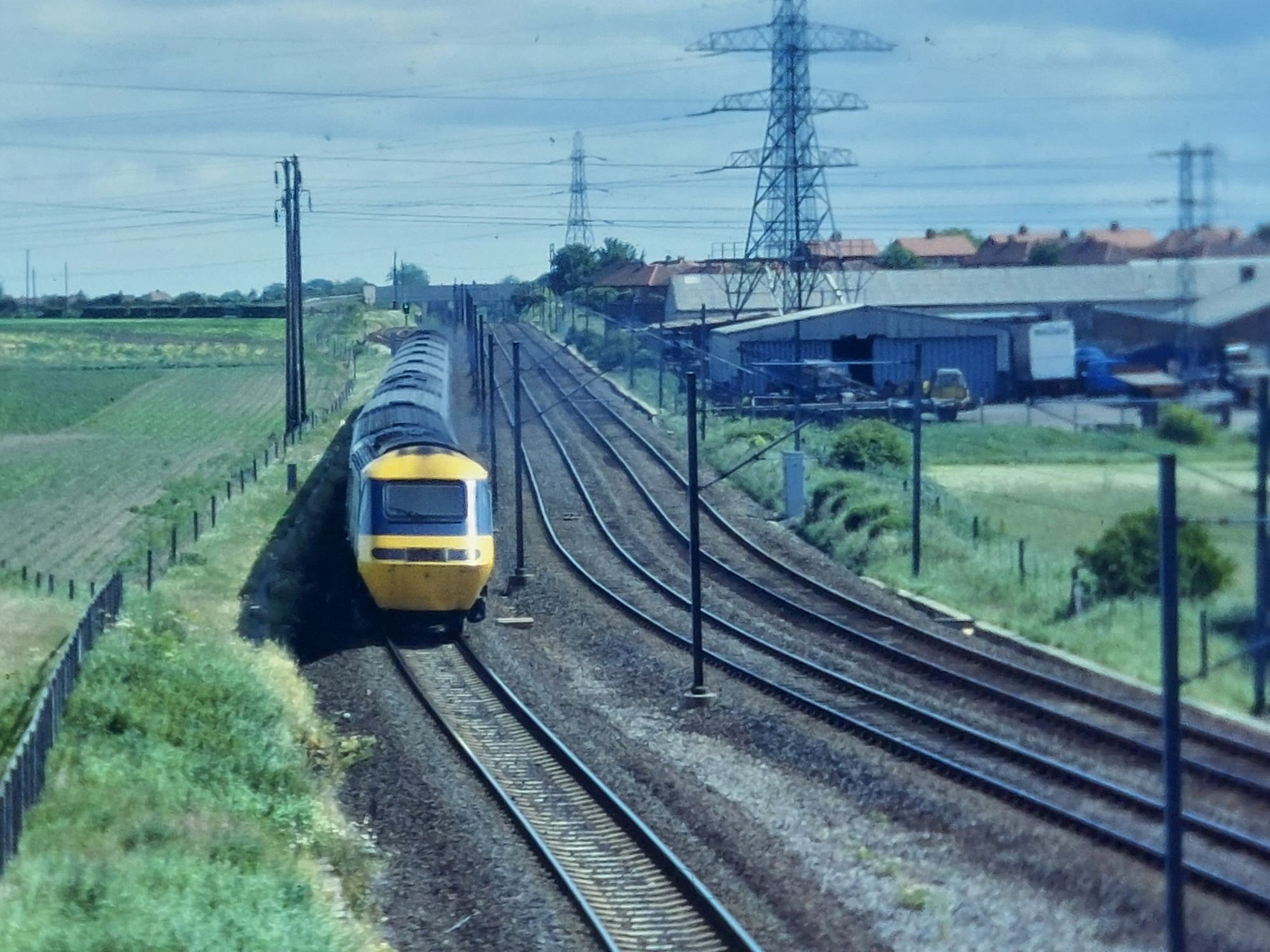
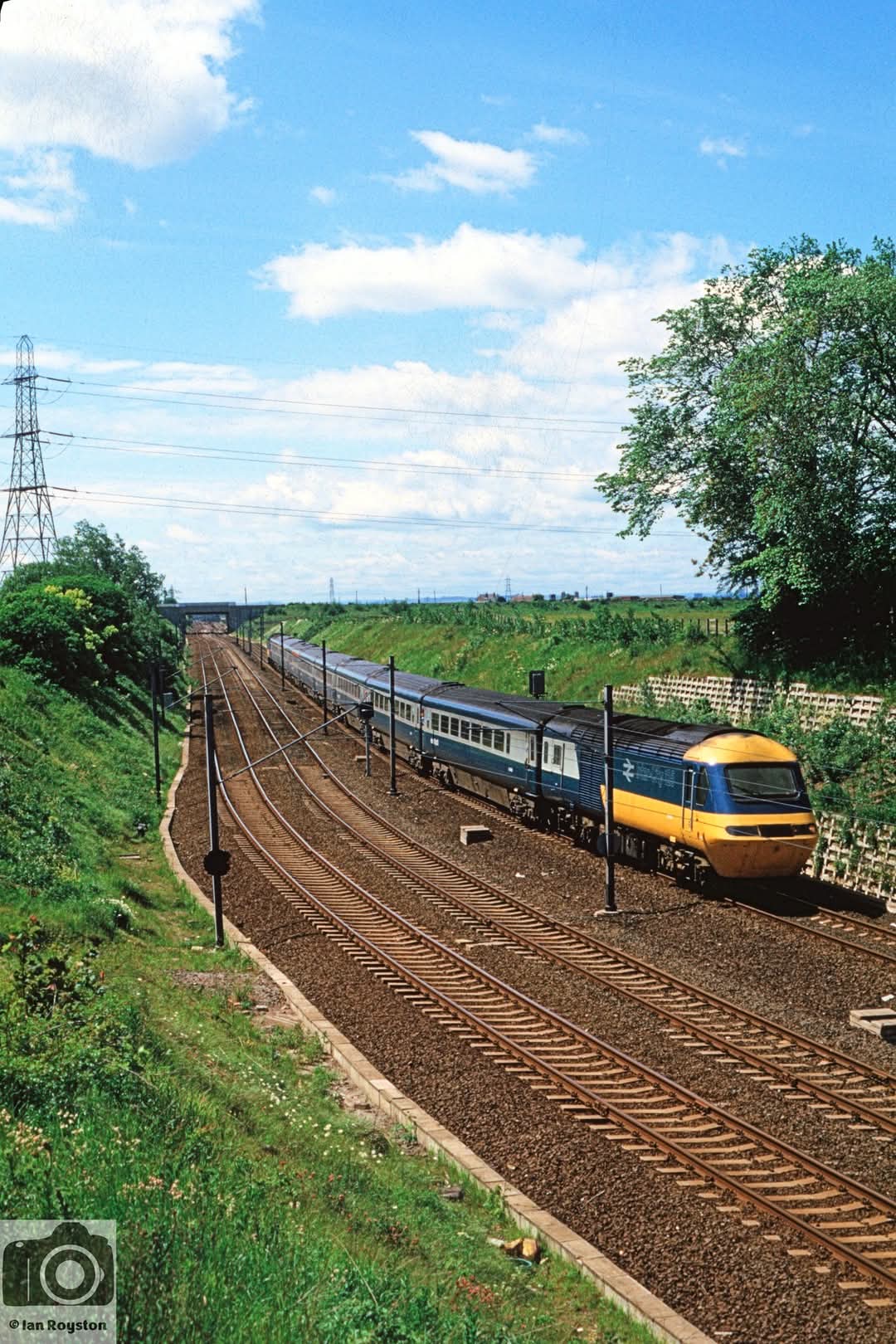
The routing of fast trains via Bedlington is far from unprecendented; with the HST (Class 43) seen below in 2017 on the ‘Bound for Craigy’ charity railtour, but on diversions in the 1980’s and 1990’s, HST’s were used in service via Bedlington.
The 2017 ‘Bound for Craigy’ railtour heads west towards Hepscott, seen here at Barrington Road, Bedlington. (My photo).A pair of HST power cars haul the ‘Blyth and Tyne Mini Tour’ by UK Railtours towards Bedlington in June 2024. (Photo by kind permission of S. Miller).
Due to Morpeth North Curve only being opened c.1980, these diverted or charter trains have only ever been able to pass through stations long closed or disappeared entirely, as all stations on the route closed in November 1964, at least fifteen years before the curve that enabled a direct route to or from the opened to traffic.
Support, and the case for the Northumberland Coast Loop
Had history been different in the 20th Century, and the now Northumberland Line stations had remained open rather than closing in 1964, I feel that it is highly likely that some direct trains to North Northumberland and Edinburgh would have been started long ago; sites such as the huge business park at Cobalt, as well as regeneration of towns such as Blyth and Bedlington would very likely have spurred this on, and it could have brought a major, positive economic impact to the area had it come to pass.
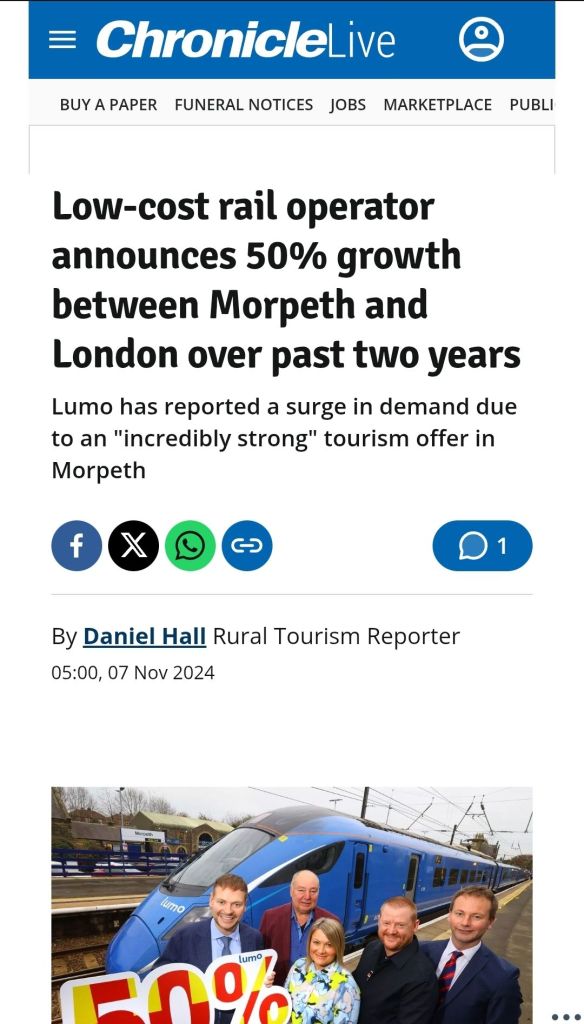
Indeed, other towns that have always been served by direct trains to both the north and south such as Morpeth or Berwick are shining local examples of places that have thrived through having good rail links around the UK, such as this example of LUMO serving Morpeth and seeing substantial passenger growth of 50% in two years.
Lumo brings 50% passenger growth to Morpeth from London.
In contrast, towns such as Bedlington and Blyth, having never had direct long-distance rail connections before, and losing their local ones in the 1960’s, have suffered greatly from demise of heavy industries that underpinned the local economies of these towns, a direct rail link between Newcastle and Edinburgh, with hindsight could have helped offset the economic decline of these areas by providing easier connections for new jobs, or helping bring greater inward investment. Now with stations reopening, now is the chance to sieze the opportunity to try a direct link?
Between the cities of Edinburgh and Glasgow, there are four electrified railway routes; the Falkirk Line, the North Clyde Line, the Shotts Line, and the Carstairs Line. If those two cities can justify four electrified lines, surely Newcastle and Edinburgh, as another city pair can justify going from just the ECML, to having the traditional ECML plus the N.C.L.? A short loop of line, that already exists, and asking for an InterCity service to run around the coast through SE Northumberland and North Tyneside is a modest suggestion for a second connection between the Scottish capital and Tyneside?
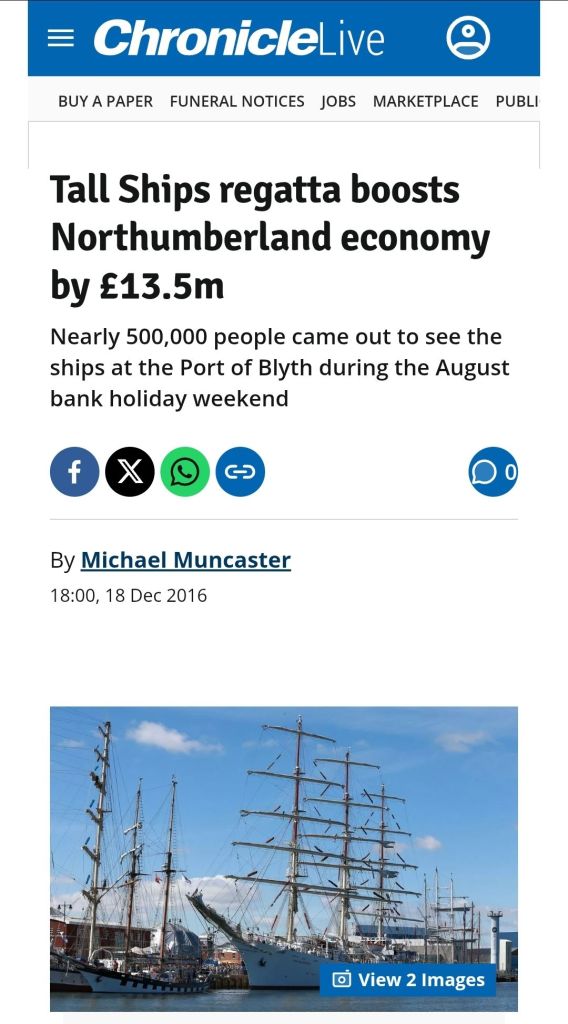
Adjusted for inflation, a similar event in August 2025 would be worth around £18.6m to the local economy, a repeat of this event, now that the Northumberland Line is open to passengers would likely bring even greater value as more people may travel to an event such as this from further afield.
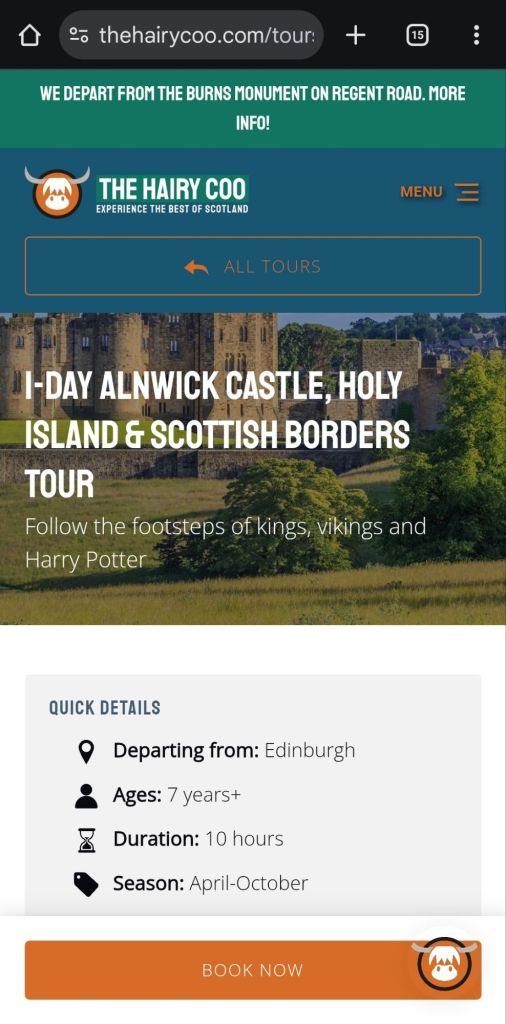
Northumberland has a great deal of tourism traffic coming from Scotland; Edinburgh based tour operators such as The Hairy Coo for example offer daily tours into Northumberland between April and October, which will only represent a tiny fraction of the overall tourist trade from Scotland into Northumberland.
A more direct rail route from Edinburgh, which is one of the largest tourism centres in the UK, could certainly benefit attractions such as Seaton Delaval Hall, Blyth Battery and more by putting them within a fast and easy connection from Edinburgh Waverley station.
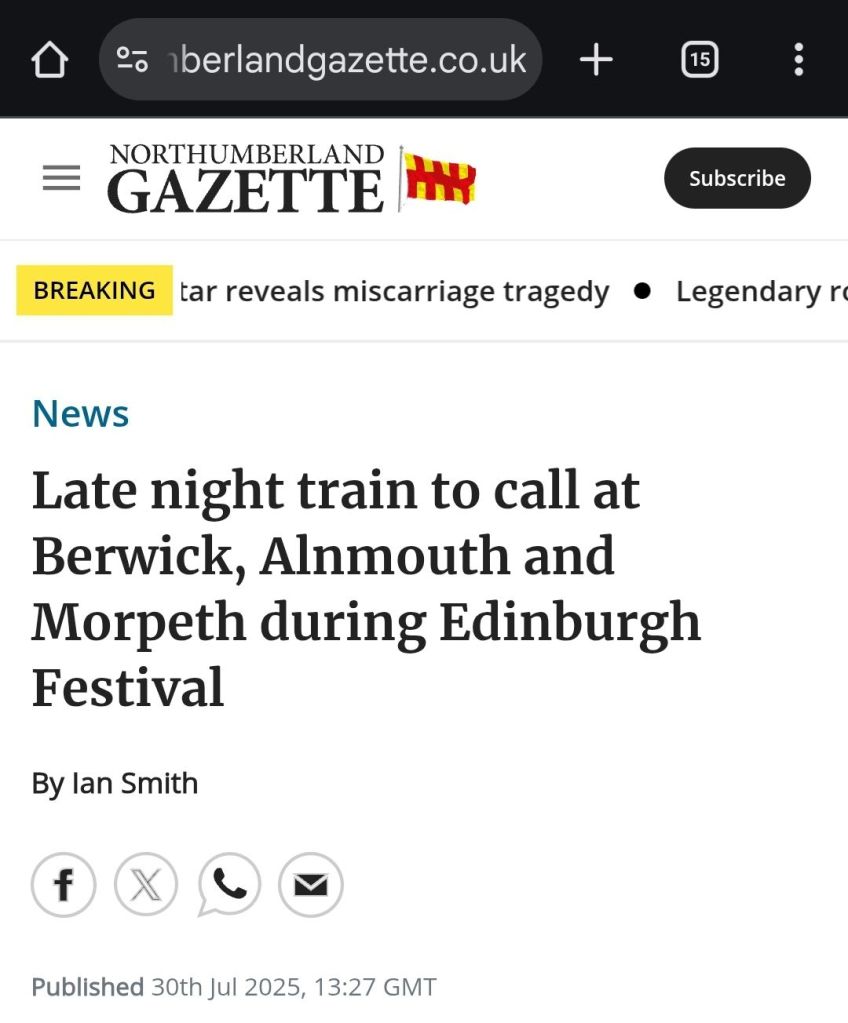
There is also the potential for towns such as Blyth to benefit from direct connections to Edinburgh during events such as The Edinburgh Fringe; it is not beyond possibility that a hotel stay in Northumberland could be combined with rail travel to visit The Fringe, as shown by the late trains run in 2025 from this article in the Northumberland Gazette, and with Blyth having hotels like The Commissioners Quay having opened in 2016, a direct rail link to Blyth could make hotels such as this more viable to visit cities such as Edinburgh, bringing more jobs and income into Northumberland from hotel stays.
Late trains back from Edinburgh during The Fringe, could towns like Blyth be connected in future?
A direct rail link via Choppington would significantly reduce journey times compared to the current ‘dog leg’ of connecting via Newcastle, with an estimated time saving of c.45mins due to avoiding the unnecessary travel south, as well as changing train in Newcastle Central.
The end to end journey times from Edinburgh Waverley to Newcastle Central is are fairly reasonable too, the route via Bedlington taking only around 30 mins longer than the current route via Cramlington, so it isn’t likely to deter people from using this route for end to end journeys either, especially if fares on the other route happen to be higher.
All in all, the route is possible now using the existing line via Pegswood and Choppington, and with the modest use of resources to allow some driver training to gain route knowledge, as well as trains being passed to run on the route, additional carriages could be operated quite quickly to alleviate crowding.
Hopefully something that can be taken forward by NCC and GBR?
A recent post from Northern, the DfT operator who runs trains on the Northumberland Line, has announced a competition (https://www.northernrailway.co.uk/offers/competitions) for those using the Northumberland Line to enter, presumably ahead of the millionth passenger travelling on the route.
This is a fantastic success for the line, with the predictions in some quarters of ridership likely to be disappointing (‘no one will use it’ or similar statements) thorough proven wrong by the immense popularity of the line thus far, a great combination of affordable fares and a great timetable, offering fast and frequent connections into Newcastle Central.
Call for more carriages echoed.
In this article from North East Bylines, ‘More good news on the Northumberland Line‘, the call by Northumberland County Council for more four carriage trains to work over the Northumberland Line on a permanent basis has been echoed by Rail Minister Lord Hendy of Richmond Hill, where he has asked Northern (an ‘operator’ that is part of the DfT operated railway, which also includes ‘operators’ such as LNER and Transpennine Express) to see what is possible to get extra carriages operating on the route.
Green Signals podcastdebates extra carriages call
This is likely to prove highly challenging, and was recently discussed in Episode 118 of the Green Signals Podcast with former RAIL Editor Nigel Harris, and former SRA Chairman and Chief Executive Richard Bowker, both with considerable experience reporting on, and being within the rail industry respectively.
You can view this episide of Green Signals below, with the section pertaining to the Northumberland Line starting just after 52mins in, but the whole episode is worth watching, and for me, has become weekly watching alongside the longer running Railnatter series by Gareth Dennis.
Green Signals Episode 118
There is indeed a valid point raised that Northern cannot take the blame for insufficient rolling stock for the level of demand, when passenger numbers are way in excess of predicted volumes, and they are doing the best that they can with strengthening services where they can.
Northumberland Coast Loop solution?
Our solution, that has long been put forward, is to use a wider range of diesel or bi-mode ECML rolling stock that currently operates daily between Newcastle and Berwick/Edinburgh via Cramlington and Morpeth to instead run some services via Bedlington, Blyth and Northumberland Park.
There could even be some potential to use charter stock such as loco-hauled carriages for such as route if other stock is unavailable?
The proposed route is a long-standing diversionary line avoiding Morpeth and Cramlington, but now with the reopening and huge success of the Northumberland Line, could become a secondary mainline between The Toon (Newcastle Upon Tyne) and Auld Reekie (Edinburgh)
A choice of two routes between Newcastle and Edinburgh along the Northumberland Coast (one via Cramlington, and the other via Blyth) could offer multiple benefits; it gives the obvious benefit of direct northward links from towns such as Blyth, as well as additonal train capacity to/from Newcastle if extra trains are operated alongside the existing Northumberland Line services, but also gives the network greater resilience in the event of disruption.
A good example of this was during October 2023 when Plessey Viaduct suffered a partial parapet wall collapse, closing one line completely to trains, and the other working at a much reduced speed. Had this event been a more significant structural problem, it may have resulted in the total severing of the East Coast Main Line (ECML) between Newcastle and Edinburgh, and may have seen the ‘Blyth and Tyne’ route via Blyth (the proposed Northumberland Coast Loop) come into use once again.
Using the route regularly has advantages in that drivers become more experienced at this alternative route (much like occasionally driving different routes between home and work to keep you familiar with it), as unlike driving a car, a train driver needs to gain ‘route knowledge’ by being accompanied by another driver for a period of time to learn it, and then regularly drive it to maintain that knowledge.
This route knowledge is vital to operate a train safely; knowing the speed limits on different sections of track, where crossings are, where signals and junctions are etc, meaning that a train can safely run on a route. Drivers need to know how much braking distance is needed for example to safely stop before a signal protecting a junction, so that they don’t pass a red signal (at danger in railway parlance) and damage equipment, or worse, be involved in a collision.
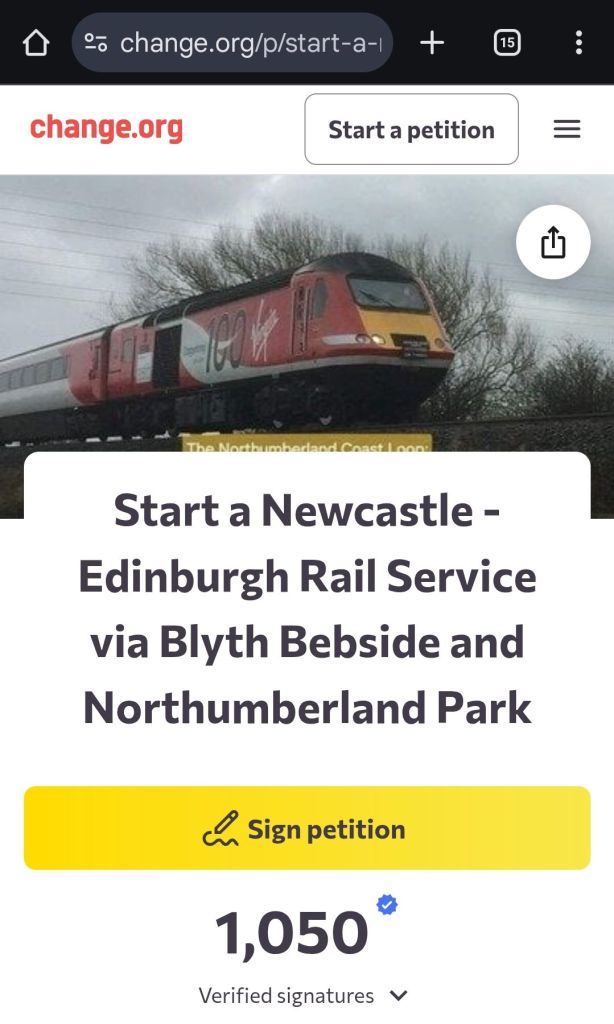
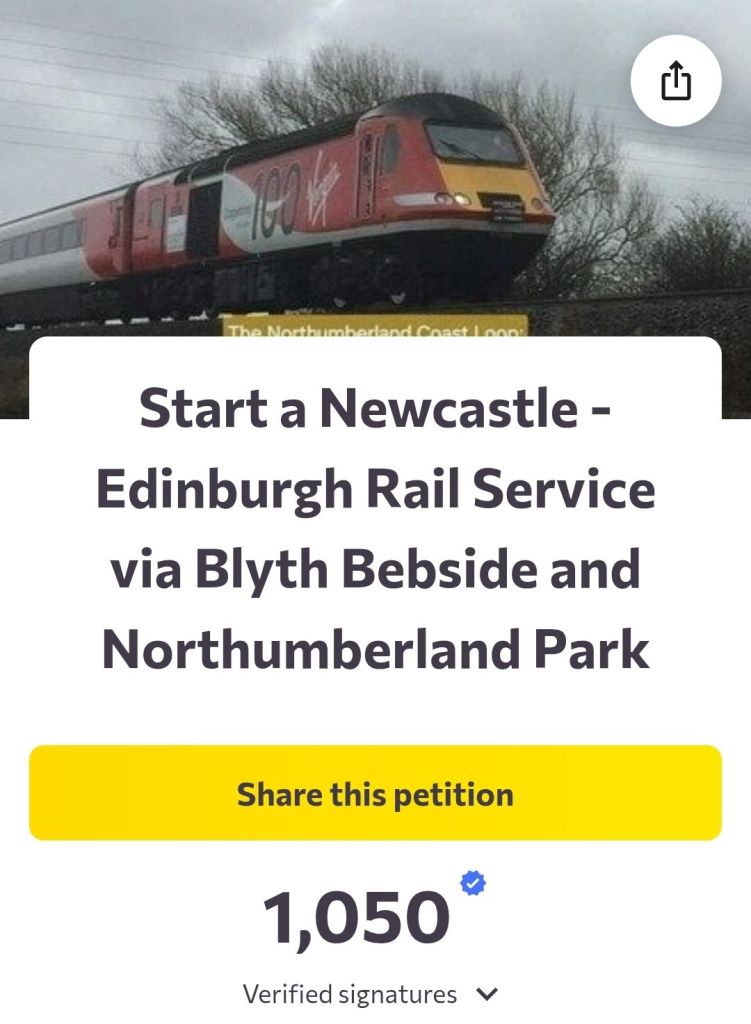
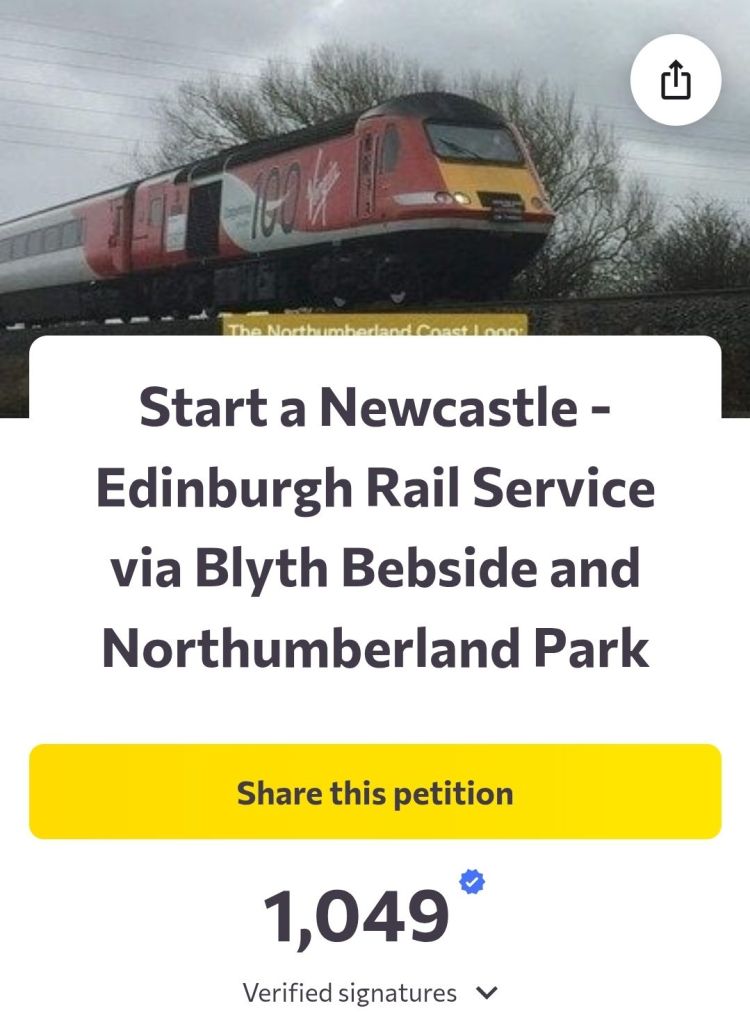
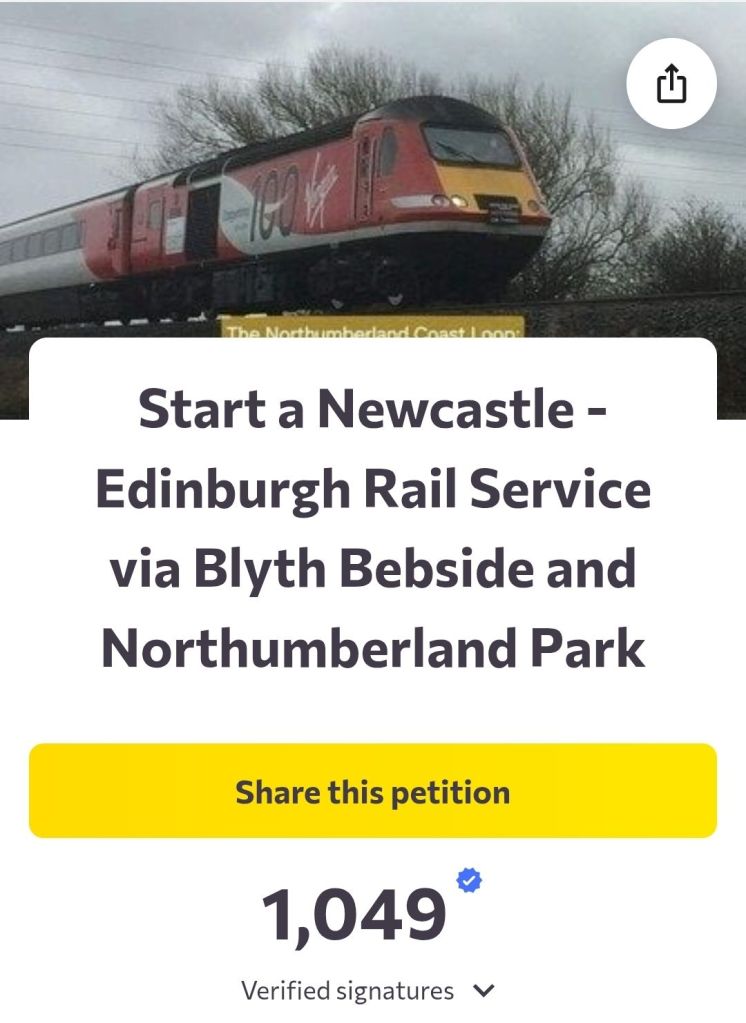
1050 signatures as of 10.1.26, thank you to all who have supported it so far!
This route could assist the capacity of the Northumberland Line ahead of opening to Newbiggin by the Sea by giving additional capacity on the ‘core’ section of the Northumberland Line between Bedlington and Newcastle, meaning that the local trains that could be already fairly full by time they reach Blyth would be augmented by longer distance services running over the route, offering more seats to/from Newcastle, but also potentially easing the number of people who might be making a connection via Newcastle to head northwards by rail.
Connections to or from the north via Newcastle is potentially a significant number of journeys given the relatively low cost of travelling into Newcastle by rail compared to driving and parking, or being driven in a taxi to a station such as Morpeth, and it would be interesting to see the ticketing data to see what percentage of the near million trips made on the Northumberland Line is composed of this market, for myself, I have made a number of trips to/from Northumberland Line stations from my own local station at Alnmouth, a sample of which are shown below.
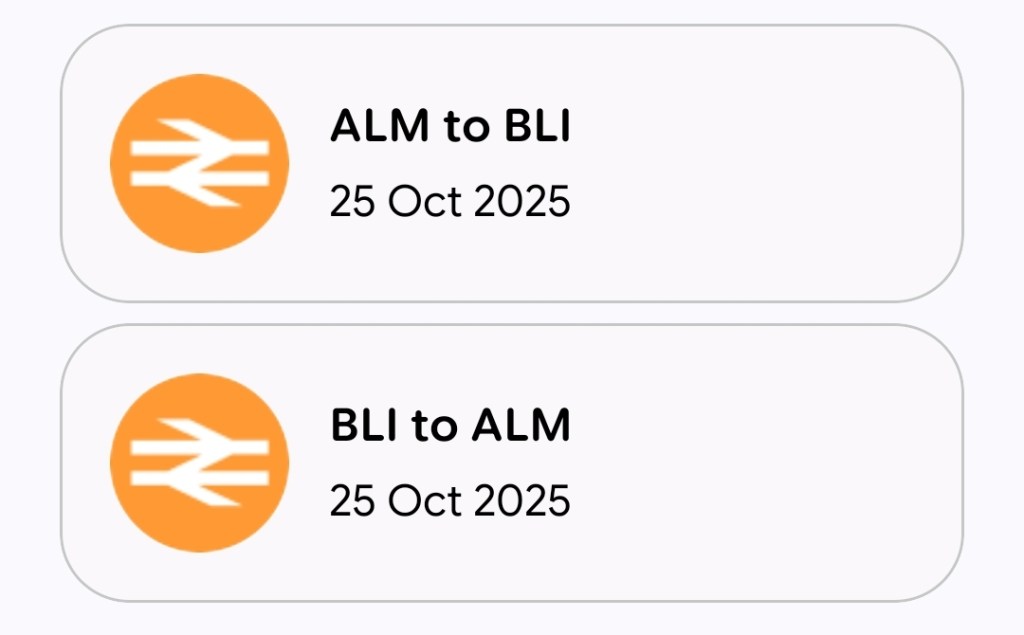
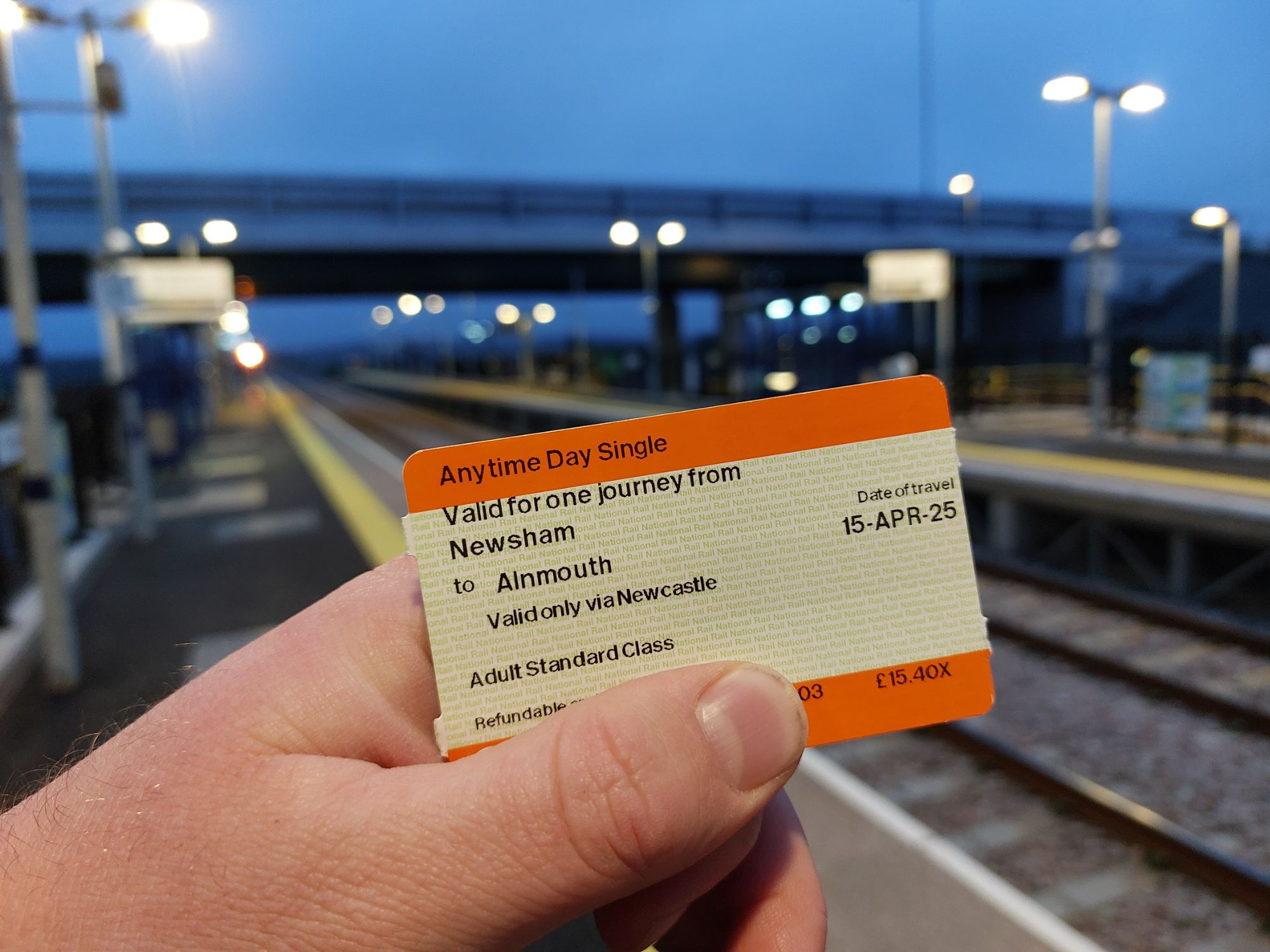
Tickets bought online for an Alnmouth to the then newly opened Blyth Bebside on 25th October 2025. A single trip from Newsham to Alnmouth on 15th April 2025, bought from the station ticket machine.
From anecdotal evidence such as speaking to friends and colleagues at work, I’m far from the only person making such trips, with one couple from Blyth for example travelling to Edinburgh via Newcastle for a short break by rail.
Again, there should be ample data, given nearly a million journeys to/from Northumberland Line stations to determine the scale of this market, but one that could grow given a single seat route, as direct trains are generally preferred over changes of trains by many passengers, as can be seen from article below with references to services calling at Cramlington.
Whilst the Northumberland Coast Loop doesn’t directly call at Cramlington station itself, it could still be of benefit to the wider town of Cramlington, as Blyth Bebside would be in each reach of the town, and offer direct connections to the north from there, or via Northumberland Park, again in easy reach from Cramlington.
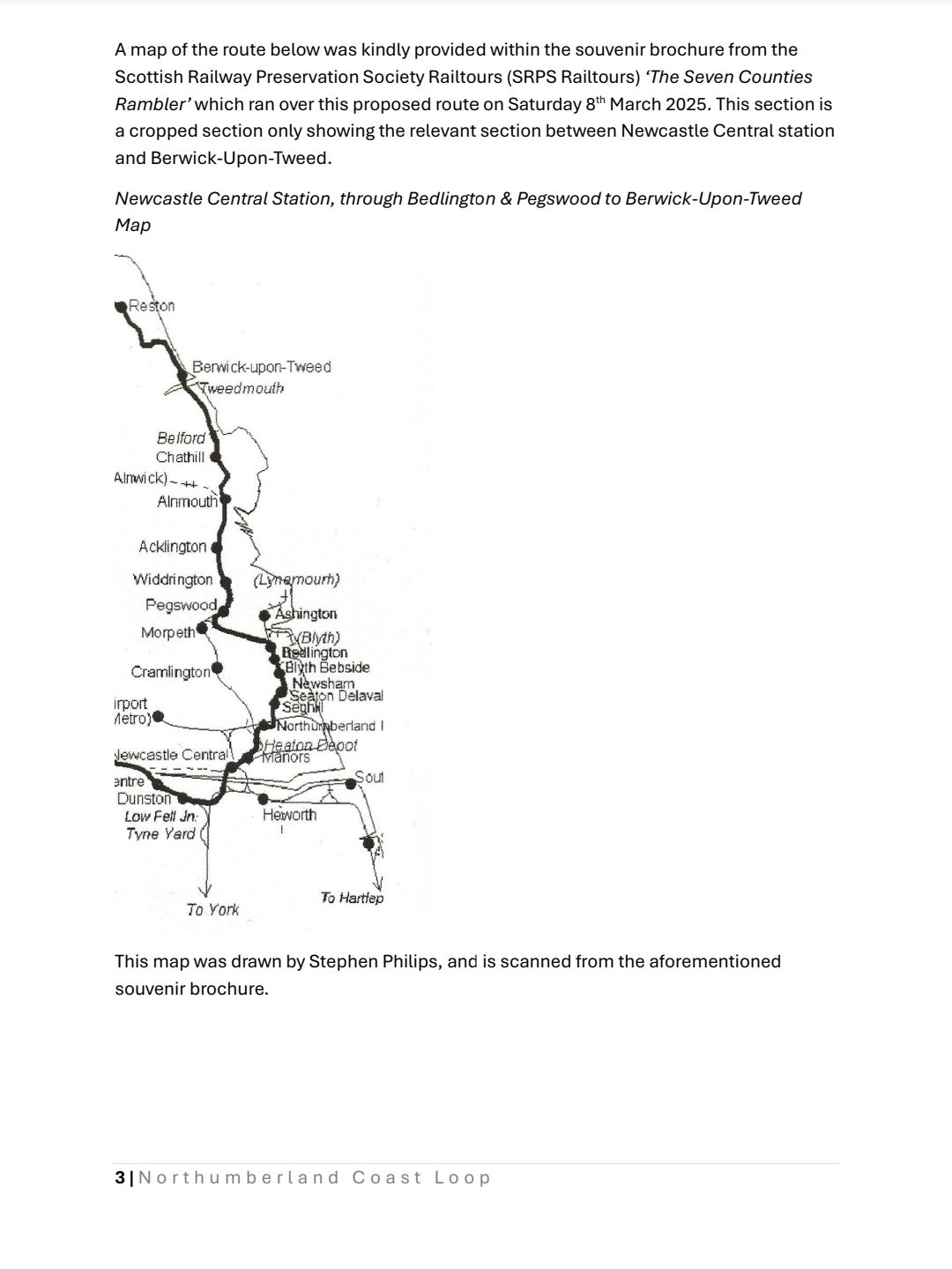
As can be seen below, this is a route that can be implemented very quickly with the political will to do so, with my own trip almost a year ago on board ‘The Seven Counties Rambler’ attesting to this, where the final leg of this long-distance circular tour going from Newcastle to Edinburgh via Bedlington on 8th March 2025.
To quote from the article; ‘In the letter to Cllr Sanderson, seen by the Local Democracy Reporting Service, Lord Hendy wrote: “My officials at Rail North Partnership (RNP) have now instructed Northern to identify whether any permanent reallocations are possible. Northern is also in discussions with other operators to see what suitable rolling stock they may have available to increase capacity ahead of Northern’s new train fleet entering service in 2030.”‘
Different trains on the Northumberland Line alongside Northern 156’s & 158’s?
Of this quote, one line is particularly interesting from our campaign’s perspective: ‘Northern is also in discussions with other operators to see what suitable rolling stock they may have available to increase capacity ahead of Northern’s new train fleet entering service in 2030.’.
This suggests that trains from other operators may well be seen on the Northumberland Line, assisting the Northern Class 156 & 158 trains currently used. One option is for these extra trains just to ply up and down to Ashington, but train lengths would be limited by the bay platform at Ashington, where trains would need to reverse.
The Northumberland Coast Loop solution to improve Northumberland Line capacity issues?
A second option, and one that has now been floated for some years, indeed predating the Northumberland Line itself opening, is that a large part of the route from Newcastle to Bedlington can be part of a new through route between Newcastle and Edinburgh.
Taking a northbound train as an example, leaving from Newcastle, it could run up the line as far as Bedlington, before leaving the Northumberland Line heading west, and travelling along the existing freight line through Hepscott, then, at Hepscott Junction, curving back north, and travelling around the c.1980 opened Morpeth North Curve to rejoin and head towards the Scottish Border on the East Coast Main Line (ECML) into North Northumberland and Scotland.
Route map of railways and the Tyne and Wear Metro north of the River Tyne and along the Northumberland Coast, showing the two potential rail routes between Newcastle and Edinburgh.
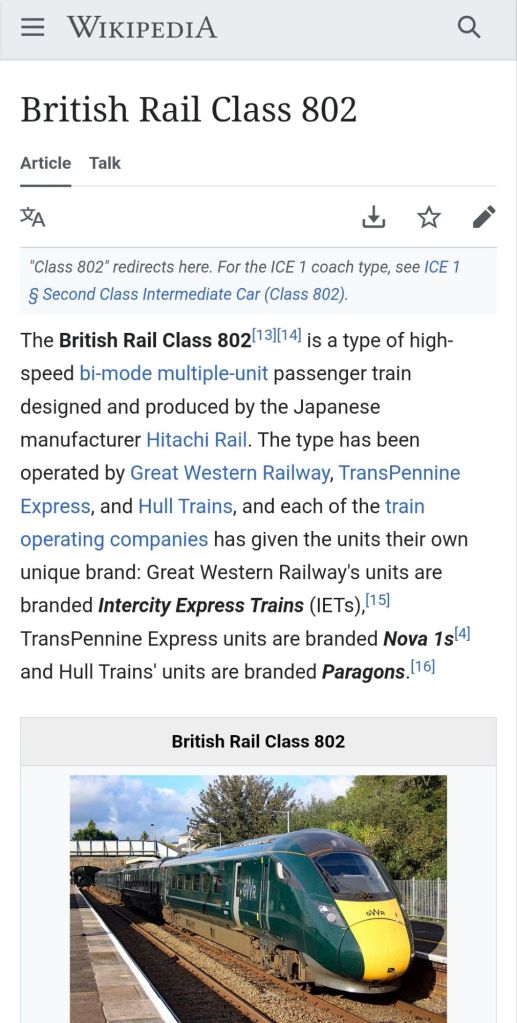
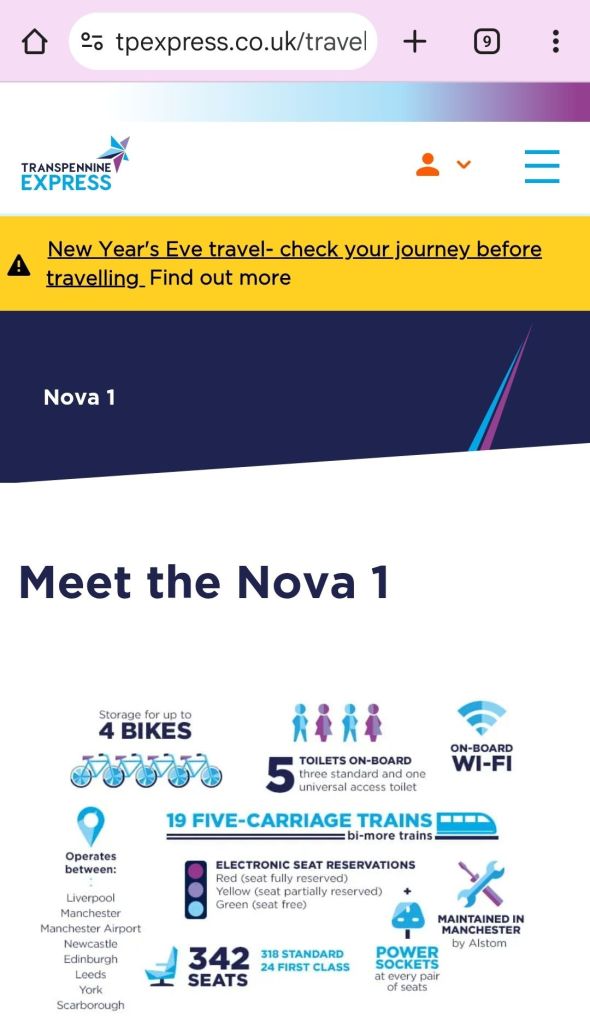
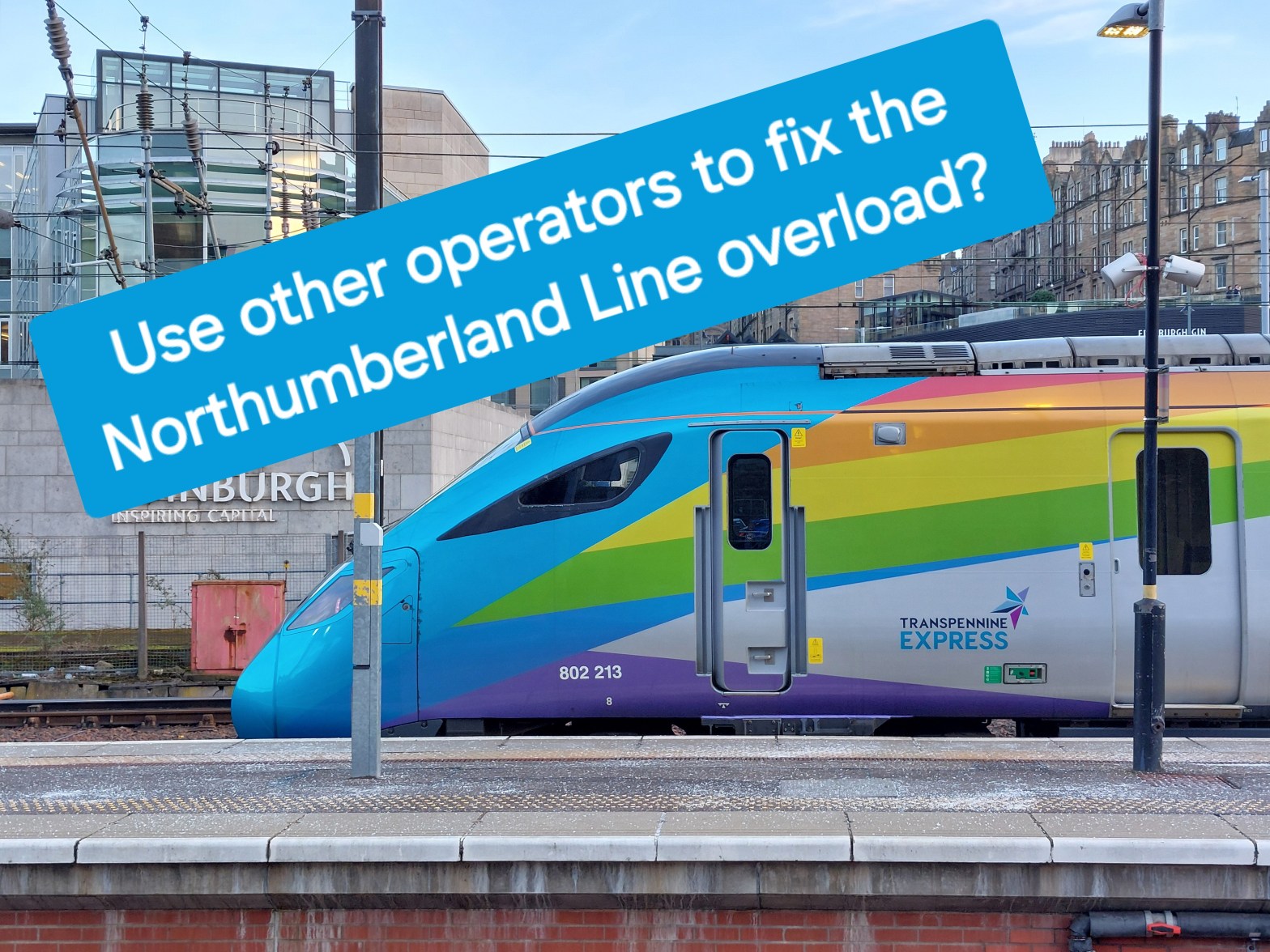
Indeed, I wrote an email to Cllr Sanderson yesterday, ahead of seeing the above article, to reiterate the advantages of the Northumberland Coast Loop route, with an example given being the Transpennine Express ‘Nova 1’ (Class 802) trains being used on a Newcastle – Bedlington – Edinburgh route, with each train having 342 seats in total, comprised of 318 in Standard Class, plus 24 in First Class, though this is not the only type of train that could work over this route.
This compares favourably with two-car Class 156 trains, which have between 146 and 152 seats, so even when working in four-car sets, have a maximum of 304 seats, 38 less than the Nova 1 trains. The Class 158 trains have an even smaller seating capacity for a two-car set, with between 138 and 142 seats each, and working as a set of four carriages having just 288 seats.
Working of longer trains over the Northumberland Line, and stopping at platforms shorter than the train itself is not a major issue, as many modern trains can selectively open doors, so that only those safe to exit or enter to or from the platform will actually be opened. An extreme example of this is Beauly, near Inverness in Scotland, where even for two-car Class 158 trains operated by ScotRail, only one door is opened to allow passengers to board or exit from the very short 15m (49ft) long platform.
Different liveries but one operator behind the scenes
It is also worth noting that an ever increasing number of the ‘operators’ are effectively integrated behind the scenes, as LNER, TPE and Northern are all run directly by the Department for Transport (DfT), and have been for a number of years, so whilst a red LNER train, the silvery blue of TPE, and the dark blue and white Northern liveries, and associated staff uniforms on each train look different, the underlying operator for all of them is the DfT.
A good parallel to this is high street bank brands; Natwest is one recognisable bank brand, but is fundamentally at a higher level is the same bank as Royal Bank of Scotland, and Coutts, them all being a part of the Natwest Group.
This means that it is in the hands of the DfT, directly controlled by the Government, to decide to operate Newcastle to Edinburgh TPE or LNER trains over the proposed Northumberland Coast Loop route, but doing so has wider advantages than just increasing the capacity of the railway between Newcastle and Bedlington, Blyth Bebside, Newsham, Seaton Delaval, and Northumberland Park.
Faster journeys between SE Northumberland and the North (North Northumberland and Scotland)
The Northumberland Coast Loop route is faster by virtue of going directly between North Northumberland and SE Northumberland, avoiding the additional travel time and distance of going beyond the destination into Newcastle, awaiting a change of train, and back-tracking up the Northumberland Line to reach the end destination, as well as avoiding the often slow bus services that connect poorly at Morpeth station.
Better rail connections beyond just the Northumberland Line, whilst itself brilliant for the area will also help to further boost the local economy, bringing in new businesses, or making existing ones more attractive.
Resilient railway routes
A wider advantage is also the resilience of the railway as a whole; using this route regularly would maintain driver and crew knowledge of this already recognised diversionary route, which while not used in the event, was highlighted with the structural issues seen with Plessey Viaduct in October 2023, which had it been more severe, could have seen the ECML totally severed between Newcastle and Morpeth, but the route via Bedlington could have carried some traffic between Newcastle and Edinburgh to maintain a connection.
With the line at present little used, it can be presumed that few train drivers will hold route knowledge over it, but with a route running regularly, and the behind the scenes integration of the railway ongoing, perhaps all, or most Newcastle to Edinburgh drivers could, in time, be trained on this diversionary route, and drive it periodically to keep their knowledge fresh and ready in the event of any disruption?
The Northumberland Coast Loop route would likely be a very similar success; a low risk by using the existing rail link between Pegswood and Bedlington with the potentially high reward of well-filled trains to boost the local economy significantly, even a trial would be surely worth a chance in 2026 given the vast volume of passengers seen on the Northumberland Line, and the reputed success of the Sunday extensions to the MetroCentre from Ashington, perhaps a Sunday N.C.L. service could be a way to test the water on this proposal?
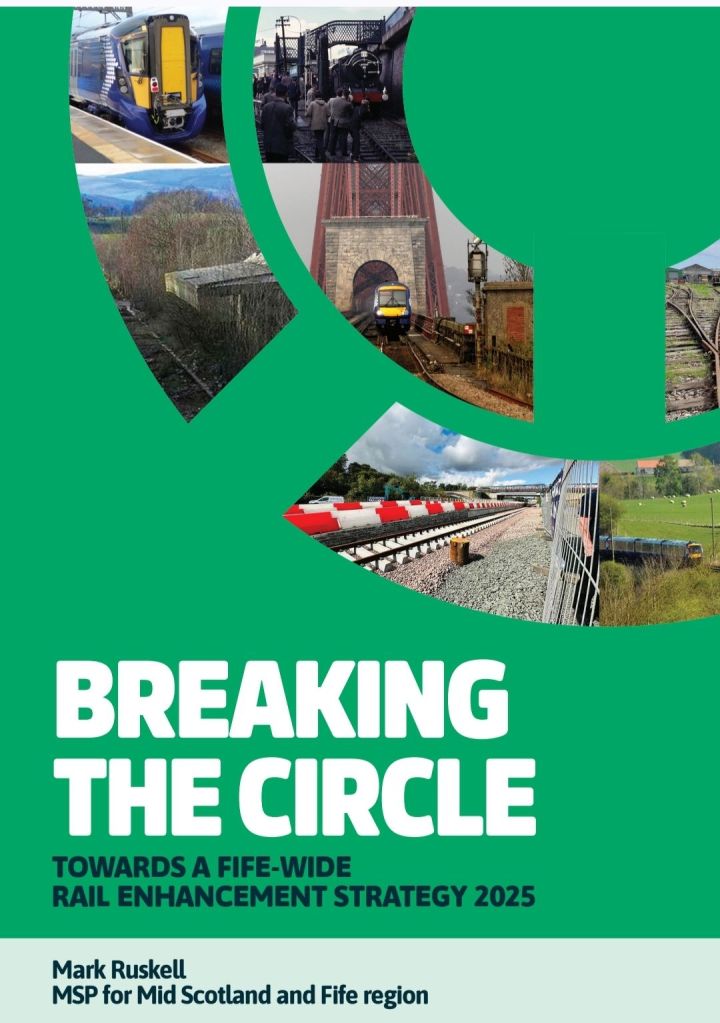
An interesting report from The Scottish Green Party about rail investments in the Fife area of Scotland, certainly food for thought for rail campaigns in Northumberland and wider UK…
A year of the Northumberland Line; not enough trains…yet?
A recent post by NEPTUG ‘One full year of new Metros and the Northumberland Line.’ discusses the success of the Northumberland Line to date, with the millionth passenger soon to be expected, and talk of extension to Newbiggin by the Sea, whilst two of the stations are still awaiting opening (Bedlington, and Northumberland Park), and the line suffers at certain times from severe overcrowding, especially with short two-car Class 156/158 units being provided to carry the vast numbers wishing to travel.
The use of the line being far greater than was originally anticipated, means that the rolling stock that is available isn’t enough to meet times of peak demand, and additional units of the type used to/from Ashington are not easy to source from elsewhere, with fleets of Class 156/158 needed to run routes around the UK.
This is why some Northumberland Line trains run with only two carriages; there is a shortage of that type of train nationally, but the Northumberland Coast Loop potentially offers a solution, by using other types of train over a large part of the route to augment the existing services.
It could be said that extension to Newbiggin without running more and longer trains on at least the Northumberland Line would add to the overcrowding issues, trains would fill at the northern end of the line, leaving no space further south, as is already experienced at stations like Seaton Delaval.
Our proposal is that more trains should run via the Northumberland Coast Loop route, making more seats available and therefore adding to the capacity of the line to carry passengers, which is outlined below…
There is more than one route to travel by train between Newcastle and Edinburgh…
As can be seen from the route map below, from Newcastle there are two routes towards Berwick (and Edinburgh) that are possible, one is well established route via Cramlington and Morpeth stations, whilst the other, less well known route is the Northumberland Coast Loop route, running via Northumberland Park, Seaton Delaval, Newsham, Blyth Bebside, and Bedlington, before cutting back across through Hepscott, and rejoining the mainline headed towards Pegswood and destinations north.
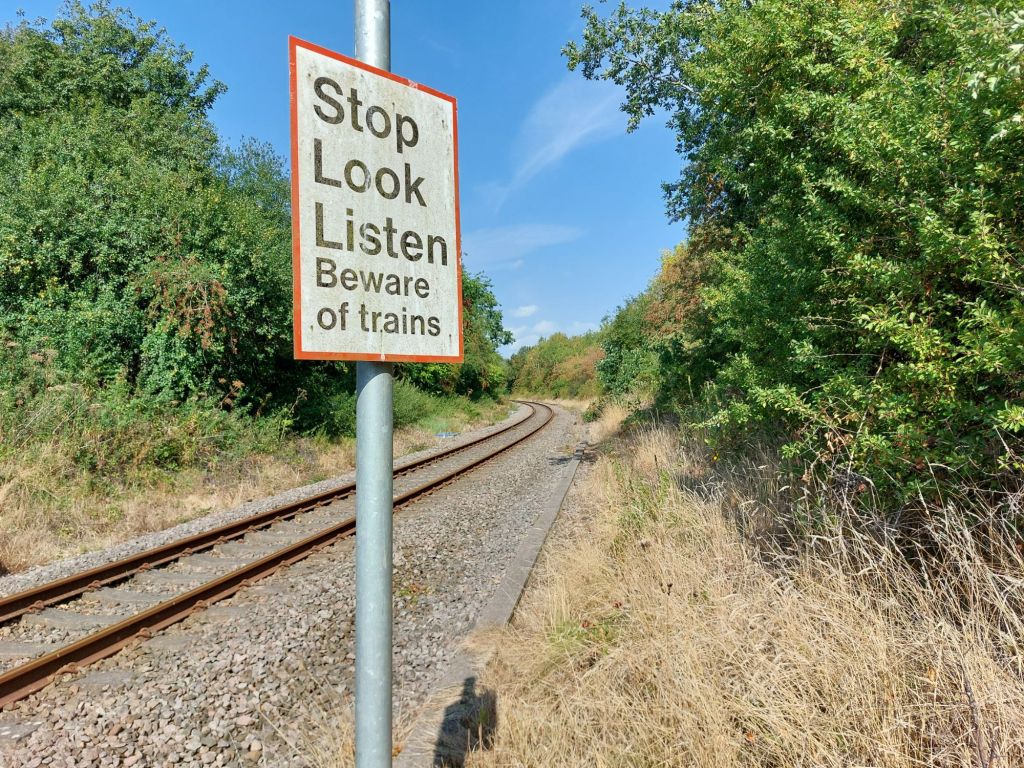
Map showing the two routes possible from Newcastle Central to Edinburgh Waverley; the usual route via Cramlington and Morpeth, the other via Northumberland Park and Blyth Bebside.The foot crossing on Morpeth North Curve, part of the route linking Bedlington to Pegswood directly by rail
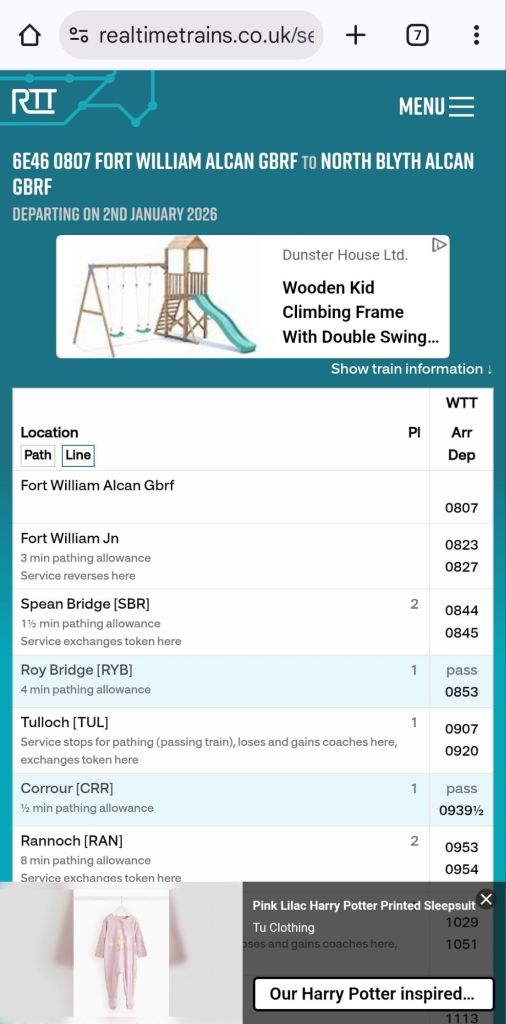
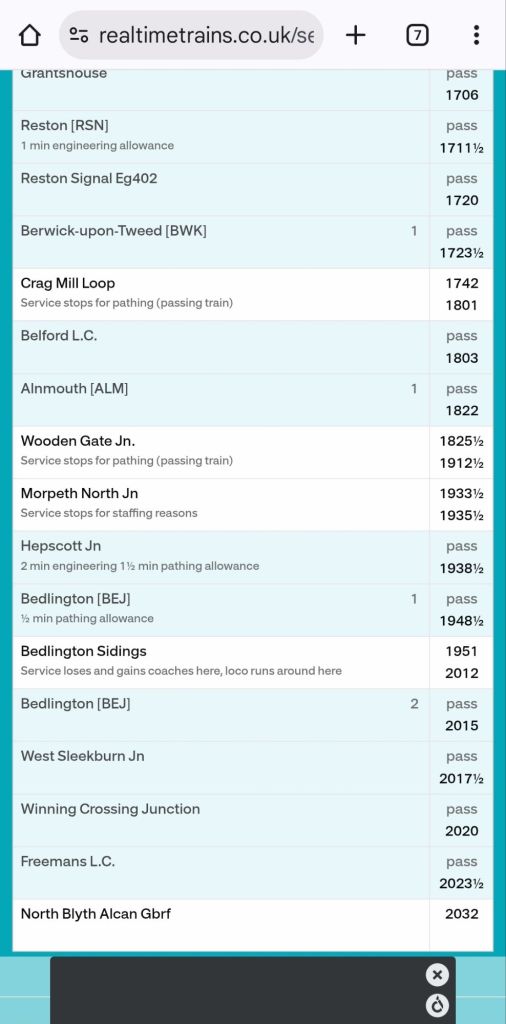
The route already exists, and is used routinely for freight, indeed the next train planned to use the route between Pegswood and Bedlington is the 6E46 GBRf operated Fort William to North Blyth alumina train, due to run later this week on Friday 2nd January 2025, which passes through Pegswood, comes off the ECML at Morpeth North Junction, and then runs to Bedlington sidings, where it turns around to head to its terminus at Cambois.
Nothing is unprecedented!
This route has also been used before during diversions around Morpeth in the 1980’s and 1990’s, as shown by the still photos below, as well as even captured on film (YouTube link, then go to about 29mins in)
More trains that are longer than the platforms could still workto ease congestionon the Northumberland Line.
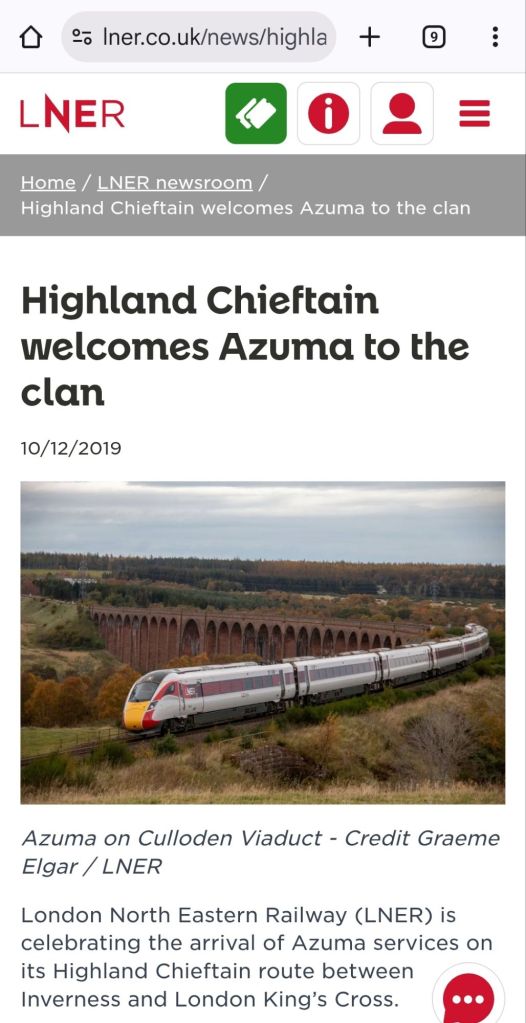
Some of you may look at the above photos of now almost retired Class 43 HST’s, or their modern equivalents in the LNER Azuma fleet, or other modern trains and rightly question that they are much longer than the new platforms are at stations such as Northumberland Park, Seaton Delaval, Newsham, Blyth Bebside, or Bedlington, and think: ‘How will that work?!?‘
For trains longer than their platform, a system known as selective door opening (SDO) can be used, meaning only those doors safely near a platform are opened, the rest remaining locked, safely keeping people within the train if they cannot safely exit onto a platform, falling out of the train onto the track isn’t going to happen by using trains longer than the platform, it will be safely managed by competent staff on board and the clever safety systems built into modern trains, you can’t reach out of the window to turn the handle like you could when the line closed in 1964.
A great example of this can be witnessed at Beauly station, near Inverness in Scotland, the UK’s shortest platform of all at just 15.06m (49ft 5in) long, and even the two-car ScotRail Class 158 trains (almost identical to those used on the Northumberland Line, just in a different colour vinyl) are much too long for this tiny platform, but manage it safely by just opening one door.
A more local example is Chester-Le-Street, where the length of the platforms means that exiting is only possible from four carriages on the train.
Beauly is still a remarkably well used station considering its minute size, being used by 33,508 passengers in the 2024/25 year. This is a far larger number of people than travel to or from many Northumbrian stations with much longer platforms, such as Acklington for example which saw just 1 passenger for every 39 who boarded or alighted from just one train door at Beauly.
Ashington is a more challenging station as it is a bay platform, so a train that is too long for the platform would potentially be foul of the line behind (the back of the train wouls still be on the through line), and might also lock the signalling system from being able to change the points for it to come back to Newcastle on the correct track.
At the ‘through’ stations elsewhere on the line, this isn’t an issue as the train will simply continue ahead after stopping.
As an example, a bi-mode (electric and diesel powered) LNER nine car Azuma could depart Newcastle, run up the Northumberland Line, calling at some stations (probably Northumberland Park and Blyth Bebside), and then continue via Hepscott to rejoin the ECML and head towards Berwick and Edinburgh.
As can be seen, the ‘Azuma’ fleet runs daily to Inverness, well away from overhead wires, via Blyth wouldn’t present any issues from the absence of overhead wires.
The availability of trains is probably a greater constraint than what could run over the route, but looking at a much wider range of train types might reveal some suitable units?
For example, there are reputedly six stored five-car Class 221 ‘Super Voyagers’, numbered 221 107, 221 110, 221 111, 221 112 221 113 and 221 117, 221 118 stored around the UK.
Sister members of the class are thundering daily between Newcastle and Edinburgh for CrossCountry, so could they be brought into use by Northern/TPE/LNER to run a Northumberland Coast Loop service, boost the capacity of the Northumberland Line and provide a new connection to, from, and within Northumberland?
This is of course just one potential option, and is in no way a definitive answer, but perhaps standing somewhere in a siding, a suitable fleet is awaiting a chance?
It is important to note that these cab ride videos pre-date the Northumberland Line project by a significant margin, and show the line as it was before the works to enable the reintroduction of passenger services began such as building new stations or closure of the level crossings at Chase Meadows or on the A1061.
These videos have simply been found on YouTube; all copyright belongs to the original uploader and ownership is theirs entirely, these links are posted for you to view them if you would wish to!







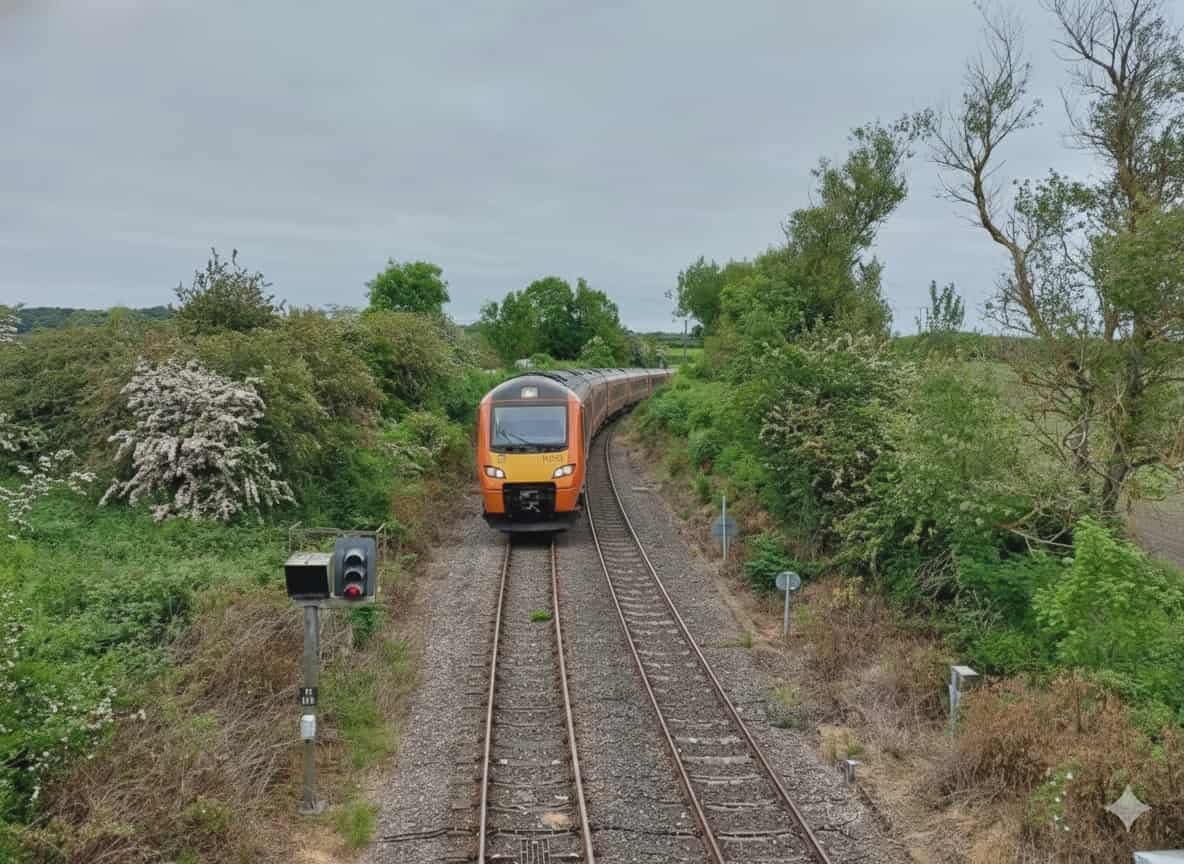
 The Northumberland Coast Loop