There are branches for most parts of the North East active, with the branches covering local authority areas, so there is a Newcastle Branch and North Tyneside Branch respectively for those council areas.
More info will be coming soon from NEPTUG itself, but if you’re interested in being part of it, which will cover rail, buses, and any other public transport in Northumberland, please take a look at their website here: https://neptug.org.uk/
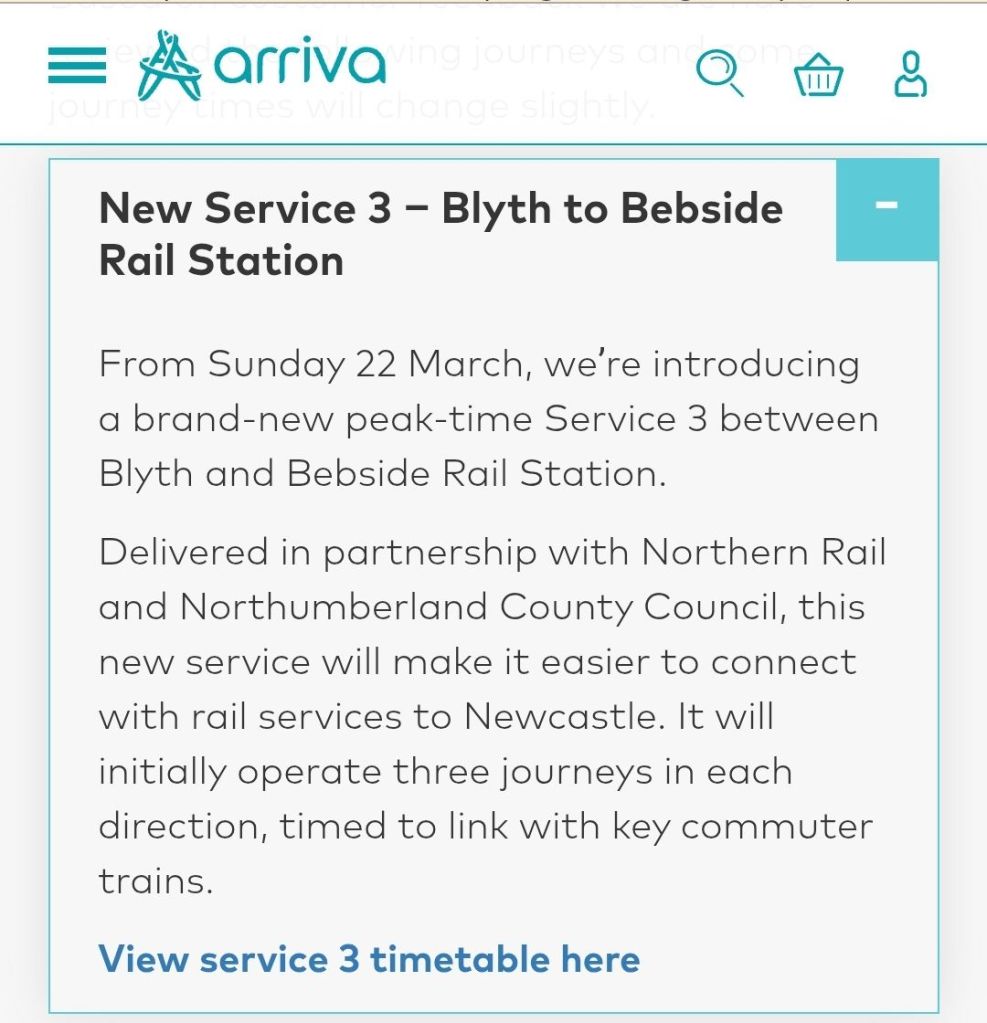
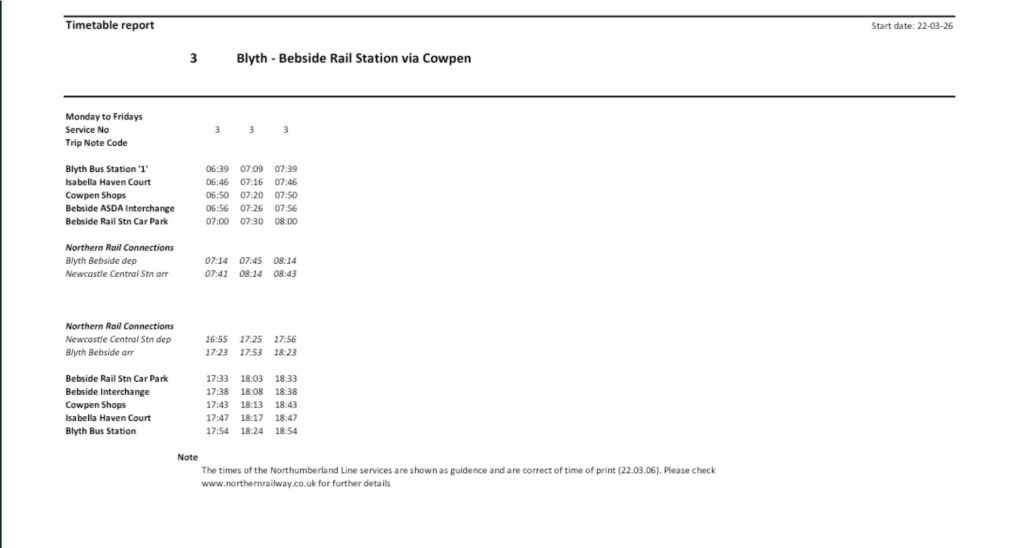
In recent news from Arriva, the major local bus operator in Blyth, Northumberland; there will be starting on Sunday 22nd March between Blyth Bus Station in the Town Centre and Blyth Bebside railway station on the Northumberland Line.
Announcement on the Arriva bus website 4.3.26
This bus will work three morning buses in each direction leaving the bus station at 06:39, 07:09, and 07:39, arriving at Blyth Bebside station at 07:00, 07:30, and 08:00 respectively, with a decent 14-15 minute margin to meet the 07:14, 07:45, and 08:14 Northern trains towards Newcastle.
Timetable for the No. 3 bus as of 4.5.26
In the evenings; the No. 3 bus will depart Blyth Bebside railway station at 17:33, 18:03, and 18:33, having met the 16:55, 17:25, and 17:56 Northumberland Line trains leaving Newcastle. These three buses will arrive back to Blyth Bus Station at 17:54, 18:24, and finally 18:54.
A great sign of bus and rail intergration between the Northumberland Line and local buses at Blyth Bebside, and hopefully a good starting point for this link to be made more frequent throughout the day and with a greater service span (first bus to last bus on the route).
Please click the link below for further information direct from Arriva.
Today, the 1st of March 2026, is just a week ahead of the first anniversary of ‘The Seven Counties Rambler’ operated by the SRPS (the Scottish Railway Preservation Society) which ran on the 8th March 2025.
Circular Tour: Linlithgow to Linlithgow via Carlisle, Preston, Newcastle, Bedlington, and Edinburgh
A huge circular route around Scotland and Northern England, ‘The Rambler’ began and ended at Linlithgow, heading to Edinburgh, before turning around via some less used lines in Edinburgh, towards Glasgow, then south to Carlisle, and down to Preston via the beautiful Settle and Carlisle Line, before going back to Carlisle up the West Coast Mainline, then along the Tyne Valley Line to Newcastle.
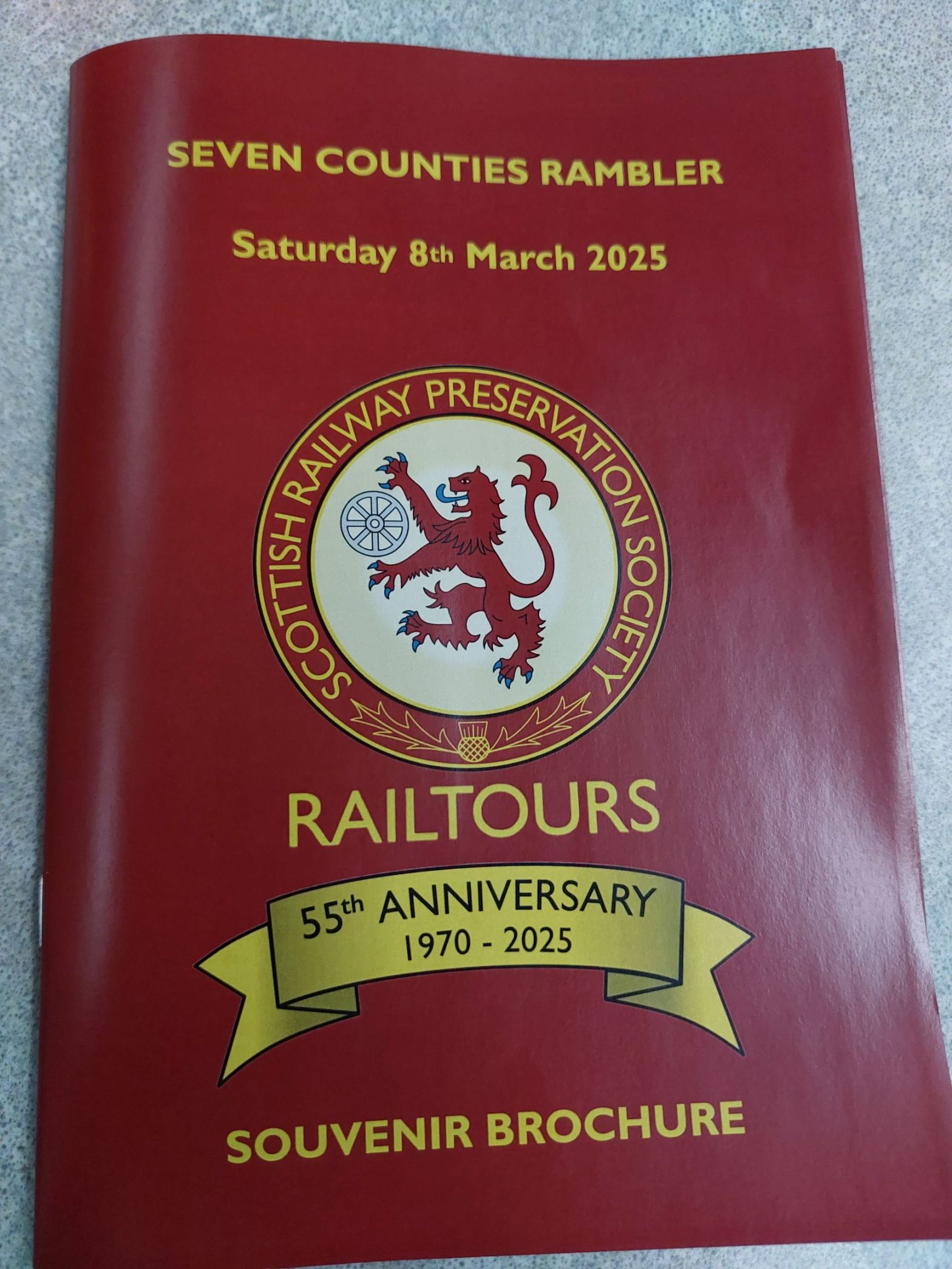
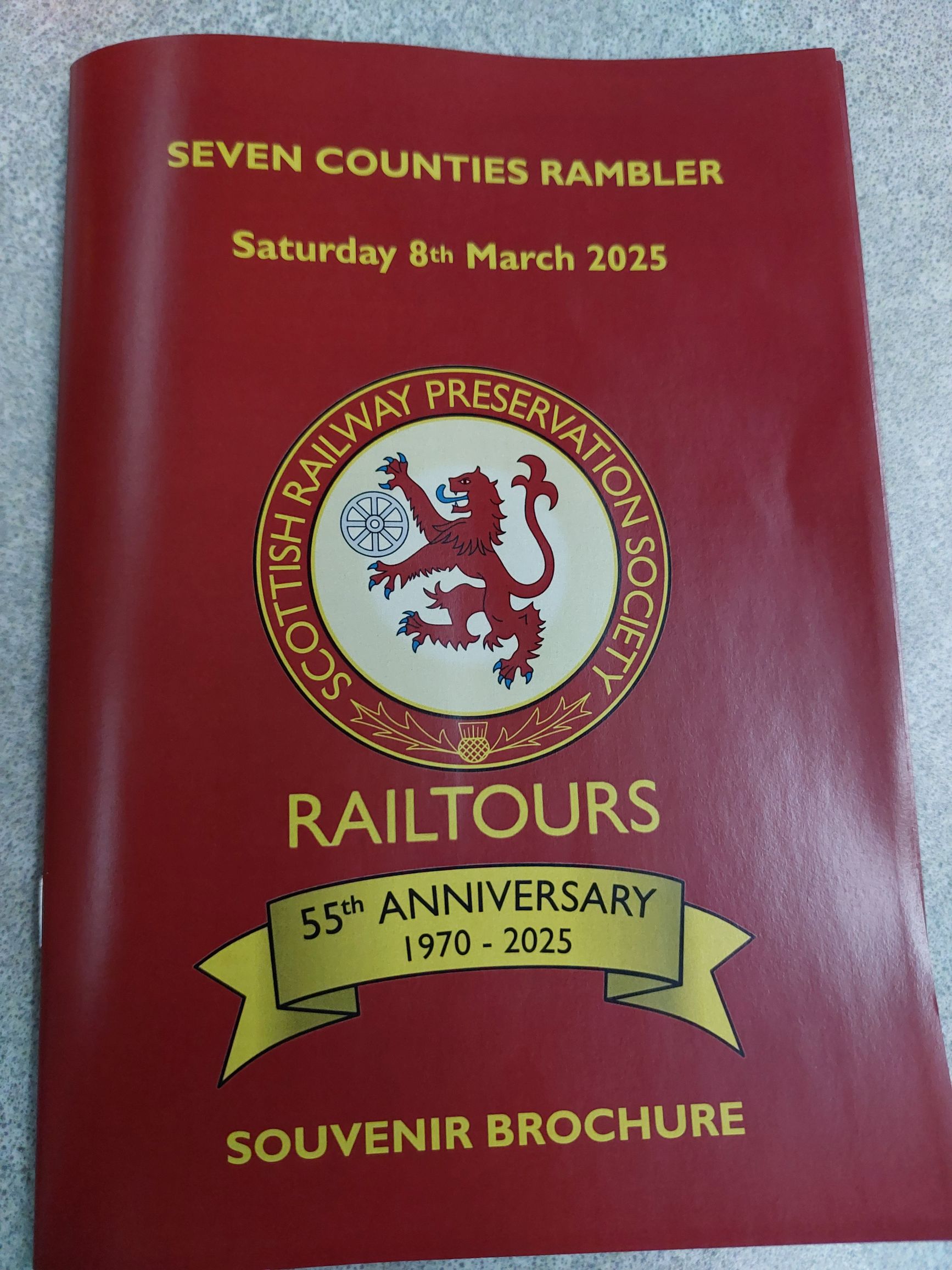
My copy of the Souvenir Brochure from the SRPS ‘The Seven Counties Rambler’.
The final leg; Newcastle, Bedlington, and Edinburgh back to Linlithgow
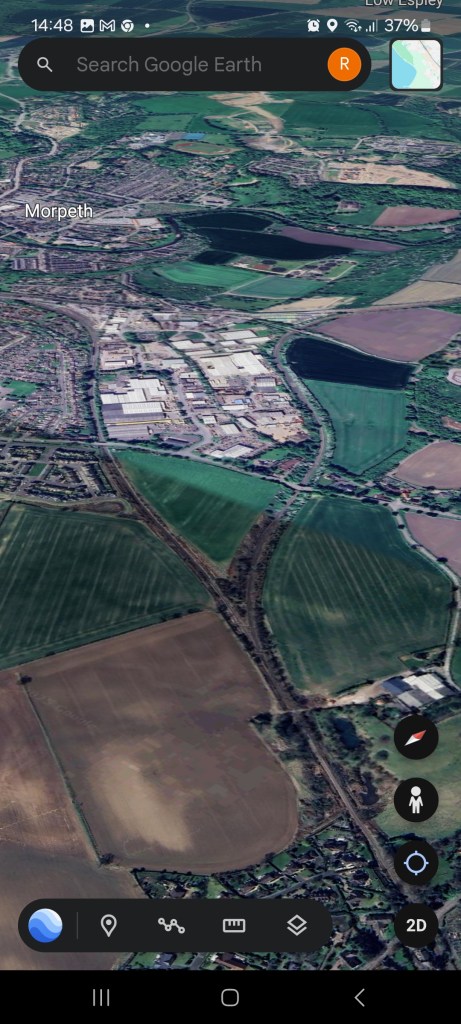
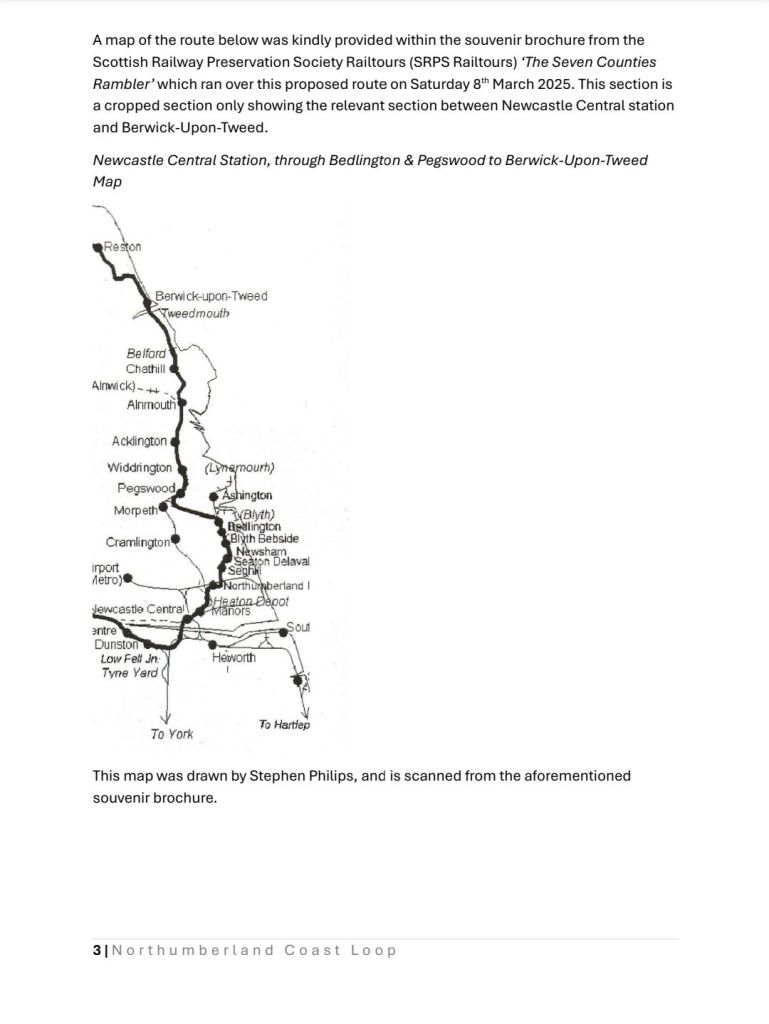
The final leg back to Linlithgow was the interesting part for me, and its relationship to this campaign; as from Newcastle Central, it took then then very recently reopened Northumberland Line to Bedlington, which at the time had only Seaton Delaval station open between Newcastle and Bedlington (Ashington is not on the route, it sitting on the former Newbiggin Branch, itself morphed today into a branchline to Lynemouth Power Station), then using the still freight only line headed west from Bedlington towards the village of Hepscott, just outside of Morpeth.
Google Maps aerial view of Hepscott (bottom of image) showing the two routes, left to Morpeth Station and direct towards Newcastle, or right towards Pegswood, Alnmouth, Berwick, and Edinburgh.
At Hepscott, at the junction that quite logically is called ‘Hepscott Junction’, allows a further choice; the left hand route from Bedlington heads towards Morpeth station, and if taken would have routed the train back toward Newcastle Central, but instead the train took the right hand route, which curves north towards Pegswood Viaduct over the River Wansbeck towards the village of Pegswood and then north along the East Coast Main Line (ECML) back to Edinburgh, and then the conclusion of this epic day trip back in Linlithgow where it had started in the wee hours on the morning!
Route map of The Seven Counties Rambler showing section from MetroCentre to Reston via Bedlington and Pegswood in a report prepared for North Northumberland MP David Smith.
The Northumberland Line a year on; and the need for the Northumberland Coast Loop is clear.
Almost a year on, the vast majority of the then incomplete stations that the railtour passed through are now open, only Bedlington is still awaited, but is due to open at the end of this month on Sunday the 29th March 2026.
The line has, despite delays in opening the route initially with only Ashington, and Seaton Delaval stations in December 2024, the other stations at Newsham, Blyth Bebside opening during 2025, and now Northumberland Park and Bedlington opening and the latter due to open in 2026.
Despite the delays, the line has been a HUGE success in terms of passenger numbers, with well over a million passengers now having used the line, and potential to reach two million by the end of 2026, with the line compete in just a few weeks once Bedlington is finally opened to the public.
While many people such as myself were very optimistic for the success of the line ahead of it being opened; I wouldn’t have even dreamt of the volume of passengers (over a million to date) using the line so early after opening, and especially when the scheme has been beset by delays and more delays.
No extra Northern trains until new units arrive in the 2030’s.
Northern is in the process of beginning procurement of new trains (which hopefully might be a minimum of four carriages in length as standard, avoiding having any two car trains at all), but there will be some years between ordering new trains and them being built, delivered, and entering service.
Diverting existing trains between Newcastle and Edinburgh via Bedlington
The solution this campaign is putting forward is to instead pull some of the wider range of rolling stock available that currently plies between Newcastle and Edinburgh via Cramlington and Morpeth to instead run a handful of services via the ‘loop’ between Pegswood and Manors via Bedlington.
This would mean that extra trains could serve the ‘core’ part of the Northumberland Line from Blyth, the largest town in Northumberland into Newcastle, bringing extra seats onto the line and easing the overcrowding of the existing services.
Some other branded trains, like TransPennine Express (TPE) are, like Northern, run by the DfT Operator (DfTO), effectively one ‘company’ with separate branding, much like British Rail had trains in different branding for different services being operated. LNER is another train operator that is directly run by the DfTO, it is just a coat of paint and different colour scheme within the train and on staff uniforms, but the same back office staff all three of these train services north of Newcastle, and as time goes on, more train operators are being brought into the DfTO.
This means that if decided by the DfTO, there shouldn’t be any great barrier to running some TPE, or LNER trains via Bedlington rather than Morpeth or Cramlington, if desired.
The lack of overhead wires isn’t a major issue, as many of those running on the ECML are bi-modes, able to run on both electric overhead power at 25kV AC, or use their fitted diesel engines when ‘off the wires’, as can be seen below from diverted LNER trains going along the Tyne Valley Line (Newcastle to Carlisle via Hexham) below.
LNER diverts at Dunston station (video found on YouTube)
In the longer term, this route is one that would benefit from electrification at 25kV AC so that 100% electric trains could be used on this route too, but for now bi-modes are practical proposition for a very quick way to get more trains running and boost the capacity of the Northumberland Line into Newcastle.
This route also offers a direct route northwards from towns like Blyth into North Northumberland and Scotland, using an existing line, which would cut journey times and the need to change trains by going via Newcastle, and could further boost the positive economic impact of the Northumberland Line for very little if any additional investment.
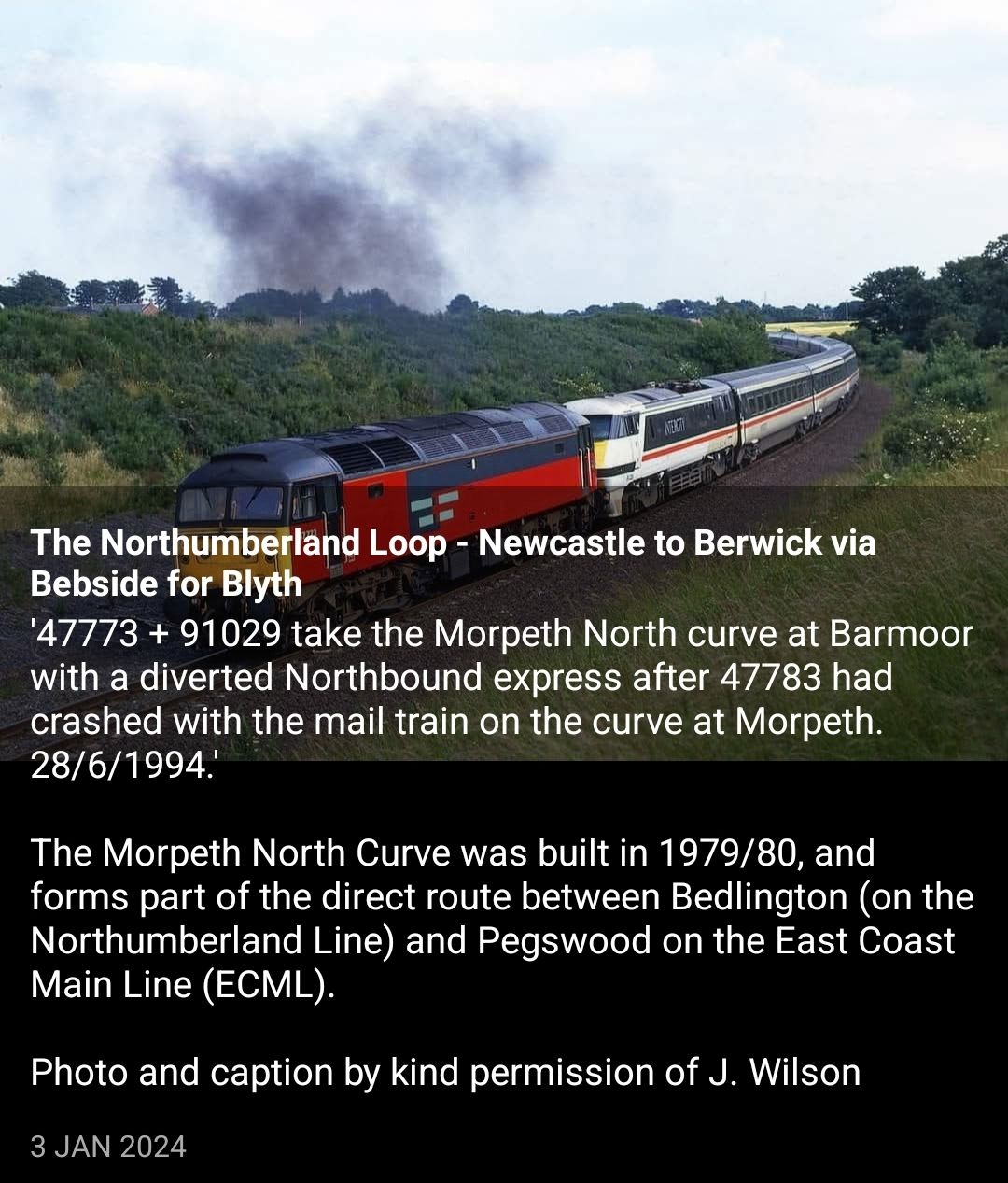
The line from Bedlington to Morpeth North Junction, where the freight only line joins the East Coast Main Line (ECML) has existed since 1980 (the opening of Morpeth North Curve, most of the route existed for over a century before that linking Morpeth station to Bedlington), yet today it only sees a handful of trains each week at most.
Using this arguably underused link to boost the capacity of the Northumberland Line, as well as bring new direct routes into play would be a massive economic opportunity for very little extra expenditure; the track and junctions are all there and used regularly if infrequently and the stations are complete and open, with Bedlington due to open in a matter of a few weeks.
Please write by post or by email to them, and ask for their support for the ‘Northumberland Coast Loop’, and explain why you feel it would be useful to you, the more support the proposal gets, the more likely it’ll be made a reality.
Please also reach out to your local Northumberland County Councillors to also raise this route with the council for its support.
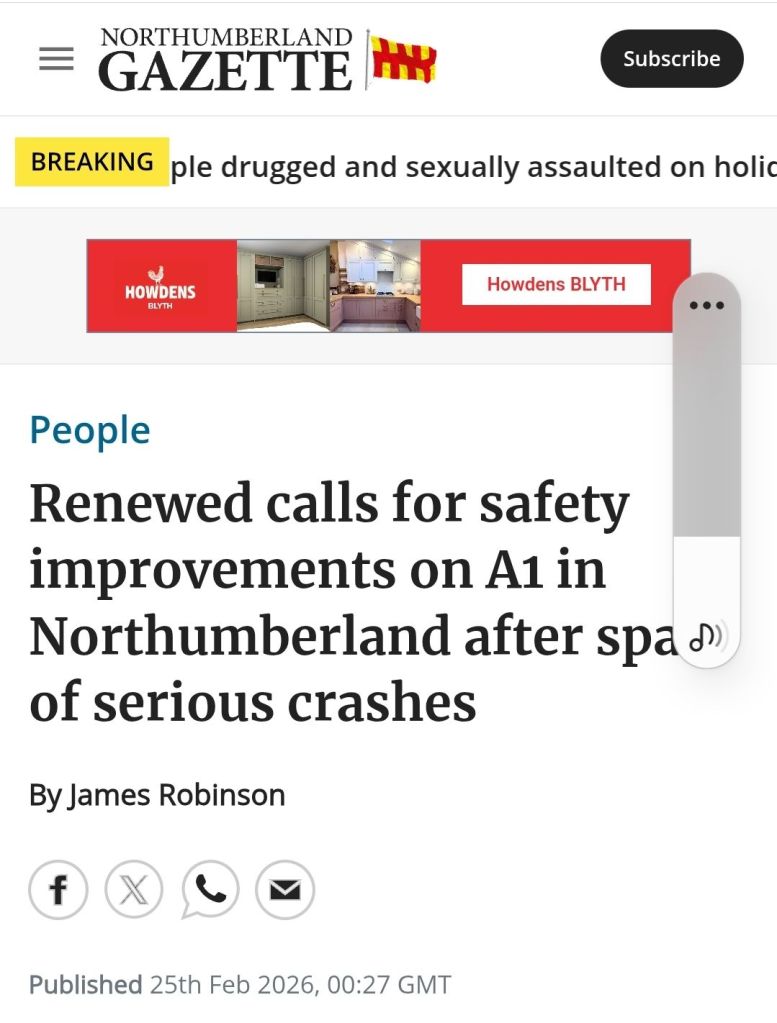
Headline from the Northumberland Gazette article quoting Cllr Hunter.
To quote Cllr Hunter from the article, ‘The Government has said it will do minor improvements, but that won’t stop all of these crashes. We need to have the A1 dualled.‘
The dualling of 13 miles of the A1 between Morpeth and Ellingham was officially cancelled quite some time ago, and was announced to be expected cost in the region of £500m, in my view, as as the case is outlined below, if safety is the main target, then transferring traffic to trains from the road is potentially the best way to deliver that outcome.
Another aspect is the tourist volumes who visit North Northumberland, which puts added strain onto the A1 and importantly many of the rural roads connected to it, and the excessive volumes of cars are a separate but equally important issue for Northumberland, which is heading down the same route as the Lake District in terms of access by car bringing a huge set of issues with it.
If more tourism by rail can be encouraged, it is a clear win-win for Northumberland; tourists still visit, yet they are coming without their cars, meaning our towns and villages will be much less congested, but will still thrive from visitors coming and spending in the local economy.
If dualling is taken forward as ‘the solution’, then it puts further pressure onto rural and urban roads that cannot cope now, only exacerbating current problems with parking and traffic congestion.
If public transport is instead put at the heart of planning for the area, and rail is coordinated with buses for onward travel to places away from the railway stations and getting back again, then it can be a much more viable option.
For many establishments such as our many great pubs and bars, there is further advantages in public transport that visitors can enjoy locally brewed beers or other drinks without one in a couple of group having to be the ‘designated driver’, that responsibilty handed to the bus and train drivers, and itself a potential market for pub businesses on a circuit.
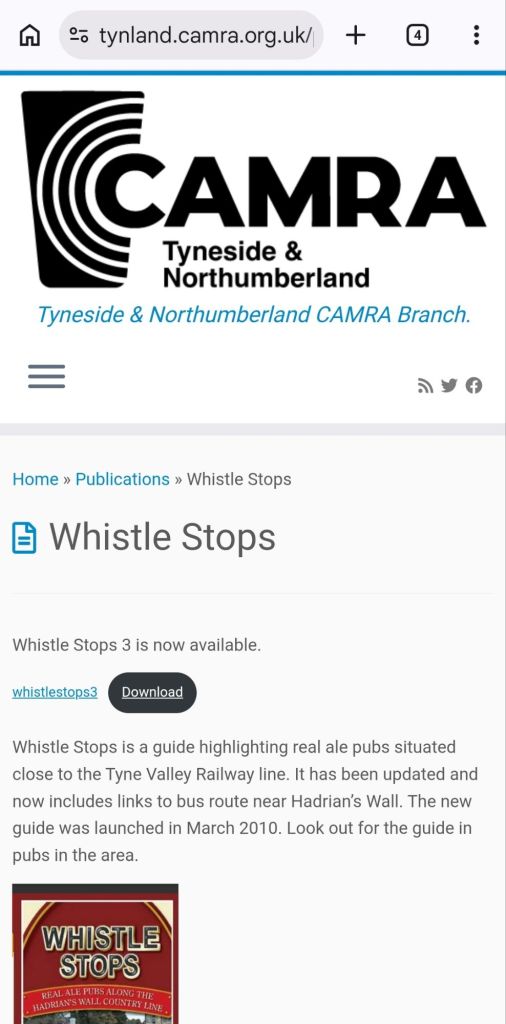
‘Ale by Rail’ on the Tyne Valley Line between Newcastle and Carlisle, a similar promotion could be applied between Newcastle and Berwick (via Morpeth and/or via Blyth) with better rail services for the area.
Drink and driving a car is a clear example of two things that are incompatible, and rightly shunned by society due to the devastating consequences of alcohol related road accidents.
Public transport is, however, an elegant solution to this, as punters going for pints or a Piña Coladas (other drinks are available) they can travel out to enjoy them, and importantly travel back safely for themselves and others. It would keep our fantastic venues open and thriving, whilst keeping people safe, again, a win-win surely?
Dualled roads are still deadly and dangerous
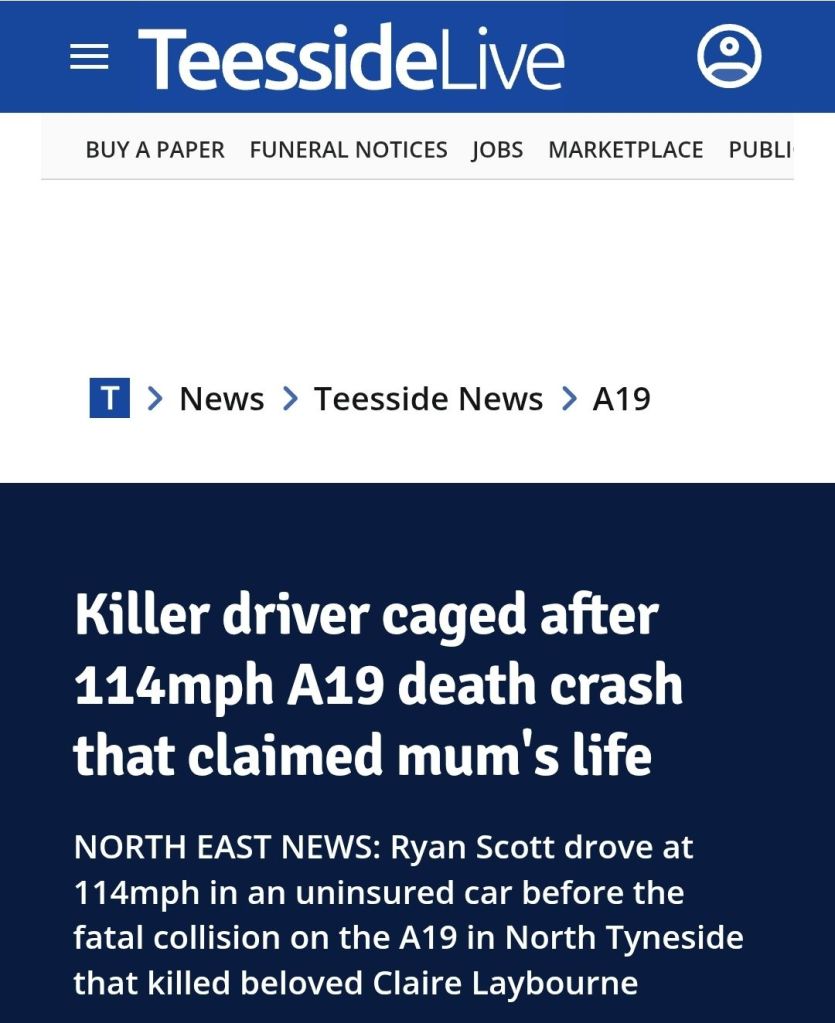
A harsh reality is that dualling alone does NOT guarantee a road becoming ‘safe’, and does not prevent serious and fatal accidents from occuring. A shocking example of this (5th December 2025) is recent tragic incident on the fully dualled A19 near Holystone in North Tyneside, caused by excessive speed, but illustrating clearly that road accidents and loss of life are sadly not prevented by dualling alone.
Teesside Live article about the tragic death of C. Laybourne caused by R. Scott driving at 114mph on the A19.
Every loss of life, or serious injury is a tragedy for the person involved, as well as for family and friends, and we as a society should surely always strive for the accident rate to be ZERO. Perhaps modal shift away from road transport could well be part of the toolkit to make that target a reality.
Whilst we need interventions to make roads like the A1 safer, moving more people and goods via the ECML would reduce traffic on the road, and therefore would reduce risk and road accidents.
HSE: Driving for work is dangerous.
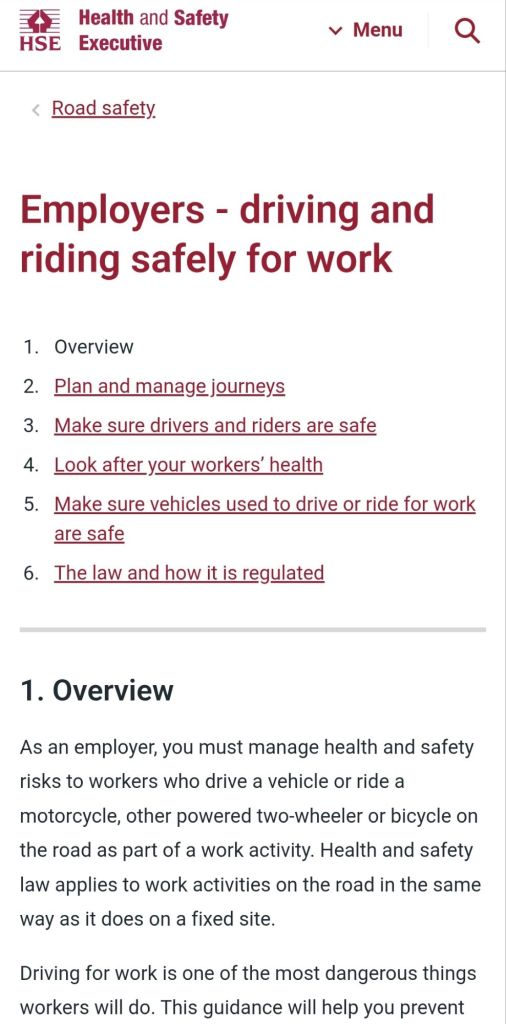
Indeed, it is recognised by the Health and Safety Executive itself that ‘Driving for work is one of the most dangerous things workers will do.’. Showing that being on the road is a dangerous place to be.
HSE webpage, ‘Driving for Work’
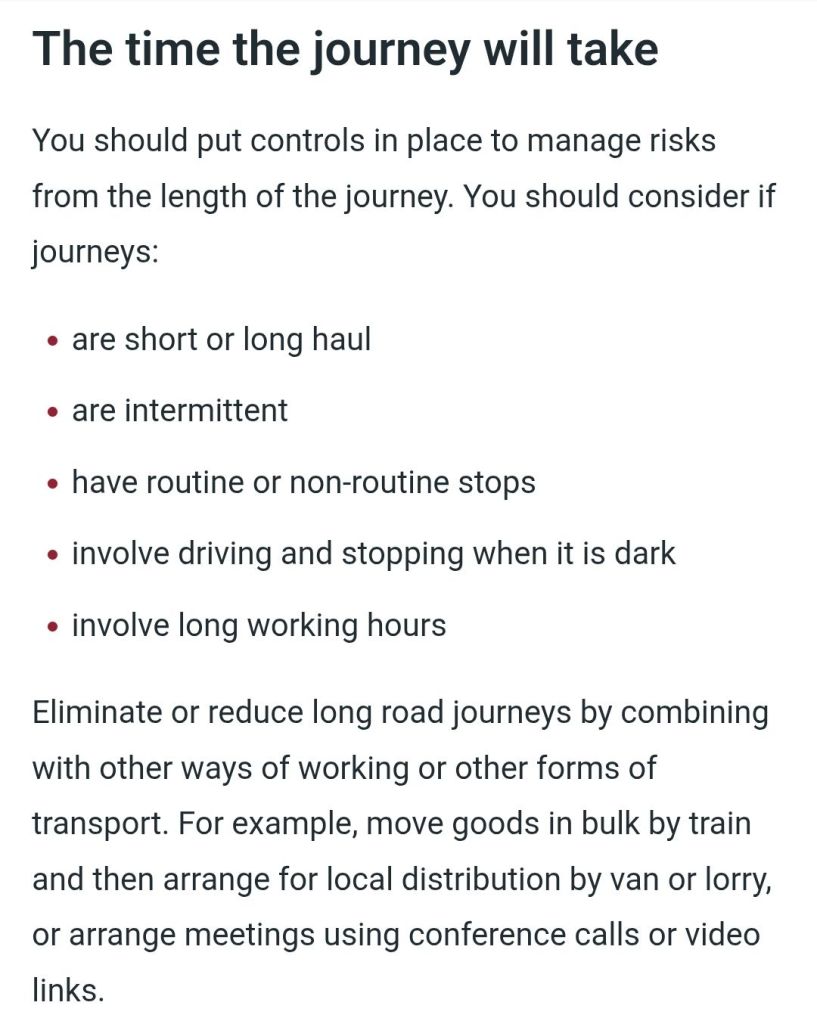
The HSE website goes further on the following webpage, and suggests that modal shift to other modes of transport could eliminate or reduce driving risks, and the hazards faced such as driving/stopping in darkness (Northumberland being a county notable for long winter nights and very dark roads due to fewer streetlights).
The HSE suggesting modal shift away from driving where possible, or to communicate online rather than travelling by road.
If the HSE suggests modal shift for greater safety, perhaps we should give it a very serious consideration?
Smaller safety schemes are welcome, but put the big money into modal shift?
There has been a lot of criticism of the decision not to dual the A1 in Northumberland from Morpeth to Ellingham, but at a cost stated as £500m, and one that doesn’t deliver much in the way of economic growth, and is unlikely to totally stop the serious accidents causing life changing injuries and tragic deaths, could there be a better case to invest in the parallel East Coast Main Line (ECML) instead?
There is still a clear need to invest some money into the A1 to redesign and replace some current flat junctions with grade-separated ones and tackle some bad sections of road layout, and cost-effective solutions such as average speed cameras that have proven themselves on other routes by reducing fatalities and serious accidents should also be employed, but expanding the capacity of rail routes like the ECML to carry more passengers and freight both locally and long-distance would perhaps be the best investment for the bulk of the money.
Rail transport has a great safety record, and modal shift away from road transport would save lives.
One of the safest ways to travel in the UK is taking the train; in modern times, passenger train accidents are exceedingly rare events, and fatal ones even rarer; for example the last at Stonehaven in Scotland was in August 2020 when an HST hit a landslip, and before that was the February 2007 derailment at Grayrigg in Cumbria. That these accidents are noteworthy, yet they are 13½ years apart shows how safe the railway system is in the UK.
In Northumberland, you would need to go back as far as 1969 and the crash at Morpeth of ‘The Aberdonian’ sleeper train on 7th May that year, almost 57 years ago for the last fatal rail accident involving passengers (sadly a nearby accident in 1992 killed a train driver due to mis-communication).
Since 1969, the East Coast Main Line between Edinburgh and Newcastle has carried many millions of passengers safely and swiftly, having had a very good safety record since this accident, and even when further accidents have re-occurred at Morpeth, improved train and carriage designs have meant that injuries were much less serious and no fatalities resulted from it.
The Northumberland Line has now also moved well over a million people safely, and allows people to avoid the A189 Spine Road which itself has a poor reputation for accidents, many of which have also tragically been fatal or serious with life changing consequences, but is largely dualled and has grade-separated junctions mostly (aside from roundabouts such as Moor Farm).
This is a passenger route that would be likely to carry many thousands, if hundreds of thousands of people each year if implemented, reducing car trips and improving road safety as a result.
Whilst no mode of transport will ever be 100% ‘safe’ and it would be a Titanic mistake to claim so (the so-called ‘unsinkable’ ship now on the bottom of the Atlantic sprung to mind), the evidence shows that railways are a fundamentally much safer way to transport people and goods; professional staff who are highly trained, working in a very tightly controlled failsafe system of systems means that accidents are incredibly rare and even when they do happen, modern rail vehicles are also extremely well designed to protect their occupants.
Rail won’t replace all road journeys, but more people and goods moving by train the better.
Rail cannot replace every car or lorry trip, but a significant modal shift from busy roads like the A1, A19, and the A189 would have clear safety benefits by reducing overall traffic volumes, and enabling travel on a much safer mode of transport, meaning a real reduction in injuries and fatalities on the road network.
Hopefully Cllr Hunter and others will help to push for railways and public transport more broadly to be part of reducing road fatalities and injuries in Northumberland, with the additional benefits of supporting businesses such as pubs, reducing road congestion and parking problems in our picturesque paradise that is Northumberland?
Today, Sunday 22nd February 2026 marked the opening of the long awaited Northumberland Park station, heavily delayed but here at last!
To visit the station on opening day to take a look, especially considering its potential importance to the Northumberland Coast Loop, I took a train from my local station at Alnmouth to Northumberland Park via Newcastle.
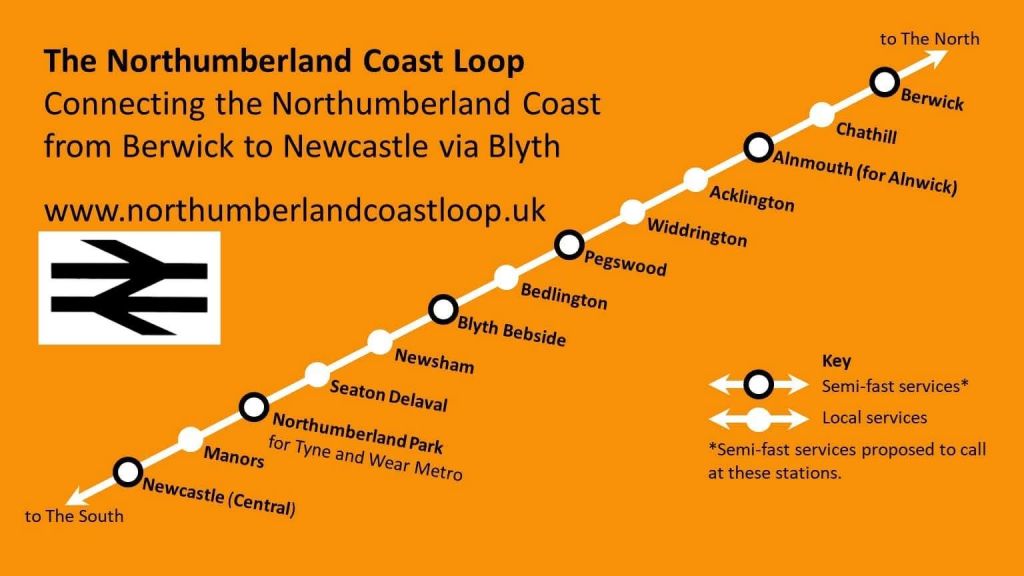
Northumberland Park would be a potential semi-fast service stop, meaning that trains serving this station may skip some other stops and roll straight through; this reason why would be done is that some fast long-distance trains are not designed to do stop-start ‘all stations’ duties, and instead would be better driven for several miles even at relatively low speeds to avoid mechanical issues developing, but the route would allow places to be directly served, cutting overall journey times and avoiding the present awkward ‘back-track’ currently occuring when going via Newcastle.
You wouldn’t take the bus to Haymarket to go from Alnwick to Blyth, or drive via the Tyne Bridge, so why expect it with rail services when a potential route exists?
Footpath over the Morpeth North Curve, a direct connection from Pegswood to Bedlington, enabling the Northumberland Coast Loop.
The more who sign, the more support is demonstrated, and builds the political will to make it happen.
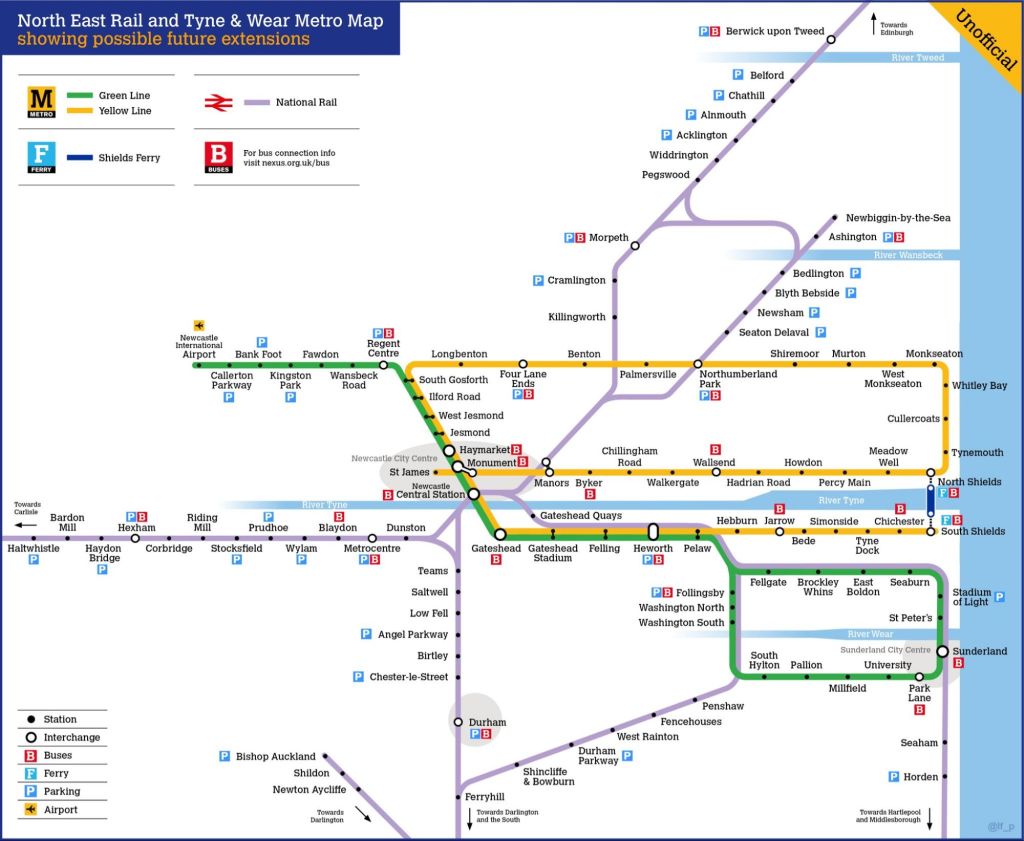
Route map of the Northumberland Coast Loop between Newcastle and Berwick, with options for extension at both ends.
The route has wide potential benefits;
It would create new, direct rail routes between most of the settlements on the Northumberland Line like North Tyneside, Blyth, Bedlington and more to North Northumberland and Scotland. This would at Northumberland Park create a more direct route into sites such as Cobalt Business Park, or links to the Port of Tyne for ferries to Europe and cruises using the Port of Tyne to visit attractions in North East England.
Adding dditional trains, alongside the Northumberland Line units, would provide additional and much needed seating capacity between Blyth and Newcastle, where presently the Northern units are struggling to cope at peak times, and would avoid those travelling to/from North Northumberland or Scotland to occupy seats headed towards Newcastle entirely, releasing that capacity for other rail users.
Regular use by planned passenger trains would mean that a wider pool of units and drivers would be route cleared in the event the route was needed for diversions (for example if further issues were to arise with Plessey Viaduct as happened in October 2023 when diversions via Blyth were discussed as a possibility.
If you can, please write to your local Councillor(s), and your Member of Parliament (MP) to express your support for the ‘Northumberland Coast Loop’.
The trip to Northumberland Park
Tickets were purchased well in advance online due to the advantages of lower fares on the ECML if booked early.
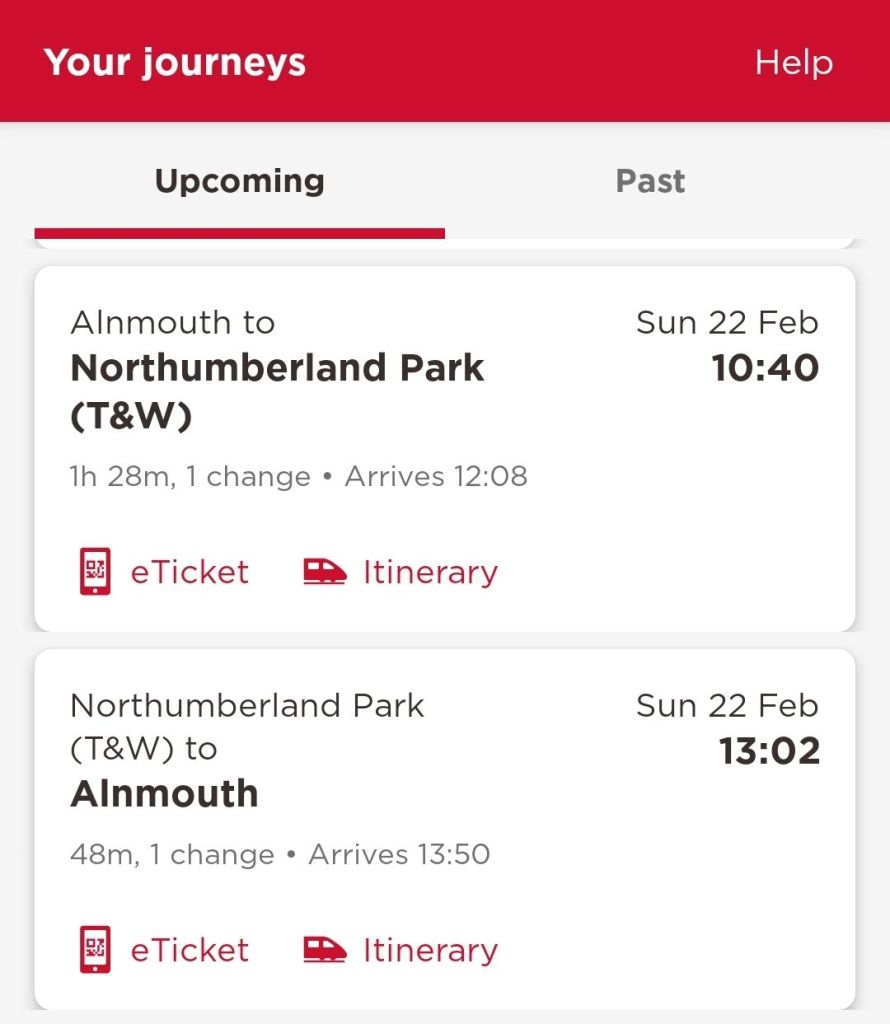
Tickets for travel from Alnmouth to Northumberland Park and return on the LNER app.
Embarking from Alnmouth
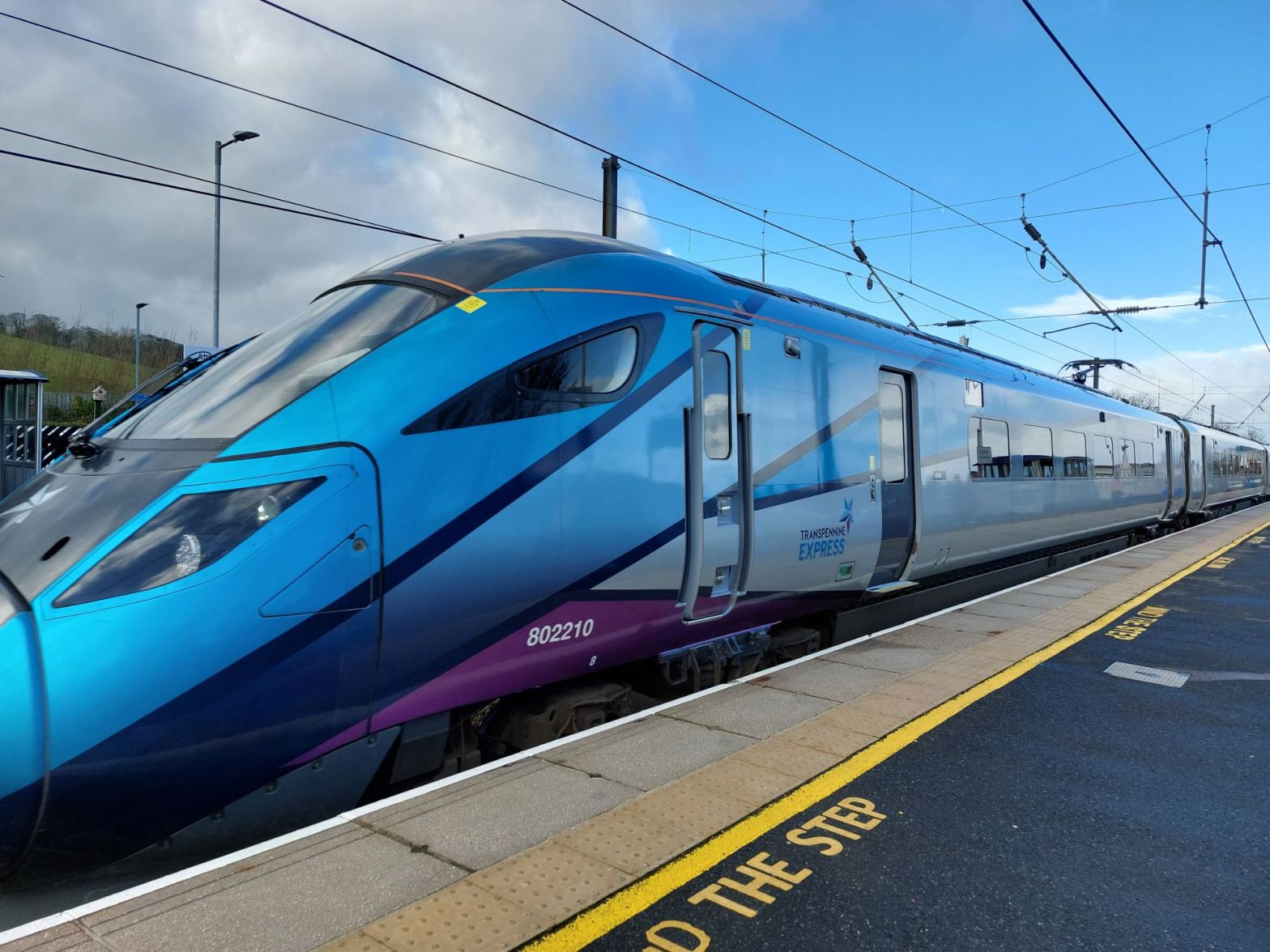
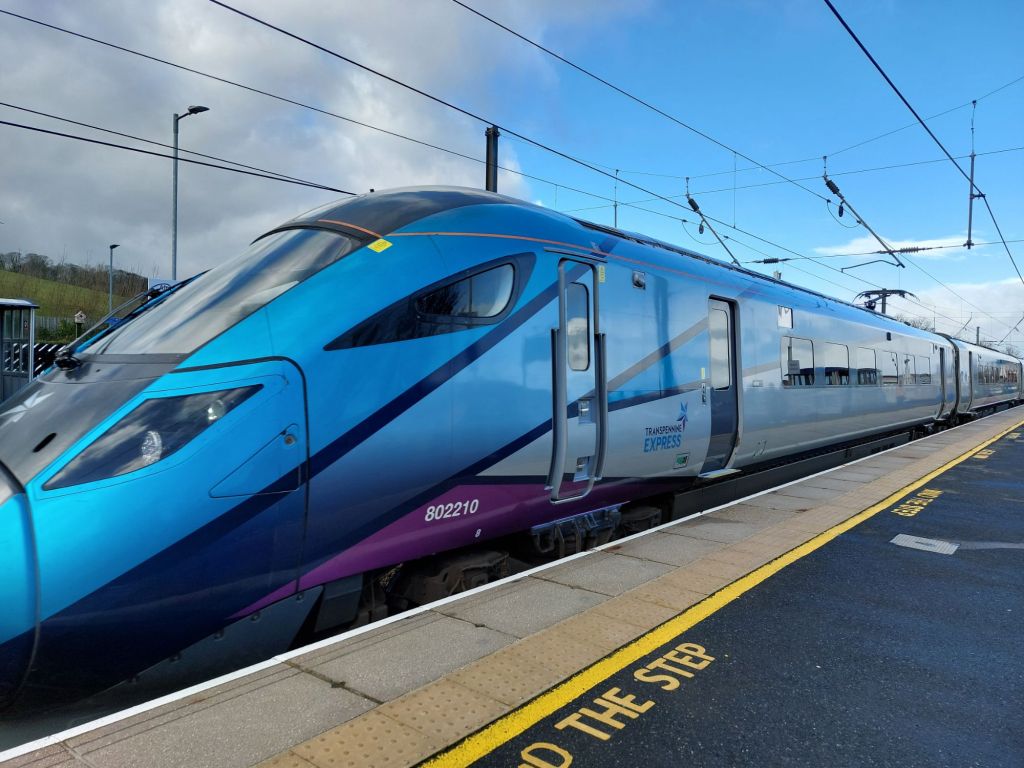
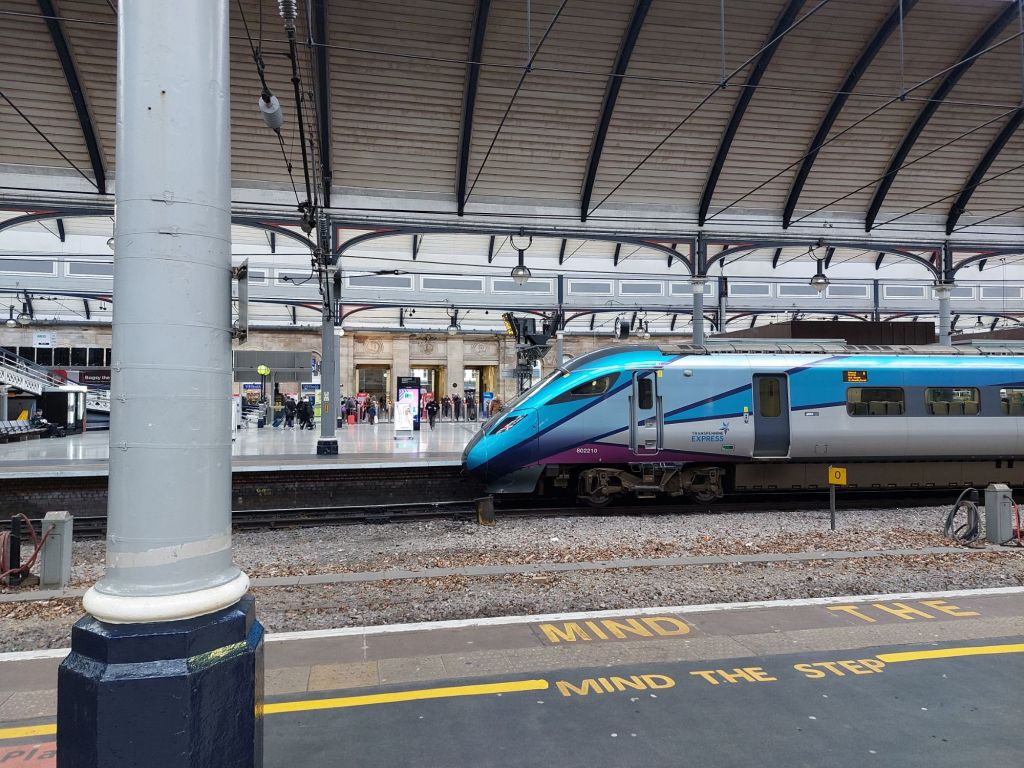
A canny day for it, and TPE 802210 was the traction for the first leg!
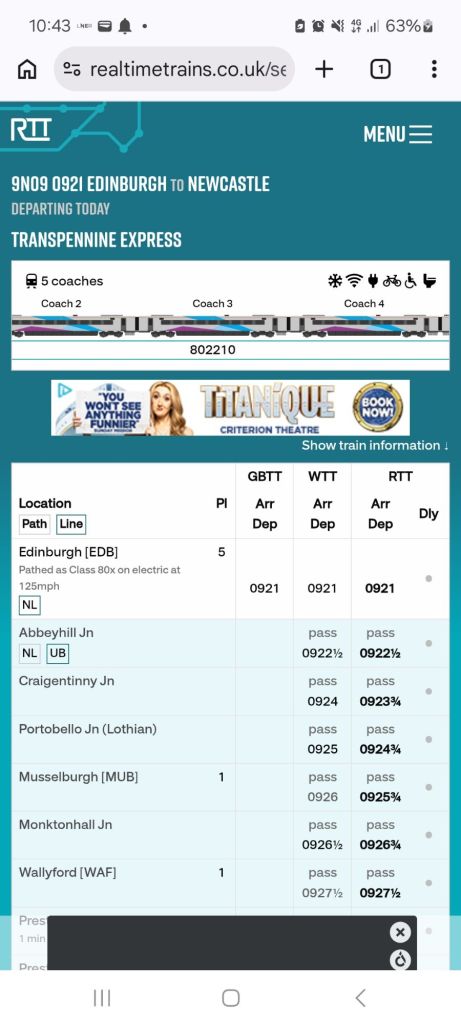
TPE 802210 arrives at Alnmouth for the first leg of the trip working 9N09 towards Newcastle.A photo of 802210 standing at Platform 2 ready to head back to Edinburgh.
Changing at The Toon
As can be seen above, the planned outward travel time from Alnmouth to Northumberland Park (T&W) of 88minutes meant a significant wait at Newcastle Central for the connection, a strong argument in favour of the more direct route via Pegswood and Bedlington which eliminates the need to change trains at all, and would make this trip significantly faster.
An estimate of a direct journey time from Alnmouth to Northumberland Park via Bedlington would be in region of 45 minutes (13 mins from Alnmouth to Pegswood, c. 15 mins from Pegswood to Bedlington, then 18 mins Bedlington to Northumberland Park (T&W))
For the observant, this very close to the return journey time expected from Northumberland Park back to Alnmouth, but as events today unfolded, it illustrated the problems with reliance on changing at Newcastle.
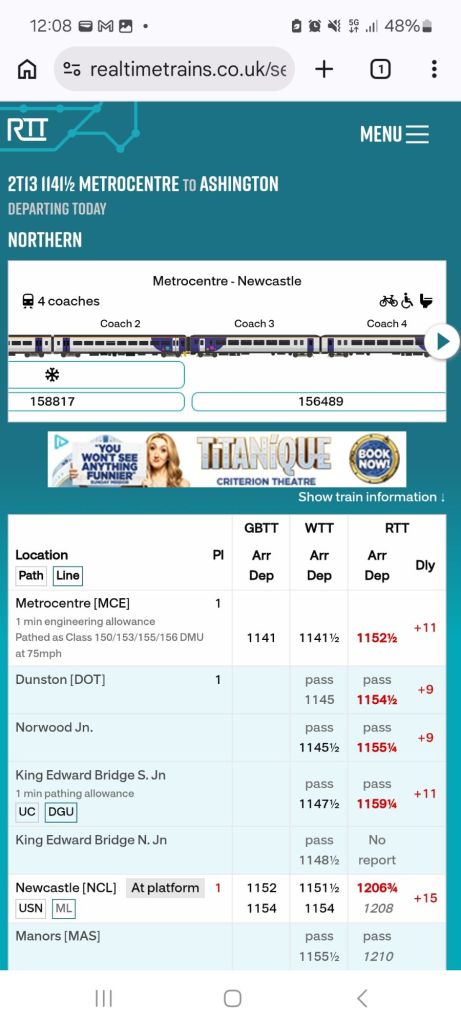
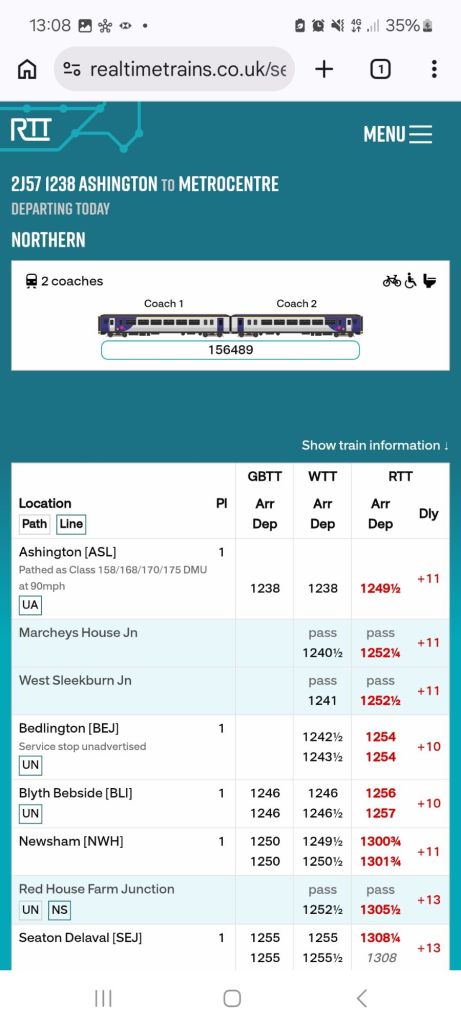
The first train, the TPE from Alnmouth to Newcastle ran to time, and all was so far well with the day trip, but the second leg from Newcastle Central to Northumberland Park was less smooth today, with a faulty Northumberland Line train from MetroCentre (2T13, made up of 158817 and 156489) getting more and more delayed, as can be seen below.
In the end, only 156489 went on to Ashington, after some shunting around in Platform 1 at Central station to take the defective 158817 off the service.
Arrival at Northumberland Park
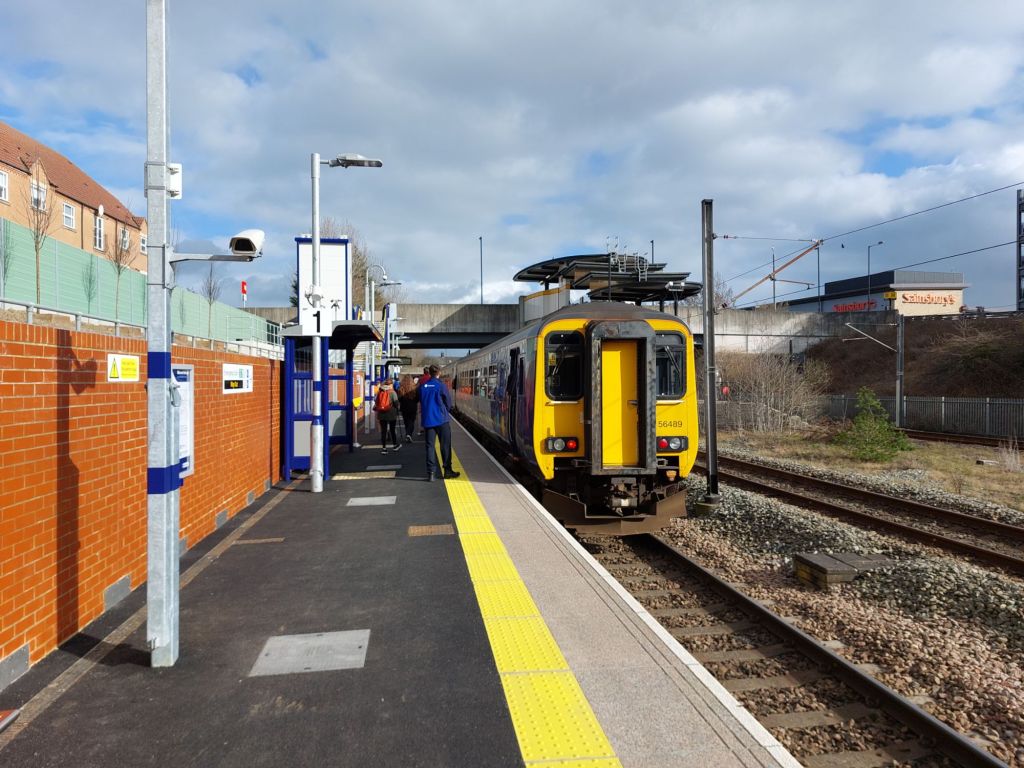
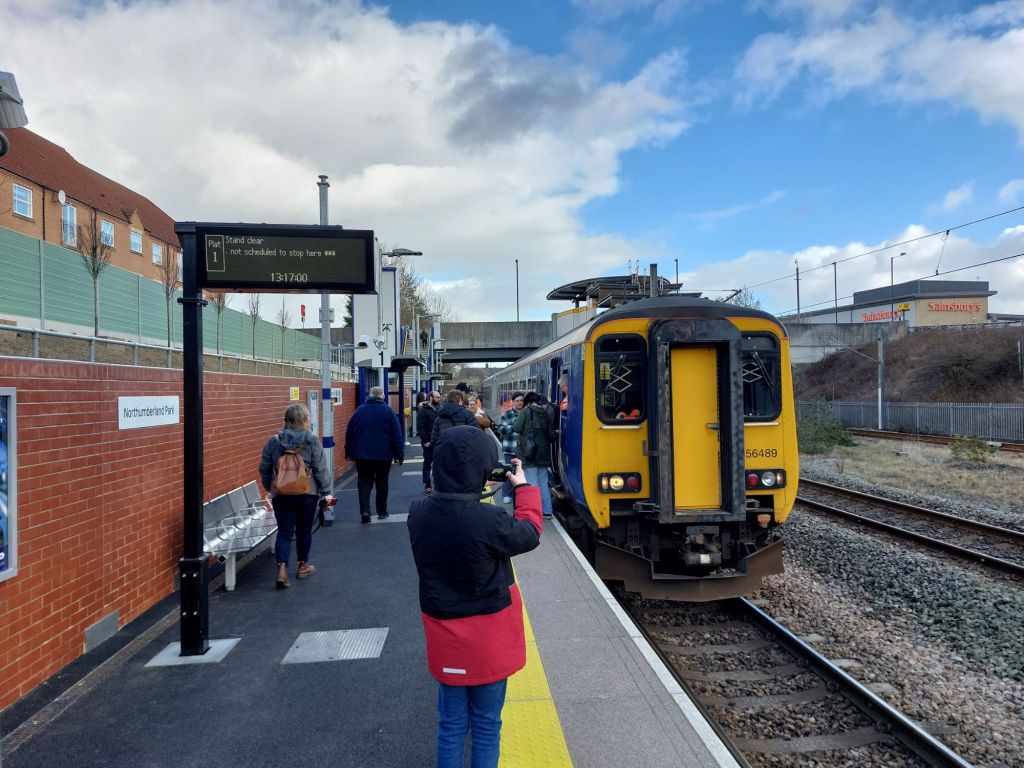
Arrival at Northumberland Park, slightly later than planned.
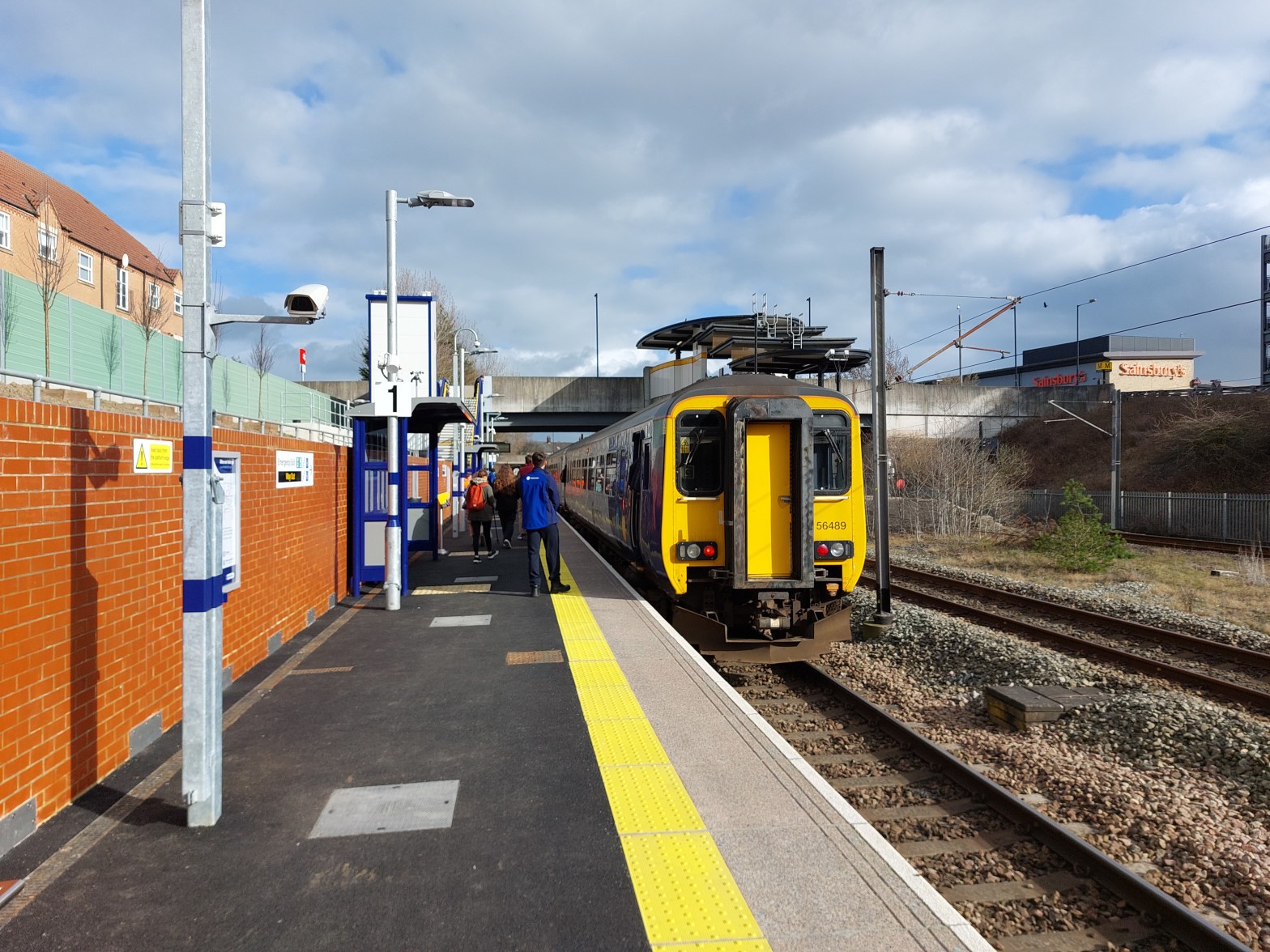
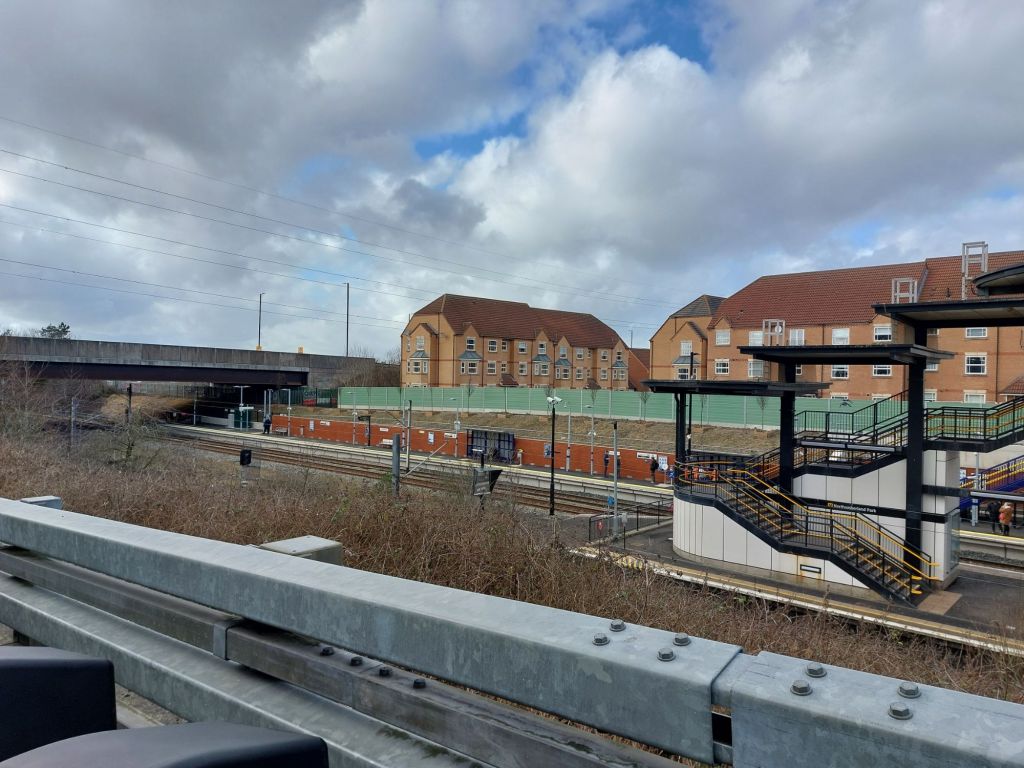
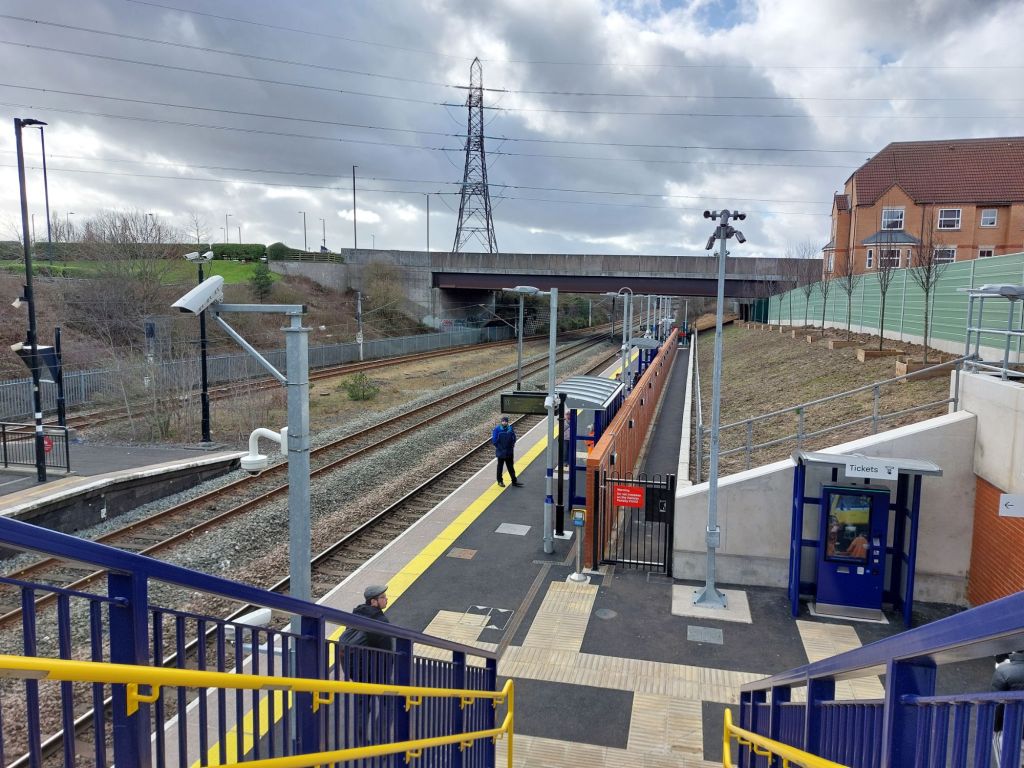
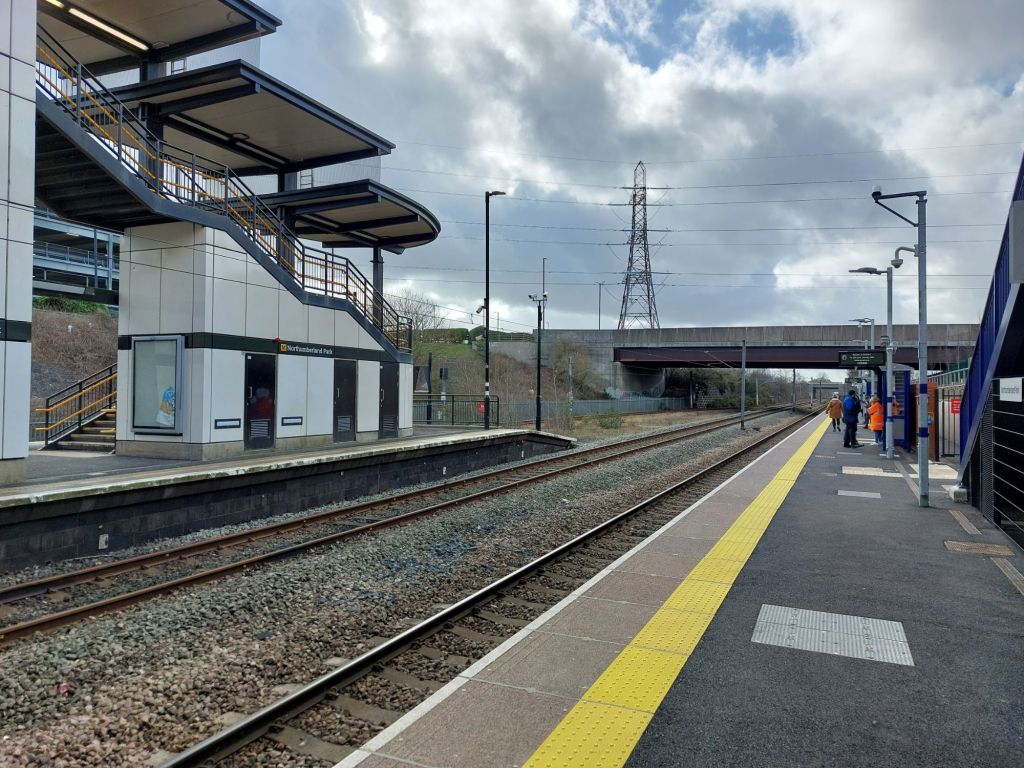
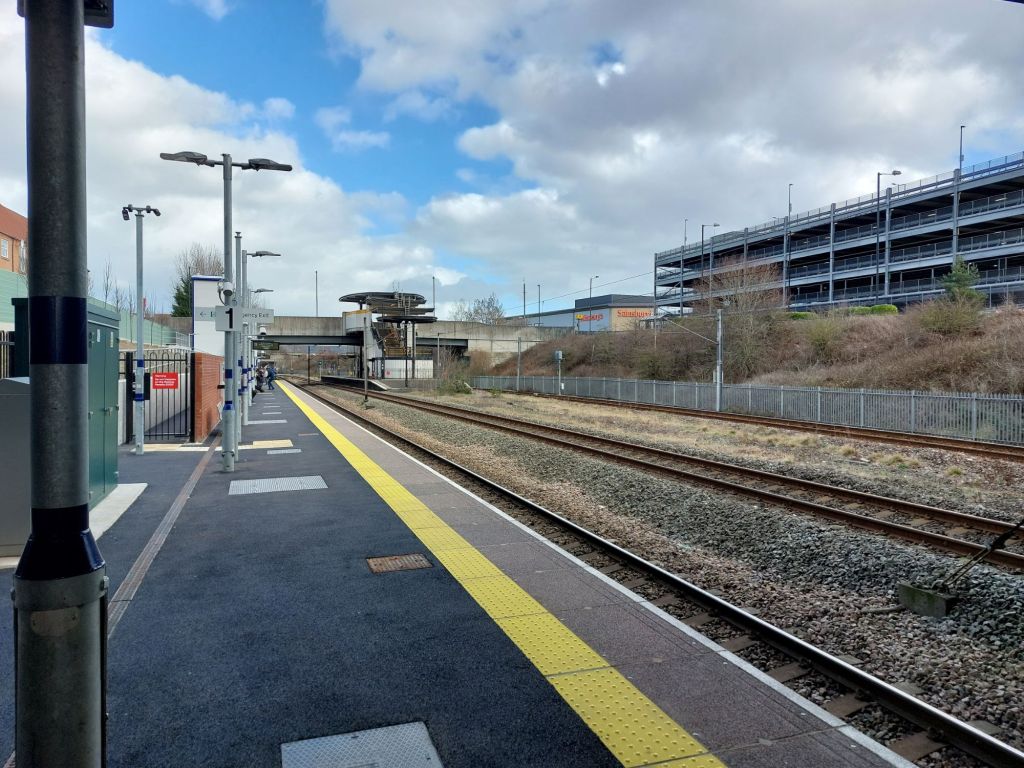
Looking around the new station
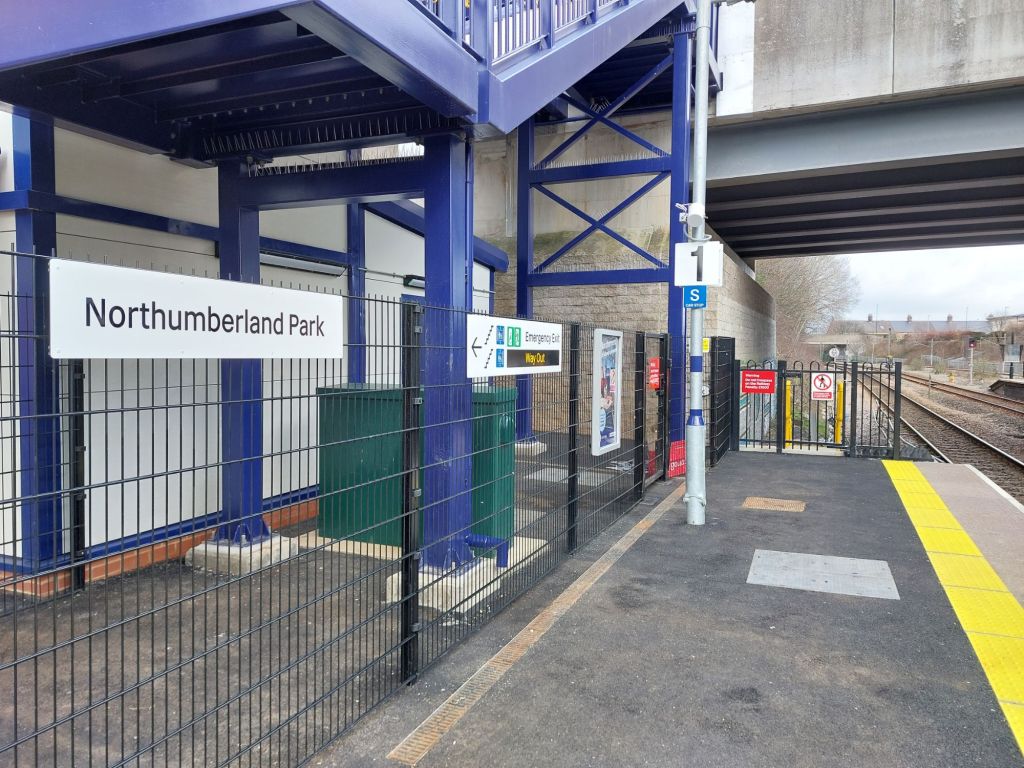
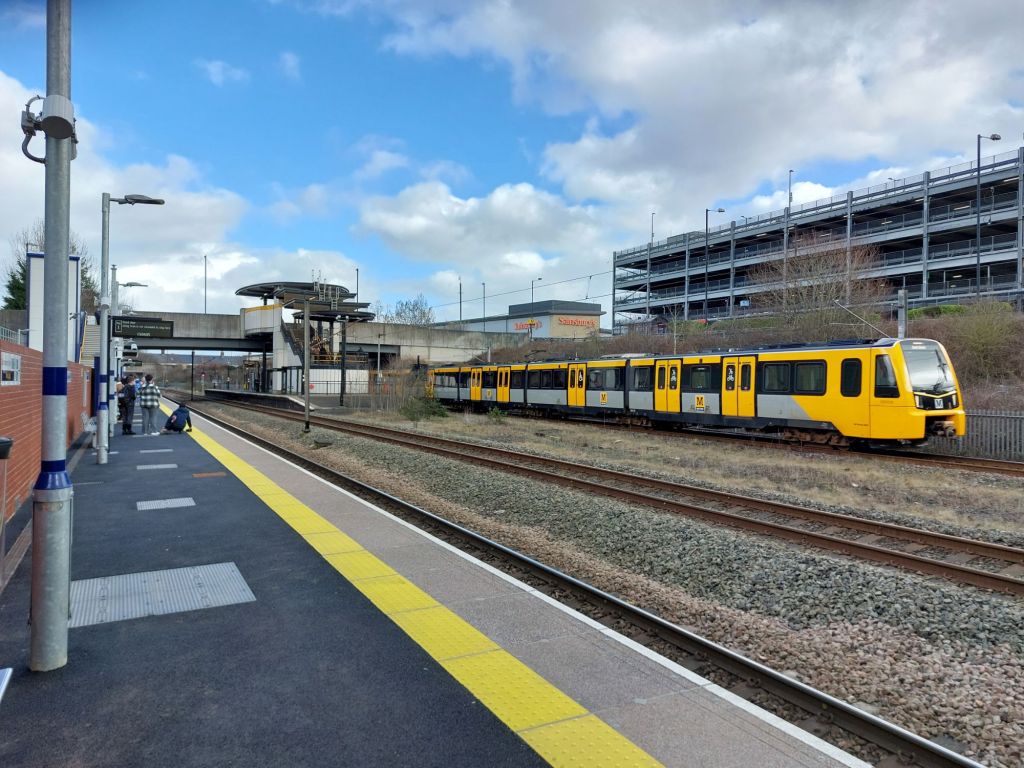
The station is, like all the others on the Northumberland Line a neat and functional station, not unpleasant in any way but a basic and hopefully hard-wearing design, especially given the likely bustle that this single platform will experience as an interchange between the ‘mainline’ trains and the Tyne and Wear Metro system.
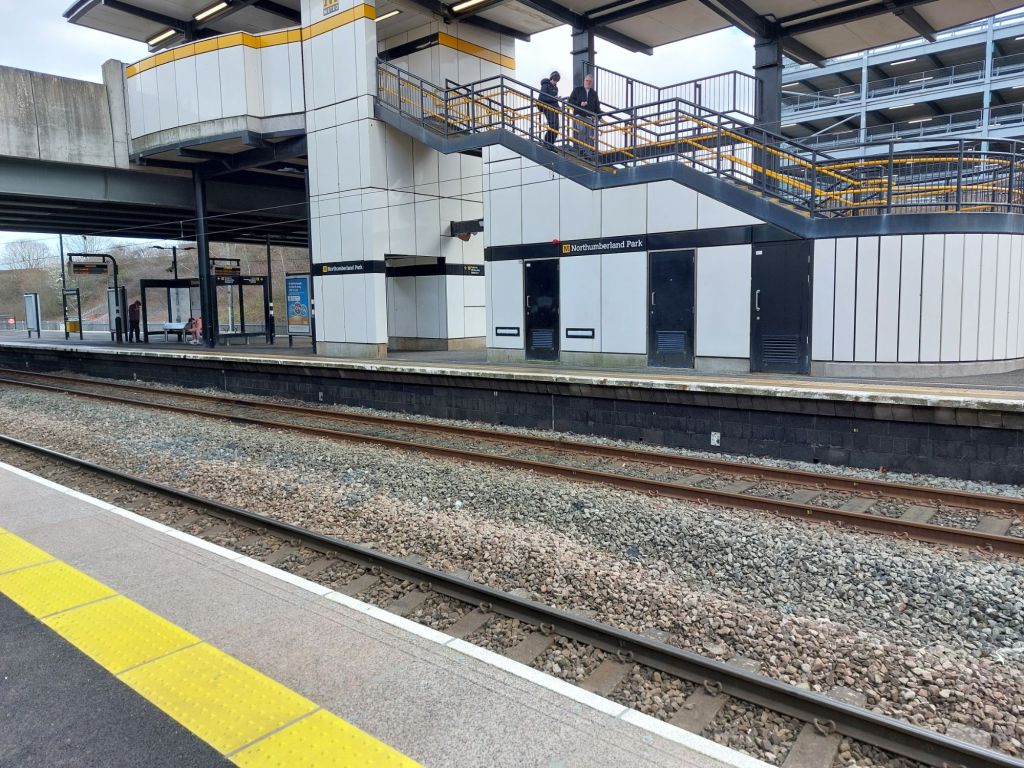
There has been some recent debates about the numbering of this new platform, which currently is number 1; whilst it is effectively parallel to the Metro, the high level of integration between the two systems in terms of the Pop card system, and here the physical closeness of the stations has meant that some have suggested that to avoid confusion (as there are two ‘Platform 1’ platforms in close proximity); that the new platform should have taken number 3 rather than 1, but that is a seperate issue.
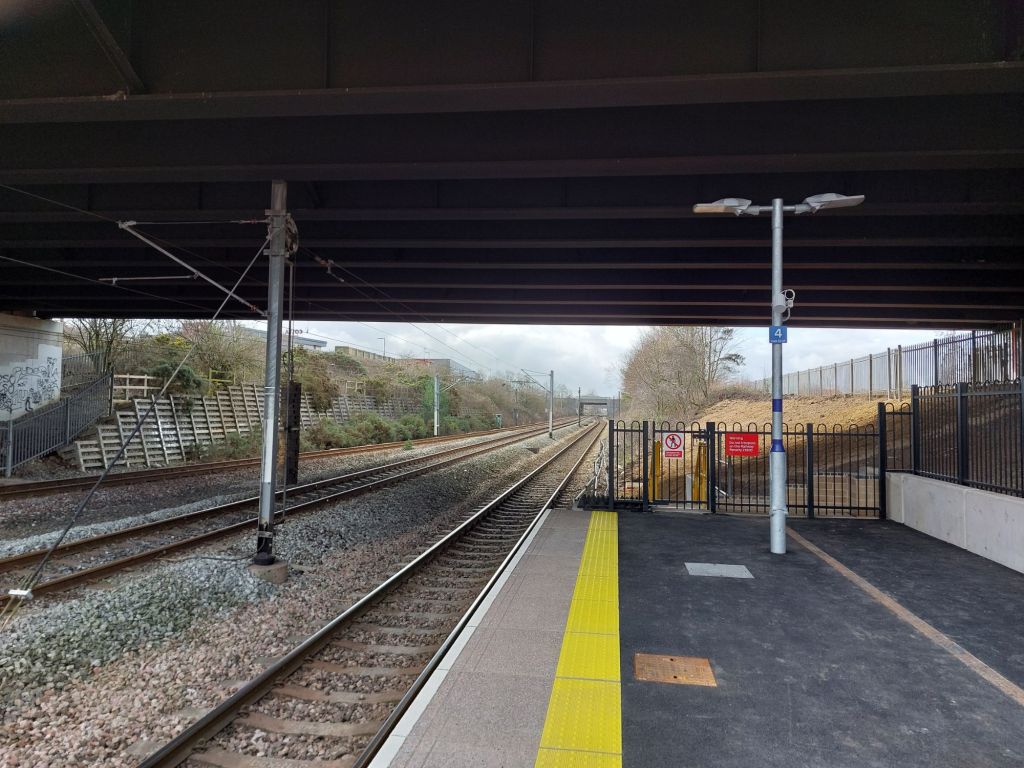
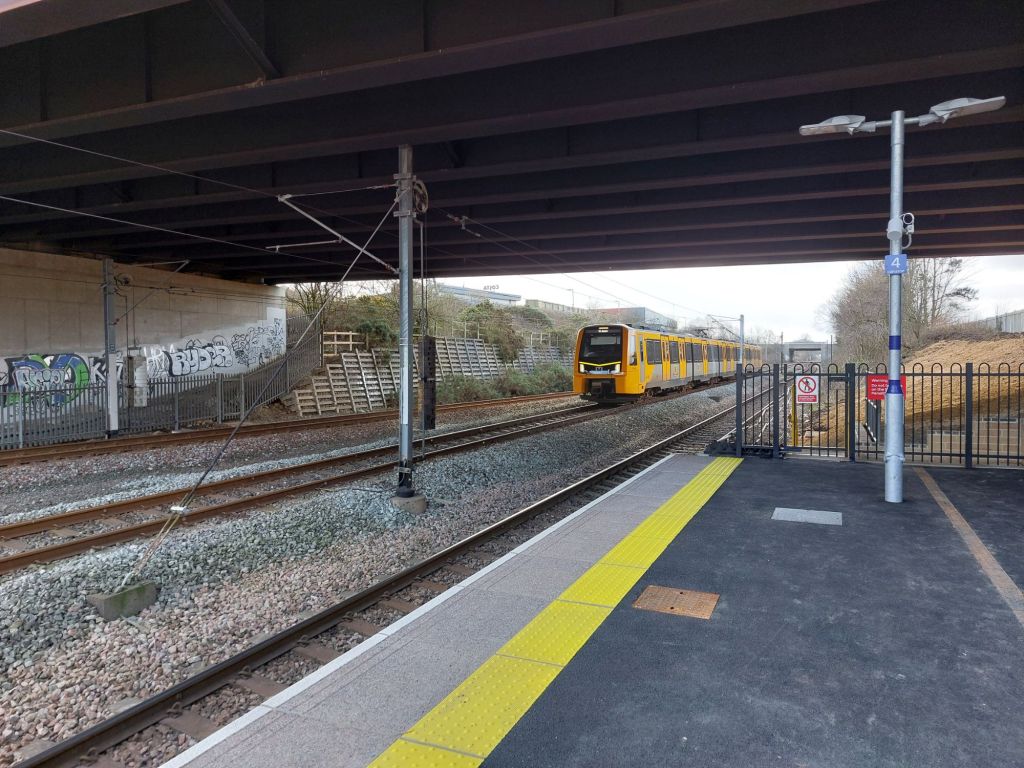
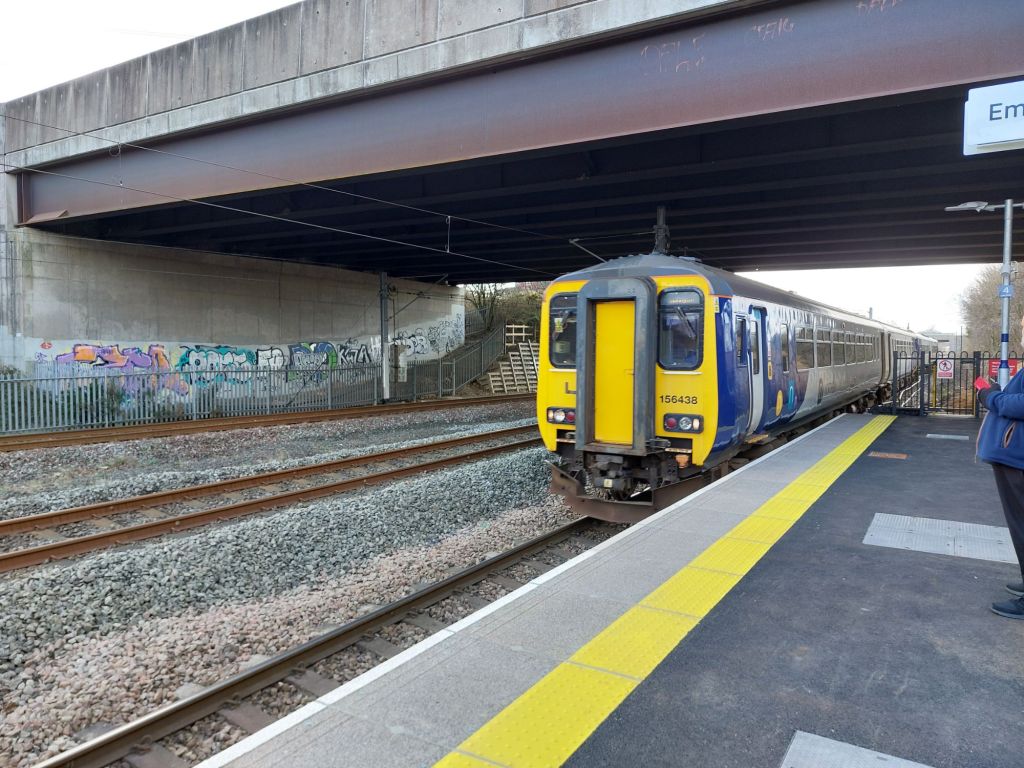
Room to lengthen the platform under the A186 in future??Two stations side by side, but very much function as one, and perhaps should be more recognised as one station serving two routes/systems in terms of platform numbering. Clean and functional design, but perhaps more could be added in future (canopies etc)?Looking towards the coast and the route towards BedlingtonThe Metro station from the new Northumberland Line station. Class 555 approaching Northumberland Park from PalmersvilleClass 555 leaving Northumberland Park headed towards Palmersville.156438 approaches Northumberland Park bound for Ashington.
A good foundation for building a bigger station?
All in all, this station will suit perfectly the intended design of four car trains calling at a suitable platform, and it is well placed to interconnect to the T&W Metro system serving the North Tyneside area, as well as local buses and much more.
There is, however, also a lot of apparent scope in my my view to make this station ideally placed for long-distance services; with ample room headed west under the A186 towards the A19 to extend the platforms for longer trains to call here, an extra 200m+ should be comfortably available before reaching the tight A19 bridge taking the road over the line.
As a temporary solution, systems like Selective Door Opening (SDO) could be employed to safely use the shorter length platform that is currently available.
Return to Toon
The unfortunately still late running 156489 returned for the trip back to Newcastle, and was VERY well loaded on the way into Newcastle, I elected to stand rather than even try looking for a seat, again showing the potential for the Northumberland Coast Loop as a solution to cope with more riders than available seats.
156489 arriving back at Northumberland Park for the third leg of the trip.
The late-running of third leg of the trip meant that my planned connection onto the 13:02 TPE service back to Alnmouth was missed by a good margin, passing me near Benton on the way into Newcastle aboard the Sprinter.
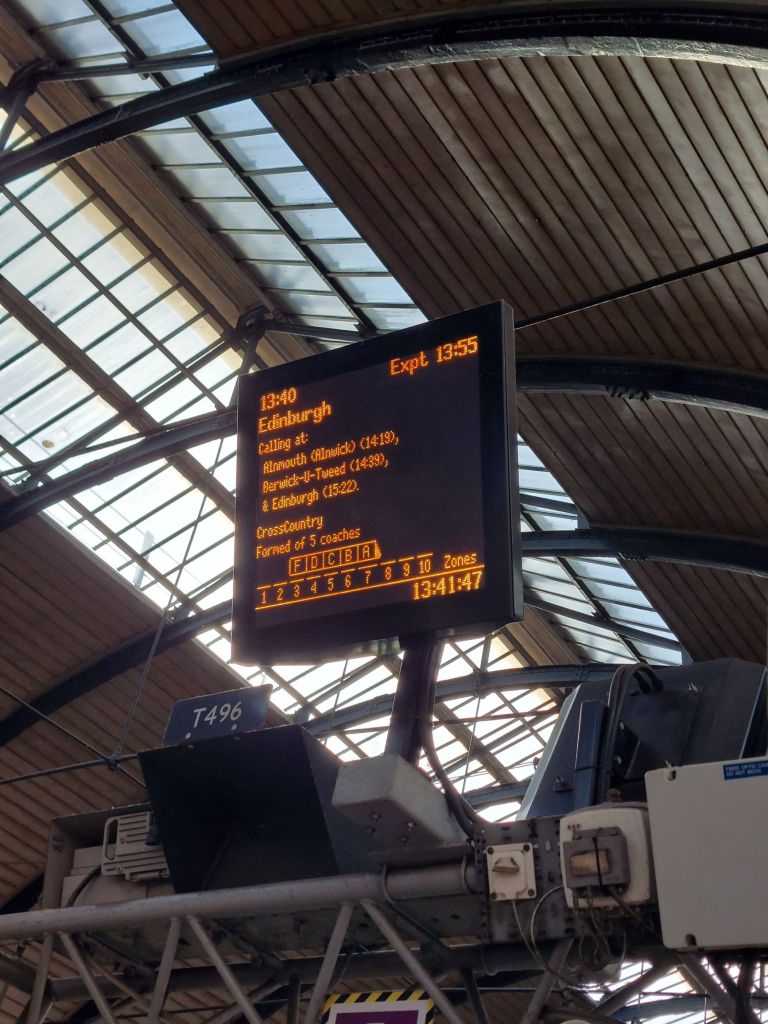
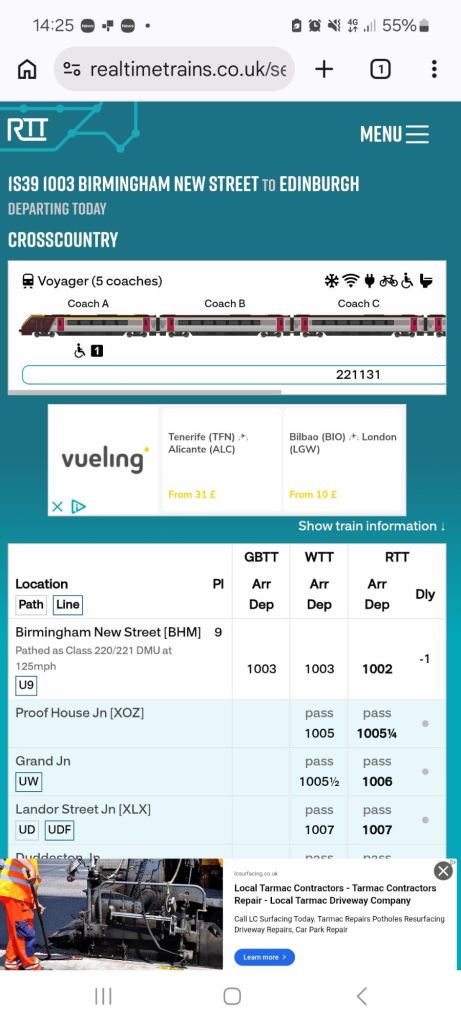
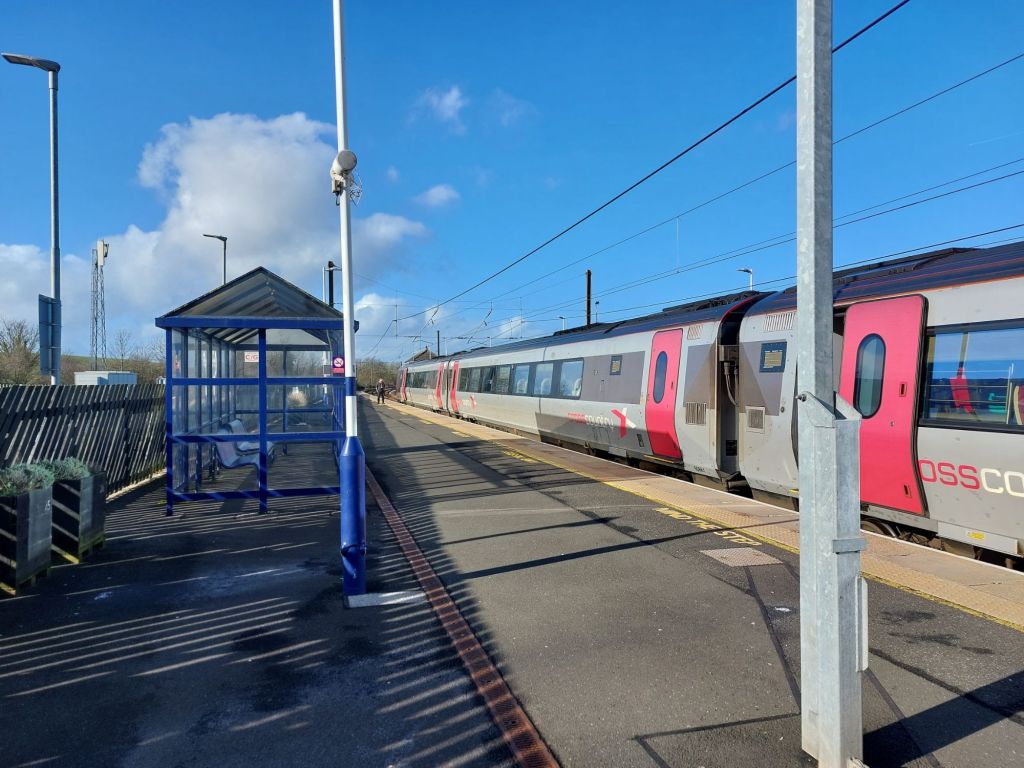
In the end, the fourth leg of the trip was completed aboard 1S39, the itself late-running CrossCountry service from Birmingham New Street to Edinburgh, which arrived at Newcastle around 13:55, nearly a full hour after my planned trains.
I would like to give a special shout-out to the station staff at Newcastle, particularly the lady who spoke to me for a while on Platform 2 to check my tickets and reassured me they’d be valid for travel aboard the CrossCountry train, before having a lovely natter during a quieter spell – splendid customer service and a lovely chat!
Arrival back into Alnmouth at c.14:19, about 30 minutes later than the planned trip. Back at Alnmouth to head home, a great day out, even if a little delayed!
In quick summary, it is great to see the Northumberland Line drawing closer to completion, now with only Bedlington station left to go (the closest to my childhood home), which itself opens on Sunday 29th March 2026, and again is very likely to be another venture out by rail to visit.
Whilst the Ashington to Newcastle/MetroCentre on Sunday service is proving massively popular (almost TOO popular!), I strongly feel that the next logical step is to introduce a long distance service that better links this newly reopened passenger line more broadly, and whilst doing so adding capacity and resilience to the network.
With a generally quieter Sunday on the railway and a less intense timetable, perhaps the Northumberland Coast Loop route could be a Sunday service to start with and develop from there? There are more potential paths available, and leisure travel on a Sunday is a potentially strong market, can our railway people make it happen?
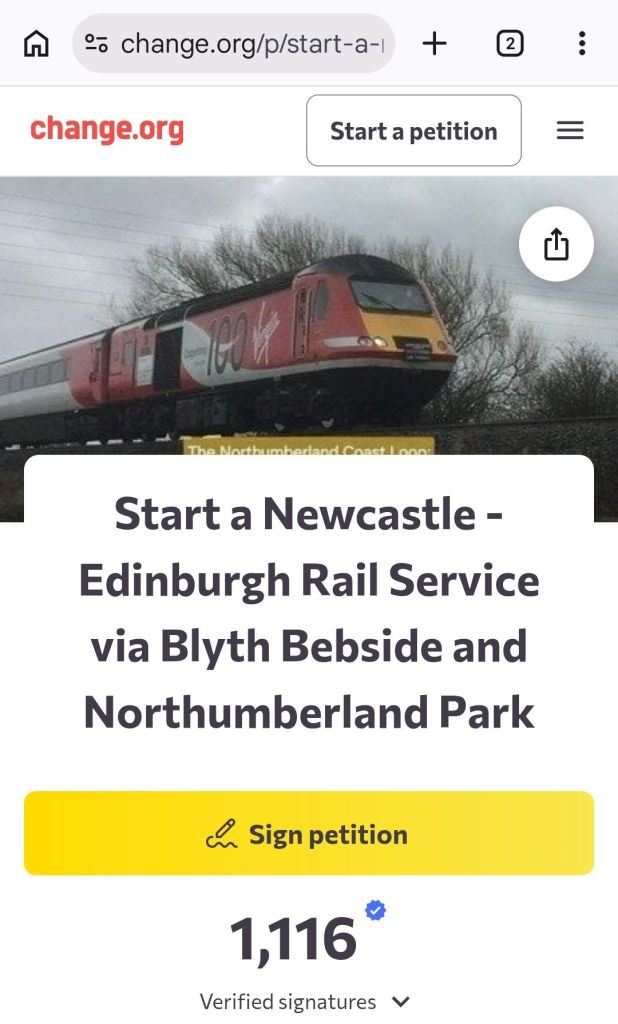
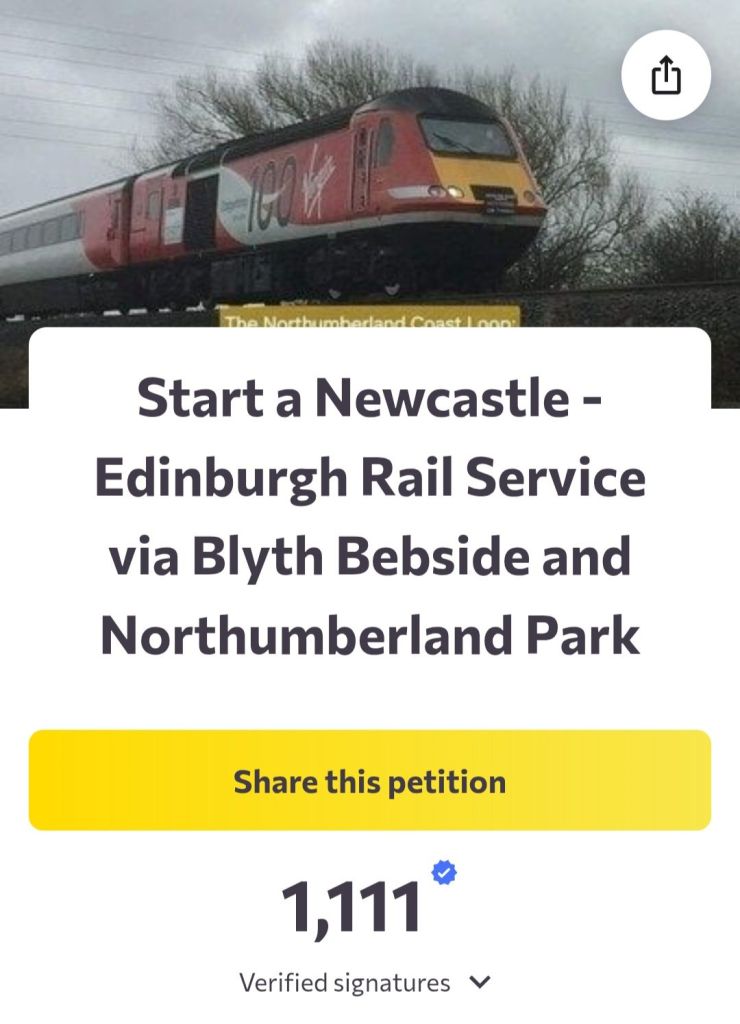
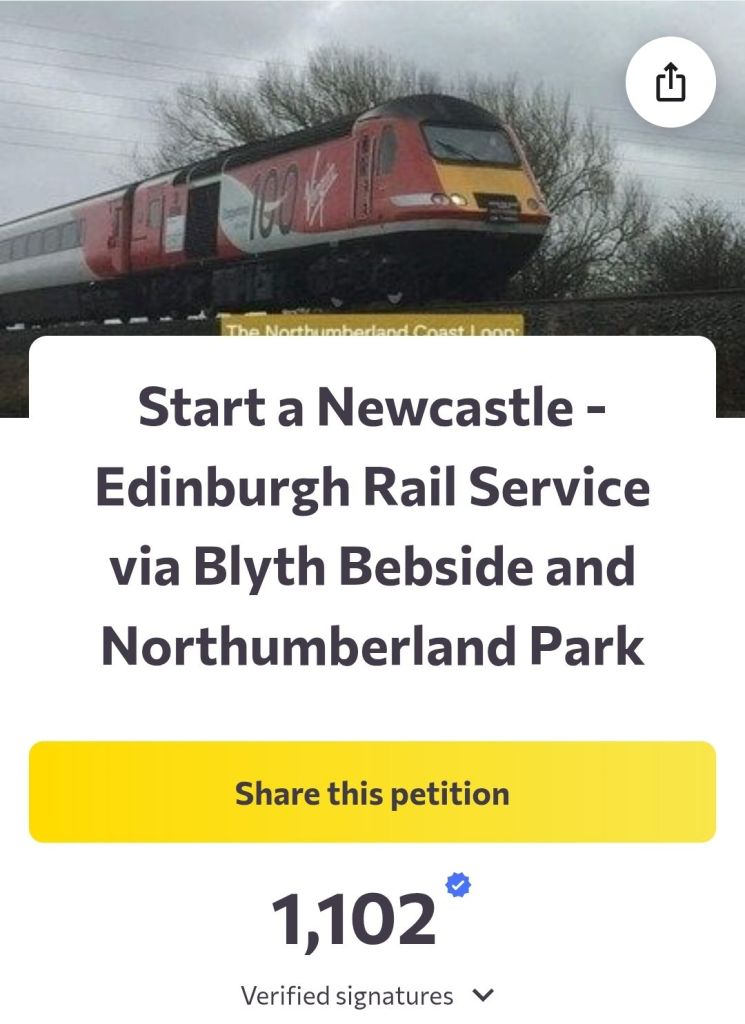
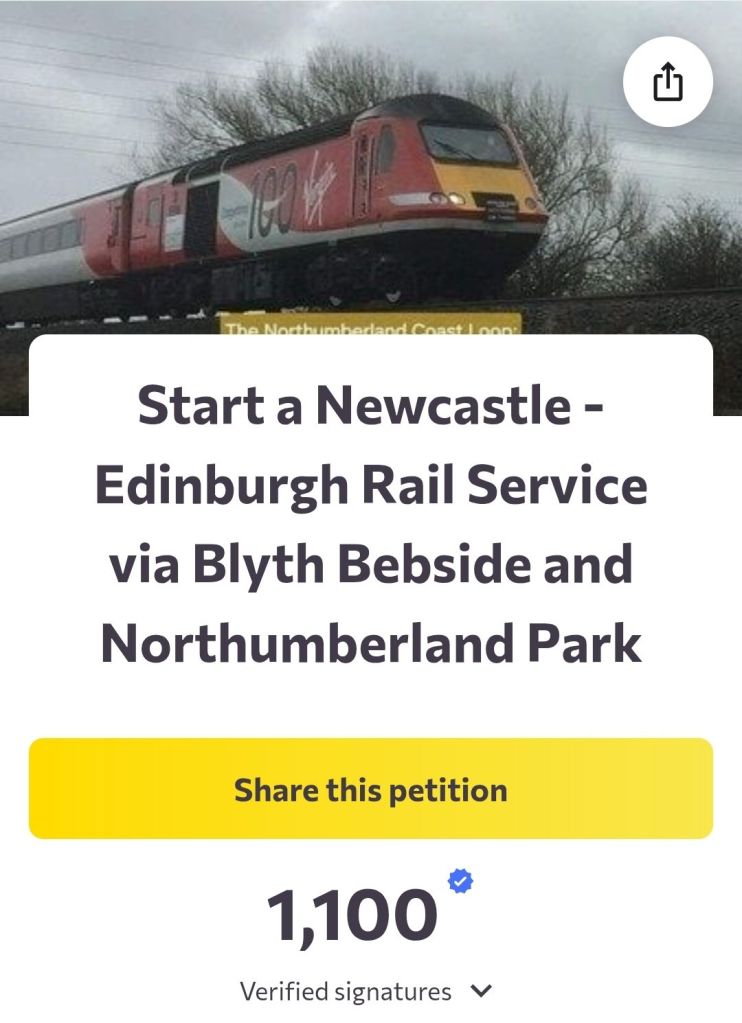
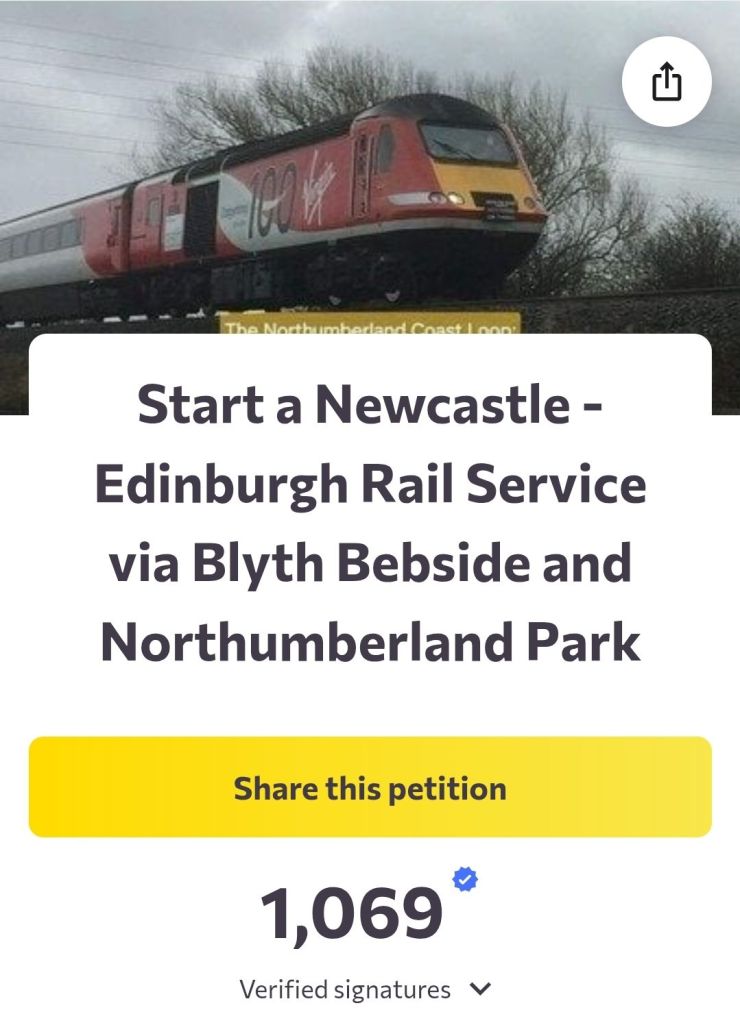
This is just shy of its first anniversary as a petition, it being launched a year ago tomorrow on 13th February 2025.
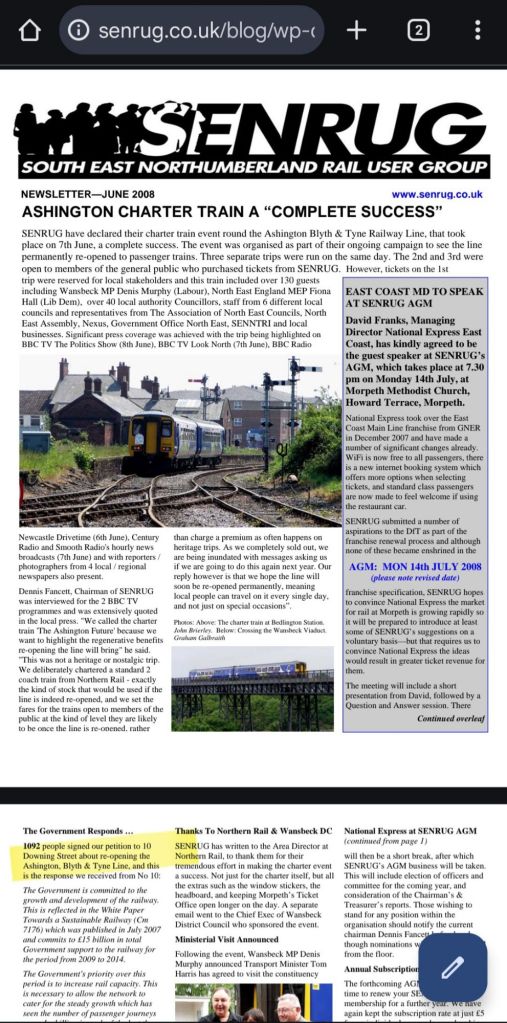
This compares well with the 2008 SENRUG petition to 10 Downing Street to reopen the Ashington, Blyth, and Tyne Line (the scheme later rebranded as the ‘Northumberland Line’, which had 1092 signatures according to their June 2008 newsletter, a line that has now carried over a million rail passengers since it opened in mid December 2024.
SENRUG petition for the reopening of the Newcastle to Ashington Line (later the Northumberland Line) had a petition with 1092 signatures when submitted to 10 Downing Street, a number the NCL petition has now exceeded)
This demonstrates the clear desire for such a link to be established for the first time; it never being a link before 1964 when the line originally closed to passengers, ALTHOUGH this nearly did happen in the Victorian era due to the North British, and the Blyth and Tyne Railway’s attempt to set up a Newcastle to Edinburgh route via Bedlington, then through Morpeth, Scots Gap, Reedsmouth Junction (which would have been built differently to be direct north to east, not east to south as actually built), then through Kielder, and on to the Waverley Line at Riccarton Junction to reach Edinburgh via Tweedbank!
This latter route never happened as the North British gained the Border Counties route from Riccarton to Hexham and onto Newcastle ahead of the route via Scots Gap and Morpeth.
Today, the Border Counties and ‘Wannie Line’ from Morpeth to Reedsmouth Junction are long gone and extremely unlikely to ever return (Kielder Water is now in the way for example), BUT leaving Newcastle, there are two potential routes as far as Pegswood; the existing ECML via Morpeth and Cramlington, and the newly reopened Northumberland Line as far as Bedlington, then the link via Choppington to rejoin the ECML heading north, which forms the Northumberland Coast Loop (NCL)
This second route, taking in Northumberland Park, Seaton Delaval, Newsham, Blyth Bebside, and Bedlington would serve a large population north and east of Newcastle; Northumberland Park for example will be the only ‘mainline’ station in the North Tyneside area since the late 1970’s, and Blyth Bebside will serve the largest town in Northumberland (Blyth) directly, whilst also offering easier links to other major local towns like Cramlington, Ashington, and Bedlington, easily accessed by a range of modes of transport, such as walking, cycling, buses, rail, or driving, and much easier in many ways than travelling to Morpeth to use the station there.
Again to compare the petition success with later results, the 1092 people who signed the SENRUG petition were highly vindicated by the success of the Northumberland Line opening 16½ years later and carrying close to a million after just a year of operation; hopefully the N.C.L. route will be far faster to become a reality than needing to wait 16½ years, as it is a far more modest proposal to simply use an existing and working railfreight link between two busy and well used passenger lines to provide a new long-distance through service?
An excellent episode on Railnatter last night on the complexity of the UK rail network in England, Wales, and Scotland. Important to note is that a lot of this complexity is inherent to the system, but as inferred to in the video there may be some scope to simplify some parts by reducing the overall number of separate organisations and bringing certain things ‘in-house’ that are presently contracted out.
A fascinating watch and some great information on both obvious and obscure job roles on the railway network, train drivers are an obvious example, but perhaps being a railway chef wouldn’t spring immediately to mind?
Railnatter 295: Why the British rail industry is SO complicated
In my own limited experience of operations on a heritage railway, the complexity of running just one train on one line on a single day is easy to see, numbers in brackets refer to job role numbers.
In the main, this was volunteer labour, but the only real difference between a volunteer and a paid employee in a safety critical context is the absence of a financial payment for their time, everything else is identical in terms of standards of work expected.
Operarions Management: Duty Officer (1), Person In Charge of Incidents (2).
Train crew: Driver (3), Fireman (4), and Guard (4).
Signalling: Signaller (5), Crossing Keeper (6).
So to just operate one train on the railway for a day needed six operational staff at a minimum; and more trains would mean more train crews needing rostered, so a two train day would jump to 9 staff and so on.
All of the above is underpinned by other staff, an obvious example being staff in the shops who sell tickets alongside tea and cake (arguably just as important as coal and water for the loco!), so perhaps another four staff can be added just on the ‘commercial’ element, taking the total to 10 people to operate just one train calling at two staffed stations on one day.
All of the above is further supported by other teams of people; the people who maintain the locomotives and carriages, the track, the signalling system, the fabric of the buildings themselves, then there are those who sort out orders for things as diverse as coal, cake, tea, track components, cleaning cloths, oil, toys, books and much more besides, then all the records being maintained, accounts being compiled and much more, then there are specialist contractors who’d be organised to do certain jobs such as welding inside of boilers.
In my decade or so of volunteering, I’ve operated a level crossing, been a passenger train guard, operated a signalbox, but also been under locos, carriages, and waggons undertaking repairs, as well as occasional stints serving tea and coffee; just one a very large team of people helping get trains out and steaming along a short heritage line, and an interesting insight into the impressive effort of keeping a heritage line going.
For the paying passenger, all of this relatively massive complexity isn’t seen; they walk across to a quaint station building, buy a ticket, and a cup of tea, and wait until the train rolls into the platform, the guard opens the doors and they board the train, the doors slam shut, the whistle goes and away they trundle.
While the ‘big railway’ is obviously quite different in how it operates, there is a much greater scale; thousands of trains working to intensive timetables around the clock at speeds of up to and perhaps beyond 125mph, needing hundreds of signallers, thousands of train crew and many more to operate major stations.
A part that perhaps is omitted from the structure outlined by Gareth Dennis in his Railnatter episode above is the role played by myself and others as campaigners who are lobbying for improved rail services; in the case of this campaign for a totally new rail route to be established to better connect the Northumberland Coast overall, while others like CRAG (Chathill Rail Action Group) campaign for better rail services at a single station, some like SENRUG and the Campaign for Borders Rail (CBR) have had great success in seeing whole lines reopened to passengers, and in the case of the Borders Railway, one revived from total closure.
These groups will largely act through other bodies such as Northumberland County Council (local authorities), or devolved transport organistions to see their wishes for better rail services hopefully implemented.
Again a very interesting video from Gareth Dennis and his Railnatter series to look at the underlying structure of the rail industry and hopefully bring about more understanding of it.
Some key takeaways:
1. Railways need to be internally better integrated: more in-house employment of staff such as cleaners to allow easier career progression (i.e. cleaner > guard > driver > management)
2. Railways are part of broader sustainable transport: integration with other modes such as Metro, buses, ferries, active travel, and moreas part of a holistic system is a key part of the thinking, not just as a single mode of transport in isolation.
3. Sustainable transport needs to be politically integrated at all levels, some parts of the system should be much more locally devolved where appropriate (i.e. Nexus might have more control of rail/buses/other public transport at a local level than they do currently.
Thank you to all who have signed it thus far, and please add yours ASAP if you haven’t already, as the first anniversary of the petition is approaching on the 13th February 2026 and it’ll be great to see how well it has done by then!
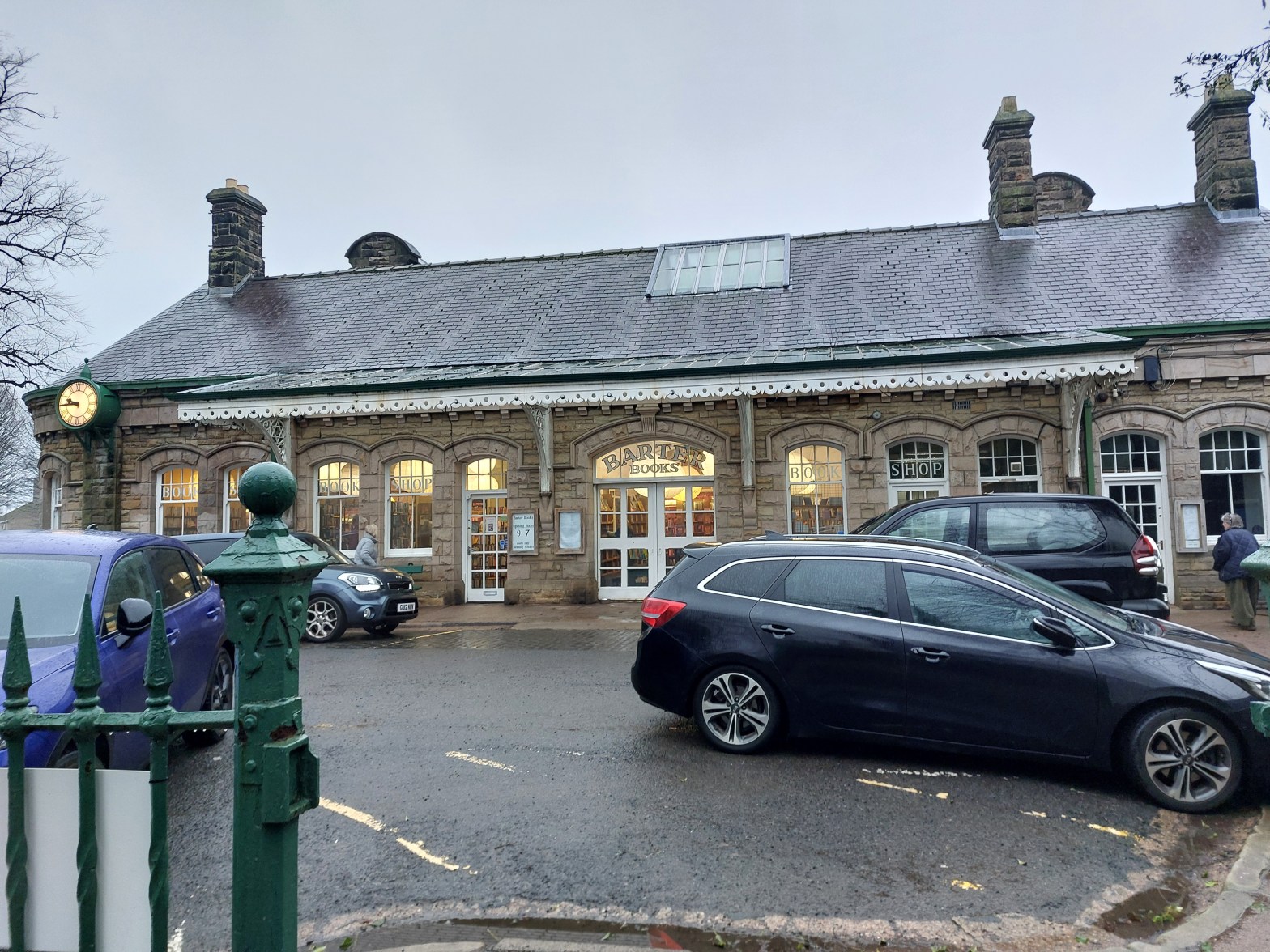
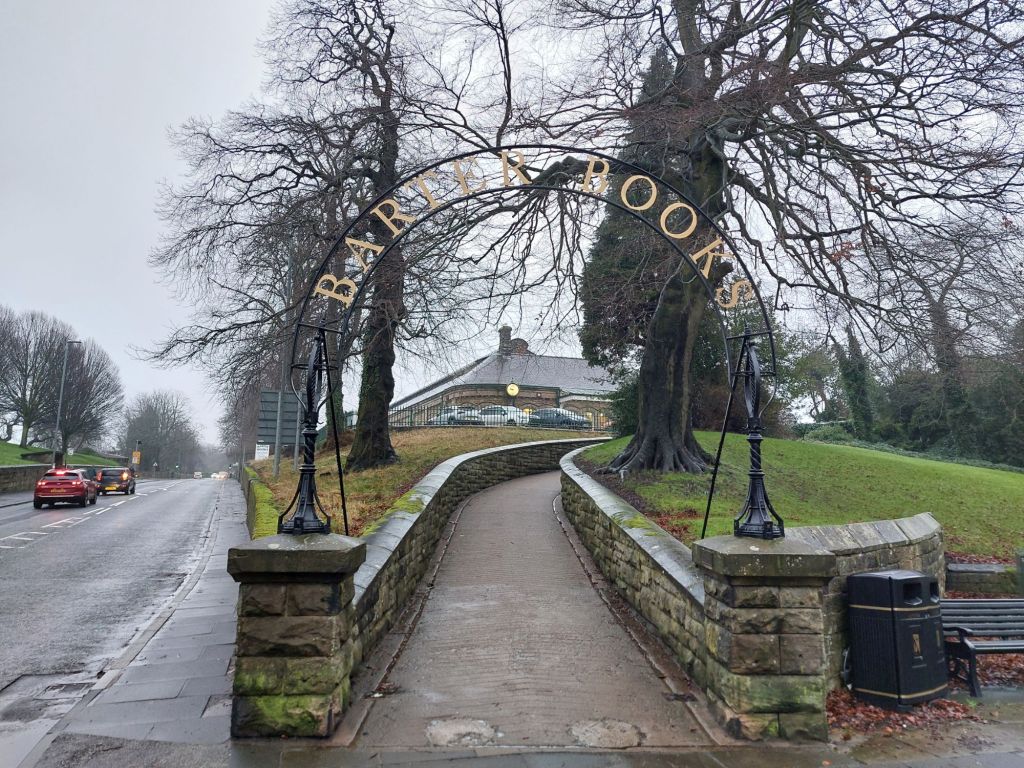
Yesterday, I joined John from the Chathill Rail Action Group (CRAG) for a coffee and a chat about Chathill station, and the wider context of the ECML, the Northumberland Coast Loop and more besides in the brilliant surroundings of Barter Books, housed in the original Alnwick station.
Could the fortunes of Chathill change in 2026, a year that marks 75 years since the demise of the North Sunderland Railway in October 1951, and Chathill ceasing its status as a junction, to just a small, rural station since then, and one that presently is arguably under served?

 The Northumberland Coast Loop