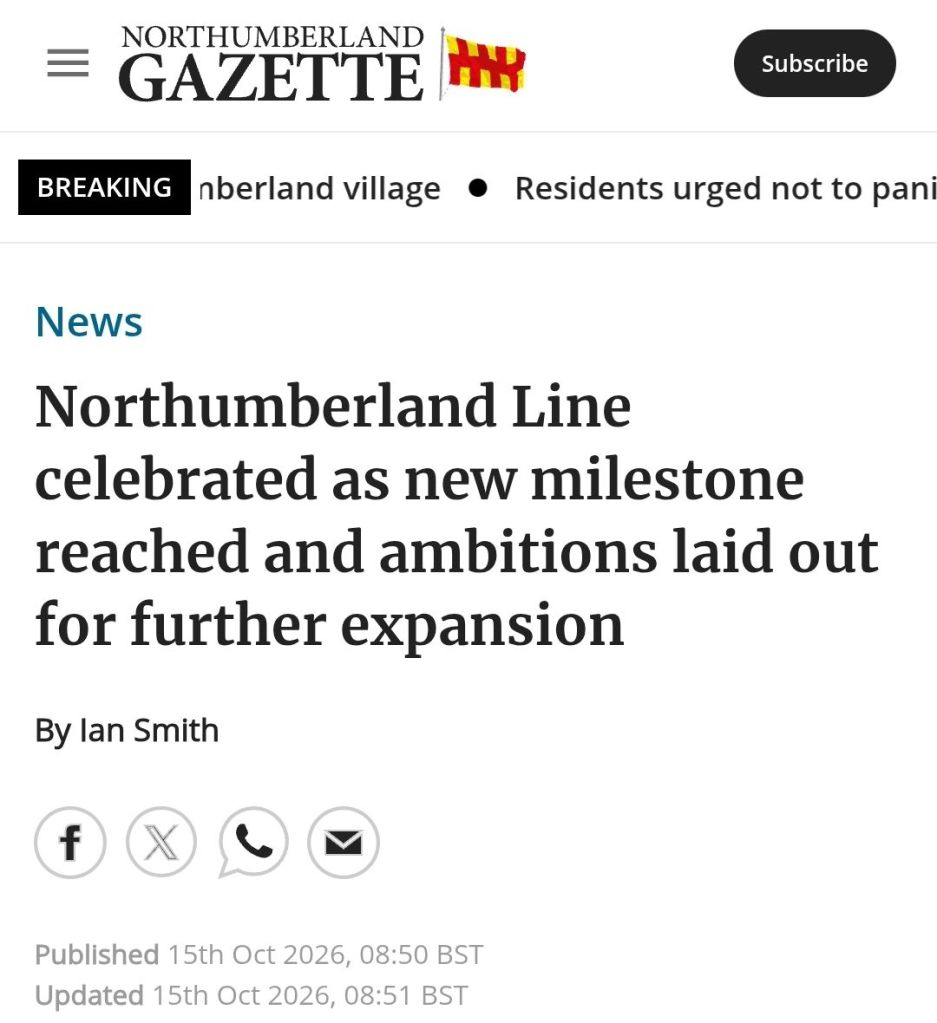
In recent news announced in the Northumberland Gazette, the Northumberland Line has now surpassed two million passenger journeys since opening on the 15th December 2024.
This is a phenomenal result for a line which didn’t have the easiest of openings; with the opening of the line much delayed, and stations coming into service at different intervals, opening with just Ashington and Seaton Delaval, followed by Newsham, Blyth Bebside, Northumberland Park, and finally Bedlington, the latter only opening back in March of this year.
Despite this sometimes tortous opening, the line has clearly proven itself to be an enormous success story, and vindicates completely those who have campaigned for the return of passenger services over many years.
It certainly isn’t the ‘white elephant‘ that the few detractors of the scheme claimed it would be, interestingly many now pivoting to the opposite position that the line should have been better prepared for higher volumes; you couldn’t make it up!
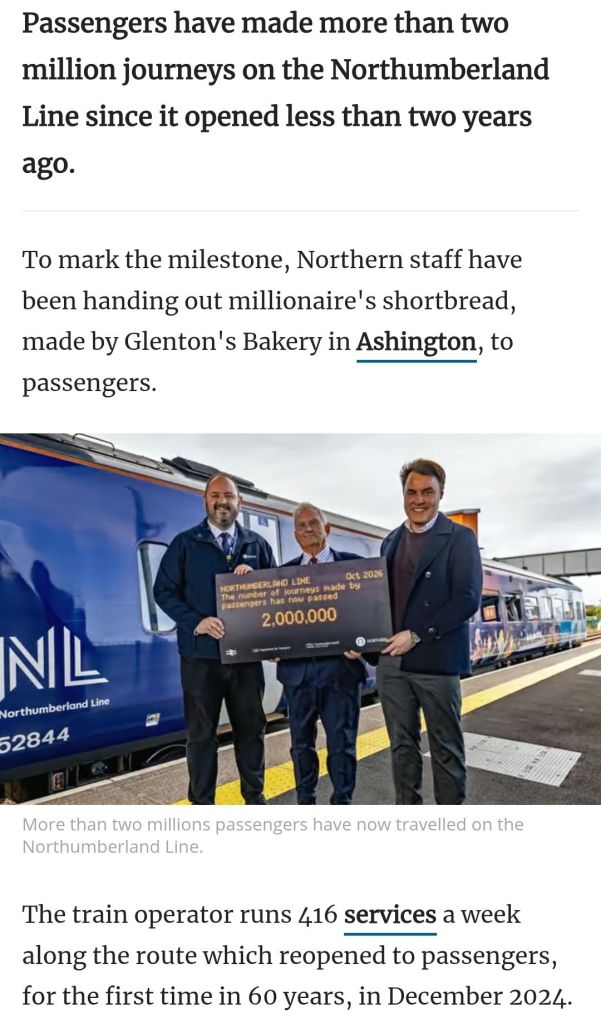
This very welcome high volume of passengers has presented some issues; many of the 416 weekly services are well filled, and some to almost bursting, with the shortage of units such as the ageing Class 156 & 158 trains, built by British Rail in the late 1980’s and early 1990’s (around my own age) being increasingly hard to resource as more lines have reopened in recent decades and stretch this fleet across more and more routes.
‘Sprinter’ replacements to come in the future
In the longer term, the solution is coming with a replacement fleet for these ‘Sprinter’ trains, which hopefully will be a fixed three or four car unit so that every train will have the maximum capacity possible on routes such as the Northumberland Line.
Current capacity of a two car Northern Class 156 is 146-152 seats, whilst a two car Class 158 has 138-142 seats, depending upon their internal layout.
This means that a pair of Class 156 units (four carriages) could give a maximum seating capacity of 292-302 seats per train, with a pair of Class 158’s between 276-284 seats per train.
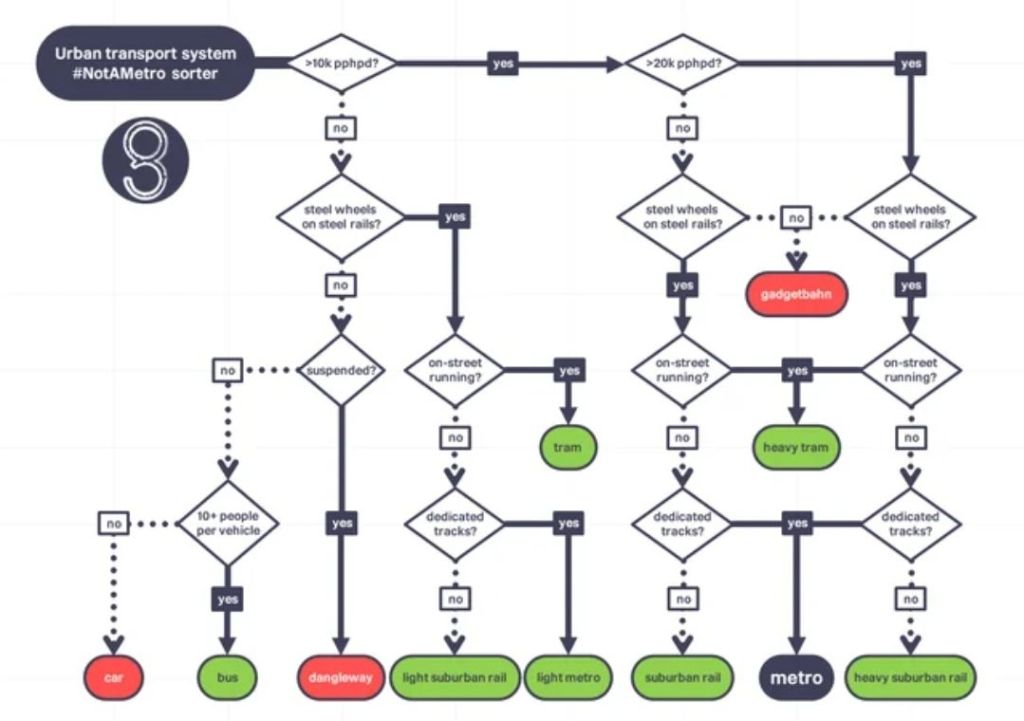
With two trains per hour in each direction, that would give a current ceiling of capacity at around 604 seats per hour per direction (pphpd), which using the ‘Not a Metro’ sorter below by rail engineer and author Gareth Dennis, would place the Northumberland Line as a light surburban rail system.
With standing passengers, the real capacity of these trains is higher, but the internal layout of the Class 156/158 isn’t really designed for standing, being more suited to longer seated journeys of an hour or more, not a c.35min max trip between Newcastle and Ashington – as a mostly short shuttle line, a unit more designed for standing passengers is probably the way forward.
If a new train similar to the Class 555 Metro was to be provided on the Northumberland Line, these have a higher overall capacity of 600 passengers per train, which on the current half hourly timetable could give upto 1200 pphpd, roughly doubling the capacity of the Northumberland Line as it stands today, still well within the light suburban rail category, but a massive improvement on current capacity.
Electrification of the Northumberland Line is probably another sensible step if new trains are to come, but this should be done to the 25kV AC standard used on routes like the East Coast Main Line (ECML) and not the Metro system 1500v DC overhead; the Metro system is unique in the UK, which means trains are bespoke to that system, whereas 25kV AC is used widely around the UK, and opens up a wider range of rolling stock that could be used; important for expansions to the route that are outlined below.
Northumberland Coast Loop BEFORE the Newbiggin extension?
The Northumberland Coast Loop route (Newcastle to Edinburgh via Blyth and North Tyneside) might be useful to implement ahead of the Newbiggin extension for a number of reasons which I’ll outline below;
Newcastle Central to Bedlington
This first section is the Northumberland Line of today, which has proven itself well in just 22 months by carrying 2 million passengers, an average of 90,909 people per month is a strong start!
Providing more line capacity on this stretch of track will likely prove key; double tracking of more sections, as well as increasing capacity of the Newcastle Central to Benton Junction stretch of the ECML is likely to prove vital, and as stated earlier, wiring the route to 25kV AC is also likely to prove a worthwhile venture; relying on heavier diesel or battery electric trains will be a poor substitute for lightweight all electric trains (perhaps with small emergency use traction batteries to reach next station/depot), which could offer much better acceleration and braking to cut journey times and increase train frequencies.
Bedlington to Morpeth North Junction
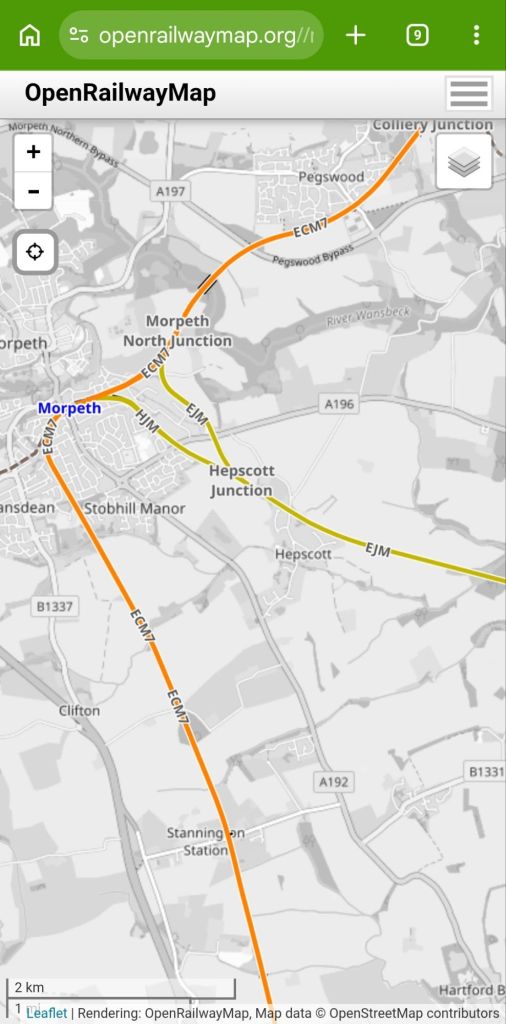
The second section is from Bedlington to Morpeth North Junction (near Storage24 on Coopies Lane, Morpeth, NE61 6JT), which has offered a direct route from Blyth to Berwick and Edinburgh since 1980. This section is currently freight only, but has been used for railtours such as ‘The Seven Counties Rambler’ back in March 2024 which followed the whole route, but this could arguably have been a useful link over a century earlier.
A link 100 years too late?
Had this curve been built back in the 1880’s, when first proposed by the North Eastern Railway, rather than a hundred years later when it was actually completed, then maybe towns such as Blyth, the largest in Northumberland, would have gained long distance services decades ago, and may even have retained passenger trains after the post-war cuts (Beeching era especially).
Blyth, as a major industrial town would almost certainly have commanded direct links to Scotland, as would the industrial areas of North Tyneside, but a direct link would also have been a major boost to special trains that ran to areas like Whitley Bay well into the 1960’s, as shown in this screenshot of a direct Whitley Bay to Glasgow Queen Street special needing to perform an awkward reversal at Morpeth Station due to the then track layout.
This is why Northumberland Coast Loop services are not proposed to stop at Morpeth station, a reversal like this is awkward and time-consuming, which would jeopardize the ECML timetable by taking too long to complete within the station at Morpeth.
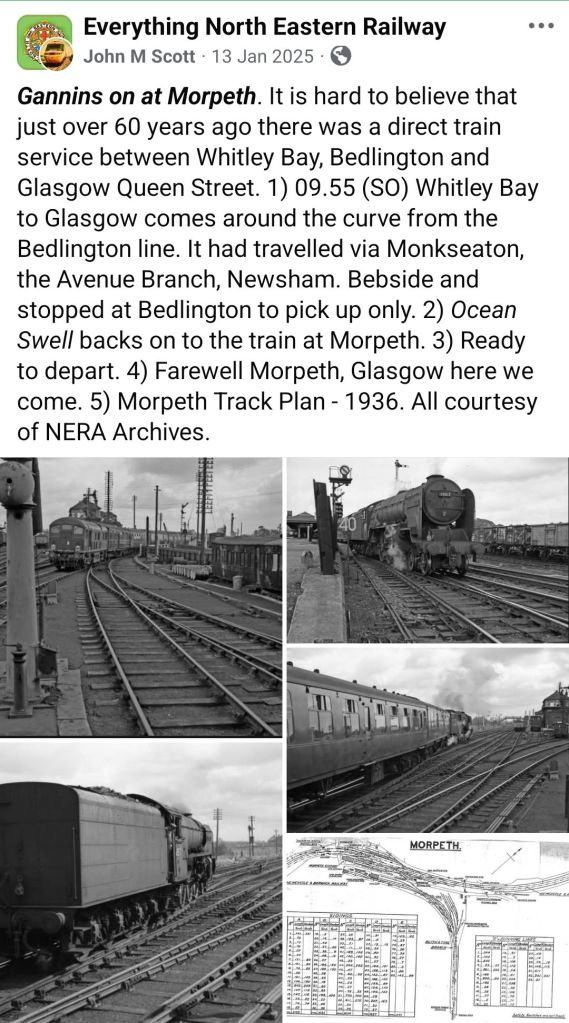
Just imagine how much easier it would have been for 60517 ‘Ocean Swell‘ to have steamed straight from Bedlington to Berwick, then on to Glasgow via the Morpeth North Curve had it been built… quite why the wealthy NER hadn’t built this curve back in the 19th Century is a mystery…
Morpeth North Junction to Edinburgh
The third section is the East Coast Main Line (ECML) from Morpeth North Junction to Edinburgh. This line is obviously used by a large number of passenger trains daily, and has some capacity constraints, but ones that are not insurmountable.
The recent Railnatter 322 by rail engineer Gareth Dennis (who also created the ‘not a Metro sorter’ above) shines some light on the capacity issues on the ECML, and some of the solutions he puts forward I would agree with, some I would disagree with.
In broad terms, I would agree with:
- Expansion of line capacity between Newcastle and Bedlington such as quadrupling Newcastle to Benton Junction, and further doubling of the Northumberland Line to Bedlington, Morpeth etc. One thought would be to keep the slow lines to the south side of Central Station and east side of the ECML to avoid need to cross from one side of the fast lines to the other, as well as putting Heaton Depot on the slow line side for ECS movements etc, but also to enable more through routes from N’land Line to Tyne Valley Line, Durham Coast & Leamside Line, and in time slow lines to Team Valley via Bensham Curve?
- Building the Morpeth Diversion to enable fast trains to bypass Morpeth and Pegswood stations, which frees up line capacity through both stations, as well as creating more paths for services such as the Northumberland Coast Loop to join the ECML, or local services passing through Morpeth to head to Bedlington and beyond.
- The building of a new platform at Morpeth (Morpeth Bay) to allow termination of Newcastle to Morpeth via Bedlington services is also welcomed, as it would also allow an uplift to services on the ‘core section’ of the Northumberland Line between Bedlington and Newcastle.
- Rebuilding stations where possible to allow them to have loops at the platforms rather than trains stopping on the mainlines as they do at present, which both reduces the capacity of the ECML, and the number of services that call at intermediate stations. Alnmouth is a good example where relocation southwards would allow use to be made of the existing loops, but also could deliver a station accessed directly from the A1068 rather than South View/Curly Lane which would ease traffic and parking issues on these roads, as well as enable better bus/coach interchange. Provision for the Aln Valley Railway to extend south into a new station on the loops could also be factored in, with a bonus being a terminus with a grand sea view rather than in a cutting, and may also enable a mainline connection for the line, which could in turn enable railtours directly into Alnwick.
- A new station at Belford is most welcome, but I would also add a second at Beal, again making provision for four tracking there too, which would not only serve Lindisfarne (Holy Island), but also major caravan sites such as Haggerston Castle more directly by being within easier walking/cycling distance
Areas where I would disagree with Gareth would be:
- Closure of stations at Pegswood, Widdrington, and Chathill would be unwelcome – though there is nuance in this; Pegswood would be bypassed by the Morpeth Diversion, so would be less affected by fast through trains, and is in a strategic location near to the A197 Pegswood Bypass to create a Pegswood Interchange for buses but also could be augmented by a well sized car park for the rural hinterland north and west of Morpeth, which could be used as both a railway car park but also as a Park and Ride into Morpeth, helping to reduce in-town road traffic. Widdrington is, I would agree relatively poorly located, and may benefit from relocation northwards nearer to Stobswood, especially if the four tracking at Chevington could be extended down to Stobswood, and could be combined with a realignment of the B1337 to take through traffic out of Widdrington and over a bridge adjacent to a new station near the brickworks site, this four tracking could also be extended north to also connect a slightly relocated Acklington, so both stations would sit adjoined by slow lines parallel to the fast lines. Chathill is another station that I would oppose closure of, especially given its surviving historic fabric; here I would suggest that the current up platform (with waiting shelter) be converted into an island platform, with central slow lines and outer fast lines, and for the road through the hamlet of Chathill to be realigned southwards, but make the station accessible via footbridges to both sides of the line, with wider road improvements such as straightening tight bends on roads leading to/from the station making access easier.
Newbiggin will take time to build; whereas the Northumberland Coast Loop could be a quick win.
This route is fully intact and available for traffic compared to the Newbiggin line which if entering the town of Newbiggin itself will require a rebuilding of the branchline from Woodhorn, which means the old embankment having to be raised up to the level of the current freight line between Ashington and Lynemouth power station to be able to cross the A189 either on a new bridge parallel to the existing one, or more likely, from a junction just east of the current bridge down into Newbiggin, as can be seen from the hand-drawn map below discussed at a Railfuture North East meeting I attended in September 2026.
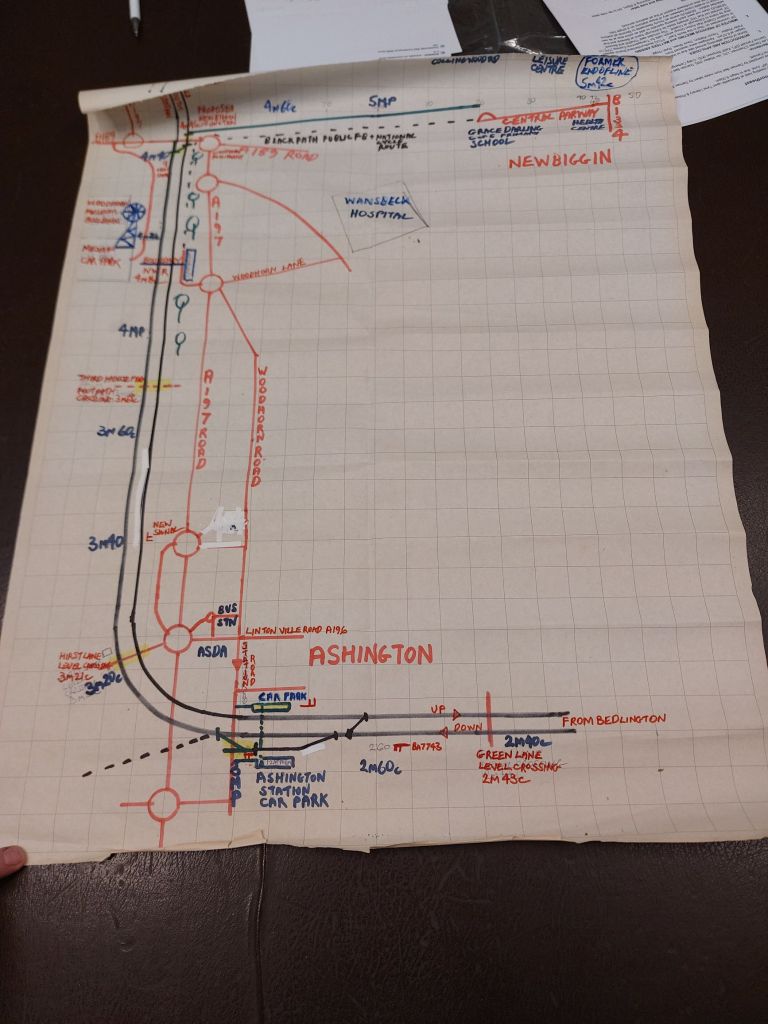
The rebuilding of the line into Newbiggin, even if given the go-ahead today will take a fair amount of time to design and build, whereas the route from Bedlington towards Berwick through Hepscott is available almost immediately by comparison as it is an active freight route.
ECML rolling stock via Blyth to boost capacity?
This wider range of rolling stock is the second element of the proposal; there are a large number of trains plying between Newcastle and Edinburgh via the current ECML, but a few of these could instead run via Blyth (also serving Cramlington, Bedlington and more).and Northumberland Park (serving wider North Tyneside).
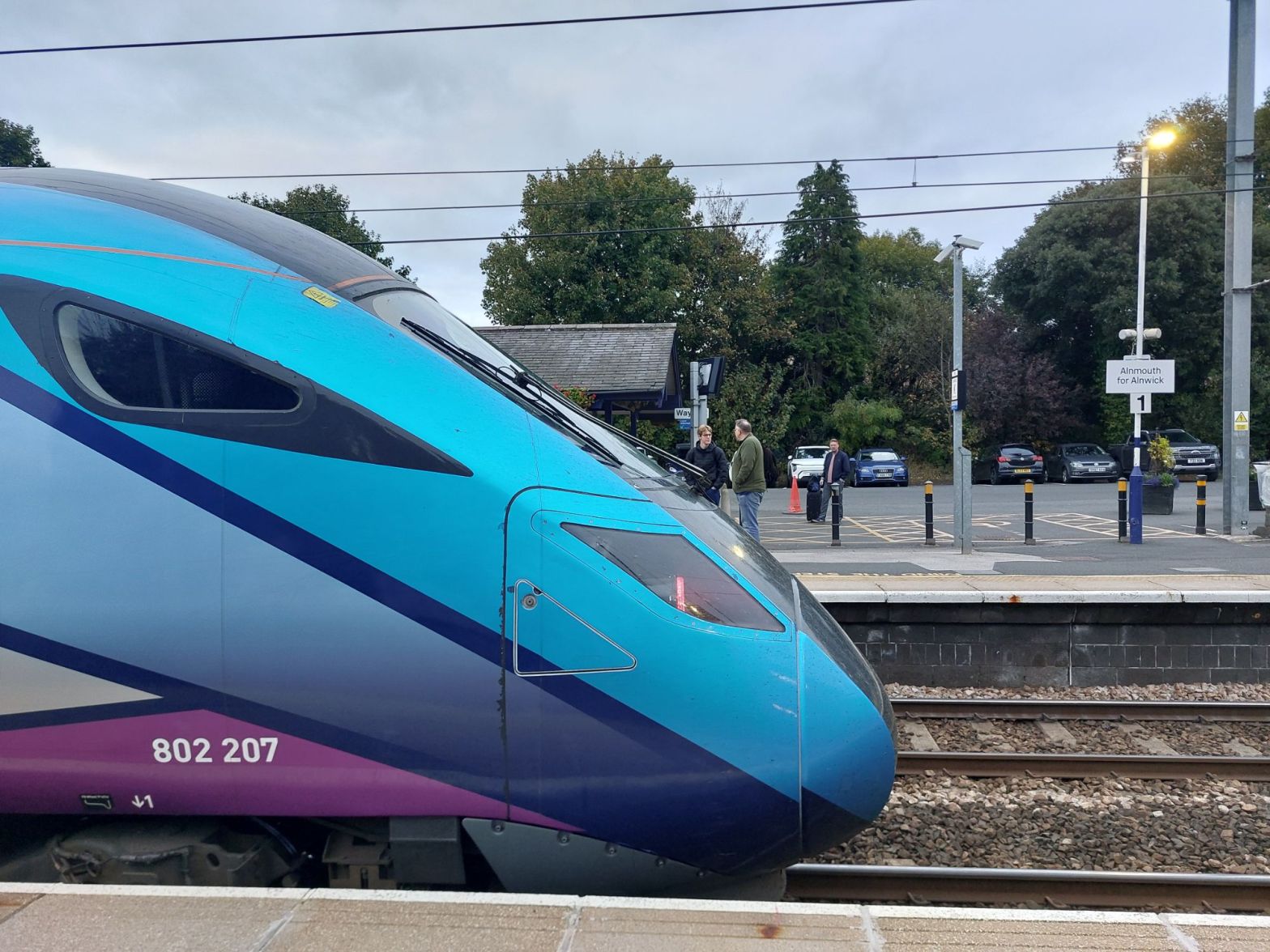
The shortages of the ‘Sprinters’ could be overcome by widening the types of trains running via Blyth; units such as the 80x Azuma fleet for example are already cleared to run via the Northumberland Line in the event of diversions, but running them regularly via this route and making some station calls would boost capacity by providing hundreds of extra seats per day.
These trains are often longer than the platforms on the Northumberland Line, but once again this is an issue that is easily solved by technology such as Selective Door Operation (SDO), which means that only doors safely on a platform can be opened.
An extreme example of this is the very short platform at Beauly station in Scotland where only a single door on a Class 158 can be opened, as the platform is only 15.06m (49ft 5in) in length, meaning even Sprinter trains (the same Class 158 type used on the Northumberland Line) use just one door, but has safely handled hundreds of thousands of passengers since reopening in 2002.
State run ‘operators’
Many of them are actually the same state-run operator (DfTO) running under different ‘brands’ such as LNER, Transpennine Express (TPE) and Northern, the latter of which also operates the Northumberland Line trains.
Therefore, the reality is that LNER, TPE, and Northern are essentially the same train operator running under different branding on the sides of trains, staff uniforms, and ticketing apps, but all ultimately lead to the doors of the DfT, and have done for many years, with LNER being state run since 24th June 2018, TPE since 28th May 2023, and Northern since 1st March 2020, with the remaining train operating companies being expected to be brought back into state ownership by the end of 2027, a little over a year away.
This means that hopefully a move to public service will be prioritised over private profit, and makes the case for direct services northwards from Blyth to Berwick and Edinburgh less challenging.
Car competitive connections
A direct rail route from Blyth Bebside to Berwick Upon Tweed and Edinburgh would have journey times competitive with driving; with estimated journey times as follows (based on 15mins added to a journey starting/ending at Morpeth, which is the approximate addition rail journey time). Road journeys are measured from station to station via Google Maps as a direct ‘Top Gear race’ style comparison.
Journey times from Morpeth via TPE semi-fast services.
- Morpeth to Edinburgh: 90 mins (1hr 30mins) by rail compared to 2hrs 7mins via driving.
- Morpeth to Berwick Upon Tweed: 35 mins by rail compared to 59mins via driving.
Blyth Bebside to The North (15 mins added to Morpeth journey times)
- Blyth Bebside to Edinburgh Waverley : Approx 105mins (1hr 45mins) by rail, compared to 136mins (2hr 16mins) via driving. Saving of 31 mins on journey time.
- Blyth Bebside to Berwick Upon Tweed: Approx 50mins by rail compared to 68mins (1hr 8mins) by driving. Saving of 18 mins on journey time.
Northumberland Park would similarly gain from direct connections (based upon 15mins added onto northward trips from Morpeth to Blyth Bebside (BLI), plus an extra 13mins on the Northumberland Line between NOP and BLI, meaning an overall 28mins addition)
- Northumberland Park (T&W) to Edinburgh Waverley: Approx 118mins (1hr 58mins) by rail compared to 141mins (2hrs 21mins) by driving. Saving of 23mins on driving time.
- Northumberland Park (T&W) to Berwick Upon Tweed: Approx 63mins (1hr 3min) by rail compared to 72mins (1hr 12 min) by driving. Saving of 9 mins compared to driving.
As can be seen above, the rail routes all offer a quite clear advantage over a 100% road journey, especially when traffic and parking would need to be factored in (Google Maps road journey estimates taken before 07:30 on Saturday 17th October 2026).
Slow buses to/from Blyth to Morpeth
Bus routes, due to lower average speeds and longer, winding routes offer a very slow alternative to driving, with the fastest, the No. 2 Arriva bus, taking 36 minutes to travel from Blyth Bebside to Morpeth.
Take the train to the town, rather than people driving to a distant station.
Driving from Blyth Bebside station to Morpeth railway station would take around 15 minutes, which is similar to the time taken by a train to reach the ECML from Blyth Bebside on the current slow line between Bedlington and Morpeth. The challenge is that is driving time only, not factoring in an earlier arrival to compensate for traffic, then finding a parking space (which can be challenging at peak times, and also has to be paid for). Depending on the route chosen, it also puts more road traffic on already busy roads such as through Bedlington or Guide Post.
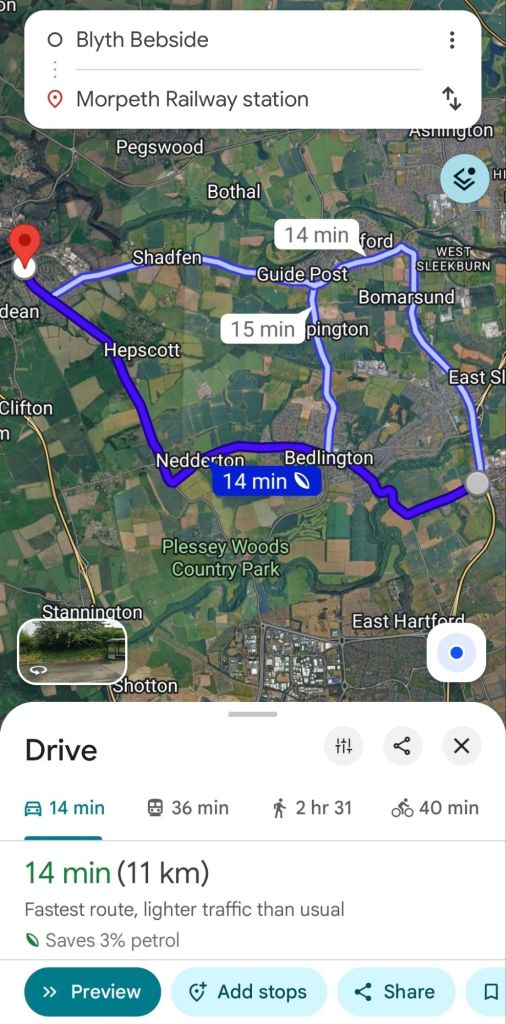
As can be seen above, while the route may be relatively quick between stations by road, it adds to local traffic; particularly at already busy junction such as the Red Lion roundabout and west along the B1331, using the A1068 to the Queens Head roundabout, or via the Half Moon roundabout and Bomarsund, then also feeding into traffic into Morpeth itself, as well as the obvious bottleneck at Cowpen Road in/out of Blyth.
Using a station several miles closer to Blyth means that modal shift to walking/cycling is much more viable from ‘home to railway station’ leg, or from station into work in Blyth by walking, cycling or buses for the short journey into town, which takes the No. 2 bus just 18 mins from Blyth Bebside railway station to Blyth Bus Station.
Cars are not available to all
There is also the obvious need to own and be drive a car too; about 73% of adults in the North East hold a driving licence, which in turn means that 27% of adults do not hold one, but that might not necessarily translate into car ownership or access; for example someone may have a driving licence but be unable to afford to own/operate their own car due to low incomes or other circumstances. That means that assuming that a person will simply drive to their nearest station to make a connection to rail services is deeply flawed.
Parking charges at Morpeth station
Another consideration for ‘Park and Ride’ connection at Morpeth is the cost of parking your car near the station, which for 24 hours is £4.50 in the NCC car park, and £4.40 in the Northern car park according to RingGo, and for a year up-front would cost £704.
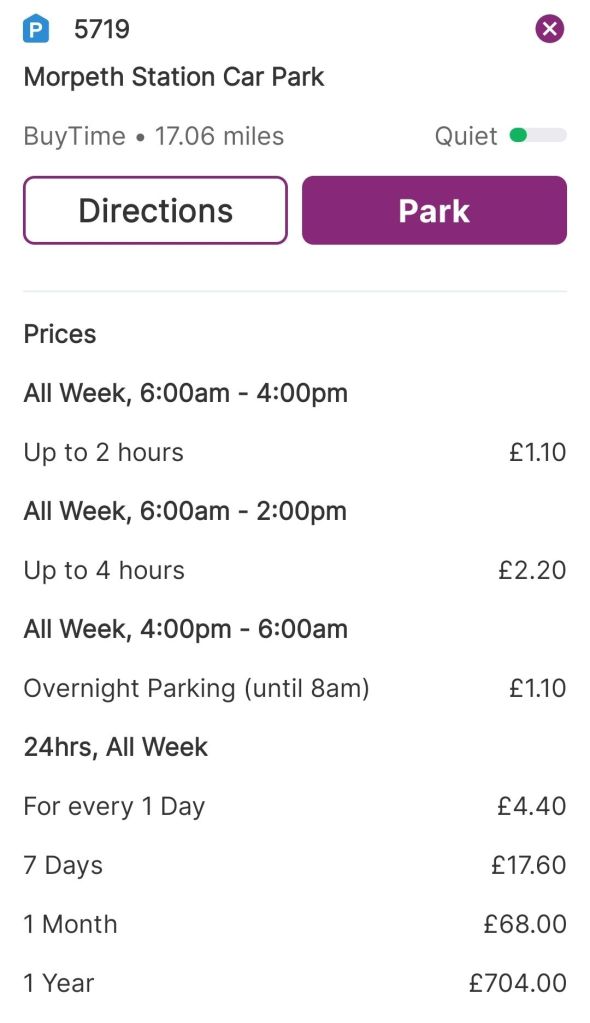
This makes a connection at Morpeth less appealing than the potential of catching a direct train from Blyth Bebside or Nortumberland Park.
Northumberland Park is a bit more of a marginal case due to its closer proximity and better connections by rail, Metro, and bus to Central Station, but a direct service still holds advantages; it takes away the need to change trains at Central Station if travelling by rail or Metro, which means that there is a lower risk of missed connections, some of which can be tight, but also avoids unduly long waits at Central Station between trains, in both examples making the overall journey faster, even if only marginally, but far more easy and convenient especially if travelling with luggage, children, or similar.
It is also psychologically more reasonable to head directly north when a route exists to enable it rather than going south to Central to head northwards again.
Conclusion
Hopefully this route will make it onto the ‘next steps’ for the Northumberland Line route, and it has already been put forward to Mayor Kim McGuinness, local MP’s David Smith, Ian Lavery, and Emma Foody, as well as leader of NCC Cllr Glen Sanderson.
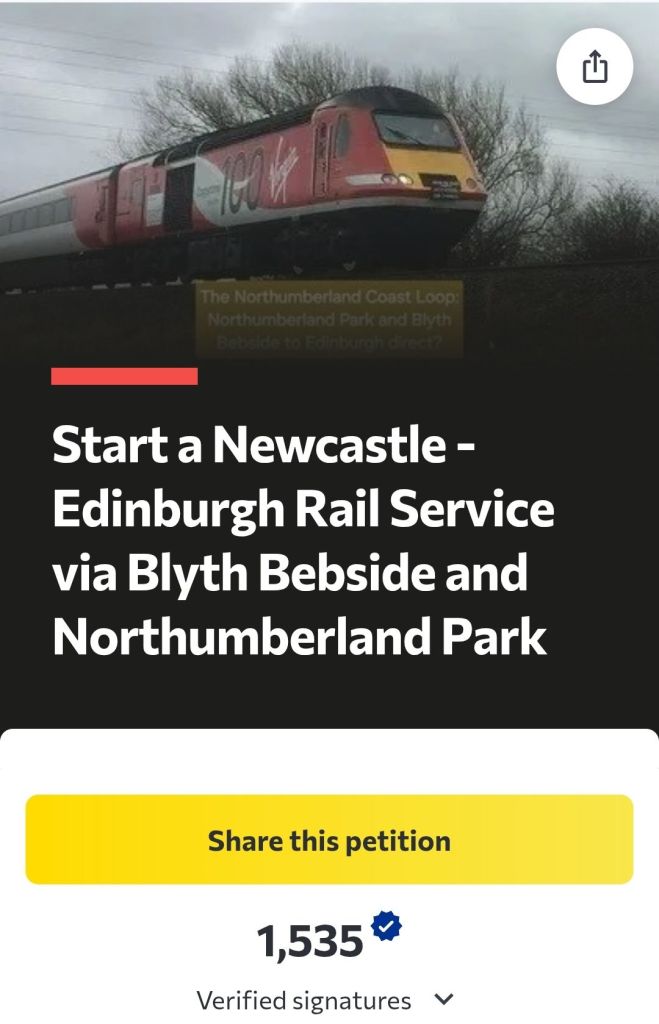
As of today, the Change.org petition stands at 1,535 signatures, but feel free to add yours to give further support!