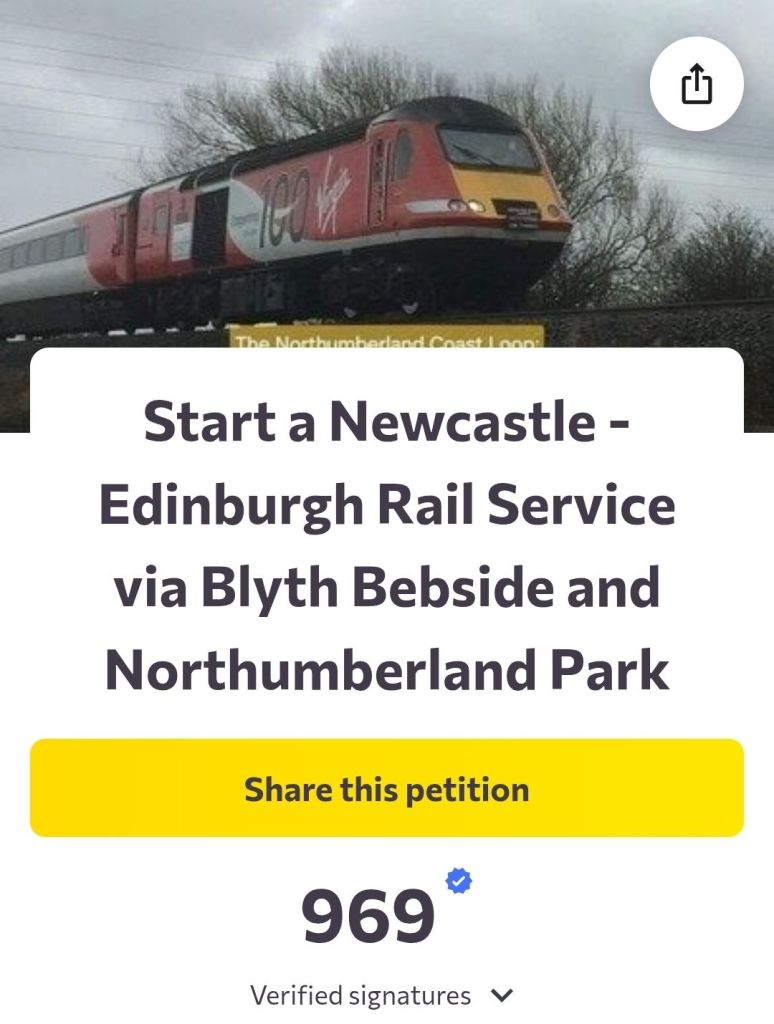
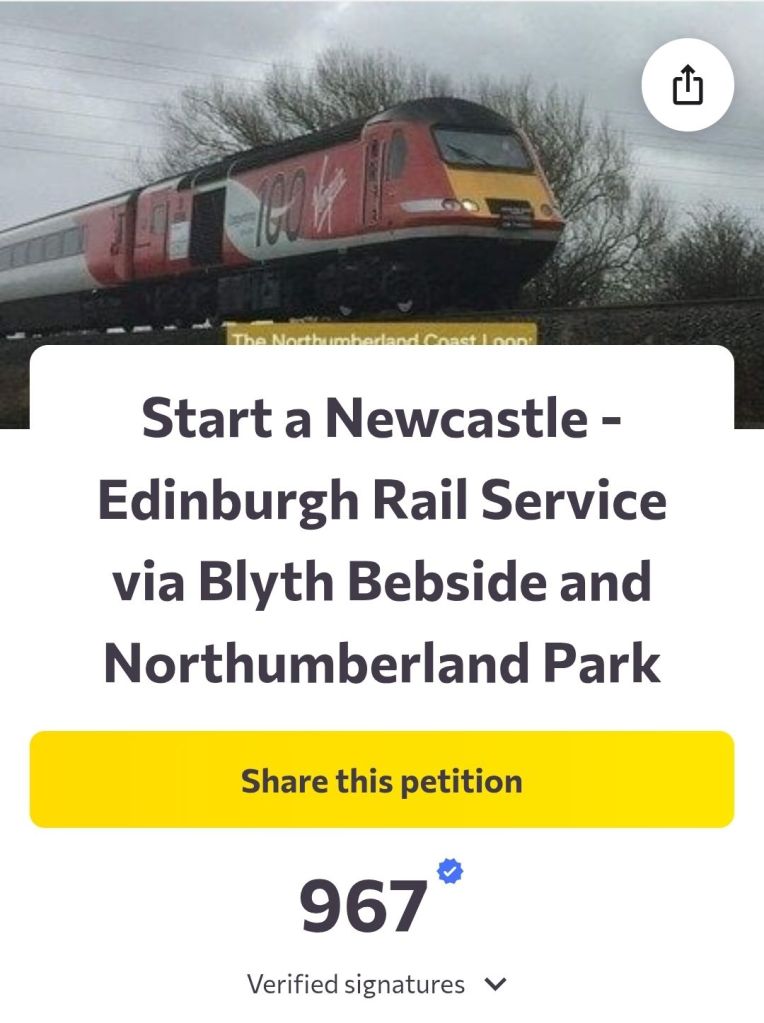
Our Change.org petition for the Newcastle to Edinburgh rail service via Northumberland Coast Loop (calling at Blyth Bebside and Northumberland Park) is steadily building again; with only 17 signatures left to go now until we reach the next target of 1000.
Screenshot of the petition as it stands on 12.11.25
Thank you very much to everyone who has signed so far, and please share this post with friends and family, and hopefully they will sign too!
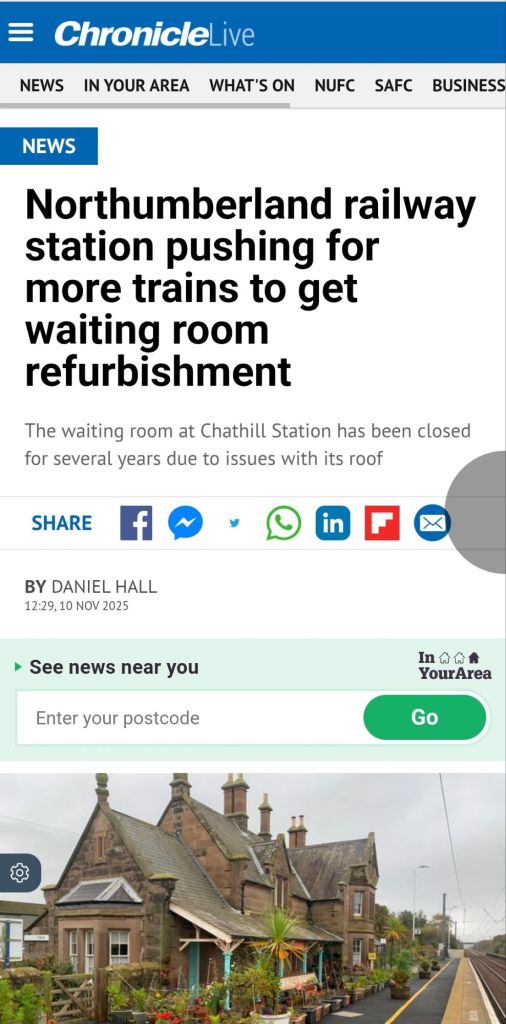
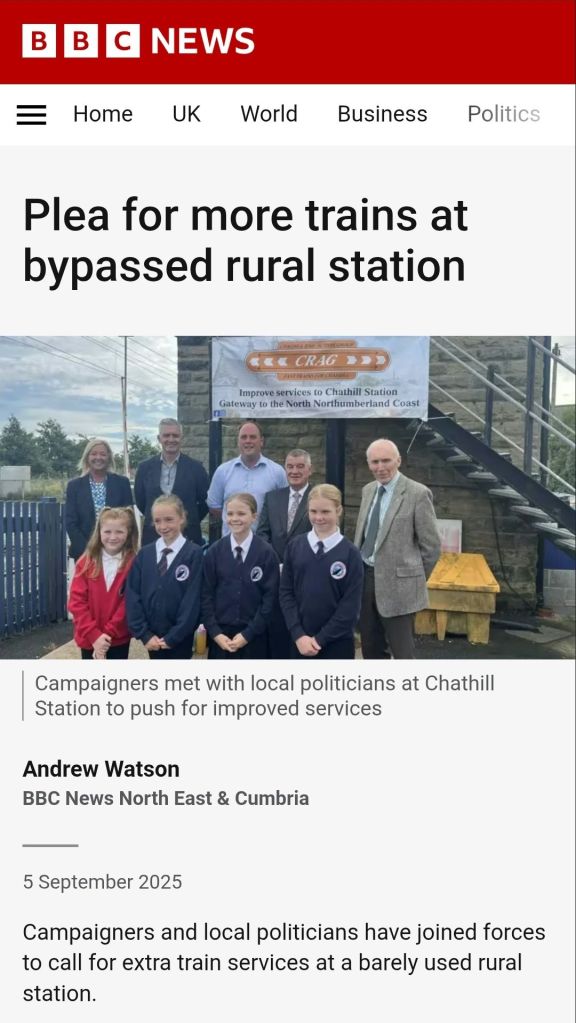
This repair is a promising sign for the future of the station, which currently only sees a very limited service from the ‘Chathill Flyer’, which serves the station twice a day in each direction.
Chathill is the current terminus for this service, the train running empty to a siding at Belford, and then returns later to run back to Newcastle.
The Chathill Rail Action Group (CRAG) intend for the station to be better served by campaigning for the Transpennine Express (TPE) trains that currently roar through the station between Newcastle and Edinburgh to stop there, and better serve major attractions nearby at Seahouses (for the Farne Islands) and Bamburgh (home to Bamburgh Castle, used in the recent 2023 film Indiana Jones and the Dial of Destiny amongst others).
To achieve these extra stopping trains, infrastructure investment into the East Coast Main Line (ECML) is likely to be required, as was outlined in our recent blog post, but was also stated in the article by Coun Martin Gannon, who states that ‘…lay-bys were being pushed for, despite being “not a perfect solution.”.’
In the wise words of Voltaire, however, it can be argued that seeking ‘Perfection is the enemy of the good’; and in terms of rail infrastructure, the relatively modest upgrading of the ECML by the addition of loops (the ‘lay-bys’) would represent a good solution; if Chathill could see even half a dozen trains per day above what it sees now, that would be a massive benefit for a huge surrounding area.
Chathill as more than just a station?
The station could be used for much more than just rail users however, as John Holwell, Chair of CRAG is quoted:
“Ultimately we’d like to see the building developed beyond a waiting room as there are other rooms in the building that aren’t used. People do come, believe it or not, cyclists come along when they use the cycle route, they’re not rail users necessarily, and it’d be nice to have a centre for tourists and other people.”
If the waiting room at Chathill could similarly offer a refreshments facility along the lines of those at Morpeth, and targeted not just to the small number of rail users, but also a wider clientele such as passing cyclists, walkers and even just those stopping for a break whilst holidaying in the area.
The North Sunderland Railway 1898 – 1951
Something that might be worth looking at for the refurbishment of Chathill station might be to have a display or perhaps small museum space dedicated to the quite unique North Sunderland Railway.
This little branchline ran from the junction Chathill to North Sunderland (Seahouses), but was always a private railway company, it hired in locos from the North Eastern Railway, LNER and later British Railways, the line closed in 1951, having never been an economic success; but today, would likely be a busy route given how popular a day out in Seahouses has become!
Armstrong Whitworth was a firm founded by the builder of Cragside, and restorer of Bamburgh Castle, Lord William George Armstrong, 1st Baron of Cragside.
In 1933, this firm built six small diesel locomotives, of which one D25 was named ‘Lady Armstrong’ and worked on the North Sunderland Railway until it was scrapped in 1949.
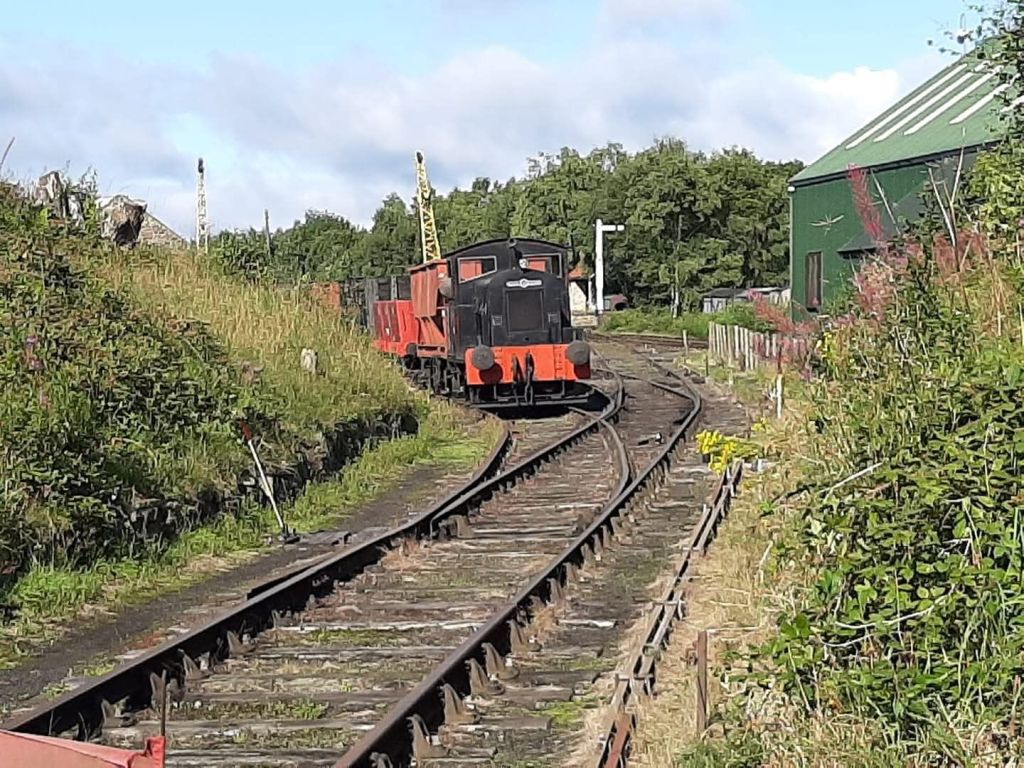
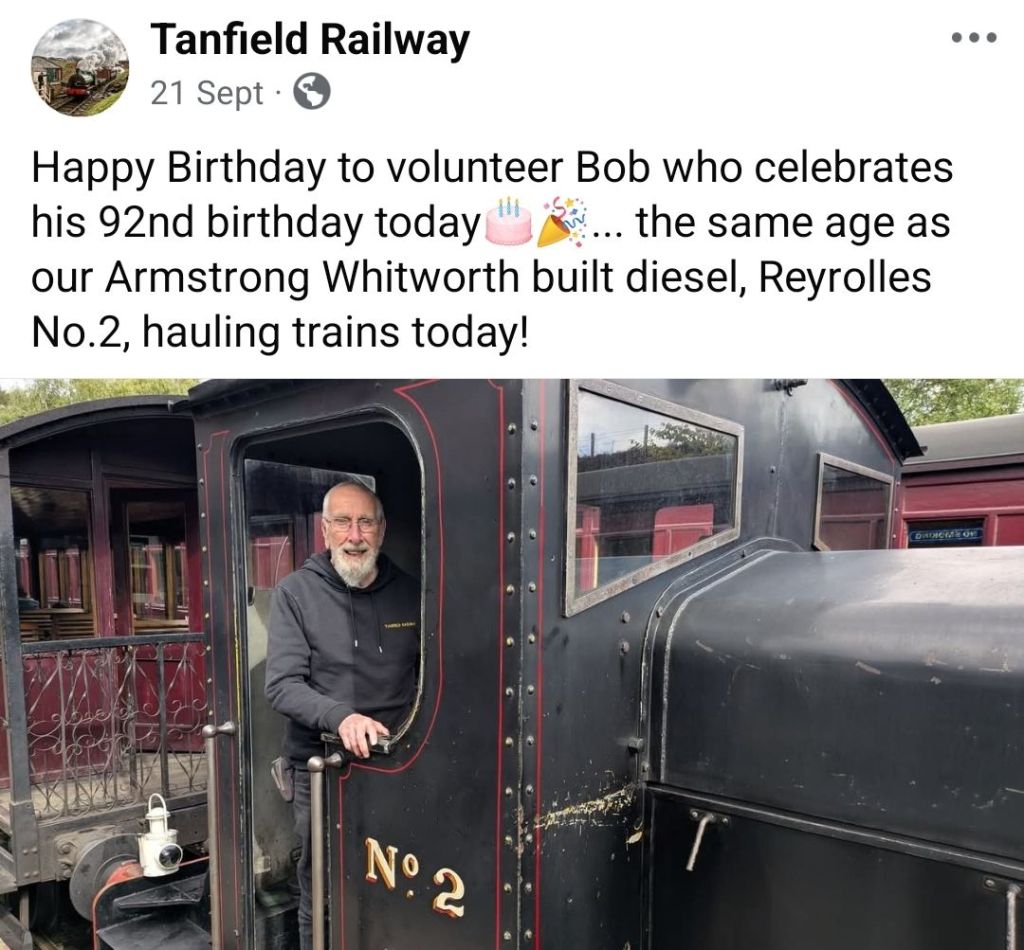
Happily, of this fleet of six locomotives, two sisters of D25 ‘Lady Armstrong’ survive, one of which, D22, is still highly active on the Tanfield Railway in Gateshead/Co. Durham, running as Reyrolles No. 2 where it spent much of its working life, but at the grand old age of 92, is still active!
Indeed, D22 has sometimes been at the head of ‘The Farne Islander’ trains at the Tanfield Railway.
D21 the other survivor is also on loan to the Tanfield Railway as a static exhibit from the National Railway Museum.
Photo of D22 active at the Tanfield RailwayPhoto of Reyrolles No.2 on the Tanfield Railway and long-time volunteer Bob, who is the same age as the loco!
Perhaps it could be fitting for one of these survivors, given their sister D25’s close tie to North Sunderland, and the founder of the firm that built them, Lord Armstrong of Armstrong Whitworth having such a close tie to Bamburgh Castle, to visit Chathill Station at some point in the future?
It could be a fitting way to celebrate Chathill looking forward to the future, but also highlight an interesting piece of the past too?
This could have a major effect on the proposed upgrade of the present Pegswood station into Pegswood Parkway, and could give it a similar appearance to Sandy station in Bedfordshire, with more details below!
New loop lines at Pegswood?
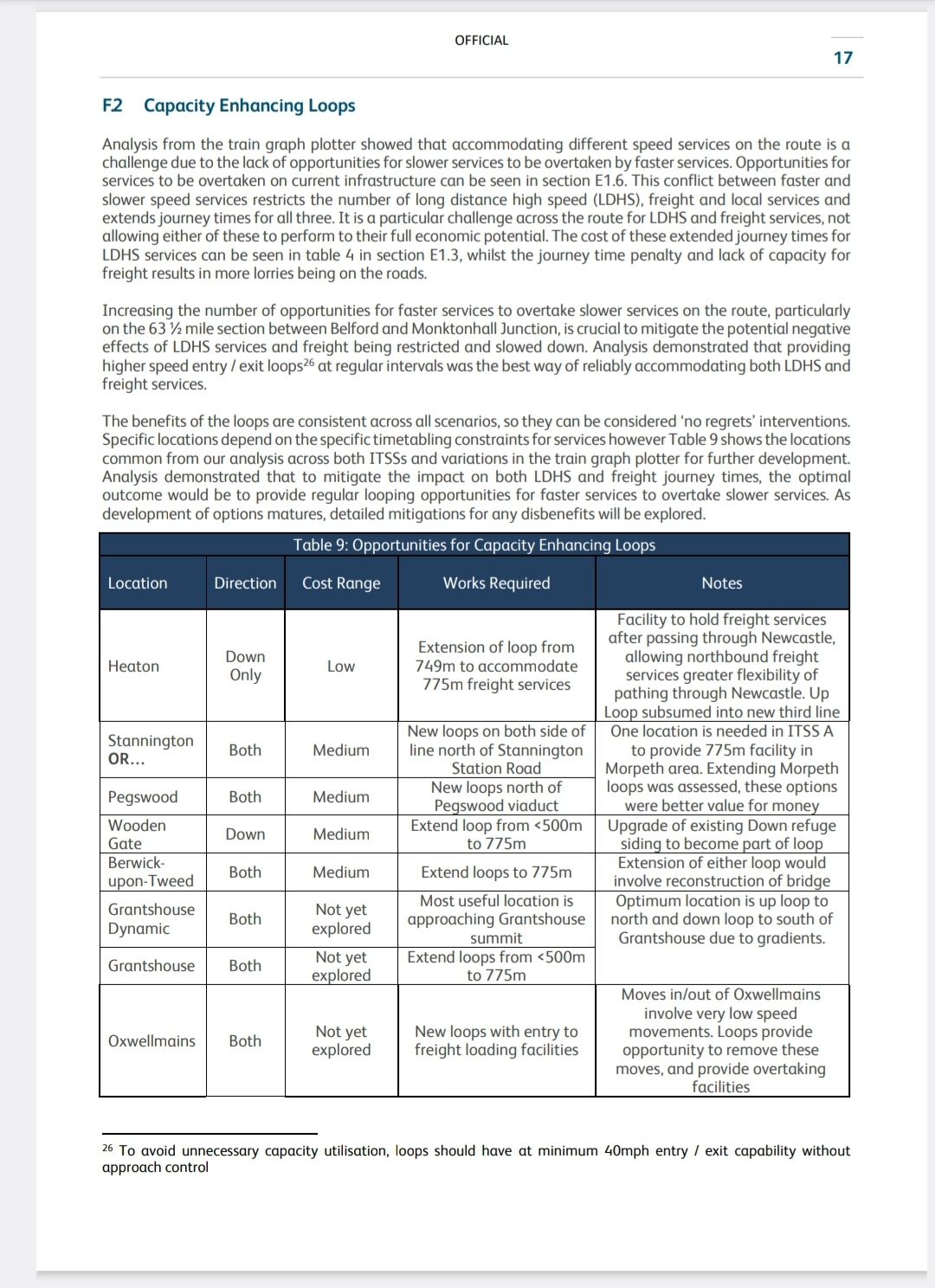
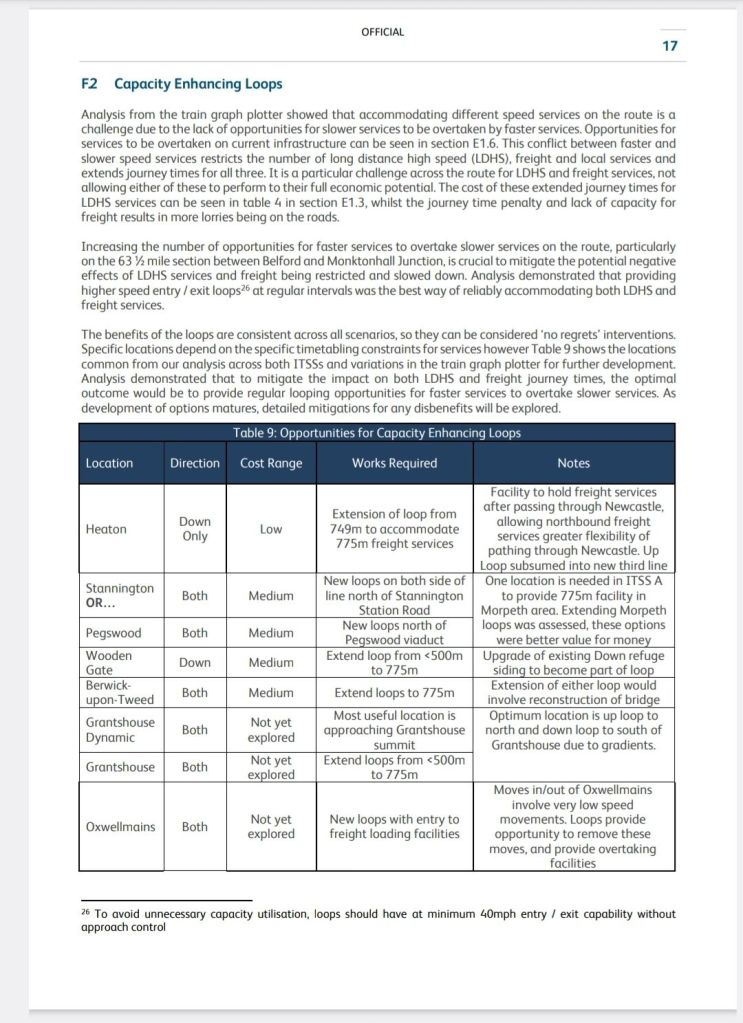
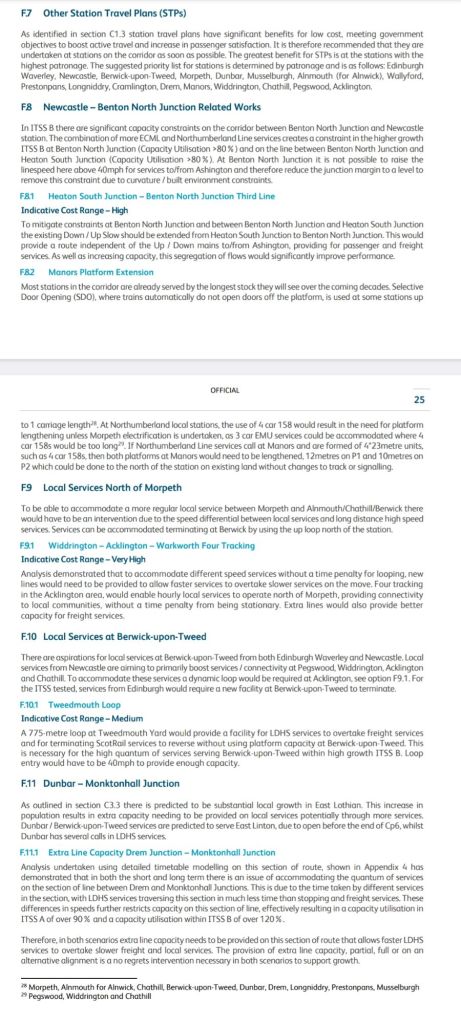
Section of the report outlining approximate cost ranges for infrastructure builds (in 2020 prices)Option of Stannington or Pegswood Loops, north of Pegswood Viaduct at ‘Medium’ cost (£5m to £50m in 2020 prices)
As can be seen in the extract from the above report, loops at either Stannington or Pegswood are options, but for the Northumberland Coast Loop, the Pegswood option is likely to be the favourable option, as it allows traffic joining the ECML headed north towards Edinburgh, or leaving it headed south to be looped on the ECML if required.
Construction of these loops, without any other upgrades such as Pegswood station, would still bring a capacity benefit to the ECML, but perhaps there is an option to multiply the benefits by rolling in a long-proposed upgrade of Pegswood station with construction of the loops?
Strategic site, and transform Pegswood station into Pegswood Parkway by simply adding a car park, and becoming a ‘hub’ for Ashington, Morpeth and beyond.
Pegswood would be ideally sited to become Pegswood Parkway (a common name for a Park and Ride Railway Station), a notable local example being the MetroCentre station on the Tyne Valley Line.
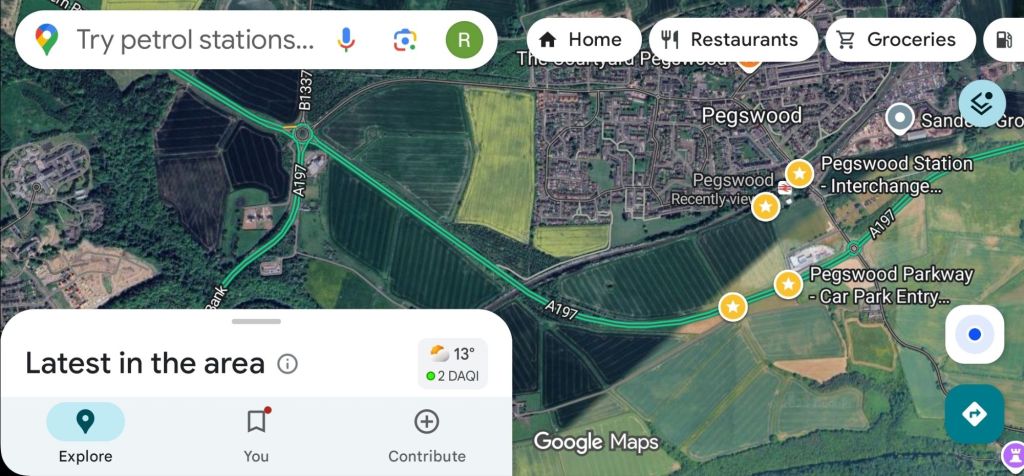
This strategic location is further bettered due to the close proximity of the A197 Pegswood Bypass, which at its western end connects onto the Whorral Bank Roundabout, offering links over to the A1, A697 and A192 via the Morpeth Northern Bypass, the A197 dropping down into Morpeth parallel to the River Wansbeck, and the B1337 towards Longhirst.
At the eastern end of the A197 Pegswood Bypass, is the link across to Ashington and Newbiggin, with the links to the A1068 and A189 Spine Road placing the station centrally for a wide catchment area, and avoiding the obvious issues of congestion around accessing the stations of both Morpeth and Ashington.
As can be seen on the image above, there is ample land to develop a simple but large car park between the railway and the bypass, with easy potential to access such a car park directly from the A197, and thus not adding any traffic into the village of Pegswood itself, as well as avoiding additional traffic feeding into Morpeth (a town with known congestion issues). Access to and from this car park could be directly from the A197 Pegswood Bypass, just west of the Pegswood Fire Station, therefore not adding to traffic in Pegswood itself, and could easily be linked to the station via a short footpath to the southbound platform just to the north of the Juliet Oakley Childrens Park.
The existing 35 bus service runs through the town of Pegswood, and passes very close to the present station site, offering a great public transport connection to the station too, and the nearby National Cycle Network Route 155 also passes very close to the station too.
Therefore, Pegswood is well sited, not just to serve the community of Pegswood, but could also clearly serve a much wider area, which includes Morpeth and Ashington, which will be outlined below.
Morpeth, whilst the station is on the ECML itself, it could still benefit from an upgraded local service calling at Pegswood to ‘feed’ into Morpeth station, allowing people to park at Pegswood and then travel into Morpeth to meet onward services. This could reduce road congestion within Morpeth itself, and with a regular bus service calling at the station could be a doubled up park and ride for the town.
An upgrade of Pegswood station to service the small number of Northumberland Coast Loop services stopping to serve Morpeth and Ashington, as well as for local services along the ECML is not intended to displace any other services calling at Morpeth; indeed it is intended to complement Morpeth by provision of additional parking away from that station but easily accessible from.
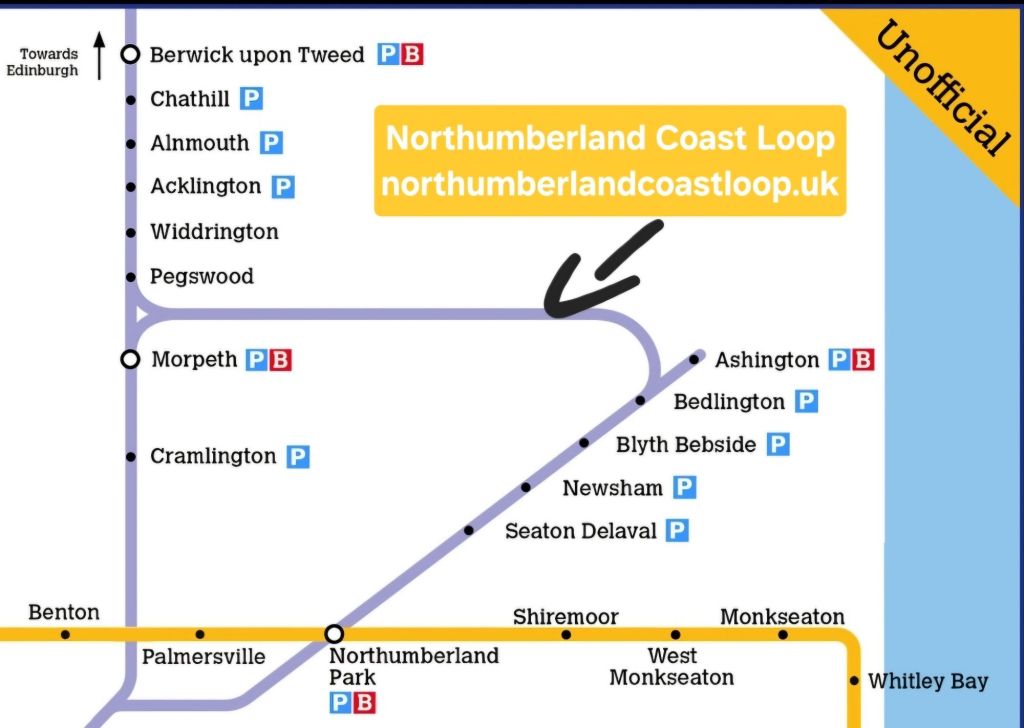
A call at Morpeth station directly is not possible due to the route of the Northumberland Coast Loop (N.C.L.) [see image below] which between Pegswood and Bedlington uses the Morpeth North Curve; this route does not run through Morpeth station, but a short drive/bus ride to Pegswood station would allow easy connection to N.C.L. services by Morpeth residents or visitors should it be required. The primary market for Morpeth residents is likely to be access to the stations and areas served by ‘the loop’; Bedlington, Blyth Bebside, Newsham, Seaton Delaval, and Northumberland Park (for North Tyneside etc).
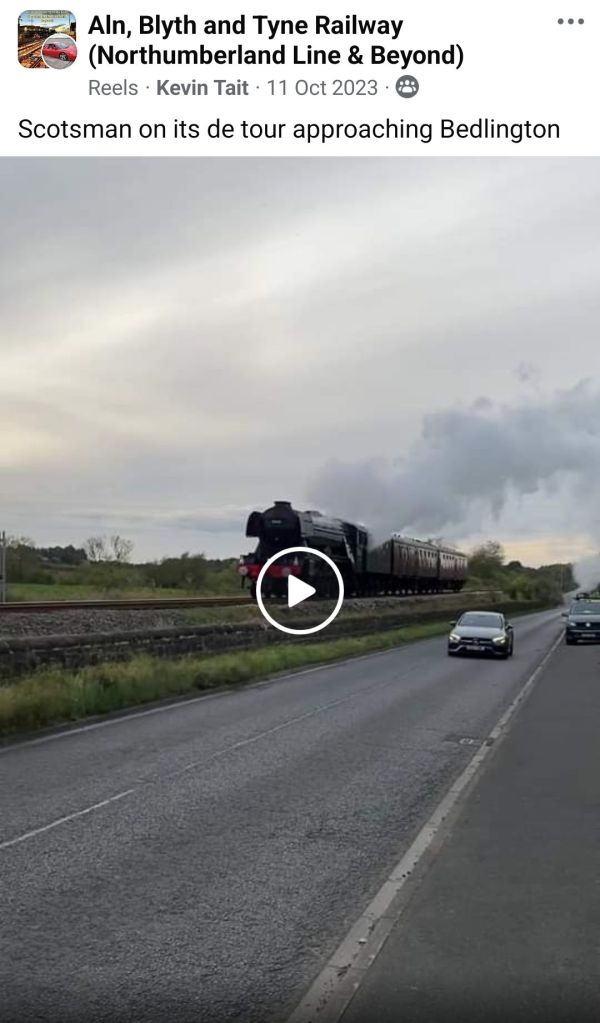
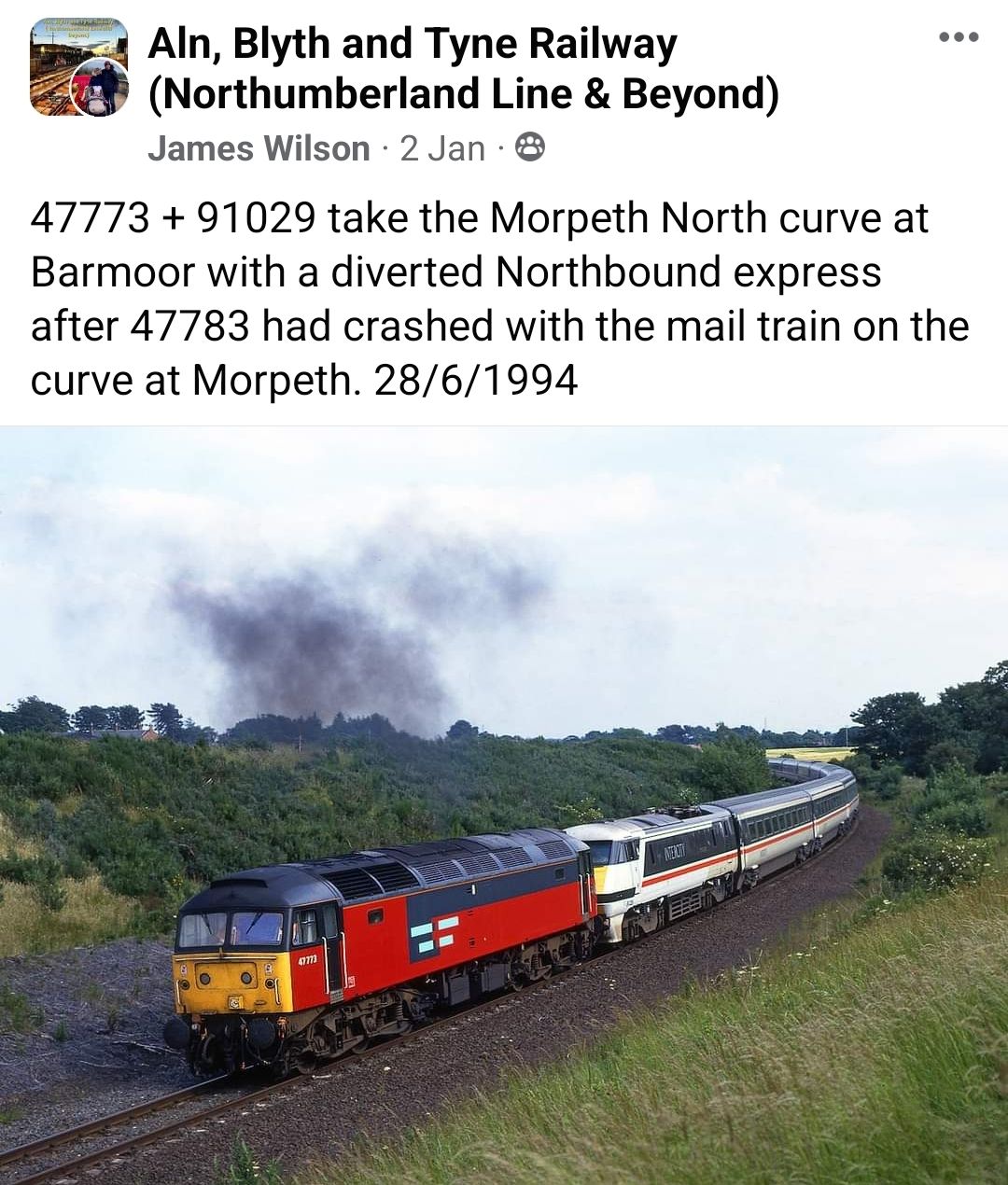
This station would be useful in the event of disruption occuring that used the Northumberland Coast Loop route for diversions; an example being engineering work, or damage to infrastructure such as occurred at Plessey Viaduct in October 2023; had this been been more severely damaged, diversions via Blyth might have been put in place (as has happened before during rail accidents at Morpeth Curve).
Locomotive ‘Flying Scotsman’ on a detour via Bedlington due to Plessey Viaduct issues in October 2023 (screenshot from a video)Class 91 being ‘dragged’ by a Class 47 around Morpeth North Curve in June 1994 due to the 1994 rail crash at Morpeth Curve near to Morpeth Station.
It is worth noting that if the proposed Ashington – Alnmouth ‘Butterwell Line’ was to be built, this route would also omit serving Morpeth, but the N.C.L. route via Pegswood offers a perhaps more reasonable connection.
Ashington, like Morpeth above is also not served by the N.C.L. route directly, but again this is due to the existing track layout; it is currently, and has never yet been possible to have a direct train from Ashington towards Edinburgh. The previous mineral lines did connect Ashington to the ECML, but in a southfacing direction; meaning trains headed north from Ashington would curve south near Linton Colliery, and head south again towards Pegswood and Morpeth.
The ‘Butterwell Line‘ campaign is seeking to alter the layout of the former, and long disused, colliery lines through Ashington Community Woods and the former Butterwell Disposal Point, and create a new curve and junction onto the ECML near to Ulgham. This is likely to be a long-term project, that will need a considerable investment to create.
The Northumberland Coast Loop route, by contrast uses currently working freight and passenger lines entirely, and would be based upon ‘no regret’ upgrades to routes such as the ECML and newly opened Northumberland Line, so could be implemented more quickly, and at lower up-front cost potentially than the Ashington – Widdrington link ‘Butterwell Line’.
If the Butterwell Line was to be built in the future, then a decision would need to be made if the N.C.L. route may get altered to run via Ashington rather than Pegswood, but as stated, upgrading Pegswood into Pegswood Parkway is likely to still represent a ‘no regrets’ scheme, as enhanced local services would still be able to operate to and from the station.
Conclusion: Pegswood could work as a hub for Morpeth and Ashingtonon the N.C.L. route
Whilst Pegswood is obviously a small settlement between its larger neighbours of Ashington and Morpeth, as outlined above it could act as a ‘hub’ for both, not dissimilar to how Alnmouth station a few miles north acts as a hub for the towns of Alnwick and Amble.
Pegswood Station: Present and Future
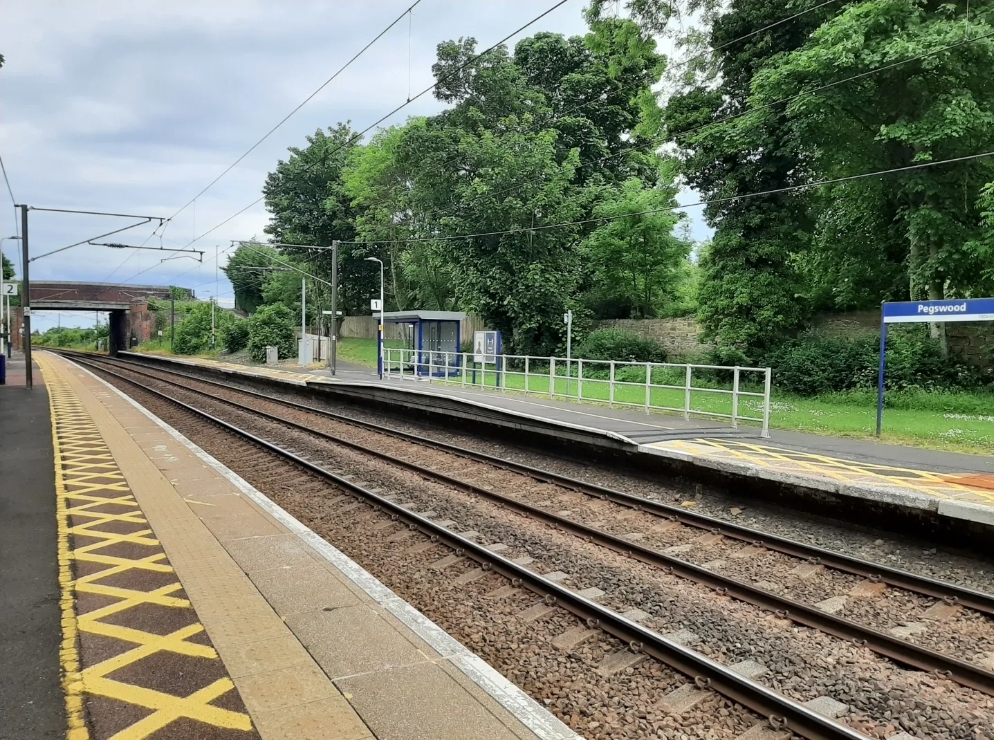
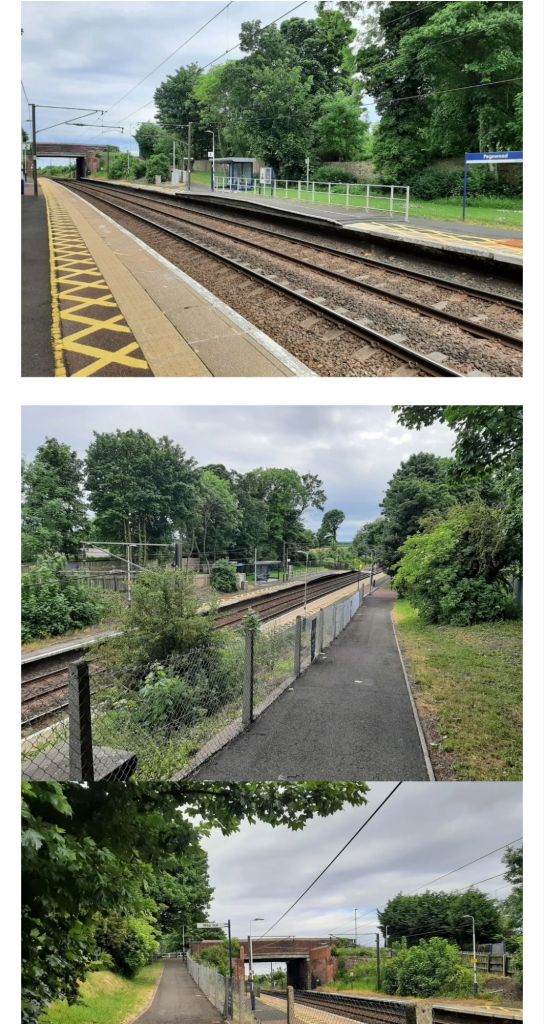
Pegswood Station today: Rebuild required for better accessibility.
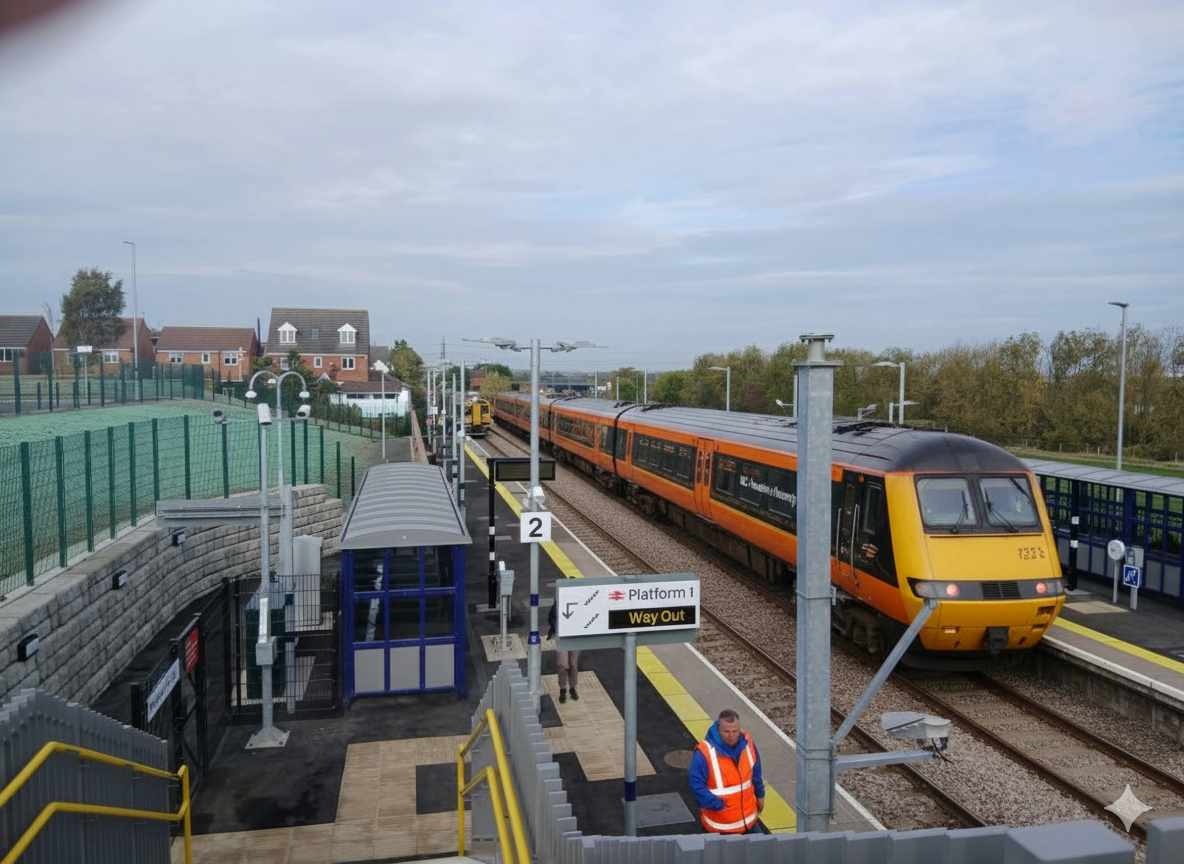
As can be seen from the photos below, Pegswood is an existing station on the ECML, and is currently served by just three trains per day. One issue at Pegswood is the low platform height, especially on the southbound line, evidenced by the ‘Harrington Hump‘ which can be seen in the upper photo, which froms a short raised section for better access to/from trains.
Photos of Pegswood station from the 2021 blog post
This is a good example of a low-cost alteration that has offered a temporary improvement a low platform, but realistically the long term fix is to correct the entire platform for height and offset (making level boarding easier as new units are increasingly designed to meet these standard heights).
Therefore, Pegswood would ideally see both platforms rebuilt to the correct standards, BUT, if loops are also proposed at Pegswood, then both schemes could be linked together; rebuild the platforms alongside the loop lines to allow stopped trains to be overtaken, which is inherently better than the current capacity limitations of a two platform station on a two-track railway.
Pegswood Parkway but Sandy Style?
As the report at the top of the post outlined, there is an option to increase the capacity of the ECML via the addition of loop lines at Pegswood. This would allow stopped trains to be overtaken by non-stop services; increasing the capacity of the ECML.
This presents a further opportunity; if Pegswood needs to be rebuilt anyway to correct the platform heights, then why not also place the platforms on the loops? This would allow stopped trains to be out of the way of fast expresses roaring through Pegswood, as they do at present (see this video as an example), rather than a stopping service having to be squeezed into very limited paths as they are at present.
A very similarly station is proposed at Belford, again a little further north on the ECML, at a proposed £14m cost in November 2024, but at that location the loop lines already exist, so it is platforms only in terms of cost.
Image of Sandy station from Google MapsImage of Sandy station from Google Maps
The track layout at Sandy station, similar to Hitchin and many others, enables fast trains to whizz past other services stopped at the station, and whilst the layout at Pegswood is likely to be loops rather than a full length of four-track layout (effectively like a layby for stopped trains rather than the equivalent of dual carriageway), it will still increase the capacity of the ECML positively and allow more trains to call at Pegswood, both local, and in the case of the Northumberland Coast Loop, long-distance ones too.
Costs
The 2020 price range for new loops at Pegswood was in the £5m to £50m range (Medium cost), which when adjusted to 2025 prices is a range of £6.4m to £64m for loops only.
The price of a new two platform station, essentially the same for a rebuild of Pegswood ‘as is’ or providing a new station built adjacent to the new loops, would be approximately £14m to £20m, based on other stations proposals such as Belford, but allowing for a contingency.
Therefore, an ‘all in’ cost of loops and a new station would likely fall somewhere within a range of £20.4m to £84m, but would need to be properly assessed to gain a more accurate costing, but compared to a route such as the ‘Butterwell Line’, which is highly likely to cost £100m+ (again would need full and professional assessement to ascertain true cost), the upgrade of Pegswood station and loop lines might well prove more cost effective as an option to improve the railways in Northumberland.
Similar to the other places served by the Northumberland Line, Newbiggin lost its rail services in 1964 when the line closed to passengers, but unfortunately, the railway into Newbiggin did not survive in freight use, and was lifted decades ago, meaning that track would need to be relaid to head towards the original station site, but it may, or may not be possible to rebuild on the original station site due to developments in the town since 1964.
The detailed research into the feasibility of extending the line beyond Ashington will be investigated by staff at Northumberland County Council in February 2026 according to the news article; hot on the heels of the hopeful completion of Bedlington, and Northumberland Park stations, which are due to open in early 2026 (presumably January/February but no official date has yet been set for either station).
Northumberland Coast Loop alongside the Newbiggin extension?
Whilst this feasability study into a Newbiggin extension is being performed, it might also be useful for NCC staff to take a look at the proposed Northumberland Coast Loop, which in contrast to the Newbiggin Line is fully complete (being in regular freight use for the ‘Alcan’ train, as well as other railfreight, engineering, and occasional charter trains.
This proposed route wouldn’t itself require the building of any stations, or perhaps even the laying of any track; just bringing the current freight line into regular passenger use to provide a passenger rail link between Bedlington and Pegswood, which would enable direct ‘to, from, and within Northumberland’ trips, such as to Bedlington, from Blyth, or a link between towns such as Berwick-Upon-Tweed to Blyth directly.
Hopefully the team working on the proposed Newbiggin extension might also be enabled to consider the Northumberland Coast Loop route while looking at the options, and give a more detailed costing on works required to enable it?
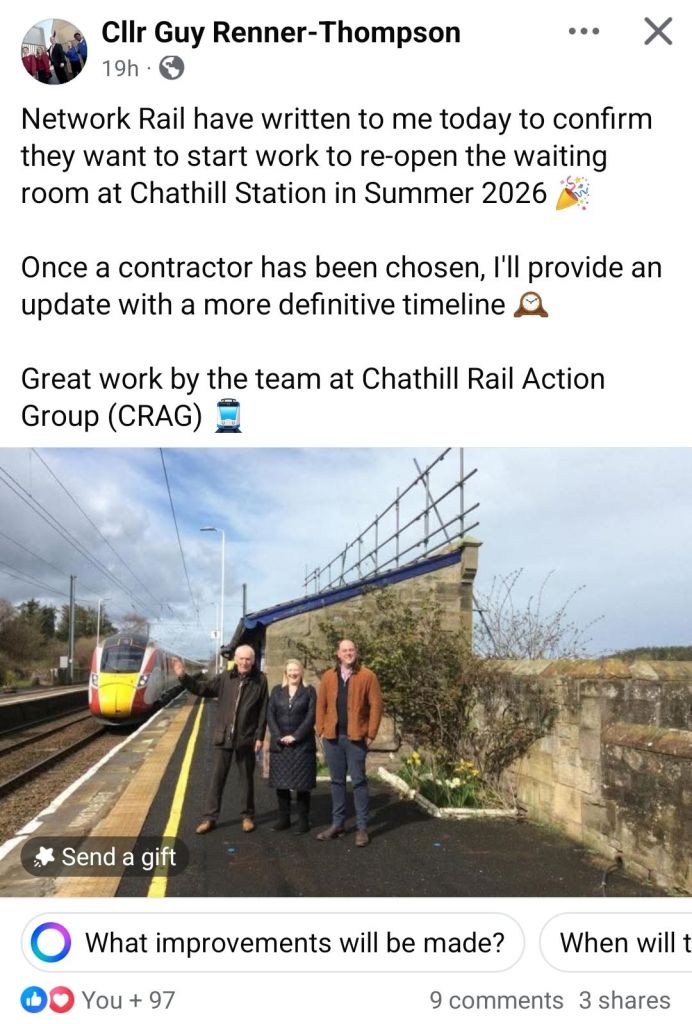
A couple of recent blog posts by the Chathill Rail Action Group (CRAG) and Cllr Guy Renner-Thompson have announced that repairs to the damaged waiting room at Chathill station are due to be started in Summer 2026; having been brought forward from a 2027 start date.
This is great news for Chathill Station and hopefully Chathill can see more trains soon too!
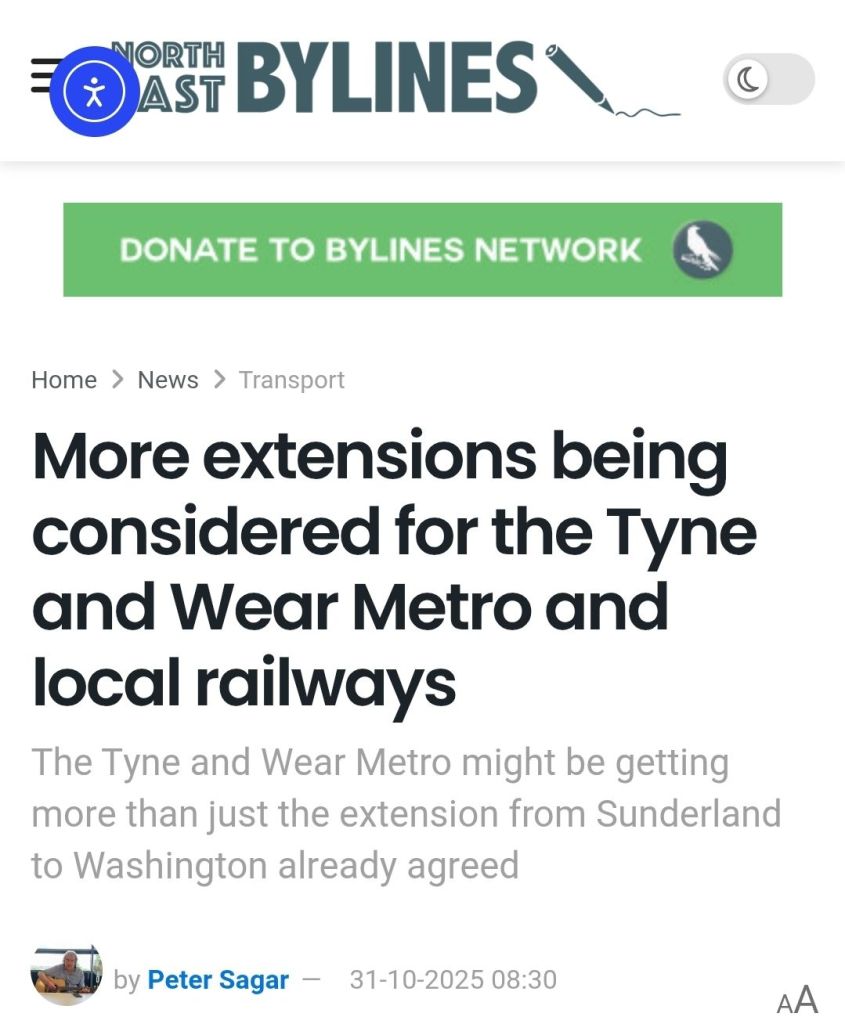
A recent article by North East Bylines, has mentioned the reopening of stations at Belford, and potentially Beal were referred to, alongside a new hourly rail service along the ECML between Newcastle and Berwick Upon Tweed.
All three of these developments would be very much welcome, and more updates will be posted here once available.
It is often said that the East Coast Main Line (ECML) between Newcastle and Edinburgh is ‘full’; running the maximum number of trains reliably and safely each day due to constraints on the capacity of the line.
The position of this campaign has always been that capacity of the ECML can grow to meet the need to run more trains, through provision of more and longer loops etc.
I was sent a link to the following Network Rail report which outlines the constraints but also their fixes; ‘How can the railway between Newcastle and Edinburgh meet the needs of the 2030s and beyond? Newcastle to Edinburgh Strategic Advice, Network Rail, November 2021.’
Cover page of the report
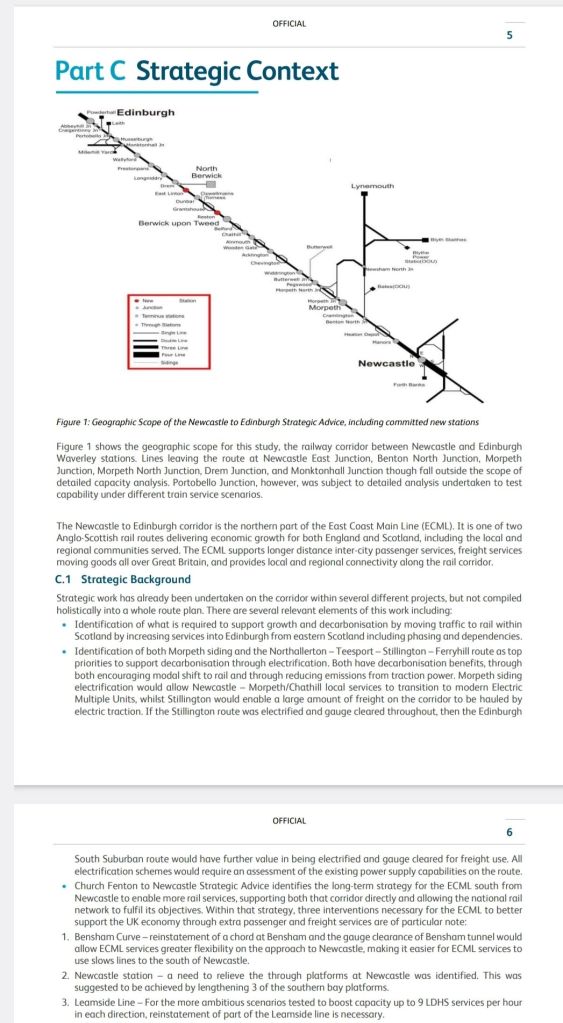
This report is focussed on the main Newcastle to Edinburgh route via Cramlington, and excludes branching traffic such as the Northumberland Line and wider Blyth and Tyne lines fall outside of the scope of the report.
This is reasonable as the report was published just over three years before the Northumberland Line opened, and rightly focusses on the core mainline route.
Strategic Context setting out how the Northumberland Line (and wider Blyth and Tyne Lines)
Interestingly, electrification of Morpeth Siding is mentioned on page 20 to allow the services to and from Morpeth/Chathill to be changed to Electric Multiple Unit (EMU) operation as part of this report, and would infer that in the longer term, the whole B&T route becoming electrified would be advantageous
Take trains to the people, not expect people to travel to trains
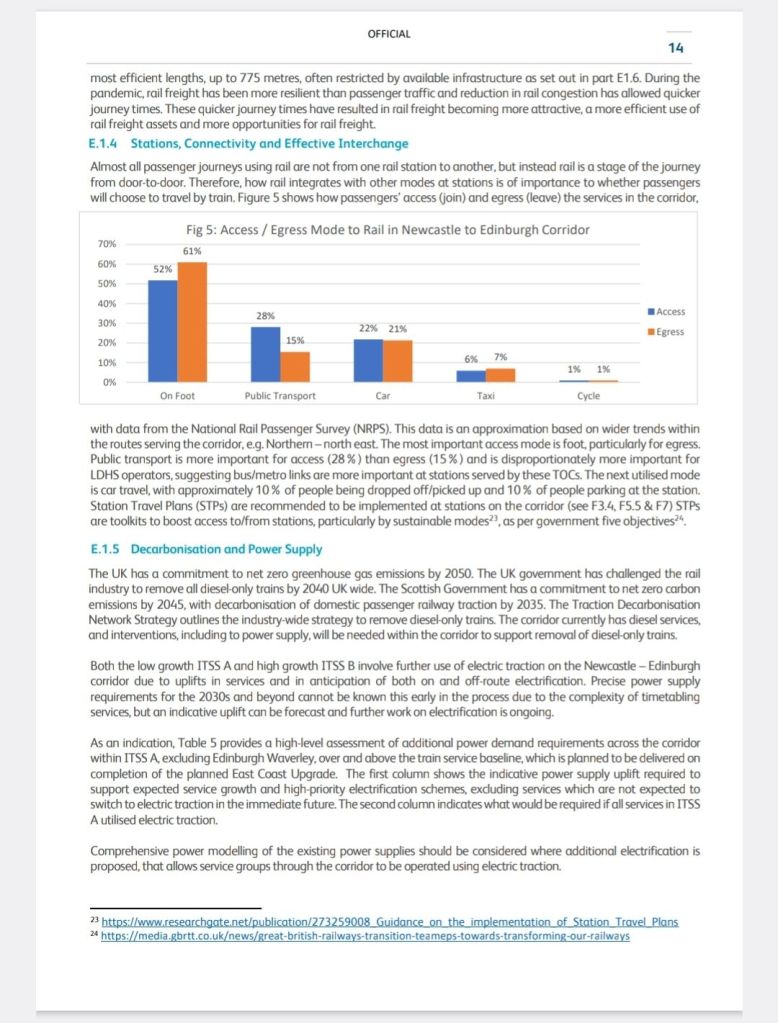
Alongside this are a wide range of assessments, such as the one below that shows rail as just a part of longer overall journeys, and how having stations within walking distance is a primary mode for both access and egress; a justification perhaps for the Northumberland Coast Loop taking Long Distance High Speed (LDHS) services to stations like Blyth Bebside and Northumberland Park, large conurbations where many more people are within walking or cycling distance, or a short bus, taxi, lift from friend/family trip, rather than the present situation of needing to travel to Morpeth or Newcastle to catch LDHS services, which isn’t required now due to stations on the route being reopened, allowing direct access to direct trains.
Page 14 of the report, showing access and egress by foot is especially important, so taking the train to the nearest station is vital.Our route map showing the potential for new direct links to, from and within Northumberland, such as between Northumberland Park to Alnmouth, or between Blyth to Berwick, or these stations and Edinburgh.
Capacity enhancement on the ECML
The interesting part of the report is especially focussed on the capacity enhancement, what physical infrastructure has been identified to enable more trains to run.
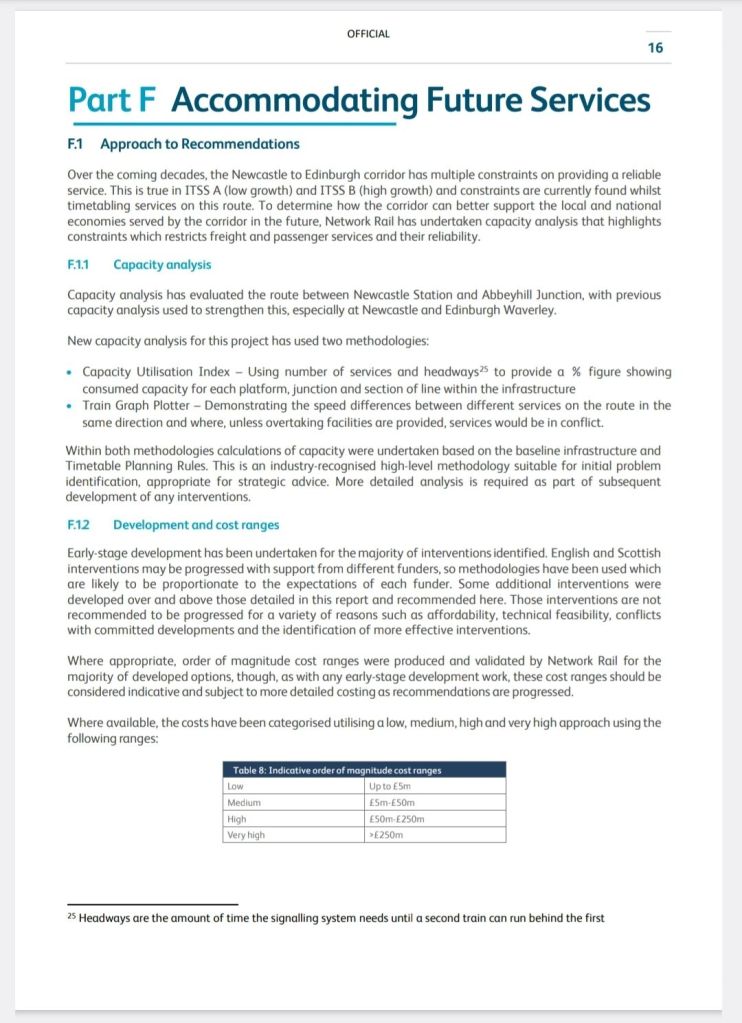
Page 16 showing cost bands for interventions, with Low being <£5m, Medium of £5m to £50m, High of £50m to £250m and Very High of £250m+, all presumably at 2021 prices, so would need appropriate adjustment to current prices. The range of possible options identified in Northumberland and the Scottish Borders, with all indicated as ‘Low’ or ‘Medium’ cost (under £50m each at 2021 prices).
Assuming that the interventions chosen would be on the Northumberland Coast Loop route, that would potentially involve interventions with existing/new loops at Heaton (<£5m), Pegswood (£50m), Wooden Gate (<£50m), and Berwick Upon Tweed(<£50m). (All in 2021 prices)
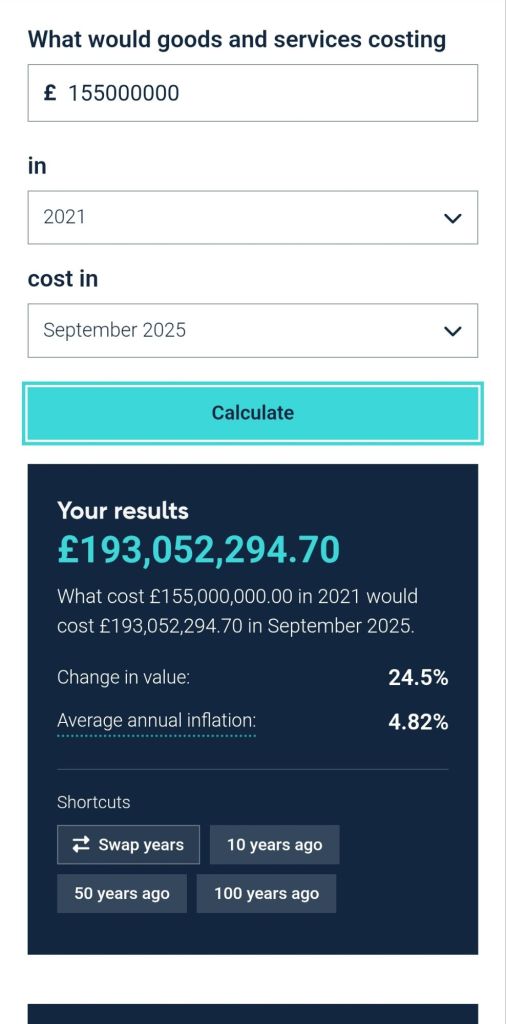
This would mean that capacity enhancements between Newcastle and Berwick could be achieved for approximately £155m in 2021 prices (when adjusted to September 2025 prices using the Bank of England Inflation Calculator, would be c.£193m today, as prices have risen by approximately 25% in those four years).
The above price, even after accounting for inflation is still under ⅔ of the price of the Northumberland Line scheme, which to date has cost £336.4m.
Newcastle and Edinburgh station upgrades
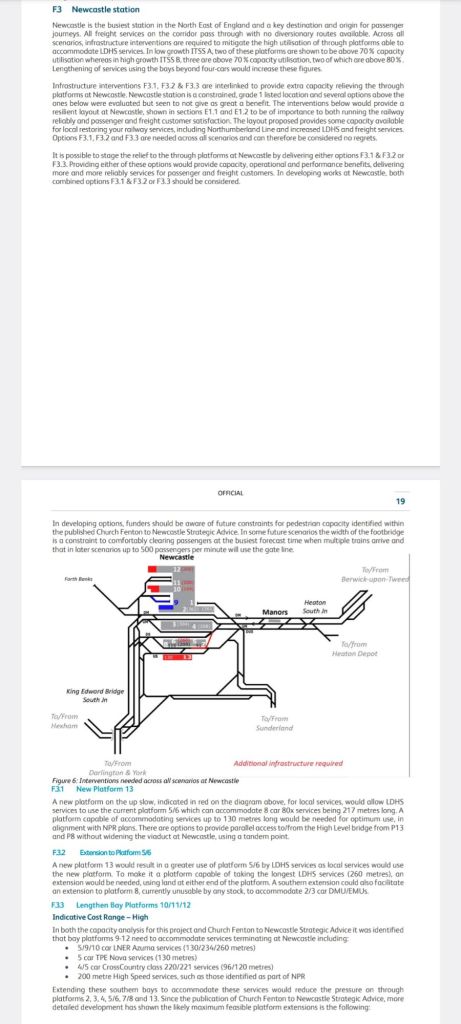
The stations at Newcastle and Edinburgh are, in themselves a bottleneck, and act to limit the number of trains able to operate on this stretch of the ECML, but once again, the report has identified potential solutions to resolve these issues, such as creating a new Platform 13 at Newcastle, and lengthening of other platforms to accomodate longer trains.
Some of these interventions are ‘high’ cost (upto £250m in 2021 prices), and some may stray into the ‘very high’ category of £250m+, but on such a busy and well-used route, again these are highly likely to be ‘no-regrets’ investments to improve capacity and enable more passenger trains and railfreight to run, boosting the economy of the region.
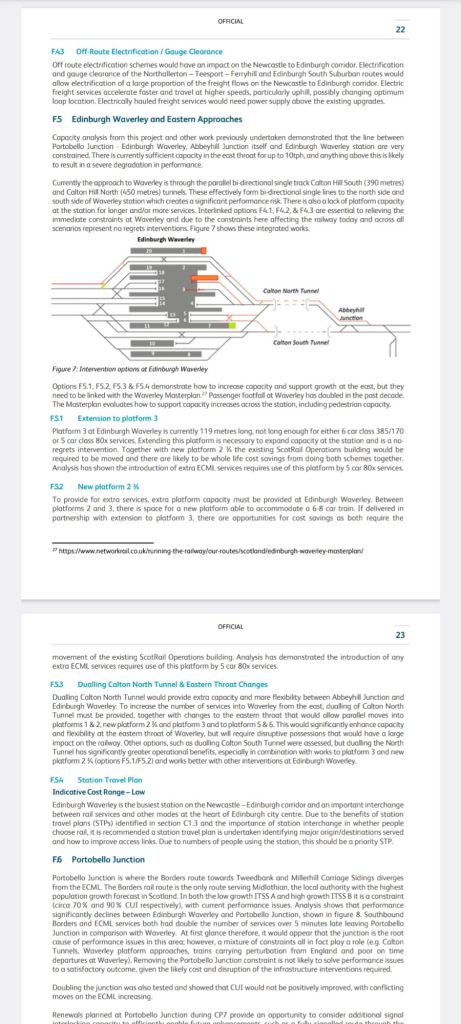
Proposals for the Edinburgh Waverley end of the ECML
Larger infrastructure proposals
There are a number of larger proposals identified in this report on Pages 24 and 25, such as a third line from Heaton South Junction to Benton North, which would split the Ashington/Northumberland Coast Loop services onto a third parallel line, rather than running up the ECML to then turn off at Benton North Junction, where trains then run parallel to the Metro. This is a ‘high’ cost intervention, with expected price range of £50m to £250m, but given the huge success of the Northumberland Line to date, would again prove likely to be a ‘no regrets’ upgrade.
Further upgrades to the ECML beyond loops
Similarly, a four tracked section in the Acklington area would be beneficial to allow slower trains to be overtaken whilst still on the move (effectively like a short stretch of dual carriageway for fast trains to overtake slower ones without making the slow ones stop in a loop), with this coming back as being within the ‘very high’ cost range (£250m+ at 2021 prices), but, like all the other options is highly likely to have a postive benefit well beyond its cost, so again should be a ‘no regrets’ upgrade.
Lets hope that this report can be picked up again, and acted upon to deliver these much needed upgrades to the ECML between Newcastle and Edinburgh?
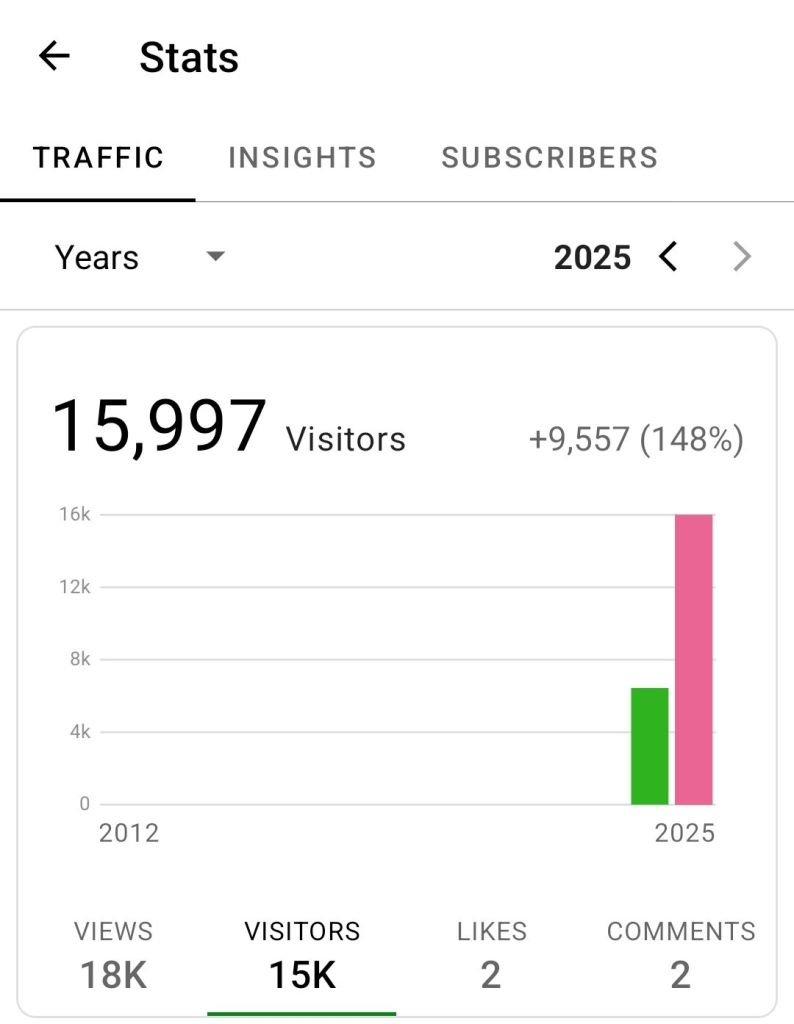
The traffic volume to the Northumberland Coast Loop website this year has been phenomenal, with very nearly 16,000 visitors over the course of the year, and who have viewed the site/blog posts over 18,000 times. These figures are ‘at time of writing’, so they can only keep climbing higher as time goes on!
Statistics for the Northumberland Coast Loop website, Halloween 2025
This shows the huge level of interest in the campaign, and respresents a growth of 148% compared to the entirety of 2024, but with November and December still to go, the figures still have ample time to grow!
If you haven’t already, please sign the petition using the link above!
Thanks again for all of you who have visited the site and especially those who have supported the petition so far, but please keep sharing with friends and family to keep the momentum going!
An update on the Northumberland County Council (NCC) website yesterday afternoon announced that £255,000 has been made available for repairs to Eden Hill Bridge, which spans the trackbed of the Alnwick Branch about halfway between Lionheart Station and Alnmouth station (the route now home to the Aln Valley Railway (AVR) and a parallel greenway), with the works enabling both to be extended beyond the current end of the line at Greenrigg Halt towards Alnmouth station.
The funding is split between NCC, who are contributing £125,000, and £130,000 from Historic Railways to carry out waterproofing and essential repairs. The bridge now belonging to NCC, it allows the council, once work is complete, to grant permission for the Aln Valley Railway to be extended east towards Alnmouth, one of the key stations on the Northumberland part of the East Coast Main Line (ECML).
The AVR has done an amazing job since first breaking ground on the Lionheart site as recently as February 2012, with the Aln Valley Railway Society formed in 1995, a lot achieved in the last 30 years!
Well done to all involved, and it’ll be great to see the AVR extended back towards the mainline, and hopefully, it’ll soon be possible to interchange between mainline services and heritage/modern shuttle service at Alnmouth to reach Alnwick (Lionheart) and the wider town of Alnwick by rail once again, after closure of the branch in October 1968.
Collaborative calls for a ‘Stopping Scotsman’ service at Berwick, and elsewhere in the Scottish Borders area.
A Facebook post by John Lamont MP and David Smith MP has highlighted the ongoing collaboration between the neighbouring MP’s either side of the Scottish Border on the East Coast Main Line (ECML) to see the services to Berwick-Upon-Tweed station improved following a reduction in the number of trains calling there as a result of the upcoming December 2025 timetable, but also more widely across Northumberland and the Scottish Borders too.
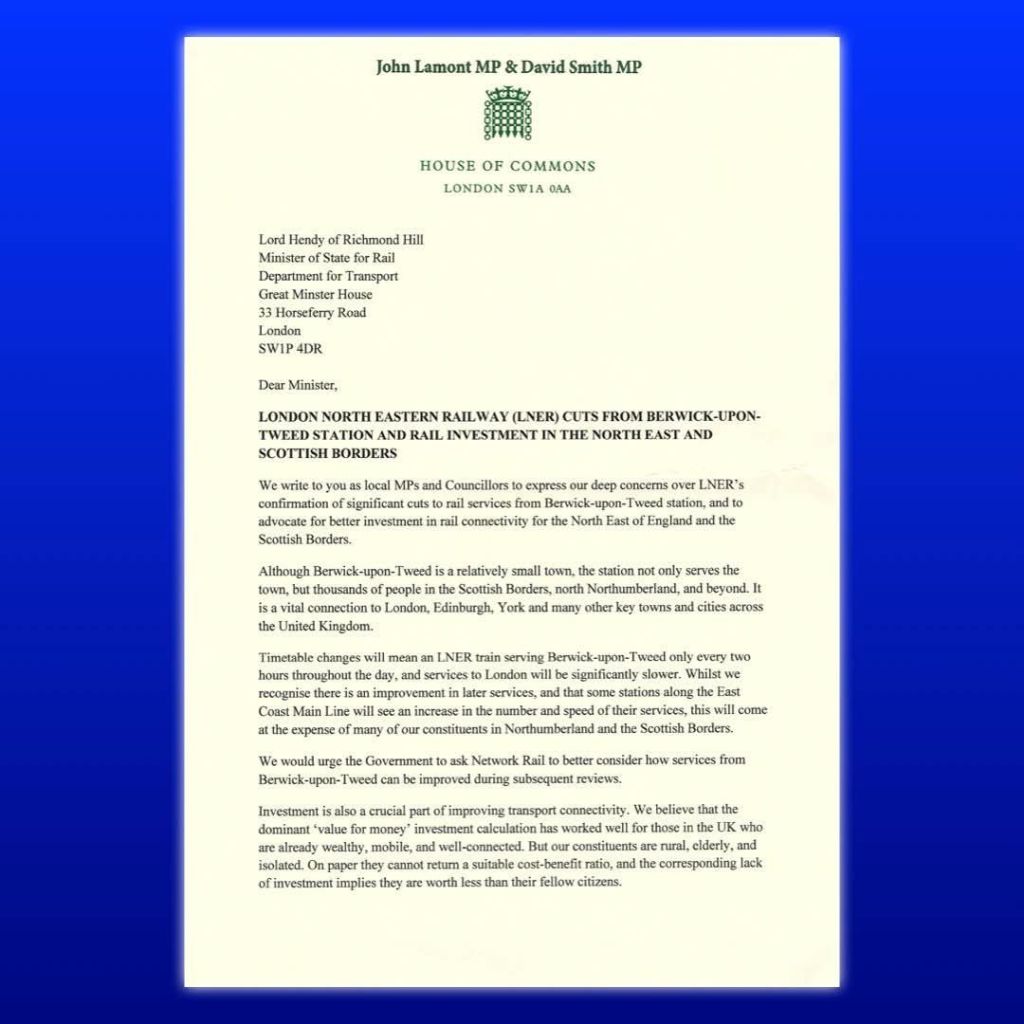
Post by David Smith MPPost by John Lamont MP (letters have been copied below for easier reading)
The reason for the issue boils down to operating the ECML for more ‘Flying Scotsman’ fast expresses, as the exclusion of local trains, which hopefully is explained below:
The Flying Scotsman, a brief history
The East Coast Main Line (ECML) is perhaps most famous as the route of ‘The Flying Scotsman’ which began as the ‘Special Scotch Express’ in 1862, taking 10½ hours, with a half hour break in York for lunch. As time and technology have moved on, the train has progressively become faster and faster.
The old LNER (1923 to 1947) was the company that eventually tied ‘The Flying Scotsman’ name to this rail service, and led to the locomotive ‘Flying Scotsman’ being named after the rail service.
The trip between Edinburgh and London now typically takes just 4hrs and 19minutes; so fast you could get to London and back in the time the original journey took in one direction! There have been specially organised trains running the route in four hours flat, a great achievement, but one that comes at a cost elsewhere, which will be explained below.
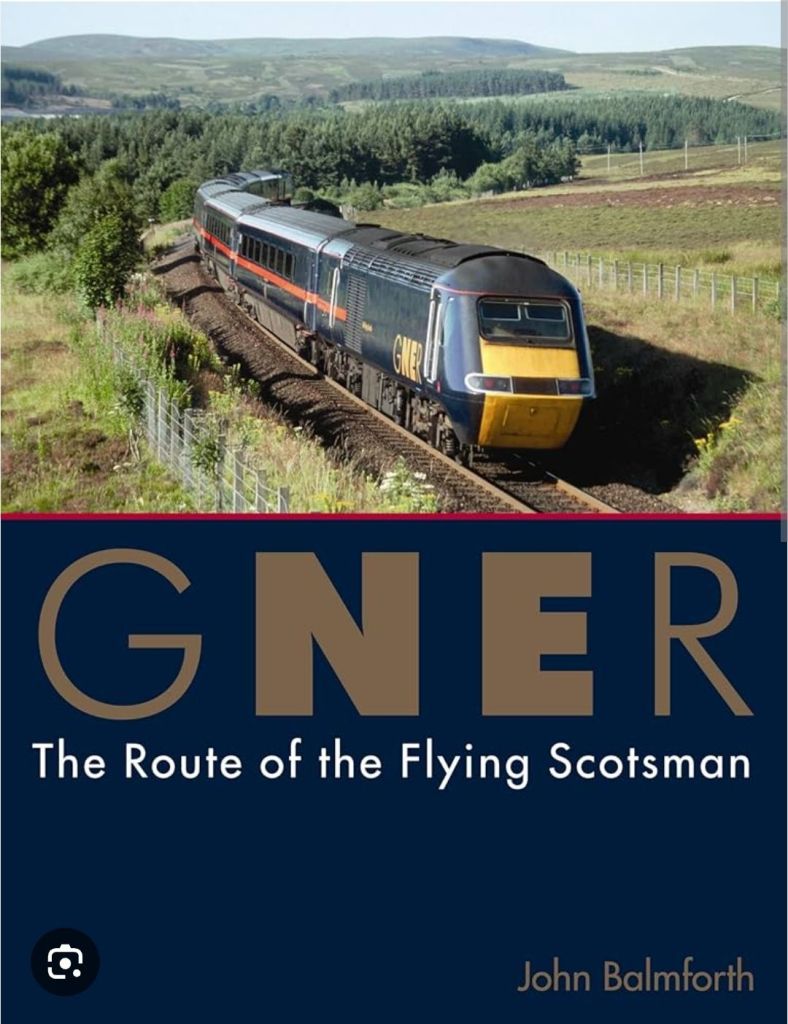
Through my own youth, the operator GNER used to subtitle itself as ‘Route of the Flying Scotsman’ on the side of its dark blue carriages, just under the red band along the sides of the carriages, highlighting the prestige of running fast between Edinburgh and London.
These fast trains don’t just depart at 10am, they run all day every day; providing a fast connection between these capitals, a great market for rail to tap into, and one it is ideally suited to, but without additional infrastructure, means it comes at the cost of other rail services.
Book cover about the history of the GNER showing a typical livery of their trains between April 1996 and November 2007, a brand I grew up with on the ECML.
Speed comes at a cost to local services
This cut from a ten and a half hour trip in the 1860’s, to one of circa four hours today has come at a high cost to local services however, as to make room for faster trains, without the costs involved of upgrading the railway to handle both types of traffic, the slower stopping trains, even those making just a few stops are being squeezed out of the timetable.
This happens as the slower train calling at stations ahead of these expresses effectively block the line, slowing the expresses down, and without additional infrastructure to enable both types of services to run, the slower trains have been squeezed out.
The Bus Analogy
A good way to visualise this is a simple road with one lane in each direction, connecting two bus stations at each end; which acts similarly to a railway with one track in each direction, linking two major stations.
Lets say that this road has a few laybys for HGV’s (the parallel of a freight train if a bus is a passenger train), but the buses rarely use them ordinarily, and for simplicity, this road is exclusively used by buses and HGV’s.
If an ‘all stops’ local bus (similar to an all stops train) is making its way along the road, then the faster traffic behind it gets held up. To run an express bus (non-stop between the big bus stations at each end), then this local bus will have to run less frequently, and turn off this main road early and turn back to allow the express bus to run fast without stopping or slowing down, which would cause passenger complaints and refunds if the bus was arriving late at the far end.
The stopping bus would potentially have little effect on a lumbering HGV (similar to a freight train), but again a fast express bus would get stuck behind a slow moving lorry,
As can easily be imagined, the more non-stop buses being timetabled down this hypothetical road means the local bus, and the HGV’s would be squeezed out, until maybe only a minimal service remains at most for the buses, and HGV’s would be largely constrained to early or late in the day when fewer buses are running.
This is why small stations like Chathill (like a minor bus stop in the analogy) have only 2 trains per day in each direction; they have been squeezed out over time, similarly railfreight can’t be run as much as it should as it too would impede express trains, and railfreight is always needing to fight to have paths.
With even more pressure, even the semi-fast buses, those only stopping at some intermediate bus stops will also be squeezed out too. This is why on the railway, demand for more fast trains is beginning to put more pressure onto stopping at stations such as Berwick, they are ‘in the way’ of faster, non-stop trains.
The key issue is that local and semi-fast services are vital feeders into the rest of the network; your local station, like your local bus stop is the gateway to everywhere else, you’re more likely to use the nearest bus stop to your house or destination, than you are to travel by other means to/from a major rail or bus station.
The Northumberland Line is a great example of this; the new stations, which have a regular and comprehensive service, are acting as a gateway onto the rail network, and to use the bus analogy, is like running a regular ‘drumbeat’ all stops bus service that makes getting into a major hub like Newcastle easier.
As an extreme example in the opposite direction, closing all the intermediate stops between Newcastle and Edinburgh would make timetabling expresses extremely easy, as thats the only train that could then exist, but the effect on towns like Berwick, Morpeth and others would be terrible as they would effectively be cut off, and overall, the railway itself would suffer as a network is made better by more connections, not less.
The loss of local rail services has only ever had negative effects on communities; places like Ashington and Blyth suffered for decades due to the loss of rail services in 1964, and even in 1974, proposals were put forward to reopen the line, and even then the closure was recognised as a ‘big mistake’.
Newspaper clipping from c.1974 to bring trains back to Ashington (Source unknown)
The obvious way to resolve this problem for a hypothetical bus is to build a few laybys for the stopping buses, so a stopped bus will pull off the main road and into a layby, and the express buses will be able overtake easily, or possibly to have stretches of dual carriageway to allow express buses to overtake slower trains with both on the move, but dualling the entire route might not be feasible or cost effective. On the railway, this is done by creating loop lines for platforms, so the stopped train stands on a side track, while fast trains can overtake on the lines in the middle.
Just as it might not be feasible to build a layby for every bus stop, the same as it wouldn’t likely be feasible to rebuild every railway station to have four tracks, and it is almost certain that quadrupling (two tracks in each direction) of the ECML would be unfeasible too (imagine building a two track parallel bridge to existing viaducts like the Royal Border Bridge for example is unlikely), a few strategically placed upgrades, could therefore make a major difference, allowing more local trains, as well as railfreight to run on the ECML.
Collaborative call for infrastructure investment
To their credit, the close collaboration of David Smith MP, John Lamont MP, and other local politicians to call for more infrastructure to enable the fast trains, local trains and railfreight to co-exist, rather than be pushed out is one that I wholly support; the ECML is far more than ‘just’ the fast line to or from Scotland, it should also be serving local communities along its length.
Facebook post by David Smith MP, showing the primary argument about Berwick, but also hinting at a wider investment for Northumberland as a whole.Facebook post by John Lamont MP with letter about rail services at Berwick, but also in the Borders more generally. To read the letter more easily, please see images further down the page.
John Lamont MPis the Member of Parliament for Berwickshire, Roxburgh & Selkirk, representing the Scottish side of the border; as whilst Berwick Upon Tweed station is actually in the English county of Northumberland, it is a significant station for those living near Berwick on the Scottish side of the dashed line.
David Smith MP is the Member of Parliament for North Northumberland, the northern part of the English county of Northumberland, and is my own constituency MP. He represents the area that Berwick-Upon-Tweed station sits in, as well as the large area surrounding the station that is served by it.
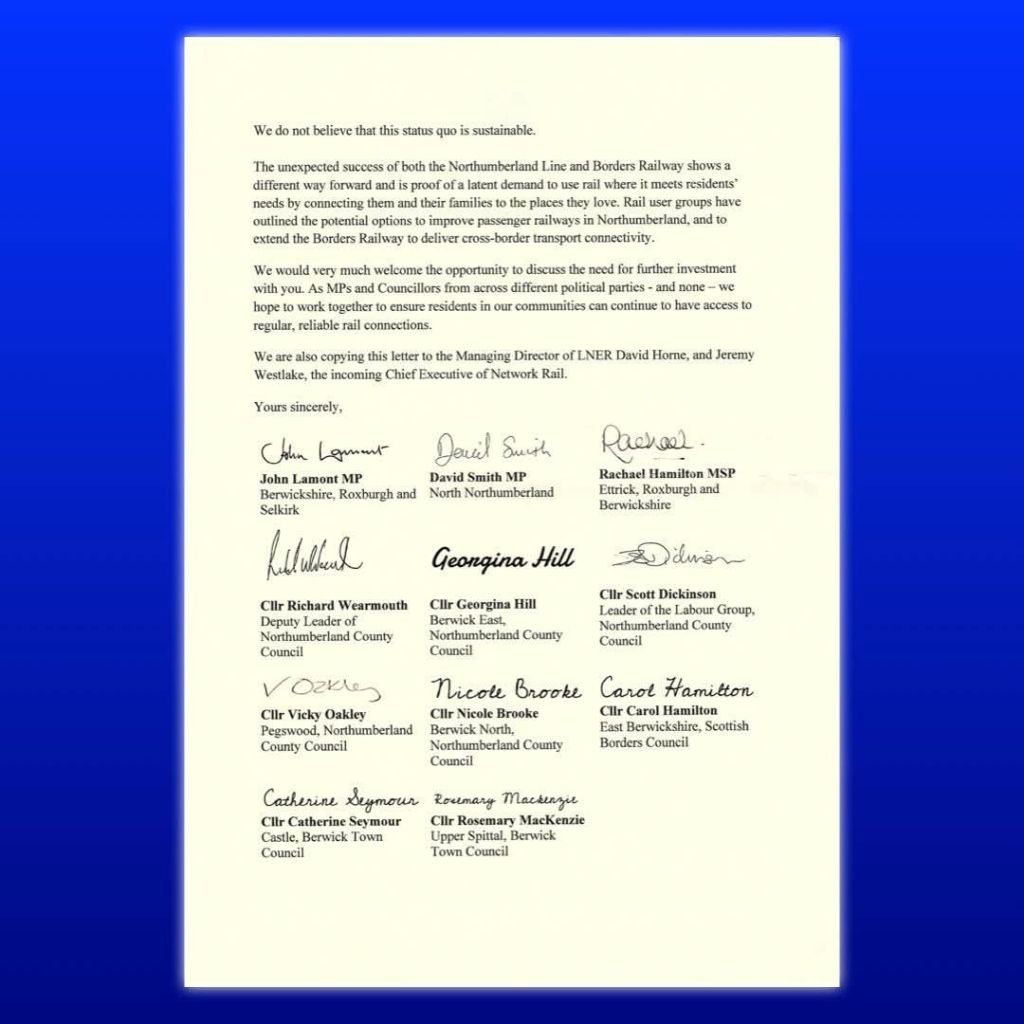
The below images have been copied directly from the post by John Lamont MP for full clarity of their contents, especially the jointly signed letter between John and David to Lord Hendy, Rail Minister about investment into the rail network between Newcastle and Edinburgh more generally.
What is also very encouraging to see is the number of other local politicians who have added their signature to the letter, who are listed below:
Rachael Hamilton MSP Ettrick, Roxburgh and Berwickshire.
Cllr Richard Wearmouth Deputy Leader of Northumberland County Council.
Cllr Georgina Hill Berwick East, Northumberland County Council.
Cllr Scott Dickinson Leader of the Labour Group, Northumberland County Council
Cllr Vicky Oakley Pegswood, Northumberland County Council
Cllr Nicole Brooke Berwick North, Northumberland County Council
Cllr Carol Hamilton East Berwickshire, Scottish Borders Council
Cllr Catherine Seymour Castle, Berwick Town Council
Cllr Rosemary MacKenzie Upper Spital, Berwick Town Council
This shows the broad collaboration across multiple political parties (and some independent candidates too), but working together for the common good of their constituents, by trying to improve the situation not only at Berwick but also for transport more generally.
Flying Scotsman + Stopping Scotsman?
The ECML route between Edinburgh and London became famous for the ‘Flying Scotsman’
Using other existing stations like Chathill, Alnmouth for Alnwick, Acklington, Widdrington, Pegswood, Morpeth, and Cramlington better by improving services calling there would be a major economic boost for their area.
The Northumberland Line being quoted as a success story!
Whilst it is a project that has faced some problems, the Northumberland Line is, as stated in the letter to Lord Hendy, an excellent example of ‘build it and they will come’ having now exceeded 700,000 passenger journeys in under a year of operation, and the line progressing towards completion, with four stations at Ashington, Blyth Bebside, Newsham, and Seaton Delaval now open, with only Bedlington, and Northumberland Park yet to be opened up, but the stations are now at an advanced stage, and will hopefully open in early 2026 at the latest.
It has been a resounding success for the fairly modest investment of £336.4m to date, and with such a busy and popular route, a similar investment into the East Coast Main Line (ECML) is more than justifiable to increase its capacity.
In my view, the Northumberland Coast Loop could be framed as an extension of the Northumberland Line, taking this highly successful line further north via Pegswood, up to Berwick and potentially into Scotland, ultimately forming a second route between Newcastle and Edinburgh via Blyth, and give an uplift to services calling at stations in North Northumberland and the Scottish Borders.
It is a known issue that capacity on the ECML is limited, but what needs to be made clear are answers to the questions below:
What infrastructure needs are there to operate more trains? Where would new loops be required, and could proposed new stations such as Belford be a way to ‘loop’ a stopping train, and allow faster following trains to overtake it while it stops there? What costs would these entail?
Are there any small changes in timetables that could be done sooner to give an uplift (i.e. using some existing loops more regularly to allow slower trains to be overtaken), for example the ‘Chathill Flyer’ is the only passenger train to use the loops at Wooden Gate to my knowledge, but could more stoppers be looped here, or elsewhere to increase line capacity?
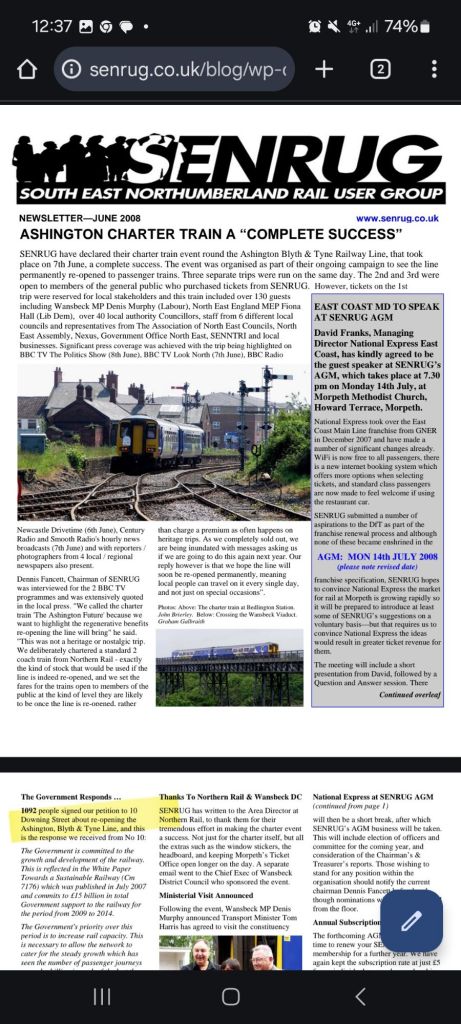
At present, an indication of the latent demand for rail services running a route such as the Northumberland Coast Loop is the success of our petition, which to date has 966 signatures, which might not sound huge, but the SENRUG petition of 2008 (shown below and highlighted in yellow) only had 1098 signatures at the time for the now near million passenger Northumberland Line (then referred to as the Ashington, Blyth, and Tyne Line), only 132 more than the current ongoing petition for the N’land Coast Loop, so what can be inferred is that a petition shows in reality only a tiny fraction of potential users, build it, and they will come.
Northumberland Coast Loop petition as of 28.10.25SENRUG newsletter of June 2008
Lets hope that the continued campaigning across both sides of the Scottish Border can result in improvements to the regions rail services, and that other neighbouring MP’s can get behind it too to see more investment made in the rail routes of this area to improve the strength of our economy and boost connectivity to, from, and within the broader Borders area, making direct links from Berwick-Upon-Tweed to Blyth possible, as well as more distant connections to places like Penzance too.
With the huge success of the Northumberland Line, lets keep investing in rail in Northumberland, which was one of the key places in the development of railways in the UK, from Huntington Beaumont introducing the waggonway to the region in c.1609, through to the development malleable iron rail at Bedlington in 1820, used extensively on the Stockton and Darlington Railway, this year celebrating its 200th anniversary.
Somewhat fittingly, the Northumberland Line itself passes above the section of the River Blyth where Beaumont began over 400 years ago; we’ve progressed from horse drawn waggons of coal, through steam hauled trains like the Flying Scotsman, to 125mph InterCity passenger trains and containerised freight.
Hopefully Lord Hendy, as well as the wider Government, will at last put long overdue investment into the ECML that is clearly needs.

















 The Northumberland Coast Loop