A recent Northumberland Gazette article has detailed how Sella Controls is intending to install two post mounted displays, one on each platform, to upgrade the passenger information systems at the station.
Please click the link above for further information.
North East Mayor Kim McGuinness, alongside MP’s Ian Lavery, and Emma Foody, have published on Facebook an open letter yesterday to Ellie Burrows, Regional Managing Director, Eastern of Network Rail to request the earliest possible opening of the last two stations under construction on the Northumberland Line scheme, those at Bedlington, and Northumberland Park, with Blyth Bebside due to open in just over a week on Sunday 19th October 2025.
Whilst it is important to have these stations up and running as soon as possible, it must also be done safely and not unduly rushed despite the delays of potentially a year or more since the opening of the line on 15th December 2024, which itself was a slipped deadline from the original ‘Summer 2023’ opening of the line.
Crowding and More Carriages Comments, and TPE via the Northumberland Coast Loop route a solution?
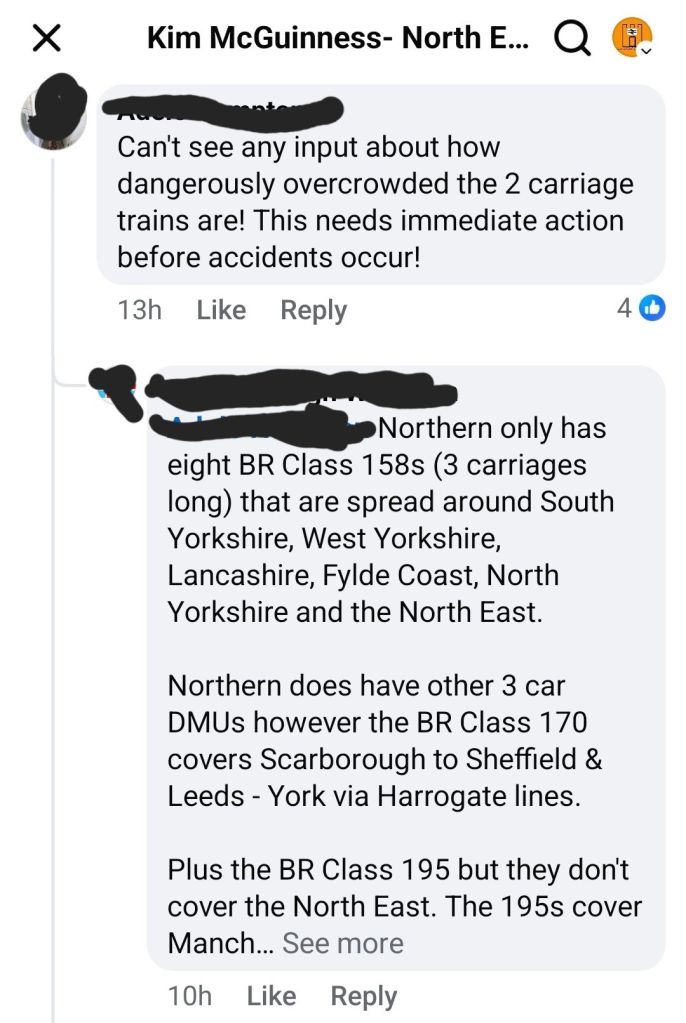
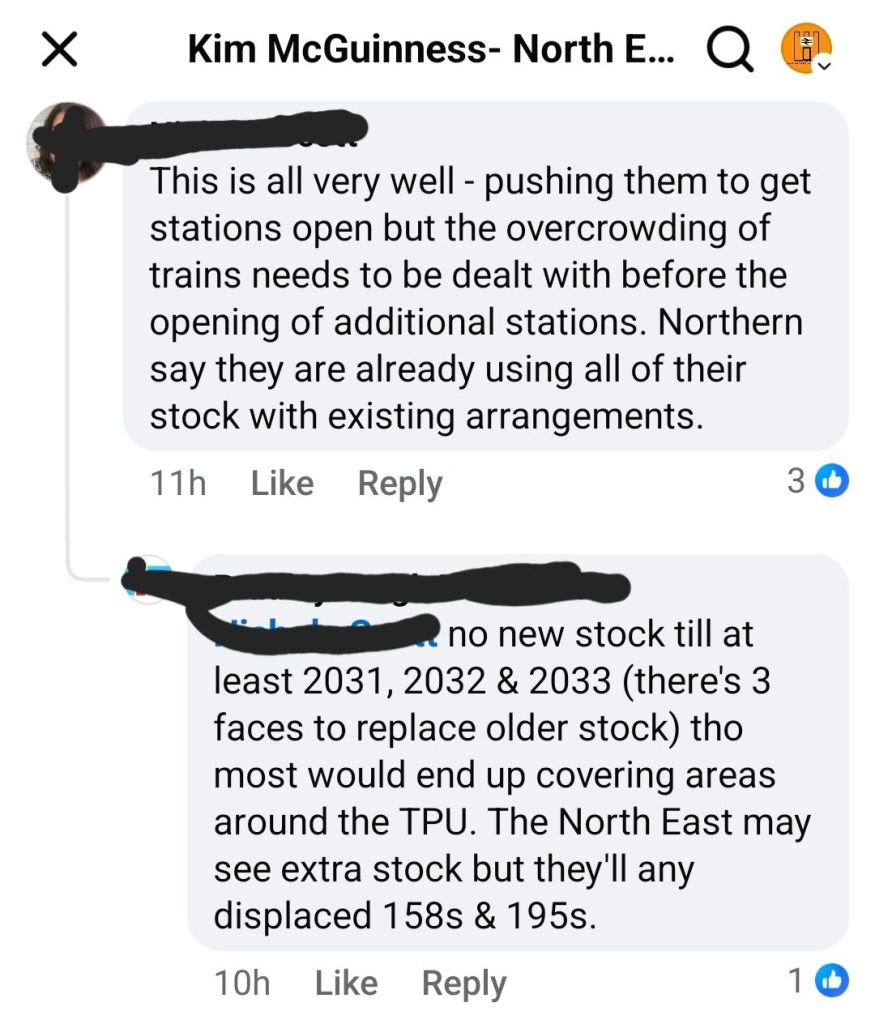
Of note on the Facebook post was the comments calling for more carriages to be provided on the Northumberland Line due to issues of crowding being experienced due to the high popularity of the route, some examples are shown below (anonymised)
The problem is that the Northern units (Class 156/158) that are used on the Northumberland Line are around 30 year old British Rail trains, and are thinly stretched across all of the Northern routes; pulling a unit from one route would make another one short of trains – very much ‘robbing Peter to pay Paul’.
There simply isn’t anywhere to get new units of the same design, and whilst new trains for Northern are in the pipeline, it’ll be quite some time until they are seen on the network.
Transpennine Express (TPE) via Blyth?
What I would propose is a re-routing of some Transpennine Express (TPE) units (the Nova 1 bi-mode fleet), which are short, 5-car trains which currently run Newcastle to Edinburgh via Morpeth and Cramlington to alternatively run via Blyth and Northumberland Park. These could add around 320+ seats, with some in First Class to the route.
As a bi-mode train, they can run on both the overhead electric wires, but also have an onboard diesel engines, which would allow them to come off the East Coast Main Line at Morpeth North Junction (https://w3w.co/insects.hamsters.issuer), then travel through Hepscott, over Choppington Level Crossing, and join the Northumberland Line at Bedlington, and could augment the Northern operated Northumberland Line trains by providing more trains, and thus more seats to/from Newcastle, but also to give a connection northwards to places like Alnmouth, Berwick Upon Tweed, and Edinburgh direct.
Alternative operators could also serve the route if TPE is unable to; CrossCountry for example uses diesel ‘Voyagers’ (Class 220) in four car sets, which could run via Blyth rather than via Morpeth and Cramlington.
A further example could be Grand Central trains extending their current London – Sunderland ‘North Eastern’ route through Newcastle and to Edinburgh via Blyth, again providing more seats, but also offering a new direct link between the Scotland and the Northumberland Coast onto the Durham Coast and Teesside.
Indeed a combination of different operators would be possible, but any additional trains running via the Northumberland Coast Loop and serving the stations would ease the crowding experienced on some services, whilst also offering new northward connections.
As of today, the petition for the Northumberland Coast Loop currently stands at near 1000 signatures, suggesting a strong demand for the route exists, so hopefully Mayot Kim McGuinness, and MP’s Ian Lavery and Emma Foody might put forward this route to help ease the crowding on the Northumberland Line, and give these new stations even better connections to the rest of the UK?
A recent Facebook post from John Lamont MP, who represents Berwickshire, Roxburgh and Selkirk just over the border in Scotland gave an update on a recent meeting held at Berwick Upon Tweed railway station.
While Berwick station is within Northumberland, and therefore in the Consituency of David Smith MP, who represents North Northumberland, it is great to see the cross-party collaboration between both elected representatives to work for the people on both sides of the Anglo-Scottish border, who pass between both countries regularly.
Like many other campaigners and organised groups, the land between Edinburgh Waverley and Newcastle Central is not just there to rattle through non-stop and admire the splendid views from the line; it should also be there to serve the local communities who live along it’s length, or nearby to it (including myself as an Alnwick resident), but also to serve the growing market for tourism in the areas served by the East Coast Main Line (ECML) between Edinburgh and Newcastle.
As John succinctly puts it, we need to push for investment in the infrastructure to deliver BOTH a fast InterCity service between Edinburgh, Newcastle, York, and London, alongside a strong set of local services calling at the intermediate stations like Berwick, but also Chathill, Belford, and hopefully, a route via Blyth, Northumberland to further link Northumberland together as one county.
Lets hope that LNER, and the other train operators, alongside Network Rail can help deliver BOTH a fast service between the cities, alongside the slower ones to serve smaller, but still vitally important places in-between.
If you’d like to join the 958 people who are supporting an Edinburgh – Blyth Bebside – Northumberland Park – Newcastle rail route becoming established, please do so here: https://chng.it/zThXj8HBpY
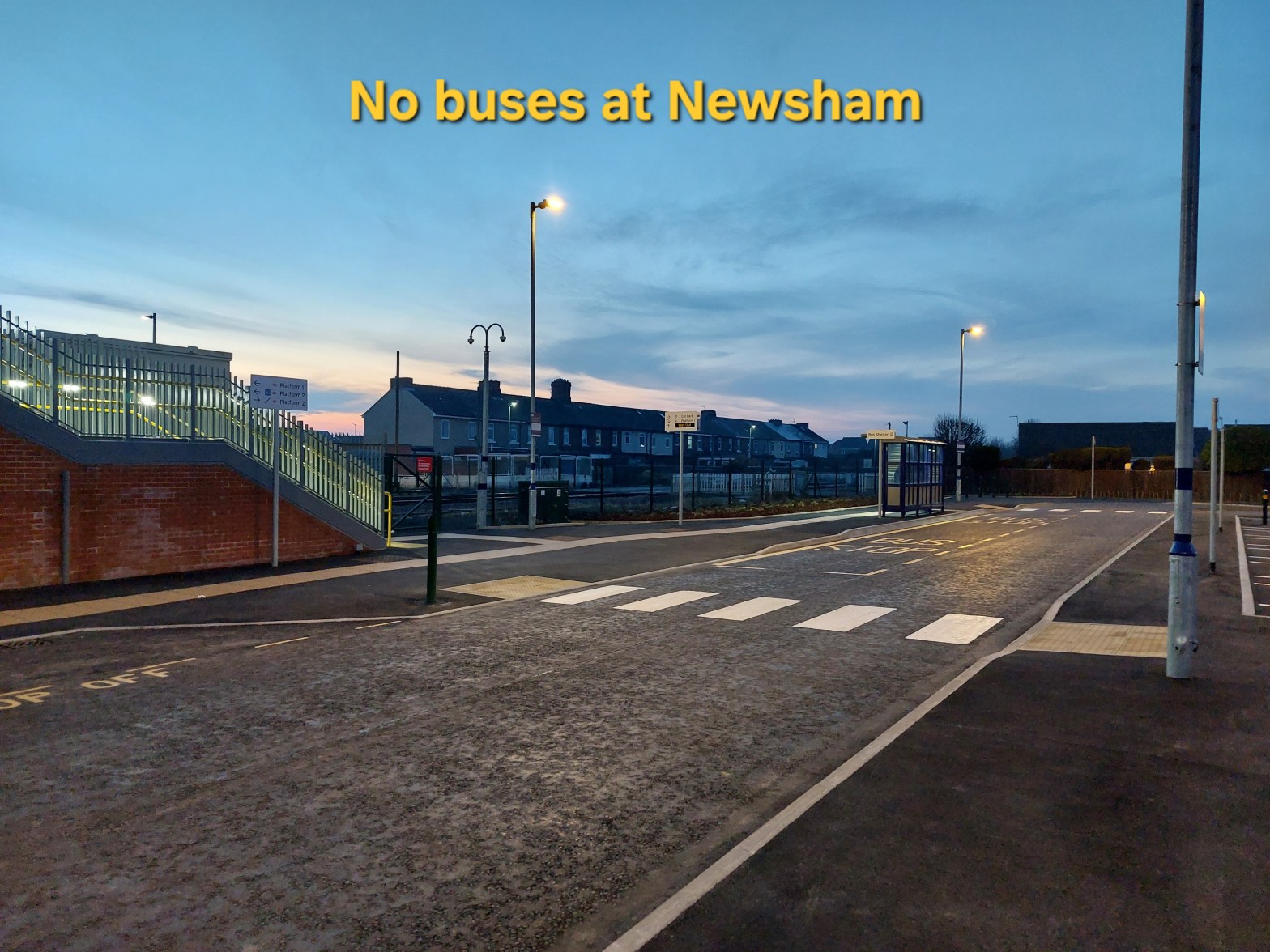
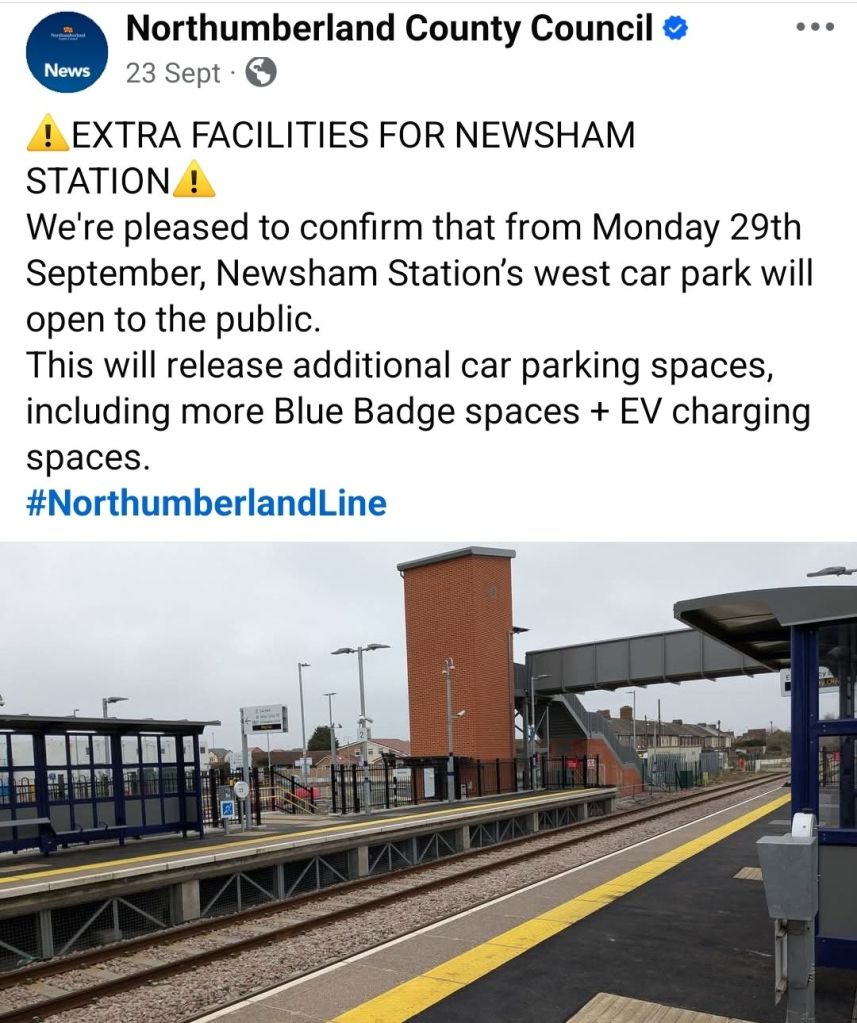
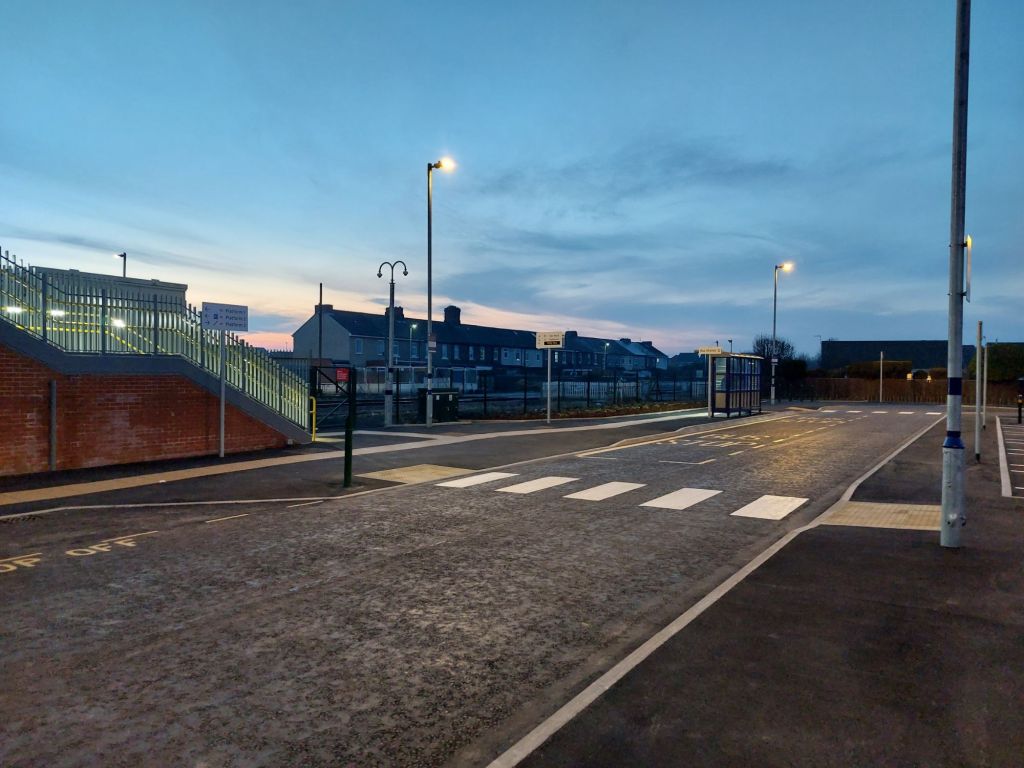
Following a recent announcement on the expansion of the facilities at Newsham station on the Northumberland Line, which largely comprising of additional car parking being completed, has raised comments about the lack of buses serving the new station.
Announcement by Northumberland County Council (NCC) of the opening of the west car park at Newsham station, the third station opened on the Northumberland Line in March 2025.
The huge success of the Northumberland Line, which has had over 500,000 passengers announced some time ago (meaning the current passenger total is likely now far higher given how busy many trains continue to be) has meant that this additional west car park being opened will ease some of the strain on the east car park, as well as the streets of local residents to the station.
High cost of the ‘free’ car parks; £6k+ per space!
Such has been the demand for the new rail services, social media comments have suggested that local streets are acting as an overflow car parking facility for station users, which obviously causes tensions, but car parking spaces are surprisingly expensive to provide, especially when they are often desired to be free at point of use.
Therefore, to build an additional 200 space car park at Newsham; a guide price of at least £1.25m would be likely (£6,120 x 200).
Given the cost overruns on the Northumberland Line, and the recent commitment of additional funds to complete the stations on the line, more being requested to provide more parking is going to be challenging to find.
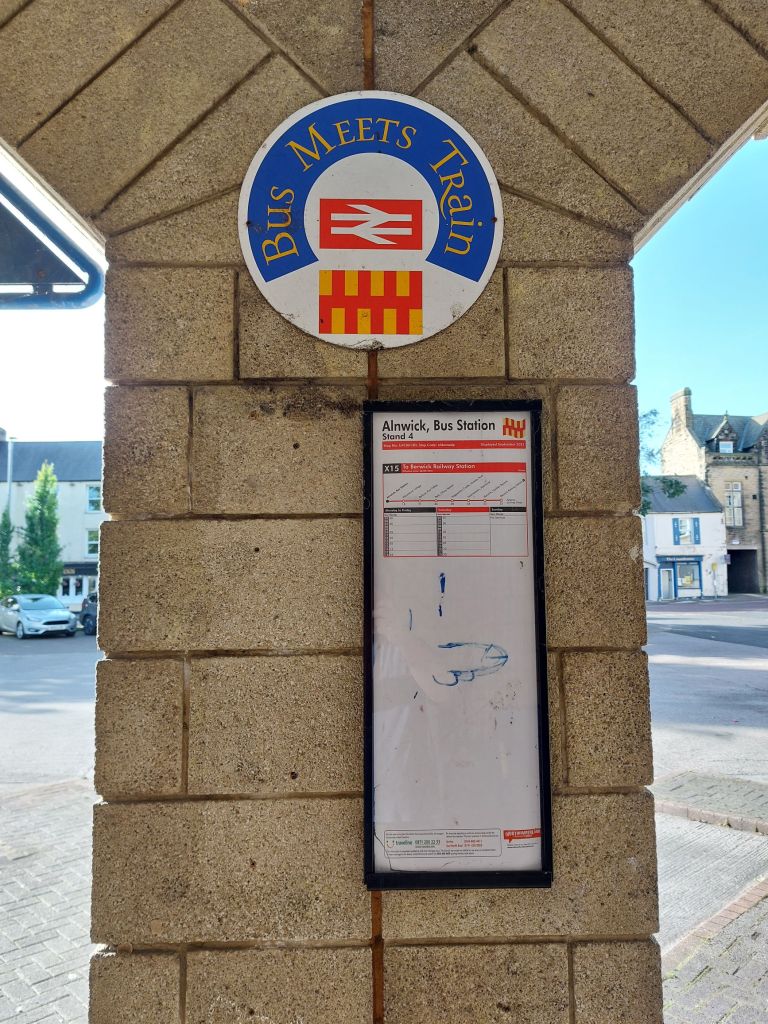
‘Bus Meets Train’ a fix for Blyth?
A clear solution to this problem would be to make access to Newsham (and other stations) without using a car at all easier, and one option would be to use the already existing bus stop in the east car park, conveniently almost adjacent to the southbound platform.
‘Bus Meets Train’ signage at Alnwick Bus Station, a town a fraction of the size of Blyth, and now without its own railway station.Photo of the new, but little used bus stop at Newsham station, taken on 20th March 2025
Whilst the bus stop has been used for rail replacement buses, to my knowledge few, if indeed any service buses have called at this bus stop, with comments on the original post by NCC below suggesting strongly that no bus companies, including Arriva, the main bus operator in the area, has been willing to serve this new bus stop.
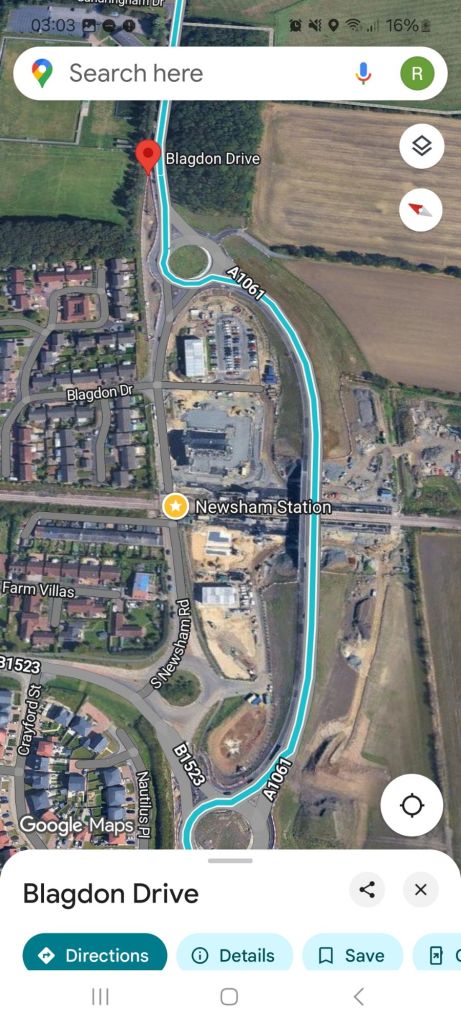
A good example of a bus that could serve this bus stop is the Arriva X8 service, that passes over the Northumberland Line itself, and then calls at the nearby Blagdon Drive bus stop, which would need to only make a tiny diversion through the car park to serve the station. Running from early morning to late evening, an interchange with the X8 would be a potentially ideal way to improve bus/rail integration at Newsham station.
This case is perhaps a good example of where the deregulation of buses is a clear policy failure; and that organisations such as NCC should have more power to compel companies like Arriva, who are in receipt of subsidies to provide bus services, to actually serve a multi-million pound new railway station that is on their bus route?
The deregulation of buses is based on flawed principle that bus services like the X8 should be ‘competing’ with the Northumberland Line services as a route into Newcastle from Blyth, where in reality, they should collaborate to their respective strengths.
The strength of the train is a fast, comfortable way to transport large volumes of people, whilst that of the bus is to carry smaller volumes nearer to origin and destination points; few streets in Blyth would be able to have a railway station at the end, but many could and indeed do have a nearby bus stop, with the inherent flexibility to run many varied bus routes to serve different areas of town.
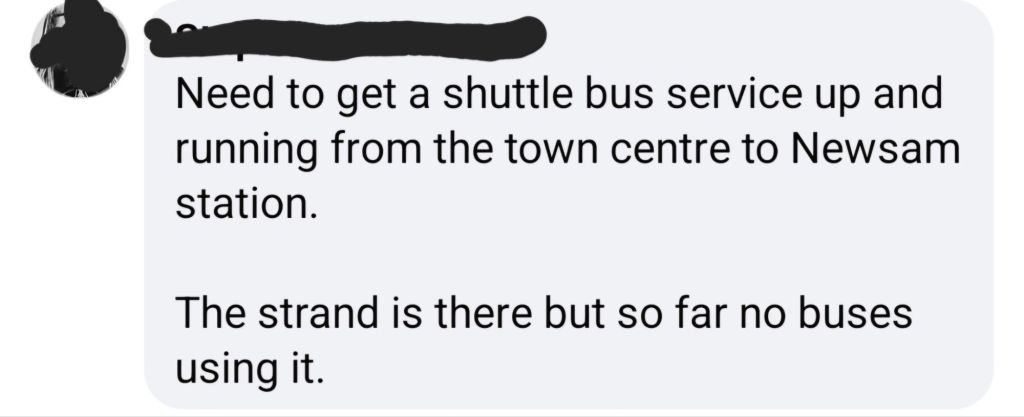
Another comment on the Facebook post suggested running a dedicated shuttle bus between the Town Centre to Newsham, which could be an alternative option, or more ideally a mix of both could be employed?
The Northumberland Line is likely to continue being a massive success with or without bus connectivity, but ‘bus meets train’ is an obvious quick, inexpensive solution to ease traffic problems more broadly; people driving in/out of Blyth to head to Newsham station, or Blyth Bebside when it opens still contributing to congestion within the town just as much as if they drove all the way to their workplace or leisure activity. A simple swap away from their own car, to a short bus trip to the nearby station as an integrated bus+train trip would be a far better solution, especially if ticketing can be changed to a single through ticket too…
Enhancing the Northumberland Line: Beyond Newcastle, and the Edinburgh Extension?
Hopefully, if successful, the Northumberland Line will see this MetroCentre link become a permanent feature on more days of the week, and maybe more routes south beyond Newcastle might prove possible, with the Durham Coast route to Sunderland and Teesside a potential contender too.
Northumberland Coast Loop
The other option is to also look north, and use the route linking Bedlington to Pegswood to give direct access to North Northumberland and Scotland, only built in the 1980’s, and largely for coal to reach the now long-gone Blyth Power Station, this link could see a new rail service to put Blyth on a through route between Edinburgh and Newcastle, making the Northumberland Line into the Northumberland Coast Loop?
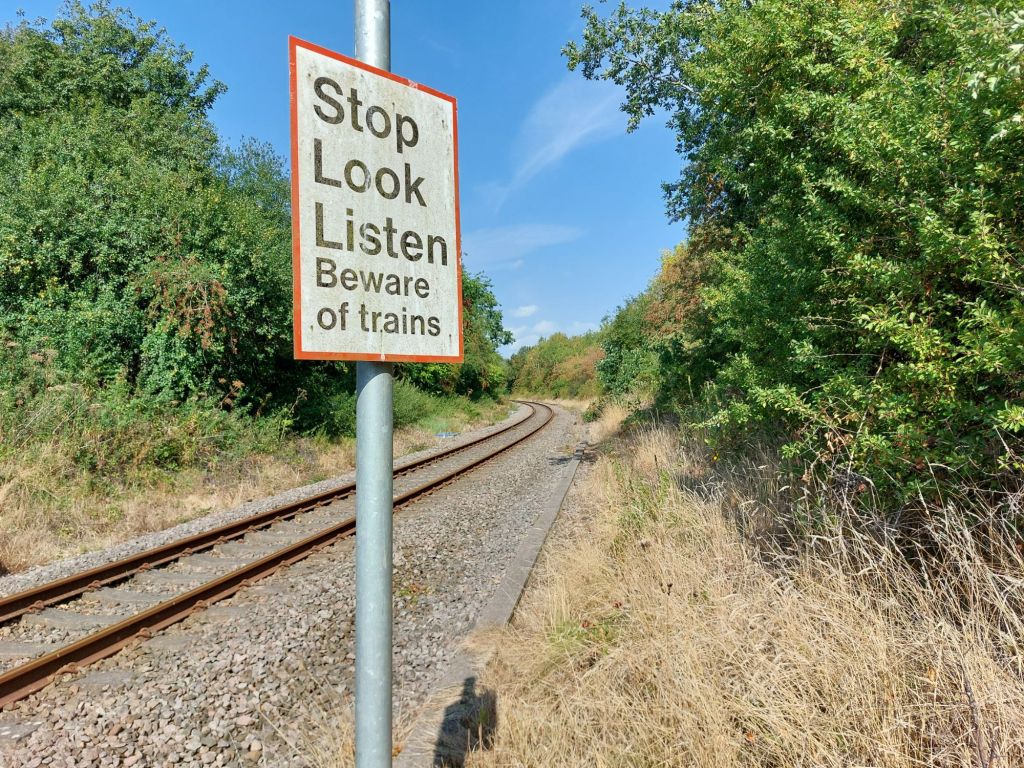
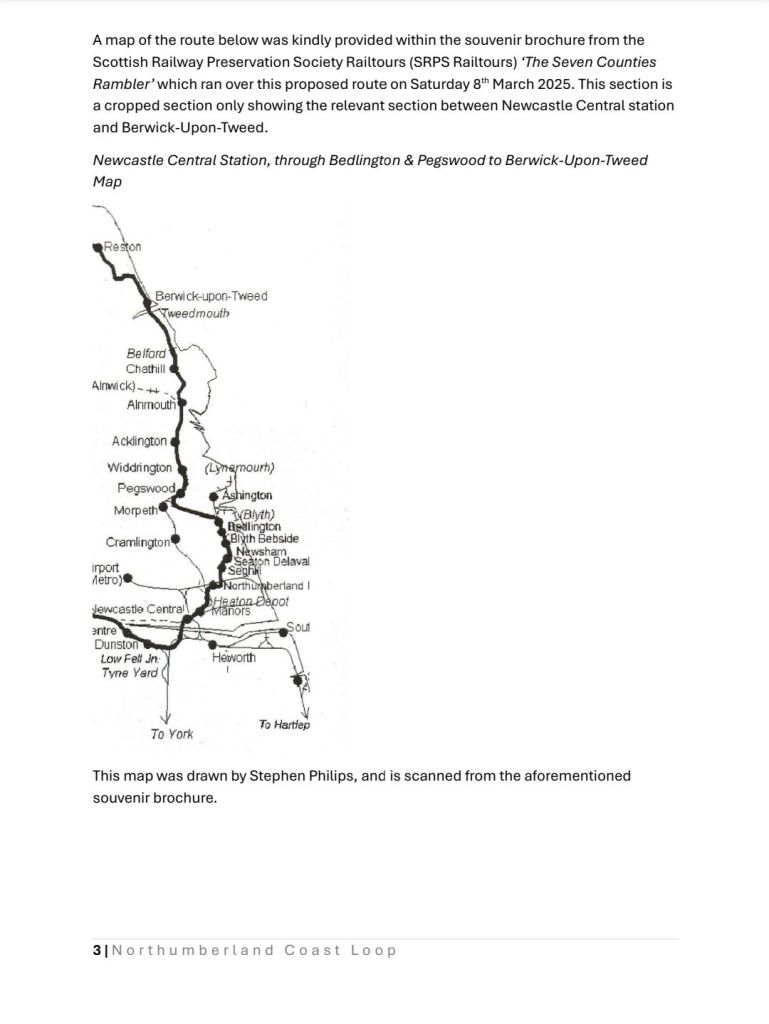
Public footpath over the Morpeth North Curve, part of the direct link from Blyth to Edinburgh. (Have a look for yourself by visiting it at what3words location: ///plea.refuses.shepherdess)Route map showing the proposed Northumberland Coast Loop allowing passage from Newsham and Blyth Bebside to Pegswood, Alnmouth, Berwick Upon Tweed, and Edinburgh. The route of ‘The Seven Counties Rambler’, which did the Newcastle – Blyth – Edinburgh route back on 8th March 2025, and hopefully could be a regular route in future!
Today is Saturday 27th September 2025, and 200 years ago marked the official opening of the Stockton and Darlington Railway, an important moment in railway history, and one that is good to reflect on both the railways of the past, but it is also ESSENTIAL to look towards the railways of the future.
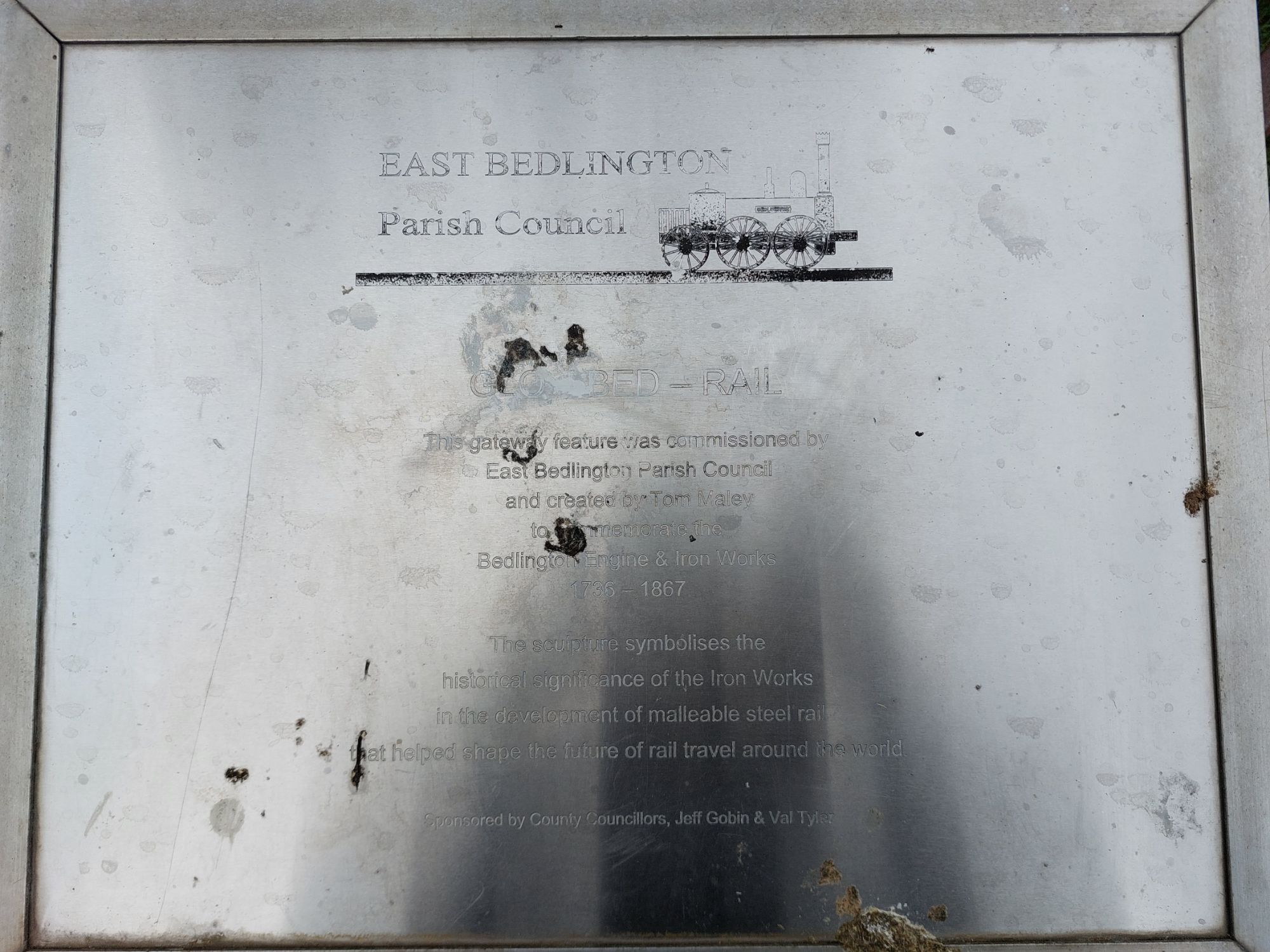
Bedlington was an important player in the success of the early railway, the malleable iron rails developed by Birkinshaw being used extensively on the S&D (around ⅔ of all the rails), but Bedlington is also, in my view a key part of the future; the passenger railway returning there hopefully marks a turning point of where investment is made, and using the railway routes through Bedington better could make a massive difference to the fortunes of my hometown and surrounding area.
Despite being a year of celebrations of the railways as a transport system, and recognition of their importance, they seem to still take a backseat compared to road schemes, and get the very undeserved reputation of being ‘staggeringly expensive’ to quote a local resident, when in reality it is many of the road schemes that are hugely expensive for little overall gain.
These roundabouts are undoubtedly busy ones, with heavy traffic at almost all times, but cost of ‘upgrades’, which range in scope and price from a £300m design through to a £775m one are staggeringly vast sums of money.
The costs of roads are huge, but they don’t necessarily bring the prosperity that politicians promise; a dualled A1 is often said to be key to unlocking growth and the economy, yet towns like Blyth and Ashington, long connected by the long dualled A189 Spine Road are amongst the most deprived communities in the UK, with the return of the passenger railway being perhaps the real catalyst for positive change. Perhaps roads are not the promised path to prosperity, maybe it is a way made of steel?
This rail scheme has seen the reopening to passengers of an 18 mile long freight railway, with six new stations (even Ashington and Bedlington, which retained platforms since the 1964 closure of the line have been so heavily rebuilt as to be classed as new, not just reopened).
The Northumberland Line, despite its issues with delays and cost overruns can be clearly defined as a success already; with over 500,000 people using it so far, and trains being so well filled as to actually suffer from crowding, despite only having half of its stations open so far.
Could it be said that rail might be both cheaper and better to build?
Northumberland Line: Approx £18.7m per mile
This gives an approximate cost per mile of the Northumberland Line of £336.4m ÷ 18miles = £18.7m (rounded up), and with being an average, would represent 1 mile of freight railway upgraded, and ⅓ the cost of a station.
That would roughly work out at £56.1m for three miles of track upgrades from freight only to passenger carrying, plus a completely new station built alongside.
The caveat with this would be that three miles of track, and a new station in one place could cost substantially less per mile (i.e. a single line and single platform station), compared to a double track section (line in each direction) and a double platform station, which might cost more, but would be heavily dependent on circumstances at the specific sites such as ground conditions.
This very much a ‘best guess’, as with no highly detailed breakdown of prices for the individual elements of the Northumberland Line which has a mix of both single and double lines, as well as single and double platforms at different stations, which prevents information on the cost of each individual station, and of each individual mile of track, an average cost as produced above is the only reasonable comparison available.
Two Roundabouts, or 16 to 41 Miles of Railway with five to thirteen new railway stations?
The low-end cost of the A19 roundabout upgrades at Seaton Burn and Moor Farm is expected to be approximately £300m, and if £300m is divided by the above £18.7m cost per mile of the Northumberland Line, it would allow for approximately16 miles of similar freight line to be reopened for passenger use, including five new stations if the money was instead invested into the rail network, rather that the the road network.
At the high-end estimate of £775m, and again using the Northumberland Line cost per mile of £18.7m, this could result in approximately 41 miles of line reopened to passengers, including the cost of up to thirteen stations.
Northumberland Line extensions to Woodhorn, Newbiggin by the Sea, & Lynemouth, Cambois for Blyth, and the Northumberland Coast Loop?
Whilst there isn’t now a singular freight line in Northumberland/North Tyneside of 16 to 41 miles long that is awaiting an upgrade to become passenger carrying, there are several shorter sections that could be upgraded, including new stations to provide further enhancements to the Northumberland Line itself.
Ashington to Lynemouth, 4 miles of line for c.£71m?
One of the obvious contenders is to extend the Northumberland Line northwards and eastwards from Ashington to connect the Woodhorn area (near the popular Woodhorn Museum), the seaside town of Newbiggin by the Sea and the former mining town of Lynemouth (presently the end of the line where Lynemouth Power Station stands).
Woodhorn Colliery Museum is about 1.25miles/2km via the existing rail route from Ashington, the likely site of a new station serving the eastern side of Ashington around the A189 Spine Road.
The line then curves northwards towards Lynemouth, passing over the A197 near the former Church of St Mary, Woodhorn at 2.2miles/3.6km from Ashington, a possible site for a station to serve Newbiggin by using the existing line, rather than rebuilding the branchline towards the coast (somewhat constrained now by a new school adjacent to the trackbed, and the significant civil engineering works needed to adjust the embankment heights to clear the A189 at the Woodhorn Colliery end).
The current headshunt of the Lynemouth Power Station, adjacent to Albion Terrace is reached at 3.5miles/5.7km from Ashington, but might reasonably be extended a few hundred yards towards Bridge Street (former railway cutting, now infilled), which would extend the line slightly (0.3miles/400m) to 3.8miles/6.1km from Ashington, giving Lynemouth an ‘edge of town’ station alongside the Lynemouth Miners Welfare Institute.
Again using the Northumberland Line average cost of £18.7m per mile, Ashington to Lynemouth, a rail route 3.8miles/6.1km long would cost in the ballpark of c.£71m; a quarter of the cost of the low-end A19 roundabout works, and near an eleventh of the high-end A19 roundabout cost (Ashington to Lynemouth Bridge Street could be done 11 times over for the same amount of money).
There is an amount of variability due to the possibility of three proposed stations relatively closely spaced at Woodhorn Museum, St Mary’s, and Lynemouth Institute, which would possibly put upward pressure on the price, as might a short bypass line around the Power Station sidings, but a generous £100m budget would still be third of the cost of minor roundabout upgrades, and around a seventh of the high-end costing.
Cambois for Blyth Town Centre for £60.7m – £101.4m?
A branch from the Northumberland Line between Bedlington and Ashington could be another contender for investment too; whilst the population of Cambois and North Blyth itself is relatively small, the line extends well into the north side of the Port of Blyth, which, when and if combined with a revival of a pedestrian ferry service across the port, similar to those used on the River Tyne, could provide a great link for central Blyth.
The rail route into central Blyth is likely now lost to development, and would likely now be truncated to near Gilbert Ward Academy, as well as the issues likely to arise from the level crossing being reopened on Plessey Road (near Plessey Chippy) likely to preclude a reopening on the Blyth side of the river.
While on the opposite bank of the River, the railway has the advantage of already being open, and whilst the level crossings at Winning, Freemans, and Unity Terrace/Foster Terrace might need upgrades, these already exist and are in regular use.
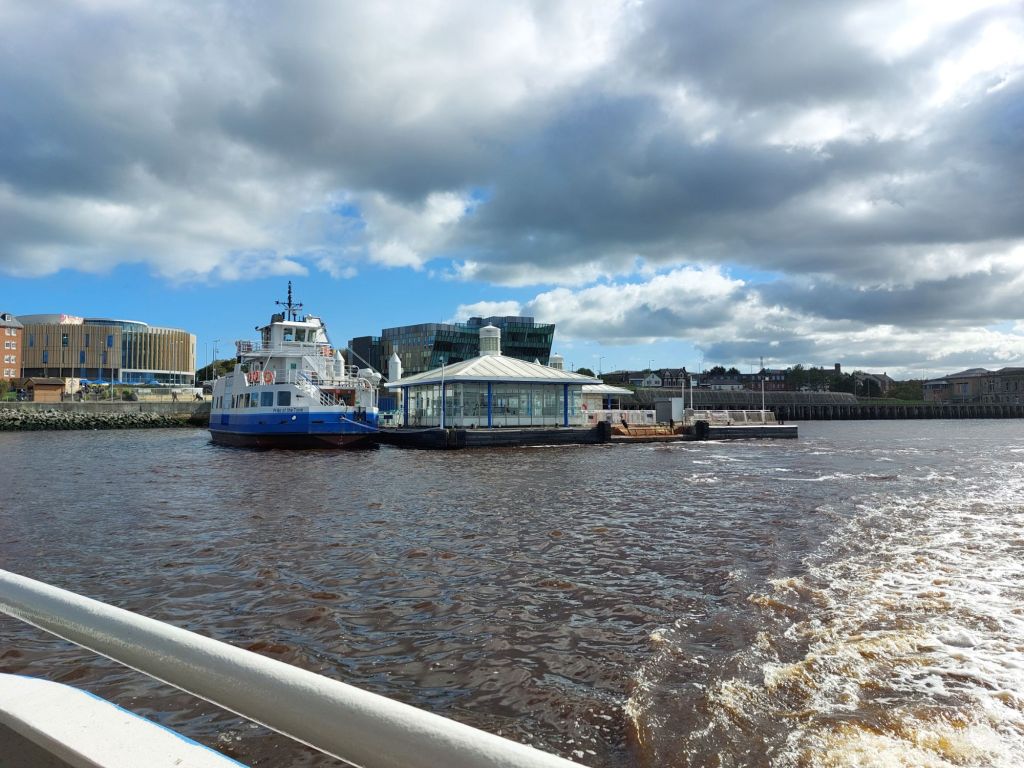
Tyne Ferry ‘Spirit of the Tyne’ in September 2025 at the dock in South Shields. Sailing aboard ‘Spirit of the Tyne’ bound for North Shields
Taking the distances from West Sleekburn Juncton (the direct route from Newcastle & Bedlington into Cambois), the site of the former Cambois Diesel Depot (stabling point for locomotives), where a station serving the township of Cambois could be built is only around 2.1miles/3.4km from the West Sleekburn Junction with the Northumberland Line.
Assuming a new landing station for a revived ferry might be built near the roundabout for Battleship Wharf, a station near to Worsdell Street might be constructed (clear of a run-round loop for the ‘Alcan’ alumina dock) which would be around 3.25miles/5.2km from West Sleekburn Junction.
Using once again the average price of the Northumberland Line per mile of £18.7m, this 3.25mile line could cost in the ballpark of £60.7m, a fifth of the price of the low-end roundabout upgrades.
This above figure does not take into account the costs of a ferry and/or new landings on each river bank, which would need to be separetely costed and accounted for, but there may be some scope to ‘pool’ the Tyne and Blyth ferries, so that a third ferry would work on the River Blyth, with the existing ‘spare’ Tyne ferry providing cover when required.
As an indicator of costs, the Spirit of the Tyne, an ‘off the shelf’ ferry design was built in 2007 at a cost of £1.9m, so adjusted to 2025 prices would be approximately £3.3m today, and the proposed new landing in North Shields is expected to cost £18.7m, so multiplied by two would be £37.4m, giving an overall estimate for cost for a new ferry, and two landings of c.£40.7m.
This would give a ‘Cambois for Blyth Rail+Ferry’ link an overall price tag of c.£101.4m, but compares well when considered alongside road schemes such as the Blyth Relief Road at £59.9m, which will run on the outskirts of Blyth, and so will not ease traffic issues in the Town Centre itself, whereas a pedestrian ferry connection across the Port of Blyth to buses, and potentially to rail services if a passenger link was built would make access to/from Blyth Town Centre by public transport far easier.
To operate the Cambois Branch without the need for additional train paths on the Newsham – Newcastle section of the Northumberland Line which is constrained by single track; one option might be to use a pair of two-car units working as ‘portions’, with a northbound four car train splitting somewhere like Newsham/Blyth Bebside/Bedlington, with two carriages going to Ashington/Woodhorn/Lynemouth, and two carriages to Cambois/North Blyth, with the pair of two-car trains heading southbound combining again into one four-car unit at whichever station is best suited for this.
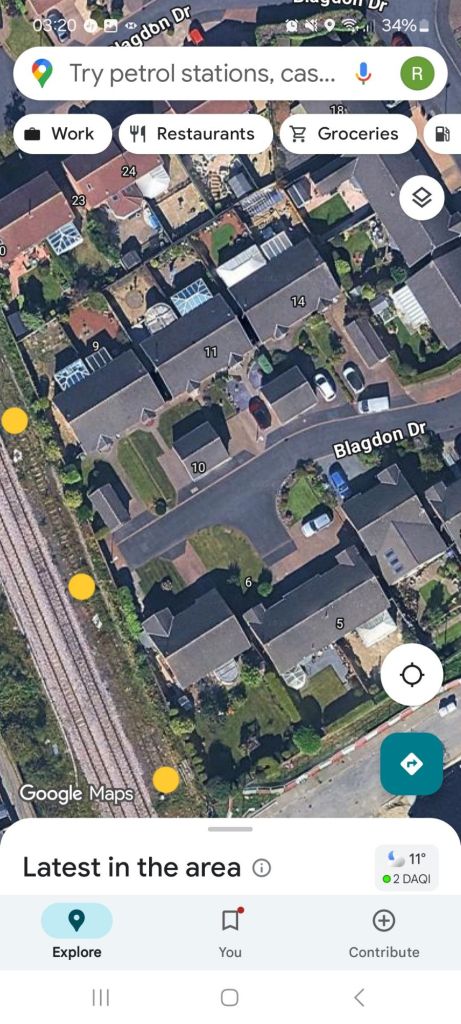
A second option could be to create a ‘shuttle’ between Cambois and Blyth Bebside (acting as an interchange onto other trains), with empty stock running towards Newsham, where it could use a rehabilitated third line next to Newsham Pond/Blagdon Drive as a reversing siding, which by measuring on Google Maps is approximately 400m long, ample long enough for a short shuttle train.
This latter option would require some infrastructure changes, but may be a better option for simplicity of operation, and could be used for other services too (such as a Newcastle – Morpeth – Blyth rail service), which adds to resilience if the Newsham – Newcastle section is closed for engineering work for example.
The ‘third line’ still in situ at Newsham adjacent to Blagdon Drive (shown by orange dots)
Lynemouth Branch and Cambois (for Blyth) Rail+Ferry Extensions for c.£172.4m-£202m
As can be seen from above estimates, the cost of extending the Northumberland Line to Lynemouth, as well as a potential extension to Cambois, including a renewed Blyth Ferry, with new vessel and landings would still only come to circa ⅔’s of the low-end costs for the A19 roundabout upgrades, and less than a third of the price of the high-end scheme of £775m.
Also to note is that other road schemes such as the £59.9m Blyth Relief Road adds to the road costs, and when included to the cost of the A19 upgrades, moves the prices to a new range of £359.9m to £834.9m, with the Blyth Relief Road likely to add pressure onto the Moor Farm and Seaton Burn roundabouts, even if upgraded, undoing the gains of increasing capacity by sending more traffic onto them.
Bedlington to Pegswood as part of the Northumberland Coast Loop: £89.8m for 4.8 miles
A third proposal, and my own preference with regards to further expansion of the railway in Northumberland, is to see the bulk of the Northumberland Line become a secondary through route between Newcastle-Upon-Tyne and Edinburgh.
Glasgow and Edinburgh are linked by four different lines; The Falkirk Line, The North Clyde Line, The Shotts Line, and finally The Carstairs Line. If Glasgow – Edinburgh can have four lines, surely Newcastle to Edinburgh can have two (essentially one and a loop through SE Northumberland and North Tyneside, hence the Northumberland Coast Loop name!).
This can be achieved using an existing route that links Bedlington Junction to Morpeth North Junction, allowing a train from Newcastle Central to travel up to Bedlington, and from the perspective of the train driver, turning left off the Northumberland Line at the Bedlington Junction, headed towards Hepscott. Just after passing over the level crossing in Hepscott, another junction is reached, the left hand route, again for a train driver coming from Bedlington, takes you into Morpeth station, and then to Cramlington and Newcastle Central; but turning right takes you towards Pegswood, Alnmouth, Berwick, and Edinburgh.
This right hand route is used by a handful of rail services, mostly the North Blyth to Fort William ‘Alcan’ train, which turns around (reverses) at Bedlington after coming from Cambois, into the sidings at Bedlington, loco off, onto the other end of the train and away to Scotland.
This line is the longest of the three, at 4.8miles/7.7km, and again using the per mile cost of the Northumberland Line of £18.7m per mile, would see an overall cost of around £89.8m, but which includes the likely cost of reopening Choppington Station, but unlike the other two schemes, could be a ‘track-only’ scheme to connect the current stations on the Northumberland Line to those in North Northumberland and Scotland, and therefore could be far less expensive as a result, indeed there are strong proposals for extension of the current Newcastle – Morpeth services to Bedlington once the latter station is opened, so running additional trains via the Northumberland Coast Loop should not prove to be problematic.
Capacity limitations on the ECML (East Coast Main Line), is likely to be the major factor in limiting the number of services that could run on the present infrastructure, but again other road schemes, such as dualling of the A1 provides a useful comparison, with a £500m price tag for 13 miles of road between Morpeth and Ellingham running at a cost per mile of £38.5m per mile, more than double the per mile cost of the Northumberland Line.
Investment in the ECML to increase its capacity is a virtually guaranteed success, whereas the benefit:cost ratio (BCR) for schemes like dualling the A1 is a known flop, with a BCR for that scheme of only 0.8, meaning for every £1 invested, a return of just 80p is expected back.
Both of these road routes run through rural areas and mixed single/dual carriageway, and both are paralleled by railways; wity a key difference between them being that the ECML is double track and already wired up, compared to the Highland Main Line which is mixed single/two track and has no wires up.
Conclusion
If all of the road schemes nearby to the Northumberland Coast Loop are taken together; the A1 at £500m, the A19 roundabouts at £300m to £775m, and the Blyth Relief Road at £60m, it gives a total between £860m and £1,335m (£1.3 billion).
A final division of these sums by the Northumberland Line per mile cost of £18.7m, would result in 45miles of line, inc 15 stations if rail investment was made vs road at the bottom of the road scheme price range (£860m), and for the top range price (£1,335m), would be equivalent to 71.4miles of line, with potentially 23 stations delivered, far greater than the distance between Newcastle and Berwick.
If the extensions to the Northumberland Line to Lynemouth, Cambois (for Blyth via Ferry), and the Northumberland Coast Loop are totalled up (£71m + £101.4m + £89.8m = £262.2m), then the cost of three rail major rail schemes could still come in below the cost of upgrading just the two A19 roundabouts (at a minimum cost of £300m)
Given the huge success of the Northumberland Line since opening last year, and the long running success of the ECML between Newcastle and Berwick, perhaps the £860m to £1.3bn proposed spend on road transport schemes would be better off being spent on railways and public transport, than on dual carriageways and roundabouts?
The ‘Big Tech’ influence on our lives can be quite an interesting one, and an article by Dan Jackson was a good example of what can be ‘pushed’ onto your screen when you happen to awake early on a Sunday morning!
Whlist reading Dan Jackson’s ‘Can Big Tech save Northumberland? Don’t expect a second coal boom‘, I found a lot of common ground within the article; as a Bedlington lad, I too grew up with Blyth Power Station standing tall on the horizon, being clearly visible from my classroom at Meadowdale Middle School during my tenure there, and being a massive landmark of ‘home’ much like the Angel of the North is now for many when returning from a day out, the chimneys being clearly visible from as far as Alnwick Moor, as the A697 started to drop down towards Longframlington after a regular day out with my grandparents in Kelso.
The mention of Bates Colliery is also one close to my heart, it being where my dad began his working career as a joiner and later shaftsman at that pit until it closed in 1986, and in December 2003, I stood with him and my brother as a teenager on the rubble of Bates, and watched those iconic chimneys fall. Even though they’ve been gone from the skyline for over 20 years, they were such a big landmark as to still appear to be ‘missing’ from the skyline.
Sir Daniel Gooch was also a Bedlington lad, born in 1816 when ‘Bedlingtonshire’ was still part of County Durham (it slowly rejoined into Northumberland proper in 1832 and finally in 1844). He had a close family link to the Longridge family, of Bedlington Ironworks fame, which perhaps led him on the path towards being one of the early great railway engineers, though somewhat eclipsed by his colleague, Mr I. K. Brunel.
Daniel Gooch, later Sir Daniel grew up in what is now ‘The Grapes’ pub on Bedlingtons Front Street (one of my frequent haunts at one time), and he is commemorated by a plaque on the front of the pub; another part of Bedlington’s, sadly often forgotton long railway history, which dates back to Huntingdon Beaumont (from Nottinghamshire), who introduced the wooden waggonway to the North East in 1609; which steadily evolved over the next 200 years into the modern railway, with the Bedlington rails developed by John Birkinshaw in 1820 being used heavily on the Stockton and Darlington Railway of 1825, itself celebrating its 200th birthday in the coming days.
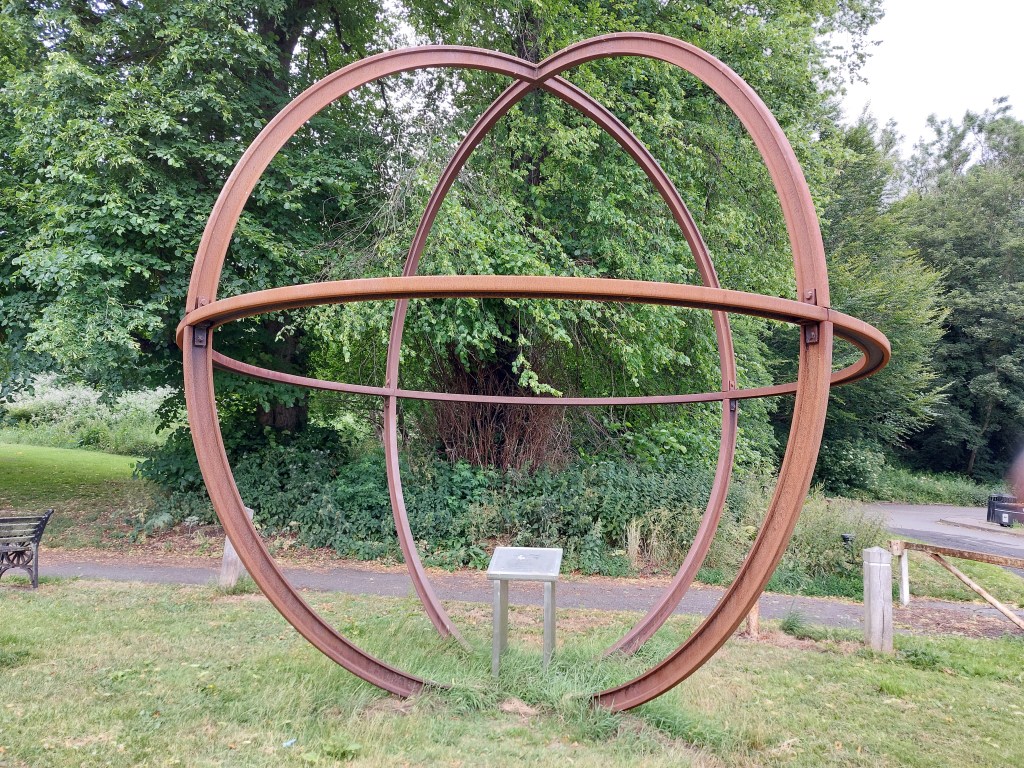
The ‘GLO-BED RAIL’ sculpture, signifying Bedlington’s place in railway history
That Sir Daniel Gooch, a railway engineer, and the transatlantic telegraph cable have such a strong connection is not actually as surprising as first thought, as railways and ‘lightspeed communications’ have developed together; the need to safely signal trains, operation of which was becoming ever more complex, and they were travelling increasingly quicker speeds was a driving force in the early telegraph system, with William Fothergill Cooke presenting a design for a mechanical telegraph to the directors of the Liverpool and Manchester Railway in January 1837.
Railways and what we now regard as the internet, have a long parallel history, and in many ways were co-dependent on one another, so for a data centre to be opening in Bedlingtonshire (the area surrounding Bedlington that also includes Cambois) is quite a fitting link to Sir Daniel Gooch overseeing the laying of the transatlantic cable back in 1866.
Bedlingtonshire, and the surrounding areas like Blyth in the nineteenth century, to use a modern phrase, must have been ‘bouncing’; with the Ironworks and later engine building thriving there, coal mines developing rapidly as waggonway technology and later the early railways were built to get coal from new pits to ports for export.
This was a time when many of my own ancestors were relocating to the area around the River Blyth and River Wansbeck for work at the many local pits, coming mostly from rural Northumberland toward the coast near Newcastle, with most members of both sides of my family having been born and lived within a few miles of where I grew up for over 100 years, with almost, if not all, of the male members of my family having employment in the coal industry, I’m the first generation of many in my family to have never worked underground.
Returning to Dan’s piece, the decline of Northumberland and the North East more generally can indeeed be seen from the First World War. Coal production in the UK peaked in 1913, so whilst the industry was still vital for many decades afterwards and well into my own lifetime, with the last deep pit at Ellington closing when I was 14 years old. After Bates closed, my dad moved to other pits, but eventually left the industry when I was still very young to go self-employed, working very long hours as a builder to make ends meet.
I have many happy memories of going in his Transit to help on jobs as I got old enough to do some useful work, with Magic 1152 playing ‘Baker Street’ to the background of rattling tools, the unmistakable revving of an old Ford diesel engine, and the smells of cement, plaster, and other building materials when travelling to or from different jobs at weekends or during school holidays, but it is a tough way to make a living. Fortunately, he retired from a white collar job, after going to University and studying to change career again while I was still in school myself.
This wider ecomomic decline of the area, when looking back, was clear to see, the once majestic Wallaw cinema in Blyth felt very run-down and tired when I went there to see the first few Harry Potter films before the cinema closed and stood empty for many years ahead of reopening as a quite spectacular Wetherspoons pub. The closure of the ‘Alcan’ smelter at Lynemouth was another major blow, with it being almost the last heavy industry aside from the remaining Lynemouth Power Station, now running on biomass rather than locally mined coal.
As Dan states, the closure of the passenger stations in 1964 dealt another major blow to the area, but one perhaps offset by the then still thriving pits such as Bates, which at the time would have been assumed to be there for decades to come, well past the Millenium (if people even thought that far ahead then) but in the end the clock was ticking much faster – closing and being cleared from the landscape in less than 25 years. The major lines fortunately held on with freight use, still carrying coal until very recently, with the Port of Blyth seeing a complete reversal, and importing coal in recent decades through a new terminal at Battleship Wharf for a few years, with a new railway branch put in as recently as 2006 to handle this traffic where imported coal was blended with local opencast coal and sent to power stations.
If the railway stations had remained open, perhaps south east Northumberland would have made a better transition to other employment opportunities, other industry coming in to replace the lost pits and the power station, itself once proposed for replacement like-for-like by RWE in around 2007, which like the later battery plant, never came to pass despite the optimism that it would, though in hindsight, a new coal power station then would be highly controversial now with the ravages of climate change beginning to be felt.
On a happier note, in 2024 the passenger railway returned with the opening of the Northumberland Line, and while only partially opened so far, has proved to be a huge success, with over half a million passengers thus far in less than a year, with the fourth station at Blyth Bebside due to open in a matter of weeks (Sunday 19th October).
In my view, the Northumberland Coast Loop could very much be a part of revitalising my home area, if Blyth and parts of North Tyneside are now going to be home to multi-billion pound data centres and AI development centres; then maybe we should rethink about the railway is.
If the railway is ‘just’ going to be a shuttle service from Ashington to Newcastle Central station, with the odd trains to the MetroCentre (as great as that is to see and use), that is fine, it is pretty much what existed before in the days of coal and iron and it is still a massive step forward from where we were just a year ago without a rail connection.
That being said, do we actually think bigger and better, shouldn’t we surely exploit the infrastructure that already exists (the direct Bedlington to Pegswood route), and create a second long-distance route between Newcastle and Edinburgh via Bedlington and Blyth; one that goes through and stops in this part of Northumberland, rather than skirting around the edge of it via Cramlington and Morpeth?
If the cities of Edinburgh and Glasgow can have four different railway routes connecting them together (The Falkirk Line, The North Clyde Line, The Shotts Line, and the Carstairs Line), then surely the cities of Newcastle Upon Tyne and Edinburgh could have the Cramlington Line and the Blyth Line?
The simple question is, if several billion pounds are being invested into data centres, then why not invest a few million more into the railway to make it connect Edinburgh and Newcastle via Blyth and North Tyneside alongside the existing mainline via Cramlington and Morpeth? The multiple lines between Edinburgh and Glasgow give the Scottish Central Belt an economic ‘bounce’, the same could be done in Northumberland and Scottish Borders?
It might not be a ‘silver bullet’ to make the area bounce again, but it could certainly give it a damn good chance?
I would like to give big thank you to all who have signed it so far, and especially to all those who have made a donation via change.org to help promote the petition, with 27 promoters giving a total of £112 so far. Thanks to all of you!
Please keep sharing the petition wide and far, which will keep the proposal in the limelight and hopefully see it at least costed out as a proposal to increase seating capacity on the highly successful Northumberland Line (now at over half a million passengers), as well as providing new, direct connections that have never before been seen by stations in this area of Northumberland.
This new link, using an existing line, could be a massive boost to both residents, as well as local, national, and international businesses located next to Blyth Bebside and Northumberland Park stations (i.e. Dräger Safety in Bebside, and businesses such as Sage, and Newcastle Building Society in the Cobalt Business Park in North Tyneside).
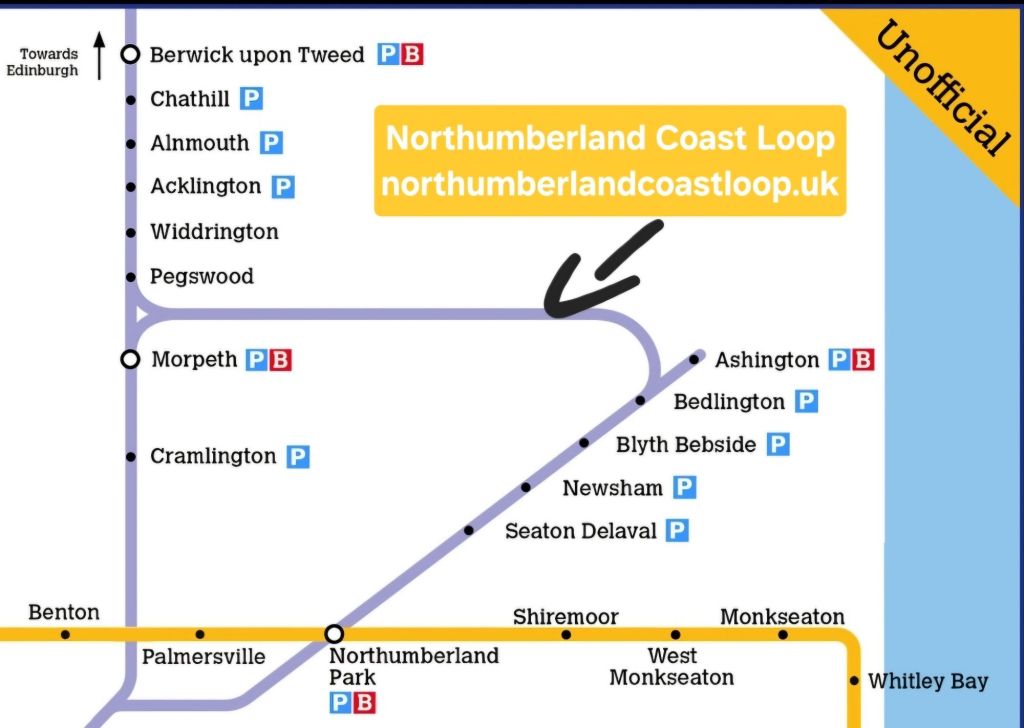
Route map of the Northumberland Coast Loop
More trains running via SE Northumberland would increase the overall number of seats available, as these would be timetabled alongside the existing half-hourly Ashington – Newcastle services, not in place of them; with the added advantage that a direct route north would also potentially release seats too.
This would work by avoiding passengers needing to travel into Newcastle to catch northbound trains, instead passengers could go directly from Northumberland Park/Blyth Bebside into North Northumberland & Scotland, this easing the crowding on Northern Class 158’s by using bi-mode units such as the TPE or LNER 80x fleet, or diesel CrossCountry ‘Voyagers’ to give a service around the ‘Loop’ via Blyth Bebside.
The two remaining stations at Bedlington, and Northumberland Park will sadly not be expected to open until early 2026.
In other positive news, the Northumberland Line is also due a few service upgrades:
Later trains on the route will start running, allowing more people to travel back from Newcastle in the evening by train.
Direct trains to the MetroCentre will also run on Sundays only.
The steady completion of stations on the route is most welcome, as is the addition of arguably ‘better’ services by them running daily into much later evenings, as well as a new direct route to the MetroCentre on a Sunday.
The huge passenger figures for the line show what a great investment the line has turned out to be, and how it was long overdue taking place, hopefully further expansions to the line will happen far sooner!
Problems of being popular!
On social media, there have been some concerns raised about the crowding on trains due to short two-car Class 158 multiple units being used, and that with the opening of Blyth Bebside, this problem may become worse, as more stations opening will add more passengers into already quite crowded trains.
In many ways, the crowding of the trains is a sign of how popular the line is proving to be, but it is a victim of its own success with the ageing Class 156 & Class 158 DMU’s unable to cope with peak demands.
Hitachi 80x fleet via Blyth?
One solution to this might be to use the proposed Northumberland Coast Loop route (Newcastle to Bedlington, then Pegswood, Berwick-Upon-Tweed, and on to Edinburgh) and using bi-mode trains such as the LNER/TPE 80x fleet to augment the Newcastle – Ashington diesel trains.
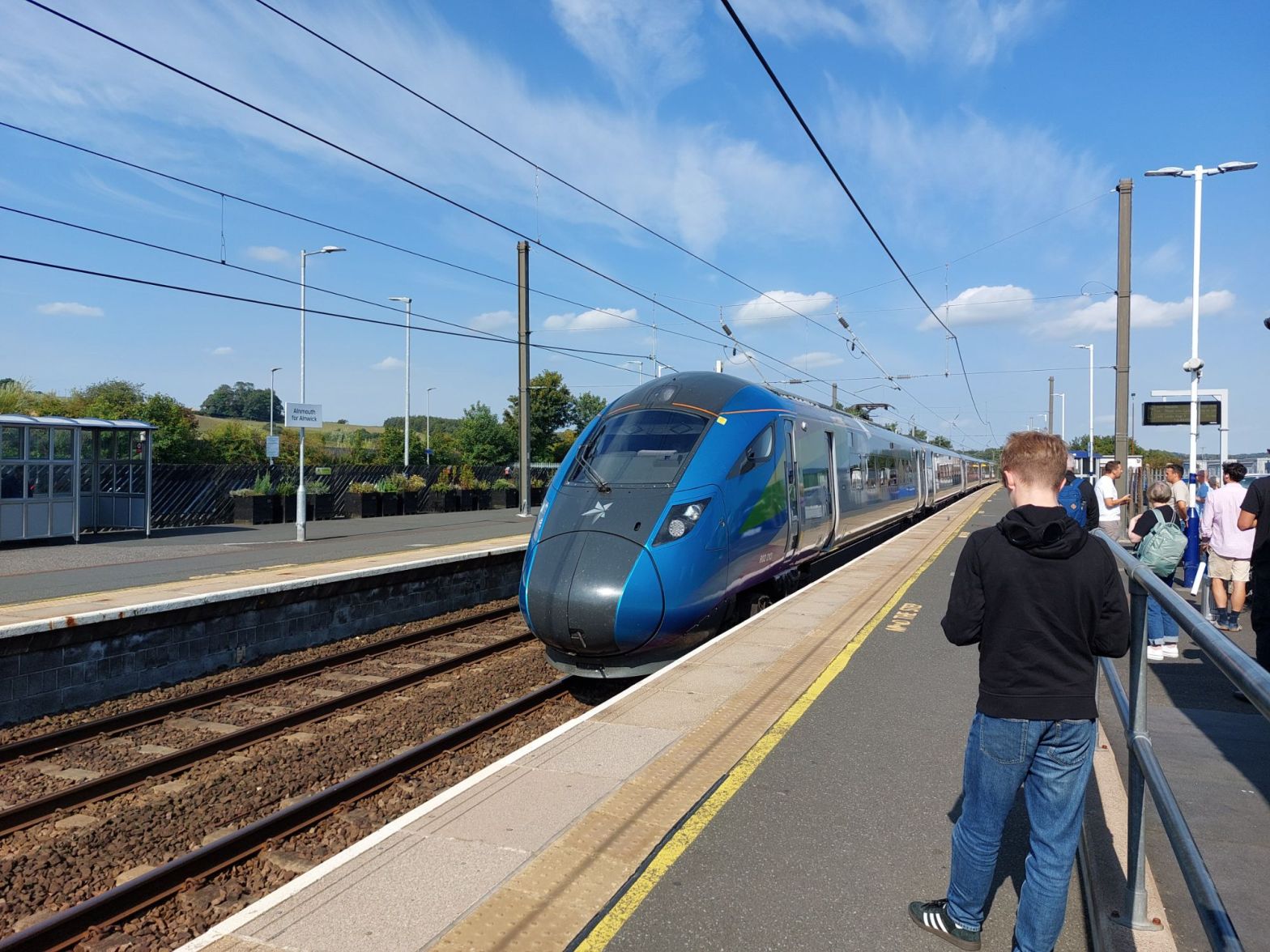
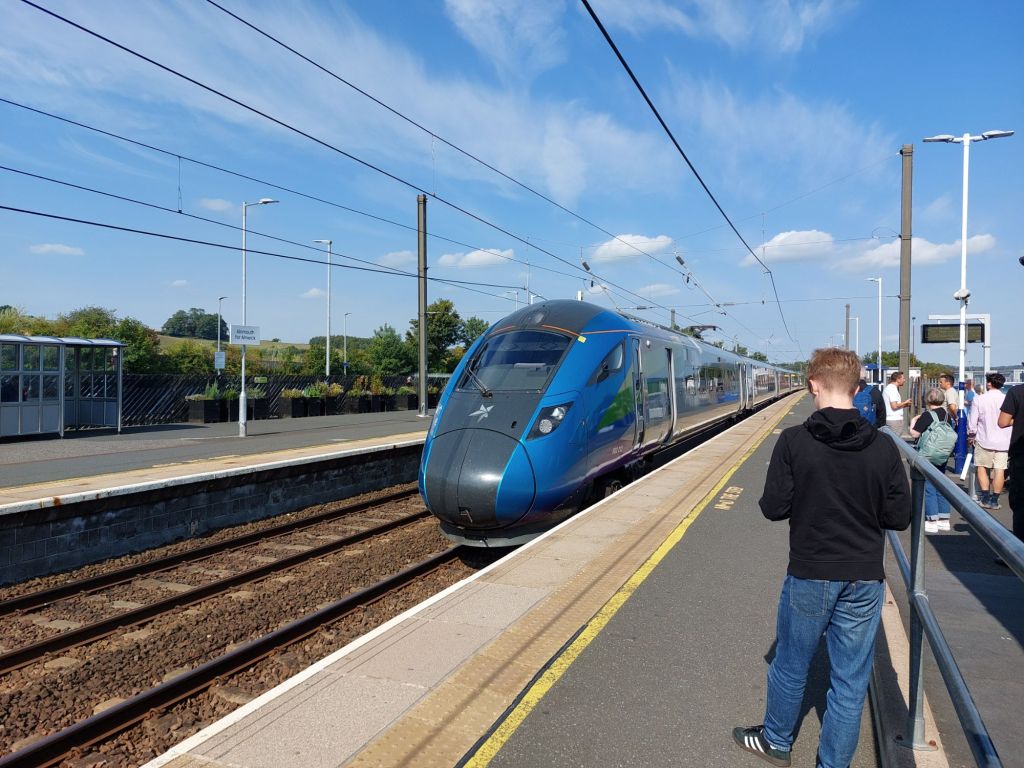
Route map showing the Northumberland Coast LoopTPE bi-mode at Alnmouth, something that could be seen at Blyth Bebside and other Northumberland Line stations?
Being bi-mode trains, the lack of wires on the Northumberland Line wouldn’t present a problem, as the trains have an on-board diesel engine to cope with unwired routes. The training of more drivers over this potentially important diversionary route would give more operational flexibility for trains to keep running in event of a line closure between Benton Junction and Morpeth, with damage to Plessey Viaduct in October 2023 a good example of the potential use of the line.
Even if calling at just some stations, the additional seats provided by running extra trains via the Loop would ease the crowding on other services, whilst also creating a new northward connection to North Northumberland and into Scotland, something that the area has never seen, but would almost undoubtedly prove popular, with Scotland and the borders being a popular destination from SE Northumberland.
Sunday Services to Scotland?
Perhaps a good way to trial this might be a Sunday service, similar to the MetroCentre one, allowing people to take a day out in North Northumberland or Scotland on a Sunday? Longer term, it is potentially a route that could run 7 days a week, 364 days a year (no trains on Christmas Day typically), but a Sunday service, similar to the Ashington – MetroCentre service would be a great start!
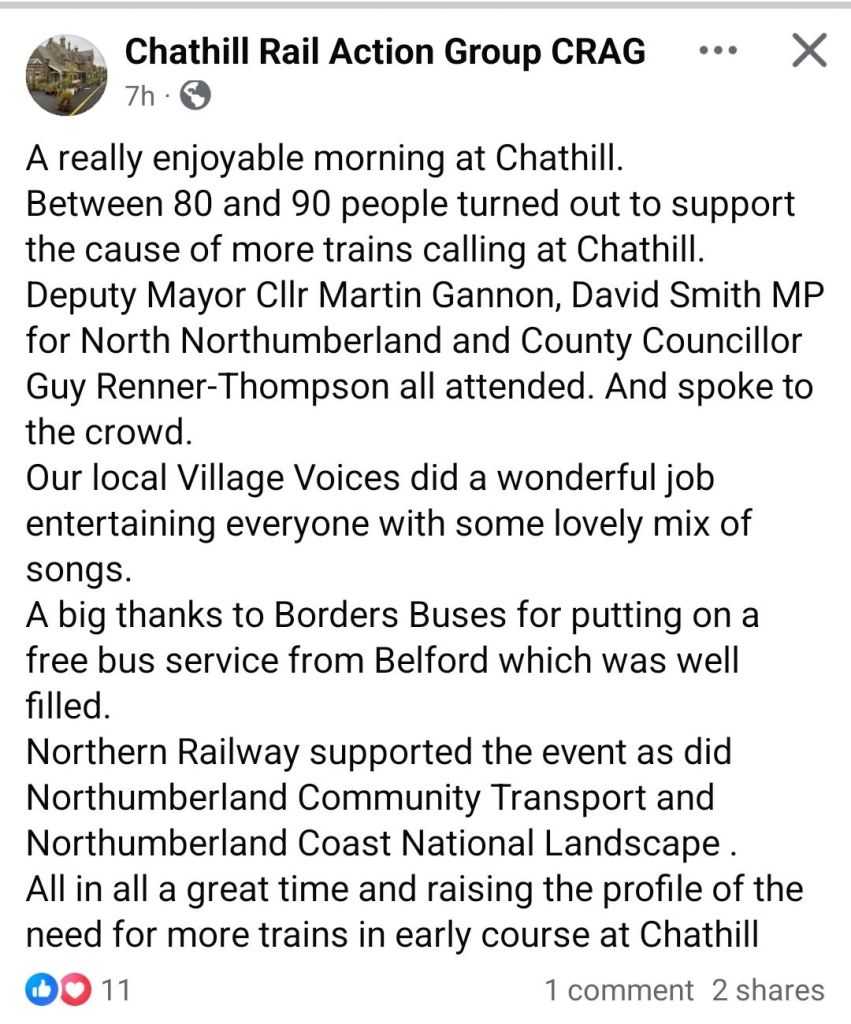
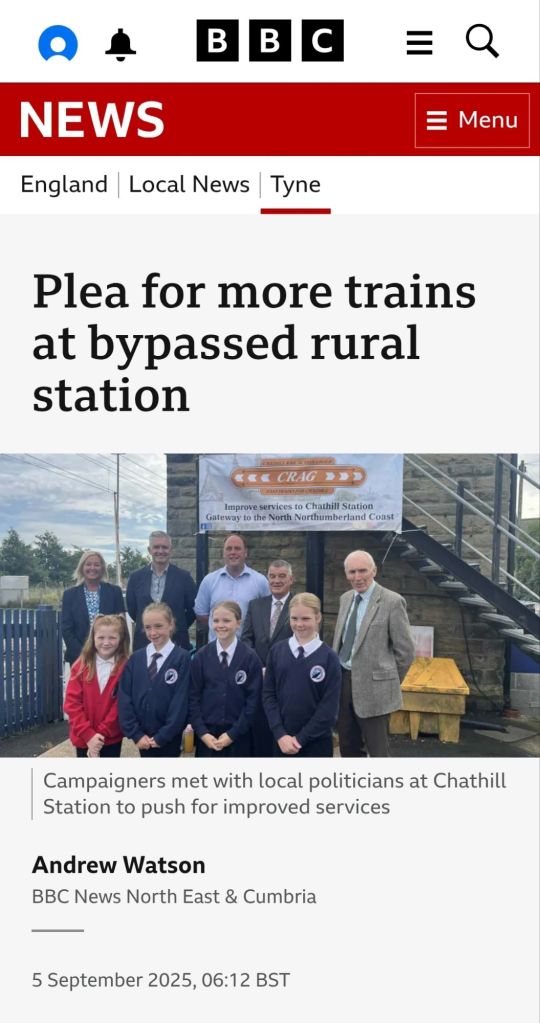
On Thursday 4th September 2025, David Smith, MP for North Northumberland, Deputy Mayor Cllr Martin Gannon, and local County Councillor Guy Renner-Thompson attended a meeting organised by the Chathill Rail Action Group (CRAG) at Chathill Station to discuss the improvement of rail services to and from this underserved station on the North Northumberland Coast.
As can be seen from the above Facebook post by CRAG, this meeting was supported by a further 80-90 persons, interested in the campaign to have more trains calling at this station on the busy East Coast Main Line (ECML); which sees 140 trains a day pass through it at speed, but only the twice daily ‘Chathill Flyer’ actually stops there; giving the station just two trains in each direction per day, and then only to/from Newcastle, it isn’t currently possible to head north to Berwick or any other station from Chathill directly.
Rail travel, and connecting buses the solution to seaside traffic trouble?
Tourism: A double-edged sword?
Articles such as the one above from The Chronicle highlight the problem of Northumberland’s reliance on car-based tourism; villages and towns are becoming overwhelmed by cars. With a limited range of public transport options, most visitors drive to these beautiful seaside villages such as Seahouses and Bamburgh, but the congestion, only added to year on year by more visitors coming, is arguably spoiling their rural charm and character, with the same problem being played out more widely across Northumberland as a whole: the tourism industry brings much needed income and jobs to the area, but road traffic is a major problem.
In the words of the well known song ‘Big Yellow Taxi’ by Counting Crows:
“Don’t it always seem to go That you don’t know what you got ’til it’s gone? They paved paradise and put up a parking lot“
The above quote is pertinent as Northumberland faces some very stark choices with the growth of tourism, do you ‘pave over paradise’ through schemes such as dualling the A1, building ever increasing numbers of car parks to accomodate more and larger cars that put even more traffic through towns that already can’t cope, or do you invest in rail and buses and part of a co-ordinated public transport service, to ger the tourists to the attractions witbout their cars in the first place?
Lifeline for locals too
On a smaller scale, but no less important is the needs of local people to access education, training, and employment beyond their hometowns, without necessitating the need to relocate for this, or be dependent upon being able to drive to access these things, which is prohibitively expensive for young people, and excludes those who may be unable to drive due to disability or for health reasons.
Chathill is just one of several existing and new stations needing a real rail service
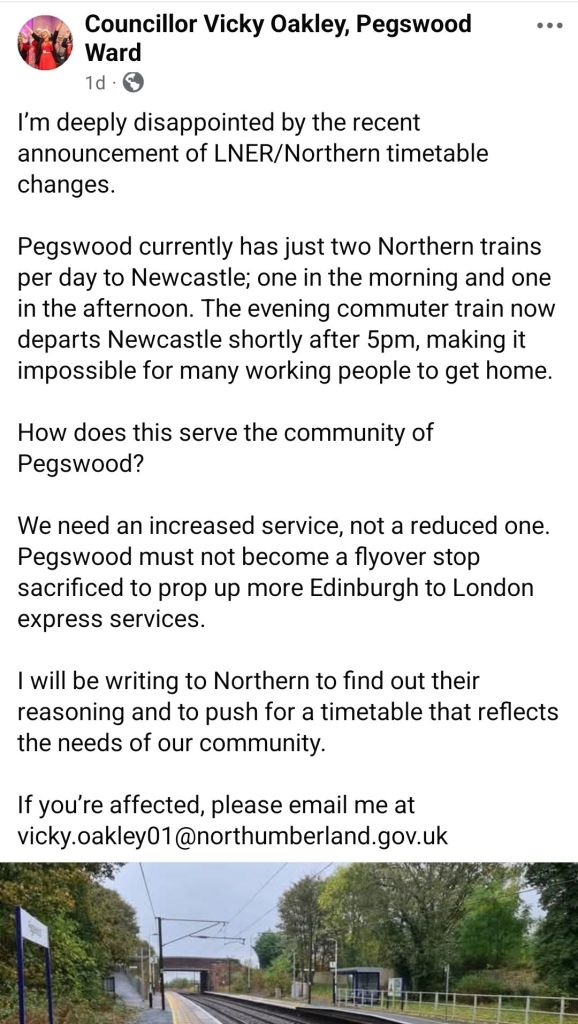
All of the stations between Newcastle and Edinburgh could do with more services; ranging from the ‘big’ stations of Berwick, Alnmouth, and Morpeth, down to the smaller ones of Chathill, Acklington, Widdrington, and Pegswood, the latter one also being highlighted by local County County Councillor Vicky Oakley in a recent Facebook post (see below).
Recent Facebook post from Cllr Vicky Oakley, Pegswood Ward
A twice daily train is arguably not a real rail service, in terms that it is of such a low frequency that is is of limited benefit to its users, and results in these stations having such a low annual usage to be amongst the least used in the whole of the UK, despite being an an area that is thriving with tourism, Seahouses has 500,000 visitors a year, yet very few of that number will travel there by rail at all, despite Chathill being on the mainline between Edinburgh, Newcastle, York, and London, and just a short bus ride from Chathill to Seahouses itself.
Problems and Solutions
Constrained Capacity and Tired Trains
With 140 trains using the double track East Coast Main Line each day, finding a ‘path’ (a timetable slot) for a train to slow down, stop, pick-up/drop-off passengers, then accelerate away again is challenging, especially with the use of ageing Class 156 and Class 158 diesel trains built by British Rail in the late 1980’s and early 1990’s, all of these being over 30 years old and approaching the end of their useful lifespan.
Northumberland Needs Electric Trains
Part of the solution is to replace these ageing diesel trains with 100% electric trains, or battery/electric bi-mode units which are capable of far better performance in acceleration and braking, and would be better able to mix amongst the faster, non-stop or few stop (semi-fast) services sharing the ECML.
A good contender for the Newcastle – Edinburgh route could be the Hitachi built Class 385 electric units, which are in regular use with ScotRail between Glasgow and Edinburgh already, and have a capacity (depending on if they are 3-car or 4-car sets of 206 or 273 seats (the latter a mix of 20 First Class and 253 Standard)), though this would need procurement via an operator such as ScotlRail or Northern, whichever was to begin the service.
Using an existing, proven design that is already in use nearby would give an opportunity to see a fleet expansion, with an already skilled workforce in operating and maintaining the units available as new trains are delivered to provide Newcastle – Edinburgh local train service. In comparison, a totally new fleet would require a much wider training and knowledge gain for the workforce, and may have teething issues such as that seen with the Tyne and Wear Metro units, something which has already been sorted on the Class 385’s to my knowledge.
Two Track Line with Passing Places
Another is factor is the largely two track nature of the line, which means that a slow train, stopping at lots of stations such as Chathill is caught up by faster trains running behind it.
In the article, Cllr Gannon suggests four-tracking of the line between Newcastle and Edinburgh would be the ideal, but this would be prohibitively expensive; imagine the costs and disruption of putting two extra tracks through Berwick for example; and getting over the Tweed potentially on a new bridge adjacent to the iconic Royal Border Bridge would pose substantial, but not insurmountable challenges.
Example: Relocate Alnmouth Station?
That being said, a more effective solution is to use both existing, and new passing places to allow stopping trains to be overtaken by faster ones behind.
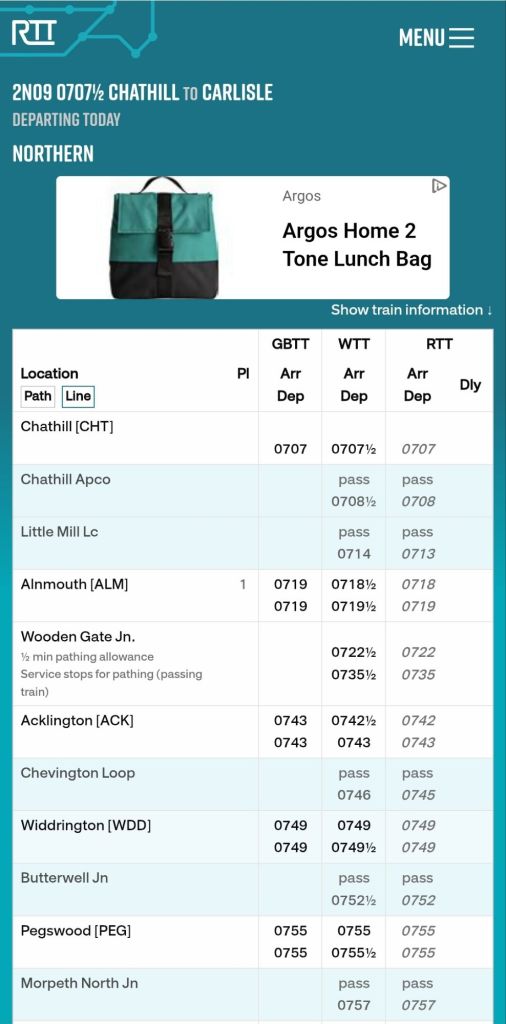
Indeed the existing ‘Chathill Flyer’ (train 2N09) does this after its call at Alnmouth heading south towards Newcastle, sitting in the loop at Wooden Gate for 13 minutes (from 07:22½ to 07:35½) to allow for a passing train.
Timetable for the morning southbound ‘Chathill Flyer’ on 8.9.25
It may prove beneficial to build new platforms adjacent to these loops at Wooden Gate, and perhaps even relocate Alnmouth Station entirely to this new location, meaning that any stopped train can be overtaken by one following behind, which could permit more trains to stop at Alnmouth station, meaning a better rail service as a result: a win-win if ever there was one?
If looped stops are longer anyway (as the ‘Flyer’ is timetabled for 13 minutes in the loop at Wooden), then it could be a more appropriate place for disabled passengers or those needing additional time to board.
This could be coupled with direct access to/from the A1068, meaning better access as a ‘Parkway’ station, but also an easier route for rail/bus integration at Alnmouth for connections to the popular towns of Alnwick and Amble.
Please also take a look at the campaign for better buses between Alnwick, Alnmouth Railway Station, and Amble here: https://chng.it/B4RwwtHnJc
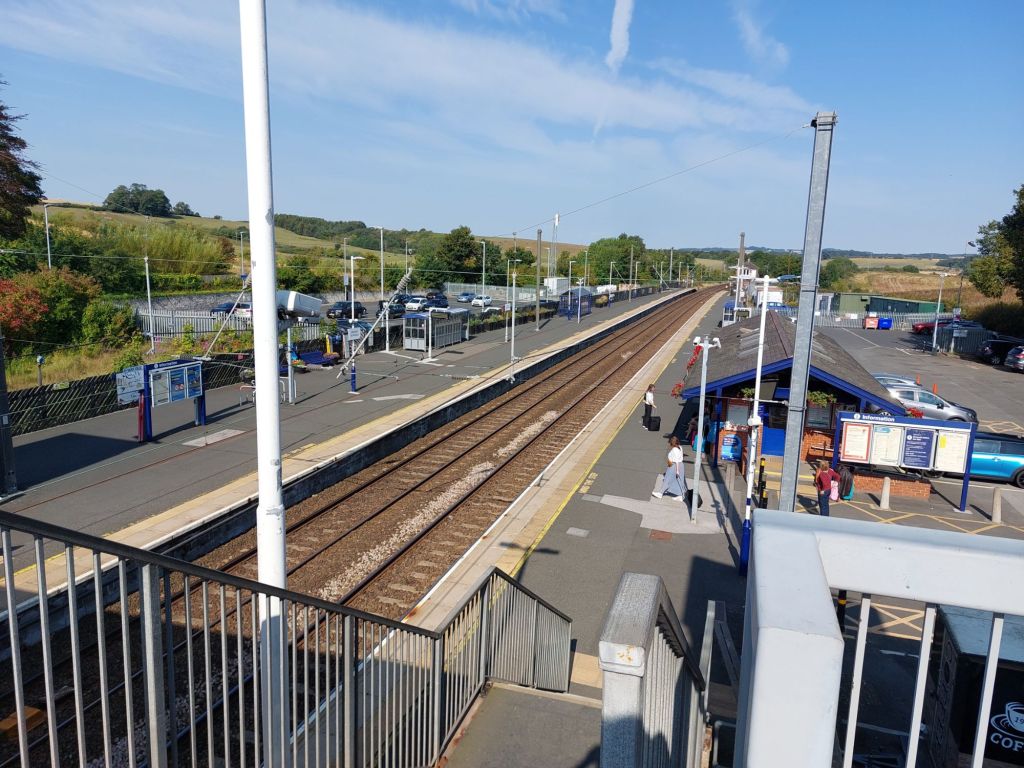
The existing but somewhat utilitarian Alnmouth station as of 2025.
As a station that somewhat sadly lost its heritage buildings many years ago, relocating Alnmouth station would offer an opportunity for a new-build station that is better than the current one, and could make use of the great view over the Aln Estuary and the picturesque village of Alnmouth itself
Catching the southbound ‘Chathill Flyer’ earlier in 2025.Sitting aboard 158796 in Wooden Gate Loops, in what perhaps could be the location for a new ‘Alnmouth’ station?
There are similar loops in other locations along the ECML, those at Belford for example would be ideally placed to build a new station adjacent to the loop lines, allowing stopping trains to serve the area around Belford, and allowing faster trains to overtake, again a huge win-win, and for the relatively modest cost of about £20m (the approximate cost of a new railway station on a mainline).
Another factor which would be worth investigation would be the route using the Northumberland Coast Loop, which in the northbound direction comes off the ECML at Benton Junction, and runs up the Northumberland Line as far as Bedlington, before cutting back to the ECML via Hepscott, and rejoining the route to Scotland at Morpeth North Junction.
The line towards Scotland from BedlingtonMorpeth North Curve looking towards ScotlandRoute map of the Northumberland Coast Loop
As can be seen from the route map above, a train making its way via the ‘loop’, calling at Northumberland Park, and Blyth Bebside (for the proposed semi-fast service), or at all five stations (N’land Park, Seaton Delaval, Newsham, Blyth Bebside, and Bedlington) for a local service, would be clear of the ECML between Benton Junction and Morpeth North, effectively forming a very long passing loop in each direction, meaning that faster trains behind could run through, or call at Cramlington, and/or Morpeth and still overtake the train taking the loop route via Blyth.
This is much like a bus route such as the X15 coming off the A1 to drive through Felton to pick-up/drop-off passengers close to their home or destination, and allowing other traffic to overtake the bus, as opposed to pulling in at the roadside and slowing down/stopping following vehicles and staying on the A1 throughout.
A rail route via Blyth is a slightly slower one than sticking solely to the ECML, but has the key advantage that catching the train at a Blyth station (Blyth Bebside is perhaps the better overall location) is more convenient for people living in/close to Blyth, or where rail services from Ashington (and in the future Woodhorn/Newbiggin) will pass through, compared to Morpeth, which, especially by public transport can be awkward/long-winded to reach from these towns.
If you’d like to support the petition for a rail service via Blyth, please visit the petition page here: https://chng.it/zThXj8HBpY
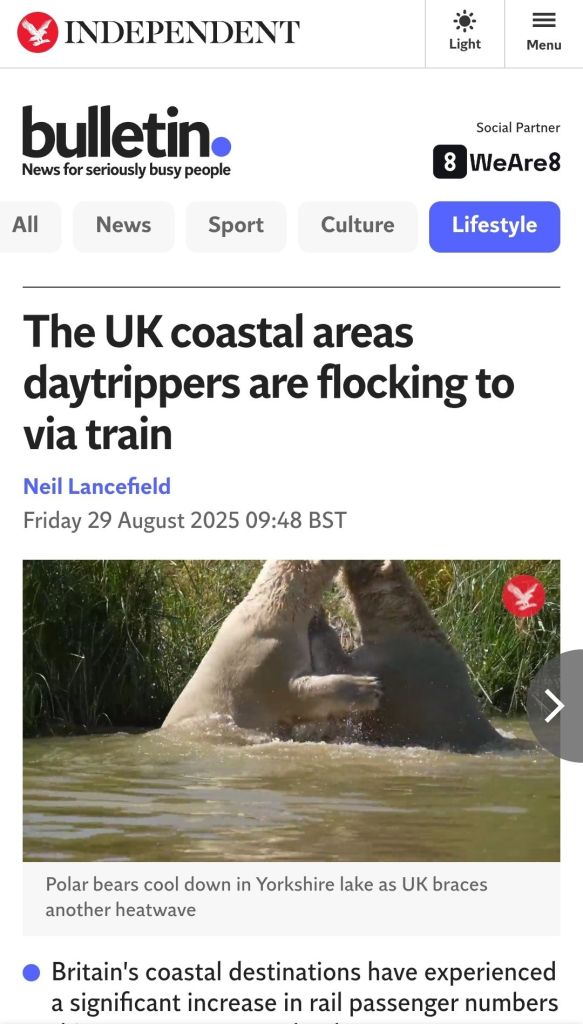
A recent article in the Independent newspaper, titled ‘The UK coastal areas daytrippers are flocking to via train‘ shows the potential importance of better rail services along the Northumberland Coast, and in particular the potential of the Northumberland Coast Loop route, which would form a direct rail link between Blyth and Berwick-Upon-Tweed.
Screenshot of the Independent article
In this article, it is anticipated that a contribution of £916m will be made to local economies around Britain where passengers are travelling by rail during the summer holiday period. Should Northumberland be better placed to capture even a fraction of this, it would be a transformative volume of investment into the local economy.
In the more detailed version of this article,the data from the Rail Delivery Group (RDG) suggests that almost half (47%) of trips are from within the same region, for example a family from Blyth might travel to Berwick for a day-out, or vice versa, and would spend money both in their ‘home’ area, as well as at the destination.
Overall, across the UK, this is expected to be around £678m in the ‘home’ area, with £916m in the destination area.
This is perhaps an opportunity that is too good to miss for Northumberland?

















 The Northumberland Coast Loop