The traffic volume to the Northumberland Coast Loop website this year has been phenomenal, with very nearly 16,000 visitors over the course of the year, and who have viewed the site/blog posts over 18,000 times. These figures are ‘at time of writing’, so they can only keep climbing higher as time goes on!
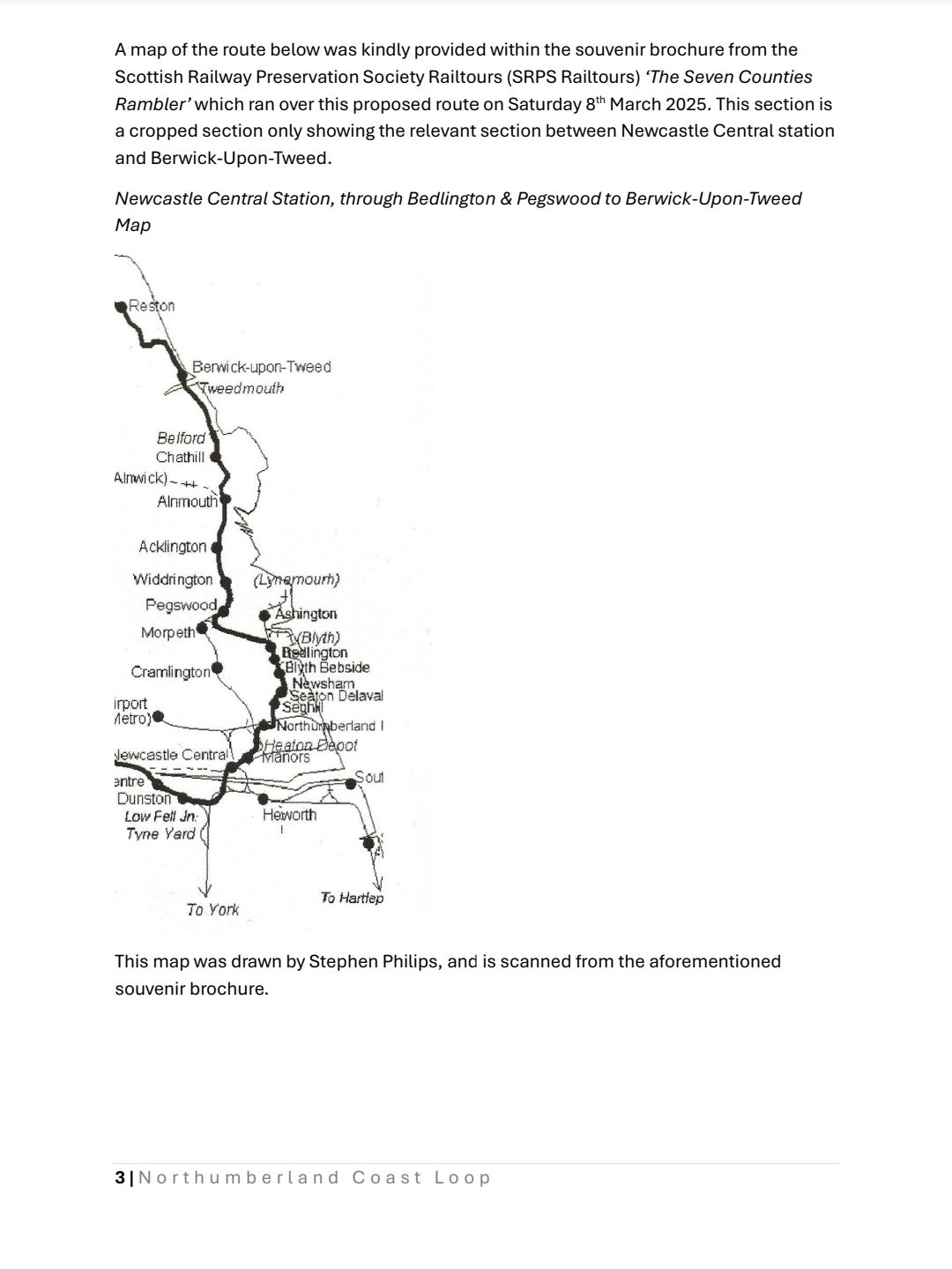
Statistics for the Northumberland Coast Loop website, Halloween 2025
This shows the huge level of interest in the campaign, and respresents a growth of 148% compared to the entirety of 2024, but with November and December still to go, the figures still have ample time to grow!
If you haven’t already, please sign the petition using the link above!
Thanks again for all of you who have visited the site and especially those who have supported the petition so far, but please keep sharing with friends and family to keep the momentum going!
An update on the Northumberland County Council (NCC) website yesterday afternoon announced that £255,000 has been made available for repairs to Eden Hill Bridge, which spans the trackbed of the Alnwick Branch about halfway between Lionheart Station and Alnmouth station (the route now home to the Aln Valley Railway (AVR) and a parallel greenway), with the works enabling both to be extended beyond the current end of the line at Greenrigg Halt towards Alnmouth station.
The funding is split between NCC, who are contributing £125,000, and £130,000 from Historic Railways to carry out waterproofing and essential repairs. The bridge now belonging to NCC, it allows the council, once work is complete, to grant permission for the Aln Valley Railway to be extended east towards Alnmouth, one of the key stations on the Northumberland part of the East Coast Main Line (ECML).
The AVR has done an amazing job since first breaking ground on the Lionheart site as recently as February 2012, with the Aln Valley Railway Society formed in 1995, a lot achieved in the last 30 years!
Well done to all involved, and it’ll be great to see the AVR extended back towards the mainline, and hopefully, it’ll soon be possible to interchange between mainline services and heritage/modern shuttle service at Alnmouth to reach Alnwick (Lionheart) and the wider town of Alnwick by rail once again, after closure of the branch in October 1968.
Collaborative calls for a ‘Stopping Scotsman’ service at Berwick, and elsewhere in the Scottish Borders area.
A Facebook post by John Lamont MP and David Smith MP has highlighted the ongoing collaboration between the neighbouring MP’s either side of the Scottish Border on the East Coast Main Line (ECML) to see the services to Berwick-Upon-Tweed station improved following a reduction in the number of trains calling there as a result of the upcoming December 2025 timetable, but also more widely across Northumberland and the Scottish Borders too.
Post by David Smith MPPost by John Lamont MP (letters have been copied below for easier reading)
The reason for the issue boils down to operating the ECML for more ‘Flying Scotsman’ fast expresses, as the exclusion of local trains, which hopefully is explained below:
The Flying Scotsman, a brief history
The East Coast Main Line (ECML) is perhaps most famous as the route of ‘The Flying Scotsman’ which began as the ‘Special Scotch Express’ in 1862, taking 10½ hours, with a half hour break in York for lunch. As time and technology have moved on, the train has progressively become faster and faster.
The old LNER (1923 to 1947) was the company that eventually tied ‘The Flying Scotsman’ name to this rail service, and led to the locomotive ‘Flying Scotsman’ being named after the rail service.
The trip between Edinburgh and London now typically takes just 4hrs and 19minutes; so fast you could get to London and back in the time the original journey took in one direction! There have been specially organised trains running the route in four hours flat, a great achievement, but one that comes at a cost elsewhere, which will be explained below.
Through my own youth, the operator GNER used to subtitle itself as ‘Route of the Flying Scotsman’ on the side of its dark blue carriages, just under the red band along the sides of the carriages, highlighting the prestige of running fast between Edinburgh and London.
These fast trains don’t just depart at 10am, they run all day every day; providing a fast connection between these capitals, a great market for rail to tap into, and one it is ideally suited to, but without additional infrastructure, means it comes at the cost of other rail services.
Book cover about the history of the GNER showing a typical livery of their trains between April 1996 and November 2007, a brand I grew up with on the ECML.
Speed comes at a cost to local services
This cut from a ten and a half hour trip in the 1860’s, to one of circa four hours today has come at a high cost to local services however, as to make room for faster trains, without the costs involved of upgrading the railway to handle both types of traffic, the slower stopping trains, even those making just a few stops are being squeezed out of the timetable.
This happens as the slower train calling at stations ahead of these expresses effectively block the line, slowing the expresses down, and without additional infrastructure to enable both types of services to run, the slower trains have been squeezed out.
The Bus Analogy
A good way to visualise this is a simple road with one lane in each direction, connecting two bus stations at each end; which acts similarly to a railway with one track in each direction, linking two major stations.
Lets say that this road has a few laybys for HGV’s (the parallel of a freight train if a bus is a passenger train), but the buses rarely use them ordinarily, and for simplicity, this road is exclusively used by buses and HGV’s.
If an ‘all stops’ local bus (similar to an all stops train) is making its way along the road, then the faster traffic behind it gets held up. To run an express bus (non-stop between the big bus stations at each end), then this local bus will have to run less frequently, and turn off this main road early and turn back to allow the express bus to run fast without stopping or slowing down, which would cause passenger complaints and refunds if the bus was arriving late at the far end.
The stopping bus would potentially have little effect on a lumbering HGV (similar to a freight train), but again a fast express bus would get stuck behind a slow moving lorry,
As can easily be imagined, the more non-stop buses being timetabled down this hypothetical road means the local bus, and the HGV’s would be squeezed out, until maybe only a minimal service remains at most for the buses, and HGV’s would be largely constrained to early or late in the day when fewer buses are running.
This is why small stations like Chathill (like a minor bus stop in the analogy) have only 2 trains per day in each direction; they have been squeezed out over time, similarly railfreight can’t be run as much as it should as it too would impede express trains, and railfreight is always needing to fight to have paths.
With even more pressure, even the semi-fast buses, those only stopping at some intermediate bus stops will also be squeezed out too. This is why on the railway, demand for more fast trains is beginning to put more pressure onto stopping at stations such as Berwick, they are ‘in the way’ of faster, non-stop trains.
The key issue is that local and semi-fast services are vital feeders into the rest of the network; your local station, like your local bus stop is the gateway to everywhere else, you’re more likely to use the nearest bus stop to your house or destination, than you are to travel by other means to/from a major rail or bus station.
The Northumberland Line is a great example of this; the new stations, which have a regular and comprehensive service, are acting as a gateway onto the rail network, and to use the bus analogy, is like running a regular ‘drumbeat’ all stops bus service that makes getting into a major hub like Newcastle easier.
As an extreme example in the opposite direction, closing all the intermediate stops between Newcastle and Edinburgh would make timetabling expresses extremely easy, as thats the only train that could then exist, but the effect on towns like Berwick, Morpeth and others would be terrible as they would effectively be cut off, and overall, the railway itself would suffer as a network is made better by more connections, not less.
The loss of local rail services has only ever had negative effects on communities; places like Ashington and Blyth suffered for decades due to the loss of rail services in 1964, and even in 1974, proposals were put forward to reopen the line, and even then the closure was recognised as a ‘big mistake’.
Newspaper clipping from c.1974 to bring trains back to Ashington (Source unknown)
The obvious way to resolve this problem for a hypothetical bus is to build a few laybys for the stopping buses, so a stopped bus will pull off the main road and into a layby, and the express buses will be able overtake easily, or possibly to have stretches of dual carriageway to allow express buses to overtake slower trains with both on the move, but dualling the entire route might not be feasible or cost effective. On the railway, this is done by creating loop lines for platforms, so the stopped train stands on a side track, while fast trains can overtake on the lines in the middle.
Just as it might not be feasible to build a layby for every bus stop, the same as it wouldn’t likely be feasible to rebuild every railway station to have four tracks, and it is almost certain that quadrupling (two tracks in each direction) of the ECML would be unfeasible too (imagine building a two track parallel bridge to existing viaducts like the Royal Border Bridge for example is unlikely), a few strategically placed upgrades, could therefore make a major difference, allowing more local trains, as well as railfreight to run on the ECML.
Collaborative call for infrastructure investment
To their credit, the close collaboration of David Smith MP, John Lamont MP, and other local politicians to call for more infrastructure to enable the fast trains, local trains and railfreight to co-exist, rather than be pushed out is one that I wholly support; the ECML is far more than ‘just’ the fast line to or from Scotland, it should also be serving local communities along its length.
Facebook post by David Smith MP, showing the primary argument about Berwick, but also hinting at a wider investment for Northumberland as a whole.Facebook post by John Lamont MP with letter about rail services at Berwick, but also in the Borders more generally. To read the letter more easily, please see images further down the page.
John Lamont MPis the Member of Parliament for Berwickshire, Roxburgh & Selkirk, representing the Scottish side of the border; as whilst Berwick Upon Tweed station is actually in the English county of Northumberland, it is a significant station for those living near Berwick on the Scottish side of the dashed line.
David Smith MP is the Member of Parliament for North Northumberland, the northern part of the English county of Northumberland, and is my own constituency MP. He represents the area that Berwick-Upon-Tweed station sits in, as well as the large area surrounding the station that is served by it.
The below images have been copied directly from the post by John Lamont MP for full clarity of their contents, especially the jointly signed letter between John and David to Lord Hendy, Rail Minister about investment into the rail network between Newcastle and Edinburgh more generally.
What is also very encouraging to see is the number of other local politicians who have added their signature to the letter, who are listed below:
Rachael Hamilton MSP Ettrick, Roxburgh and Berwickshire.
Cllr Richard Wearmouth Deputy Leader of Northumberland County Council.
Cllr Georgina Hill Berwick East, Northumberland County Council.
Cllr Scott Dickinson Leader of the Labour Group, Northumberland County Council
Cllr Vicky Oakley Pegswood, Northumberland County Council
Cllr Nicole Brooke Berwick North, Northumberland County Council
Cllr Carol Hamilton East Berwickshire, Scottish Borders Council
Cllr Catherine Seymour Castle, Berwick Town Council
Cllr Rosemary MacKenzie Upper Spital, Berwick Town Council
This shows the broad collaboration across multiple political parties (and some independent candidates too), but working together for the common good of their constituents, by trying to improve the situation not only at Berwick but also for transport more generally.
Flying Scotsman + Stopping Scotsman?
The ECML route between Edinburgh and London became famous for the ‘Flying Scotsman’
Using other existing stations like Chathill, Alnmouth for Alnwick, Acklington, Widdrington, Pegswood, Morpeth, and Cramlington better by improving services calling there would be a major economic boost for their area.
The Northumberland Line being quoted as a success story!
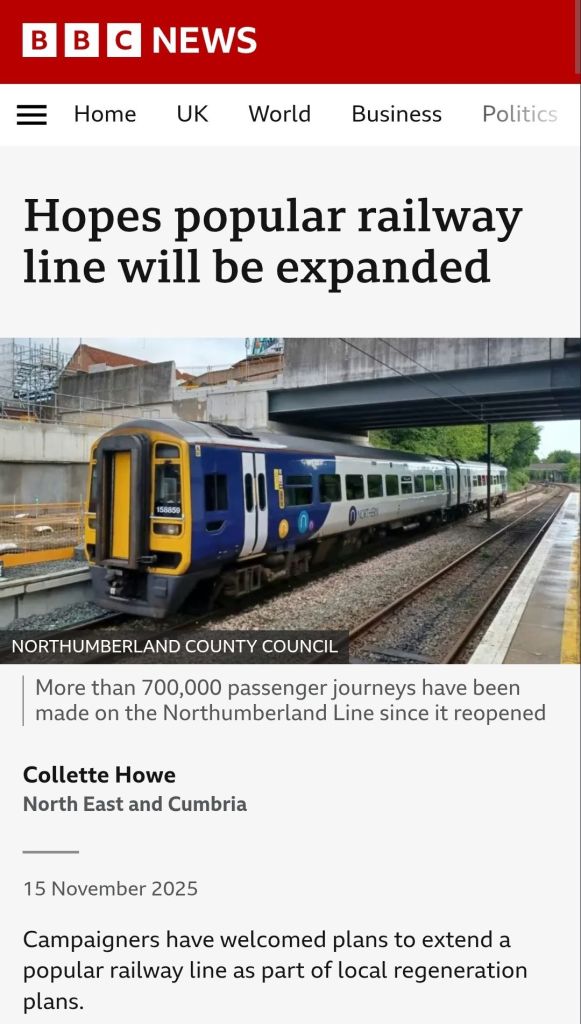
Whilst it is a project that has faced some problems, the Northumberland Line is, as stated in the letter to Lord Hendy, an excellent example of ‘build it and they will come’ having now exceeded 700,000 passenger journeys in under a year of operation, and the line progressing towards completion, with four stations at Ashington, Blyth Bebside, Newsham, and Seaton Delaval now open, with only Bedlington, and Northumberland Park yet to be opened up, but the stations are now at an advanced stage, and will hopefully open in early 2026 at the latest.
It has been a resounding success for the fairly modest investment of £336.4m to date, and with such a busy and popular route, a similar investment into the East Coast Main Line (ECML) is more than justifiable to increase its capacity.
In my view, the Northumberland Coast Loop could be framed as an extension of the Northumberland Line, taking this highly successful line further north via Pegswood, up to Berwick and potentially into Scotland, ultimately forming a second route between Newcastle and Edinburgh via Blyth, and give an uplift to services calling at stations in North Northumberland and the Scottish Borders.
It is a known issue that capacity on the ECML is limited, but what needs to be made clear are answers to the questions below:
What infrastructure needs are there to operate more trains? Where would new loops be required, and could proposed new stations such as Belford be a way to ‘loop’ a stopping train, and allow faster following trains to overtake it while it stops there? What costs would these entail?
Are there any small changes in timetables that could be done sooner to give an uplift (i.e. using some existing loops more regularly to allow slower trains to be overtaken), for example the ‘Chathill Flyer’ is the only passenger train to use the loops at Wooden Gate to my knowledge, but could more stoppers be looped here, or elsewhere to increase line capacity?
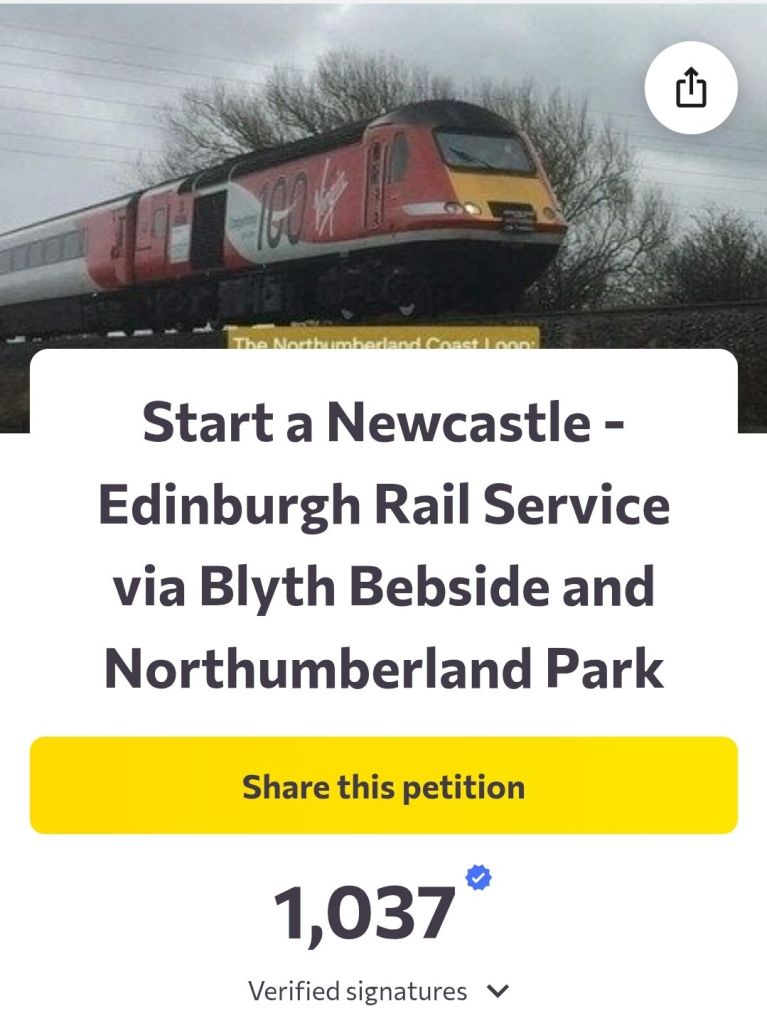
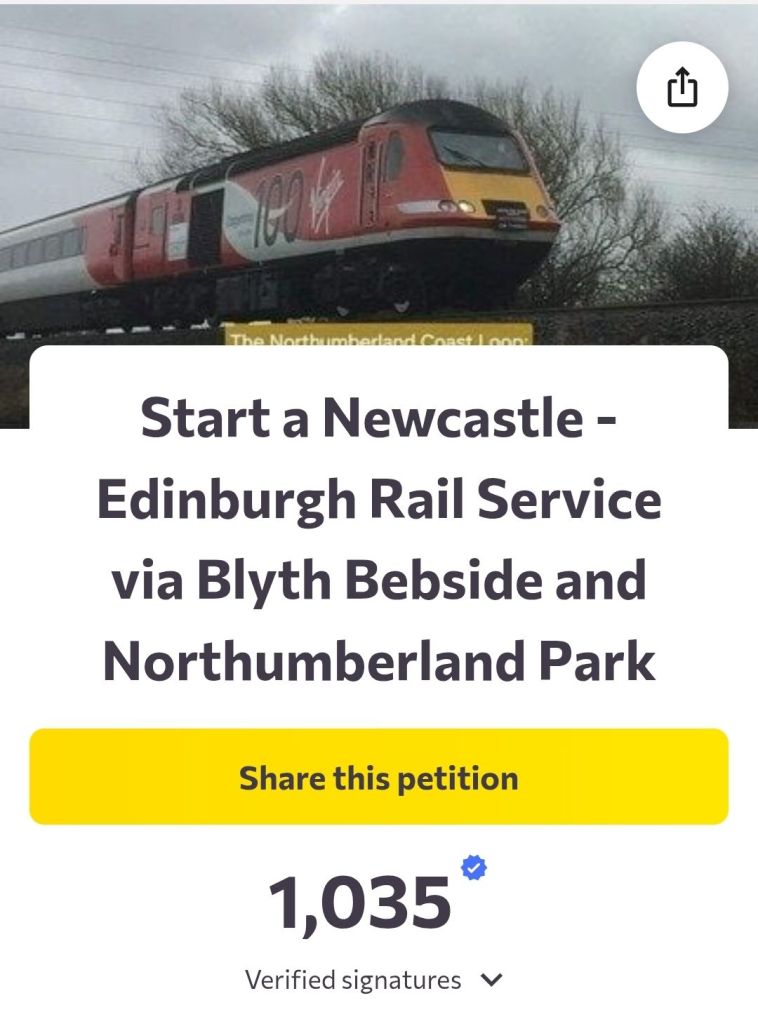
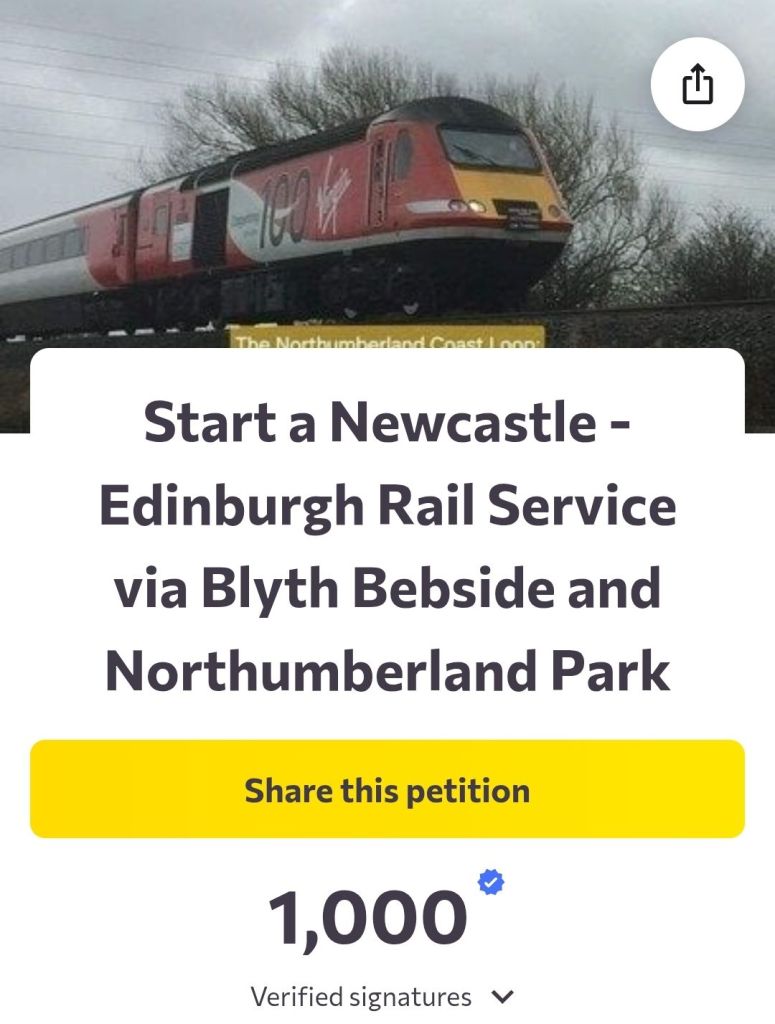
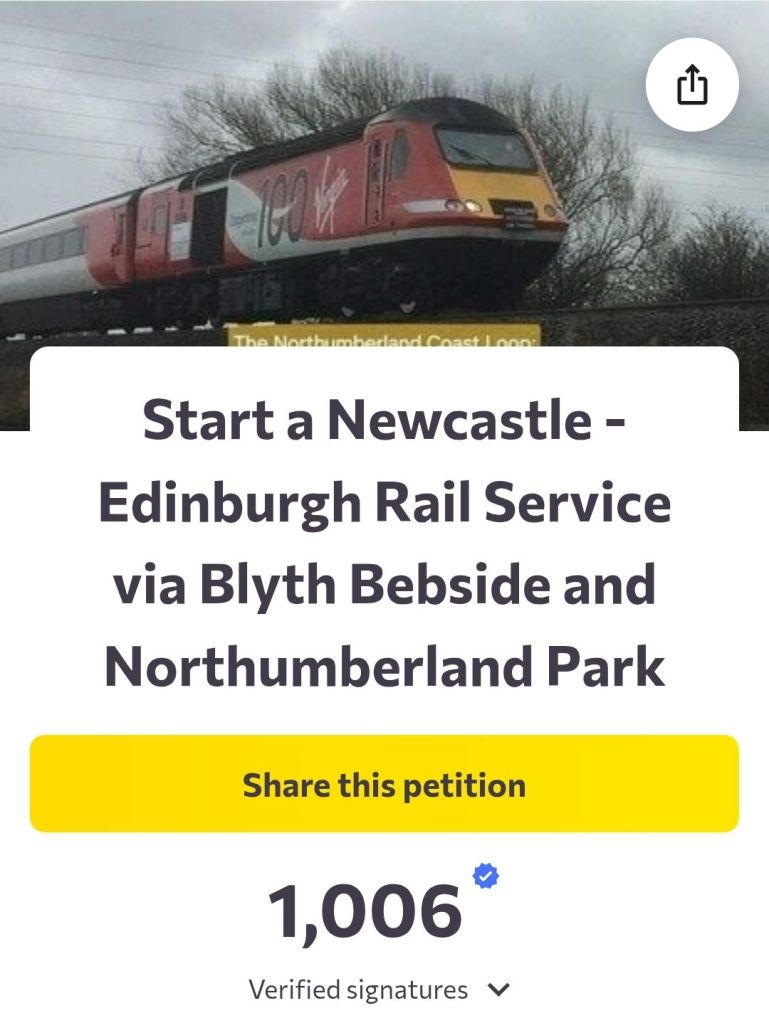
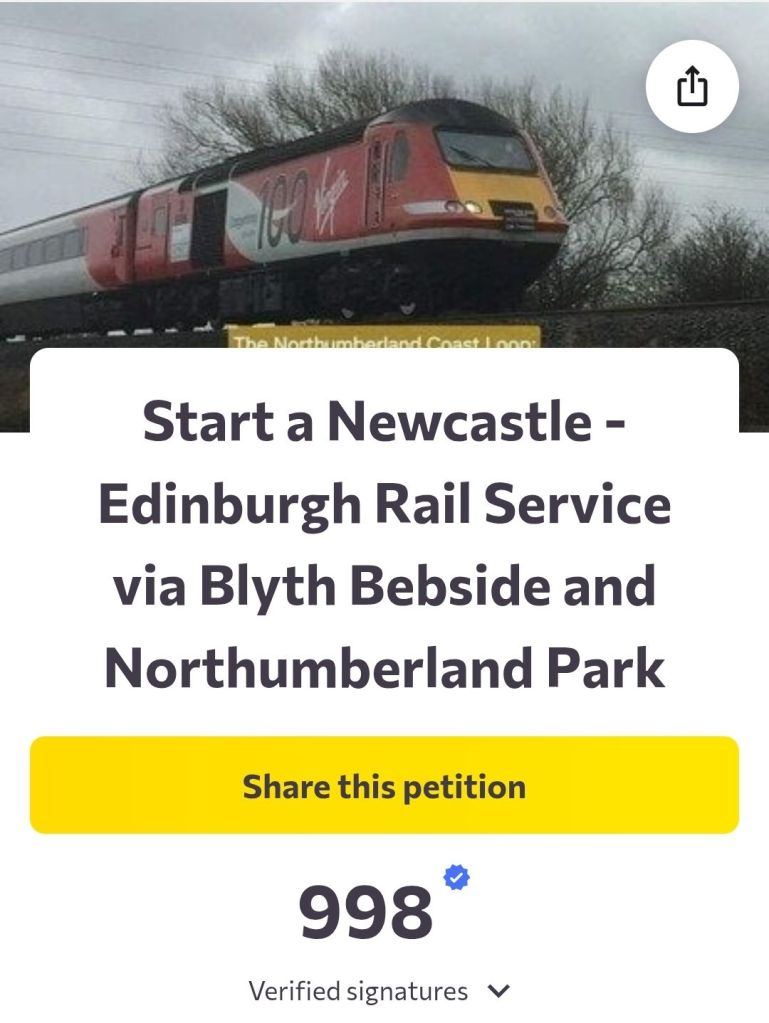
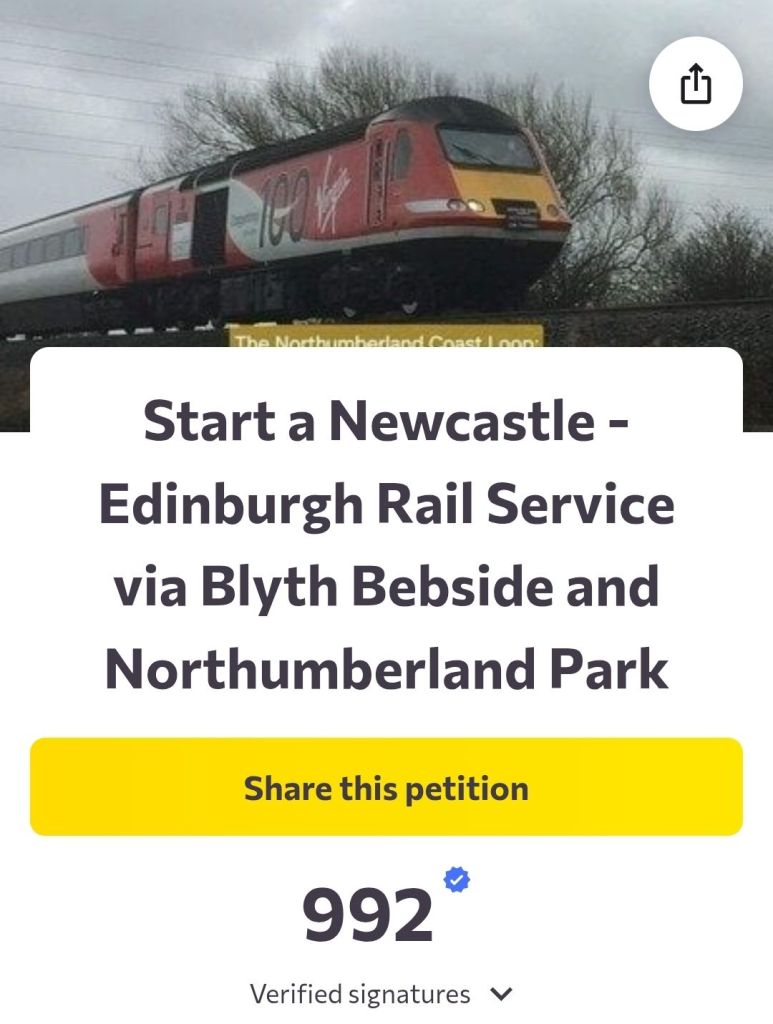
At present, an indication of the latent demand for rail services running a route such as the Northumberland Coast Loop is the success of our petition, which to date has 966 signatures, which might not sound huge, but the SENRUG petition of 2008 (shown below and highlighted in yellow) only had 1098 signatures at the time for the now near million passenger Northumberland Line (then referred to as the Ashington, Blyth, and Tyne Line), only 132 more than the current ongoing petition for the N’land Coast Loop, so what can be inferred is that a petition shows in reality only a tiny fraction of potential users, build it, and they will come.
Northumberland Coast Loop petition as of 28.10.25SENRUG newsletter of June 2008
Lets hope that the continued campaigning across both sides of the Scottish Border can result in improvements to the regions rail services, and that other neighbouring MP’s can get behind it too to see more investment made in the rail routes of this area to improve the strength of our economy and boost connectivity to, from, and within the broader Borders area, making direct links from Berwick-Upon-Tweed to Blyth possible, as well as more distant connections to places like Penzance too.
With the huge success of the Northumberland Line, lets keep investing in rail in Northumberland, which was one of the key places in the development of railways in the UK, from Huntington Beaumont introducing the waggonway to the region in c.1609, through to the development malleable iron rail at Bedlington in 1820, used extensively on the Stockton and Darlington Railway, this year celebrating its 200th anniversary.
Somewhat fittingly, the Northumberland Line itself passes above the section of the River Blyth where Beaumont began over 400 years ago; we’ve progressed from horse drawn waggons of coal, through steam hauled trains like the Flying Scotsman, to 125mph InterCity passenger trains and containerised freight.
Hopefully Lord Hendy, as well as the wider Government, will at last put long overdue investment into the ECML that is clearly needs.
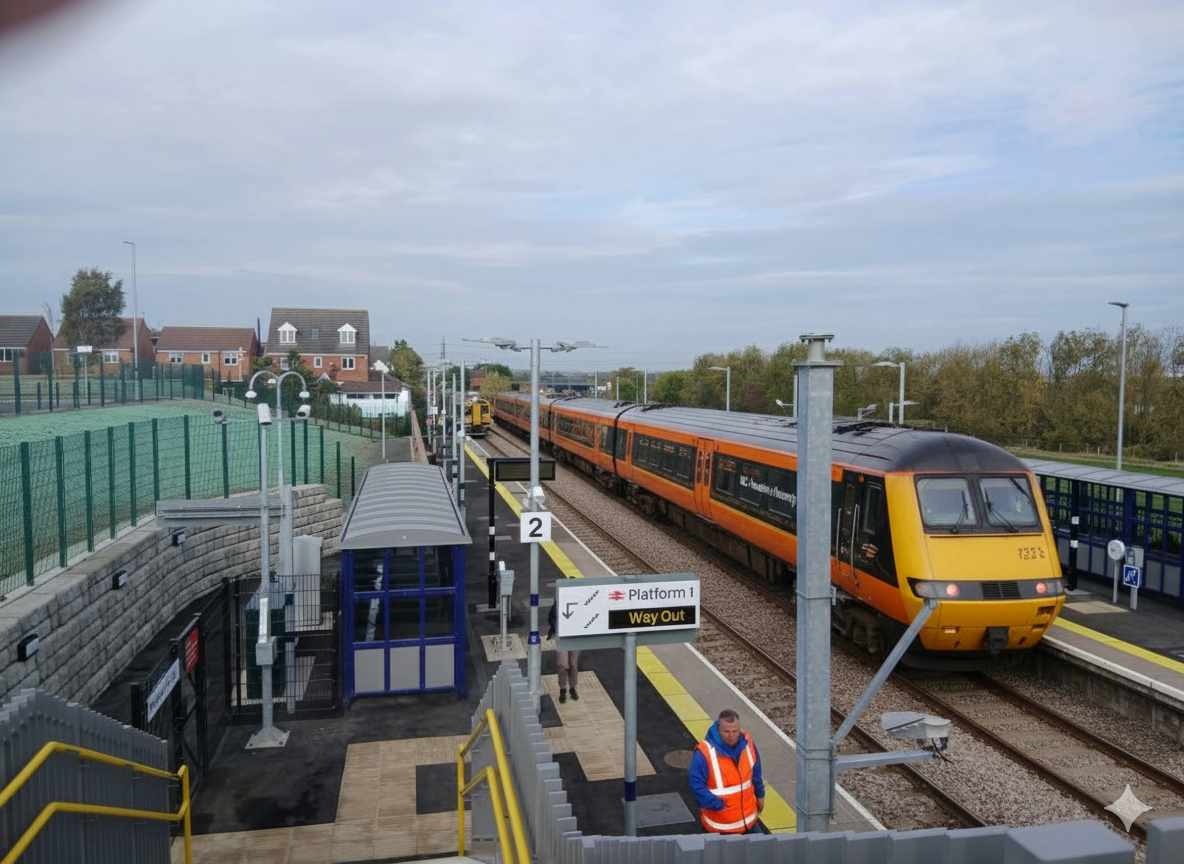
Yesterday was my first opportunity to travel to Blyth Bebside station, the most recent station to open on the Northumberland Line (fourth of the six new stations), and a potentially key one on the Northumberland Coast Loop, for reasons which will hopefully become clearer as this blog post progresses.
Tickets for todays trip to Blyth Bebside from Alnmouth
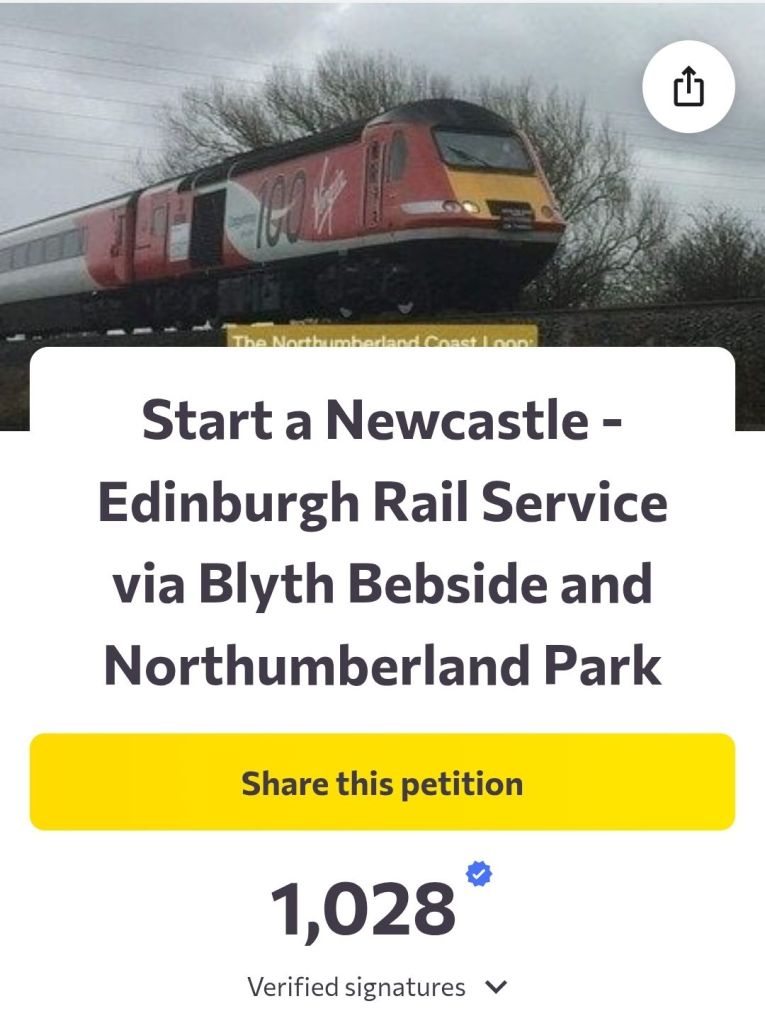
Northumberland Coast Loop Edinburgh to Newcastle rail service via Blyth Bebside and Northumberland Park
Blyth Bebside is the first of the potential ‘semi-fast’ station stops completed, with Northumberland Park due in early 2026 by most recent estimates. Taking a good look at the station was to confirm that this station would be ideally placed for such a service, which to me it would be; it direct serves the largest town in Northumberland (Blyth), but is also well connected to many of the other largest towns too.
Cramlington (second largest Northumberland town) is easily accessed via the A189 Spine Road, or the A193/B1505 Horton Road, and has already existing bus links (Arriva X9) via Bebside Front Street running near to the station. The A189 route would also provide an easy direct bus link between the station and NSECH hospital a few miles down the road.
Hathery Lane, linking the former Three Horseshoes pub and East Hartford area to Blyth Bebside via a car free route could also be upgraded and a shortcut created at the station end (linking Errington Street to Hathery Lane to the south of Front Street) to make a much easier and safer active travel route to the station too.
Ashington (third largest town) is also easily accessed via the A189 Spine Road, and also has existing bus links such as the Arriva 1 headed into Cowpen Road, as well as the obvious interchange between rail services at Blyth Bebside station itself (all Northumberland Line trains call at the station, with proposed new stations at Woodhorn and Newbiggin by the Sea also feeding through the station.
Ashington is probably a bit too distant to consider active travel for most, but extending the cycle route that parallels the A189 further towards Blyth Bebside, and perhaps connect the Wansbeck bridge and Blyth (Kitty Brewster bridge) direct would make this more viable.
Bedlington (fourth largest town in Northumberland) is similarly to Ashington linked by bus and rail connections to Blyth Bebside, and easily reached via the A193 route from the Bedlington Red Lion ‘top end’ area, as well as the A189 Spine Road, as is also well connected via Bebside Furnace Road as a potential active travel route.
As can be seen above, the four largest towns in Northumberland, together making up a vast proportion of residents in the county as a whole could be served well by Blyth Bebside, as well as smaller communities nearby, for example Choppington, Stakeford, Cambois etc.
This station would also have far easier access than is presently possible to/from Morpeth railway station, which is not linked directly by rail ( Morpeth may get some connectivity to Bedlington in the near future, but no direct link from Blyth, Ashington etc meaning two changes of train to reach destination such as Edinburgh).
If you’d like to support the campaign for the Newcastle to Edinburgh via Blyth rail service, please sign the petition here: https://c.org/zThXj8HBpY
Returning to the Alnmouth to Blyth Bebside trip
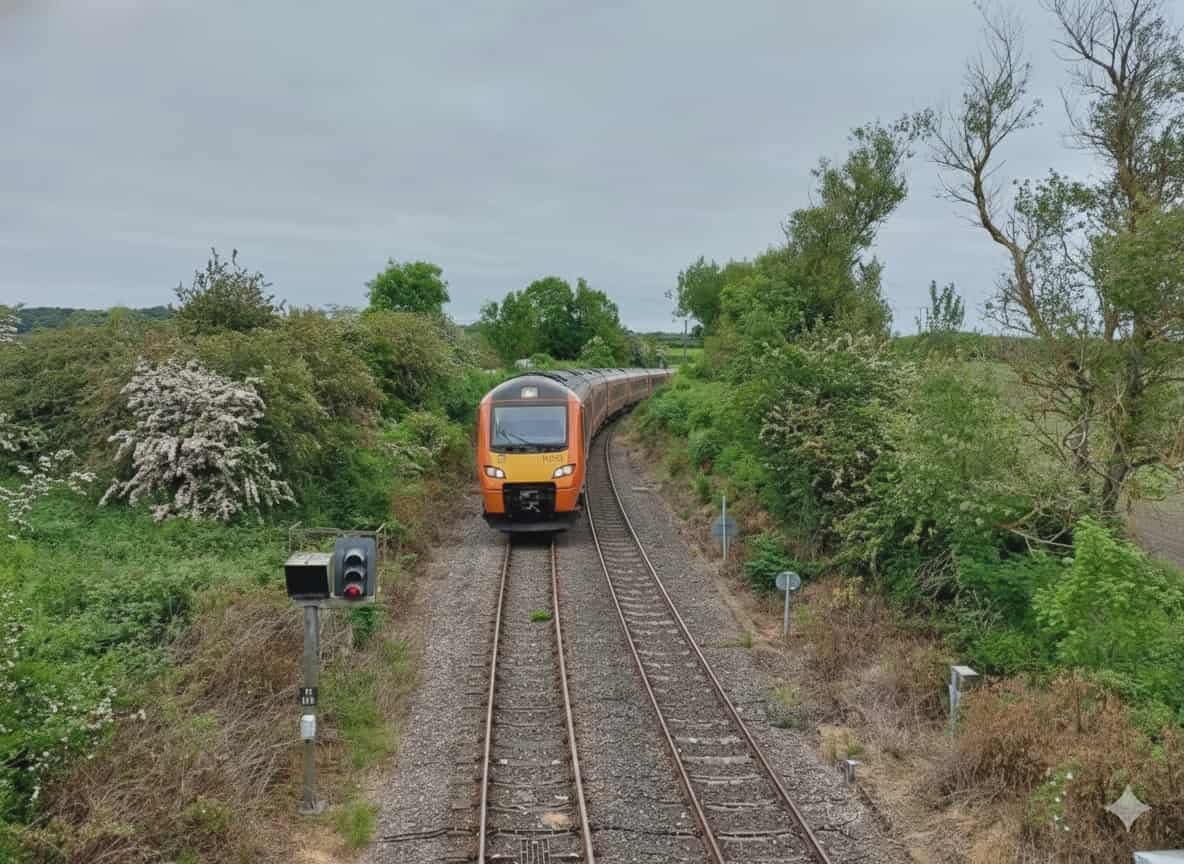
Early that morning, I embarked from my local station at Alnmouth bound for Blyth Bebside via Newcastle Central, and the first train was Voyager 220001, working 1V52 between Edinburgh and Darlington, departing on-time at 07:08.
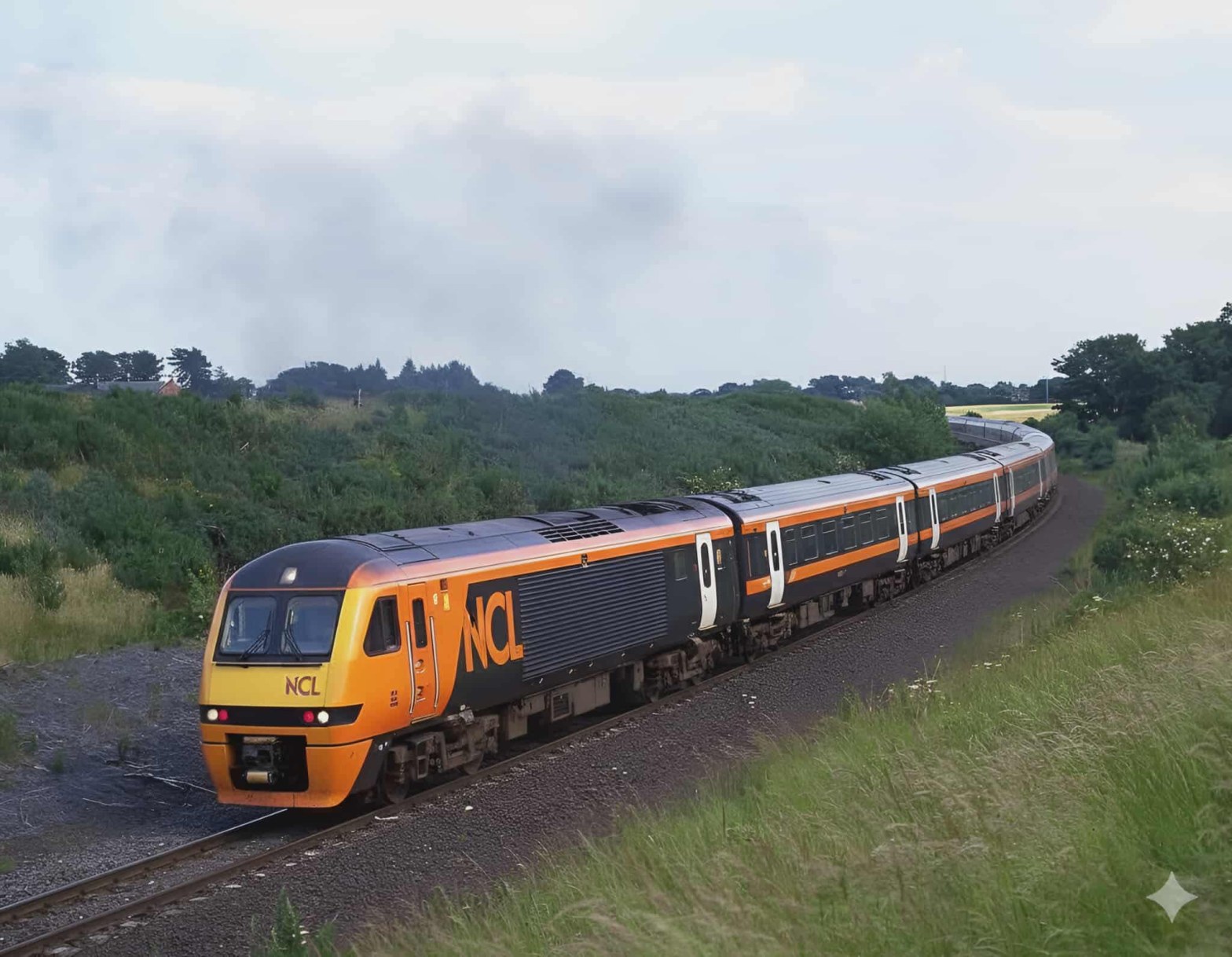
Interestingly, this unit would be one easily capable of doing the direct ‘Northumberland Coast Loop’ route via Bedlington, being a four coach diesel train; no problems with the absence of overhead wires, or the length of the train being longer than the platform (which again will be addressed further on in the blog too).
Route map showing the northern link between Pegswood and Bedlington, enabling a direct service
The only obvious requirements that are outstanding would be route clearance for the Voyager fleet via Bedlington, development of appropriate driver knowledge (all drivers need to know their train route in high levels of detail for safety), and appropriate paths to be able to deviate from the east coast main line (ECML) from Morpeth North Junction to Benton Junction.
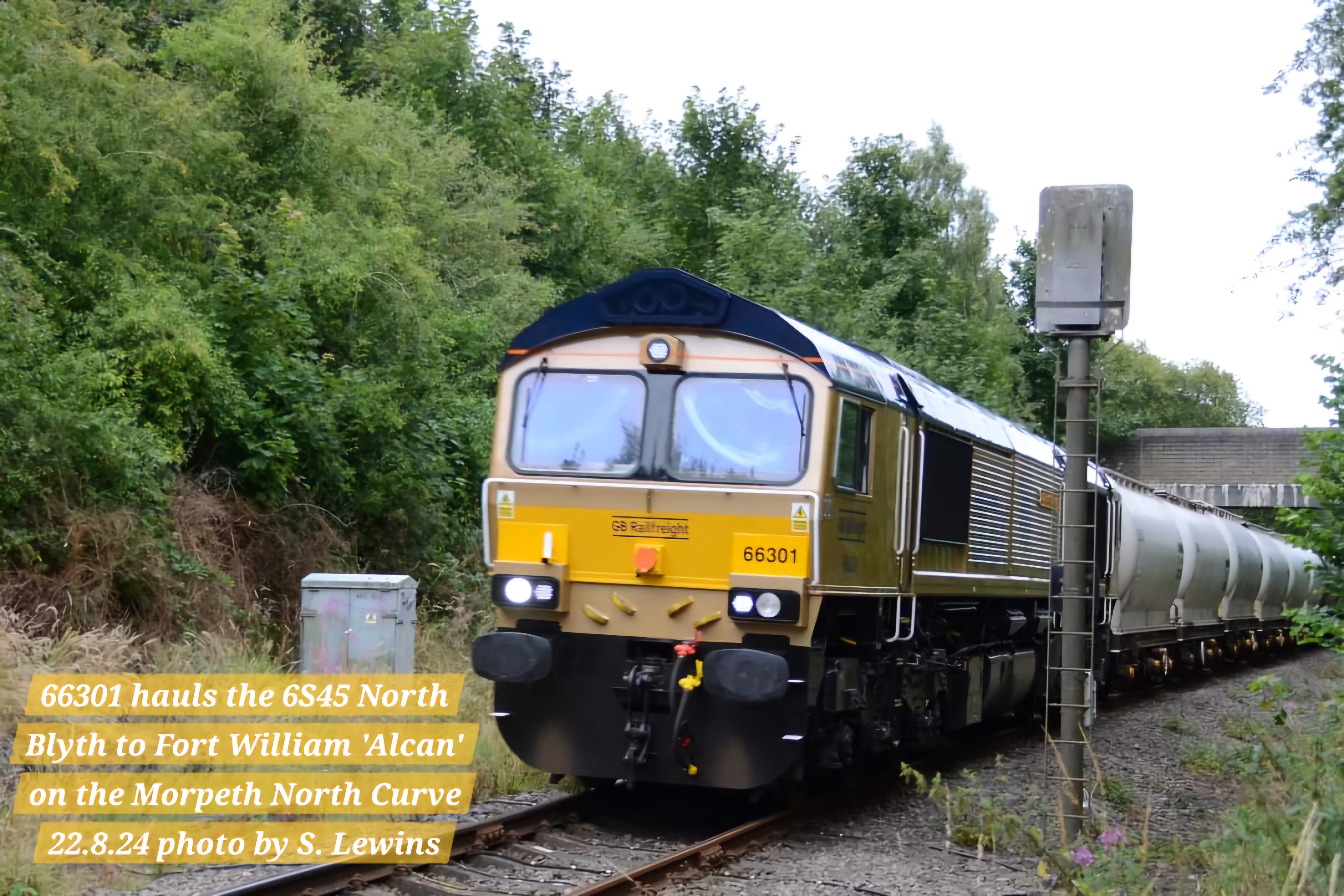
A direct run from Alnmouth to Blyth Bebside is possible due to the Morpeth North Curve, which allows trains from the north to curve off the ECML shortly after crossing Pegswood Viaduct over the River Wansbeck, bound for Bedlington. This route would be a single seat (no need to change trains), and would save approximately 30-40 minutes compared to the indirect route via Newcastle.
Alnmouth to Central Station
Returning to yesterdays trip, the Voyager run was timetabled to take 26 minutes to reach Newcastle, and due to arrive at 07:34, which it did on-time.
Voyager 220 001 arriving at Alnmouth 25.10.25RTT info for the Voyager leg
Changing at Central Station
As can be seen below, arrival on the CrossCountry Voyager was on-time into Newcastle, allowing a full 14 minutes to change train, with some of this time used to nip into Sainburys at the station.
The second leg aboard Northern 156463, 25.10.25
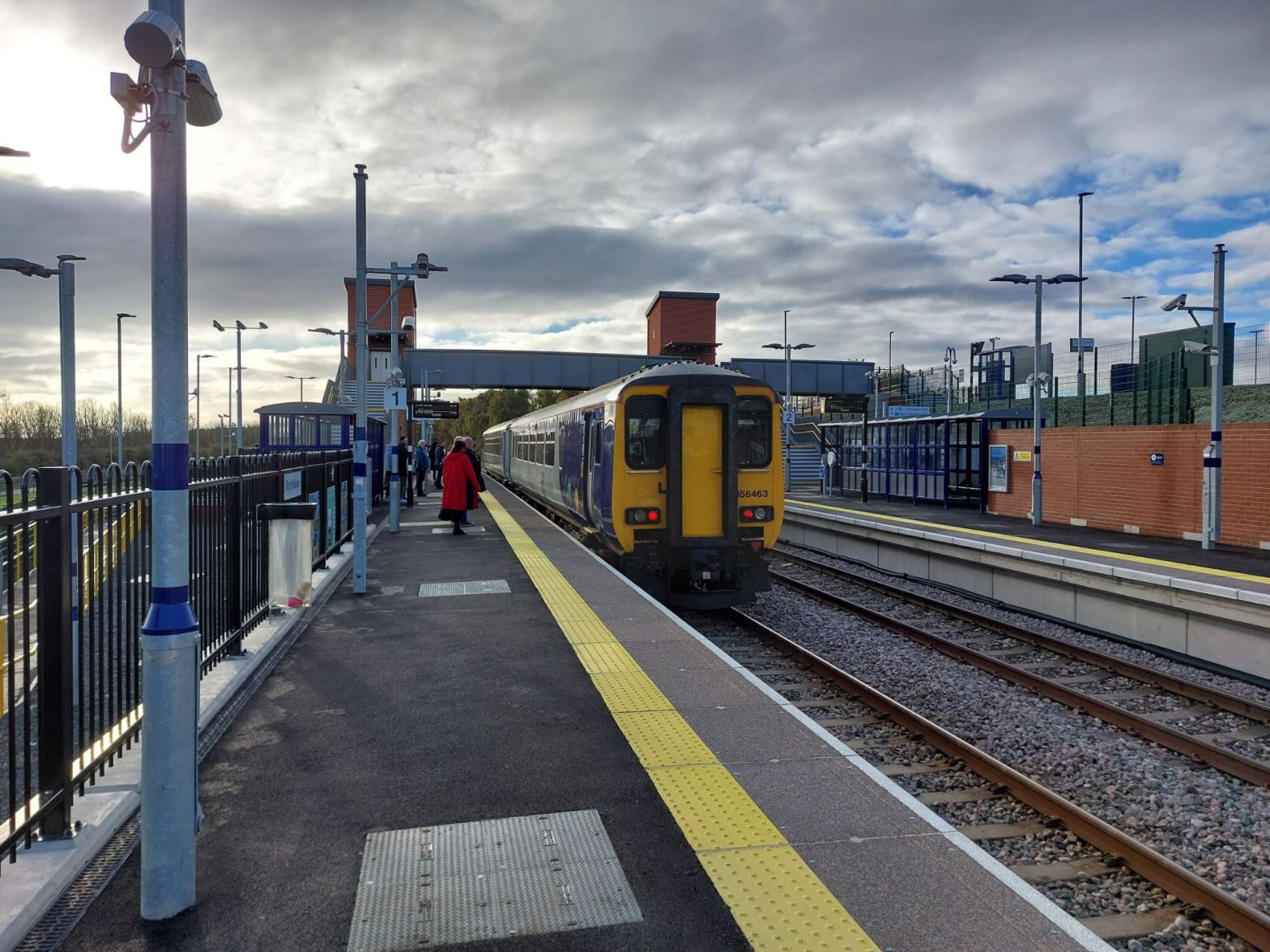
The next leg of the journey was aboard Northern 156463, standing in Platform 1 at Newcastle, and it got away bang on time working the 2T11 at 07:48 bound for Ashington.
LNER app train tracker, a brilliant feature for customer information.
Boots on the ground at Blyth Bebside station
Again arriving bang on schedule, at 08:17, 156463 dropped me off at the brand new Blyth Bebside Station, somewhat breezy and cool in yesterdays wind!
156463 departing Blyth Bebside station 25.10.25
Possible platform extensions at Blyth Bebside?
Like the rest of the Northumberland Line stations, the design is utilitarian and functional, but nicely finished off. It would outwardly appear from the station site that extension of the platforms to serve longer trains would be possible here, with an ample length of line in either direction to allow for future expansion of the station, should longer trains of nine or ten carriages be used to serve the Northumberland Coast Loop.
View of the station from Platform 2, the northbound side of the line. Looking north towards the A193 level crossing (site of the previous Bebside station)Looking south towards tbe rail bridge over the A189 Spine Road (quite a distance beyond the curve in the track)View east from the car park towards the new footbridge over the A189 and Blyth’s Starbucks outlet.Blyth Bebside bus & rail interchange, plus large car park.Exits from the station car park.
After exiting the station via the Heather Lea estate, it brought me out onto Front Street in Bebside, part of the A193 route, which starts at the Bedlington Red Lion roundabout, and heads through Blyth, towards Tynemouth and ends in central Newcastle.
This road is a major bus route in/out of Blyth, served by the regular Arriva X9 service between Blyth Bus station and Haymarket via Cramlington Town Centre.
Front Street looking west towards the ‘top end’ of Bedlington (Red Lion)Front Street looking east towards BlythThe Bebside Inn, a local landmark next to the level crossing; with the original station at Bebside a bit further north and closer to this pub, but still on the south side of the level crossing. Crossing the A189 via the A193 junction, and looking south towards the new bridge linking the station to the bottom of the ASDA car park and Chase Farm DriveThese images from Google Maps show the risky pedestrian crossings where the busy slip roads to/from the A189 meet the roundabout on the A193. No. 2 bus entering Blyth stopped at ‘Interchange’, which is passed by the 1, 2, X9, and X30 buses, and is a reasonable walking distance to Blyth Bebside station. Bus exiting Blyth via the ‘interchange’ stops next to ‘big ASDA’ in Blyth.
New bridge to link Blyth Bebside to Blyth
As part of the new station, and to avoid large numbers of pedestrians and cyclists using the A193 bridges to reach the station, a new bridge has been built over the A189 Spine Road, creating a much more traffic free route between the town of Blyth and Blyth Bebside station.
What was also clear from a brief observation is that drop-off/pick-up of passengers using the station on the ASDA/Starbucks side of the line will potentially be quite significant, as it avoids the congestion associated with driving to the station car park on the far side of the A189. Potentially the ASDA/Starbucks outlet on the eastern end of the bridge will stand to benefit from this passing trade though.
Despite a relatively quiet and chilly early Saturday morning in October, the new bridge was proving quite busyA far safer and easier crossing of the A189 than via the busy slip roads to/from the A189.Approaching Blyth Bebside station from the new bridge. Train approaching Blyth Bebside from the connecting path. View from the footbridge looking east towards the Port of Blyth and the Starbucks outlet on the opposite side of the bridge.
The return trip to Alnmouth
Once again, 156463 was the train of the day on the Northumberland Line stretch of the trip, arriving on-time once again on 2T18 at 10:08 for the journey back to Central Station. Leaving Bebside the train had a good number of passengers aboard, but towards Newcastle, the two carriage train was running well filled indeed, demonstrating the clearly high demand on this newly opened line.
A dozen or so passengers awaiting to board ‘463The crowd leaving ‘463 at Newcastle Central bound for Toon or other connectionsNow empty ‘463 waiting to head back to Ashington again in Platform 1.
Arrival back at Newcastle was again on-time at 10:34, with a shorter 9 minute wait for changing onto the LNER service to head home.
Of particular note on this service was the guard going the extra mile for two wheelchair users who boarded the train, and were sat nearby on the way into Newcastle.
Last leg back to Alnmouth
The last of the four trains yesterday was LNER 801229 working 1S06, departing Newcastle at 10:43. Not letting the side down, all trains ran perfectly to time, were all clean and comfortable and staff encountered on each were great; the lady checking tickets on the LNER train in particular was very cheerful and friendly.
801229 at Newcastle Central801229 ready for the off at NewcastleApproaching the beautiful Alnmouth village by train, one of my favourite views! 801229 is passed by an unidentified CrossCountry train at Alnmouth
Conclusion
All in all, yesterday was one of those days that shows the railway at its best; everything ran like clockwork, and everyone got where they needed to be on-time, and ALL of the staff were great, all friendly and helpful whenever they were interacting with passengers.
Journey Times
Compared to travelling by bus, the rail route via Newcastle is still a much faster trip, but still is over an hour, compared to driving between Alnmouth/Alnwick and Blyth in c.40mins. If the Northumberland Coast Loop route is implemented, it could reduce journey times by rail significantly, probably to around a 30 minute trip between Blyth Bebside and Alnmouth stations, representing a 30-40 minute reduction in journey time, and also elimination of a change of train.
Capacity
With the lack of available Sprinter trains to make all Northumberland Line trains four carriages in length, the proposed use of units like the Voyagers could increase seating substantially if added alongside the existing Northumberland Line passenger trains.
If, for example 220 001 had ran via Bedlington to reach Blyth Bebside direct from Alnmouth, and ran alongside the Sprinters such as 156 463, it would have added extra seats towards Newcastle from Blyth Bebside, but also would have released capacity on other trains, as I would not have needed to occupy one seat south into Newcastle, then another seat north towards Blyth Bebside.
This could go some way to freeing up some extra capacity on the existing Northumberland Line trains, allowing the line to carry more people and provide more economic return on the investment, as easier and faster rail access to/from north Northumberland and Scotland to towns such as Blyth will drive businesses to base themselves there.
As stated in previous blog posts, Edinburgh and Glasgow are linked by FOUR rail routes, whilst Newcastle and Edinburgh presently only has one; the Northumberland Coast Loop route, if implemented could become a second route between the two cities, boosting the economy of the region. Let’s hope that it is duly considered as a next phase of the rail network in Northumberland.
This month has been a very positive one for rail news in Northumberland!
With the opening of the fourth Northumberland Line station at Blyth Bebside on Sunday 19th October, as well as the ‘World Cup of Stations’ win for Ashington, and good news hopefully for the Aln Valley Railway extending beyond Eden Hill Bridge, towards Alnmouth, with these latter two outlined below, it is a succession of good news stories!
Aln Valley Railway: Alnwick (Lionheart) to Alnmouth Station advancing forwards?
The Aln Valley Railway currently runs from their main operating base and station at Lionheart, which was started on a greenfield site in February 2012 to the south of the original Alnwick branch, and just east of the A1 Alnwick Bypass.
Brief history of the Alnwick Branch
Opened in 1850, the branch originally had a different station site, until the current Alnwick Station (now home to Barter Books etc.) was opened in 1887, alongside the opening of the then new Alnwick and Cornhill Railway.
Like most railways post-war, decline in both passenger and goods traffic took hold, but, towards the end of it’s life as a railway station Alnwick was actually seeing passenger growth in decade before (probably linked to Alnwick Castle first opening to the public in May 1950, and growing to c.350,000 per year in the 2020’s).
From ‘The Alnwick Branch’ by Bartle Rippon (2008 p.60) ticket sales in 1951 were 7,683; rising to 15,183 by 1967, the last full year before closure. It is interesting to speculate just how busy the line would be today had it survived, particularly given the iconic role of Alnwick Castle in the Harry Potter films; an arrival into the trainshed at Alnwick would have been a great experience ahead of a visit to the Castle, the Alnwick Garden and more… alas it wasn’t to be…
…Alnwick Station closed to passengers on the 29th January 1968, and completely on 7th October 1968, much later than other local stations such as Ashington, which, alongside other stations now reopening as part of the Northumberland Line programme, had closed in November 1964.
It is rumoured locally that the development of the A1 Alnwick Bypass put pressure on to close the railway, presumably to reduce costs by not providing a bridge over the A1. With the bypass being completed soon after in 1970, it does suggest that the timing of closure could well be connected to the building of the bypass.
Since closure in 1968, the line on the Alnwick side of the A1 has been steadily developed upon, with Lidl on the station throat, and the South Road Industrial Estate on the junction between the Alnwick Branch to Alnmouth, and the Alnwick and Cornhill Line. A now demolished bridge carried the line over the A1068 South Road, and a now heavily overgrown embankment remains towards the A1.
Railway Revival
Since the founding of Lionheart in 2012, the Aln Valley Railway (AVR) has made remarkable progress in building a new railway depot from a greenfield site high above and offset from the original trackbed, then connecting it to the old railway by creating a long, curved embankment, allowing trains to steadily drop down onto the original line, and passing beneath farmers’ bridges to travel eastwards along the line, and passing over the relatively small but still impressive Cawledge Viaduct to reach the current end of the line at Greenrigg Halt.
The reason for this halt at the halfway point of the route from Lionheart to Alnmouth station was due to Eden Hill Bridge, which the Aln Valley was not permitted to pass beneath by its owners (Historical Railways Estate), due to maintenance costs that this could incur to that organisation.
Happily in April 2025, adoption of the structure was taken on by Northumberland County Council (NCC), which should ease the challenges of extension of the line beyond Greenrigg Bridge, and go a long way to further reversal of the postwar rail closures.
On this front, a recent public post from NCC Deputy Leader Cllr Richard Wearmouth, noted a meeting with Alnwick Cllr’s Mr Gordon Castle and Mr Martin Swinbank, and it is very encouraging to see that this expansion is being actively talked about with members of Aln Valley Railway.
Original post by Cllr WearmouthComments on the original post
Like the Northumberland Line, this railway could potentially be an immensely popular link between the busy town of Alnwick, now home to several other major attractions alongside Alnwick Castle, such as the Alnwick Garden, Lilidorei, Barter Books and many more smaller attractions.
Old AVR booklet c.1997 purchased recently from Barter Books
With luck, the AVR may, once the route is established into Alnmouth station (or close enough to have a short walk between them), re-establish the ‘shuttle’ service concept that was floated many years ago (assuming a date of c.1997) in one of their booklets (still for sale at Barter Books as far as I know).
Modern units for commuter service; still a good idea for Alnmouth to Alnwick (Lionheart)?
Taking from the text ‘The Aln Valley Railway also has another serious purpose, and that is to provide a commuter link for the residents of Alnwick… Although the tourist side if the railway would be mainly steam operated a modern…vehicle…is envisaged for the commuter side’.
The Parry People Mover vehicles using flywheel technology were mentioned as an example in the booklet, but with battery technology having advanced significantly in the years since the publication of the booklet, it might be more apt for a new battery powered train with rapid charging?
Digital brochure for the Revolution VLR train
Something like the Revolution VLR train, or similar might be a great option if the AVR decides to operate a commuter shuttle service to and from Alnmouth Station in the future, which could boost sustainable access to and from Alnwick, and make public transport both more effective and faster, making access for tourists coming to Alnwick easier, and for residents to head outwards too!
Please note that the views above are entirely my own, and do not reflect those of any other persons or organisations.
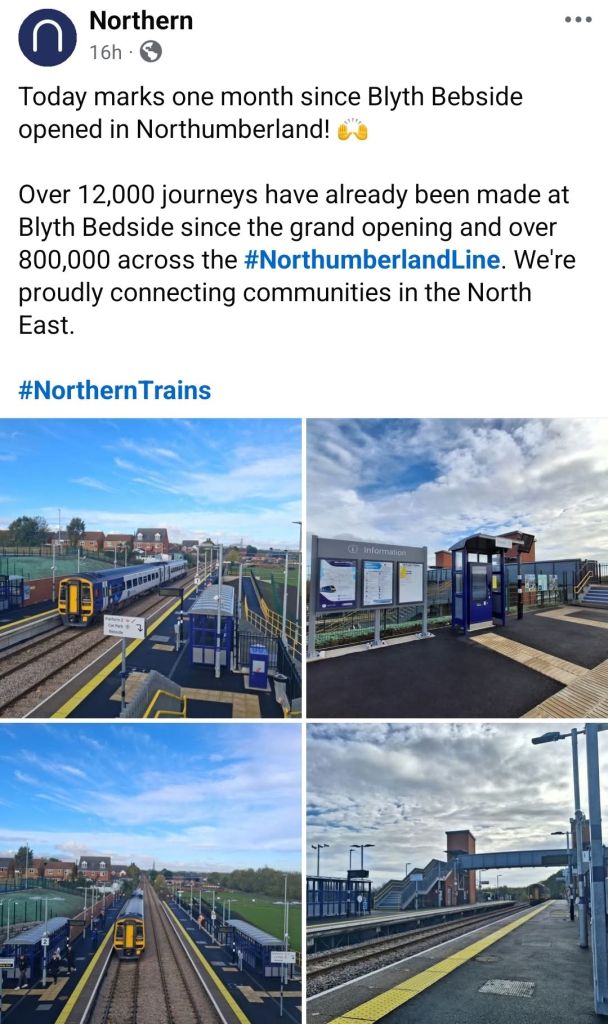
Yesterday, on Sunday 19th October 2025, Blyth Bebside station became the fourth of the six new stations on the Northumberland Line to open, and from footage and images shared online, which shows the great active travel connections into Blyth (new bridge over the A189 Spine Road), as well some of the first trains to call at the station.
The two stations that now remain to be opened are Bedlington, and Northumberland Park, both of which which are due to open in early 2026.
For now, the Northumberland Line largely operates as a shuttle between Ashington and Newcastle Central, with some trains soon to be extended on Sundays only to the MetroCentre, but the line could be used for more…
Blyth Bebside to Edinburgh?
This campaign, which seeks to see the ‘Northumberland Coast Loop’ developed as a regularly operated route, which would see trains from Newcastle take the Northumberland Line to Bedlington, but then take the westward line through Hepscott towards Pegswood, rejoining the East Coast Main Line (ECML) at Morpeth North Junction, and run to Berwick-Upon-Tweed for local trains (Newcastle to Berwick via Blyth); but also long distance, semi-fast (limited stop) services between Newcastle and Edinburgh to run via this route too.
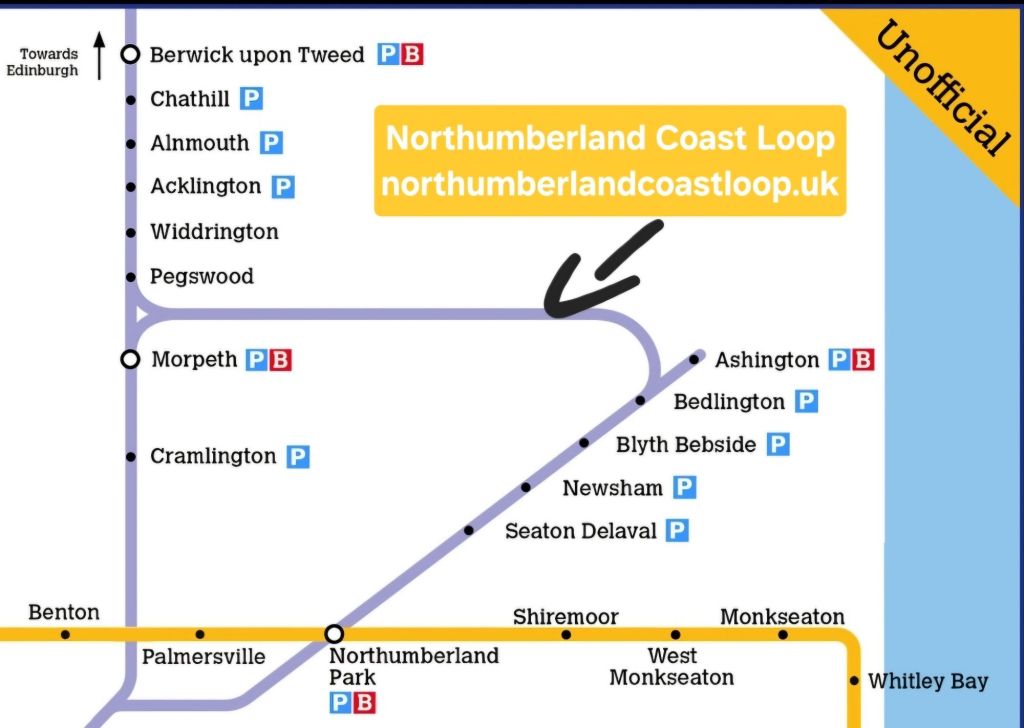
Route map of the proposed ‘Northumberland Coast Loop’, using the existing railfreight link from Bedlington to Pegswood.
Blyth Bebside is one of the ‘key’ stations on this proposed route, where we suggest that semi-fast trains between Newcastle and Edinburgh via ‘the loop’ would call, as well as the yet to be completed Northumberland Park.
Route map of the Northumberland Coast Loop, the second potential route between Newcastle and Edinburgh via Blyth and North Tyneside
This station was selected as it is perhaps the most ideally suited of the N’land Line stations to act as a ‘hub’ for long distance services as it is in a very strategic location; it serves the largest town in Northumberland directly, but compared to the other station serving the town of Blyth at Newsham, Blyth Bebside is in an easier to reach location from other towns.
Bedlington was discounted for semi-fast services due to its very constained location for platforms; which are limited by the track layout, with Bedlington Junction at the NW end, and level crossing at the opposite SE end, and a further junction for sidings only just beyond that!
Google Maps image showing the level crossing and junction for Furnaceway Sidings in close proximity to Bedlington Station.
In contrast, Blyth Bebside is a much simpler site, with a fair distance between the platforms and the level crossing/bridge over the A189 a fair distance in each direction, potentially allowing relatively easy platform lengthening if required in future.
Blyth Bebside station very much ‘in the distance’ from Bebside Level Crossing
Active Travel (Walking, Cycling, etc)
Blyth Bebside station is nearby to the coastal Route 1 on the National Cycle Network, and is also at a convergence of many other footpaths and cycle routes connecting Bedlington (Bebside Furnace Road towards the Bank Top pub in Bedlington) and Cramlington (such as Hathery Lane towards the former Three Horseshoes pub/East Hartford), making it ideally placed for multiple towns to connect into.
Buses and Cars
Blyth Bebside station is adjacent to the crossroads of the A189 Spine Road and A193, which are both major bus routes into and out of Blyth, as well as easily accessible to motorists from a very wide area surrounding the station. This again makes Blyth Bebside ideally placed as a strategic interchange between rail and bus services, as well as those arriving by taxi, or own private car.
Rail
The station is also in a great position for rail connectivity; towns like Ashington that cannot be served directly by the proposed loop route will still have an easy interchange at Blyth Bebside as all trains running to Ashington pass via that route anyway, the same applying for extension of the line to Woodhorn, Newbiggin by the Sea, or Lynemouth.
Example Trip
Ashington to Edinburgh: a hypothetical trip from a home in Ashington to visit Edinburgh could be done in multiple ways, a quick taxi/lift/car trip down the A189 to Blyth Bebside, and join a northbound train there for the Scottish capital, or using the railway, just two stops down the Northumberland Line, over the bridge to change platforms and again board the northbound rail servive to Edinburgh.
In reverse, the same would apply, arriving back at Blyth Bebside, it would either be getting a taxi/lift/car back to Ashington, or jumping onto a Northumberland Line train to head home.
Blyth Bebside vs Central Station or Morpeth
InterCity rail services being introduced between Newcastle and Edinburgh via Blyth hold a few key advantages over the present status quo of connecting onto long-distance services via Newcastle Central or Morpeth.
Newcastle Central is too far south; adding significantly to journey times
Travel times on the Northumberland Line from Blyth Bebside to Newcastle Central are usually 28-30mins, then entail a waiting time at Newcastle (to get off N’land Line train, change platforms and join next service is usually at least 5 minutes to allow sufficient time for change of train), then even the fastest services take approx 15mins to pass through Pegswood an overall total time of around 50 minutes (as borne out by Google Maps below, which involves a change of train at Manors), compared to a direct trip from Blyth Bebside to Pegswood via Hepscott, which takes around 15 minutes by rail.
Public Transport as of 20.10.25 between newly opened Blyth Bebside and Morpeth Stations More detail of the rail trip between Blyth Bebside, Manors, and Morpeth
This means that from Blyth Bebside, the direct route would represent an approximately 30 minutes (half an hour) of time saved in each direction compared to travelling south into Newcastle to change train, then travel north again, for a day-out, that would mean an extra hour overall, either spent enjoying an activity North Northumberland or Scotland, or being home earlier at the end of day out.
Not only that, but a smaller station is easier to understand for less familiar rail users, and if travelling with luggage, small children etc (being ‘encumbered’), reducing the number of changes of train, and ideally travelling on a single seat as much as possible is helpful to promote rail use to those less confident with using passenger trains.
Morpeth is awkward to reach
Again from Blyth Bebside, Morpeth is an awkward station to reach; there is no proposal for a direct rail service to Morpeth from here (there is a proposal for a Newcastle to Bedlington via Morpeth route), meaning that to reach Morpeth by rail, would mean change of train at Bedlington, again adding to journey times, and is relatively inconvenient given such short distances.
A solution to this would be to extend services to Blyth Bebside/Newsham rather than terminating at Bedlington, but this may require additional infrastructure such as a turnback siding being constructed, and may not fit within the current gap in the timetable allowing a ‘Bedlington and back’ extension of the route as proposed.
Using buses, though direct is also a very slow option, with a combination of the X9 and 43 buses (again change of bus mid-journey), taking 36 minutes, only five minutes faster than cycling.
Bus connections between Blyth Bebside and Morpeth stations
As can be seen above even for buses running reasonably directly between Blyth Bebside and Morpeth stations, the journey times are poor, taking at least 36 minutes for the trip, and that involving a change of bus from the X9 onto the 43 at Heather Lea. The 2 service offers a direct link, but there no time saving, taking 36 minutes for the trip.
The 2: the ‘direct’ bus between Blyth Bebside and Morpeth
Morpeth is a fairly short drive, being around 15 minutes, but that adds to congestion problems in Blyth, Bedlington, Choppington and Morpeth itself, and with a highly constrained car park at Morpeth, which is also often quite full, and parking charges can also be significant, that acts to deter rail use, compared to driving the entire journey instead.
Direct trains to Edinburgh from Blyth Bebside could be an answer to these issues?
Given the challenges of ‘travelling south to go north’ to change at Newcastle (and also using up limited seating capacity to do so), or getting across to Morpeth to catch trains there, the logical solution might be to take the trains to the people; after all, Blyth IS the largest Northumberland town, so surely deserves at least some direct connectivity to other major cities, even if just a fraction of what its much smaller counterpart Morpeth gets.
Direct trains could also have the benefit of adding to seating capacity; an additional train running InterCity between Newcastle and Edinburgh via Blyth Bebside, alongside the existing Northumberland Line trains would put more seats onto the route, allowing people to do Newcastle to Blyth Bebside, whilst those headed northwards would jump into the now empty seat, and wouldn’t be using seats towards Newcastle and towards Morpeth either, thereby releasing capacity on other trains.
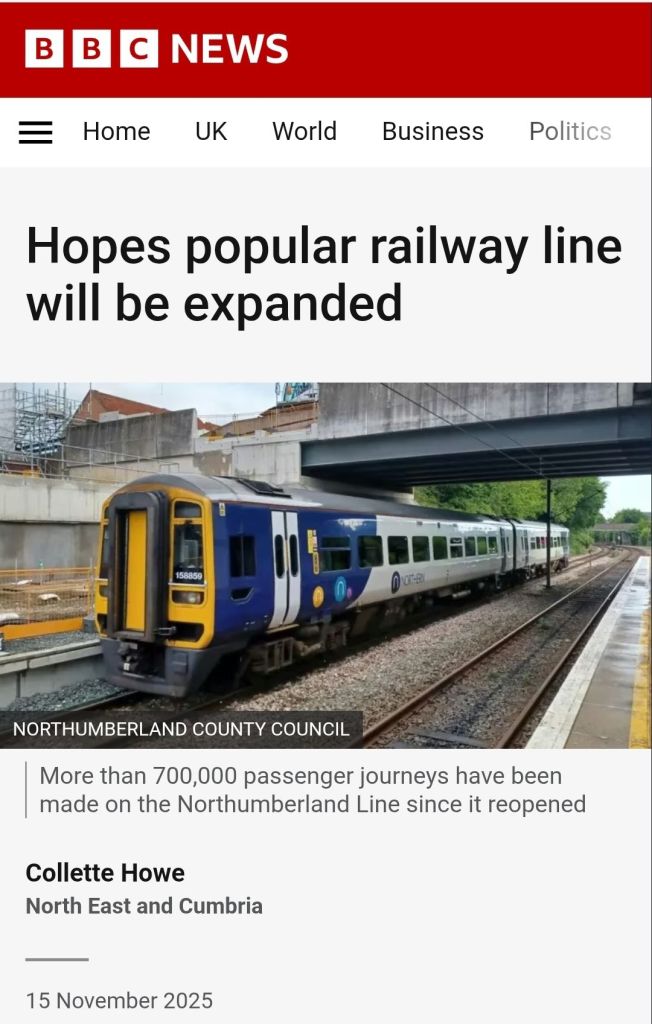
With the fourth station on the line at Blyth Bebside due to open tomorrow (19th October 2025), and already around 700,000 passengers having travelled on the Northumberland Line since it opened less than a year ago (15th December 2024), there have been many of the two carriage trains becoming overwhelmed by the volume of passengers using the services, with occasionally passengers being unable to board due to how full the trains are.
To help ease this problem (in many ways a good one, in that the line is being far more successful than was predicted, and proves the ‘build it, and they will come’ of major public transport investment), the operator of trains, Northern, is putting on extra carriages where possible at peak times to provide added capacity, but a shortage of diesel multiple units (DMU’s) like the Class 156 and 158 used on the route, as well as others across the UK nationally is an issue.
The statement in the article that ‘Northern have introduced extra carriages on some of its services and will continue to closely monitor capacity with a view to meeting demand wherever possible.‘ is an encouraging one, but does suggest that what might be possible could be limited in scope, due to the availability of old units like the Class 156 and 158 trains, which are stretched thinly across the UK.
Encouragingly, the article does also state that ‘Programme partners will continue to explore all options to provide more capacity for customers, while acknowledging the real practical difficulties because of the shortage of suitable vehicles nationally.‘ so perhaps our suggestion of using other trains, such as the TPE Nova 1 fleet, CrossCountry or other diesel/bi-mode units to run the Newcasyle to Edinburgh via Bedlington route, and thus augment the Northumberland Line services (run alongside the Northern trains) has happily not been ruled out, and the other major advantage of this would be offering direct services from this immensely popular reopened line serving south east Northumberland, into North Northumberland and Scotland.
Map of the proposed Northumberland Coast Loop, showing the possibility to return to the ECML near Pegswood via the existing freight line from Bedlington Junction to Morpeth North Junction
With the fourth station on the line at Blyth Bebside due to open tomorrow (19th October 2025), and already around 700,000 passengers having travelled on the Northumberland Line since it opened less than a year ago (15th December 2024), there have been many of the two carriage trains becoming overwhelmed by the volume of passengers using the services, with occasionally passengers being unable to board due to how full the trains are.
To help ease this problem (in many ways a good one, in that the line is being far more successful than was predicted, and proves the ‘build it, and they will come’ of major public transport investment), the operator of trains, Northern, is putting on extra carriages where possible at peak times to provide added capacity, but a shortage of diesel multiple units (DMU’s) like the Class 156 and 158 used on the route, as well as others across the UK nationally is an issue.
The statement in the article that ‘Northern have introduced extra carriages on some of its services and will continue to closely monitor capacity with a view to meeting demand wherever possible.‘ is an encouraging one, but does suggest that what might be possible could be limited in scope, due to the availability of old units like the Class 156 and 158 trains, which are stretched thinly across the UK.
Encouragingly, the article does also state that ‘Programme partners will continue to explore all options to provide more capacity for customers, while acknowledging the real practical difficulties because of the shortage of suitable vehicles nationally.‘ so perhaps our suggestion of using other trains, such as the TPE Nova 1 fleet, CrossCountry or other diesel/bi-mode units to run the Newcasyle to Edinburgh via Bedlington route, and thus augment the Northumberland Line services (run alongside the Northern trains) has happily not been ruled out, and the other major advantage of this would be offering direct services from this immensely popular reopened line serving south east Northumberland, into North Northumberland and Scotland.
In a Facebook post today (16.10.25) from Northumberland County Council, council leader Glen Sanderson stood at Blyth Bebside, the next station due to open on the Northumberland Line, which will mark four of the six stations new completed and opened to passengers, showcasing what the completed station will look like ahead of opening.
In the same post, he also announced that 700,000 passengers had been reached in 10 months since the opening of the line on 15th December 2024, 306 days ago to be more precise.
A simple average of the total passenger volume (700,000) shared by the number of operating days (306) means an average per day of 2,288 passengers per day (rounded up to nearest whole number) using the line daily.
At that rate, a MILLION passengers on the line should be achieved in late 2025/early 2026, phenomenally beyond even the most optimistic expectations of the most optimistic people backing the project, and showing clearly the ‘build it, and they will come‘ analogy has rung very true with regards the Northumberland Line.
Next steps?
With such a roaring success comes an issue; the often two carriage Class 158/156 units are often struggling to carry all the passengers desiring to use the line, and there aren’t any easy options to get more similar carriages to make trains up to four on every train.
Our route map for the proposed Northumberland Coast Loop
Our proposed solution is to redirect some current East Coast Main Line (ECML) services via Bedlington, possible along the existing route from Morpeth North Junction (w3w: ///insects.hamsters.issuer), curving off the mainline coming from Pegswood heading south, passing through Hepscott, then joining the Northumberland Line at Bedlington Junction.
Sending some trains, such as the Transpennine Express Nova 1 fleet (which is capable of running on either a diesel engine or from overhead wires, and can achieve 125mph when on the ECML) could be one solution: it would add valuable extra seats on the Northumberland Line to/from Newcastle if ran in addition to the Northern trains, but would also give direct northbound connections from towns like Blyth into North Northumberland (i.e. Blyth to Berwick Upon Tweed direct), or ideally into Edinburgh Waverley, linking the Scottish capital to Newcastle via south east Northumberland proper.
This would have the side benefit of developing diversionary route knowledge for train drivers; which potentially might have been needed during the issues with Plessey Viaduct in October 2023 and the ensuing repairs required had both lines been closed entirely.
Fortunately, the damaged viaduct remained partially open until repairs were completed, but driver knowledge of the diversionary route via Bedlington would certainly be of benefit in added resilience for rail services, and one of the best ways to achieve, and to maintain route knowledge is regular running of trains over the route.
Our petition for a Newcastle to Edinburgh via Bedlington service is steadily growing, standing at just under 1000 signatures so far, if you’d like to sign it too, please do so here: https://c.org/J8DxHqpWdf
To quote directly from the above sale annoucement however, ‘Mike Cooper, CEO of Arriva Group, said: “We want to see a future where people choose to leave their car at home, a future with less traffic congestion and cleaner air.‘ So surely serving Newsham station (and other railway stations) better is surely a clear way to achieve this goal?
Improved connections to and from the railway station, delivered through a fully integrated bus service, is likely to help with the choice of ‘leaving the car at home‘, which especially in a town as congested as Blyth, would make a huge difference almost immediately, and especially to the parking problems being experienced around the new station Newsham due to high demand for rail services, but the relatively poor inward or outward public transport connections mean that many view driving to the station as the only viable option.
Whilst the existing bus stops may, or may not be far away from the station depending on your own opinion, an ‘ideal’ situation surely is an ‘as close as possible‘ interchange between rail and bus services; so where feasible, a dedicated station bus stop on a turning circle or within a station car park is clearly the preferable option to be served compared to a ‘nearby street’.
For everyone, but especially those with mobility issues, travelling with items of luggage, small children etc, or even just in poor weather conditions such as rain, snow, or wind; a close interchange is obviously of huge benefit, and worth the minor detour (as shown below) of the bus service itself to serve the station directly. Even in perfect weather, an easily visble bus stop near the platform is more obvious than needing directions to a bus stop a few streets away.
Whilst Arriva can be forgiven to some extent for Newsham being a relatively ‘new’ station, it having been open for less a year (opened in March 2025), and thus sticking with its existing bus routes for a while; now that the station, and the Northumberland Line more broadly is proving so popular, with over 650,000 passengers, it is perhaps time to adapt to this major change and begin running there directly?
As the major operator of buses in Northumberland, it is clear that more could be done throughout the county by Arriva to ensure better bus and rail integration, which has multiple benefits for local residents, but also for the many tourists to our region, there is literally a zero downside to a better integrated public transport system.
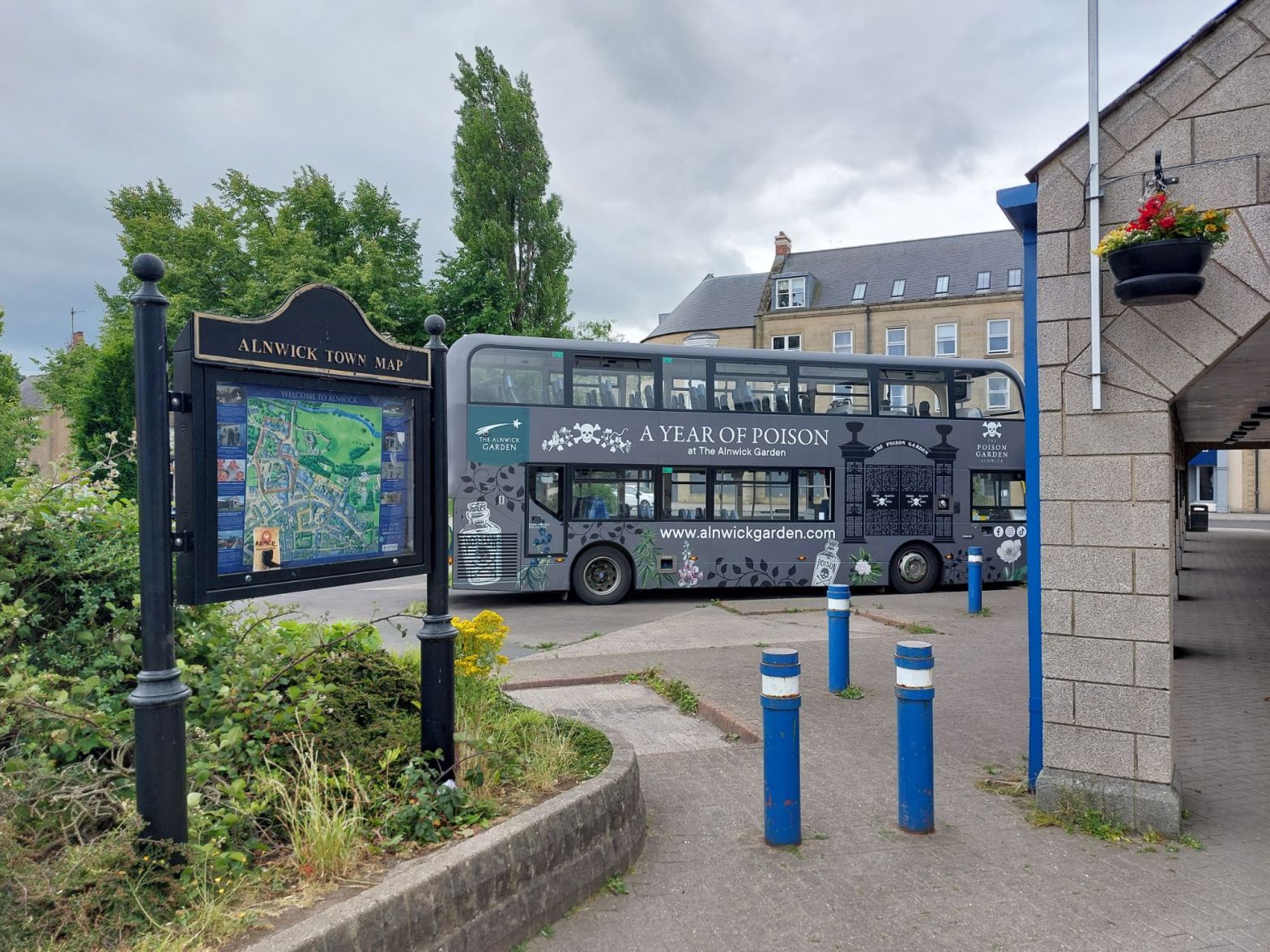
Another recent article highlighting tourism issues identified by Mayor McGuinness is a good case in point; buses linking to rail services in a co-ordinated fashion would help make many attractions easier to visit, especially as a bus can act as a mobile billboard for them, such as the ‘Poison Garden’ branded bus, as seen in Alnwick Bus Station below.
Could there be ‘Blyth Battery’ or ‘Bamburgh Castle’ branded bus services too?
Public Transport: Integration is better than false competition.
This is an issue that stems more broadly from the privatisation and deregulation of buses back in the 1980’s, so that rather than co-ordinated and integrated system, public transport still takes a Victorian ‘competitive’ approach that the bus services are attempting to compete with trains, when really both would benefit from working as part of a single larger system.
Buses are advantageous in providing access to places a train cannot viably reach; central Blyth is unlikely to ever again see rail services due to the loss of the branchline into the centre and the development on the routes into the town since then have probably precluded it being rebuilt, but an integrated system of buses linking both Newsham and Blyth Bebside station into the town centre is a reasonable alternative.
Similarly, other stations such as Morpeth or Alnmouth, that act as hubs for a much wider area, and offer UK wide connections are relatively poorly connected by buses, which is an absurd situation in many ways.
Indeed, better integration of buses and rail would likely boost Arriva by additional ticket sales; more than compensating for the tiny additional distance and time required.
As an example, the fastest Blyth Bus Station to Haymarket service, the X10, takes 54mins for its trip end to end; but would three minutes extra, to run via the Newsham Station bus stop make that much difference?
X10 route from Blyth Bus Station to Newcastle HaymarketExisting loop in the X10 route via Walsham Close, why can’t a second smaller loop be made via Newsham Station?
How far away are the alternative stops?
Using Google Maps, an approximate journey time can be ascertained for the walking distances to and from Newsham station to both the Blagdon Drive bus stops (for the X8 service to/from Blyth Town Centre), and the Park Farm Villas bus stops (for the X10 and X30 buses).
Whilst neither of the current stops could be described as ‘a million miles away’ from the station, they are still a fair walking distance away, and especially for a disabled person or someone unfamiliar with the area could present issues, for the fairly for a simple and very modest short re-routing of a bus service to obviate the whole issue entirely.
Blagdon DriveBus Stop to Newsham Station
The bus stops on Blagdon Drive for the X8, which are located just to the east of the new roundabout to the east of Newsham station (map below orientated east up), are the closest stops to the new bus stop within the station car park, but would also mean the smallest detour of bus route to serve the station bus stop, as the route already crosses to/from the east side of the Northumberland Line.
Location of Blagdon Drive bus stop relative to Newsham Railway Station. Approximate walking distance to Newsham Station from Blagdon Drive bus stop to the east of the station.
As can be seen above, the Blagdon Drive bus stop is a fairly modest 4 minute, 290m distant, and mostly flat walking route for passengers changing between the X8 bus and trains calling at Newsham station, but as can be seen below, a deviation of the bus route would represent an approximate two minutes of additional time compared to present situation of ignoring the stop.
The direct route between Laverock Hall Farm and Blyth Battery ignoring the station bus stop is an 8 min expected journey time for a car.The same start and end points via Newsham Station would represent circa two minute diversion, and extra 400m of bus route.
With such a minor diversion of the bus route (c.2 mins) in exchange for a much improved connection between the X8 and Northumberland Line rail services, then hopefully Arriva will change their mind about this route being amended to serve the station, especially if requested as part of the subsidy arrangements that companies like Arriva receive for operating buses at reasonable cost.
Park Farm Villas to Newsham Station
The current bus routes of the X10 and X30 run near to the Northumberland Line, but instead of passing over the line near Newsham station, instead head north and in parallel along the B1523, passing near to the station.
Walking distance from Park Farm Villas to Newsham Station (Railway Cottage Retreat used as a proxy due to Google Maps suggesting an unduly long route)
As can be seen, again a circa 4 minute, 300m walk isn’t a huge distance, but for those with mobility problems, heavy luggage, small children, or even those simply being unfamiliar with the area, a bus stop well out of sight of the station is not a welcoming way to encourage use.
Example route avoiding Newsham Station, from Laverock Hall Farm to Co-op Food, New Delaval. Route between Laverock Hall Farm and the New Delaval Co-op, but running via Newsham Station bus stop, a c.3min diversion and extra 600m on the bus route.
As can be seen from the maps above, diversion of the X8, X10, and X30 buses to serve Newsham Station is not an outrageous request, it would represent a matter of under 4 minutes to run the bus via Newsham Stations own bus stop, even for those having to cross the new bridge and go back again, yet would provide massively better bus & rail integration.
Hopefully Arriva may test out a diversion of the bus routes to at least assess the impact of the change as a compromise?