Today, Sunday 31st August 2025 marks the end of Summer and the beginning of Autumn, but with some significant progress being made on our campaign for the Northumberland Coast Loop, a new rail service between Newcastle-Upon-Tyne, England, and Edinburgh, Scotland via Blyth, Northumberland.
Hopefully all six stations will be fully completed by Spring 2026, and thoughts can then be more focussed on running this new rail service via Blyth?
I would like to wish a massive thank you to all who have signed and supported this petition so far, but please keep sharing with friends and family to keep it making progress!
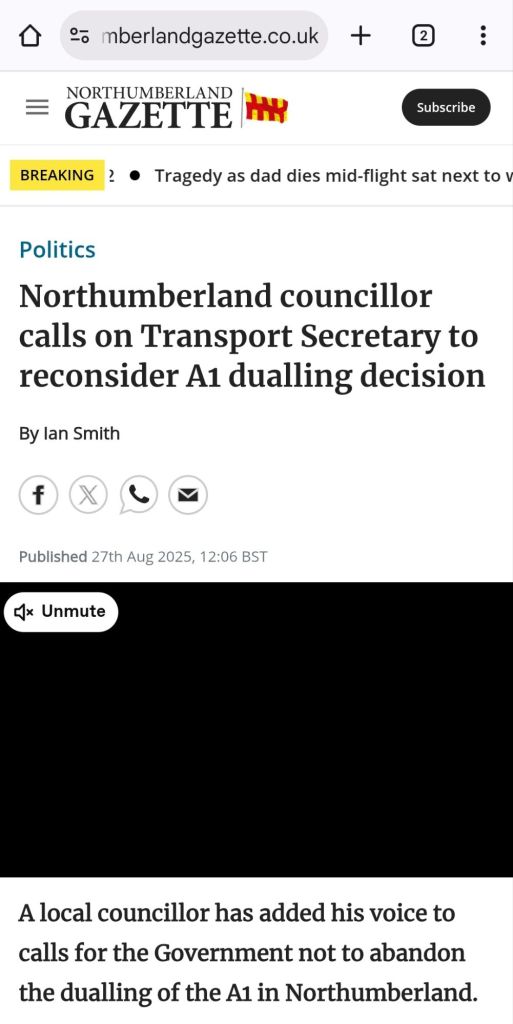
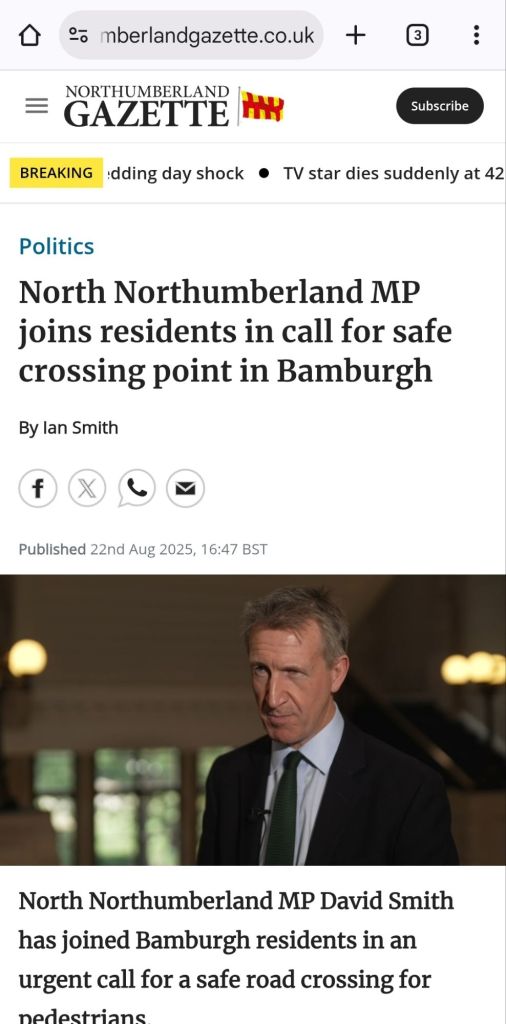
Dualling of the A1 would, however, bring the considerable downsides of increased volumes of traffic both on the A1 itself (overwhelming other stretches of the road), and in places like his own ward of Bamburgh, road traffic is already a significant safety issue, with the campaign for a safer road crossing in Bamburgh gaining increasing traction, and with venues such as Bamburgh Castle attracting around 150,000 visitors a year, it brings a lot of vehicles into the historic village, making the roads busy and increasingly risky for visitors trying to enjoy the village.
Rail investment is an answer to both; get people to Belford, Bamburgh, and the surrounding area WITHOUT cars, for a fraction of the price?
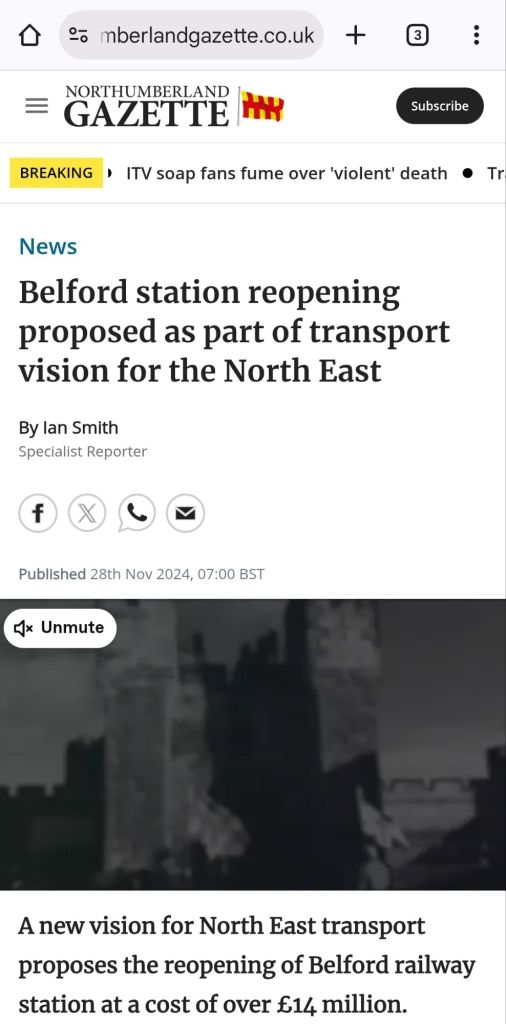
In the above article, Cllr Thompson himself states that “Hundreds of thousands of tourists visit north Northumberland each year and a station at Belford would be in the epicentre of the tourist trade.“, so if the A1 is highly unlikely to be built in the coming years, why not get Belford Station rebuilt and opened to passengers instead?
If it is assumed that Belford railway station would cost in the ballpark of £20m (minimum of £14m in Novemeber 2024), then 25 railway stations could be delivered for the cost of dualling just 13 miles of road.
This figure is borne out by the recent opening and ongoing construction of the Northumberland Line, with 18 miles of freight line reopened to passengers, as well as six new stations expected to cost £298.5m so far, plus an extra £37.9m needed towards completion coming at a grand total of £336.4m, which is still £163.6m less than the expected cost of dualling the A1 between Morpeth and Ellingham.
For the comparatively small sum of £20m (compared to £500m+ price of dualling the A1), surely getting Belford Station rebuilt would represent a better investment for Northumberland.
As also hinted at in the article, the opening of railfreight facilities at Belford could also help to reduce HGV movements on the A1, cutting carbon emissions and reducing traffic on the A1 too.
Lets hope that Belford could be reopened far faster than 2036; two platforms adjacent to an existing passenger railway should not need a decade to be built, lets hope that 2030, or even earlier could be possible.
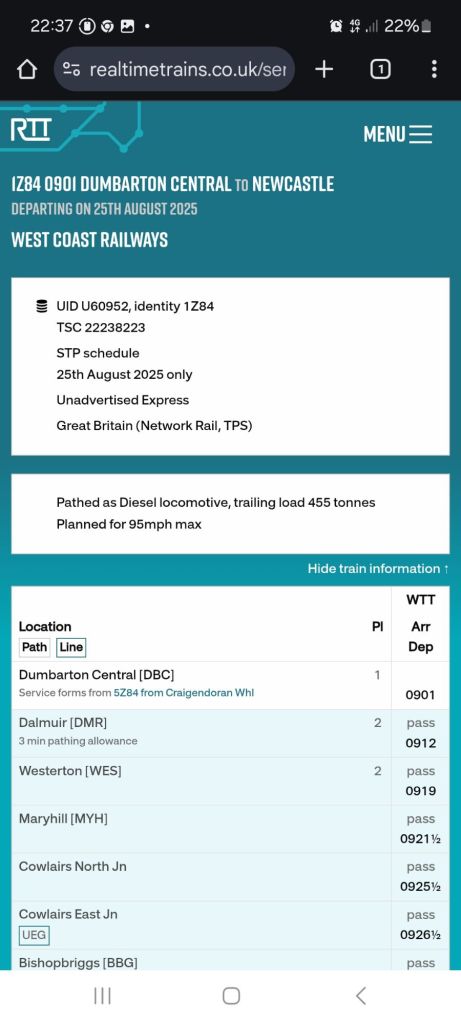
‘The Royal Edinburgh Military Tattoo and Waverley Weekender‘, a railtour organised by UK Railtours, and operated by the West Coast Railway Company had a section the return leg of the trip from Dunbarton, Scotland to Newcastle-Upon-Tyne, England due to travel over the proposed Northumberland Coast Loop route today (Monday 25th August 2025).
The original plan…
The tour was originally planned to run from Dunbarton to Edinburgh, then run south along the East Coast Main Line (ECML), but at Morpeth North Junction, the train would then leave the ECML, and run along the presently rarely passenger worked section to Bedlington Station on the Northumberland Line; it then continuing towards Newcastle Central via the under-construction and open stations at Blyth Bebside, Newsham, Seaton Delaval, and Northumberland Park.
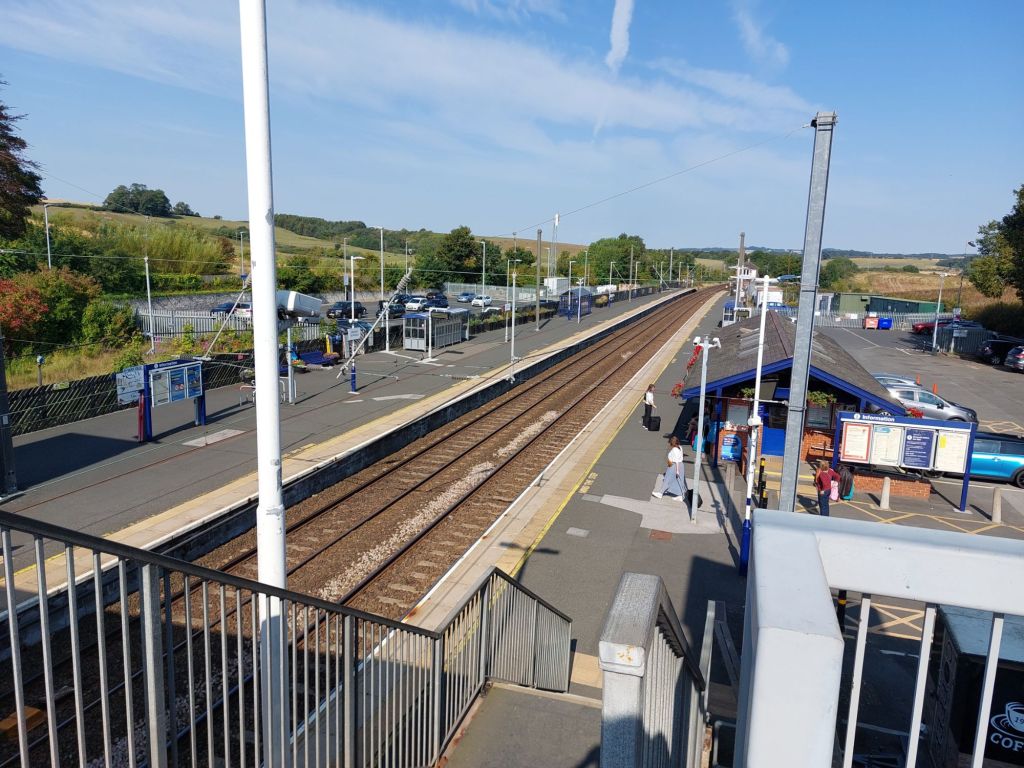
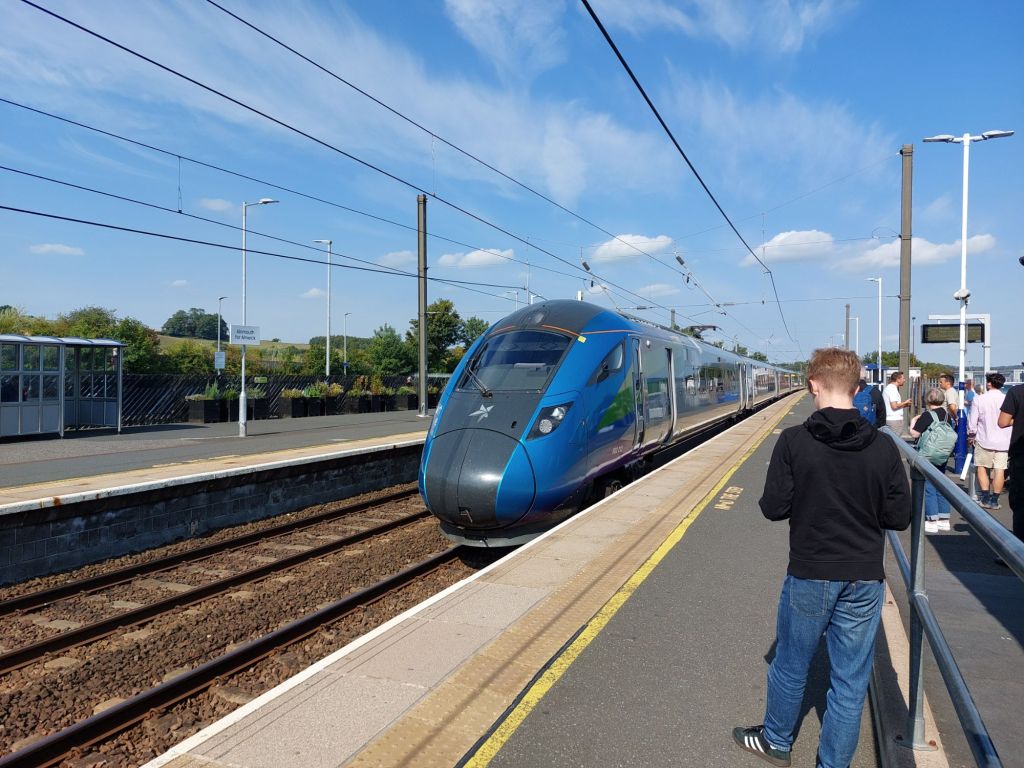
With an aim to taking photos/videos of this service, I travelled from my ‘home’ station at Alnmouth to Morpeth (in very glorious weather!) aboard the 10:47 TPE service 9N09, as operated by 802213, the aim being to ‘catch’ the railtour on the rarely passenger worked Morpeth North Curve, though sadly this didn’t work out on the day.
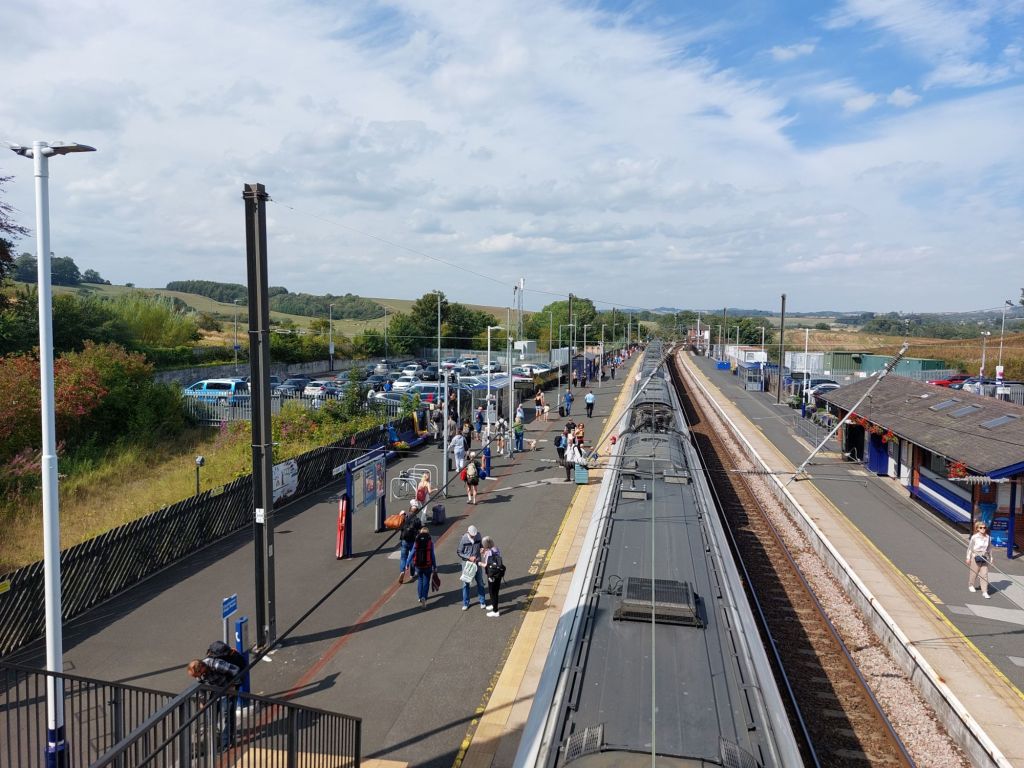
Glorious weather at AlnmouthTPE 802213 arrives at AlnmouthAfter arrival at Morpeth, making my way to Morpeth North Curve and seeing 802213 departing towards Newcastle
The departure from Alnmouth and arrival at Morpeth was two minutes late (11:02 rather than 11:00 exactly) but this allowed more than ample time to walk to my destination as the railtour was booked at Morpeth North Junction for 12:02, reaching Hepscott Junction at 12:04, so still almost an hour ahead of the scheduled arrival time.
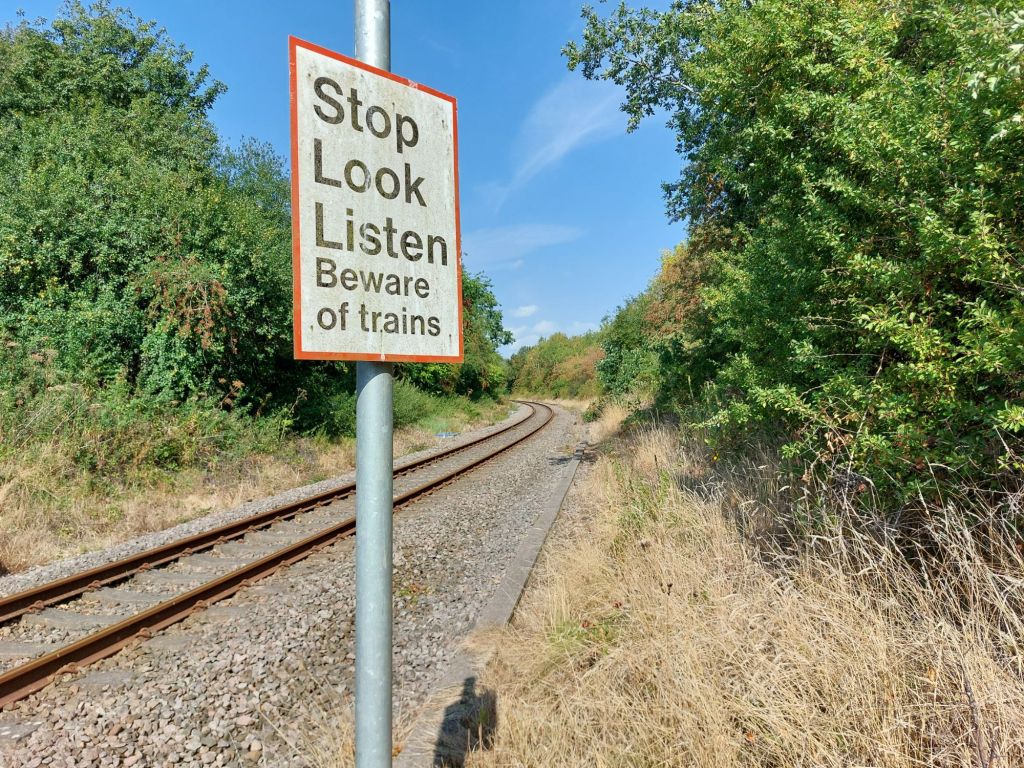
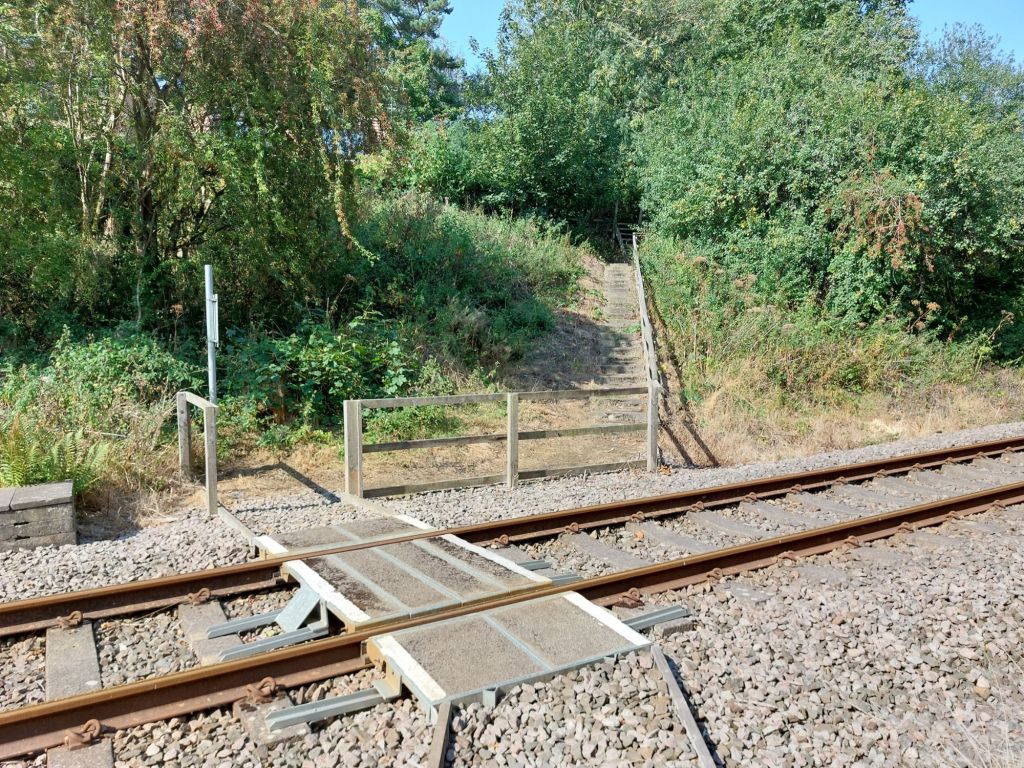
A short walk along Coopies Lane, Coopies Lane, and then onto Coopies Haugh brought me to the end of a footpath (w3w ///processes.unwound.barn), which leads to a foot crossing (w3w ///plea.refuses.shepherdess) over the Morpeth North Curve where I intended to view 1Z84 from at a safe distance on the approaches to this crossing.
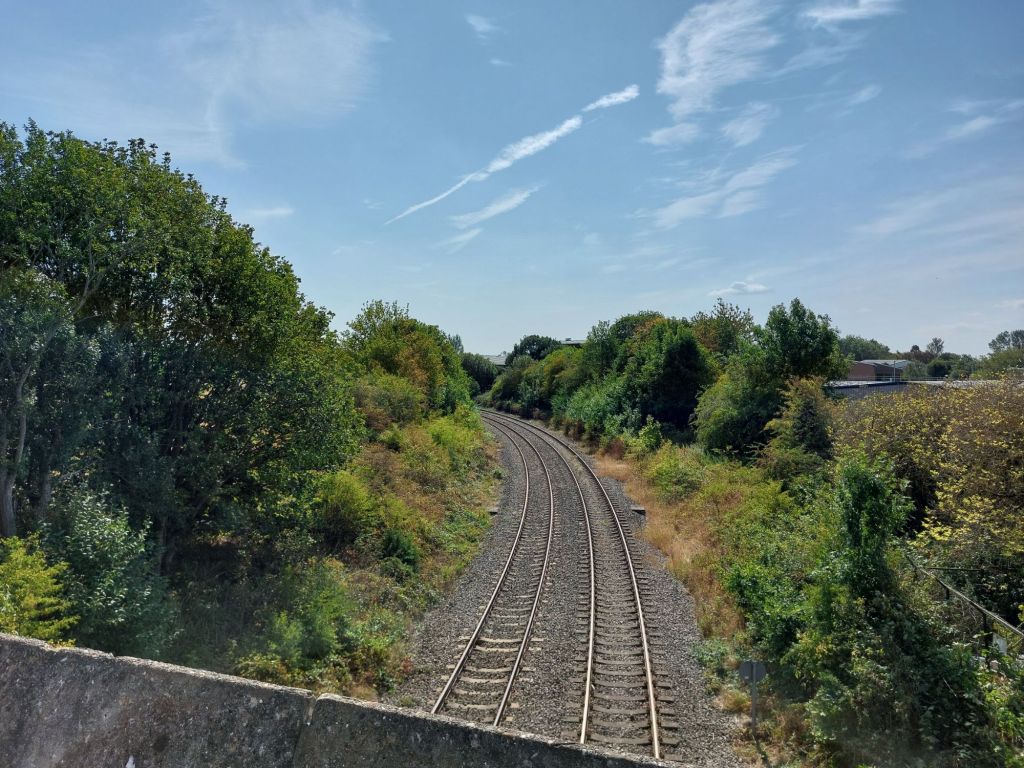
Concrete style towards the foot crossingThe crossing looking towards the ECMLThe crossing itself from the western side of the line looking towards Coopies Haugh and Coopies WayThe line towards Bedlington, Blyth and Newcastle via the Coastal route
… but unexpected problems lead to a late running railtour!
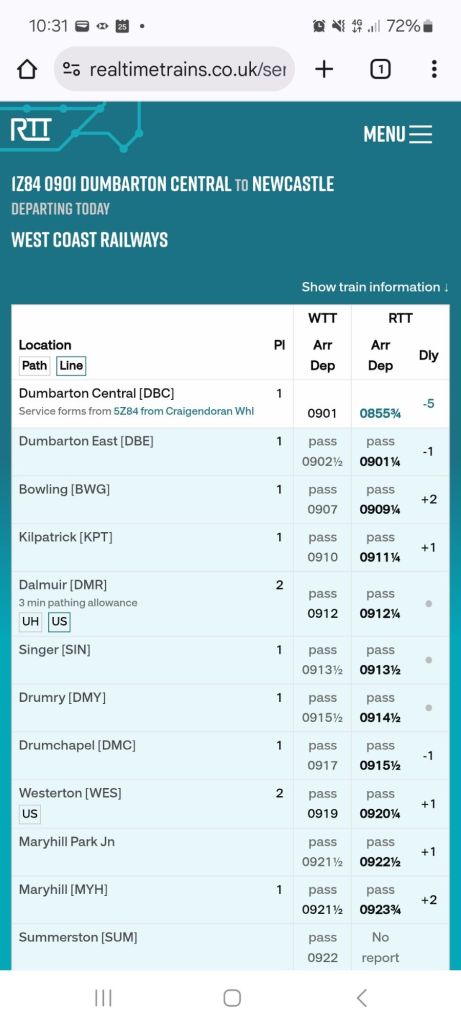
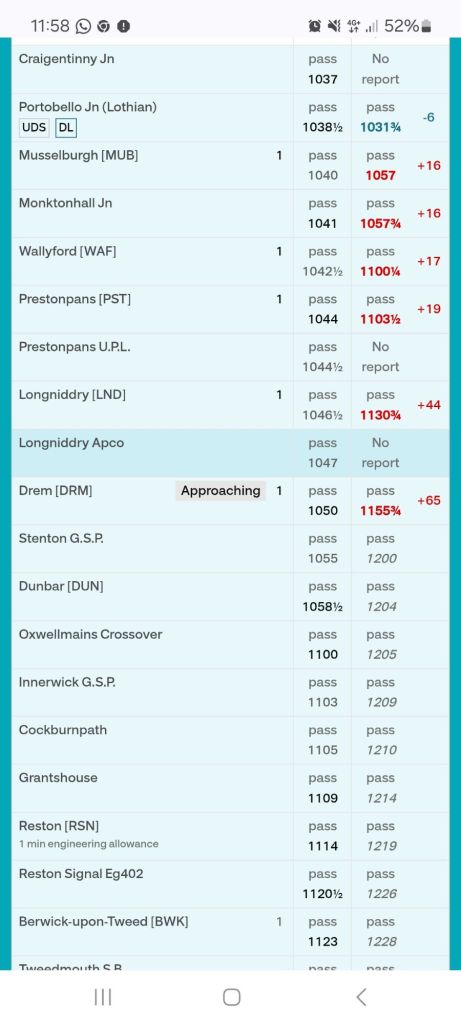
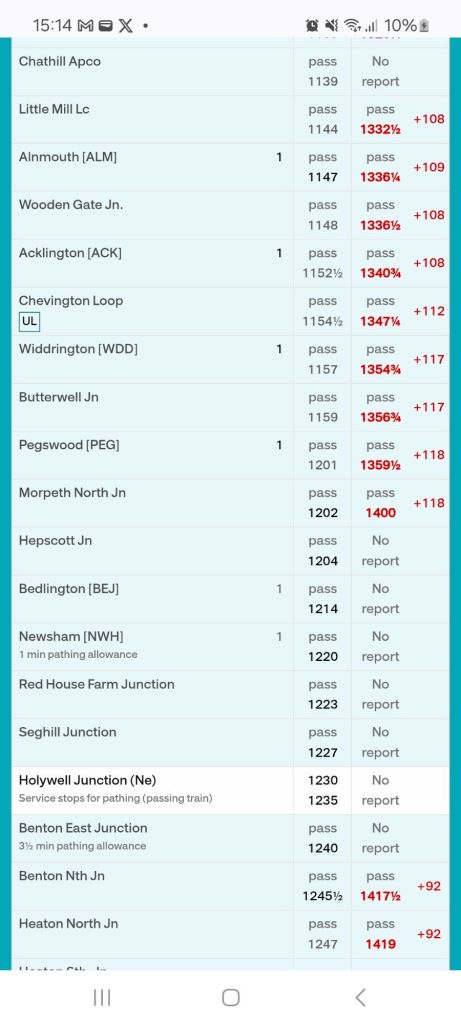
Once at the above foot crossing, the data from the excellent Realtime Trains website showed that things were going awry with the railtour, with information beginning to trickle through that the railtour was beginning to get delayed, and then more substantially so quickly.
It started well……but things started going wrong up in Scotland.
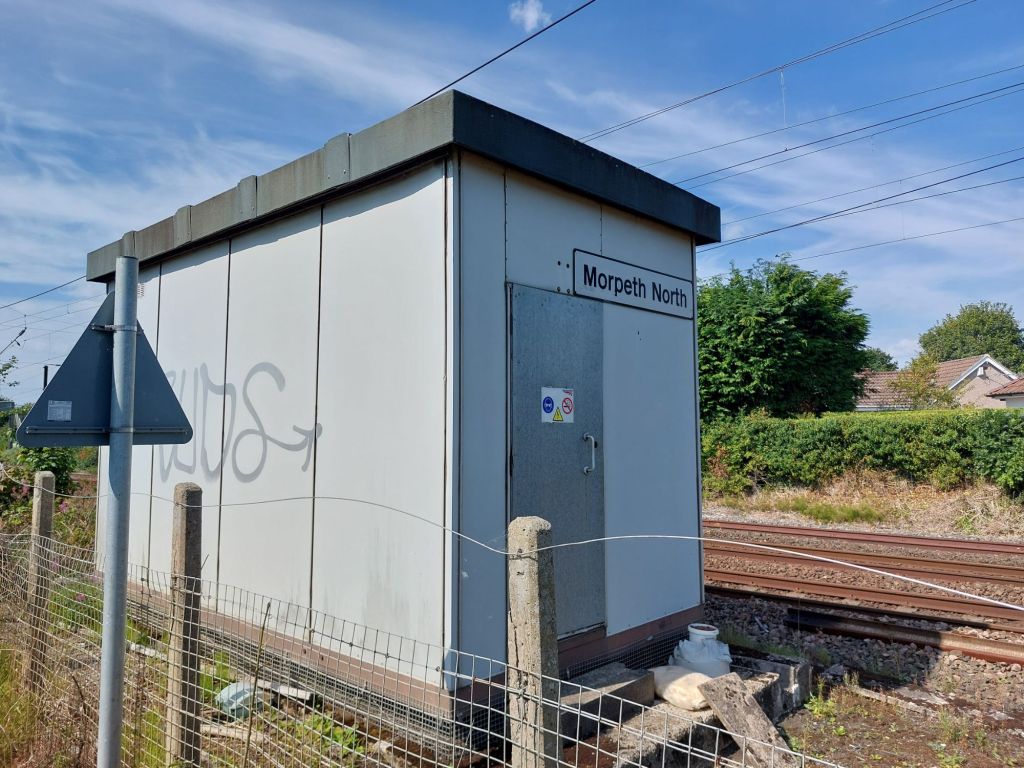
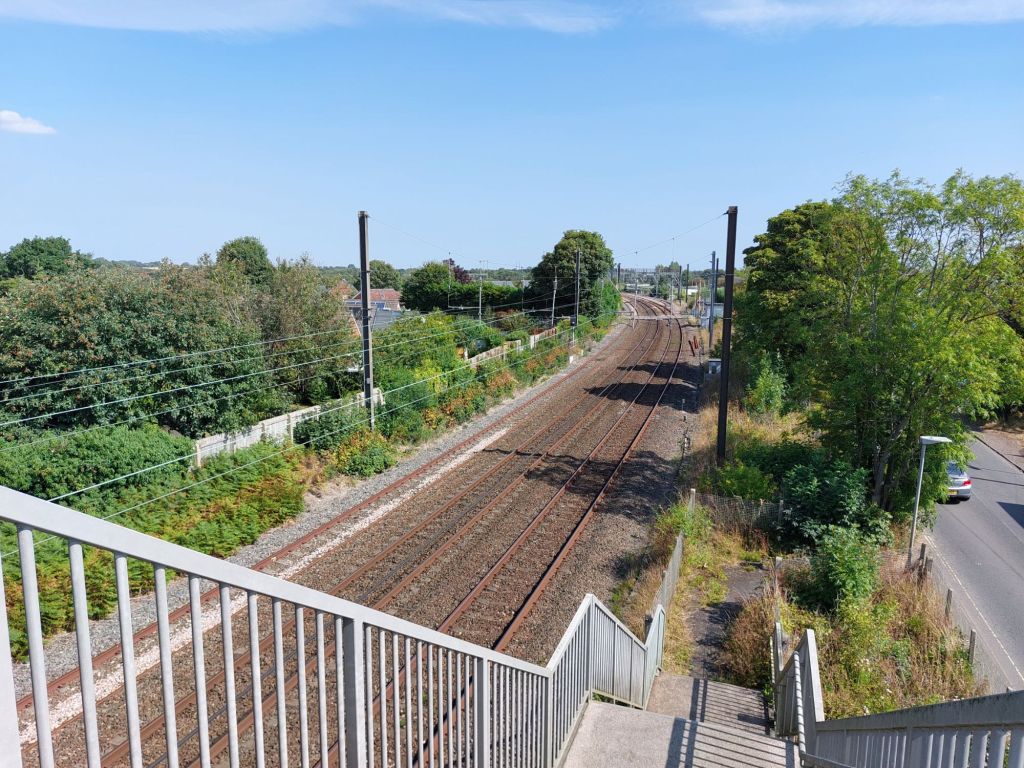
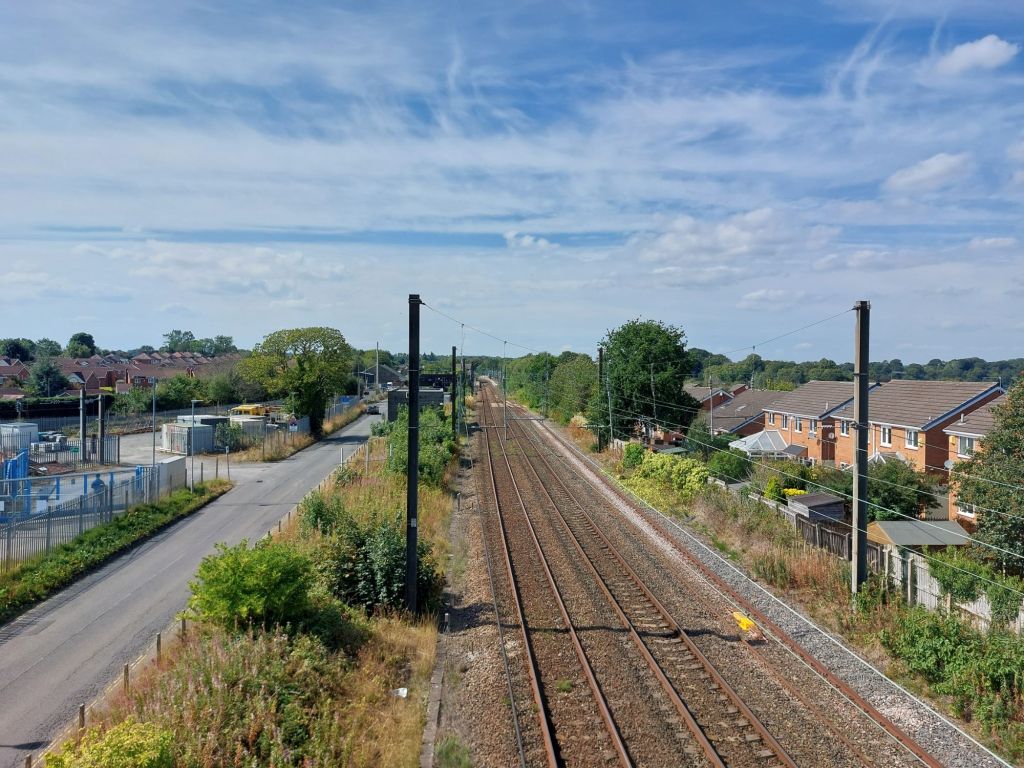
With my train back booked for 12:54 aboard the LNER service back to Alnmouth, and a family event to attend, I made my way back to the station via Clarks Bog, a nature reserve adjacent to the Morpeth North Curve, and over the bridge that takes Coopies Lane over the line (w3w ///encloses.stowing.loosens)
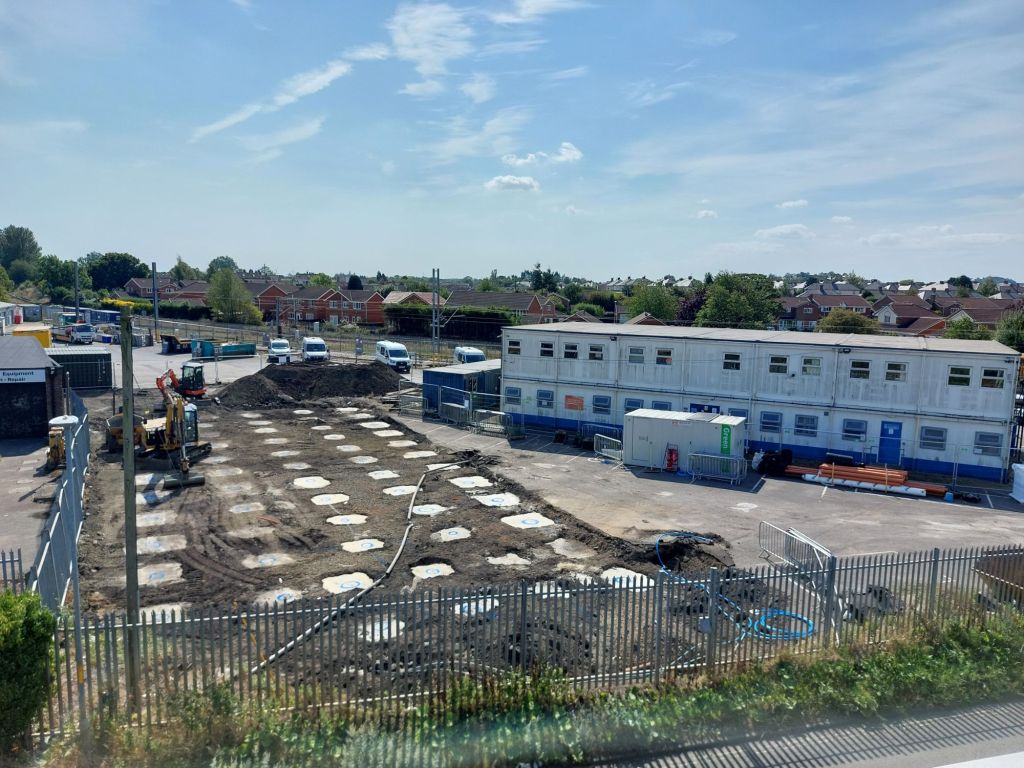
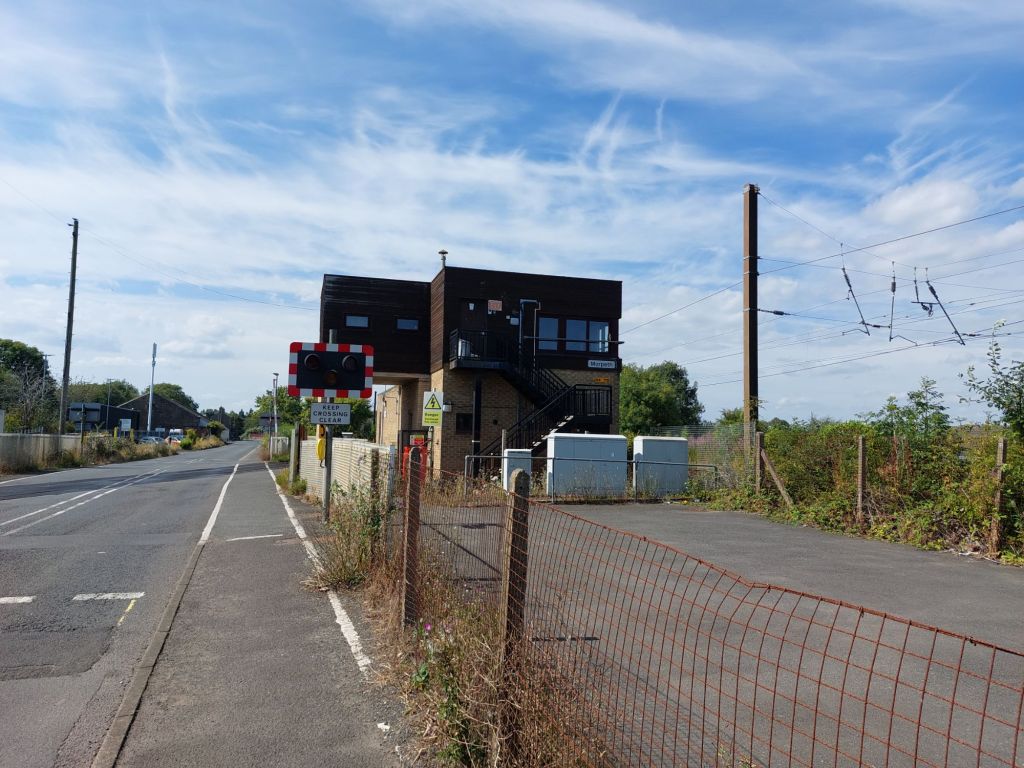
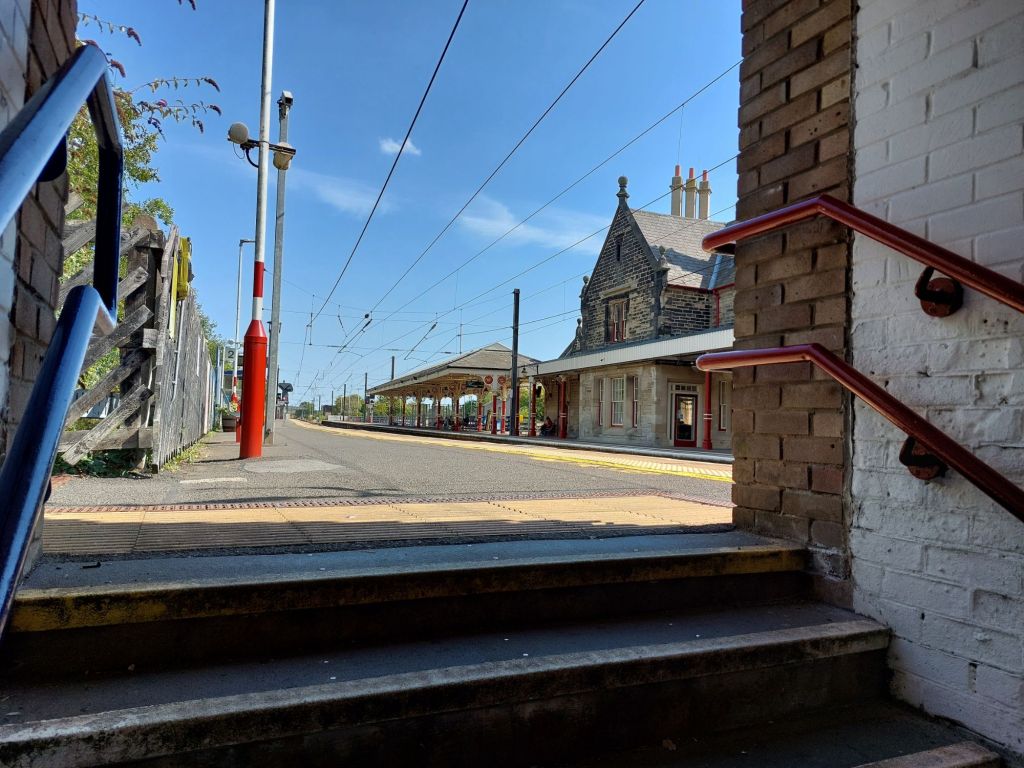
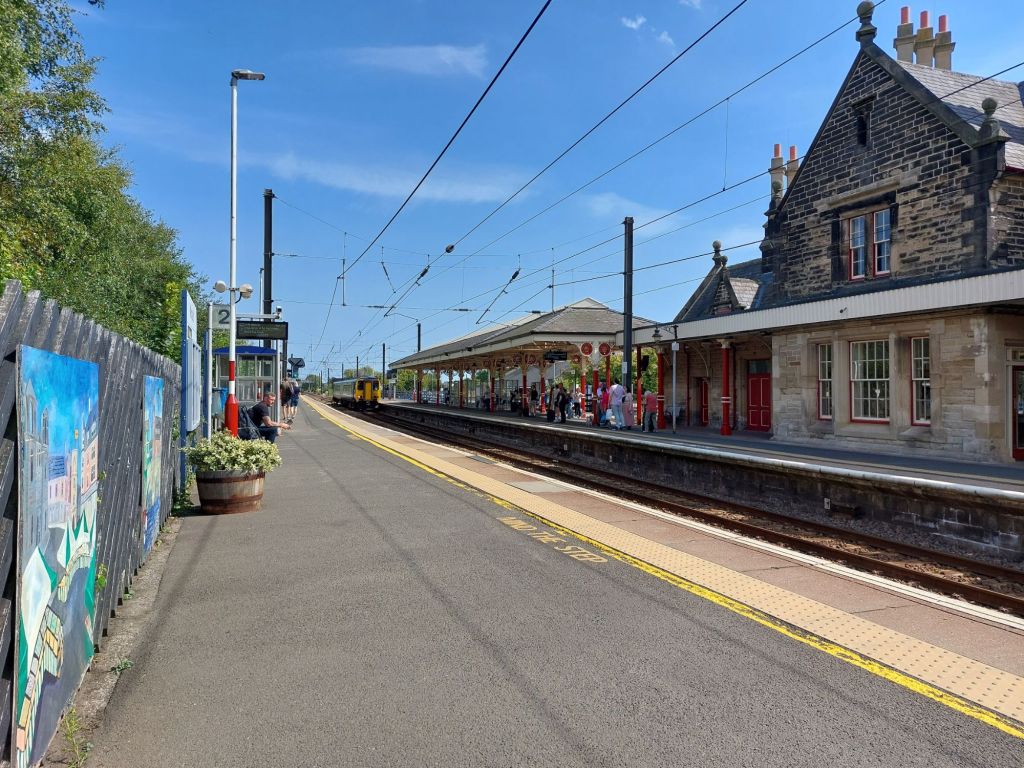
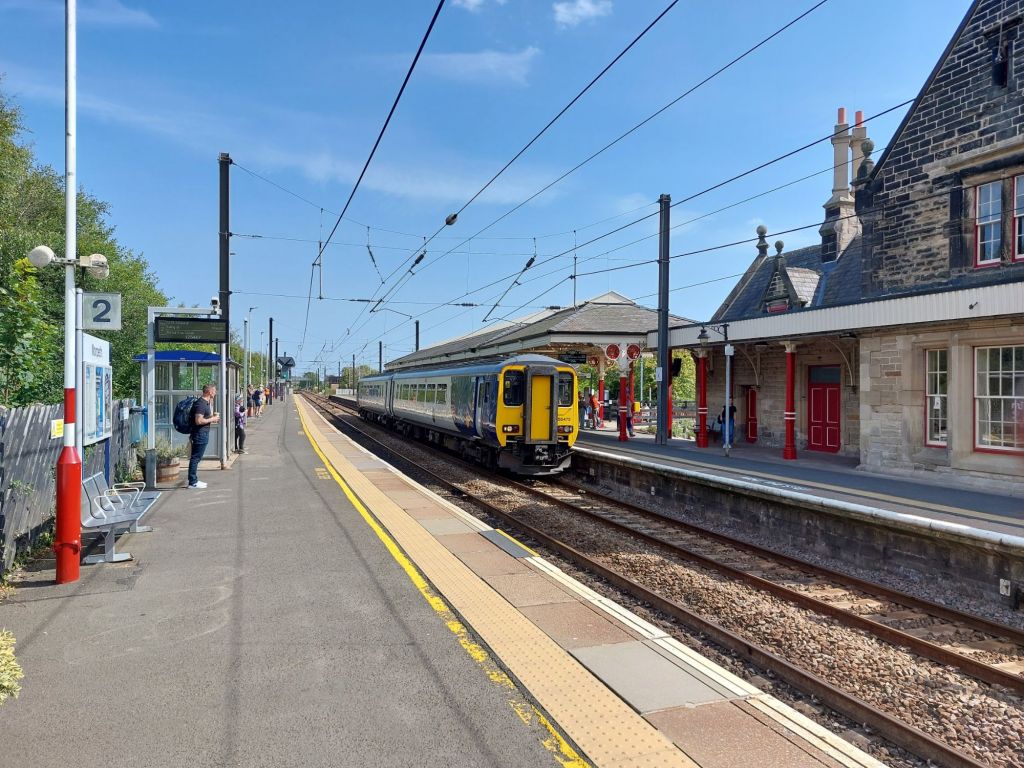
Looking towards the ECML from Coopies LaneTowards Bedlington from Coopies LaneStorage24 is nestled in the triangular space between the Morpeth North Curve, the ECML and Coopies Lane at Morpeth. Part of the lineside features on the ECML heading back towards Morpeth StationFootbridge over the ECML near Morpeth, looking northbound. Looking southbound at the same footbridge.Construction work in the Network Rail compound at Morpeth. Morpeth SignalboxMorpeth Station after some quick refreshments at the cafe, and a shoutout to the lovely staff within! Plenty of passengers waiting to board the 2A28 towards Carlisle worked by 156475A now well loaded 156 waiting to head off to Carlisle as 2A28My return train, the two minute late 12:54 LNER service towards AlnmouthAnother well filled service (I chose to stand due to well filled seats), with many disemarking at Alnmouth, arriving back at 13:09.
With the now heavily delayed 1Z84 now expected to pass Alnmouth around 13:30, I decided to simply catch it there instead.
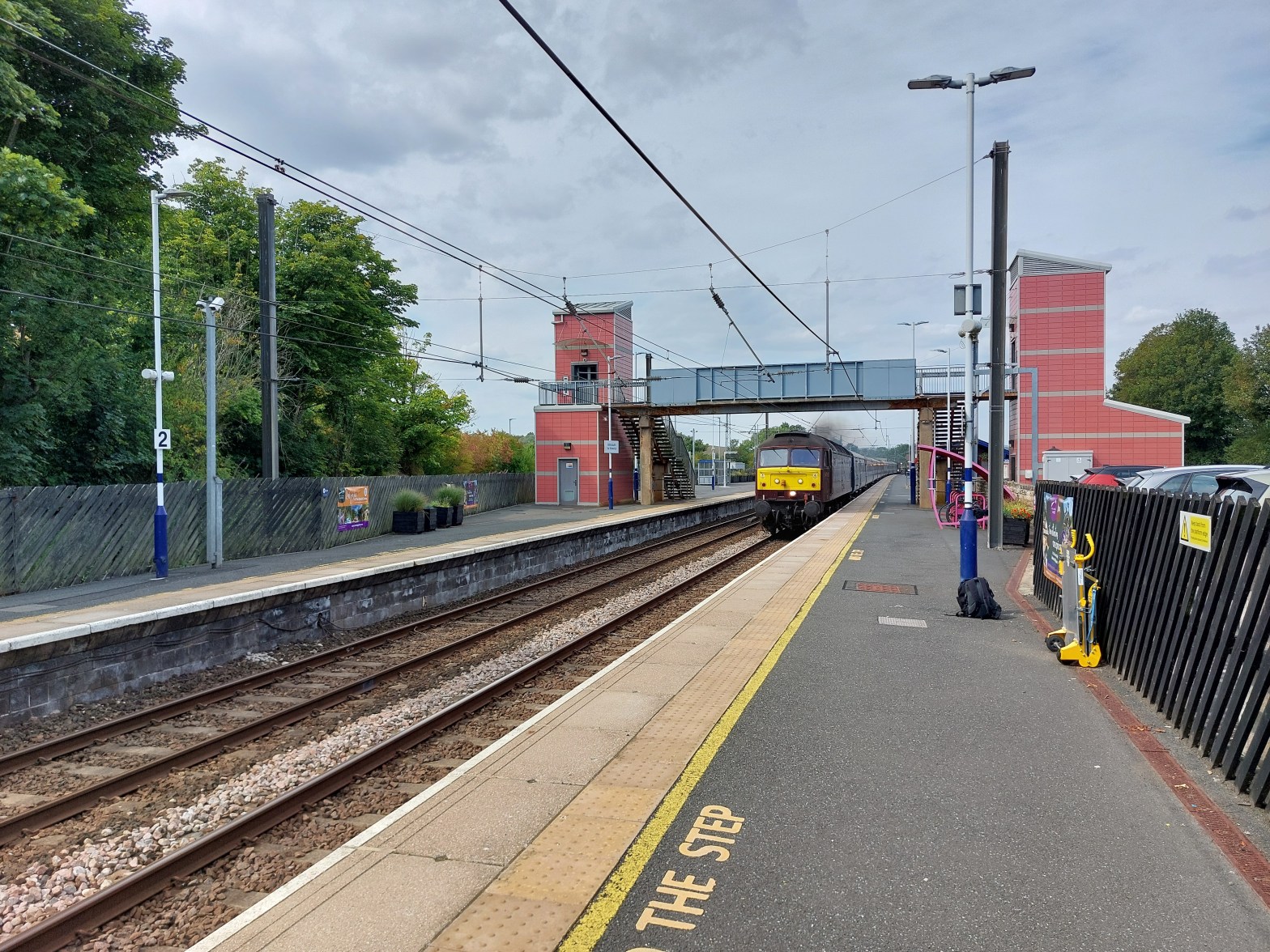
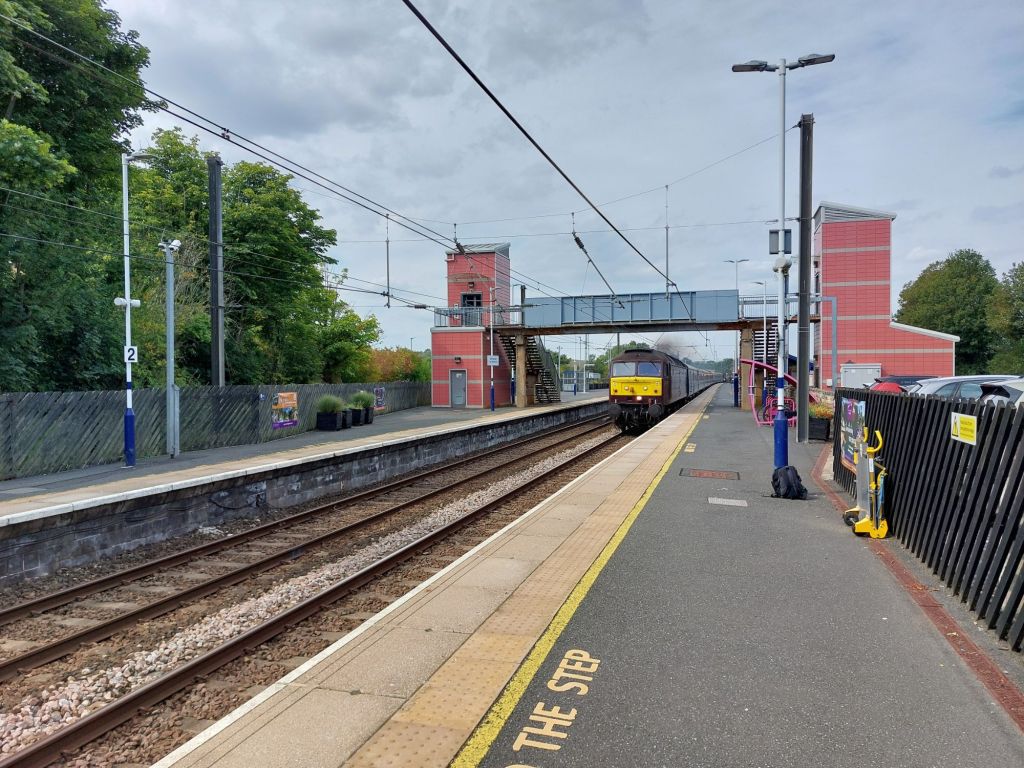
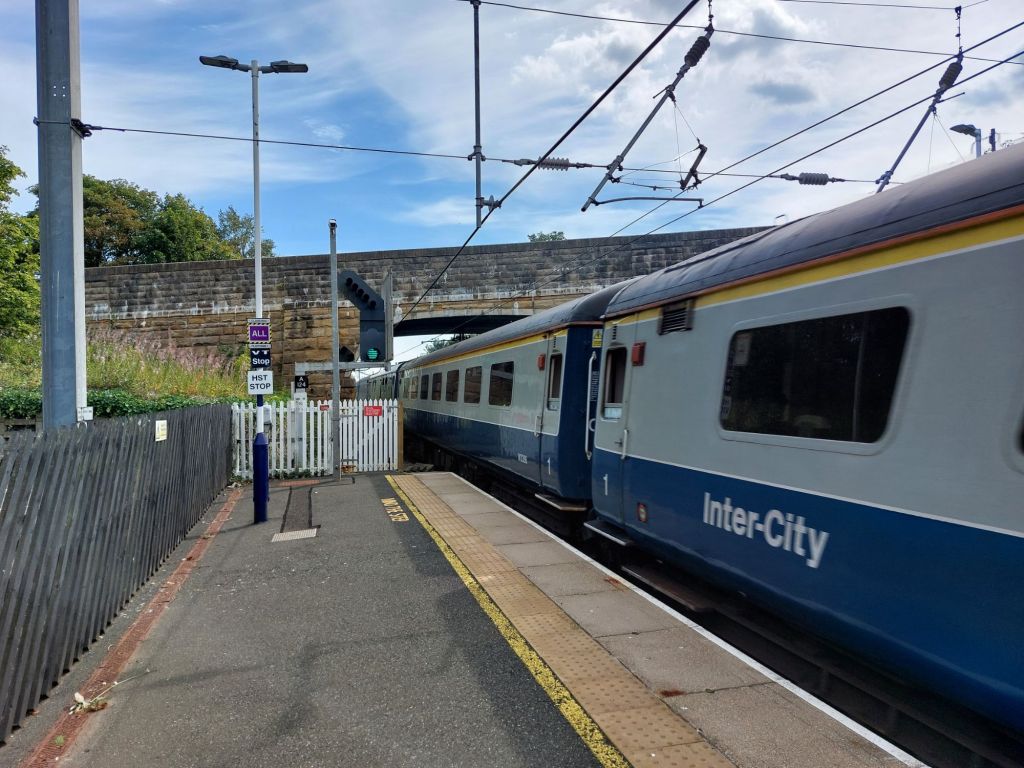
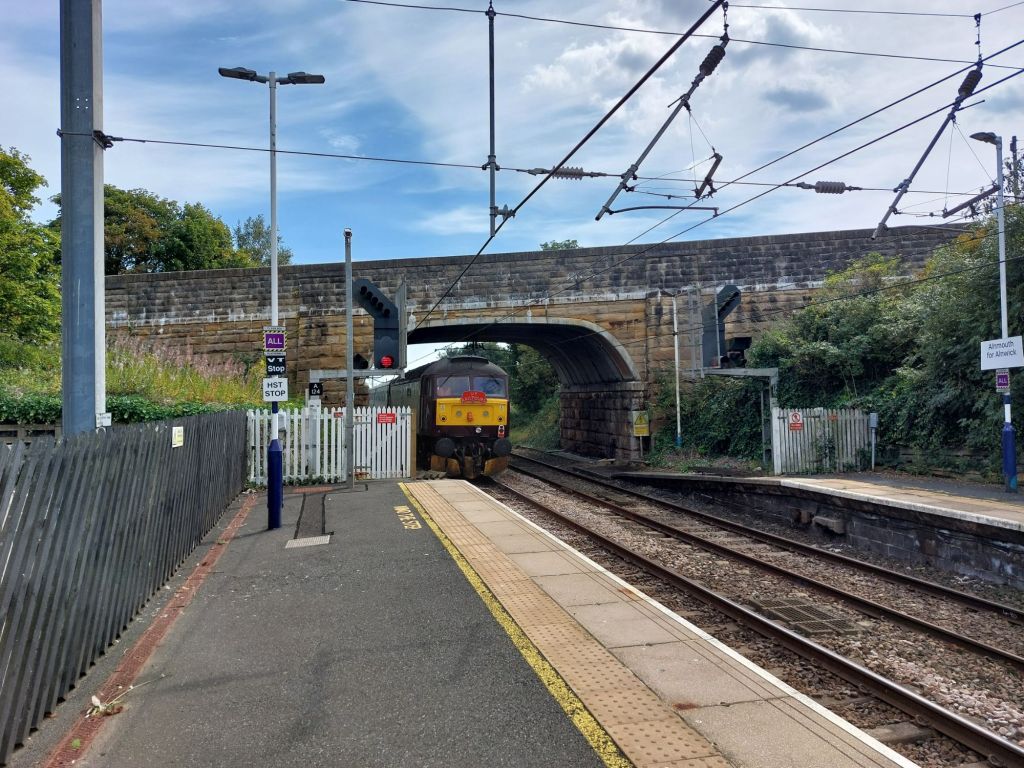
WCRC Class 47 roars through Alnmouth with the then 109min late railtour.
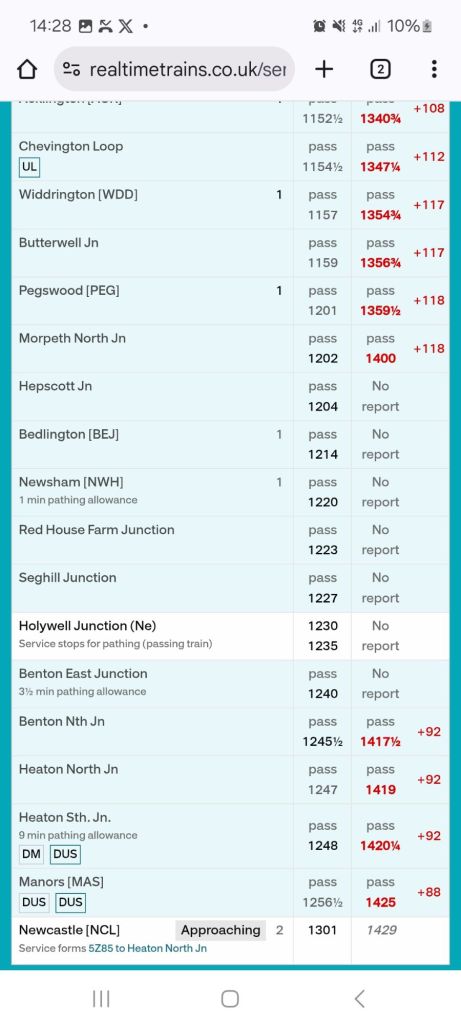
The cause of the delay is at present unclear, with some rumour than the locomotives on the railtour suffered issues, but also other trains in the area having traction problems, but by the time the railtour reached Morpeth North Junction, it was by the 118 minutes behind schedule. The decision was presumably taken by signallers to avoid going via Bedlington, and to make up time by going via Morpeth and Cramlington instead.
Late running of 1Z84 caught up by avoiding Bedlington and running via Morpeth and Cramlington.
The change of route allowed the recovery of 26 minutes, with the delay falling from 118 minutes late to 92 minutes late, with expected timetable for the route via Bedlington from Morpeth North Junction (12:02) to Benton North Junction (12:45½) expected to take 43½ minutes overall, compared to the 17½ of the route via Morpeth and Cramlington for this train (running at max of 95mph with a c.450ton trailing load).
Conclusions
Whilst the problems encountered meant that unfortunately the railtour didn’t actually run via Bedlington today, the planned timetable does offer some useful information for the proposed regular passenger service via this route (Newcastle – Bedlington – Edinburgh and vice versa).
30 minutes or less to go via Bedlington vs via Cramlington
The 26 minute difference in the route timings between Morpeth North Junction and Benton North Junction for example, demonstrates that the route is not an unduly long detour, with modern rolling stock such as the TPE 80x fleet allowing higher train performance, and potential to upgrade line speeds on the Morpeth North Junction to Bedlington Junction section, the running times over this loop, inclusive of stops might be capable of remaining below 30 minutes of additional time compared to the current route via Cramlington, and Morpeth stations.
Driver Knowledge and Route Resilience
In addition, the last minute change of route to run via Cramlington rather than Bedlington, in this case simply to make up lost time, shows the benefits of the driver knowing both routes; had the driver lacked the route knowledge of running via Cramlington, the train would have been restricted to the slower route, or might have been further delayed to await another driver or a route conductor to take the train over the alternative route.
In the event of a much larger problem, as demonstrated by the structural issues with Plessey Viaduct in October 2023, the knowledge of an alternative route could be invaluable, especially if a ‘normal’ route was to be closed for a substantial time (Plessey Viaduct could have been a total closure had damage been more extensive for example).
The use of electric only trains would be problematic due to the absence of wiring ‘on the loop’ at present, but a lot of rolling stock is still diesel or bi-modal, so the lack of wiring would not itself present an issue.
The main challenges would be rolling stock clearance and driver knowledge, but both of these problems could be resolved by routine running; stock clearance would be reasonable to ensure for a regularly run route, and driver knowledge would be gained and retained by using the route routinely for passenger services.
Economic gains
The major justification for a rail service via the Northumberland Coast Loop is the potential economic gain for towns such as Bedlington and Blyth, as well as wider areas such as North Tyneside from the provision of direct rail services to as many places as possible.
It is well known that communities which are better connected by rail tend to thrive economically, Morpeth for example does very well from the wide range of services that call there, with great links to Newcastle, Edinburgh, and Carlisle, as well as many other towns and cities, but shouldn’t far larger towns on the Northumberland Line also see a similar range of destinations become available, even if operated at a lower frequency?
A quick reminder of the railtour over the Northumberland Line is around noon tomorrow (12:00 Monday 25th August 2025), operated by West Coast Railways, and will take the proposed southbound Northumberland Coast Loop route (Edinburgh to Newcastle Upon Tyne via Bedlington).
Will be great to see photos/videos of this service if you can get out and catch it!
A railtour running via the proposed southbound Northumberland Coast Loop route (from Berwick Upon Tweed , through Pegswood and Bedlington, then to Newcastle Central) has just had timings released on Realtime Trains, please click the link below for further information:
This is a railtour operating southbound, so in the opposite direction to ‘The Seven Counties Rambler‘ back in March, with the added bonus of running in broad daylight rather than darkness too.
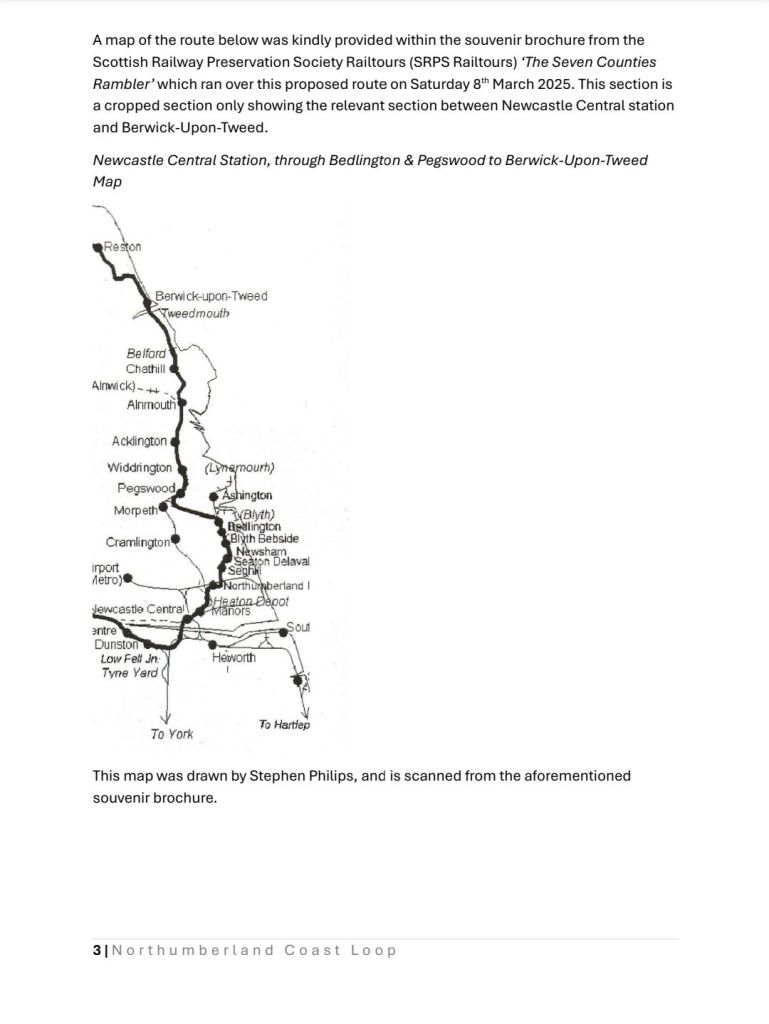
Route map taken from the Souvenir Brochure of the SRPS ‘The Seven Counties Rambler‘, showing the route of both railtours via the Northumberland Line
The expected departure from Dunbarton is at 09:01, to begin the journey south.
The train is due to pass Alnmouth at around 11:47, the railtour will then leave the East Coast Main Line at Morpeth North Junction at approx 12:02, pass Bedlington at around 12:14,pass Newsham at around 12:20, then arrive in Newcastle Central at approximately 13:01. Please note these timings can be subject to change, the information shared here is only for those interested in potentially taking photos/video of the train as it passes.
If you do happen to capture it, I’d be delighted to share photo’s/links to videos (i.e. YouTube) on this blog, so please get in contact via our social media pages to arrange if you’d like to share your content.
For this campaign, a particularly interesting site for photographs/video/drone footage to be captured, if possible, would be the train traversing the Morpeth North Curve, which is the line passing from Temples Bridge (w3w: ///insects.hamsters.issuer), under the Coopies Lane bridge at (w3w: ///encloses.stowing.loosens), then under the A196 at (w3w: ///driftwood.clerk.pupils), to Hepscott Junction (w3w: ///worms.blending.cans). Again please share a link to your content if you manage to capture this! Similarly, along the route between Morpeth North Curve at Bedlington would also be much appreciated!
Thank you to all who have signed the petition so far, and a special thanks to the 21 of you who’ve helped to promote the petition, with £94 donated so far on Change.org to help the petition to reach more people!
However if you can’t chip in, please just share with friends and family, via WhatsApp, your own Facebook wall or any other means such as email if you can, it’s free, but goes a long way to highlighting the campaign to more people and hopefully seeing the service introduced!
This shows the continued and increasing support for the route to become established, which hopefully will come soon after the completion of stations in late 2025/early 2026.
The next major milestone for the petition will be 1000 signatures, which will hopefully be reached quite soon, but the petition will remain open until a service is started over the route.
Railtour expected over the Northumberland Coast Loop: 25th August 2025
Starting from Dunbarton, then running through Edinburgh Waverley, and down the East Coast Main Line (ECML), before curving off the mainline at Morpeth North Junction, heading towards Bedlington and then heading south along the Northumberland Line towards Newcastle.
The last railtour over the proposed N.C.L. route (on which I was a passenger), was ‘The Seven Counties Rambler‘ operated by SRPS Railtours on 8th March 2025, with 171 days between these two railtours.
As of yet, exact timings and traction for the UK Railtours train on Monday 25th August is not known, but should be uploaded soon to websites such as Realtime Trains once released, and will also be shared here.
If you can, please try and grab a photograph/video of this railtour (please do so from a position of safety, NEVER trespass on the railway for any reason), and if you’d like them featured/shared on this blog/our social media, please send them via the Facebook page or via X (Twitter).
For 37 years (1988-2025) the humble four wheeled PCA waggons have taken alumina (a powder created from Bauxite ore) from the Port of Blyth terminal to the smelter in Fort William, Scotland (and also whilst open, the smelter at Lynemouth).
Somewhat famously, these waggons were for a short time hauled by Deltic 55022 ‘Royal Scots Grey’, with a YouTube clip set to the theme music for the 1971 movie Get Carter (some scenes filmed in Port of Blyth) you can view here: https://youtu.be/qYimjSWXEHE?si=PFxSEqP6cJD9SuUC
Still known locally as the ‘Alcan train’ from the long-standing former operator of the Smelter and branding on these waggons for many years, under Alvance these small four-wheelers have finally met the end, and will be presumably mostly scrapped on Sunderland Docks in the near future, though hopefully one or two might be saved for preservation.
On a happier note, this isn’t due to the end of the Alumina traffic from Port of Blyth to Scotland, it is simply that the wagons are being replaced by more modern and larger wagons.
In those 37 years, the PCA fleet of waggons has covered in excess of 50 million miles, equivalent to 2000 laps of the globe, 105 return trips to the Moon, or getting halfway to Mars, so they’ve certainly earnt their keep!
End of the line for the PCA’s, but a start soon for Passenger Trains?
The route of the ‘Alcan’ train, leaving Port of Blyth, reversing in the Furnaceway sidings at Bedlington (on the Northumberland Line), before heading west, towards Hepscott, taking the Morpeth North Curve to join the East Coast Main Line, and passing through Pegswood, Alnmouth and Berwick bound for Scotland.
This freight route perhaps highlights the existing infrastructure that could provide an immediate uplift to the Northumberland Line in permitting a direct route to North Northumberland and into Scotland by using this lesser known rail route for passenger services?
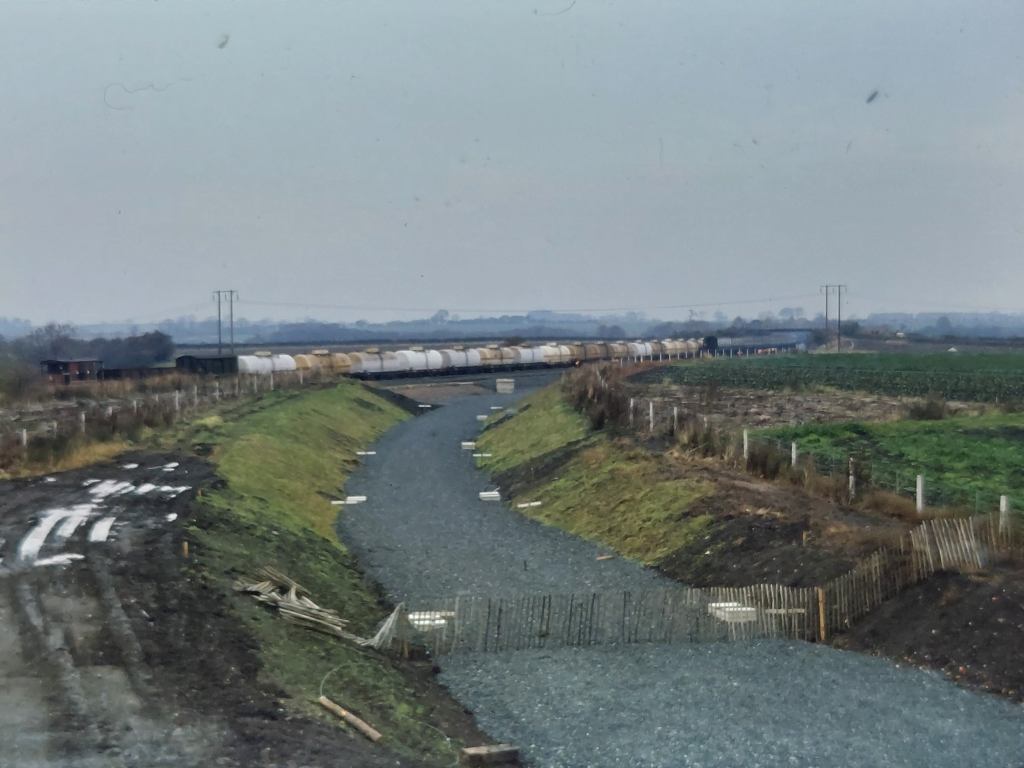
Construction of the Morpeth North Curve in c.1979, photo by P. Kirkland.
This curve from Hepscott towards Pegswood direct has only existed for about 45 years, very modern in contrast to most of the rail network, and has been mostly, but not always, been used for railfreight as by that time, the ‘Blyth and Tyne’ hadn’t carried passengers routinely for 16 years (with stations such as Bedlington, Bebside, Newsham etc. closing in 1964).
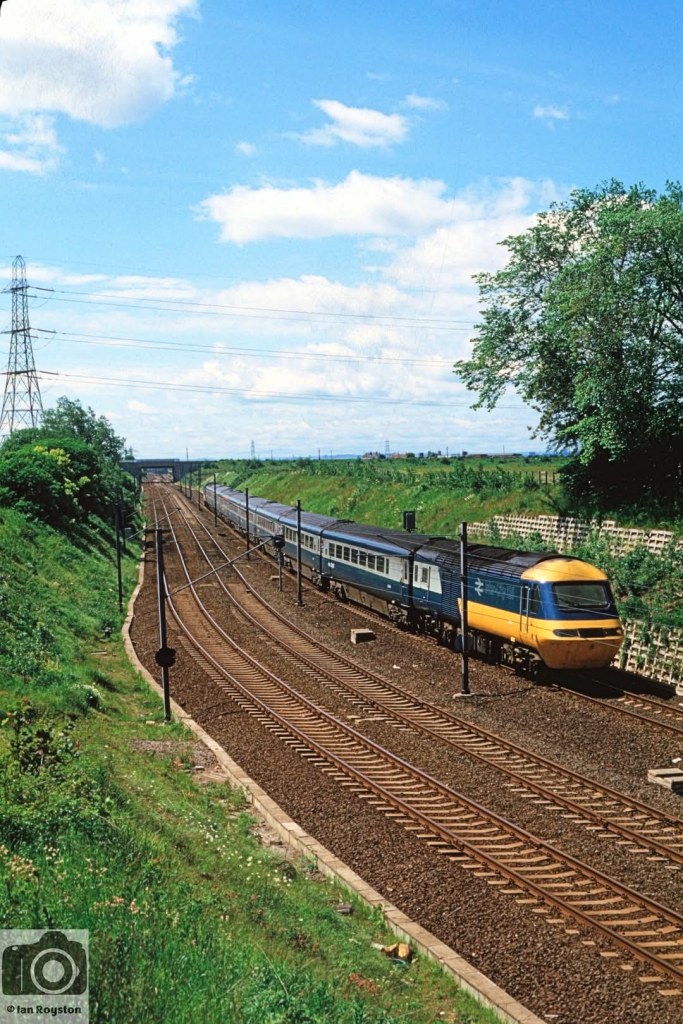
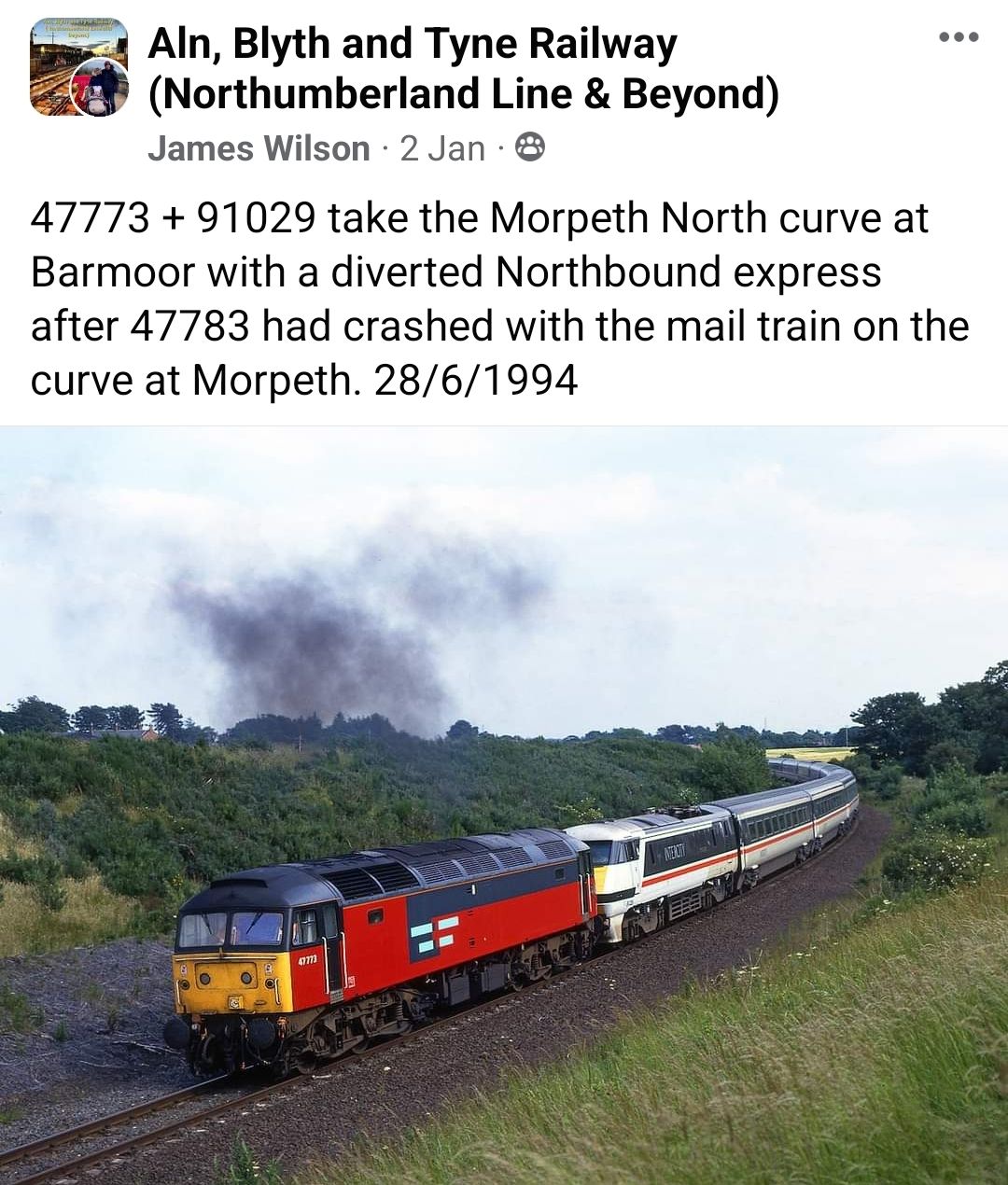
HST diversion over the Blyth and Tyne lines in the British Rail era, photo by Ian Royston. Photo showing a ‘drag’ of a Class 91 Electra by 47783 in 1994, photo by James Wilson
The above photos show examples of diverted trains in the 1980’s/1990’s using the then freight only route, but this has also been done by a number of railtours too.
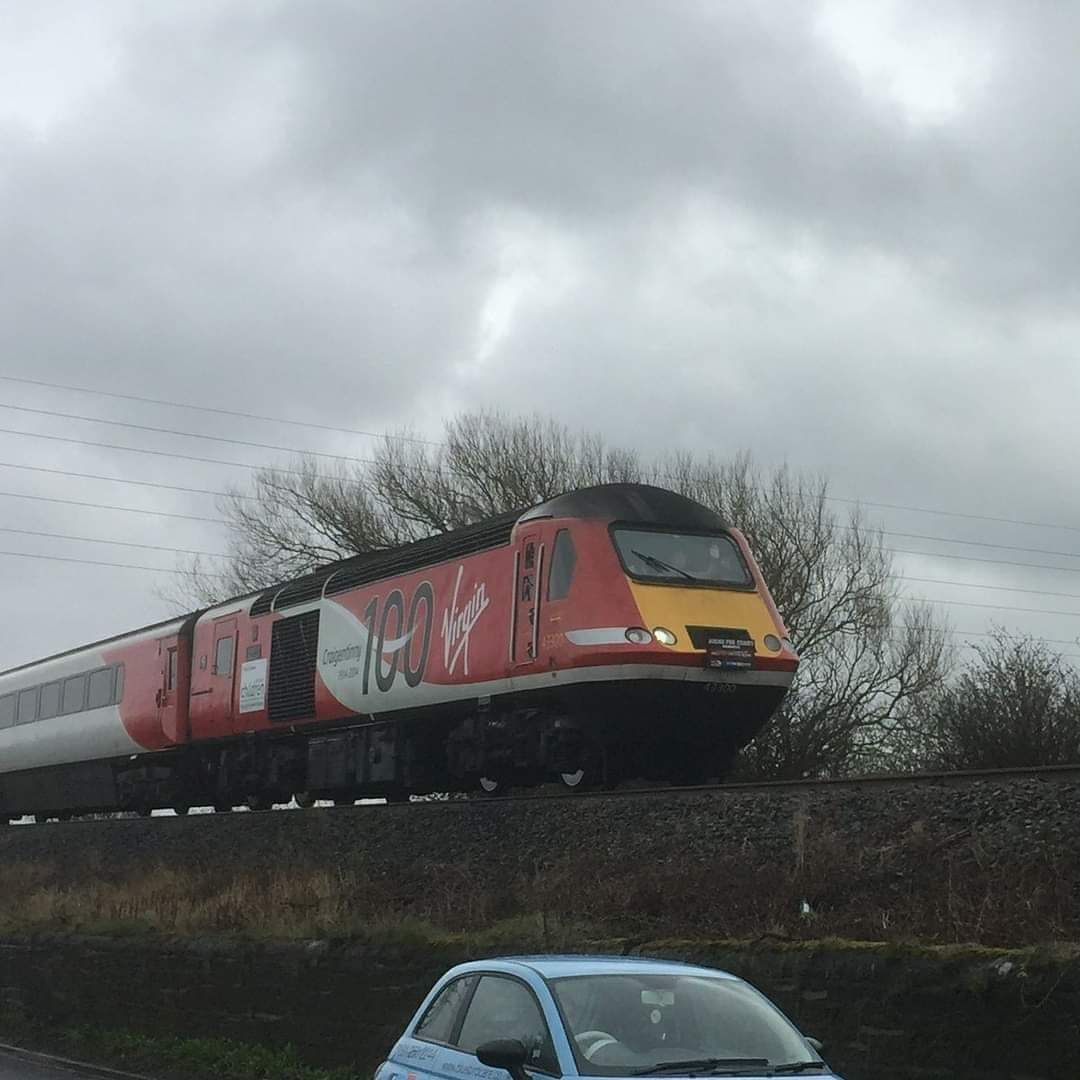
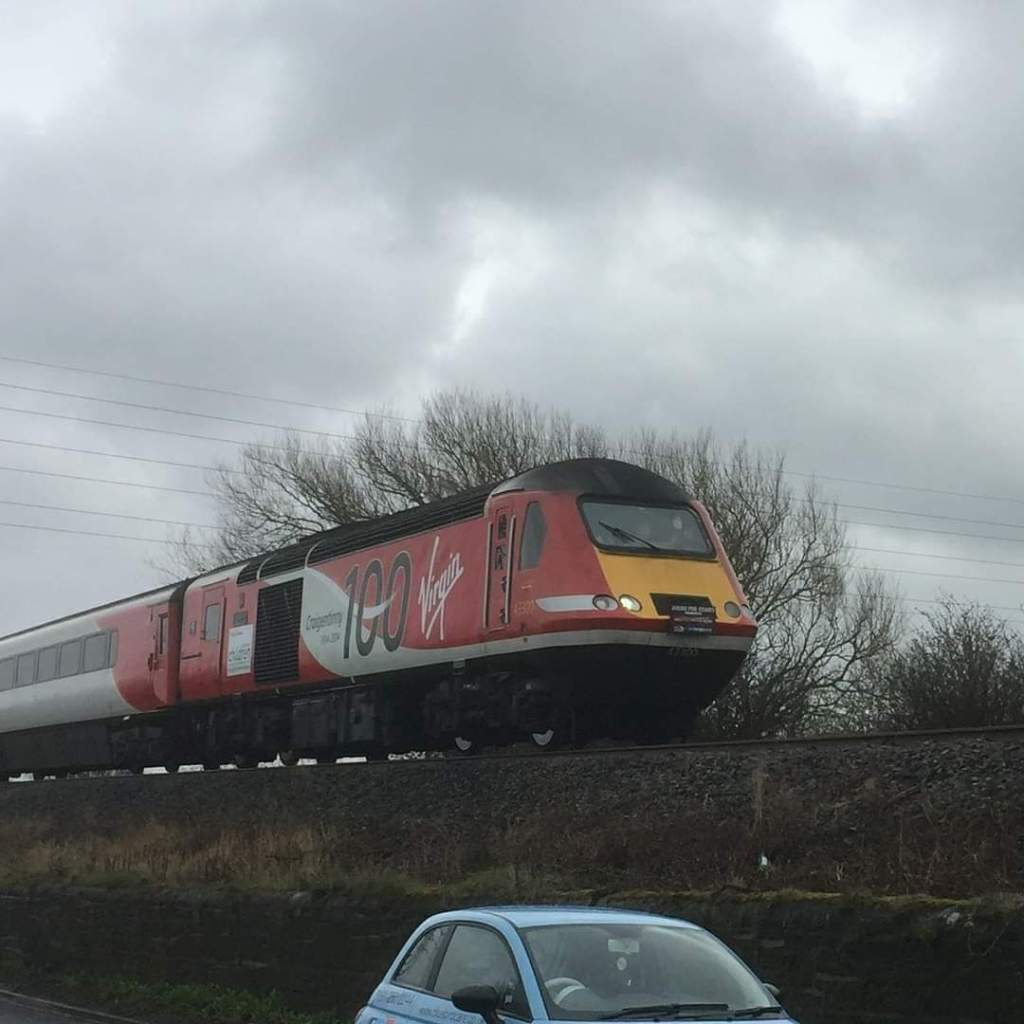
The ‘Bound for Craigy’ Railtour of 2017, photo by R. Hogg
It is interesting to speculate that an alternative universe, and if stations had survived, it is probably highly likely that with the Morpeth North Curve being built, the area served by the Northumberland Line would likely now have the proposed Northumberland Coast Loop services up and running already.
With the Northumberland Line recently announcing 500,000 passengers, less than a year after opening, there is clearly a huge demand for rail travel in the area, and while Newcastle and destinations beyond is clearly a principal major flow, there is almost certainly a strong demand to head north into North Northumberland and Scotland, with places such as Alnwick, and Berwick being popular ‘day out’ destinations from towns like Blyth, as well as connections into Scotland.
Our petition for this route now stands at a strong 854 signatures since its launch in February, and 1000 signatures likely to be reached before Blyth Bebside station opens, lets hope that this potential expansion of passenger services can be considered as a ‘next step’ for the Northumberland Line?
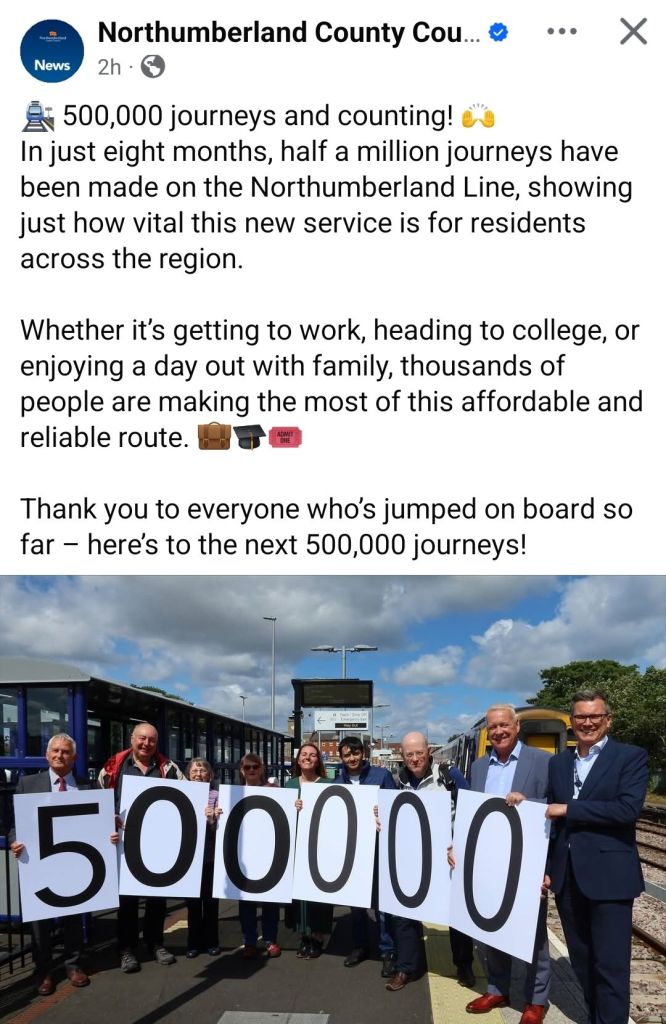
A recent announcement from Northumberland County Council puts the passenger use of the Northumberland Line at 500,000 since opening in December 2024.
Facebook update for the Northumberland Line 5.8.25 by Northumberland County Council
This is fantastic news for the reopening scheme, which has achieved this half million passenger figure despite still only having three of the six planned stations open as of today, with Ashington, Newsham, and Seaton Delaval serving passengers, witb Bedlington, Blyth Bebside, and Northumberland Park yet to be completed and opened for traffic.
Completion of Stations and Service Expansion?
The next station due to be completed is Blyth Bebside station, an announcement on which will hopefully be made soon as opening is anticipated for late summer/early autumn 2025; Bedlington, and Northumberland Park are now not due to open until early 2026.
Seeing these stations completed will be fantastic for the Northumberland Line, but given the huge popularity and success of the route, thoughts should also be focussed on the next phases of the route to expand it and serve more places.
Northumberland Coast Loop proposal, using 5 of the 6 Northumberland Line stations (all except Ashington), and offering a connection northwards onto the ECML via Bedlington and Pegswood.
The Northumberland Coast Loop could be an obvious ‘next step’; unlike the proposal to head to Newbiggin, where track has been lifted for decades, the line from Bedlington to Pegswood via Choppington has been in regular use several times per week for the North Blyth to Fort William ‘Alcan’ freight train, as well as it’s past use for coal trains bound for Blyth Power Station/Port of Blyth until this traffic ceased, and for occasional diversions around Morpeth as and when required.
While this route has never before had a passenger service, due to only being completed in its present form c.1980, 16 years after passenger trains on the old ‘Blyth and Tyne Lines’ ceased in 1964, the reopening of stations has changed that situation dramatically, meaning a route between Newcastle and Berwick/Edinburgh via Bedlington would now have stations to call at.
This route would vastly improve public transport connectivity in Northumberland, giving faster, more direct rail connections between the large population centres in the south east of Northumberland and settlements/visitor attractions in the north of Northumberland.
A petition on Change.org to support this route now has 852 signatures, showing the high level of support this proposal has gained over the last couple of years that it has been put forward.
A recent article from The Chronicle ‘Upgrades to two notorious A19 roundabouts would cost up to £775m’ has shed some light on the vast costs of upgrading the Seaton Burn junction of the A1 and A19, alongside the A19 and A189 interchange at Moor Farm, with Option A (fully grade separated junctions) coming at a cost of approximately £775m. The cheaper option E (the only one with a positive benefit:cost ratio, meaning it would generate an economic return on investment, the others would be loss making), with altered kerb lines, better signage and road markings would cost £300m, about the same as it cost to reopen the 18 miles of track for the Northumberland Line and open six stations along its length, and had a clear positive benefit:cost ratio of 1.5 (meaning for every £1 spent, £1.50 in economic gain is expected in return).
Proposed £800m to £1,275m spend for A1 & A19 roads in Northumberland?
Together with the long proposed dualling of the A1 between Morpeth and Ellingham, recently costed at £500m, means that an expected spend on just two roundabouts and 13 miles of dualling in Northumberland could cost between £800m and £1,275m for both schemes (A1 dualling and A19 roundabouts) combined.
Roads are, however, only one mode of transport, and surely the alternatives to road transport should also be considered, especially as these schemes are near to existing passenger railways that are already busy and popular routes, which would certainly benefit from further enhancements, so could the money be better placed by improving the railway and leaving the roads as they are now?
The A19 north of the Tyne and its connection to the A1 is largely mirrored by the proposed Northumberland Coast Loop (N.C.L.) which passes below the A19 at Holystone, with Northumberland Park station almost inmediately adjacent to this road, and Seaton Delaval station close-by to Moor Farm Roundabout.
The connection of the N.C.L. back onto the East Coast Main Line (ECML) at Morpeth mirrors the connection of the A19 and A1 at Seaton Burn, with the option to head both north and south using Morpeth North Junction and Morpeth Junction (crossing Coopies Lane near Morpeth station respectively).
With a very similar rail and road layout, there is perhaps a unique opportunity to compare them side by side for relative cost vs benefit.
Comparing rail and road options
Please note that these are simplistic approximations based on the overall cost of the Northumberland Line at £298.5m, at 18 miles in length, with six new stations, hence decimal values for stations.
At the low end figure of £800m (A1 dualling + Option E), that would be equivalent to 2.6x the Northumberland Line, or a similar freight railway 48.6 miles in length being reopened for passenger traffic with 15.6 stations along its length.
The high end figure of £1,275m (A1 + Option A) would be equivalent to 4.2x the Northumberland Line, upgrading a 75.6 mile long freight line with 25.2 stations along its length.
As can be seen from the above calculations, every £1 spent on rail gives you more than the same £1 spent on roads, especially considering almost all rail projects have a far stronger benefit:cost ratio compared to road schemes that tend to be loss-making.
Northumberland Coast Loop rail route a better option than A1 dualling and A19 roundabout rebuild for £800m to £1,275m?
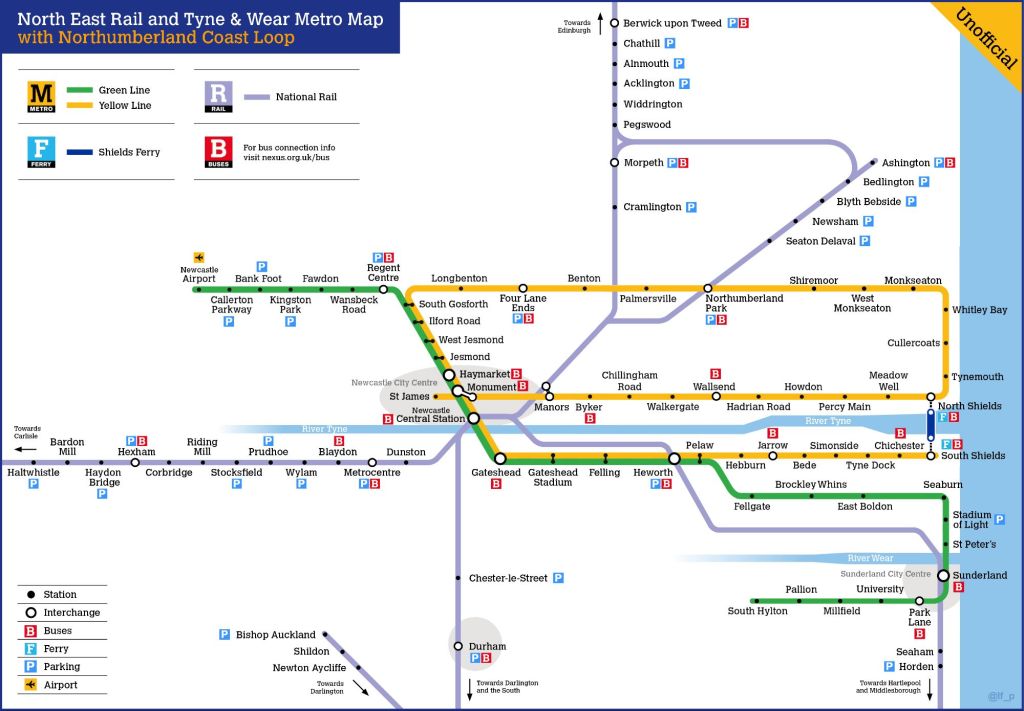
The proposed route of the Northumberland Coast Loop between Newcastle-Upon-Tyne and Berwick-Upon-TweedRail and Metro Map surrounding Newcastle Upon Tyne, the Northumberland Coast Loop would start at (or pass through) Newcastle Central, head north east along the Northumberland Line as far as Bedlington, before cutting back west to Pegswood, and heading north to Berwick Upon Tweed and beyond. Section of the above map showing the relationship between the proposed Northumberland Coast Loop, the T&W Metro Yellow Roite and the existing ECML.
The Northumberland Coast Loop route could be a good alternative to the proposals for both the A1 dualling and the A19 roundabout rebuilds, as it would offer a better rail connection between North Tyneside and south east Northumberland with Scotland, and if the route was extended south beyond Newcastle, specifically along the Durham Coast, it would provide a parallel rail route to the A19 almost along its length.
Let’s assume that a budget of £300m (Option E for the two A19 Roundabouts) was allocated to rail improvements instead.
Bedlington to Pegswood by rail for £30m to £83m (max of £100m)?
The line linking Bedlington to Pegswood is only around 5 miles in length, and largely single track; a similar upgrade to the Northumberland Line which had a £298.5m cost ÷ 18 miles of track = £16.6m per mile inc stations, would give an approximate cost of c.£83m, which would cover doubling sections of the route (perhaps almost in entirety given the very rural nature for the most part), and may even allow for rebuild of Choppington station alongside the line), and could allow level crossing upgrades/replacement by a bridge if required for the A1068 at Choppington too.
If Choppington station wasn’t initially included, then this cost may fall from c.£83m to c.£73m (assuming single track station at c.£10m cost), or to c.£63m (assuming two track station at c.£20m).
The replacement of Newsham level crossing with a bridge for the A1061 cost a reported £33m, so assuming the level crossing on the A1068 was to remain at Choppington might further reduce the cost to around c.£30m to improve this line to a similar standard to the recently Northumberland Line, in terms of additional double tracking and linespeed enhancements (allowing trains to travel faster).
In a worst case scenario, a £100m budget (assuming full doubling of the line, building of a two track station at Choppington, and replacement of the A1068 level crossing at Choppington with a grade separation) would seem to be a reasonable figure.
All of the above would need to be professionally costed and assessed of course, but it seems a likely estimate based on nearby, recent rail infrastructure works for the Northumberland Line.
Newcastle – Bedlington and Pegswood – Edinburgh rail improvements with remaining £270m to £1,175m?
Wider work to both the Northumberland Line and East Coast Main Line (ECML) might also be required to enable more rail services, for example the Newcastle Central Station to Bedlington Junction stretch of line might require some further capacity enhancement, as might the ECML from Morpeth North Junction to Edinburgh Waverley.
Assuming an overall budget of £300m for the route between Newcastle and Edinburgh via Bedlington, and between £30m-£100m being spent on the Bedlington Junction to Morpeth North Junction section, that would, depending on costs, leave between £270m (assuming approx £30m to improve Bedlington Junction to Morpeth North Junction), and £200m in a ‘worst case’ scenario.
For example, would relocating some stations on the ECML such as Alnmouth onto the loops at Wooden, which would allow stopping trains to be overtaken by fast, through expresses offer a good capacity increase for relatively low cost (approx £20m assumed cost for new station to be built whilst current Alnmouth Station remains open)?
Similarly, the reopening of Belford station, again proposed to be on the loops there rather than against the mainlines, could allow slower stopping trains (both semi-fast and local) to be overtaken by faster through expresses, again at a cost of c.£20m, which together with Alnmouth could still leave a potential budget of £160m to £230m assuming the modest overall investment of £300m into the ECML/Northumberland Coast Loop rail routes between Newcastle and Edinburgh. This assuming a low budget of £300m (similar to the spend on the Northumberland Line).
In contrast, if the amount of money that many advocate to spend on roads such as the dualling of the A1 and roundabout rebuilds on the A19 (c.£1,275m in total) was instead invested into the these two rail routes between Newcastle and Edinburgh, the results could be truly transformational.
Spending a billion pounds or more on rail in Northumberland and southern Scotland could truly transform services not only within the region, but also nationally, giving better Edinburgh – London connectivity to compete more effectively with domestic air travel, begin moving an increasing share of freight by rail, as well as decarbonisation of rail travel through more and better electrification schemes.
The Northumberland Line has proven that rail investment in Northumberland is money well spent, and as a region with a rich railway history, dating back to Beaumont at Bedlington in 1609 with early waggonways, wouldn’t it be a wonderful way to recognise that railway heritage by reviving rail as front and centre of transport in the 21st Century?



















 The Northumberland Coast Loop