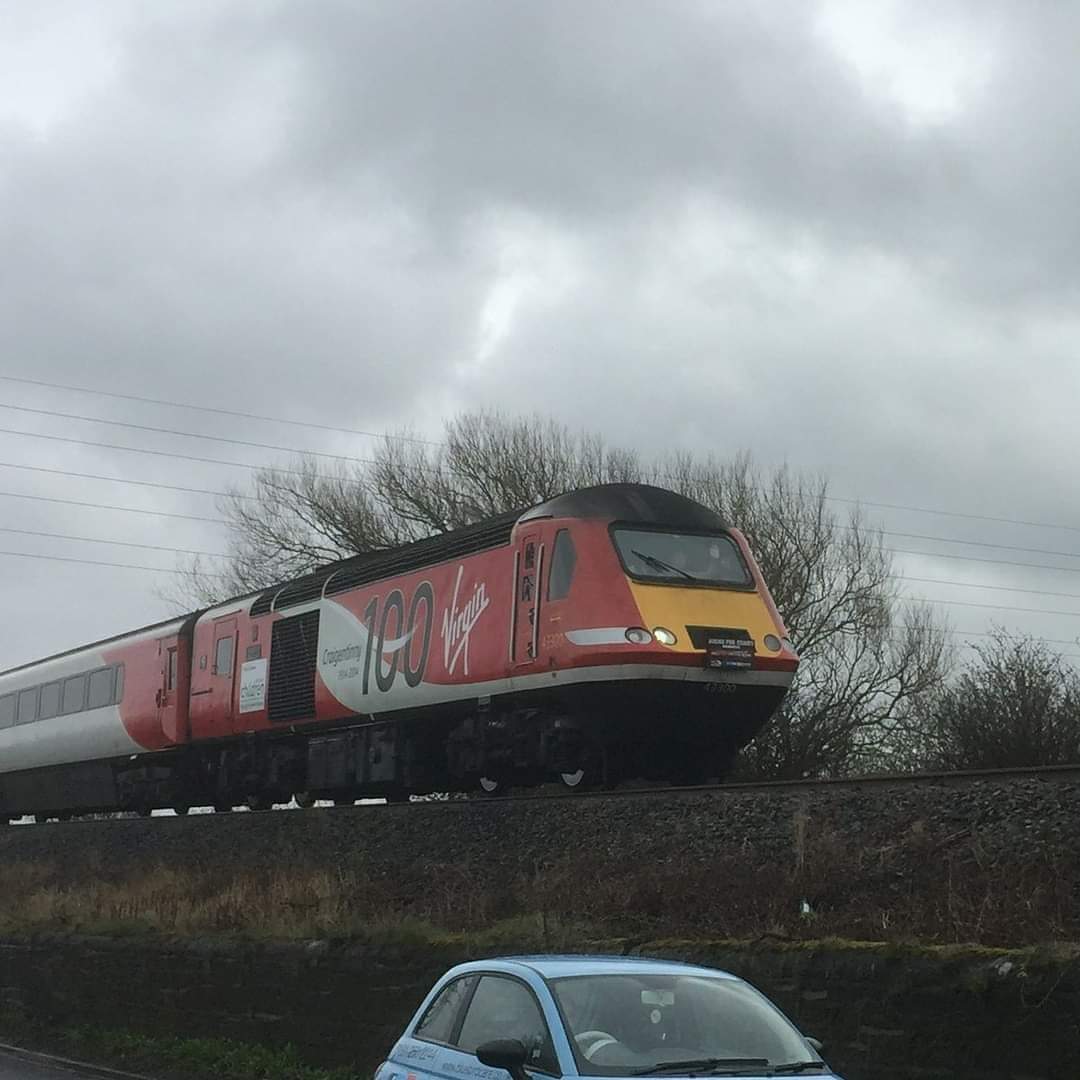
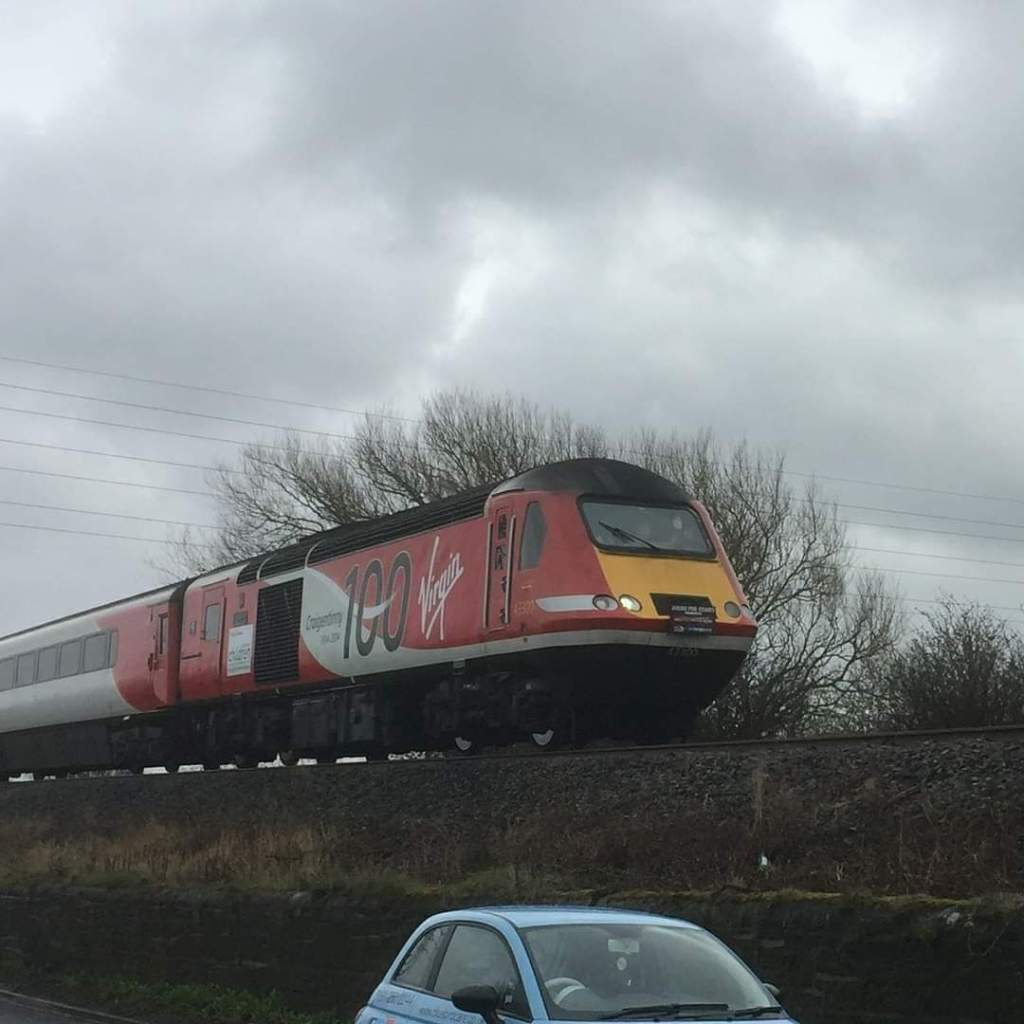
Please see the image below as one of many artistic interpretations of the Northumberland Coast Loop by Garry Hall, who has submitted these on the ‘Northumberland Coast Loop Group‘ on Facebook.

Why not pop onto the group to take a look?
Please see the image below as one of many artistic interpretations of the Northumberland Coast Loop by Garry Hall, who has submitted these on the ‘Northumberland Coast Loop Group‘ on Facebook.

Why not pop onto the group to take a look?
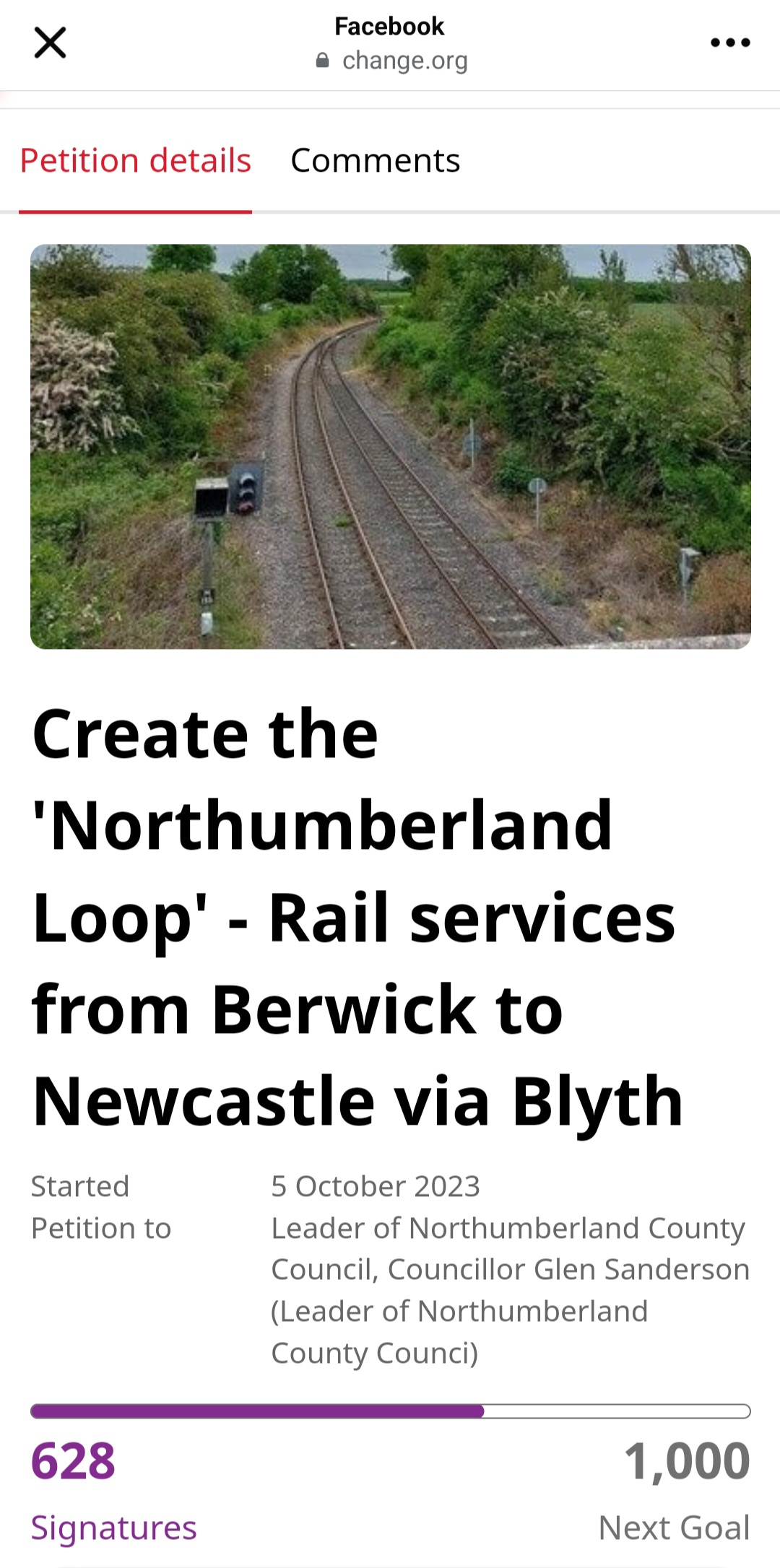
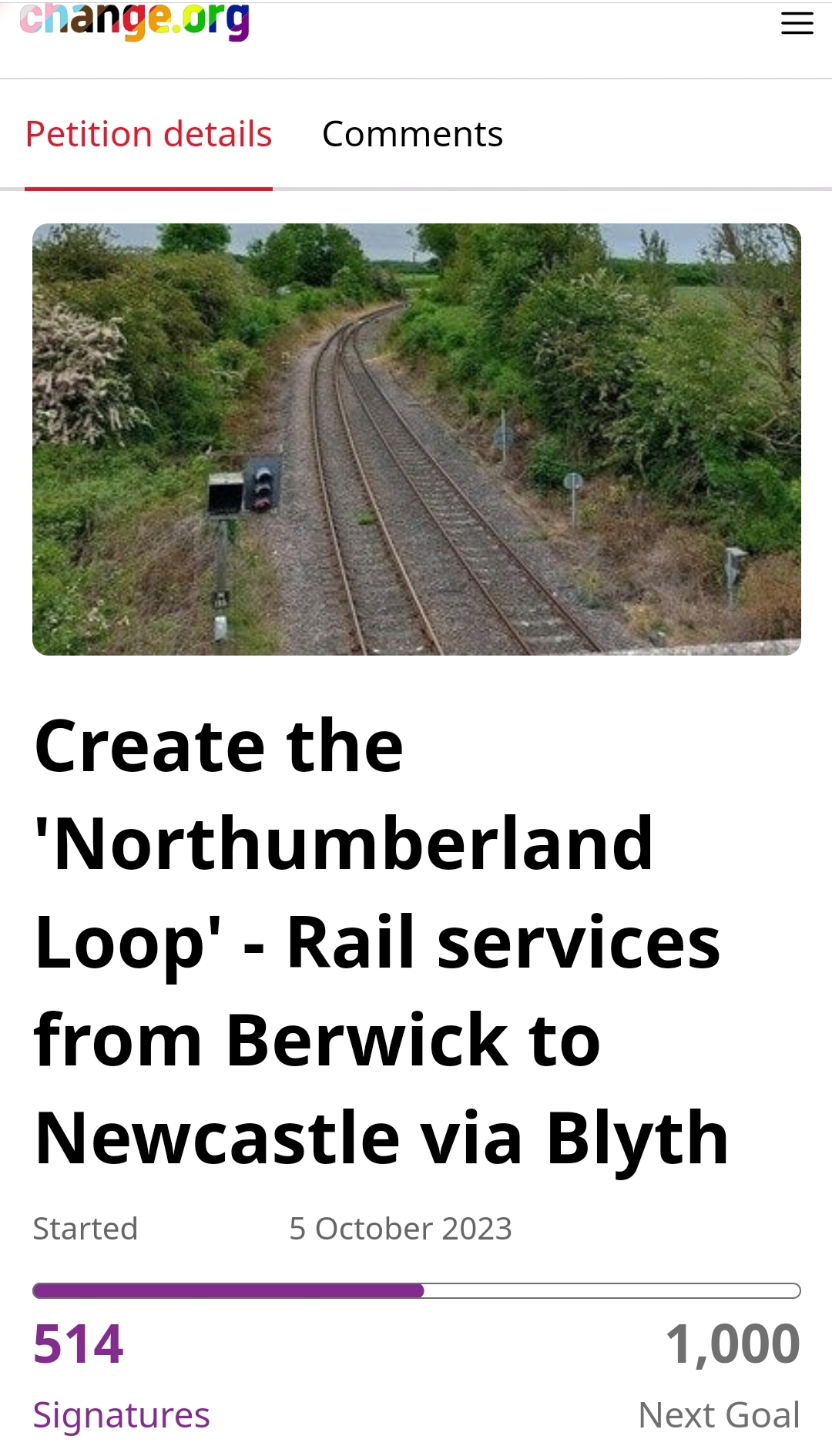
Petition: Quick update on the change.org Northumberland Coast Loop online petition: which has now reached 250 signatures at 20:00 on 1.4.24 since being started on the 5.10.23, and shows the growing level of support for the N.C. Loop to improve connectivity in Northumberland.
If you haven’t already, please sign it via link above and feel welcome to leave a comment too.

Website and Social Media:
The website is receiving a healthy level of traffic daily and has had 1868 visitors since launch in the early days of 2024, and on social media (Facebook page & Twitter account) steadily gaining page likes and followers.
Summary: I’d like to thank everyone who’s given their support thus far with the campaign and please keep on liking, sharing and discussing the posts on social media or via this blog to keep this potential future part of Northumberland’s railway network at the forefront.
The N.C.L. is a fairly modest scheme to link the East Coast Main Line to the Northumberland Line at Bedlington to give direct rail connectivity between North Northumberland and Scotland to South East Northumberland and North Tyneside, all the track is in place and regularly used, all it needs is services to link it up.
If you can, please contact your elected representatives at all levels, from Parish/Town Councillors, to County Councillors, NE Mayor Candidates (due for election on 2nd May 2024) and your MP (inc the prospective candidates ahead of the expected 2024/2025 General Election).
Attendance at SENRUG Public Meeting:

Work and family commitments allowing, I will hopefully be attending the meeting above, and will try raising the Northumberland Coast Loop to the prospective North East Mayoral candidates who are attending – more on this nearer the time.
Could the delay in completing both Blyth Bebside and Northumberland Park be an opportunity for longer platforms to handle longer trains, not just for the Northumberland Coast Loop but for wider use too?
Firstly, the intention of the Northumberland Coast Loop would be to see semi-fast trains serving both of these stations, so making them long enough (same length as platforms at Morpeth/Alnmough/Berwick of approx 200m-230m long) to serve longest trains would perhaps be a sensible addition at the construction phase rather than remodelling later on. The longest trains can have the most seats and thus makes the best use of every available path.
Secondly, there is the potential for special trains such as railtours (which may even possibly connect with Cruises into Port of Tyne as Northumberland Park is very close to the Tyne Cruise Terminal), which could offer a lot of opportunities for railway connections to tourist attractions across the North East, decarbonising tourist trips, as well as offering more time while on-shore by faster connections, meaning more time available at attractions.
Another less obvious case is the potential of special trains in 2025 to link into the Stockton and Darlington 200th Anniversary celebrations; as Bedlington made rails were used in nearly two-thirds of the S&D, and pivotal to other railways of following years too going beyond 2025.
This is just part of many more relevant 200th anniversaries associated with this part of the Blyth Valley, with locomotives built by R.B. Longridge – De Arend (‘The Eagle’) being one of the first pair of locomotives to work in the Netherlands in 1839 as one example. Surely it makes sense to celebrate a place so key in railway development via a newly reopened railway?
Just three lengthened platforms (two at Blyth Bebside and one at Northumberland Park) could be a fairly cheap and easy win and giving even a modest boost to tourism would be invaluable for the local economy creating new jobs and new opportunities. Assuming the platforms to be c. 100m in length as planned now, thats only ~100m extra to be added.
Any feedback is always welcome, especially any source that could give a fair costing of this and especially if a benefit/cost ratio could be calculated for this work… please get in touch!
It might seem odd the claim that Northumberland, a county that HS2 has never been planned to pass through (the original, full proposal ended at Newcastle Upon Tyne) needs High Speed 2, but it arguably does.
There has been a long running issue for many years of London – Newcastle – Edinburgh expresses being the major focus of operators, with this recent BBC article (”Levelling down’ fears over new rail timetable’) highlighting the potential of cuts to smaller stations on the East Coast Main Line (ECML) at Morpeth, Alnmouth and Berwick in Northumberland, amongst many others.
This is all in aid of speeding up long distance trains using the existing railway; the more stops a train does, the slower it is, but on the exisiting network that also slows down the train behind (a bit like being in your car and getting stuck behind a bus calling at bus stops would slow you down if it doesn’t pull into a layby type stop, a stopping train will slow following trains if it doesn’t use a loop).
Therefore, it means a constant timetabling conflict between running the fast, almost non-stop ‘intercity’ service between the major cities mentioned, and slower services that call at more minor stations such as Berwick, Alnmouth or Morpeth, and for the Northumberland Coast the lesser used stations between the ‘Big Three’ which includes Cramlington, Pegswood and more.
So where does HS2 fit within this?
Before its heavy cut-backs, HS2 would have sent more of the London – Scotland expresses up the West Coast Main Line (WCML), which would have reduced the pressure on the ECML timetable greatly and allowed many more semi-fast (calling at likes of Morpeth, Alnmouth and Berwick), local services (all stations), and more railfreight which runs at a more limited overall speed but on average fits well with stopping passenger trains.
This is highlighted numerous times by rail engineer Gareth Dennis in this RailNatter series on YouTube and has advocated for HS2 in Parliament and on major news channels too, but also by groups like Greens4HS2 which reference the same article. For full disclosure I (RH) am a member of Greens4HS2.


The decision to ‘make do’ with the existing network and not to more fully build out HS2 prolongs this conflict in the timetable, and means that services to smaller stations are always under threat, and capacity being available for a new route like the Northumberland Coast Loop will be restricted.
If you want better local services along the Northumberland Coast, you need HS2 to work properly and be built.
Please lobby your MP’s and other elected representatives to fix this issue by building HS2 in full.
This article from the BBC ‘North East tourism businesses adapt to changing landscape’ mentions two issues; attracting tourists and having staff available. The Northumberland business was the Craster Arms in Beadnell, but it would apply across many more such as the castles, the historic houses and gardens etc.
An improved rail service, particularly serving North Northumberland, would be a welcome step, closely integrated with local buses as the railway tends not to be close to many of the attractions, but offers a much better option than hours travelling on buses from centres like Newcastle. If these are 100% on the ECML, it would still be welcomed, but a mix of ECML and Northumberland Coast Loop could be even better.
A major market for a pub is, of course, a lovely refreshing beer, maybe with or without food. So getting there without needing the car is perhaps the ideal situation – you can enjoy an alcoholic drink without worrying about driving home.
Unless you’re able to simply walk or cycle to the pub, then you need public transport to go ‘car free’. At present buses to/from Northumberland can take literally hours to reach places like Newcastle, or the larger towns in SE Northumberland, whereas rail is much faster over the long distances involved, is much more comfortable with access to toilets on board and a smoother ride too, but would need integrated with buses for the first and last miles between stations, pub and back to the hoose.
A better local service along the East Coast Main Line would of course be welcome, but for many, the new Northumberland Line stations opening later this year, and into early next year (2025) would be far closer and more convenient; meaning the Northumberland Coast Loop between Bedlington and Newcastle could potentially connect even more people than stations such as Cramlington and Morpeth.
So that could get the pub patrons there, but it could also work for staffing, mentioned as an issue by the publican in the article. Connecting places like Bedlington, Blyth and more to North Northumberland could allow the seasonal tourism industry of North Northumberland to draw staff from the large populations of SE Northumberland where improved access to work is a key part of putting the Northumberland Line back in place.
Having some services head northwards too would make further gains from the investment into the line at low additional costs – you don’t need any additional stations or even track (as its already in place linking Bedlington to Pegswood and onwards north), you just need the train put on the route.
What are your thoughts?
The campaign is centred around connecting the populated south east of Northumberland to North Northumberland and Scotland, but this idea has been around for over 160 years in a wide variety of forms, so why did it not happen before and what shape could it take today?
The Blyth and Tyne (B&T) Company, which was incorporated on 30th June 1852 alway sought northward expansions that somewhat frustratingly never panned out.
The history of the routes is long and complex, with many factors at play, so below is as brief a synopsis as possible to tru and cover the main events.
Firstly, the B&T grew out of an amaglamation of various colliery lines, rather than the vision of a strategic route like the neighbouring Newcastle and Berwick Railway, meaning its growth was by adding branches and sections over a longer period of time.
The growth of railways in the first half of the 19th Century was chaotic to say the least; with many companies in intense rivalry to promote and build routes all over the UK. The North East perhaps saw this to a lesser extent with the heavy influence of George Hudson, who was perhaps strategic in his thinking of routes, but his means of achieving it were dubious and ultimately led to his downfall.
The Seghill Railway for example was involved with the Newcastle and North Shields Railway (N&NSR) until 1844 when it was absorbed into Hudson’s Newcastle and Berwick Railway scheme. This led to the ‘Blyth and Tyne Junction Railway’ being formed as it needed indepedence from the Hudson’s railways to reach the Tyne for shipping coal out of the area, but also the lines running passengers on at least some of the lines.
This hotchpotch growth of separate colliery lines amaglamating their way into a wider network, rather than a clear, single line of route as such, perhaps helped kept the area out of the Hudson empire. The empire collapsing in 1849, following the wider end of the Railway Mania, marked by ‘The Panic of 1847’, which a commercial and banking crisis (sounds familiar?) which brought the somewhat dodgy deals of Hudson to light as money stopped pouring into railways for at least a while.
With the B&T formed in 1852, and in a post-Mania and Hudson environment, it perhaps would be easy to see why the railway would continue growth bit by bit rather than by bold schemes.
A rival railway proposal to the steadily growing B&T, was the ‘Tynemouth Docks, Morpeth and Shields Direct Railway’ which proposed a direct route from North Shields to Morpeth, which would have had branches to Ashington and Seaton Sluice.
The B&T responded by proposing to extend their line from Newsham to Morpeth via Bedlington which was the line that won out, and got authorisation for a Bedlington to Longhirst route by Acts of 1853 and 1854, though the route was never built to Longhirst. Other schemes by the B&T to link Warkworth Harbour (Amble) also never came to fruition as the North Eastern Railway blocked by the NER with the Amble Branch, which meant that the B&T line to Newbiggin was the northernmost part of the route in the end.
The route to Morpeth was opened for passengers and goods by 1st April 1858, ending in a separate station (now houses) on the opposite side of Coopies Lane to the present day Morpeth Station, with connection to the Newcastle and Berwick facing southward.
So by 1858, almost all of what could form the Northumberland Coast Loop was in place, and has been for 166 years, but a crucial link still wouldn’t be there for another 122 years…
…instead, the ‘Wannie Line’, properly the Wansbeck Railway, comes onto the scene, an might have seen direct connections to Scotland from Blyth, but via a very strange route!
The mad nature of Victorian railway empires again arises with the North British Railway trying to reach Newcastle – it ran the Scottish part of what is now the East Coast Main Line north of Berwick, but desired its own route, and the B&T was part of the plan.
The North British was behind the Border Counties Railway from Riccarton Junction, through what is now Kielder Water to Hexham, and joining the Newcastle and Carlisle (N&C) Line (now the Tyne Valley Line).
The problem was, the Newcastle & Carlisle, while still independent, was closely linked to the former Hudson empire (now the North Eastern Railway (NER)), and the North British was desperate to avoid any dependence upon the the NER.
For the North British, a vision developed for a new line from Reedsmouth to Morpeth, which would link the Border Counties railway to the B&T, providing a through route to Scotland, although a very indirect one!
In the end, the line didn’t prove successful, the NBR gaining powers along the Tyne Valley route meant that through trains via Morpeth never materialised to my knowledge. Reedsmouth Junction was built facing the wrong way for through services from Newcastle into Scotland, which perhaps shows this idea being abandoned before the line was completed, and the Wansbeck Railway had a weird connection to the B&T east of Morpeth (Wansbeck Junction, near present day Coopies Lane Industrial Estate), which meant to reach Morpeth B&T station, trains had to propel (run backwards) to reach it.
This caused a number of issues, the worst being an accident, which meant that shortly afterwards, the connection was rebuilt to run through the present day Morpeth station anyway (1872). Not long after, in 1874, the B&T was merged into the North Eastern Railway too, perhaps being the final nail in the idea of the North British having an independent route between Newcastle and Scotland.
Due to these factors, the Wansbeck Railway ended up as just a rural local route, not an alternative mainline to Scotland, and closed in 1965, but had that line opened a bit earlier, the North British absorbed or made deals with the famoisly independent B&T, maybe local railway history could have been very, very different; could have been Scotland bound expresses roaring through Bedlington, Bebside, Newsham and more?
The step-change for the area came when the independent but landlocked B&T was finally absorbed into the much larger North Eastern Railway (though seemingly quite amicably), the system then became part of a much wider network rather than an individual company reaching outwards.
The North Eastern quickly worked to consolidate the B&T routes into its system, closing the separate station at Morpeth and building a bay platform (now the Northern Car Park) for services to terminate in the present day Morpeth Station.
However, now that the former Newcastle and Berwick Railway was owned by the same company that had the Blyth and Tyne route to Morpeth, there was authorisation given for a new curve to link them in 1882, which would have allowed a train (either passenger or freight) from Bedlington to travel direct towards Pegswood or vice versa. (More details are available here: What if the Morpeth North Curve had been built by the Victorians?).
For an unknown reason, this curve was not built until 1980, which perhaps is strange given the relatively good financial position of the North Eastern Railway.
Had it been built by 1890, maybe once again local railway history would have been radically different; freight is covered in the post above where there was known flows from pits in the Alnwick and Amble area to Blyth for shipping, these reversing at Morpeth to reach the River Blyth, but potential passenger flows are much less certain.
That being said, had the link existed, its hard to imagine it’s use being totally exclusively for freight alone, especially ahead of World War One. Railway passenger services tended to be fairly intense on nearly all lines, and at the time, both the East Coast Main Line and the Morpeth – Manors North routes has a good level of service, so it seems a reasonable assumption that had the Pegswood – Hepscott Curve (known as Morpeth North Curve) existed, it would likely have seen at least some form of use by local services, as well as likely use by excursions to reach places like Whitley Bay or Tynemouth direct?
While the route certainly would have been unlikely to rival the ECML for fast expresses, it could well have been used for slower trains over long distances.
Perhaps Amble might have seen passenger services extended closer to Newcastle to link the coalfield communities?
As a couple of examples, Choppington Station had a fairly limited range of direct trains serving it, but in 1911 had ticket sales of 115,642, and Bedlington had figures of 227,121 in the same year, and its likely that at least some of those journeys probably would have been northbound ones connecting via Morpeth. It would be interesting if data exists showing the destinations of these tickets in 1911 rather than just the number of tickets sold.
Again, caution needs exercised in speculation, but had the Morpeth North Curve existed during WW1, its likely that it would have been used by troop trains, as a major training area was Alnwick Camp, set up in the pastures across the River Aln from Alnwick Castle. With many soldiers drawn from areas such as Blyth, its not unreasonable to expect that troop trains could have run. Near direct connections between many North Sea ports could also have been strategically important too.
The interwar period tended to see decline in rail traffic with the rise of buses and lorries, passenger services became reduced but importantly didn’t disappear. Had longer distance direct trains been possible, a market rail became more able to compete with, the decline in services may have been more limited.
Excursions to the likes of Whitley Bay and Tynemouth would probably have been quite likely too.
As with WW1, it is hard to speculate with any certainty on ‘what could have been’, but a again given the population size and connections to ports, but also the many airfields along the Northumberland Coast during the war.
After WW2, the continued growth of road traffic ate into railway passenger numbers, and stations such as Hepscott and Choppington closed well before Dr Beeching produced his report, both closing to passengers on 3rd April 1950, but Choppington was reused for an excursion as late as the 22nd September 1962.
Again, speculation with caution, but had longer distance trains become established in the decades prior, it possibly fair to assume they may have kept these stations open for longer, and may have prevented the later closures of places such as Bedlington, Bebside and Newsham altogether, some smaller stations may still have closed but some of the larger stations might have remained open, perhaps never closing.
The tragic fatal crash at Morpeth, where Deltic ‘The Royal Northumberland Fusiliers’ (D9011/55011) became derailed while hauling the northbound ‘Aberdonian’ sleeping car train from London to Aberdeen, where sadly six people died, 11 were injured and the roof of Morpeth Station was heavily damaged.
This accident was the first to show the dangers of Morpeth Curve (on the actual ECML), where the driver was apparently distracted and went around the then 40mph curve at 80mph. Sadly it was the first of three overspeed incidents on the notorious curve to date (March 2024)
This accident highlighted a long standing (since at least 1877) issue that Morpeth Curve is too tight to be on a mainline and presents a risk. While the Northumberland Coast Loop wouldn’t be a fix for this (a Morpeth Diversion is the solution), it has offered an alternative route in subsequent accidents and disruptions.
Despite being authorised in 1882, it wasn’t until around 98 years later that the Morpeth North Curve was finally built and opened to traffic, almost exclusively freight, as by this point all of the stations on the route via Bedlington to Newcastle had long since closed (November 1964).
Overall rail passenger figures in the early 1980’s were at a very low ebb, oddly enough at a very similar level to that of the 1880’s, however, this era marked the resurgence of rail, being contemporary with the opening of the first parts of the Tyne and Wear Metro, the first section opening in August 1980 just months after the Morpeth North Curve.
This marks the route for the Northumberland Coast Loop being put in place, but it is still not quite the end of the story.
To once again consider the ‘What if…?’ question of services being reintroduced between April 1980 and the present, towns such as Blyth, or areas like probably could probably have justified a ‘Parkway’ style station as the decline in traditional industries such as shipbuilding, shipbreaking and mining taken place, and perhaps could have been delivered alongside the Tyne and Wear Metro at places like Northumberland Park to serve major businesses parks like Cobalt and Silverlink when they were initially built too.
The second accident on the curve, fortunately not a fatal one but resulting in 35 injuries, closes the mainline but with the M.N.C. in place allows for diversions.
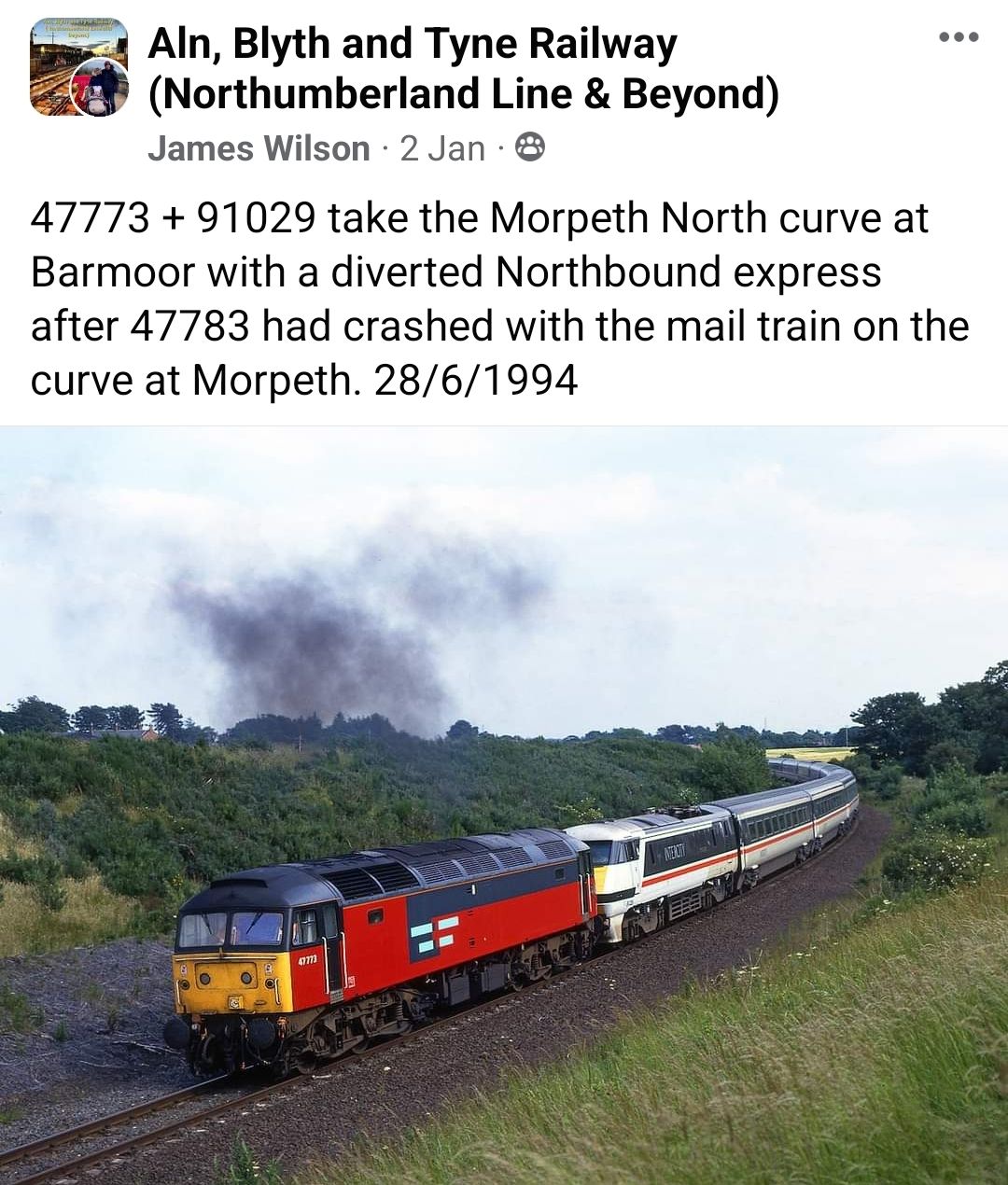
The third (and hopefully final) overspeed accident occurs with a parcels train, with only the driver sustaining injuries, again the Morpeth North Curve is used for diversions, with the image below showing it in use by 47773 dragging electric 91029 along the curve.


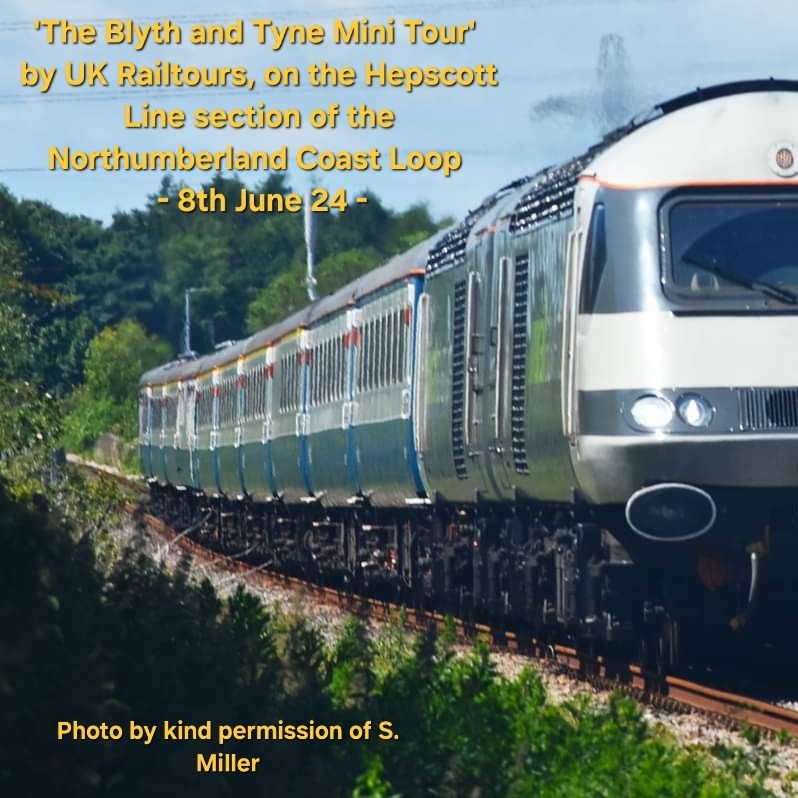
On the 18th March 2017, a railtour operated over the now proposed route, and was a leading part in inspiring it, especially as at that time, moves to start the Northumberland Line project were gathering pace.
The first online suggestion of the route was made in February 2023, with later a petition, followed by the establishment of this website in early 2024.
On the 8th October, news broke of issues with Plessey Viaduct (carries the ECML over the River Blyth), causing major disruption to rail services. Most local services to Morpeth were cancelled, while heavy disruption ensued to long distance services having to use a single line over the viaduct.
Some limited diversions happened over the route, including a light engine run by Flying Scotsman on the 11th October, but no passenger diversions. The ECML was reopened for normal traffic on the 6th November.
Had the Plessey Viaduct been totally closed to traffic, the B&T would likely have seen a number of diverted trains, highlighting the importance of the route.
As of today, the Northumberland Coast Loop is gaining support from an online campaign, and the Northumberland Line is progressing well, with hopefully stations at Newsham and Seaton Delaval to be completed later this year (2024) with other stations to be completed later in 2024 or early 2025.
Hopefully the Northumberland Coast Loop can become a reality in the near future – the route is there, why not use it?
Please click the link below to view (and hopefully take part in) our March 2024 Survey!

Please click here to see the Rail Baltica article about The Evolution of Rail Transportation
The Northumberland Coalfield has a long association with waggonways and railways, with Huntingdon Beaumont establishing the first example near the River Blyth in the early 1600’s, and Bedlington Ironworks/R.B. Longridge and Co being significant in the development of both rails and early locomotives, giving a rich railway heritage to the area.
The Northumberland Coast Loop would use existing, conventional railway technology, but by making use of the existing link between Bedlington and Pegswood, would introduce a new rail service connecting the Northumberland Coast.
Please take a look at the homepage (northumberlandcoastloop.uk) to find out more!
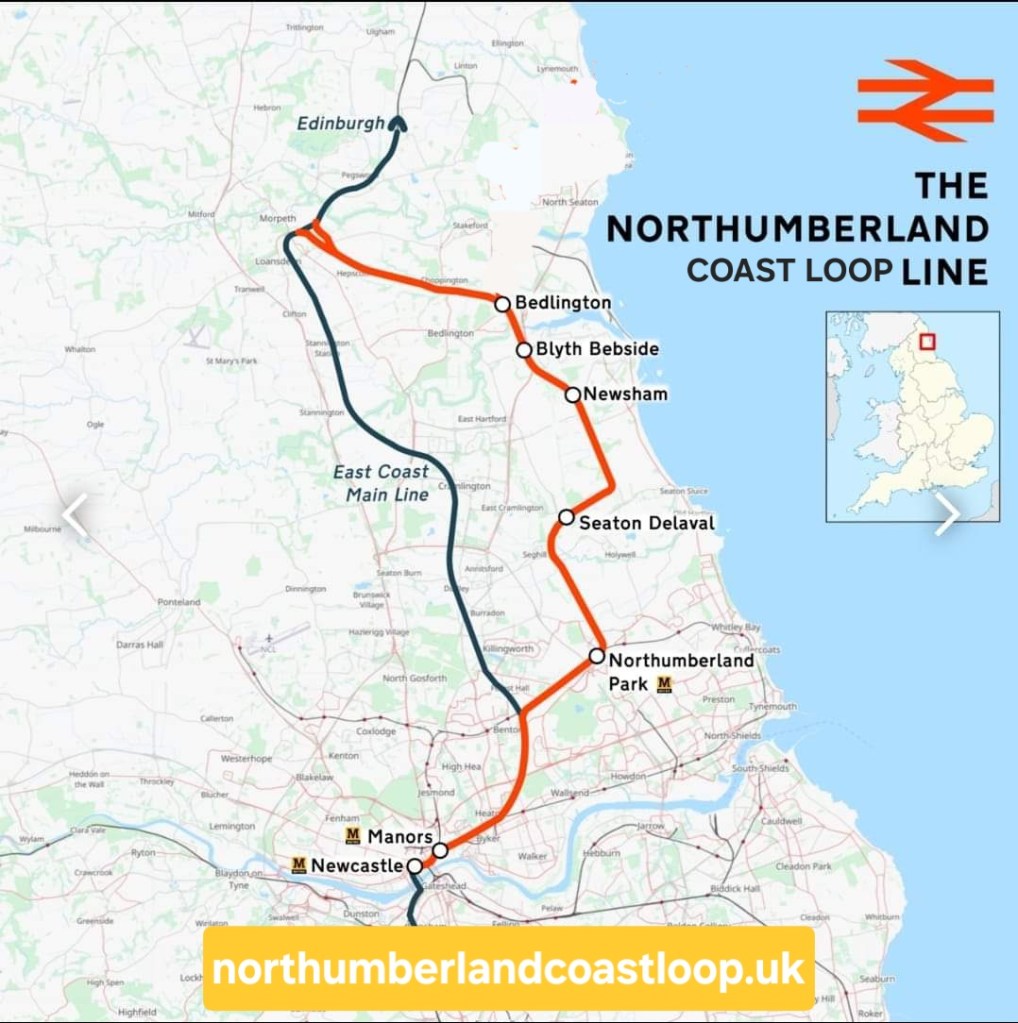
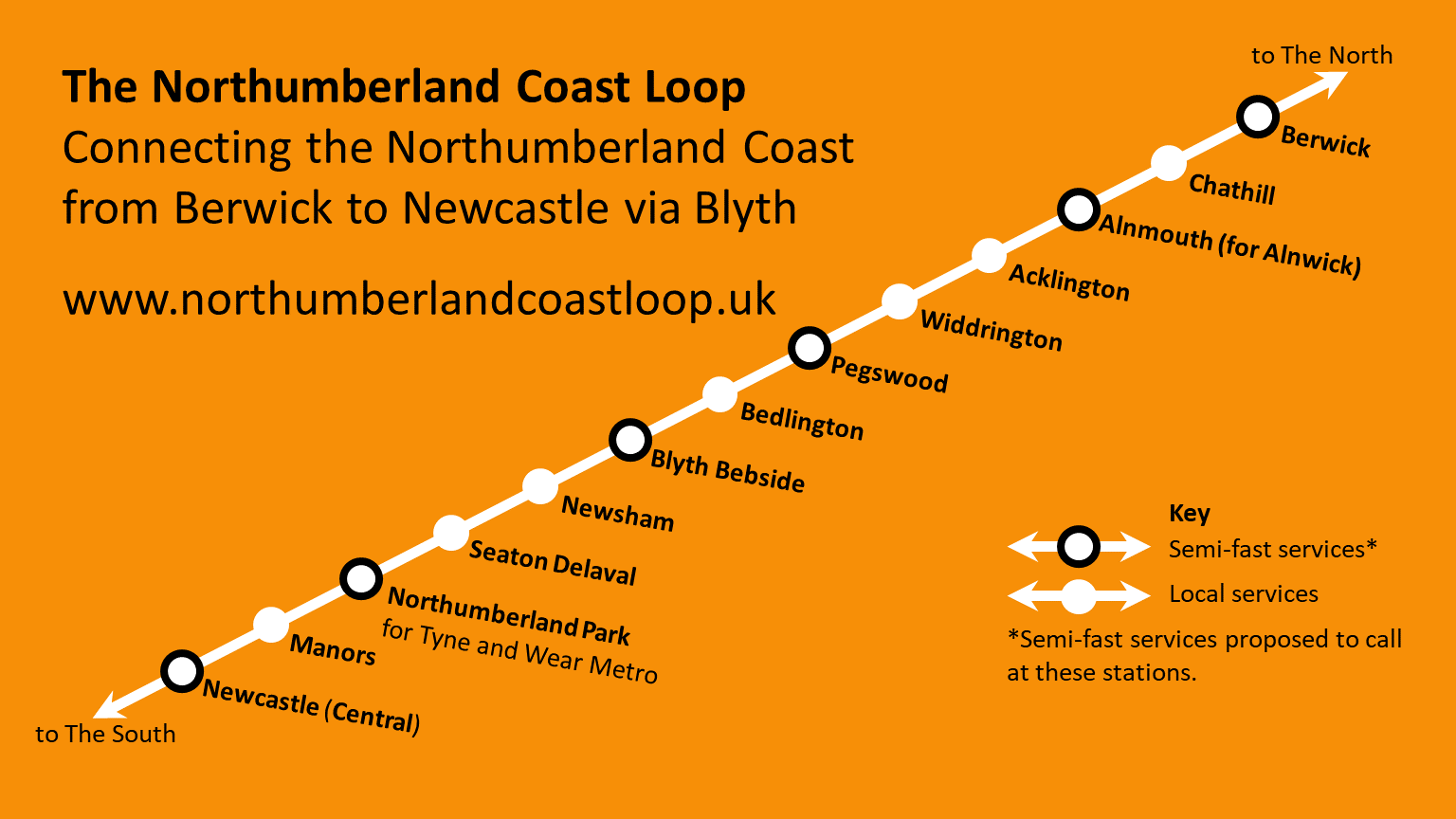
As can be seen from the route map below, the Northumberland Coast Loop wouldn’t directly serve Ashington, with it being on a branch from the main route between Newcastle and Berwick.

This is perhaps most clearly seen on the geographical map from Rail Map Online below, where after leaving the main route at Bedlington, the line continues through Ashington to Lynemouth, with the Cambois Branch also diverging near Bomarsund.
The line near to Linton Colliery, north of Ashington (known locally as the Butterwell Line) is beyond the scope of this post, as the connection to Ashington has been out of use since 1999, and has never formed a northbound link, only a southbound one.

While Ashington wouldn’t therefore be a stop en-route, the Northumberland Coast Loop could though still hold advantages for Ashington in reducing journey times to and from the North of Northumberland.
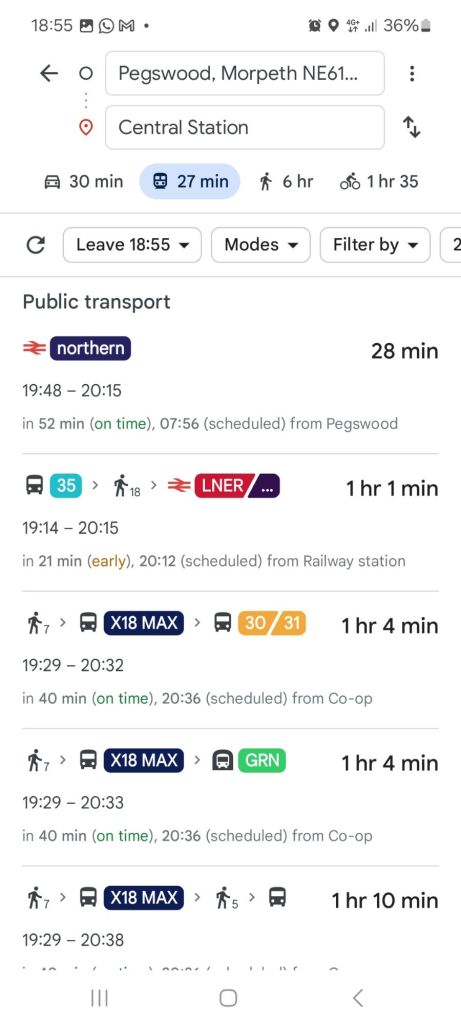
While not served direct, Ashington would be within easy reach of Bedlington or Blyth Bebside stations, being just one or two stops away respectively, offering a very short and reasonable connection by rail; shorter than connection via Newcastle Central in both time and distance.
Another option would be travelling via Pegswood Station, which would offer interchange with local buses (No. 35 particularly), but ideally the simple addition of a car park could upgrade this modest station into a ‘Pegswood Parkway’, easily accessed from many areas by its strategic location on the A197, linking the A1, A697, A1068 and A189 roads.
Blyth Bebside in particular would probably be ideally suited to the role of a local hub, with easy connections being possible by rail, bus and by car (as it is being built with a substantial car park from outset), whereas Pegswood would require the addition of a car park to form a potential ‘Pegswood Parkway’, and offer similar ease of use to Blyth Bebside.
All of these options could allow for easier access both to and from Ashington for access to work, education or training, especially from North Northumberland where existing connections are somewhat awkward.


The Northumberland Coast Loop is a proposal to see a range of services introduced on the alternative through route between Newcastle Upon Tyne and Berwick Upon Tweed (and destinations beyond) via Bedlington.
As of February 2024, the East Coast Main Line (ECML) is the only passenger carrying line along the Northumberland Coast, running between Newcastle and Berwick via Cramlington and Morpeth (the dark blue line on the second map).
This line of this route almost demarcates the western edge of SE Northumberland, with most of the settlements east of, or immediately adjacent to this line, which we’ll revisit later.
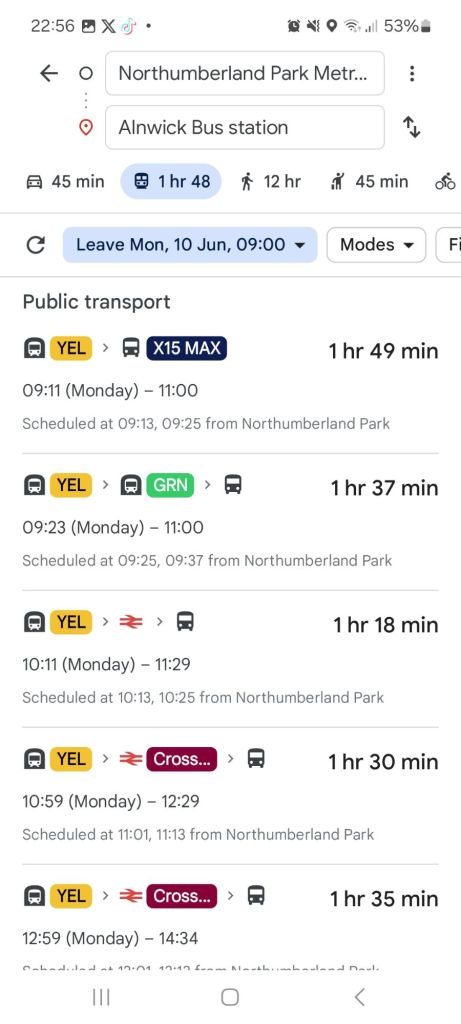
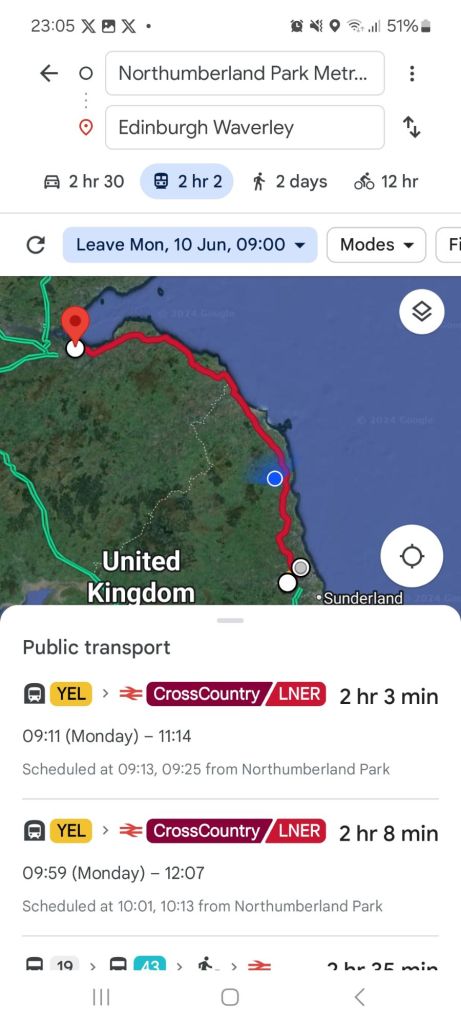
The services on this route largely provide connections from and between major stations (Berwick, Alnmouth and Morpeth, with Cramlington to a lesser extent) into Newcastle and other destinations to the south such as London, York, and Manchester, and to the north to Edinburgh, Aberdeen, and more.
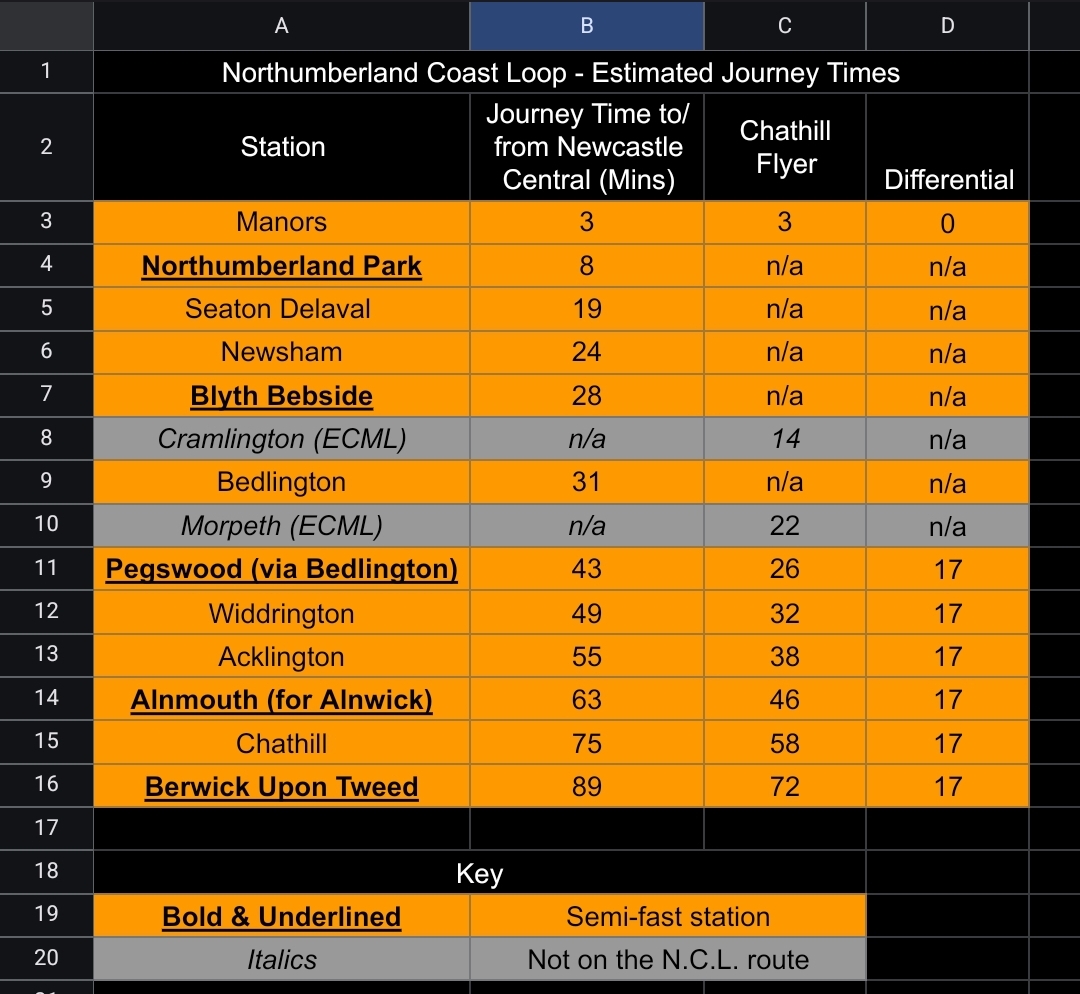
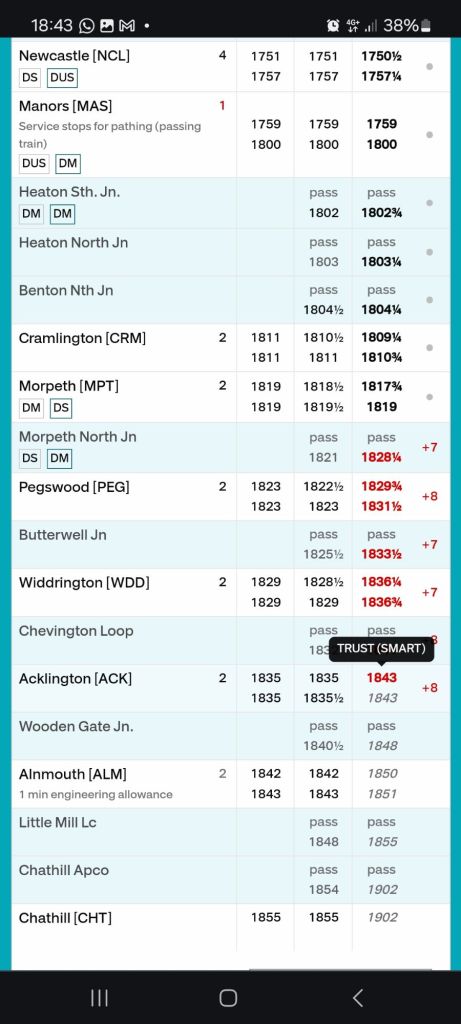
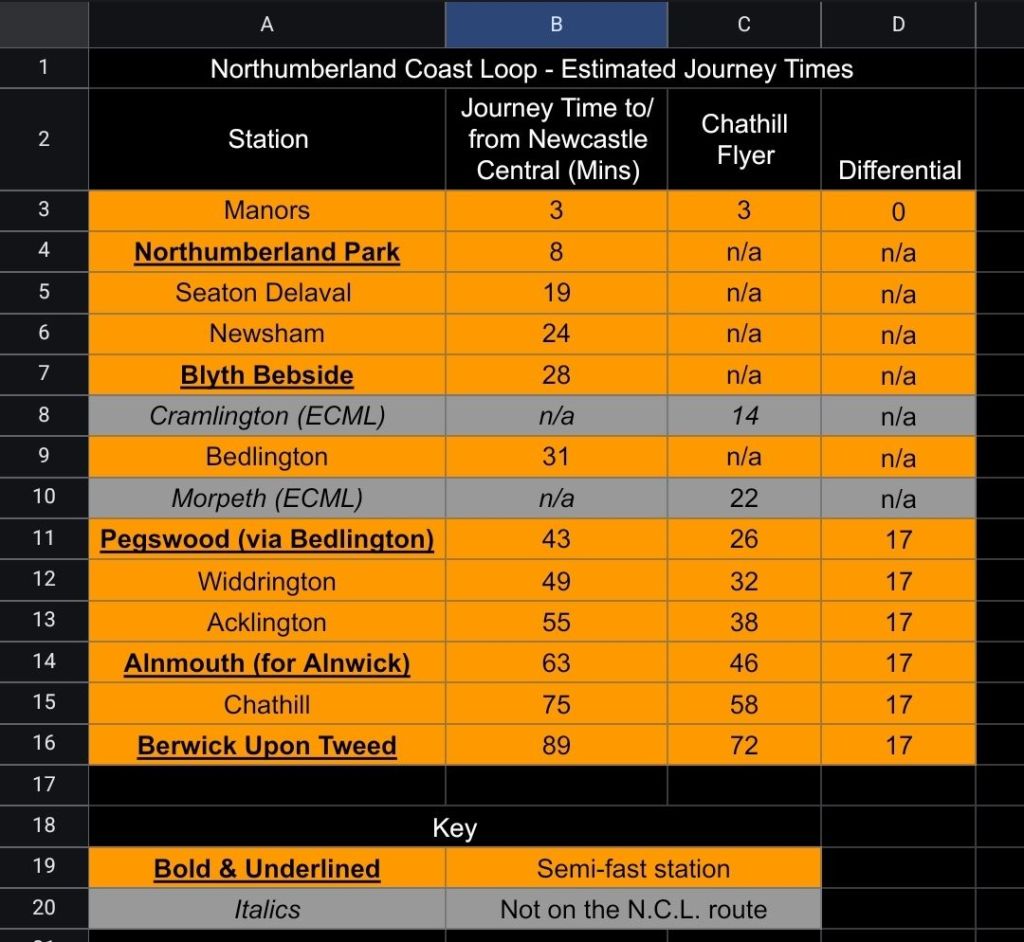
To a lesser extent, there is a local service (all stations) between Newcastle and Chathill, locally referred to as the ‘Chathill Flyer’ which links many of the smaller stations but with a very minimal service of a morning and evening train, with the northbound morning service omitting several stops.
There are many improvements planned for this route, more stops by semi-fast trains being the primary service to most stations, but also a long-running campaign to see an hourly electric rail service along the route, all of which are welcomed.
While exact figures are not available due to commercial confidentiality, it is easily observed that stations in Northumberland such as Morpeth, Alnmouth and Berwick see a majority of trips to/from the south, but also a sizeable proportion of their passengers headed northward from these stations and not simply to/from Newcastle or destinations south.
As ‘Bedlingtonian’ from birth (now living in North Northumberland) Morpeth has always been viewed as the main station for the area, with the lines through Bedlington solely for freight, until the fairly recent development of the Northumberland Line, which is where, in my view there is an opportunity for change for the better.
Cramlington has always had a much more limited service compared to Morpeth, and has seldom seen direct services to/from North Northumberland and Scotland. One issue is that trains are unlikely to call at both Morpeth and Cramlington due to their close proximity, so Cramlington has always ‘played second fiddle’ to Morpeth despite it being a substantially smaller town.
The issues with this Beeching-era arrangement (fewer ‘hub’ stations over local ones) is getting to and from Morpeth Station; requiring driving into Morpeth, catching the bus or getting driven/taking a taxi, as for most people, the walking and cycling distances are too great, alongside the very poor provision of safe walking and cycling routes (often no footpath or cycleway separated from traffic), ruling these options out for most.
Both Morpeth and Cramlington are towns notable for their traffic issues, Morpeth as the major station for the area is a good example to work through.
Traffic around the station at Morpeth has perennially bad, with often long queues along the A192 Shields Road. This effectively increases the ‘resistance’ of using the railway, as journey times are lengthened, often unpredictably which means needing to allow extra time.
Particularly for the buses, traffic is often so difficult at the junction of Shields Road and Coopies Lane, where station bus turning circle is, that the local bus operators have long been reluctant (to say the least) of directly serving the station and instead using stops further along Shields Road, a 4 min walk away, which while not unreasonable, involves several road crossings (Shields Road, Kingswell and Coopies Lane), as well as entries to/from car parks.

The situation for drivers is also not ideal, as traffic congestion adds to the unpredictability of reaching the station, and with its constrained site, there is the potential at busy times to not have a parking space available.
For taxis, the parking problems are obviously much less of an issue, but road congestion will play out into higher fares.
It also must be said that traffic to/from Morpeth Station also and somewhat obviously contributes more broadly to the traffic issues in the towns themselves, with a similar issue at Cramlington that the town-centre location is great for walking/cycling and bus access but a drawback for ‘park and ride’ type access from other towns or outlying areas.
Later this year (Summer 2024) the Northumberland Line is due to open at least partially, with the full scheme due to complete in late 2024/early 2025 judging by recent announcements.
In geographical terms, the ‘Northumberland Line’ is much more central to the area it serves, broadly sitting between the ECML and the Northumberland Coast, as can be seen from the map below.

This is often touted as being a ‘Reversing Beeching’ scheme, while the infamous ‘Beeching Report’ was only part of wider postwar changes to the rail network, it will go some way to bringing back local stations (ones within easy walking and cycling distance or much shorter bus/driving/taxi trip).
While the primary aim of the Northumberland Line is to bring back connections to/from Newcastle (and therefore easy connections to destinations beyond) into South East Northumberland, this major investment could potentially be put to even greater advantage by giving direct connections to/from the North.
It will obviously be easier to make connections at Central Station, for northbound services, but this would still entail travelling the ‘wrong’ way for part of the trip, adding somewhat unnecessarily to journey times and distance.
There is a further proposal to improve rail access to Morpeth by extending the present Carlisle – Morpeth trains to Bedlington. This link is welcome, but still requires changing trains to head north, and unless travelling from Bedlington directly, would mean two changes of train from any other station.
One solution, if possible would be to extend this service beyond Bedlington, getting over the river to Blyth Bebside would, in my view, be worthwhile exploring and potentially investing in a turnback siding/bay platform to enable extension of the service but extension even further to Newsham, Seaton Delaval or maybe even Northumberland Park/Cobalt Business Park would be worthwhile considerations.

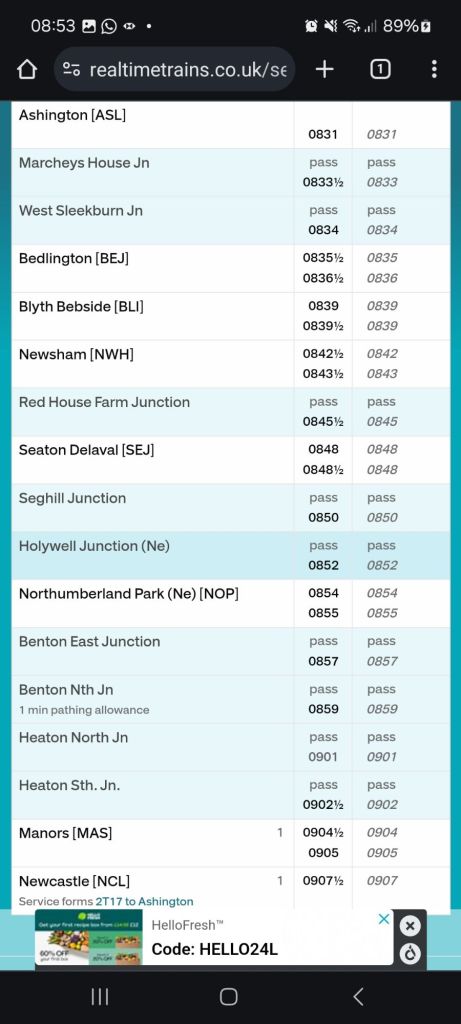
As can be seen from the map above, the issues surrounding travelling to/from Morpeth or Cramlington and their surrounding townships could be eliminated by simply routing some services to via the Northumberland Line as far as Bedlington, then taking the existing freight line westward to rejoin the ECML at Morpeth North Junction and carry on northwards towards Pegswood and beyond. This would give direct connections between places in North Northumberland and Scotland to SE Northumberland and North Tyneside, both large centres for population and employment.
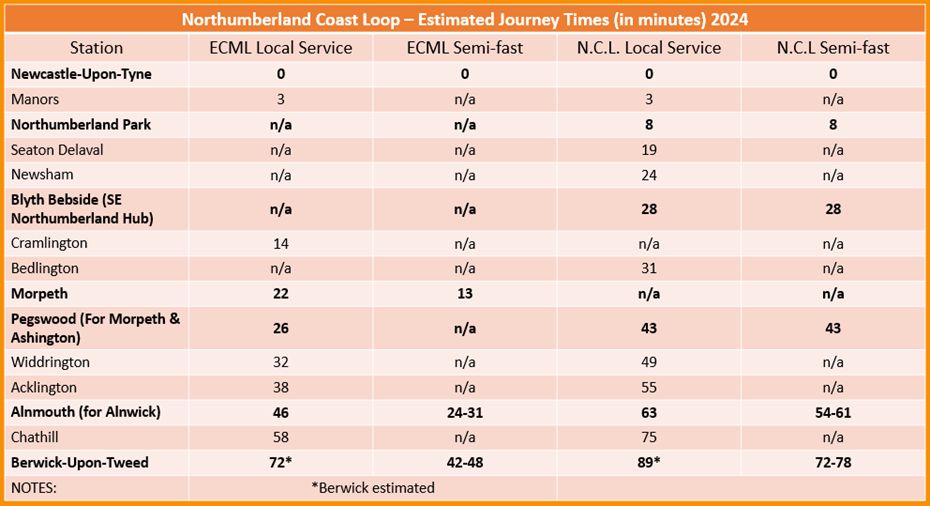
The intention for services along the Northumberland Coast Loop would be a mix of local trains (stopping at all stations en-route) and ‘semi-fast’ that call at some key places, which potentially could be Berwick, Alnmouth (for Alnwick), Pegswood (which coule be upgraded to ‘Parkway’ status fairly simply by addition of a car park), Blyth Bebside and Northumberland Park or any mix thereof.
Costs
The cost of developing this route should be comparatively minimal – the stations already exist on the ECML section of line, and will soon exist on the sections of the Northumberland Line, and no new stations are planned as a direct result of this scheme.
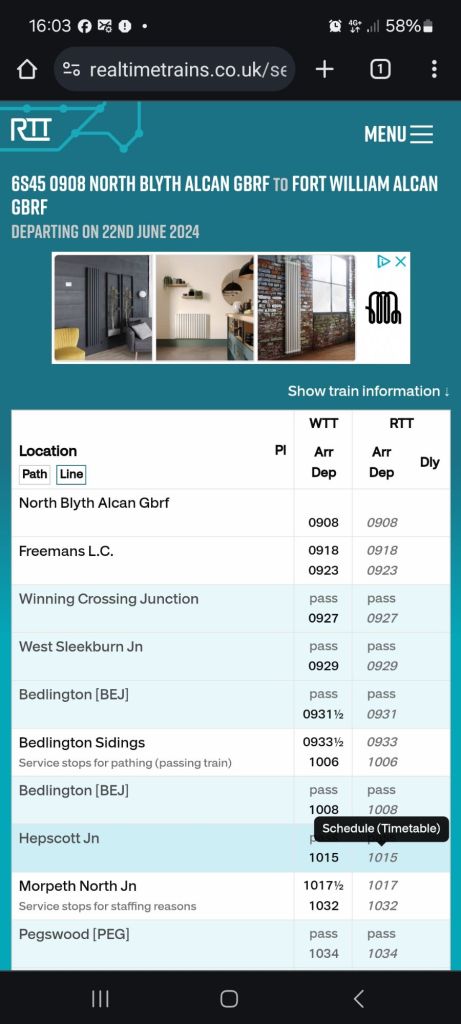
Therefore the only costs would be in upgrading the route to handle passenger services; with both the ECML and N’land Line both passenger carrying lines now/in very near future, this would only leave the section between Bedlington and Pegswood to upgrade, with that also being utilised by Morpeth – Bedlington services potentially. This means the only specific section of line required would be the Morpeth North Curve which is about 1.4km/1mi in length with only one foot crossing (roads are bridged over the line).

Single Seat Trips
This would mean rather than having to travel to Morpeth or Newcastle to catch services, passengers could instead board or alight at a much closer local station, and enjoy reduced journey times alongside greater comfort and convenience of single-seat travel or a very short connection (i.e. Ashington to Blyth Bebside).
Would Blyth Bebside be better than Morpeth?
The soon to reopen station at Bebside might be almost perfectly placed to serve South East Northumberland, being in close proximity to the A189 ‘Spine Road’, which connects towns such as Ashington, Newbiggin, Bedlington Station, Cramlington and into North Tyneside as well as the A193 which is a major bus route in and out of Blyth and links the ‘top end’ of Bedlington (surrounding the Red Lion pub) to Bebside. Not only that but the station is near to existing active travel routes, and could easily be better connected to likes of Cramlington with some tactical upgrades to Hathery Lane, and to Bedlington via Furnace Bridge and existing the National Cycle Route 1.
As a stop for both local trains on the Northumberland Line and proposed mix of local and semi-fast services on the Northumberland Coast Loop, Blyth Bebside could be ideally placed as a ‘hub’ for the area and would work well alongside the existing hub at Morpeth, with the benefit of being surrounded by Blyth, Cramlington and Bedlington (the 1st, 2nd and 4th largest towns in Northumberland respectively).
Energising Blyth
With the huge investments (tens of millions of £’s) into Green Energy businesses in the Blyth Estuary, having this area connected via long-distance trains would surely complement this nationally important investment by providing connections to the rest of the UK?
Northumberland Park for North Tyneside
Similarly, Northumberland Park would arguably make an excellent ‘hub’ for connecting the North Tyneside area without the need to travel into central Newcastle by Metro, bus, taxi or driving and instead connecting at an ‘edge of city’ site.
Northumberland Park could also be part of wider international connections, with the Port of Tyne being a major ferry connection across the North Sea that serves not only the North East but also Scotland (no similar ferry connection from Scotland to Europe), which has the mutual benefit and ‘virtuous circle’ of better rail services helping develop enhanced ferry connections and vice versa.
This aspect is highlighted by Steve Marsh in this video where he travels to Port of Tyne from Edinburgh to take the trip.
This station could also be a good location for incoming cruise lines to have onward rail connections to sites such as Alnwick/Bamburgh Castle and more which are common cruise line destinations, and would be served by Alnmouth Station in the short term and Bamburgh better served by the proposed Belford Station in future.
As a small campaign with limited funding (self funded), research has been limited to freely available polling so far.
However, from 481 respondents to a public Facebook poll in December 2023 returned the following results:
307 persons (63.8%) said ‘Yes – I would find it useful’,
Maybe/Don’t know recieved 48 votes (9.9%) and finally,
No – I would not use it at 126 votes (26%).

The above results imply that further, broader research is warranted to either confirm above basic survey or to dismiss the results.
If you believe this route should be investigated further, please contact your local elected representatives by post, email, phone call or in person to discuss the ideas raised, and share this post to your social media too.
Thanks for reading, RH.