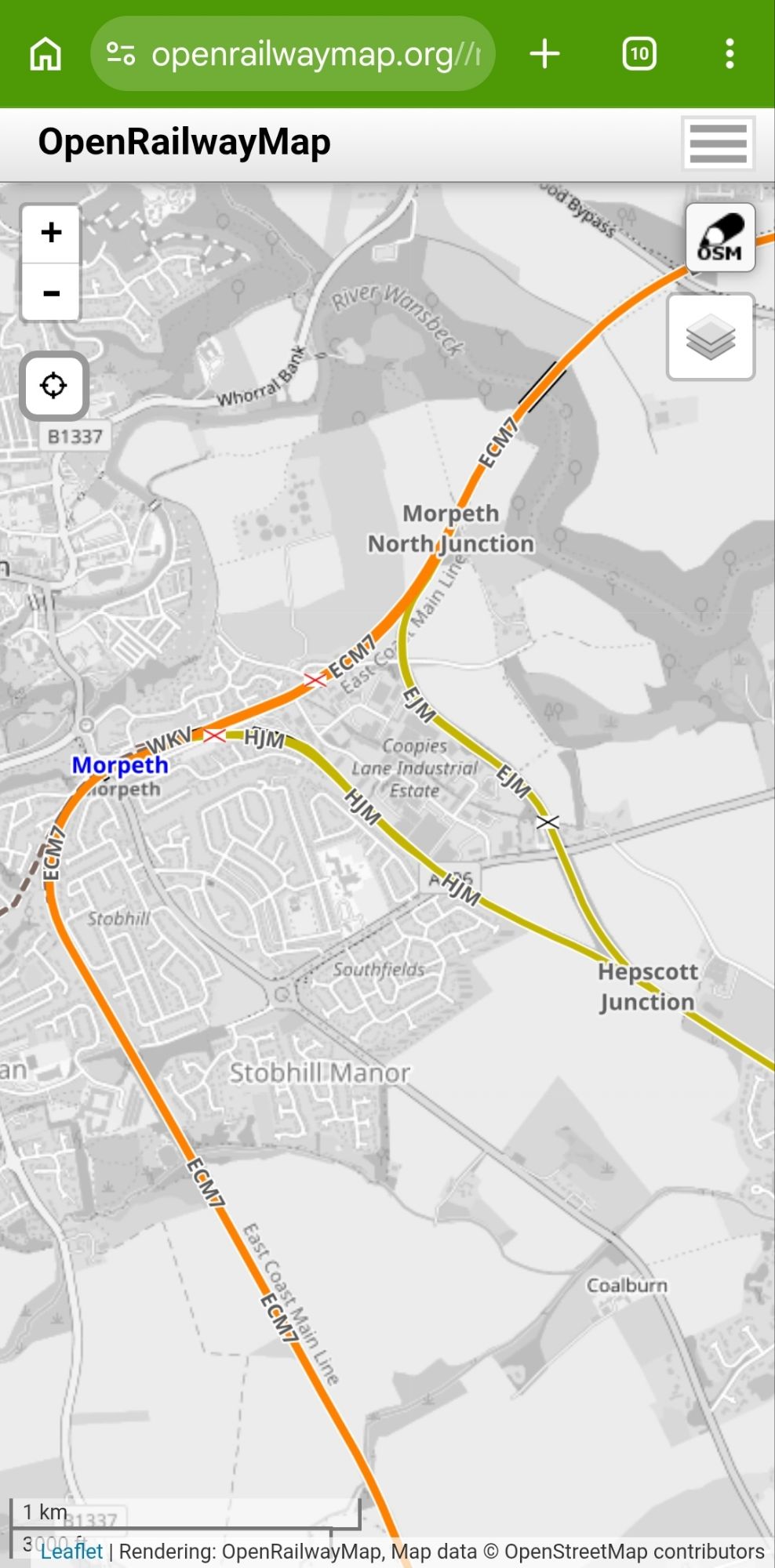
Following an interesting discussion on a recent post about funding £300,000 toward feasibility study for the extenstion of the Northumberland Line to Newbiggin, and suggesting that the Northumberland Coast Loop could benefit from a similar study; there was some need to address the ideas at play at Pegswood, and the connections at Morpeth.
First though, an explanation for those not already familiar with the proposed Northumberland Coast Loop.
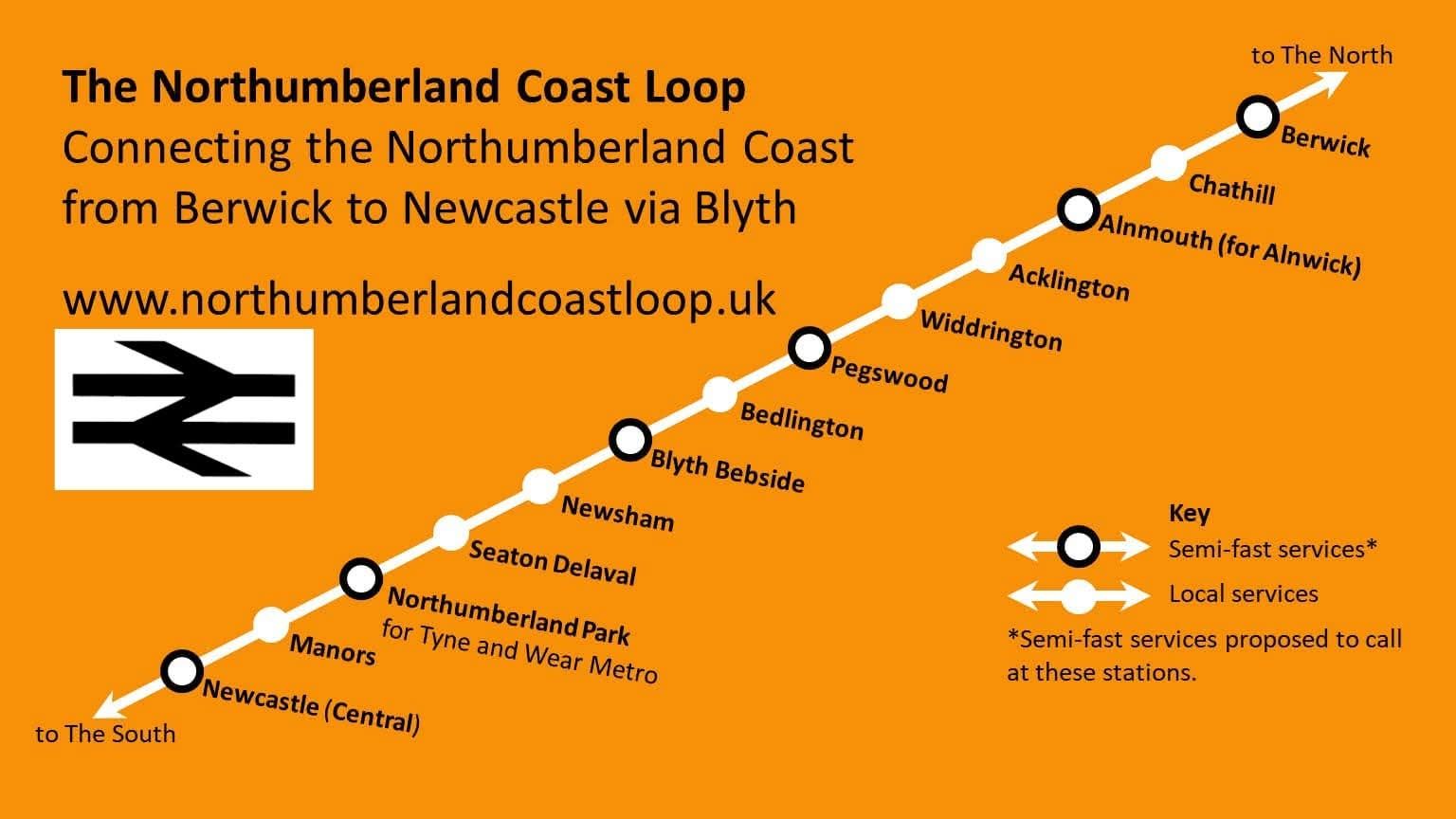
The Northumberland Coast Loop route is a proposed long-distance, semi-fast rail link between Newcastle Upon Tyne and Edinburgh via Blyth, as well as a complementary local service between Newcastle and Berwick Upon Tweed via Blyth.
This route would offer direct rail links for areas such as North Tyneside (via Northumberland Park), and South East Northumberland (via Blyth Bebside), to reach Scotland and North Northumberland on a single seat trip; faster and more convenient than the current via Newcastle Central route which takes people many miles in the wrong direction to then make a connection onto a northbound service, or needing to travel to Morpeth to make connections, which presently is poor by either having to drive, or catch slow bus services which fail to reach the station itself.
It also offers a capacity boost on the Northumberland Line by widening up the types of train used between Blyth and Newcastle, and by makimg use of current ECML trains could be implemented quickly and cheaply too.
The Morpeth Triangle
To help explain the service proposals, here is a hand drawn map of the rail routes as they stand today, with the addition of two proposed bay platforms, one at Morpeth, and another at Pegswood. Apologies for my handwriting in advance; I have sausage fingers!
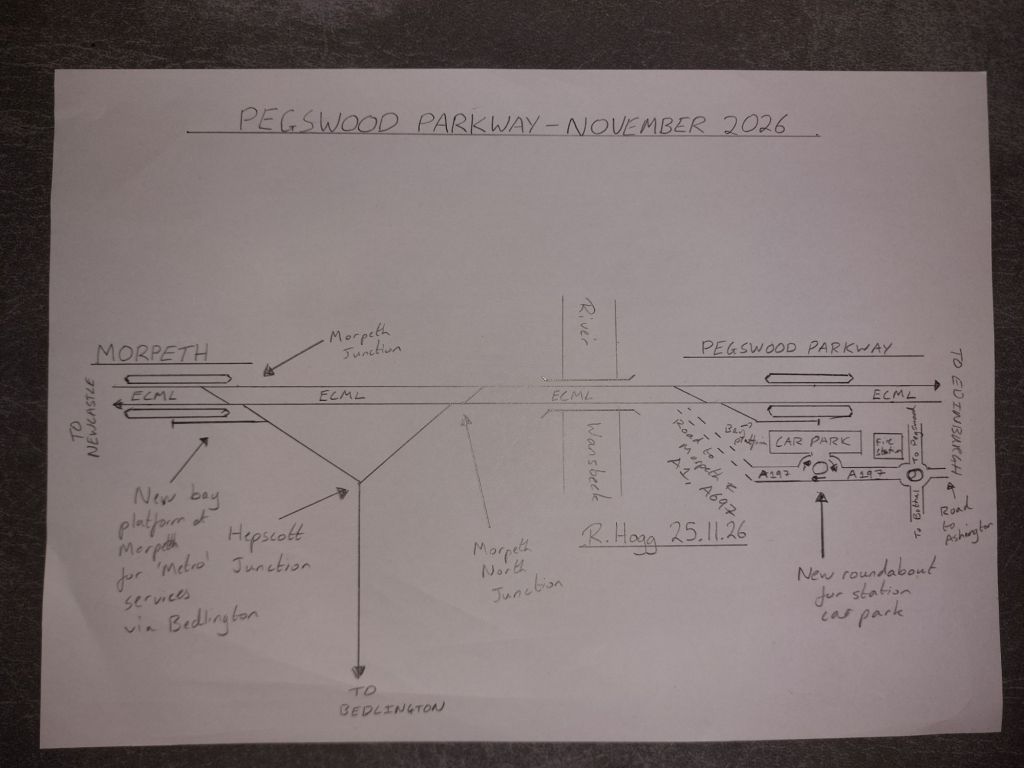
For clarity, some infrastructure such as loops and sidings have been omitted.
Morpeth to Pegswood
This first side of the triangle is part of the well known East Coast Main Line (ECML), and is something that most readers are going to be familiar with; in the area around Morpeth it is mostly two track, and runs between Newcastle and Edinburgh daily carrying dozens of trains and thousands of passengers.
Starting at Morpeth; either starting away after a station call, or after squeaking around Morpeth Curve non-stop, the train will pass over the River Wansbeck and usually pass straight through Pegswood en-route north, or vice versa heading south, with Pegswood unfortunately one of those stations that sees only three stopping services in each direction between Monday and Saturday, with no Sunday services at all.
Less familiar might be the route leading off the ECML here which leads to Bedlington, now on the Northumberland Line, and there are two potential routes to/from Bedlington, forming a triangular junction.
Morpeth to Bedlington
The second side of the triangle starts at Morpeth station, leaving the ECML at Morpeth Junction and heading towards Hepscott Junction, then through the site of the former Hepscott station, continuing on to Bedlington Junction where this line meets the Northumberland Line at Bedlington Station.
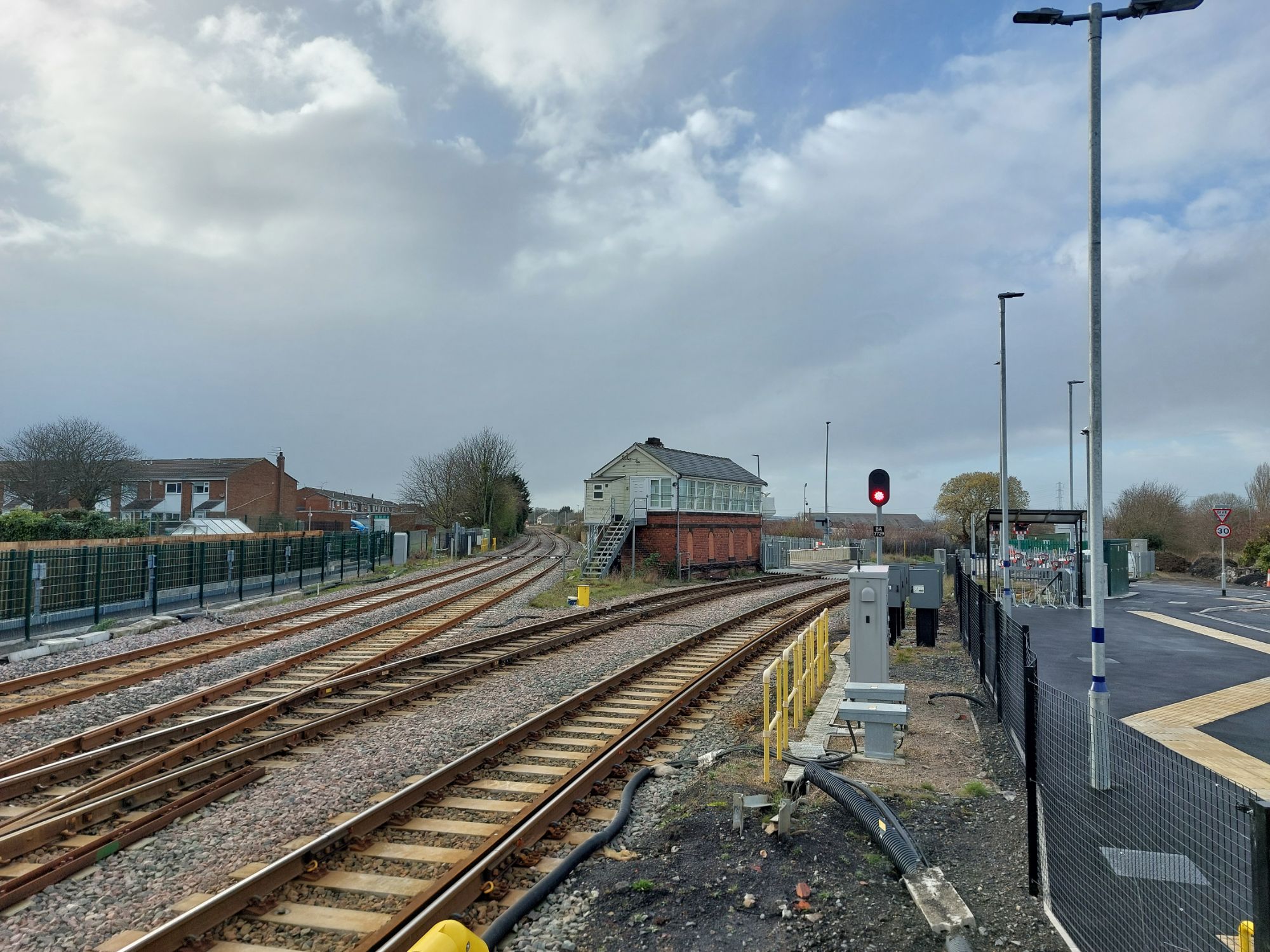
This route is proposed by SENRUG for the extension of the current Newcastle to Morpeth ‘Northern’ service on to Bedlington, where it would reverse and then run back to Newcastle via Morpeth; though I would propose some alterations to this.
This route also forms part of a large ‘balloon loop’ north of Central Station by going north on the Northumberland Line to Bedlington, west to Morpeth, then south again to Newcastle, and is often used by loco hauled railtours (especially steam locomotives) to turn the loco and carriages without the need to shunt the train somewhere, and thus allows the locomotive to remain ‘chimney first’ for the next leg of the trip.
This is, however, the reason why the Northumberland Coast Loop route doesn’t serve Morpeth station, as it would require the train to reverse direction in Morpeth station in each direction which is not viable due to how busy the ECML is. Prior to the building of the Morpeth North Curve in the late 1970’s, this was done by special trains, as well as freight, but now they can go directly from Pegswood to Bedlington, the third side of the triangle, outlined below.
Pegswood to Bedlington – The Nortumberland Coast Loop route
A much less commonly used route by railtours or other passenger trains at present is the third side of the triangle, which connects to the ECML at Morpeth North Junction, which is near to the viaduct carrying the ECML over the River Wansbeck.
This link was built in the late 1970’s, opening in 1980, and allowed freight and diverted passenger trains to avoid the awkward reversal in Morpeth station, and instead travel directly from Pegswood to Bedlington or vice versa. As shown below by the movements of ‘Ocean Swell’ running from Whitley Bay to Glasgow in the 1960’s.
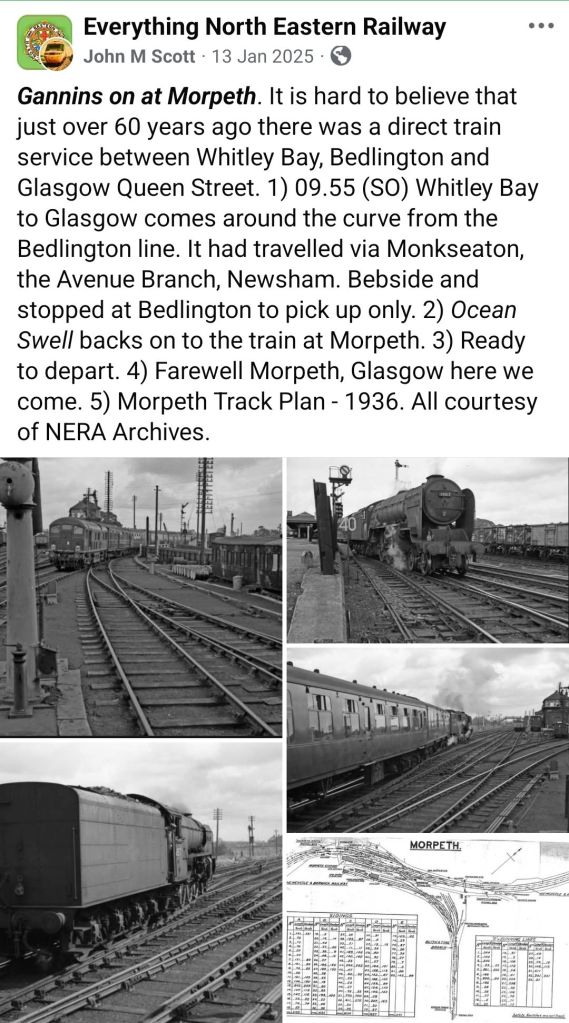
When this new link opened, unfortunately the stations on the ‘loop’ via Blyth had closed around 16 years earlier, with only the platform at Bedlington remaining standing; so it wasn’t really used for passenger trains aside from railtours and diversions when the line via Morpeth was closed, but now with the Northumberland Line open and thriving, there is a clear case for the route to offer a ‘through SE Northumberland’ semi fast and local service, and offer direct ‘Blyth to Berwick’ or ‘North Tyneside to Edinburgh’ services for the first time.
This would also bring in the potential to use Pegswood station in a much more effective way; since the Northumberland Coast Loop rains can’t serve Morpeth station, they could instead call at Pegswood, which indirectly would serve Morpeth, as well as Ashington, and the surrounding area, but if upgrading Pegswood for this use, it perhaps can also serve a wider role, which is outlined below.
Pegswood Parkway – An overlooked strategic station?
As Pegswood station stands today, somewhat forlorn due to the lack of services, it consists of two, fairly short platforms and ‘bus stop’ style shelters, with ramps leading up to the main road.
Pegswood is, however, arguably in a highly strategic position; the road over the ECML, where Pegswood station connects to is served by the very frequent No. 35 bus, that runs from Morpeth Bus Station through Pegswood to Ashington and then Woodhorn, giving the bus route a great catchment area to the north of the River Wansbeck.
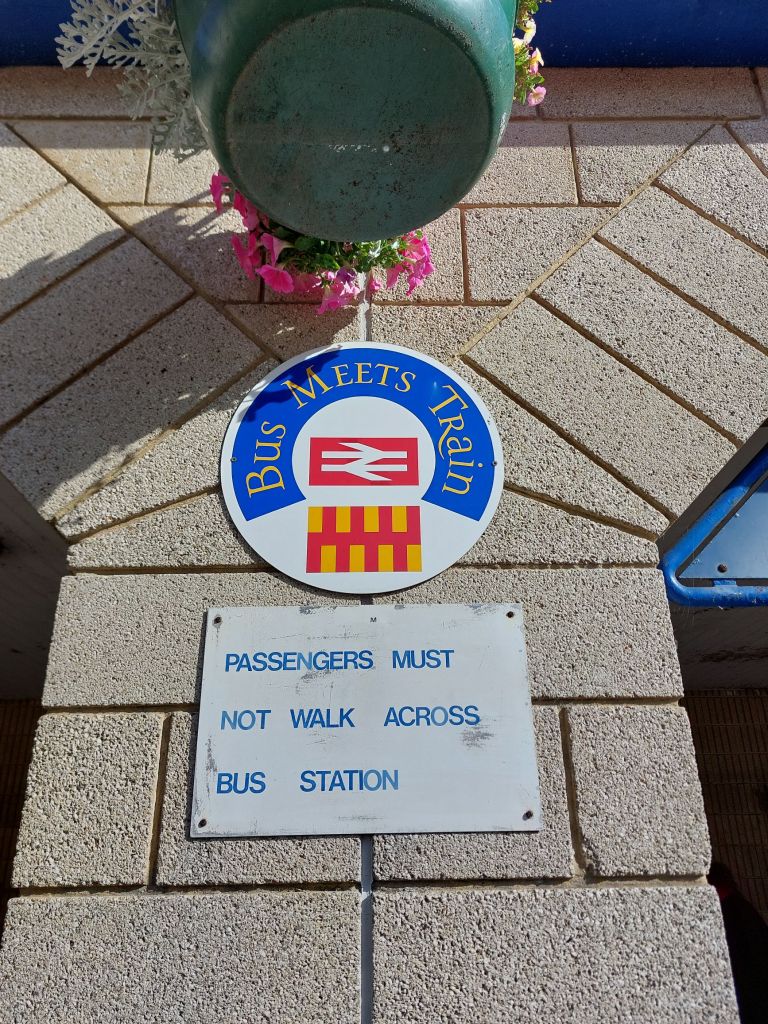
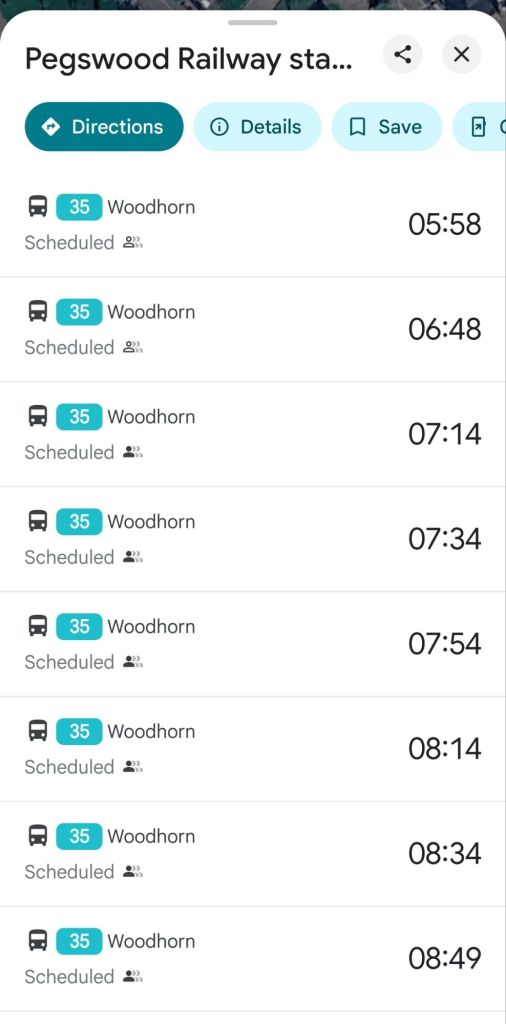
Bad bus connections at Morpeth Railway Station, whilst Pegswood is well placed for an becoming a bus/rail interchange.
This is important as bus connections between Morpeth Bus Station and Morpeth Rail Station tend to be fairly poor; only the No. 2 & 43 buses run to Shields Road (A192) bus stop near the station, and traffic in Morpeth, particularly over the Telford Bridge can be very heavy causing delays to buses regularly, and there is has been a very long standing issue with buses not serving the turning circle at Morpeth station as exiting Coopies Lane onto Shields Road means buses can be stuck waiting on a space or being ‘let out’ by queuing motorists.
This could be partially fixed with addition of traffic lights and bus priority measures, but this would likely prove to be unpopular in Morpeth to say the least.
In contrast, traffic through Pegswood is very light, and with the bus route already very close to the station, could make it an ideal interchange immediately with the No. 35, but with a slight diversion of the X18 to loop around the ‘Robin of Pegswood’ roundabout, could also interchange directly with that service too.
Plenty of parking opportunity at Pegswood, and easy access from the Pegswood Bypass
Another aspect of Pegswood station is there is room to build ample car parking nearby; with a potentially ideal site just to the west of Pegswood Fire Station, which would have direct access to and from the A197 Pegswood Bypass, itself well connected to the A1, A697, and A1068 and a number of other roads, meaning that road traffic would remain out of town and not be drawn into Pegswood itself.
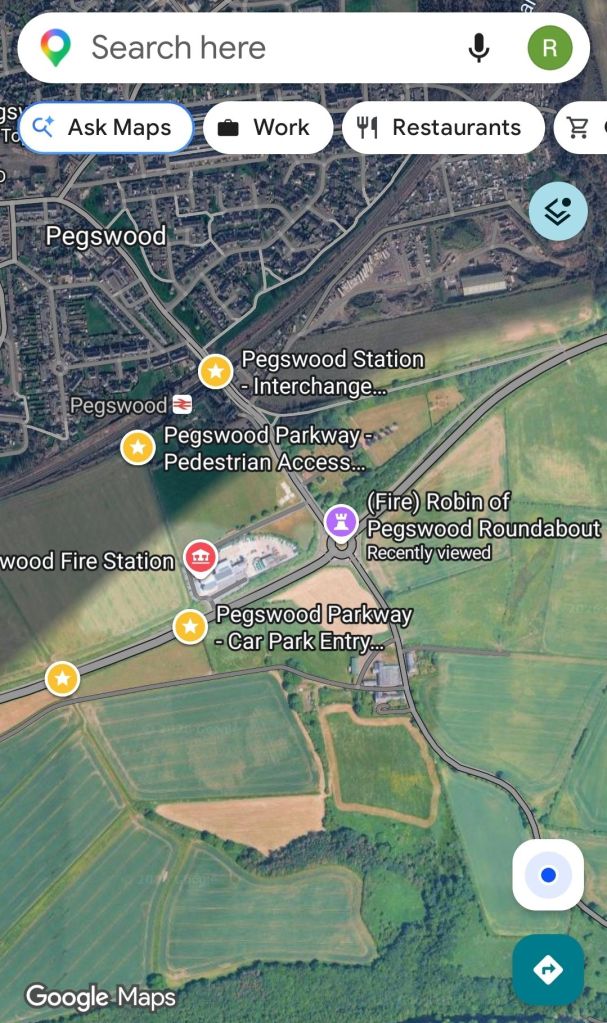
A new roundabout west of the ‘Robin of Pegswood’ roundabout could be used to access this new car park, outlined on the hand drawing.
Three platforms for Pegswood?
At Pegswood, investment would be needed to correct platform height and offsets (presence of a Harrington Hump shows the platforms are too low), as well as lengthening of them to fit full length trains such as the Class 80x fleet at 9-11 car lengths, and likely inclusion of a new footbridge and lifts at the western end to serve the new, large car park, which would also need to be built.
With large volumes of housing being built on the northern side of Morpeth, such as around Northgate, and St Georges, and known issues with traffic over the Telford Bridge, investment in Pegswood to transform it into a Parkway for easier access to rail services would be a major boost, as well as the anecdotal evidence that suggests people from more rural parts of Northumberland like Longframlington are using Ashington station to head into Newcastle due to free parking and low cost rail fares.
Creating a similarly served station at Pegswood would help reduce the need for people to drive into Ashington to catch a train into Newcastle, helping to reduce the large volumes of traffic using the A197 into Ashington.
I would also suggest the inclusion of a third platform, forming a bay facing southwards; my rationale for this would be to allow dor a more intensive Newcastle – Cramlington – Morpeth – Pegswood service, ideally on a half-hourly ‘clockface’ schedule similar to the Northumberland Line, and having similar fares too. The link across to Bedlington and beyond would be fulfilled by other services using the Morpeth Bay, outlined later.
This would vary the SENRUG proposal to extend the current Newcastle to Morpeth services on to Pegswood rather than Bedlington; the reason for this being that a Pegswood Parkway could act as a park and ride not only for Morpeth, but also for Newcastle, with a large, easily accessed car park at Pegswood helping reduce stress on the A1 and other road routes into Newcastle, whilst also boosting the local service at Morpeth and Cramlington.
Morpeth Bay – ‘Metro to Morpeth’
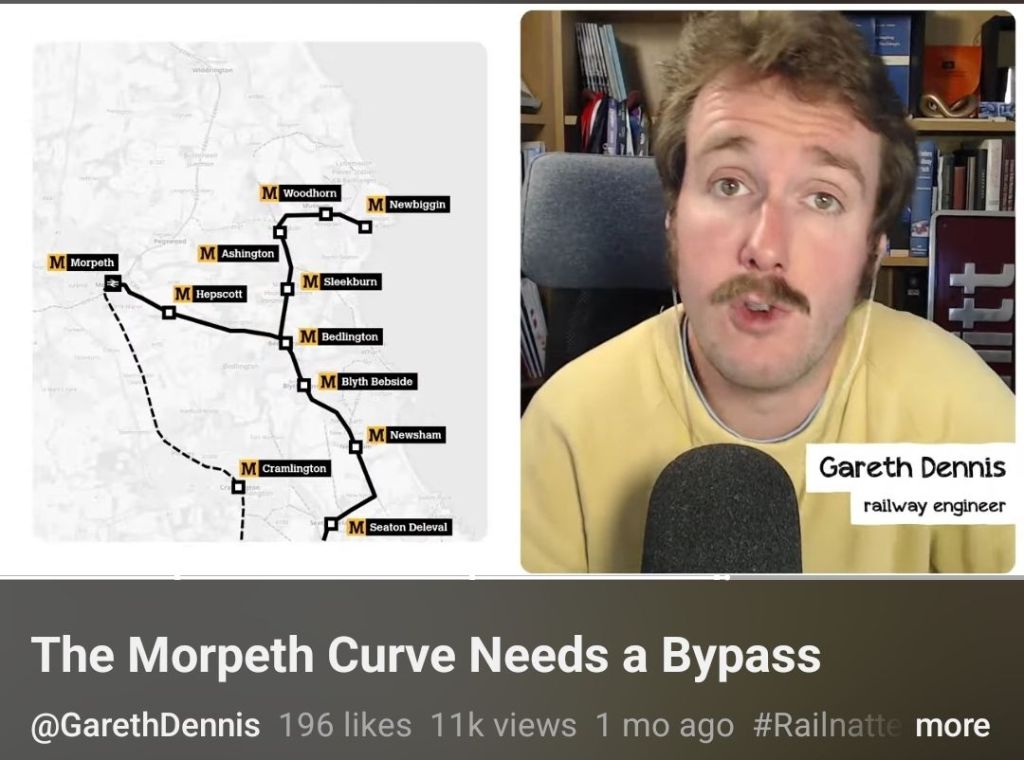
A rebuilt Morpeth Bay platform, which existed into the 1970’s would allow for Morpeth to regain status as a junction for Bedlington, Blyth, and beyond.
Rather than the SENRUG idea of running trains through Morpeth to reach somewhere like Bedlington to then return, I would contest that a bay terminus at Morpeth is better as isolation from the ECML will allow a higher frequency service to operate, and will cope better during any disruption such as engineering works as it should be possible to keep one route open as normal if the other is closed or running with serious disruption.
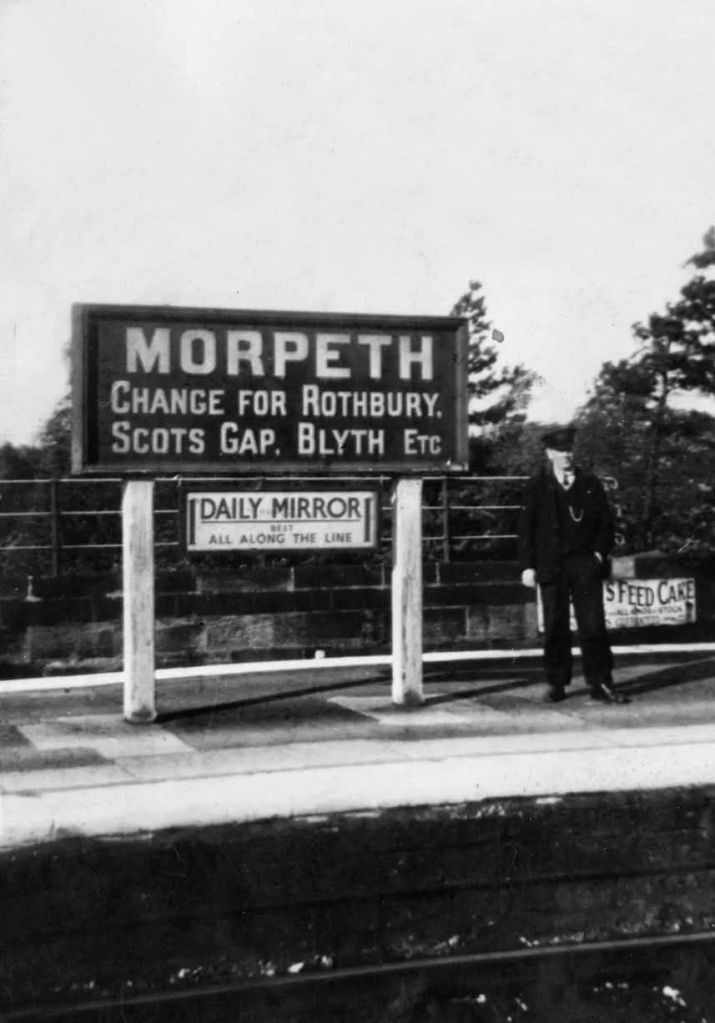
As outlined by Gareth Dennis in Railnatter 322, a new bay platform at Morpeth could help enable a ‘Metro to Morpeth’ service; in my view it would be a dual voltage variant of the Class 555, able to run on the mainline standard 25kV AC as well as the 1500v DC of the current Metro network, and would be kept separate from the ECML, but would allow a direct link onto the Metro network at/near Northumberland Park to be made, and could offer routes such as Morpeth to Airport/South Shields/South Hylton.
This would offer a huge number of new direct connections and easier interchanges to elsewhere on the Metro system, and would boost the capacity of the Northumberland Line too, with one Class 555 able to carry around 600 passengers when full.
In my view the former ‘Blyth and Tyne’ lines that make up the Northumberland Line, Bedlington to Morpeth/Pegswood Lines and the Cambois branch should be reserved for 25kV AC mainline standard and not wired at 1500v DC as the route has heavy freights, and the Northumberland Coast Loop is intended in the longer term to be all electric rather than bi-mode, and to run InterCity, 25kV AC is the way forward, and would be seamless to/from the ECML.
Losing parking at Morpeth for a more productive third platform
The bay platform at Morpeth station would ideally be built where it used to be, which is now taken up by the Northern car park; this would result in some parking at Morpeth being lost; BUT long stay spaces at stations are a poor use of space compared to a platform.
For example, the row of car parking spaces nearest the track would likely be lost, with the other side adjusted to remain, so a loss of 29 spaces would be expected.
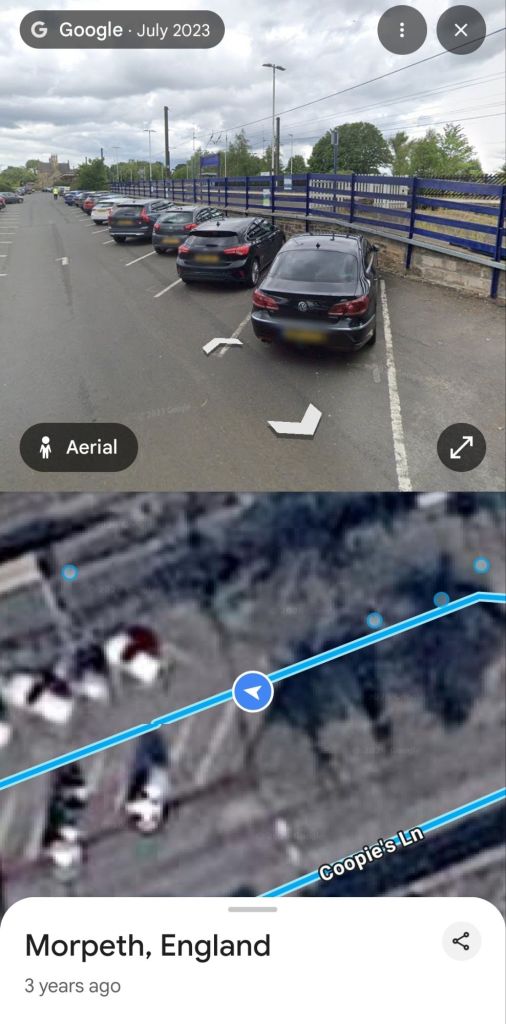
Those 29 spaces would be used by a minumum of 29 people per day (one driver staying all day), with a likely maximum of around 200 per day (full family cars and some turnover of spaces throughout the day).
That means a fairly small group of people being displaced to alternative car parking (which could be found elsewhere in Coopies Lane industrial estate if a business such as Jewsons relocated and site used for parking), but that would be approximately just one full train load of passengers entering Morpeth from the east, and over the course of the day would translate into hundreds and potentially thousands of rail passengers.
The latest passenger figures for Ashington, a single platform bay platform has come back at 0.437m passengers in 2025/26, this compares favourably with the estimated annual passengers parking which is probably in the range of 10,556 (29 people per day x 364 days) to 72,800 (200 people per day x364).
It is important to note that these passengers currently parking at Morpeth might be very willing to use an expanded Pegswood; NCC could offer cheaper or free parking as an incentive to use Pegswood station, as well as the additional ease of getting to Pegswood for a driver. Also, some may currently be driving to Morpeth from places such as Bedlington or Blyth, and may make a modal shift onto a rail service if one becomes available into Morpeth station itself.
If Pegswood was priced inline with Alnmouth, it would cost £2.50 for 24hrs of parking; a £2 daily saving compared to parking at Morpeth whilst still returning revenue to NCC to help recover car parking costs, a cost to users of around 11p per hour.
At present, the NCC operated south and west car parks at Morpeth station charge £4.50 per 24hrs, £9 for 48hrs, and a maximum of £13.50 for 72hrs, a charge per hour of nearly 19p, whilst more time resticted town centre parking elsewhere in Morpeth is free to use by motorists.
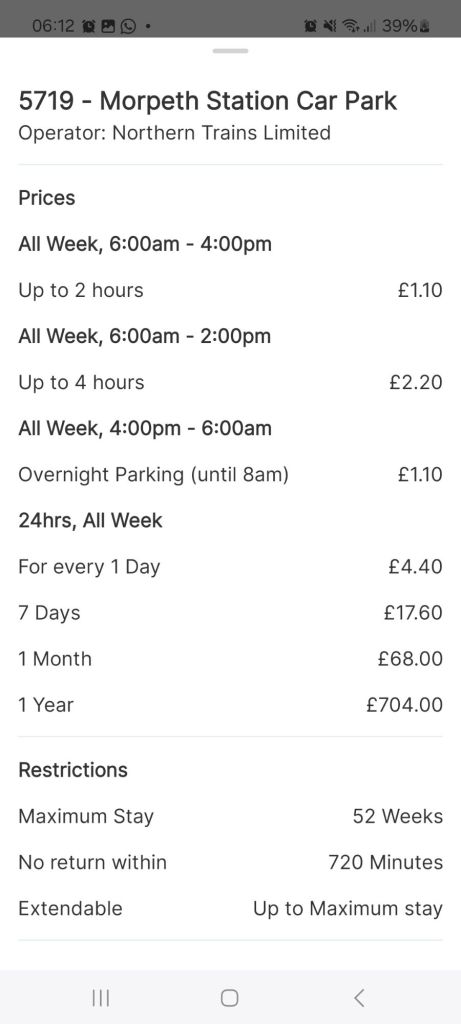
The Northern car park at Morpeth, and the one effected by the proposed Morpeth Bay is slightly cheaper than the NCC car park, as shown below, with a per 24hr charge of £4.40, just over 18p per hour.
The Morpeth Diversion
These changes to services would be further supported if the Morpeth Diversion (Rail Bypass) was to be finally built having been suggested by HM Railway Inspector Captain Henry Tyler way back in 1877.
Returning once again the the Railnatter 322 episode (a clip from it shown below), an alternative route for non-stop passenger and freight trains would release capacity in both Morpeth and Pegswood stations, as well a releasing capacity on the respective junctions.
The Morpeth Diversion would allow more stopping trains at Pegswood and Morpeth, by allowing non-stop express services and railfreight to avoid the station.
The tight and dangerous Morpeth Curve has been incompatible with a major route between London and Edinburgh since it was built, but on an increasingly fast and busy ECML, it is increasingly at odds with it as time progresses and train speeds and frequencies increase.
As always, please leave your thoughts in the comments!

