
Following a spate of recent serious incidents on the A1 in Northumberland, a new safety campaign called ‘NASA’ (Northumberland A1 Safety Alliance) has formed.
While making the A1 safer is undoubtedly an admirable and much needed aim for everyone, is using the parallel ECML being overlooked as an option to reduce traffic on the A1 and transport people and goods in much greater safety?
NASA: Northumberland A1 Safety Alliance


Taken from their Facebook page, the campaign intends compile a record of incidents and the promises made for improvements.
NORTHUMBERLAND A1 SAFETY ALLIANCE (NASA)
It shouldn’t be rocket science.
Over the coming months, NASA will compile and publish the definitive 10-year safety record of the A1 through Northumberland.
We will document:
- Fatal collisions
- Serious injuries
- Collision locations
- Road conditions
- Safety concerns raised by communities
- Promises made by authorities
- Progress made – or not made
This is not a political campaign.
This is not a blame campaign.
This is an evidence project.
Too many people have lost their lives. Too many families have been affected. Too many questions remain unanswered.
If you have information, reports, photographs, local knowledge, historical records, media coverage or personal experience relevant to A1 safety, we would like to hear from you.
Our aim is simple:
To produce the most comprehensive public record ever assembled on safety along the A1 through Northumberland.
NASA
A1Safety
Northumberland
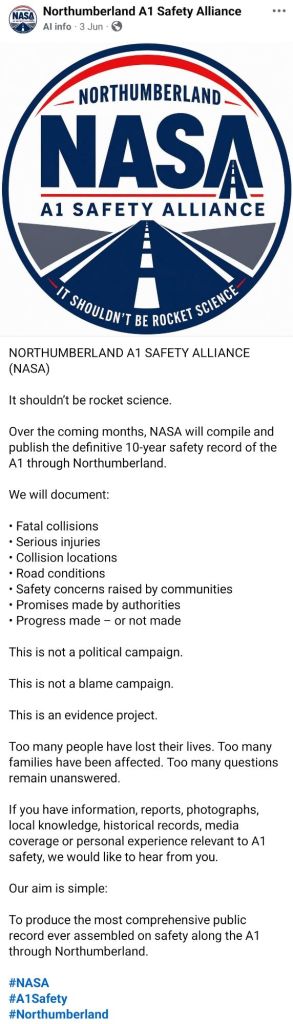
The above is certainly an admirable project; get a data driven analysis of where particular ‘hot spots’ are on the A1 and what type of incidents occur at those locations, and what might be done to rectify these junctions or sections of road to make them safer.
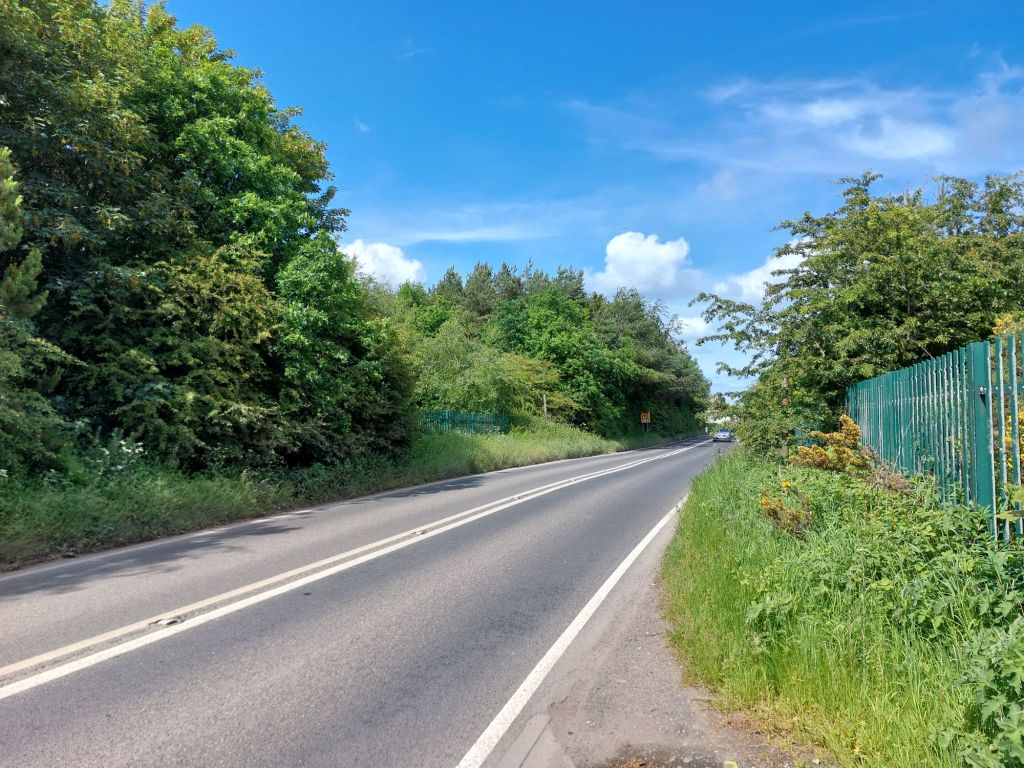
As a regular driver of the road personally, there are many places from my own experience that are dangerous places where extra vigilance is required, for example the Swarland & Guyzance junction, where when passing a couple of days ago, a van was sitting in the central reservation, but timber tied to the roof rack was overhanging the southbound fast lane substantially.
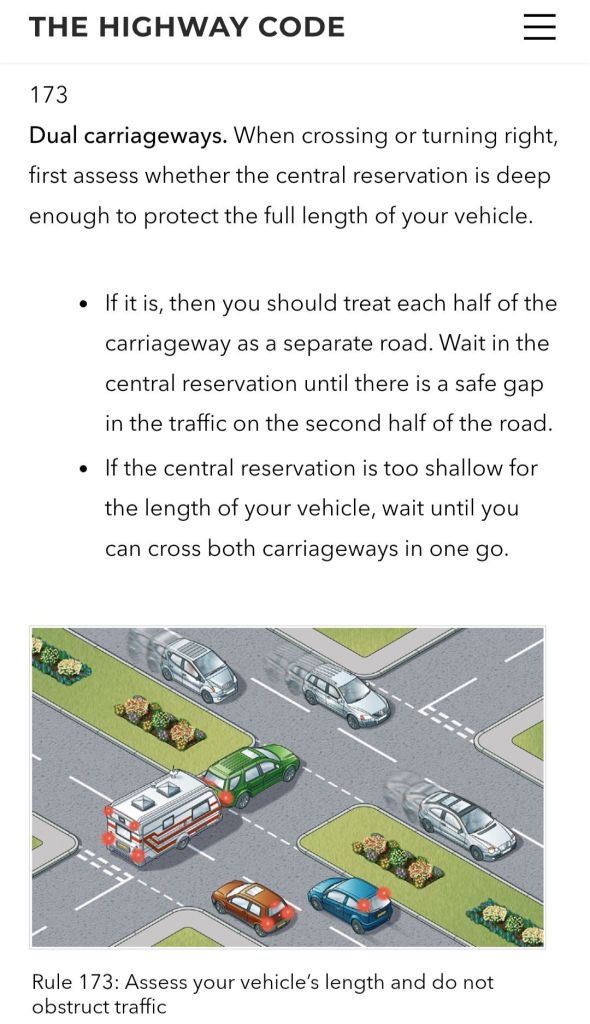
In many cases, it is likely that substantially rebuilding many of the outdated junction designs will be needed, with flat junctions on dual carriageways such as that illustrated in Rule 173 of the Highway Code being of a very outdated design and unfit for most dual carriageways in the 21st Century.
With every reported incident, the comments pour onto social media about what should be done; ‘Dual the A1 to Scotland’, ‘the slip roads are not long enough where the A1068 joins the A1 at Alnwick’, and so on, but these are not without major challenges.
Dualling has major drawbacks
Dualling just 13 miles of the A1 between Morpeth and Ellingham was forecast to cost £500m back in 2024 when the scheme was cancelled by the current Government, but had been ‘promised’ repeatedly for over a decade by that point with little real work done on the ground.
Dualling more sections of the A1 has several major drawbacks which is worth setting out as part of a balanced and holistic ‘bigger picture’ of transport to, from, within, and through Northumberland as a whole.
Induced demand is a well recognised phenomenon globally, as well as here in the UK, that when the capacity of a transport system increases, the use of it also usually increases as the ‘cost’ in journey time is temporarily reduced. A great local example is the Tyne Tunnel, where the original 1968 motor vehicle tunnel, with one lane in each direction, was long seen as a bottleneck on the A1/A19.
This prompted the building of a second Tyne Tunnel, which opened in 2011, the old one closing for several months to be refurbished, both of them opening in late 2011 as twin lane, single direction tunnels in ordinary operation, far safer than a bi-directional tunnel, and part of a response to the 1999 Mont Blanc tunnel fire in which 39 people tragically died, meaning tunnels around the world were upgraded with better safety systems.
However, one consequence of the second Tyne Tunnel being opened, and making the route four lanes throughout was the effect of induced demand; congestion dropped temporarily, so more people were encouraged to drive, meaning traffic volumes actually increased, and put more pressure on the next bottlenecks which were the Silverlink and Testos roundabouts, leading to those junctions needing rebuilt, and now pressure on Moor Farm and Seaton Burn is building.
The issue is that almost ALL roads feel the consequences of this induced demand, the traffic going through the Tyne Tunnels has to originate and terminate elsewhere, meaning other roads also tend to see a rise in traffic volumes, making those roads less safe.
The same can be seen elsewhere with ‘upgrades’ to the A1 around the Western Bypass for example, the road is now three lanes in many sections, but isn’t necessarily ‘free flowing’ as the traffic volume has simply grown to fill up the available capacity, but that traffic starts in places like Morpeth, Bedlington, Ashington, Blyth etc, putting more strain on roads like the A189, A1068, and more.
This additional traffic makes towns gridlocked, makes the roads less safe within towns where the traffic is starting from or coming back to at the end of the day.
Dualling a road like the A1 will lead to similar induced demand; more people will choose to drive because for a short while, the driving time will reduce, but that will put more pressure onto other roads like the A1068 within towns like Alnwick that are already very busy and makes those roads more dangerous as a result.
The Northumberland Line is a great example of induced demand on rail
This effect of induced demand is not only seen on roads, it can also be seen on public transport, and a clear example of this is the HUGE success of the Northumberland Line, which despite its challenges in getting completed has blown all expectations of usage out of the water with it likely to be rapidly approaching two million passengers based on passenger figures so far.
Has modal shift already happened on the A189 Spine Road/Northumberland Line corridor?
It would be interesting to see if the opening of the Northumberland Line, and its huge passenger numbers have actually decreased traffic on roads such as the A189, which seems to have much less congestion on it than prior to the opening of the Northumberland Line; figures to prove, or to disprove this theory are welcome!
Modal shift of car drivers and passengers moving onto trains was a primary goal of the Northumberland Line, so hopefully data is available and being collected to analyse this against earlier data.
Using the ECML and Northumberland Coast Loop to cut A1 traffic in Northumberland?
9Returning to the A1, it would therefore make sense to try and use the East Coast Main Line (ECML) between Newcastle Upon Tyne and Berwick Upon Tweed to reduce congestion and traffic volumes on the A1.
The proposed Northumberland Coast Loop acting to connect SE Northumberland and North Tyneside to North Northumberland and Scotland more directly, cutting journey times and making rail a more viable and attractive option, taking the trains to the people, rather than the Beeching era notion of expecting them to drive to a more distant station, itself creating more traffic issues.
The Northumberland Coast Loop route would eliminate the need to change train at Newcastle Central Station to go northwards, doing so direct on one train, and could cur the rail journey time from Blyth Bebside to Alnmouth, Berwick, Edinburgh and other northerly destinations by around 50 minutes.
The Hepscott Line: Ready and waiting to go?
The two recent photos of Hepscott Level Crossing show the currently quiet link between Bedlington and Pegswood that the Northumberland Coast Loop route would use to send trains from Newcastle to Berwick via Blyth and Northumberland Park, a line I’ve personally travelled over on 8th March 2025 aboard ‘The Seven Counties Rambler’ railtour on the final leg of the long milage tour from Newcastle back to the end of the tour at Linlithgow, Scotland.
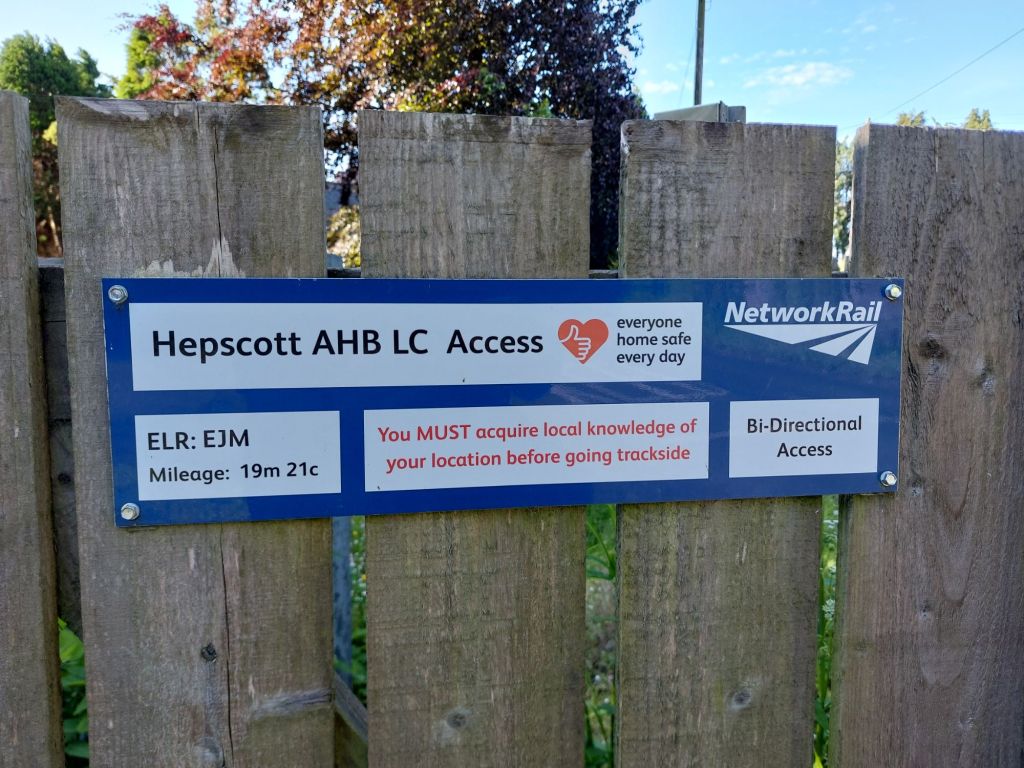
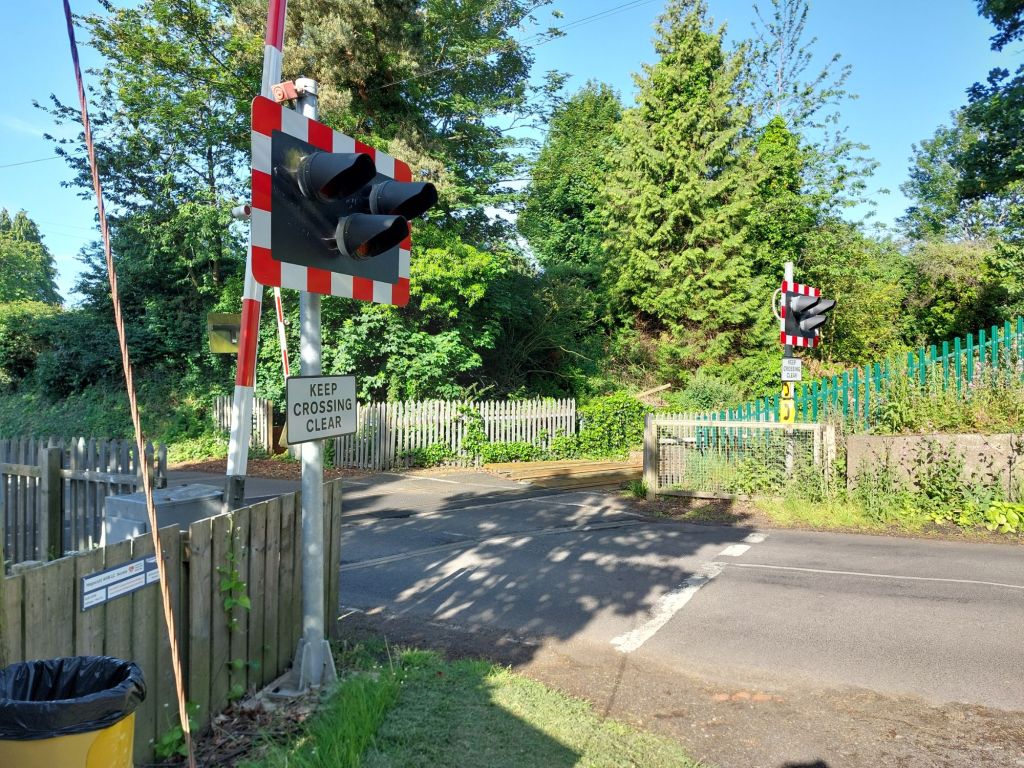
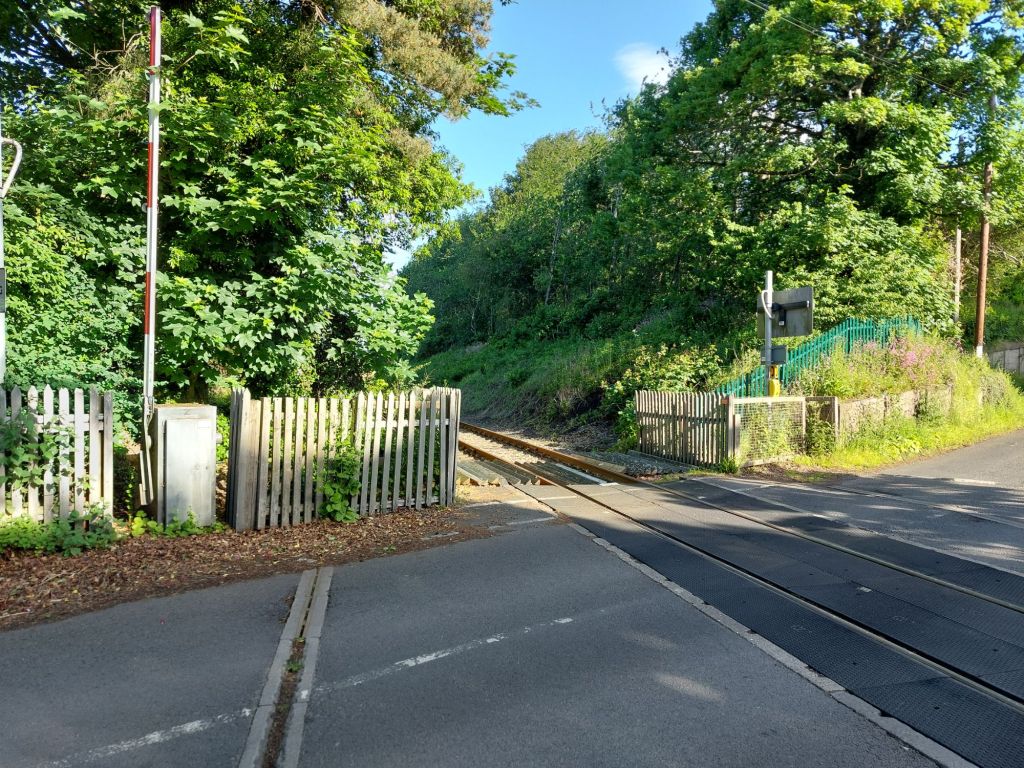
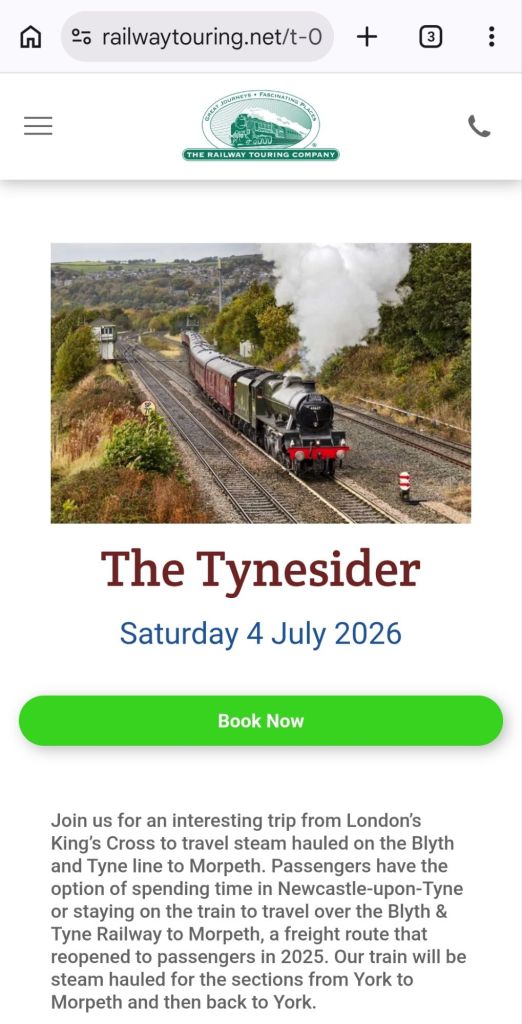
This line is clearly kept to a pretty good standard as an operating railway carrying infrequent but regular railfreight, and has some use by passenger services too, such as the upcoming ‘The Tynesider‘ railtour which will pass over this crossing headed to Morpeth on 4th July 2026.
The Butterwell Line: Future potential but derelict for decades.
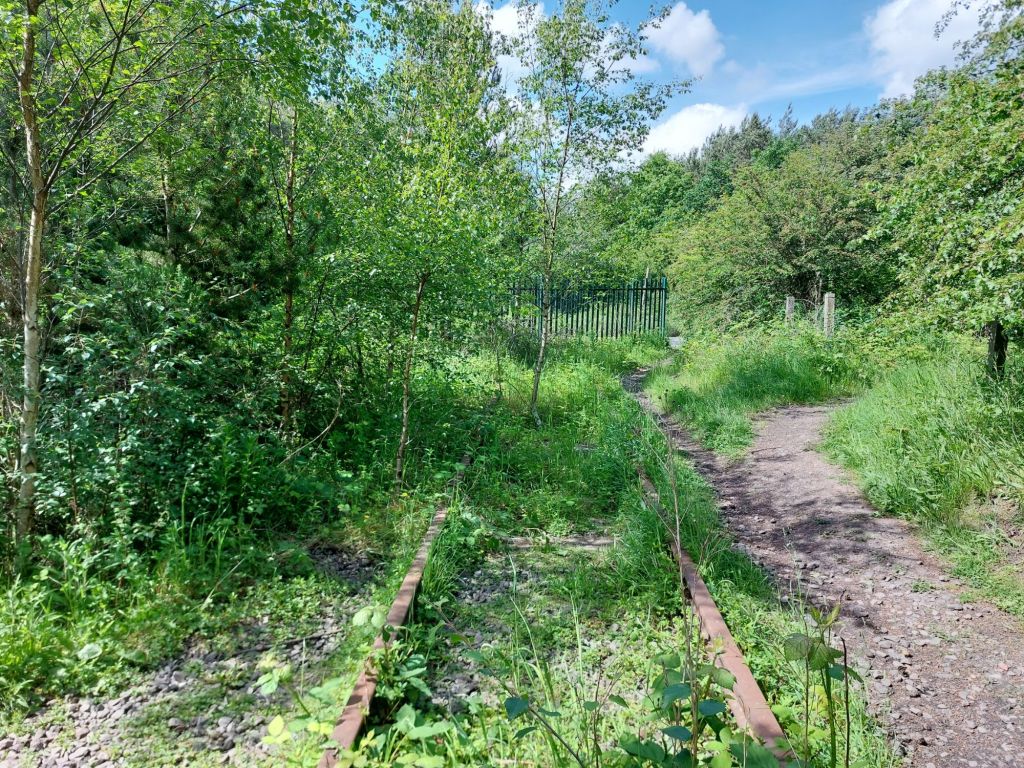
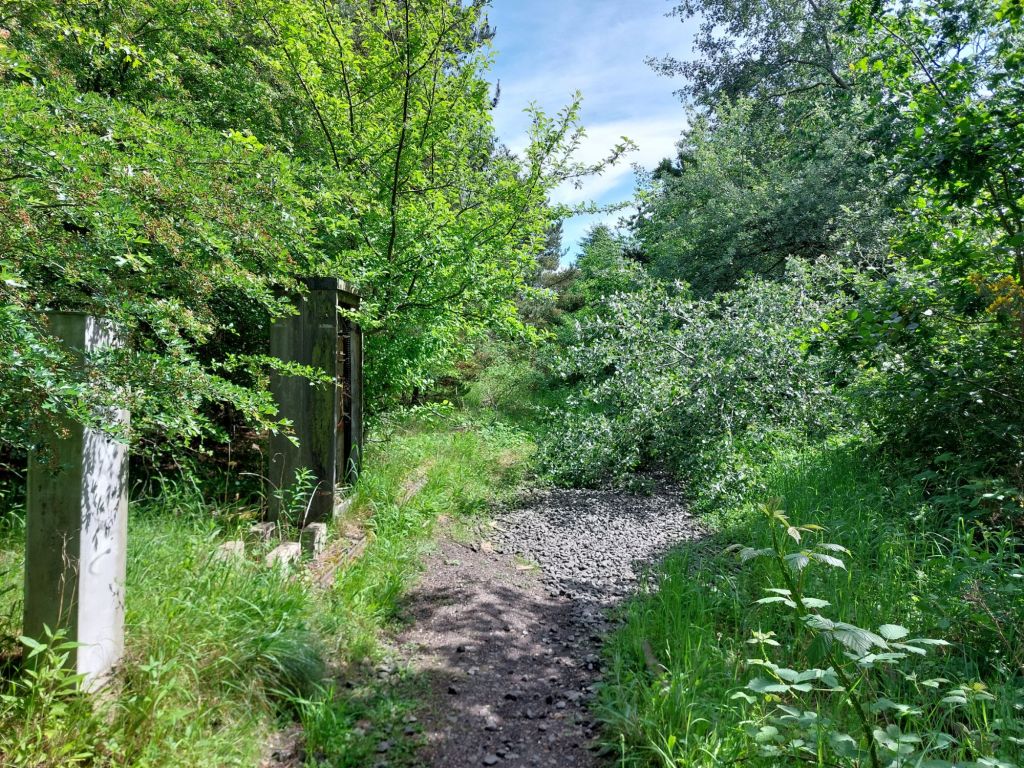
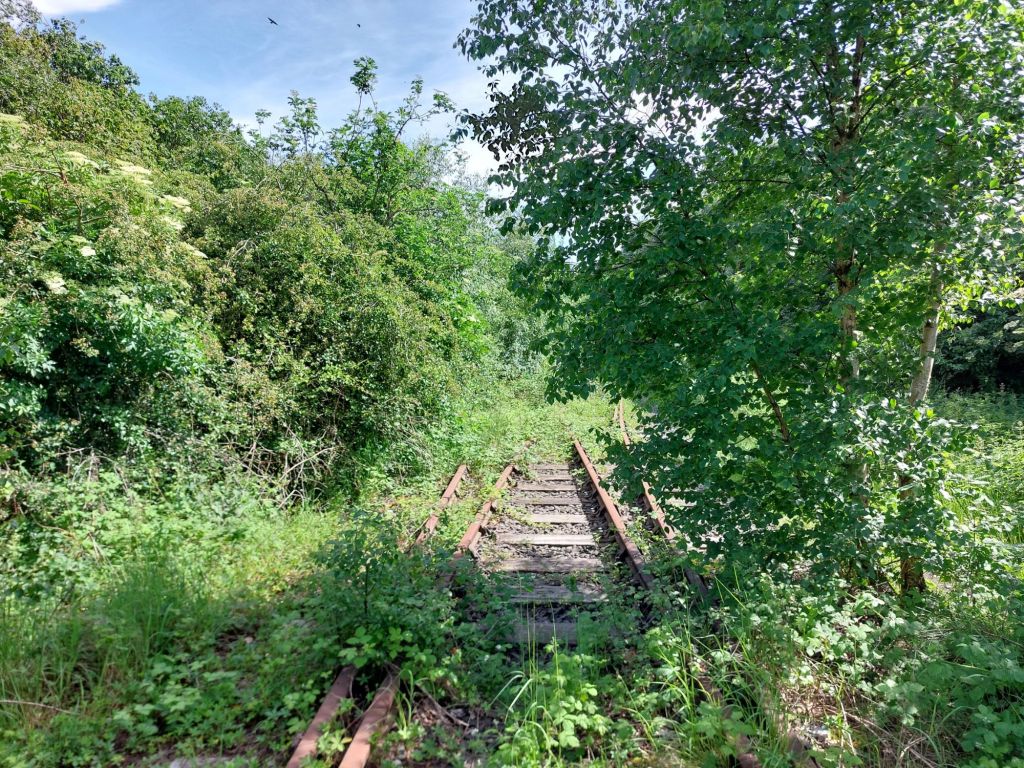
In contrast is the similar Northumberland Line to the north link via the Butterwell Line as proposed by SENRUG, but this route is clearly one that’ll need substantial work to revive long derelict sections through Ashington Community Woods (closed since c.1999-2004), and would also require a newly build curve and junction to connect trains in the right direction at the northern end.
It’s safer by train: 57 years since the last passenger fatality on a train in Northumberland.
The ECML, as well as other rail routes in Northumberland as a whole have a remarkably good safety record; the worst hotspot on the network being Morpeth Curve, which has seen four incidents in 1877, 1969, 1984, and 1994, with only the 1877 and 1969 incidents having any passenger fatalities.
That means that in 57 years, there have been zero passenger fatalities on trains in Northumberland due to derailment or collision, and since 1992 for train staff, when one driver tragically died after two freight trains collided due to a signalling error.
Even in the 1984 derailment at Morpeth, as serious as the incident was didn’t result in a fatality.
These extremely rare events showcase just how safe rail travel is compared to road travel, where incidents sadly occur almost daily.
Modal shift to save lives?
Therefore, it surely makes sense that any review into safety on the A1, and how it may be improved should also take into account the benefits of modal shift away from road altogether and move people and goods by rail, especially over longer distances such as through Northumberland, or longer within Northumberland trips such as Berwick to Blyth?
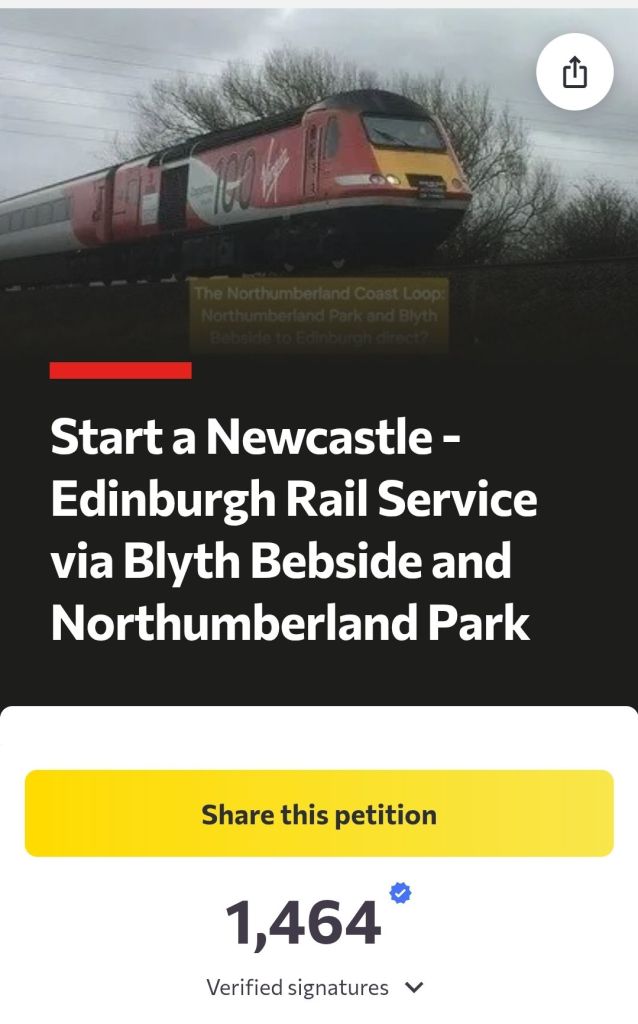
 The Northumberland Coast Loop