
Collaborative calls for a ‘Stopping Scotsman’ service at Berwick, and elsewhere in the Scottish Borders area.
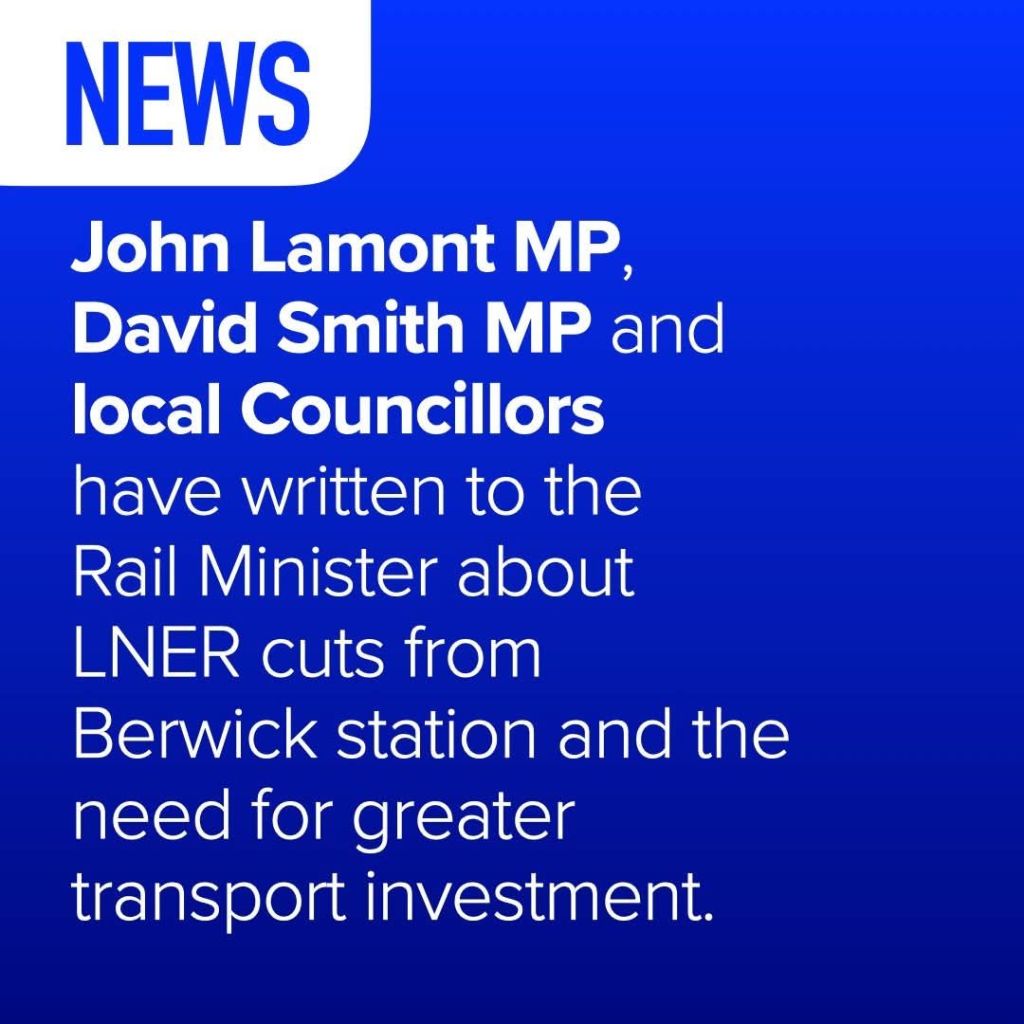
A Facebook post by John Lamont MP and David Smith MP has highlighted the ongoing collaboration between the neighbouring MP’s either side of the Scottish Border on the East Coast Main Line (ECML) to see the services to Berwick-Upon-Tweed station improved following a reduction in the number of trains calling there as a result of the upcoming December 2025 timetable, but also more widely across Northumberland and the Scottish Borders too.


The reason for the issue boils down to operating the ECML for more ‘Flying Scotsman’ fast expresses, as the exclusion of local trains, which hopefully is explained below:
The Flying Scotsman, a brief history
The East Coast Main Line (ECML) is perhaps most famous as the route of ‘The Flying Scotsman’ which began as the ‘Special Scotch Express’ in 1862, taking 10½ hours, with a half hour break in York for lunch. As time and technology have moved on, the train has progressively become faster and faster.
The old LNER (1923 to 1947) was the company that eventually tied ‘The Flying Scotsman’ name to this rail service, and led to the locomotive ‘Flying Scotsman’ being named after the rail service.
The trip between Edinburgh and London now typically takes just 4hrs and 19minutes; so fast you could get to London and back in the time the original journey took in one direction! There have been specially organised trains running the route in four hours flat, a great achievement, but one that comes at a cost elsewhere, which will be explained below.
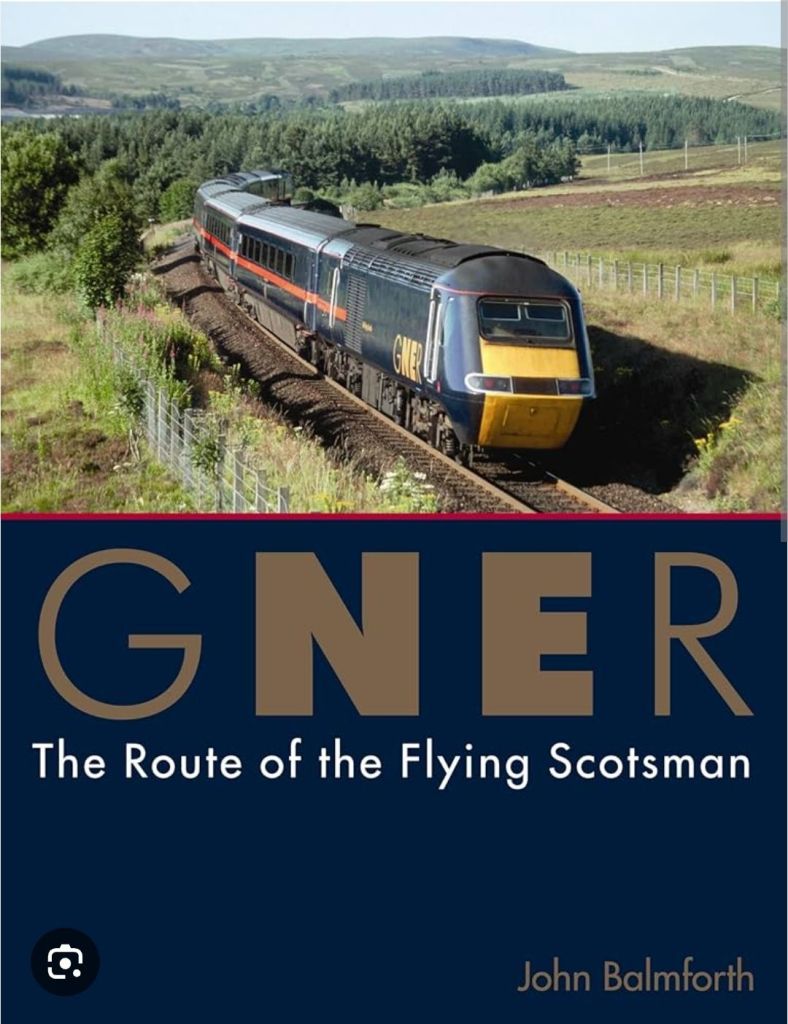
Through my own youth, the operator GNER used to subtitle itself as ‘Route of the Flying Scotsman’ on the side of its dark blue carriages, just under the red band along the sides of the carriages, highlighting the prestige of running fast between Edinburgh and London.
These fast trains don’t just depart at 10am, they run all day every day; providing a fast connection between these capitals, a great market for rail to tap into, and one it is ideally suited to, but without additional infrastructure, means it comes at the cost of other rail services.
Speed comes at a cost to local services
This cut from a ten and a half hour trip in the 1860’s, to one of circa four hours today has come at a high cost to local services however, as to make room for faster trains, without the costs involved of upgrading the railway to handle both types of traffic, the slower stopping trains, even those making just a few stops are being squeezed out of the timetable.
This happens as the slower train calling at stations ahead of these expresses effectively block the line, slowing the expresses down, and without additional infrastructure to enable both types of services to run, the slower trains have been squeezed out.
The Bus Analogy
A good way to visualise this is a simple road with one lane in each direction, connecting two bus stations at each end; which acts similarly to a railway with one track in each direction, linking two major stations.
Lets say that this road has a few laybys for HGV’s (the parallel of a freight train if a bus is a passenger train), but the buses rarely use them ordinarily, and for simplicity, this road is exclusively used by buses and HGV’s.
If an ‘all stops’ local bus (similar to an all stops train) is making its way along the road, then the faster traffic behind it gets held up. To run an express bus (non-stop between the big bus stations at each end), then this local bus will have to run less frequently, and turn off this main road early and turn back to allow the express bus to run fast without stopping or slowing down, which would cause passenger complaints and refunds if the bus was arriving late at the far end.
The stopping bus would potentially have little effect on a lumbering HGV (similar to a freight train), but again a fast express bus would get stuck behind a slow moving lorry,
As can easily be imagined, the more non-stop buses being timetabled down this hypothetical road means the local bus, and the HGV’s would be squeezed out, until maybe only a minimal service remains at most for the buses, and HGV’s would be largely constrained to early or late in the day when fewer buses are running.
This is why small stations like Chathill (like a minor bus stop in the analogy) have only 2 trains per day in each direction; they have been squeezed out over time, similarly railfreight can’t be run as much as it should as it too would impede express trains, and railfreight is always needing to fight to have paths.
With even more pressure, even the semi-fast buses, those only stopping at some intermediate bus stops will also be squeezed out too. This is why on the railway, demand for more fast trains is beginning to put more pressure onto stopping at stations such as Berwick, they are ‘in the way’ of faster, non-stop trains.
The key issue is that local and semi-fast services are vital feeders into the rest of the network; your local station, like your local bus stop is the gateway to everywhere else, you’re more likely to use the nearest bus stop to your house or destination, than you are to travel by other means to/from a major rail or bus station.
The Northumberland Line is a great example of this; the new stations, which have a regular and comprehensive service, are acting as a gateway onto the rail network, and to use the bus analogy, is like running a regular ‘drumbeat’ all stops bus service that makes getting into a major hub like Newcastle easier.
As an extreme example in the opposite direction, closing all the intermediate stops between Newcastle and Edinburgh would make timetabling expresses extremely easy, as thats the only train that could then exist, but the effect on towns like Berwick, Morpeth and others would be terrible as they would effectively be cut off, and overall, the railway itself would suffer as a network is made better by more connections, not less.
The loss of local rail services has only ever had negative effects on communities; places like Ashington and Blyth suffered for decades due to the loss of rail services in 1964, and even in 1974, proposals were put forward to reopen the line, and even then the closure was recognised as a ‘big mistake’.

The obvious way to resolve this problem for a hypothetical bus is to build a few laybys for the stopping buses, so a stopped bus will pull off the main road and into a layby, and the express buses will be able overtake easily, or possibly to have stretches of dual carriageway to allow express buses to overtake slower trains with both on the move, but dualling the entire route might not be feasible or cost effective. On the railway, this is done by creating loop lines for platforms, so the stopped train stands on a side track, while fast trains can overtake on the lines in the middle.
Just as it might not be feasible to build a layby for every bus stop, the same as it wouldn’t likely be feasible to rebuild every railway station to have four tracks, and it is almost certain that quadrupling (two tracks in each direction) of the ECML would be unfeasible too (imagine building a two track parallel bridge to existing viaducts like the Royal Border Bridge for example is unlikely), a few strategically placed upgrades, could therefore make a major difference, allowing more local trains, as well as railfreight to run on the ECML.
Collaborative call for infrastructure investment
To their credit, the close collaboration of David Smith MP, John Lamont MP, and other local politicians to call for more infrastructure to enable the fast trains, local trains and railfreight to co-exist, rather than be pushed out is one that I wholly support; the ECML is far more than ‘just’ the fast line to or from Scotland, it should also be serving local communities along its length.

John Lamont MP is the Member of Parliament for Berwickshire, Roxburgh & Selkirk, representing the Scottish side of the border; as whilst Berwick Upon Tweed station is actually in the English county of Northumberland, it is a significant station for those living near Berwick on the Scottish side of the dashed line.
David Smith MP is the Member of Parliament for North Northumberland, the northern part of the English county of Northumberland, and is my own constituency MP. He represents the area that Berwick-Upon-Tweed station sits in, as well as the large area surrounding the station that is served by it.
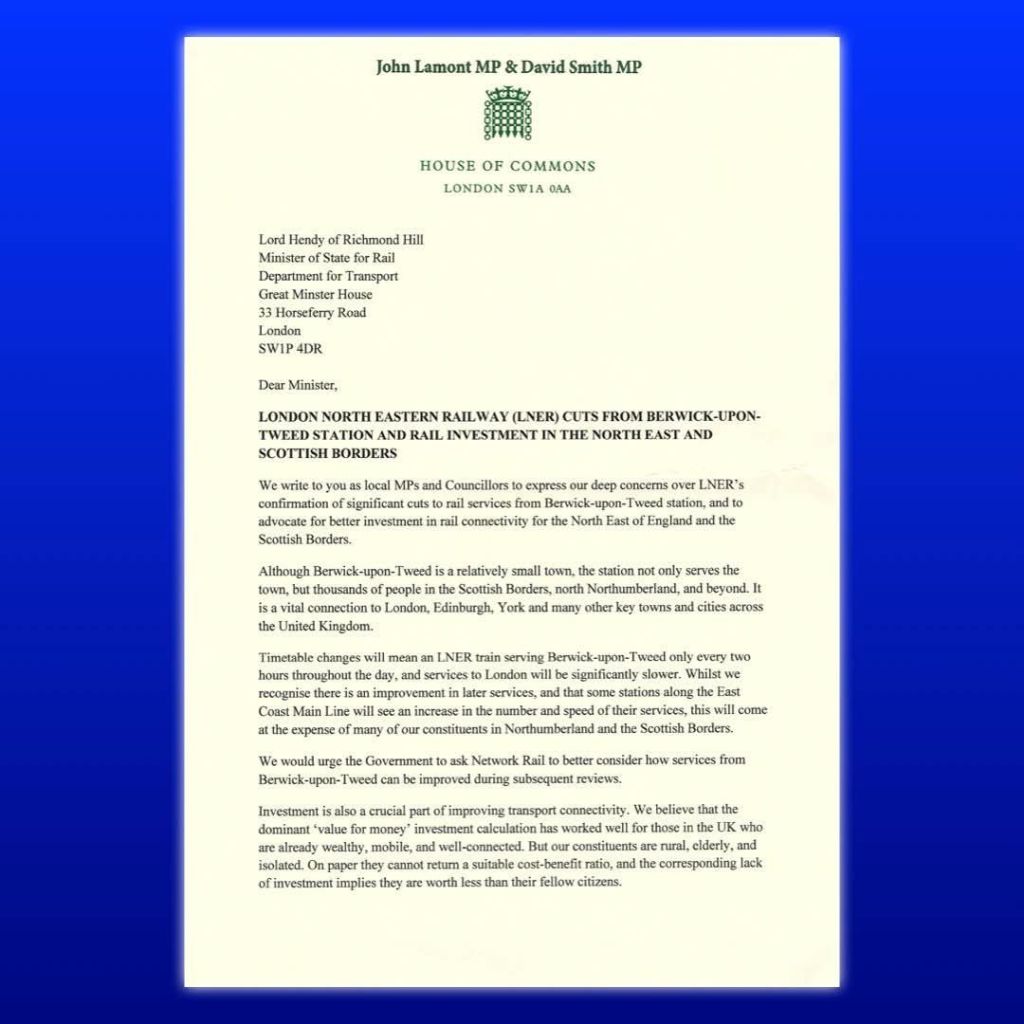
The below images have been copied directly from the post by John Lamont MP for full clarity of their contents, especially the jointly signed letter between John and David to Lord Hendy, Rail Minister about investment into the rail network between Newcastle and Edinburgh more generally.
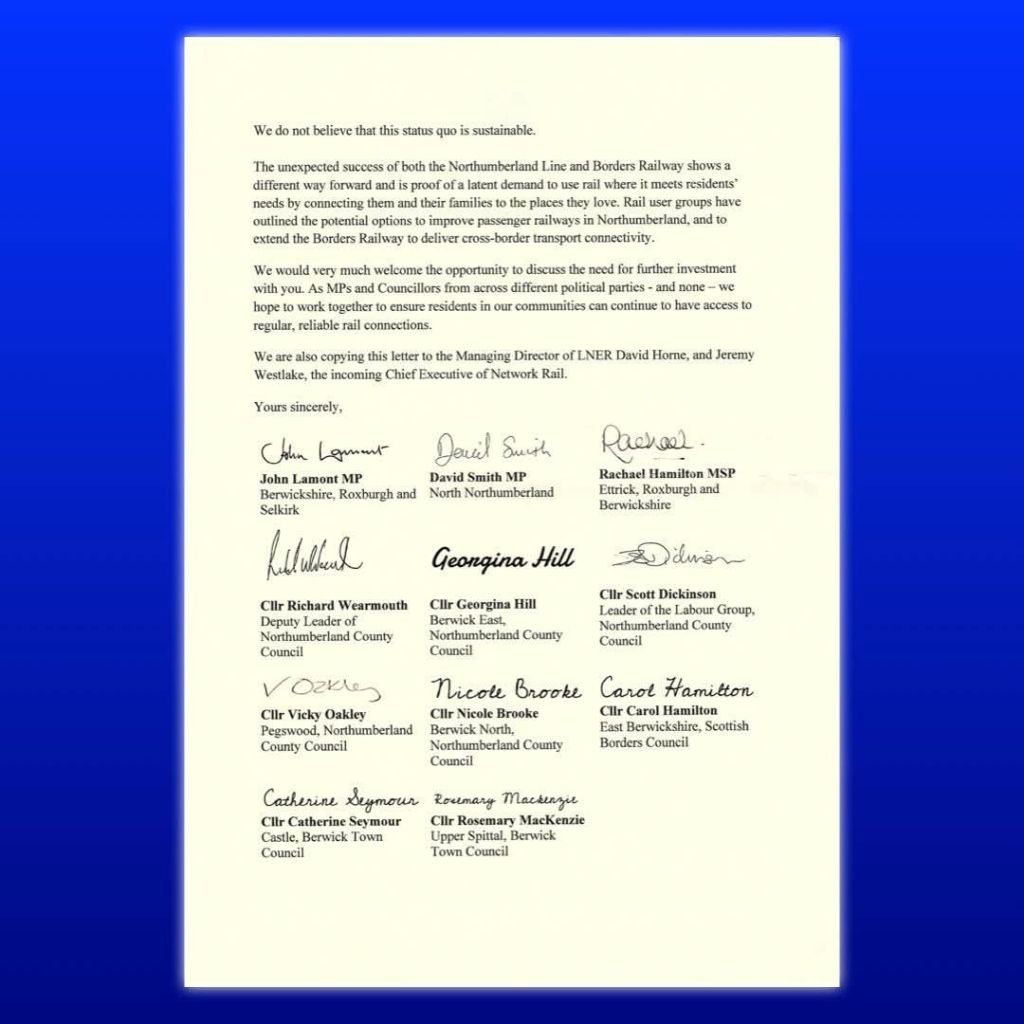
What is also very encouraging to see is the number of other local politicians who have added their signature to the letter, who are listed below:
Rachael Hamilton MSP Ettrick, Roxburgh and Berwickshire.
Cllr Richard Wearmouth Deputy Leader of Northumberland County Council.
Cllr Georgina Hill Berwick East, Northumberland County Council.
Cllr Scott Dickinson Leader of the Labour Group, Northumberland County Council
Cllr Vicky Oakley Pegswood, Northumberland County Council
Cllr Nicole Brooke Berwick North, Northumberland County Council
Cllr Carol Hamilton East Berwickshire, Scottish Borders Council
Cllr Catherine Seymour Castle, Berwick Town Council
Cllr Rosemary MacKenzie Upper Spital, Berwick Town Council
This shows the broad collaboration across multiple political parties (and some independent candidates too), but working together for the common good of their constituents, by trying to improve the situation not only at Berwick but also for transport more generally.
Flying Scotsman + Stopping Scotsman?
The ECML route between Edinburgh and London became famous for the ‘Flying Scotsman’
Using other existing stations like Chathill, Alnmouth for Alnwick, Acklington, Widdrington, Pegswood, Morpeth, and Cramlington better by improving services calling there would be a major economic boost for their area.
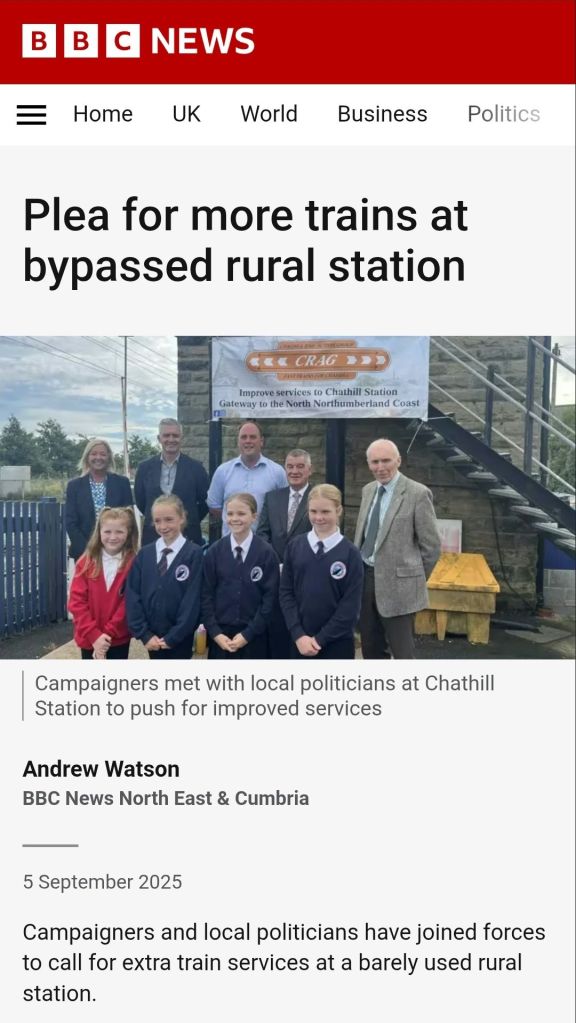
Groups like the Chathill Rail Action Group have long campaigned for their station to see better rail services; why not use these existing stations, already open for passengers to better effect by investing into the ECML to enable places like this to be better served?
The Northumberland Line being quoted as a success story!
Whilst it is a project that has faced some problems, the Northumberland Line is, as stated in the letter to Lord Hendy, an excellent example of ‘build it and they will come’ having now exceeded 700,000 passenger journeys in under a year of operation, and the line progressing towards completion, with four stations at Ashington, Blyth Bebside, Newsham, and Seaton Delaval now open, with only Bedlington, and Northumberland Park yet to be opened up, but the stations are now at an advanced stage, and will hopefully open in early 2026 at the latest.
It has been a resounding success for the fairly modest investment of £336.4m to date, and with such a busy and popular route, a similar investment into the East Coast Main Line (ECML) is more than justifiable to increase its capacity.
In my view, the Northumberland Coast Loop could be framed as an extension of the Northumberland Line, taking this highly successful line further north via Pegswood, up to Berwick and potentially into Scotland, ultimately forming a second route between Newcastle and Edinburgh via Blyth, and give an uplift to services calling at stations in North Northumberland and the Scottish Borders.
It is a known issue that capacity on the ECML is limited, but what needs to be made clear are answers to the questions below:
- What infrastructure needs are there to operate more trains? Where would new loops be required, and could proposed new stations such as Belford be a way to ‘loop’ a stopping train, and allow faster following trains to overtake it while it stops there? What costs would these entail?
- Are there any small changes in timetables that could be done sooner to give an uplift (i.e. using some existing loops more regularly to allow slower trains to be overtaken), for example the ‘Chathill Flyer’ is the only passenger train to use the loops at Wooden Gate to my knowledge, but could more stoppers be looped here, or elsewhere to increase line capacity?
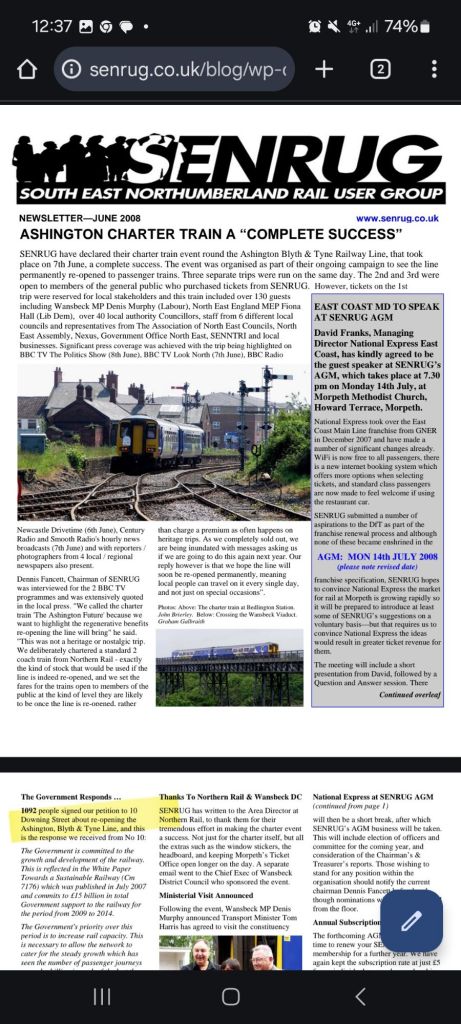
At present, an indication of the latent demand for rail services running a route such as the Northumberland Coast Loop is the success of our petition, which to date has 966 signatures, which might not sound huge, but the SENRUG petition of 2008 (shown below and highlighted in yellow) only had 1098 signatures at the time for the now near million passenger Northumberland Line (then referred to as the Ashington, Blyth, and Tyne Line), only 132 more than the current ongoing petition for the N’land Coast Loop, so what can be inferred is that a petition shows in reality only a tiny fraction of potential users, build it, and they will come.

Lets hope that the continued campaigning across both sides of the Scottish Border can result in improvements to the regions rail services, and that other neighbouring MP’s can get behind it too to see more investment made in the rail routes of this area to improve the strength of our economy and boost connectivity to, from, and within the broader Borders area, making direct links from Berwick-Upon-Tweed to Blyth possible, as well as more distant connections to places like Penzance too.
With the huge success of the Northumberland Line, lets keep investing in rail in Northumberland, which was one of the key places in the development of railways in the UK, from Huntington Beaumont introducing the waggonway to the region in c.1609, through to the development malleable iron rail at Bedlington in 1820, used extensively on the Stockton and Darlington Railway, this year celebrating its 200th anniversary.
Somewhat fittingly, the Northumberland Line itself passes above the section of the River Blyth where Beaumont began over 400 years ago; we’ve progressed from horse drawn waggons of coal, through steam hauled trains like the Flying Scotsman, to 125mph InterCity passenger trains and containerised freight.
Hopefully Lord Hendy, as well as the wider Government, will at last put long overdue investment into the ECML that is clearly needs.
 The Northumberland Coast Loop