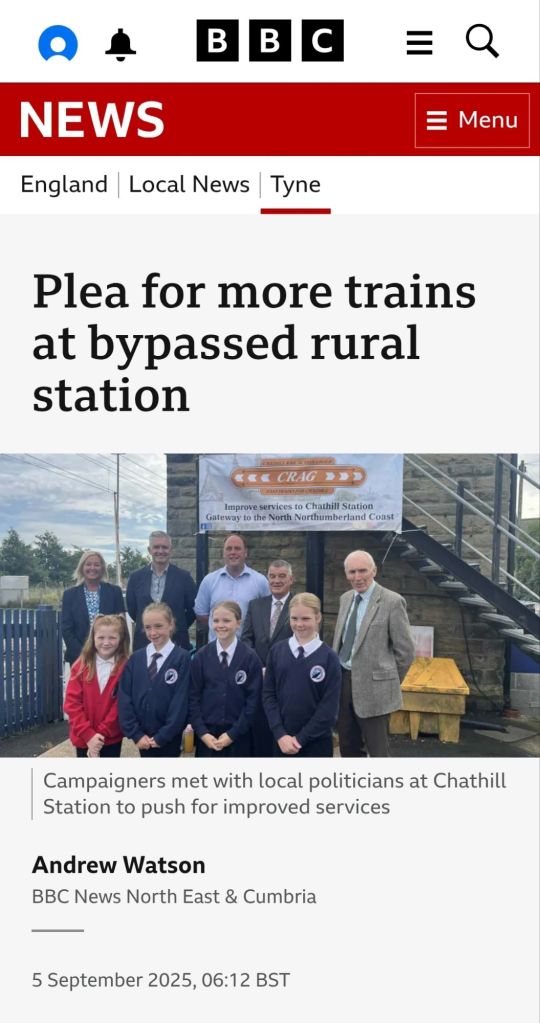
On Thursday 4th September 2025, David Smith, MP for North Northumberland, Deputy Mayor Cllr Martin Gannon, and local County Councillor Guy Renner-Thompson attended a meeting organised by the Chathill Rail Action Group (CRAG) at Chathill Station to discuss the improvement of rail services to and from this underserved station on the North Northumberland Coast.
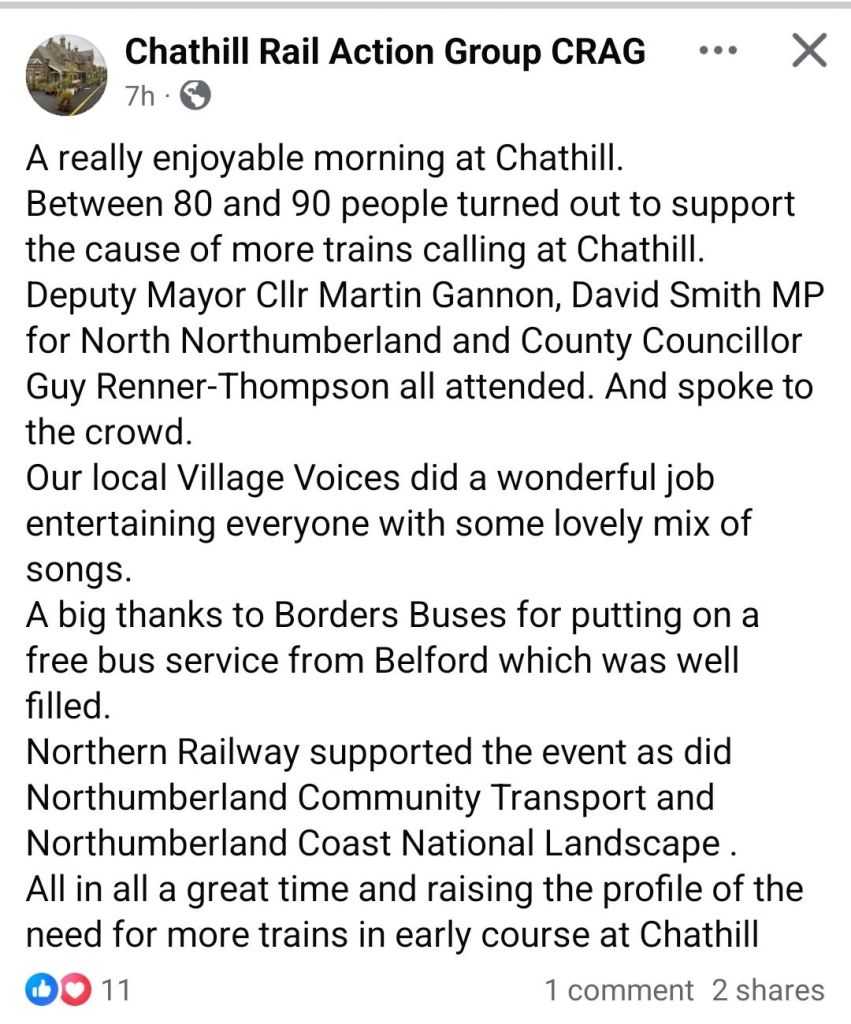
As can be seen from the above Facebook post by CRAG, this meeting was supported by a further 80-90 persons, interested in the campaign to have more trains calling at this station on the busy East Coast Main Line (ECML); which sees 140 trains a day pass through it at speed, but only the twice daily ‘Chathill Flyer’ actually stops there; giving the station just two trains in each direction per day, and then only to/from Newcastle, it isn’t currently possible to head north to Berwick or any other station from Chathill directly.
Rail travel, and connecting buses the solution to seaside traffic trouble?
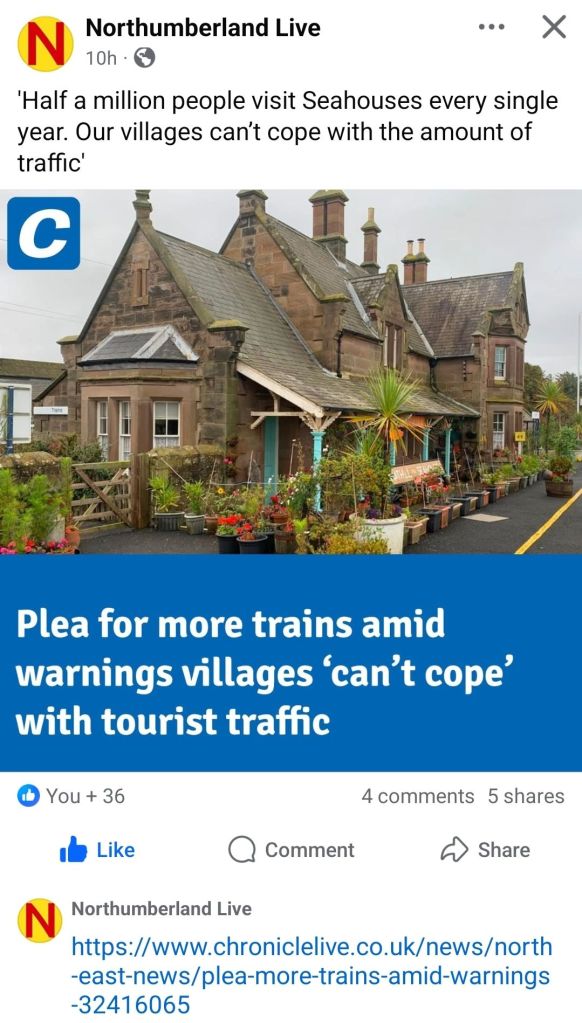
Tourism: A double-edged sword?
Articles such as the one above from The Chronicle highlight the problem of Northumberland’s reliance on car-based tourism; villages and towns are becoming overwhelmed by cars. With a limited range of public transport options, most visitors drive to these beautiful seaside villages such as Seahouses and Bamburgh, but the congestion, only added to year on year by more visitors coming, is arguably spoiling their rural charm and character, with the same problem being played out more widely across Northumberland as a whole: the tourism industry brings much needed income and jobs to the area, but road traffic is a major problem.
In the words of the well known song ‘Big Yellow Taxi’ by Counting Crows:
“Don’t it always seem to go
That you don’t know what you got ’til it’s gone?
They paved paradise and put up a parking lot“
The above quote is pertinent as Northumberland faces some very stark choices with the growth of tourism, do you ‘pave over paradise’ through schemes such as dualling the A1, building ever increasing numbers of car parks to accomodate more and larger cars that put even more traffic through towns that already can’t cope, or do you invest in rail and buses and part of a co-ordinated public transport service, to ger the tourists to the attractions witbout their cars in the first place?
Lifeline for locals too
On a smaller scale, but no less important is the needs of local people to access education, training, and employment beyond their hometowns, without necessitating the need to relocate for this, or be dependent upon being able to drive to access these things, which is prohibitively expensive for young people, and excludes those who may be unable to drive due to disability or for health reasons.
Chathill is just one of several existing and new stations needing a real rail service
All of the stations between Newcastle and Edinburgh could do with more services; ranging from the ‘big’ stations of Berwick, Alnmouth, and Morpeth, down to the smaller ones of Chathill, Acklington, Widdrington, and Pegswood, the latter one also being highlighted by local County County Councillor Vicky Oakley in a recent Facebook post (see below).
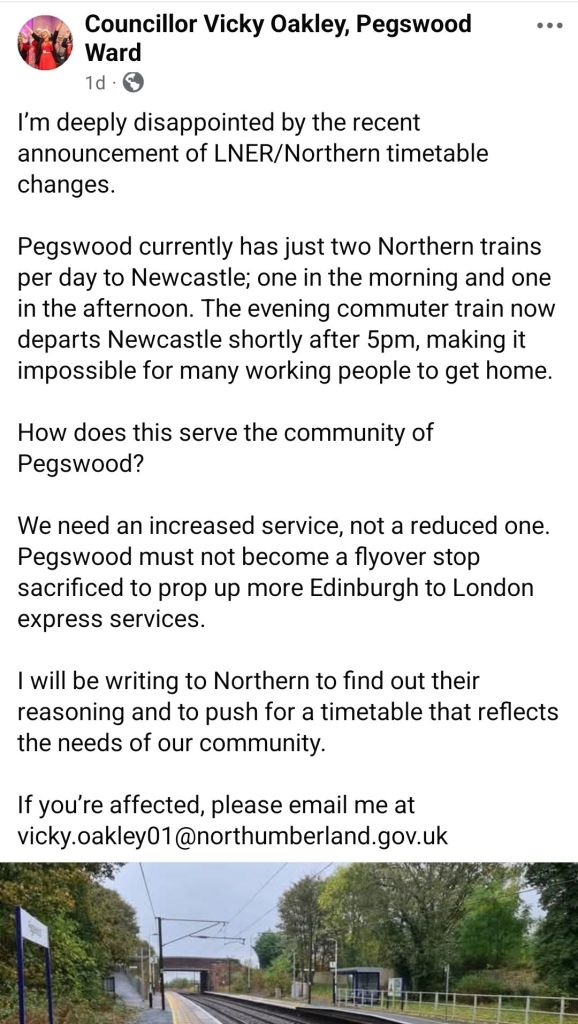
A twice daily train is arguably not a real rail service, in terms that it is of such a low frequency that is is of limited benefit to its users, and results in these stations having such a low annual usage to be amongst the least used in the whole of the UK, despite being an an area that is thriving with tourism, Seahouses has 500,000 visitors a year, yet very few of that number will travel there by rail at all, despite Chathill being on the mainline between Edinburgh, Newcastle, York, and London, and just a short bus ride from Chathill to Seahouses itself.
Problems and Solutions
Constrained Capacity and Tired Trains
With 140 trains using the double track East Coast Main Line each day, finding a ‘path’ (a timetable slot) for a train to slow down, stop, pick-up/drop-off passengers, then accelerate away again is challenging, especially with the use of ageing Class 156 and Class 158 diesel trains built by British Rail in the late 1980’s and early 1990’s, all of these being over 30 years old and approaching the end of their useful lifespan.
Northumberland Needs Electric Trains
Part of the solution is to replace these ageing diesel trains with 100% electric trains, or battery/electric bi-mode units which are capable of far better performance in acceleration and braking, and would be better able to mix amongst the faster, non-stop or few stop (semi-fast) services sharing the ECML.
A good contender for the Newcastle – Edinburgh route could be the Hitachi built Class 385 electric units, which are in regular use with ScotRail between Glasgow and Edinburgh already, and have a capacity (depending on if they are 3-car or 4-car sets of 206 or 273 seats (the latter a mix of 20 First Class and 253 Standard)), though this would need procurement via an operator such as ScotlRail or Northern, whichever was to begin the service.
Using an existing, proven design that is already in use nearby would give an opportunity to see a fleet expansion, with an already skilled workforce in operating and maintaining the units available as new trains are delivered to provide Newcastle – Edinburgh local train service. In comparison, a totally new fleet would require a much wider training and knowledge gain for the workforce, and may have teething issues such as that seen with the Tyne and Wear Metro units, something which has already been sorted on the Class 385’s to my knowledge.
Two Track Line with Passing Places
Another is factor is the largely two track nature of the line, which means that a slow train, stopping at lots of stations such as Chathill is caught up by faster trains running behind it.
In the article, Cllr Gannon suggests four-tracking of the line between Newcastle and Edinburgh would be the ideal, but this would be prohibitively expensive; imagine the costs and disruption of putting two extra tracks through Berwick for example; and getting over the Tweed potentially on a new bridge adjacent to the iconic Royal Border Bridge would pose substantial, but not insurmountable challenges.
Example: Relocate Alnmouth Station?
That being said, a more effective solution is to use both existing, and new passing places to allow stopping trains to be overtaken by faster ones behind.
Indeed the existing ‘Chathill Flyer’ (train 2N09) does this after its call at Alnmouth heading south towards Newcastle, sitting in the loop at Wooden Gate for 13 minutes (from 07:22½ to 07:35½) to allow for a passing train.
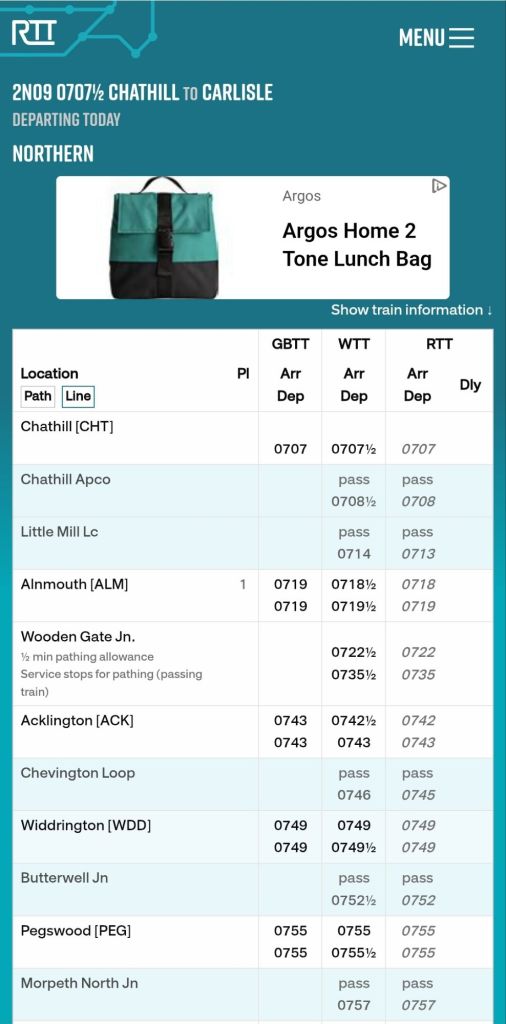
It may prove beneficial to build new platforms adjacent to these loops at Wooden Gate, and perhaps even relocate Alnmouth Station entirely to this new location, meaning that any stopped train can be overtaken by one following behind, which could permit more trains to stop at Alnmouth station, meaning a better rail service as a result: a win-win if ever there was one?
If looped stops are longer anyway (as the ‘Flyer’ is timetabled for 13 minutes in the loop at Wooden), then it could be a more appropriate place for disabled passengers or those needing additional time to board.
This could be coupled with direct access to/from the A1068, meaning better access as a ‘Parkway’ station, but also an easier route for rail/bus integration at Alnmouth for connections to the popular towns of Alnwick and Amble.
Please also take a look at the campaign for better buses between Alnwick, Alnmouth Railway Station, and Amble here: https://chng.it/B4RwwtHnJc
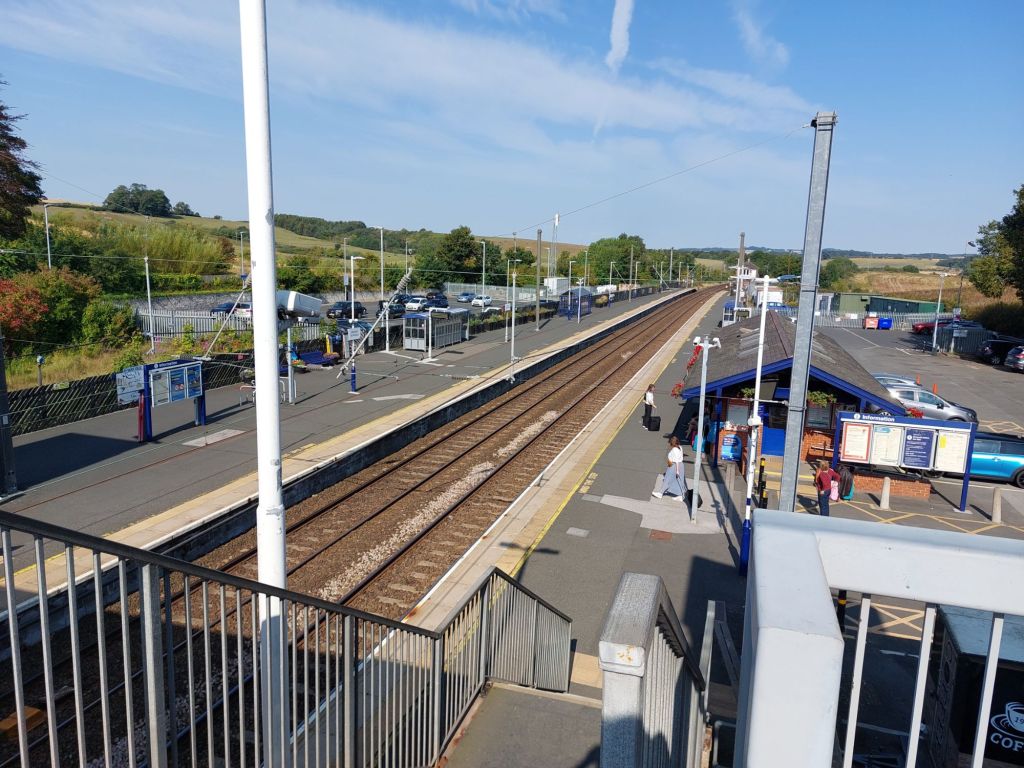
As a station that somewhat sadly lost its heritage buildings many years ago, relocating Alnmouth station would offer an opportunity for a new-build station that is better than the current one, and could make use of the great view over the Aln Estuary and the picturesque village of Alnmouth itself

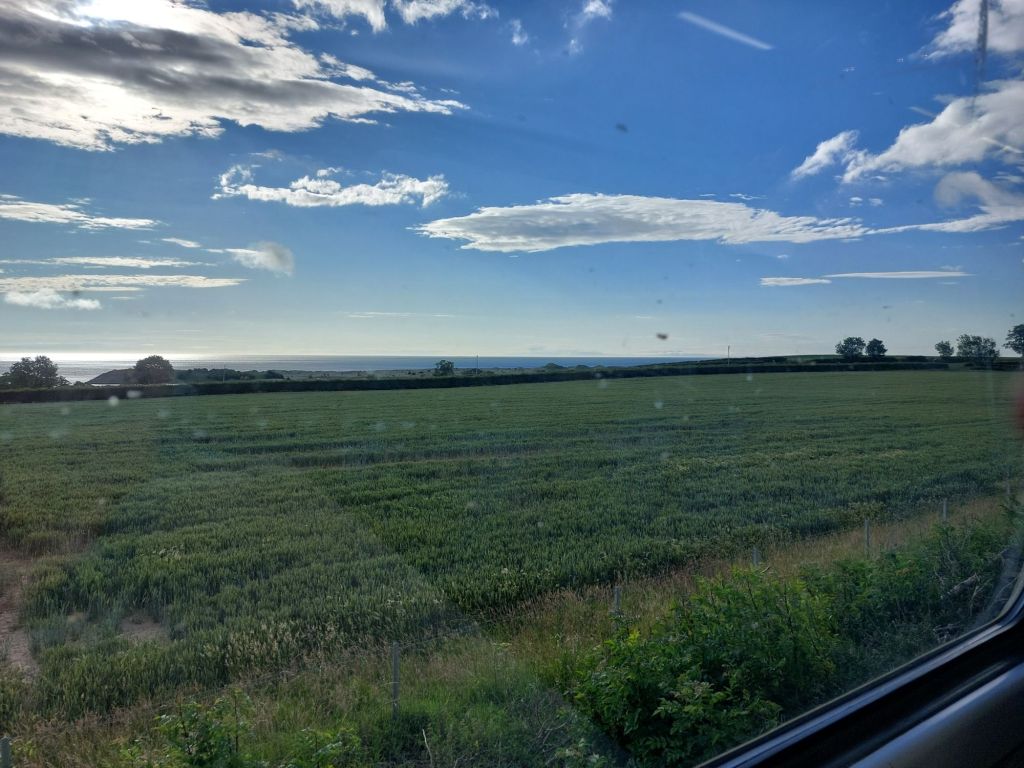
There are similar loops in other locations along the ECML, those at Belford for example would be ideally placed to build a new station adjacent to the loop lines, allowing stopping trains to serve the area around Belford, and allowing faster trains to overtake, again a huge win-win, and for the relatively modest cost of about £20m (the approximate cost of a new railway station on a mainline).
Therefore a rebuild of Alnmouth, and a new station entirely at Belford, both on loop lines to allow other trains to overtake could be potentially achieved for approx £40m in total, a fraction of the expected cost of alterations to Moor Farm, and Seaton Burn Junctions on the A19 (£300m to £775m depending on option selected), or dualling of the A1 (£500m+), and rail schemes typically have a far greater economic return too, so again a huge potential win-win.
Northumberland Coast Loop

Another factor which would be worth investigation would be the route using the Northumberland Coast Loop, which in the northbound direction comes off the ECML at Benton Junction, and runs up the Northumberland Line as far as Bedlington, before cutting back to the ECML via Hepscott, and rejoining the route to Scotland at Morpeth North Junction.


As can be seen from the route map above, a train making its way via the ‘loop’, calling at Northumberland Park, and Blyth Bebside (for the proposed semi-fast service), or at all five stations (N’land Park, Seaton Delaval, Newsham, Blyth Bebside, and Bedlington) for a local service, would be clear of the ECML between Benton Junction and Morpeth North, effectively forming a very long passing loop in each direction, meaning that faster trains behind could run through, or call at Cramlington, and/or Morpeth and still overtake the train taking the loop route via Blyth.
This is much like a bus route such as the X15 coming off the A1 to drive through Felton to pick-up/drop-off passengers close to their home or destination, and allowing other traffic to overtake the bus, as opposed to pulling in at the roadside and slowing down/stopping following vehicles and staying on the A1 throughout.
A rail route via Blyth is a slightly slower one than sticking solely to the ECML, but has the key advantage that catching the train at a Blyth station (Blyth Bebside is perhaps the better overall location) is more convenient for people living in/close to Blyth, or where rail services from Ashington (and in the future Woodhorn/Newbiggin) will pass through, compared to Morpeth, which, especially by public transport can be awkward/long-winded to reach from these towns.
If you’d like to support the petition for a rail service via Blyth, please visit the petition page here: https://chng.it/zThXj8HBpY
 The Northumberland Coast Loop