
A recent article from The Chronicle ‘Upgrades to two notorious A19 roundabouts would cost up to £775m’ has shed some light on the vast costs of upgrading the Seaton Burn junction of the A1 and A19, alongside the A19 and A189 interchange at Moor Farm, with Option A (fully grade separated junctions) coming at a cost of approximately £775m. The cheaper option E (the only one with a positive benefit:cost ratio, meaning it would generate an economic return on investment, the others would be loss making), with altered kerb lines, better signage and road markings would cost £300m, about the same as it cost to reopen the 18 miles of track for the Northumberland Line and open six stations along its length, and had a clear positive benefit:cost ratio of 1.5 (meaning for every £1 spent, £1.50 in economic gain is expected in return).
Proposed £800m to £1,275m spend for A1 & A19 roads in Northumberland?
Together with the long proposed dualling of the A1 between Morpeth and Ellingham, recently costed at £500m, means that an expected spend on just two roundabouts and 13 miles of dualling in Northumberland could cost between £800m and £1,275m for both schemes (A1 dualling and A19 roundabouts) combined.
Roads are, however, only one mode of transport, and surely the alternatives to road transport should also be considered, especially as these schemes are near to existing passenger railways that are already busy and popular routes, which would certainly benefit from further enhancements, so could the money be better placed by improving the railway and leaving the roads as they are now?
The A19 north of the Tyne and its connection to the A1 is largely mirrored by the proposed Northumberland Coast Loop (N.C.L.) which passes below the A19 at Holystone, with Northumberland Park station almost inmediately adjacent to this road, and Seaton Delaval station close-by to Moor Farm Roundabout.
The connection of the N.C.L. back onto the East Coast Main Line (ECML) at Morpeth mirrors the connection of the A19 and A1 at Seaton Burn, with the option to head both north and south using Morpeth North Junction and Morpeth Junction (crossing Coopies Lane near Morpeth station respectively).
With a very similar rail and road layout, there is perhaps a unique opportunity to compare them side by side for relative cost vs benefit.
Comparing rail and road options
Please note that these are simplistic approximations based on the overall cost of the Northumberland Line at £298.5m, at 18 miles in length, with six new stations, hence decimal values for stations.
At the low end figure of £800m (A1 dualling + Option E), that would be equivalent to 2.6x the Northumberland Line, or a similar freight railway 48.6 miles in length being reopened for passenger traffic with 15.6 stations along its length.
The high end figure of £1,275m (A1 + Option A) would be equivalent to 4.2x the Northumberland Line, upgrading a 75.6 mile long freight line with 25.2 stations along its length.
As can be seen from the above calculations, every £1 spent on rail gives you more than the same £1 spent on roads, especially considering almost all rail projects have a far stronger benefit:cost ratio compared to road schemes that tend to be loss-making.
Northumberland Coast Loop rail route a better option than A1 dualling and A19 roundabout rebuild for £800m to £1,275m?

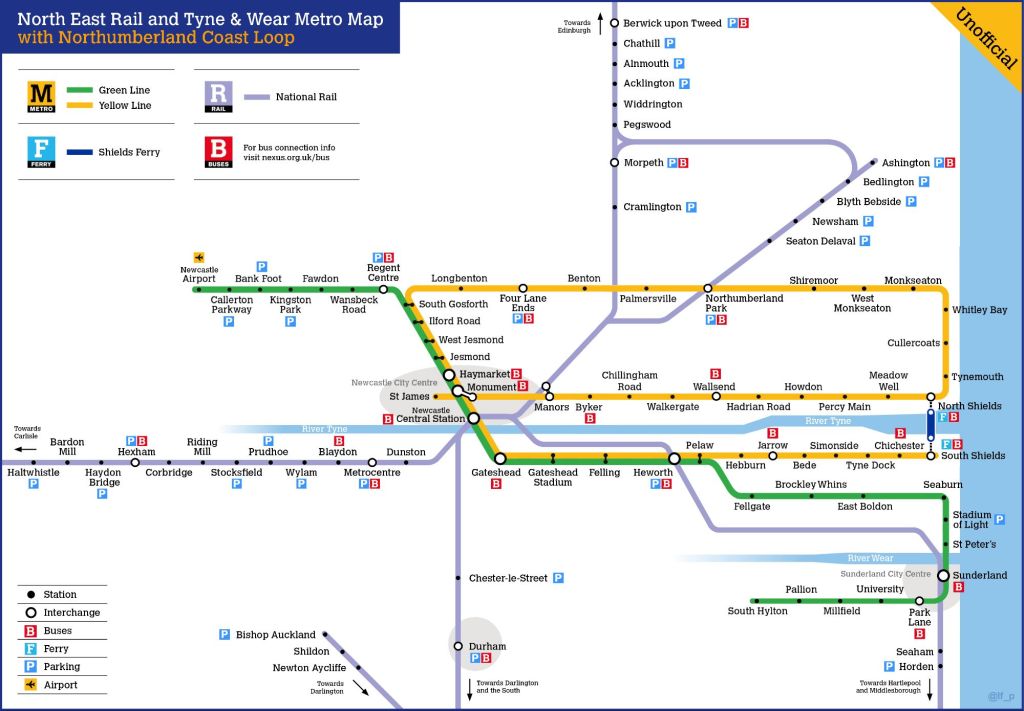

The Northumberland Coast Loop route could be a good alternative to the proposals for both the A1 dualling and the A19 roundabout rebuilds, as it would offer a better rail connection between North Tyneside and south east Northumberland with Scotland, and if the route was extended south beyond Newcastle, specifically along the Durham Coast, it would provide a parallel rail route to the A19 almost along its length.
Let’s assume that a budget of £300m (Option E for the two A19 Roundabouts) was allocated to rail improvements instead.
Bedlington to Pegswood by rail for £30m to £83m (max of £100m)?
The line linking Bedlington to Pegswood is only around 5 miles in length, and largely single track; a similar upgrade to the Northumberland Line which had a £298.5m cost ÷ 18 miles of track = £16.6m per mile inc stations, would give an approximate cost of c.£83m, which would cover doubling sections of the route (perhaps almost in entirety given the very rural nature for the most part), and may even allow for rebuild of Choppington station alongside the line), and could allow level crossing upgrades/replacement by a bridge if required for the A1068 at Choppington too.
If Choppington station wasn’t initially included, then this cost may fall from c.£83m to c.£73m (assuming single track station at c.£10m cost), or to c.£63m (assuming two track station at c.£20m).
The replacement of Newsham level crossing with a bridge for the A1061 cost a reported £33m, so assuming the level crossing on the A1068 was to remain at Choppington might further reduce the cost to around c.£30m to improve this line to a similar standard to the recently Northumberland Line, in terms of additional double tracking and linespeed enhancements (allowing trains to travel faster).
In a worst case scenario, a £100m budget (assuming full doubling of the line, building of a two track station at Choppington, and replacement of the A1068 level crossing at Choppington with a grade separation) would seem to be a reasonable figure.
All of the above would need to be professionally costed and assessed of course, but it seems a likely estimate based on nearby, recent rail infrastructure works for the Northumberland Line.
Newcastle – Bedlington and Pegswood – Edinburgh rail improvements with remaining £270m to £1,175m?
Wider work to both the Northumberland Line and East Coast Main Line (ECML) might also be required to enable more rail services, for example the Newcastle Central Station to Bedlington Junction stretch of line might require some further capacity enhancement, as might the ECML from Morpeth North Junction to Edinburgh Waverley.
Assuming an overall budget of £300m for the route between Newcastle and Edinburgh via Bedlington, and between £30m-£100m being spent on the Bedlington Junction to Morpeth North Junction section, that would, depending on costs, leave between £270m (assuming approx £30m to improve Bedlington Junction to Morpeth North Junction), and £200m in a ‘worst case’ scenario.
For example, would relocating some stations on the ECML such as Alnmouth onto the loops at Wooden, which would allow stopping trains to be overtaken by fast, through expresses offer a good capacity increase for relatively low cost (approx £20m assumed cost for new station to be built whilst current Alnmouth Station remains open)?
Similarly, the reopening of Belford station, again proposed to be on the loops there rather than against the mainlines, could allow slower stopping trains (both semi-fast and local) to be overtaken by faster through expresses, again at a cost of c.£20m, which together with Alnmouth could still leave a potential budget of £160m to £230m assuming the modest overall investment of £300m into the ECML/Northumberland Coast Loop rail routes between Newcastle and Edinburgh. This assuming a low budget of £300m (similar to the spend on the Northumberland Line).
In contrast, if the amount of money that many advocate to spend on roads such as the dualling of the A1 and roundabout rebuilds on the A19 (c.£1,275m in total) was instead invested into the these two rail routes between Newcastle and Edinburgh, the results could be truly transformational.
Spending a billion pounds or more on rail in Northumberland and southern Scotland could truly transform services not only within the region, but also nationally, giving better Edinburgh – London connectivity to compete more effectively with domestic air travel, begin moving an increasing share of freight by rail, as well as decarbonisation of rail travel through more and better electrification schemes.
The Northumberland Line has proven that rail investment in Northumberland is money well spent, and as a region with a rich railway history, dating back to Beaumont at Bedlington in 1609 with early waggonways, wouldn’t it be a wonderful way to recognise that railway heritage by reviving rail as front and centre of transport in the 21st Century?
 The Northumberland Coast Loop