
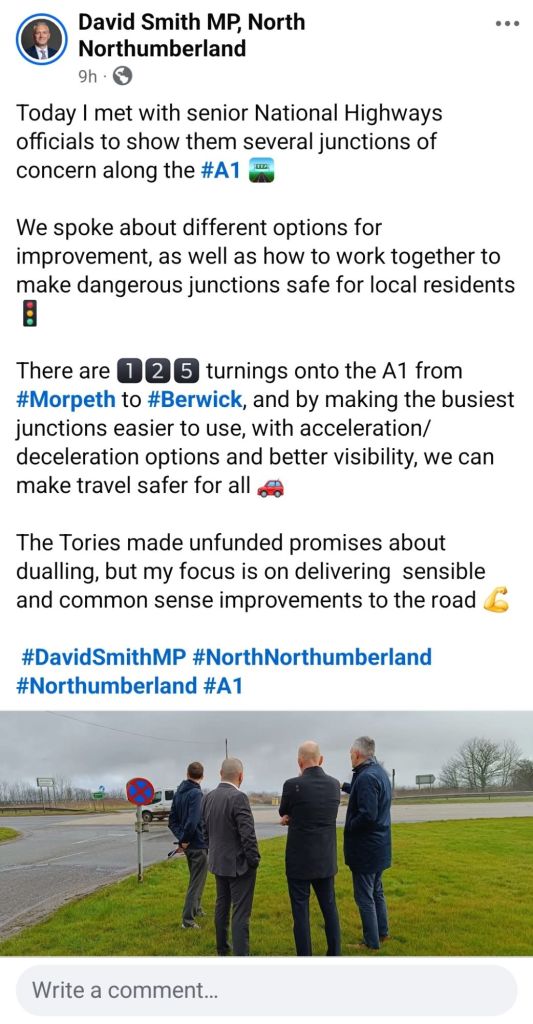
As a Northumberland resident and a frequent user personally of the A1, it was very welcome to see David Smith, MP for North Northumberland meeting with officials from National Highways to show them several problematic junctions along this stretch of road between Morpeth and Berwick.
For those unfamiliar with it, it is a mixed route with some dual carriageway, and some single carriageway, with, as stated by David, 125 junctions from it in that length of road. These range from the most minor farm accesses through to other busy routes joining/leaving the A1.
The repeated failure of the dualling scheme for the A1 has long been held as example of Northumberland being underinvested in; with comments on the above like ‘Dual the bloody thing ,oh forgot we’re north of Watford so don’t matter‘, or ‘Dual carriage way Or is that only for the south?‘, however, the Northumberland Line is a clear example of where investment IS being made in Northumberland, which goes a long way to dispel this long held view.
With the multiple challenges of road safety, economic growth and climate change, the only real solution that stands out is to improve rail connections;
Rail travel is far safer, with the last rail passenger fatality on the ECML in Northumberland happening in 1969 (crash of the Aberdonian at Morpeth Curve that tragically killed six people, but marked the last fatal passenger rail crash in Northumberland, which will be 56 years ago on the 7th May 2025. The last injuries in a rail accident in Northumberland was again at Morpeth Curve in the 1984 derailment of a sleeper train.
That this one location has seen four accidents is notable as railways are amongst the safest modes of transport and accidents are rare, and so are highly notable, tragically many people die or are severely injured every year on Northumberland roads, and because of their frequency, often attract minimal attention, despite driving or being driven being one of the most dangerous of daily activities for many.
Part of any investment could be a new stretch of ECML to create a ‘Morpeth Diversion’, first touted by HMRI Inspector Captain Henry Tyler in 1877, though not yet built, which would remove this notorious curve, and improve improve both capacity and linespeeds, meaning faster and safer journeys on the ECML.
Railways boost economic growth, proven by the positive benefit to cost ratio of the Northumberland Line (BCR of 1.5), compared to the A1 which had a BCR of just 0.8, this meaning an effective economic loss by dualling the road. Some of the most deprived areas in Northumberland are adjacent to the A189, proving that roads don’t always lead to prosperity.
Climate change is resolved by modal shift of people and goods away from petrol, diesel and even electric vehicles and onto much cleaner and greener rail travel; which has long been capable of 100% electric travel, with the ECML wired since the 1990’s in Northumberland.
Rail is a proven success story
The northern end of the Northumberland Line is just a few miles from Morpeth, and has proven a HUGE success in just its first few months in service, and even then only being partially open with only Ashington and Seaton Delaval open at present (Newsham opening expected on Monday 17th March, the third of six new stations on the route).
In addition, the East Coast Main Line (ECML), which virtually runs in parallel from Morpeth to Berwick has long been an excellent and very popular route for passengers to travel to, from, within and through Northumberland; but it is nearing or at capacity, meaning that transporting more people by rail is challenging without further investment, though some changes could be done within the existing infrastructure.
Groups such as Railfuture North East have long campaigned for improved rail services in Northumberland, with proven solutions to meet demand for travel such as an hourly rail service using electric trains being found to be both possible AND ecomomically viable in a 2019 report by SYSTRA.
The Northumberland Coast Loop proposal seeks to use an existing connection (the Hepscott Line) to link the newly reopened Northumberland Line to the East Coast Main Line. This would allow a new through service between Newcastle and Berwick/Edinburgh to run via Blyth, the largest town in Northumberland; enabling modal shift onto rail by offering a faster and more convenient rail service as soon as possible from these newly built railway stations.
A previous petition gained 742 supporters for this route, and a new one for starting a Newcastle, Blyth and Edinburgh rail service is currently at 178 signatures.
Whilst the local service between Newcastle and Berwick is a known possibility, the clear and sensible course of action is to grow the capacity of the ECML and other routes to meet demand for transport, as it is far cleaner and greener than alternative modes.
As a contrast, the petition by the former Conservative MP for Berwick, Anne-Marie Trevelyan to dual the A1 to Scotland only gained 624 signatures, the rail service is therefore potentially far more popular and has greater backing than dualling the road.
Invest in the ECML to carry more people and goods, alongside improving junctions on the A1.
The campaign here seeks to push for more investment into the ECML, as well as connecting rail routes such as the Northumberland Coast Loop and reconnection of towns such as Alnwick by mixed heritage/commuter railways such as the Aln Valley Railway.
This mixed approach is complimentary to both schemes; making the road safer is further improved by drawing more traffic away from the A1 and onto the rail network. More rail passengers and freight by rail creates a virtuous loop of more investment drawing more traffic inwards and continuous development of the system.
Key changes needed for the ECML
Double the capacity of the ECML in Northumberland
In an address to the Permanent Way Institute on the 20th February 2025, rail engineer Gareth Dennis proposes a nationwide doubling of passenger and freight capacity on the rail network as a solution to meeting the challenges Britain, and Northumberland face in the future.

Let’s see a detailed plan by Network Rail/Great British Railways of how doubling the capacity of the ECML in Northumberland could be achieved by 2040.
New stations in locations such as Belford, or at Beal (for Lindisfarne and Haggerston Castle) would also be a major part of this increasing capacity by reopening a limited number of stations in Northumberland.
Make rail fares fairer
The Northumberland Line is again a great example of something different being tried with great success; it has been started with a simple and cheap fare structure, tied into the Tyne and Wear Metro network meaning a modest maximum fare for travel (£3 max single price for Ashington to Newcastle, or £6 return).
This type of fare structure could be applied to some (but ideally all) trips from Berwick to Newcastle (and stations between), which again could drive modal shift onto rail, as had been seen with the Northumberland Line, a key aim of which was to reduce traffic volumes on the A189 Spine Road. The ECML could repeat that policy on the A1 by simply having cheap fares and more seats available (longer trains and more of them).
New rail routes and dedicated buses for towns away from the ECML
The plans for the above should also include the potential for new rail routes such as the Northumberland Coast Loop (giving a direct route to/from Blyth and other towns in SE Northumberland), as well as new routes beyond Newcastle. Direct links to cities such as Carlisle could be improved (only served modestly by the ‘Chathill Flyer’ at present, as well as new links to cities such as Sunderland or areas such as Teesside worthy of consideration too.
What could also be transformative is a dedicated bus connection from towns such as Alnwick or Amble that are some distance away from the ECML to have improved access, with my petition for this gaining quite a lot of support in recent weeks, having 258 signatures at time of writing.
If you’d like to support me and the Northumberland Coast Loop, please consider a donation via my Ko-fi page.
Thanks, RH.
 The Northumberland Coast Loop