In the last few days, two articles cite plans for new stations at Killingworth in North Tyneside, and at Belford in North Northumberland on the East Coast Main Line (ECML).
We’ll explore the opportunities and challenges of both of these stations below.
Killingworth Station

A new station at Killingworth on the East Coast Main Line has long been proposed, with the former station closing on 15th September 1958 to passengers and completely on 7th June 1965.
This was one of many stations between the currently open Manors Station and Cramlington that were closed to traffic, the others being Heaton, Forest Hall, and finally Annitsford, closing in 1980, 1958, and 1963 respectively.
Whilst a new station at Killingworth is certainly not unwelcome by any stretch, the layout of such a station would need careful consideration; if it is built similarly to Cramlington, where it is simply platforms adjacent to the existing two lines, it might suffer the similar drawbacks of limited services calling there, as at Cramlington, which has a modest local service and not many other connections, despite it being the second largest town in Northumberland and on the same line as Morpeth.
This is because any service stopped at stations with just one northbound and one southbound line (as most between Newcastle and Edinburgh stations are laid out), means that following trains either have to slow down/stop behind the stopping train, or a large gap must be left in the timetable behind it, to avoid the stopping train being caught up too quickly.
If Killingworth is to have loops where a stopping service can reside while faster non-stop services overtake, that could allow more services to call at the station without as much disruption to the timetable.
On this we’ll need to await more detailed information, but a quicker solution to serve the Killingworth area with long distance rail services (complementing already reasonable access to Tyne and Wear Metro), would be to implement the proposed Northumberland Coast Loop service, which would call at Northumberland Park station (opening in 2025) in North Tyneside to give the area new rail links.
This could certainly help build a business case for a new station at Killingworth, by establishing a market for long-distance services serving North Tyneside via Northumberland Park, with an improved bus connection direct to Northumberland Park easily implemented.
So in summary, lets see the Northumberland Coast Loop service begin, establish a market via Northumberland Park as a starting step/interim solution until/if Killingworth gets a renewed station?
Belford Station
Belford is the second station proposal on the ECML, several dozen miles north between Berwick and Chathill. This station has once again been long advocated for, with the Belford Rail Users Group arguing for the station since 2001.
As mentioned at the start of the post, stations where loops are available for stopping trains to refuge in, and allow for non-stop trains to overtake is preferable over simply plonking platforms against an existing line and resulting in stations having a relatively poor service due to timetable constraints.
Belford is in the very fortunate position of these loops already being in existence, so is perhaps a no-brainer of a station location to provide a good level of service, while not impeding the fast services also using the ECML.
With our recent analysis revealing that almost one million station entries and exits were made between Berwick and Pegswood last year (2023/24), and Belford being in a key position in North Northumberland, and it could easily offer onward bus connections
Belford: JDI!
Given its long, consistent campaign since 2001, and a certain, proven market in North Northumberland for inward and outward rail travel, in my view, it should be built as soon as possible, and not be a 2036 project (why should it take 12 years from now given at least 23 years of knowledge?)
It certainly shouldn’t need 35 years from start of campaign to delivery (2001 – 2036), for a station on an already working passenger route surely?
I would propose a two phase fix for Belford:
Belford Phase 1 could be a quick win of a platform on the siding where the ‘Chathill Flyer’ reverses direction every morning and evening, which should be quickly deliverable as a bay platform like that at Ashington, with modest car park/bus interchange provided nearby. A temporary platform could be a very quick win indeed if the will is there to provide one?
Belford Phase 2 would likely be a (slightly) longer term scheme to build new platforms adjacent to the loop lines at Belford, again with car parking/bus interchange facilities provided, but again, it should be far from needing until 2036 to deliver this.
Beyond Belford and Killingworth
Below are a few suggestions for wider new stations (inc those relocated slightly from existing positions).
Alnmouth (for Alnwick): relocation of the station onto Wooden Gate loops could allow similar improvements to rail services by allowing stopping trains to be overtaken by non-stop services, improving line capacity and allowing new station to be built without disruption to existing station.
Chevington: reopened station to allow slower trains that already refuge in the loops (Chathill Flyer) to pick up/drop off passengers, and to avoid the sensation of trains ‘stopping in middle of nowhere’ for pathing reasons.
Building the Morpeth Diversion for Pegswood, Morpeth, and the Branch to Bedlington
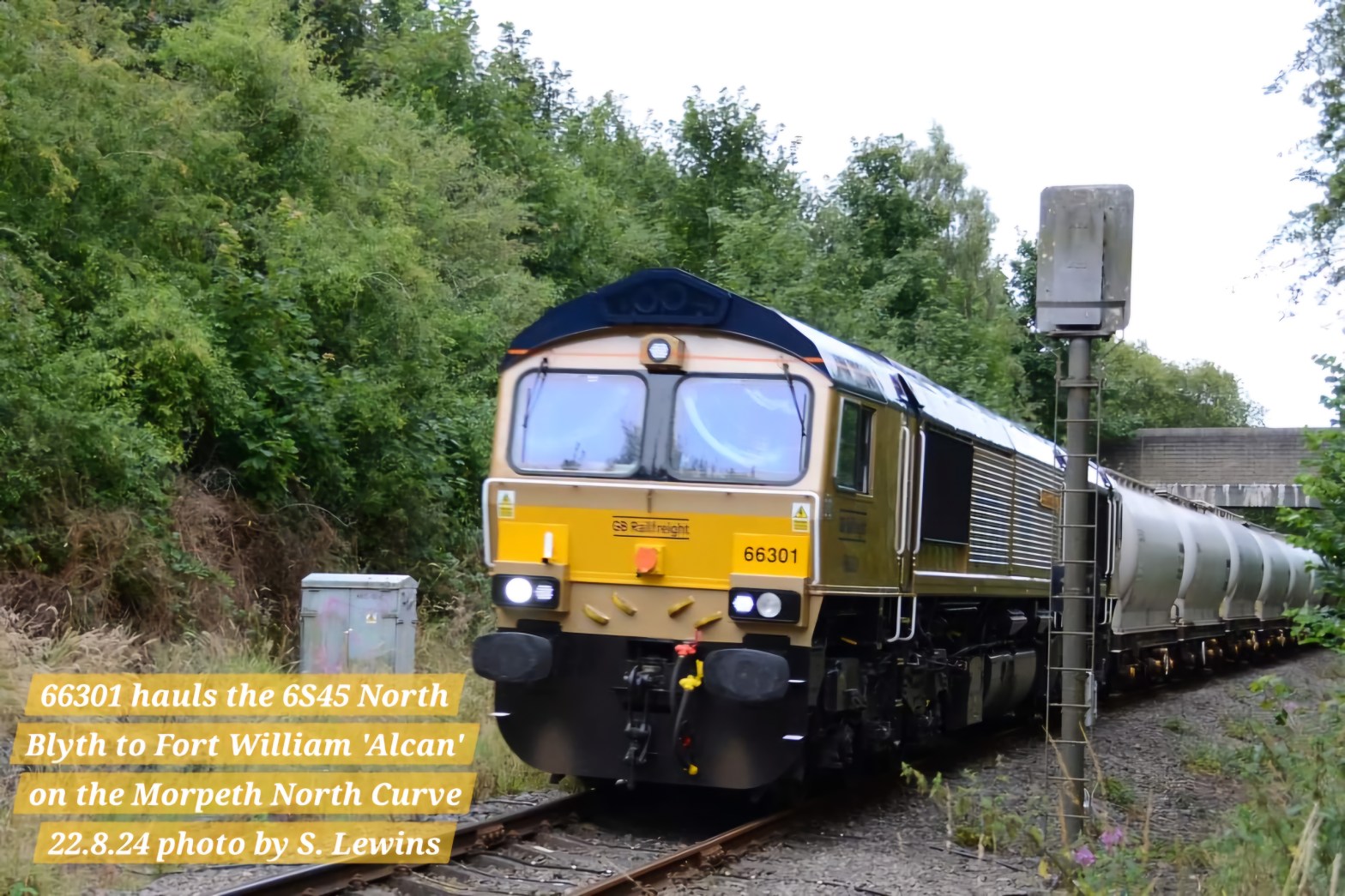
The potentially the best way to alleviate congestion in/through Pegswood, Morpeth, and across both junctions leading to/from Bedlington is to bypass the whole lot, which would allow trains stopping at Morpeth and/or Pegswood to be unaffected by non-stop trains as these would use the new higher speed avoiding line (also improving safety by avoiding the notorious Morpeth Curve, site of three derailments, six fatalities in 1969, and fortunately none in the derailments of 1984 and 1994).
This diversion has been proposed since 1877 when Captain Henry Tyler, a notable member of HM Railway Inspectorate said “It would obviously be better if a deviation line could be constructed, to avoid the use of such a sharp a curve on a main line”. Wise words considering the fatal consequences of the curve on 7th May 1969 when ‘The Aberdonian’ hauled by D9011 ‘The Royal Northumberland Fusiliers‘ came to grief on the curve. Later accidents in 1984 and 1994 were fortunately not fatal ones, but show that this curve could still pose a significant risk to this day.
The benefits to Morpeth, Pegswood and services to/from Bedlington would be via the present mainline having a much quieter timetable, being reduced to a secondary route, allowing more services to serve both of the stations, or come to/from Bedlington.
Please leave your thoughts in the comments, or on our social media pages!
 The Northumberland Coast Loop