The campaign is centred around connecting the populated south east of Northumberland to North Northumberland and Scotland, but this idea has been around for over 160 years in a wide variety of forms, so why did it not happen before and what shape could it take today?
The Blyth and Tyne to 1873
The Blyth and Tyne (B&T) Company, which was incorporated on 30th June 1852 alway sought northward expansions that somewhat frustratingly never panned out.
The history of the routes is long and complex, with many factors at play, so below is as brief a synopsis as possible to tru and cover the main events.
Firstly, the B&T grew out of an amaglamation of various colliery lines, rather than the vision of a strategic route like the neighbouring Newcastle and Berwick Railway, meaning its growth was by adding branches and sections over a longer period of time.
The growth of railways in the first half of the 19th Century was chaotic to say the least; with many companies in intense rivalry to promote and build routes all over the UK. The North East perhaps saw this to a lesser extent with the heavy influence of George Hudson, who was perhaps strategic in his thinking of routes, but his means of achieving it were dubious and ultimately led to his downfall.
The Seghill Railway for example was involved with the Newcastle and North Shields Railway (N&NSR) until 1844 when it was absorbed into Hudson’s Newcastle and Berwick Railway scheme. This led to the ‘Blyth and Tyne Junction Railway’ being formed as it needed indepedence from the Hudson’s railways to reach the Tyne for shipping coal out of the area, but also the lines running passengers on at least some of the lines.
This hotchpotch growth of separate colliery lines amaglamating their way into a wider network, rather than a clear, single line of route as such, perhaps helped kept the area out of the Hudson empire. The empire collapsing in 1849, following the wider end of the Railway Mania, marked by ‘The Panic of 1847’, which a commercial and banking crisis (sounds familiar?) which brought the somewhat dodgy deals of Hudson to light as money stopped pouring into railways for at least a while.
With the B&T formed in 1852, and in a post-Mania and Hudson environment, it perhaps would be easy to see why the railway would continue growth bit by bit rather than by bold schemes.
A rival railway proposal to the steadily growing B&T, was the ‘Tynemouth Docks, Morpeth and Shields Direct Railway’ which proposed a direct route from North Shields to Morpeth, which would have had branches to Ashington and Seaton Sluice.
The B&T responded by proposing to extend their line from Newsham to Morpeth via Bedlington which was the line that won out, and got authorisation for a Bedlington to Longhirst route by Acts of 1853 and 1854, though the route was never built to Longhirst. Other schemes by the B&T to link Warkworth Harbour (Amble) also never came to fruition as the North Eastern Railway blocked by the NER with the Amble Branch, which meant that the B&T line to Newbiggin was the northernmost part of the route in the end.
The Wansbeck Line: Blyth and Tyne to Scotland 1.0?
The route to Morpeth was opened for passengers and goods by 1st April 1858, ending in a separate station (now houses) on the opposite side of Coopies Lane to the present day Morpeth Station, with connection to the Newcastle and Berwick facing southward.
So by 1858, almost all of what could form the Northumberland Coast Loop was in place, and has been for 166 years, but a crucial link still wouldn’t be there for another 122 years…
…instead, the ‘Wannie Line’, properly the Wansbeck Railway, comes onto the scene, an might have seen direct connections to Scotland from Blyth, but via a very strange route!
The mad nature of Victorian railway empires again arises with the North British Railway trying to reach Newcastle – it ran the Scottish part of what is now the East Coast Main Line north of Berwick, but desired its own route, and the B&T was part of the plan.
The North British was behind the Border Counties Railway from Riccarton Junction, through what is now Kielder Water to Hexham, and joining the Newcastle and Carlisle (N&C) Line (now the Tyne Valley Line).
The problem was, the Newcastle & Carlisle, while still independent, was closely linked to the former Hudson empire (now the North Eastern Railway (NER)), and the North British was desperate to avoid any dependence upon the the NER.
For the North British, a vision developed for a new line from Reedsmouth to Morpeth, which would link the Border Counties railway to the B&T, providing a through route to Scotland, although a very indirect one!
In the end, the line didn’t prove successful, the NBR gaining powers along the Tyne Valley route meant that through trains via Morpeth never materialised to my knowledge. Reedsmouth Junction was built facing the wrong way for through services from Newcastle into Scotland, which perhaps shows this idea being abandoned before the line was completed, and the Wansbeck Railway had a weird connection to the B&T east of Morpeth (Wansbeck Junction, near present day Coopies Lane Industrial Estate), which meant to reach Morpeth B&T station, trains had to propel (run backwards) to reach it.
This caused a number of issues, the worst being an accident, which meant that shortly afterwards, the connection was rebuilt to run through the present day Morpeth station anyway (1872). Not long after, in 1874, the B&T was merged into the North Eastern Railway too, perhaps being the final nail in the idea of the North British having an independent route between Newcastle and Scotland.
Due to these factors, the Wansbeck Railway ended up as just a rural local route, not an alternative mainline to Scotland, and closed in 1965, but had that line opened a bit earlier, the North British absorbed or made deals with the famoisly independent B&T, maybe local railway history could have been very, very different; could have been Scotland bound expresses roaring through Bedlington, Bebside, Newsham and more?
1874 to Today
The step-change for the area came when the independent but landlocked B&T was finally absorbed into the much larger North Eastern Railway (though seemingly quite amicably), the system then became part of a much wider network rather than an individual company reaching outwards.
North Eastern Railway Era and the long-awaited Morpeth North Curve
The North Eastern quickly worked to consolidate the B&T routes into its system, closing the separate station at Morpeth and building a bay platform (now the Northern Car Park) for services to terminate in the present day Morpeth Station.
However, now that the former Newcastle and Berwick Railway was owned by the same company that had the Blyth and Tyne route to Morpeth, there was authorisation given for a new curve to link them in 1882, which would have allowed a train (either passenger or freight) from Bedlington to travel direct towards Pegswood or vice versa. (More details are available here: What if the Morpeth North Curve had been built by the Victorians?).
For an unknown reason, this curve was not built until 1980, which perhaps is strange given the relatively good financial position of the North Eastern Railway.
Had it been built by 1890, maybe once again local railway history would have been radically different; freight is covered in the post above where there was known flows from pits in the Alnwick and Amble area to Blyth for shipping, these reversing at Morpeth to reach the River Blyth, but potential passenger flows are much less certain.
That being said, had the link existed, its hard to imagine it’s use being totally exclusively for freight alone, especially ahead of World War One. Railway passenger services tended to be fairly intense on nearly all lines, and at the time, both the East Coast Main Line and the Morpeth – Manors North routes has a good level of service, so it seems a reasonable assumption that had the Pegswood – Hepscott Curve (known as Morpeth North Curve) existed, it would likely have seen at least some form of use by local services, as well as likely use by excursions to reach places like Whitley Bay or Tynemouth direct?
While the route certainly would have been unlikely to rival the ECML for fast expresses, it could well have been used for slower trains over long distances.
Perhaps Amble might have seen passenger services extended closer to Newcastle to link the coalfield communities?
As a couple of examples, Choppington Station had a fairly limited range of direct trains serving it, but in 1911 had ticket sales of 115,642, and Bedlington had figures of 227,121 in the same year, and its likely that at least some of those journeys probably would have been northbound ones connecting via Morpeth. It would be interesting if data exists showing the destinations of these tickets in 1911 rather than just the number of tickets sold.
World War One
Again, caution needs exercised in speculation, but had the Morpeth North Curve existed during WW1, its likely that it would have been used by troop trains, as a major training area was Alnwick Camp, set up in the pastures across the River Aln from Alnwick Castle. With many soldiers drawn from areas such as Blyth, its not unreasonable to expect that troop trains could have run. Near direct connections between many North Sea ports could also have been strategically important too.
London and North Eastern Railway Era
The interwar period tended to see decline in rail traffic with the rise of buses and lorries, passenger services became reduced but importantly didn’t disappear. Had longer distance direct trains been possible, a market rail became more able to compete with, the decline in services may have been more limited.
Excursions to the likes of Whitley Bay and Tynemouth would probably have been quite likely too.
World War Two
As with WW1, it is hard to speculate with any certainty on ‘what could have been’, but a again given the population size and connections to ports, but also the many airfields along the Northumberland Coast during the war.
Postwar
After WW2, the continued growth of road traffic ate into railway passenger numbers, and stations such as Hepscott and Choppington closed well before Dr Beeching produced his report, both closing to passengers on 3rd April 1950, but Choppington was reused for an excursion as late as the 22nd September 1962.
Again, speculation with caution, but had longer distance trains become established in the decades prior, it possibly fair to assume they may have kept these stations open for longer, and may have prevented the later closures of places such as Bedlington, Bebside and Newsham altogether, some smaller stations may still have closed but some of the larger stations might have remained open, perhaps never closing.
7th May 1969
The tragic fatal crash at Morpeth, where Deltic ‘The Royal Northumberland Fusiliers’ (D9011/55011) became derailed while hauling the northbound ‘Aberdonian’ sleeping car train from London to Aberdeen, where sadly six people died, 11 were injured and the roof of Morpeth Station was heavily damaged.
This accident was the first to show the dangers of Morpeth Curve (on the actual ECML), where the driver was apparently distracted and went around the then 40mph curve at 80mph. Sadly it was the first of three overspeed incidents on the notorious curve to date (March 2024)
This accident highlighted a long standing (since at least 1877) issue that Morpeth Curve is too tight to be on a mainline and presents a risk. While the Northumberland Coast Loop wouldn’t be a fix for this (a Morpeth Diversion is the solution), it has offered an alternative route in subsequent accidents and disruptions.
April 1980: Morpeth North Curve opens at last!
Despite being authorised in 1882, it wasn’t until around 98 years later that the Morpeth North Curve was finally built and opened to traffic, almost exclusively freight, as by this point all of the stations on the route via Bedlington to Newcastle had long since closed (November 1964).
Overall rail passenger figures in the early 1980’s were at a very low ebb, oddly enough at a very similar level to that of the 1880’s, however, this era marked the resurgence of rail, being contemporary with the opening of the first parts of the Tyne and Wear Metro, the first section opening in August 1980 just months after the Morpeth North Curve.
This marks the route for the Northumberland Coast Loop being put in place, but it is still not quite the end of the story.
To once again consider the ‘What if…?’ question of services being reintroduced between April 1980 and the present, towns such as Blyth, or areas like probably could probably have justified a ‘Parkway’ style station as the decline in traditional industries such as shipbuilding, shipbreaking and mining taken place, and perhaps could have been delivered alongside the Tyne and Wear Metro at places like Northumberland Park to serve major businesses parks like Cobalt and Silverlink when they were initially built too.
24th June 1984
The second accident on the curve, fortunately not a fatal one but resulting in 35 injuries, closes the mainline but with the M.N.C. in place allows for diversions.
27th June 1994
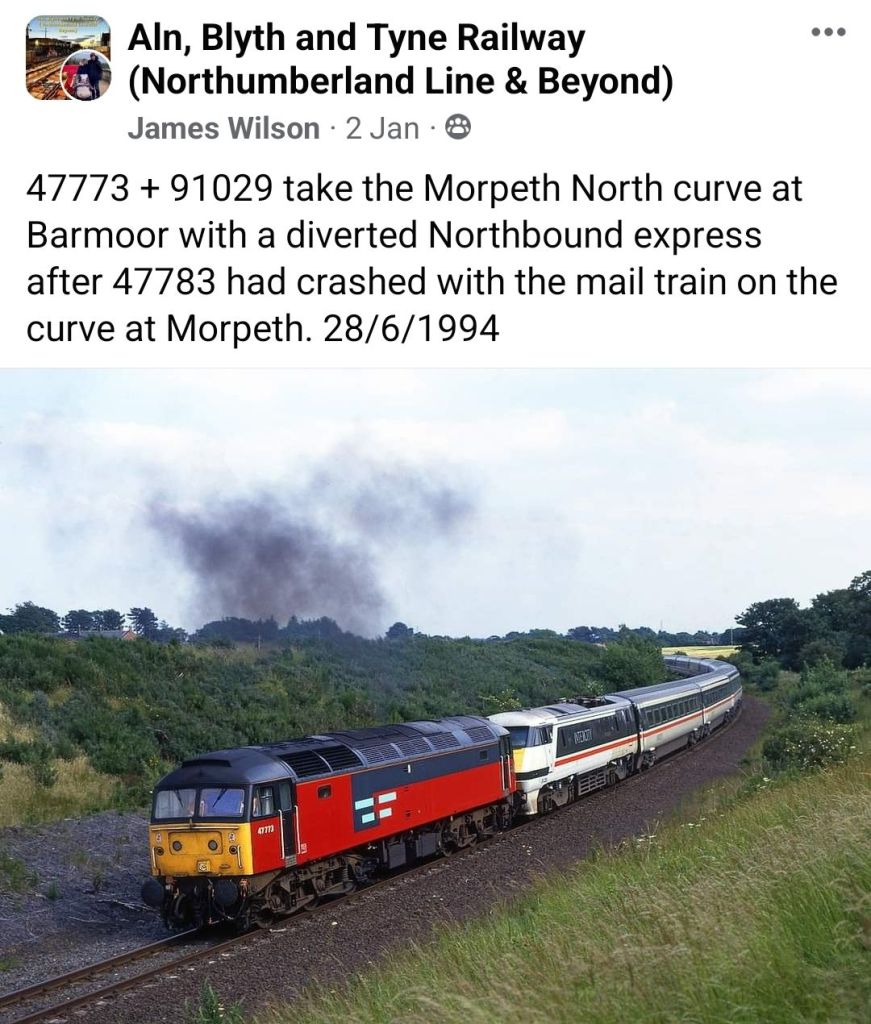
The third (and hopefully final) overspeed accident occurs with a parcels train, with only the driver sustaining injuries, again the Morpeth North Curve is used for diversions, with the image below showing it in use by 47773 dragging electric 91029 along the curve.
18th March 2017: Bound for Craigy Railtour
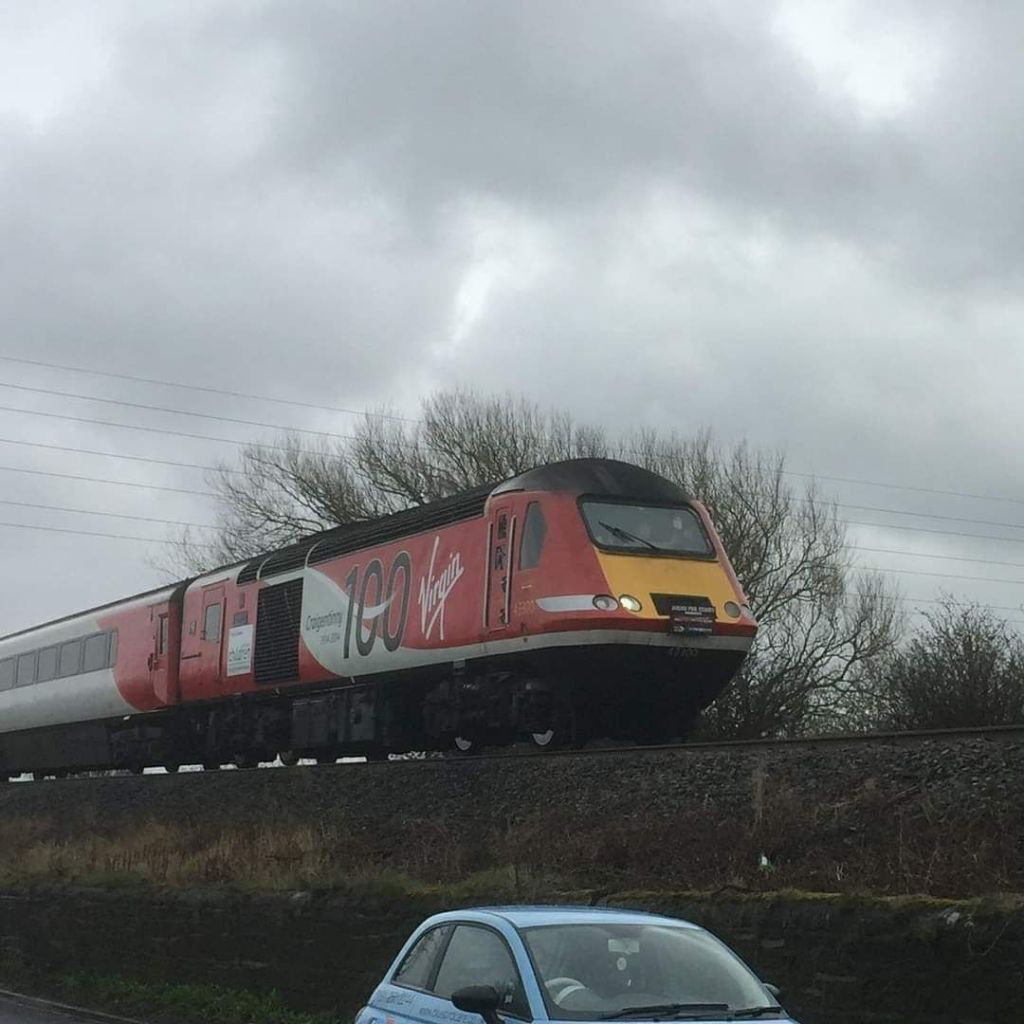
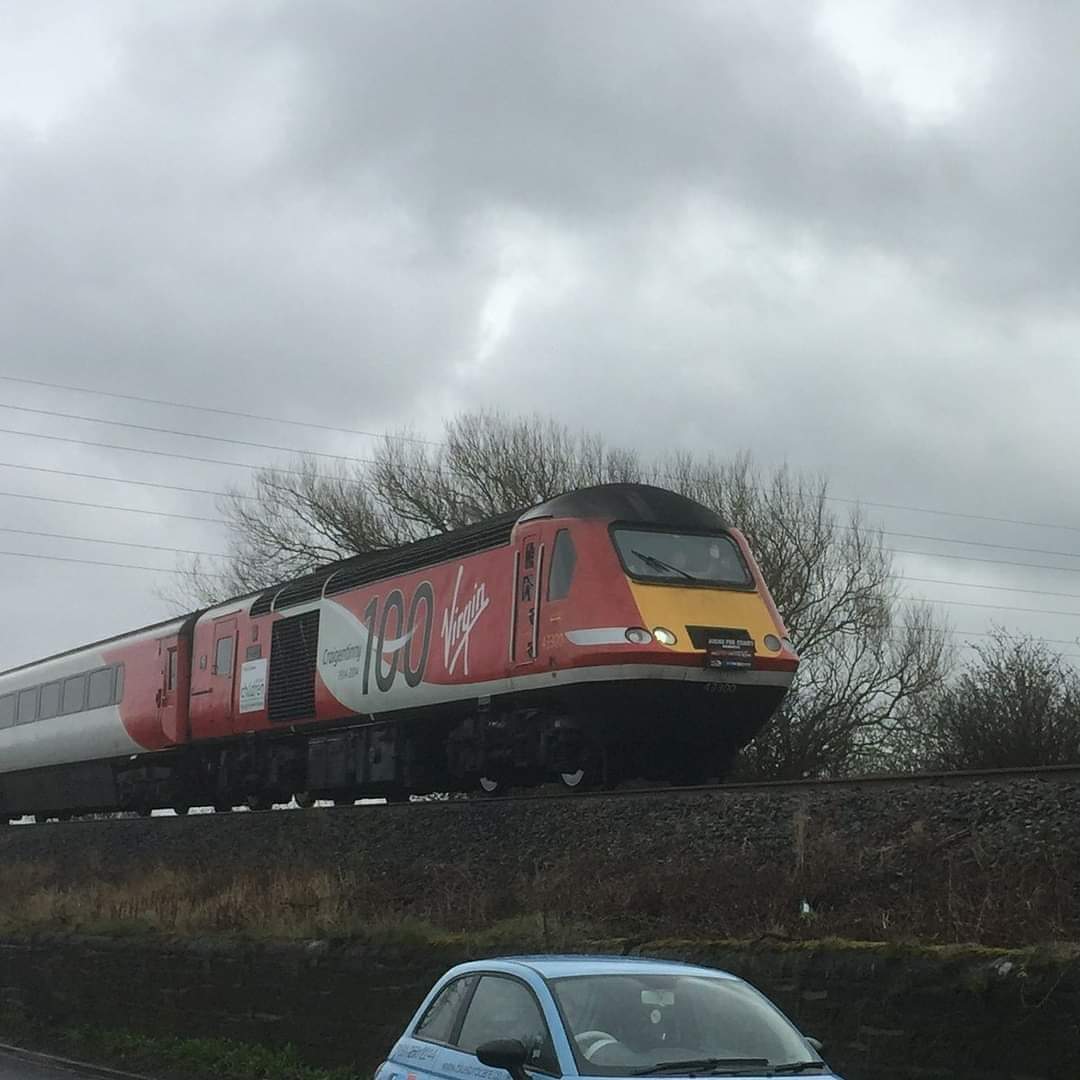
On the 18th March 2017, a railtour operated over the now proposed route, and was a leading part in inspiring it, especially as at that time, moves to start the Northumberland Line project were gathering pace.
The first online suggestion of the route was made in February 2023, with later a petition, followed by the establishment of this website in early 2024.
8th October 2023: Plessey Viaduct
On the 8th October, news broke of issues with Plessey Viaduct (carries the ECML over the River Blyth), causing major disruption to rail services. Most local services to Morpeth were cancelled, while heavy disruption ensued to long distance services having to use a single line over the viaduct.
Some limited diversions happened over the route, including a light engine run by Flying Scotsman on the 11th October, but no passenger diversions. The ECML was reopened for normal traffic on the 6th November.
Had the Plessey Viaduct been totally closed to traffic, the B&T would likely have seen a number of diverted trains, highlighting the importance of the route.
17th March 2024 (today)
As of today, the Northumberland Coast Loop is gaining support from an online campaign, and the Northumberland Line is progressing well, with hopefully stations at Newsham and Seaton Delaval to be completed later this year (2024) with other stations to be completed later in 2024 or early 2025.
Hopefully the Northumberland Coast Loop can become a reality in the near future – the route is there, why not use it?
 The Northumberland Coast Loop
First rate, thank you!
LikeLiked by 1 person
Thank you!
LikeLike