
Today is Saturday 27th September 2025, and 200 years ago marked the official opening of the Stockton and Darlington Railway, an important moment in railway history, and one that is good to reflect on both the railways of the past, but it is also ESSENTIAL to look towards the railways of the future.
Bedlington was an important player in the success of the early railway, the malleable iron rails developed by Birkinshaw being used extensively on the S&D (around ⅔ of all the rails), but Bedlington is also, in my view a key part of the future; the passenger railway returning there hopefully marks a turning point of where investment is made, and using the railway routes through Bedington better could make a massive difference to the fortunes of my hometown and surrounding area.
Despite being a year of celebrations of the railways as a transport system, and recognition of their importance, they seem to still take a backseat compared to road schemes, and get the very undeserved reputation of being ‘staggeringly expensive’ to quote a local resident, when in reality it is many of the road schemes that are hugely expensive for little overall gain.
These roundabouts are undoubtedly busy ones, with heavy traffic at almost all times, but cost of ‘upgrades’, which range in scope and price from a £300m design through to a £775m one are staggeringly vast sums of money.
The costs of roads are huge, but they don’t necessarily bring the prosperity that politicians promise; a dualled A1 is often said to be key to unlocking growth and the economy, yet towns like Blyth and Ashington, long connected by the long dualled A189 Spine Road are amongst the most deprived communities in the UK, with the return of the passenger railway being perhaps the real catalyst for positive change. Perhaps roads are not the promised path to prosperity, maybe it is a way made of steel?
To give a road vs rail price comparison, the Northumberland Line, a rail scheme in the same area of Northumberland (Seaton Delaval Station is only 2.8miles by road away from Moor Farm Roundabout) is often critiqued for its now £336.4m price tag (taking into account its cost-overruns to date).
This rail scheme has seen the reopening to passengers of an 18 mile long freight railway, with six new stations (even Ashington and Bedlington, which retained platforms since the 1964 closure of the line have been so heavily rebuilt as to be classed as new, not just reopened).
The Northumberland Line, despite its issues with delays and cost overruns can be clearly defined as a success already; with over 500,000 people using it so far, and trains being so well filled as to actually suffer from crowding, despite only having half of its stations open so far.
Could it be said that rail might be both cheaper and better to build?
Northumberland Line: Approx £18.7m per mile
This gives an approximate cost per mile of the Northumberland Line of £336.4m ÷ 18miles = £18.7m (rounded up), and with being an average, would represent 1 mile of freight railway upgraded, and ⅓ the cost of a station.
That would roughly work out at £56.1m for three miles of track upgrades from freight only to passenger carrying, plus a completely new station built alongside.
The caveat with this would be that three miles of track, and a new station in one place could cost substantially less per mile (i.e. a single line and single platform station), compared to a double track section (line in each direction) and a double platform station, which might cost more, but would be heavily dependent on circumstances at the specific sites such as ground conditions.
This very much a ‘best guess’, as with no highly detailed breakdown of prices for the individual elements of the Northumberland Line which has a mix of both single and double lines, as well as single and double platforms at different stations, which prevents information on the cost of each individual station, and of each individual mile of track, an average cost as produced above is the only reasonable comparison available.
Two Roundabouts, or 16 to 41 Miles of Railway with five to thirteen new railway stations?
The low-end cost of the A19 roundabout upgrades at Seaton Burn and Moor Farm is expected to be approximately £300m, and if £300m is divided by the above £18.7m cost per mile of the Northumberland Line, it would allow for approximately 16 miles of similar freight line to be reopened for passenger use, including five new stations if the money was instead invested into the rail network, rather that the the road network.
At the high-end estimate of £775m, and again using the Northumberland Line cost per mile of £18.7m, this could result in approximately 41 miles of line reopened to passengers, including the cost of up to thirteen stations.
Northumberland Line extensions to Woodhorn, Newbiggin by the Sea, & Lynemouth, Cambois for Blyth, and the Northumberland Coast Loop?
Whilst there isn’t now a singular freight line in Northumberland/North Tyneside of 16 to 41 miles long that is awaiting an upgrade to become passenger carrying, there are several shorter sections that could be upgraded, including new stations to provide further enhancements to the Northumberland Line itself.
Ashington to Lynemouth, 4 miles of line for c.£71m?
One of the obvious contenders is to extend the Northumberland Line northwards and eastwards from Ashington to connect the Woodhorn area (near the popular Woodhorn Museum), the seaside town of Newbiggin by the Sea and the former mining town of Lynemouth (presently the end of the line where Lynemouth Power Station stands).
Woodhorn Colliery Museum is about 1.25miles/2km via the existing rail route from Ashington, the likely site of a new station serving the eastern side of Ashington around the A189 Spine Road.
The line then curves northwards towards Lynemouth, passing over the A197 near the former Church of St Mary, Woodhorn at 2.2miles/3.6km from Ashington, a possible site for a station to serve Newbiggin by using the existing line, rather than rebuilding the branchline towards the coast (somewhat constrained now by a new school adjacent to the trackbed, and the significant civil engineering works needed to adjust the embankment heights to clear the A189 at the Woodhorn Colliery end).
The current headshunt of the Lynemouth Power Station, adjacent to Albion Terrace is reached at 3.5miles/5.7km from Ashington, but might reasonably be extended a few hundred yards towards Bridge Street (former railway cutting, now infilled), which would extend the line slightly (0.3miles/400m) to 3.8miles/6.1km from Ashington, giving Lynemouth an ‘edge of town’ station alongside the Lynemouth Miners Welfare Institute.
Again using the Northumberland Line average cost of £18.7m per mile, Ashington to Lynemouth, a rail route 3.8miles/6.1km long would cost in the ballpark of c.£71m; a quarter of the cost of the low-end A19 roundabout works, and near an eleventh of the high-end A19 roundabout cost (Ashington to Lynemouth Bridge Street could be done 11 times over for the same amount of money).
There is an amount of variability due to the possibility of three proposed stations relatively closely spaced at Woodhorn Museum, St Mary’s, and Lynemouth Institute, which would possibly put upward pressure on the price, as might a short bypass line around the Power Station sidings, but a generous £100m budget would still be third of the cost of minor roundabout upgrades, and around a seventh of the high-end costing.
Cambois for Blyth Town Centre for £60.7m – £101.4m?
A branch from the Northumberland Line between Bedlington and Ashington could be another contender for investment too; whilst the population of Cambois and North Blyth itself is relatively small, the line extends well into the north side of the Port of Blyth, which, when and if combined with a revival of a pedestrian ferry service across the port, similar to those used on the River Tyne, could provide a great link for central Blyth.
The rail route into central Blyth is likely now lost to development, and would likely now be truncated to near Gilbert Ward Academy, as well as the issues likely to arise from the level crossing being reopened on Plessey Road (near Plessey Chippy) likely to preclude a reopening on the Blyth side of the river.
While on the opposite bank of the River, the railway has the advantage of already being open, and whilst the level crossings at Winning, Freemans, and Unity Terrace/Foster Terrace might need upgrades, these already exist and are in regular use.

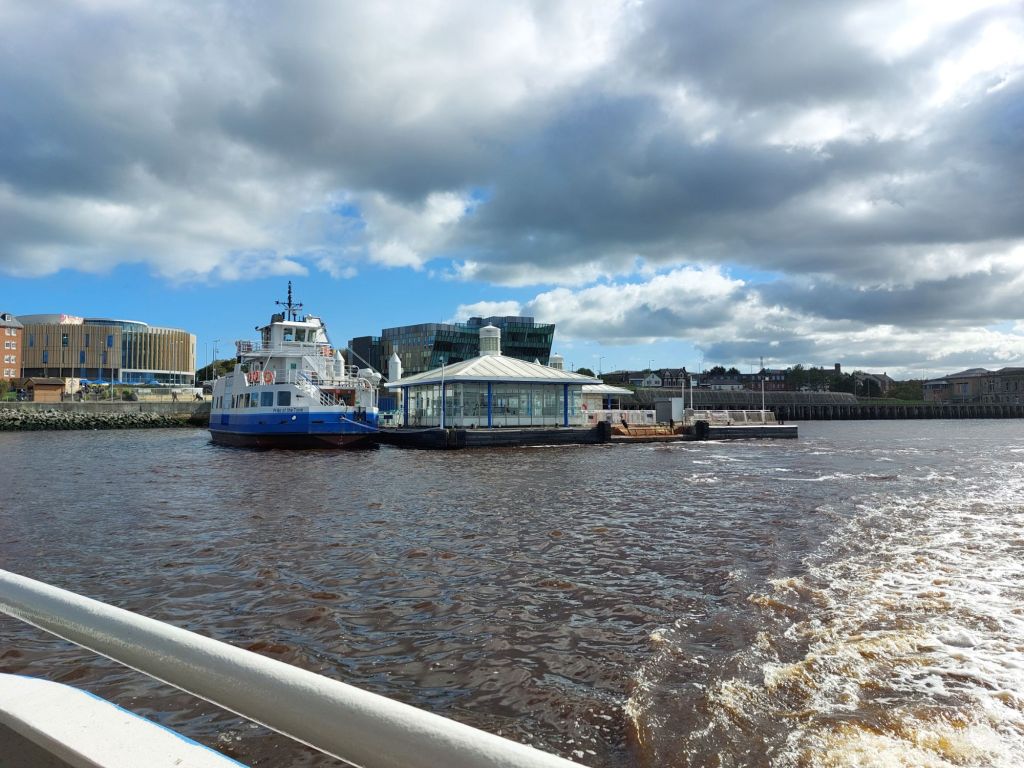
Taking the distances from West Sleekburn Juncton (the direct route from Newcastle & Bedlington into Cambois), the site of the former Cambois Diesel Depot (stabling point for locomotives), where a station serving the township of Cambois could be built is only around 2.1miles/3.4km from the West Sleekburn Junction with the Northumberland Line.
Assuming a new landing station for a revived ferry might be built near the roundabout for Battleship Wharf, a station near to Worsdell Street might be constructed (clear of a run-round loop for the ‘Alcan’ alumina dock) which would be around 3.25miles/5.2km from West Sleekburn Junction.
Using once again the average price of the Northumberland Line per mile of £18.7m, this 3.25mile line could cost in the ballpark of £60.7m, a fifth of the price of the low-end roundabout upgrades.
This above figure does not take into account the costs of a ferry and/or new landings on each river bank, which would need to be separetely costed and accounted for, but there may be some scope to ‘pool’ the Tyne and Blyth ferries, so that a third ferry would work on the River Blyth, with the existing ‘spare’ Tyne ferry providing cover when required.
As an indicator of costs, the Spirit of the Tyne, an ‘off the shelf’ ferry design was built in 2007 at a cost of £1.9m, so adjusted to 2025 prices would be approximately £3.3m today, and the proposed new landing in North Shields is expected to cost £18.7m, so multiplied by two would be £37.4m, giving an overall estimate for cost for a new ferry, and two landings of c.£40.7m.
This would give a ‘Cambois for Blyth Rail+Ferry’ link an overall price tag of c.£101.4m, but compares well when considered alongside road schemes such as the Blyth Relief Road at £59.9m, which will run on the outskirts of Blyth, and so will not ease traffic issues in the Town Centre itself, whereas a pedestrian ferry connection across the Port of Blyth to buses, and potentially to rail services if a passenger link was built would make access to/from Blyth Town Centre by public transport far easier.
To operate the Cambois Branch without the need for additional train paths on the Newsham – Newcastle section of the Northumberland Line which is constrained by single track; one option might be to use a pair of two-car units working as ‘portions’, with a northbound four car train splitting somewhere like Newsham/Blyth Bebside/Bedlington, with two carriages going to Ashington/Woodhorn/Lynemouth, and two carriages to Cambois/North Blyth, with the pair of two-car trains heading southbound combining again into one four-car unit at whichever station is best suited for this.
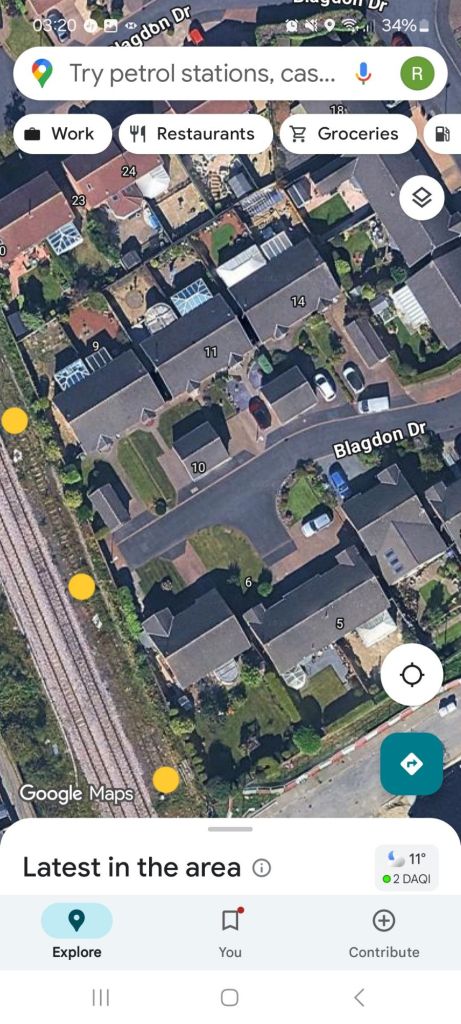
A second option could be to create a ‘shuttle’ between Cambois and Blyth Bebside (acting as an interchange onto other trains), with empty stock running towards Newsham, where it could use a rehabilitated third line next to Newsham Pond/Blagdon Drive as a reversing siding, which by measuring on Google Maps is approximately 400m long, ample long enough for a short shuttle train.
This latter option would require some infrastructure changes, but may be a better option for simplicity of operation, and could be used for other services too (such as a Newcastle – Morpeth – Blyth rail service), which adds to resilience if the Newsham – Newcastle section is closed for engineering work for example.
Lynemouth Branch and Cambois (for Blyth) Rail+Ferry Extensions for c.£172.4m-£202m
As can be seen from above estimates, the cost of extending the Northumberland Line to Lynemouth, as well as a potential extension to Cambois, including a renewed Blyth Ferry, with new vessel and landings would still only come to circa ⅔’s of the low-end costs for the A19 roundabout upgrades, and less than a third of the price of the high-end scheme of £775m.
Also to note is that other road schemes such as the £59.9m Blyth Relief Road adds to the road costs, and when included to the cost of the A19 upgrades, moves the prices to a new range of £359.9m to £834.9m, with the Blyth Relief Road likely to add pressure onto the Moor Farm and Seaton Burn roundabouts, even if upgraded, undoing the gains of increasing capacity by sending more traffic onto them.
Bedlington to Pegswood as part of the Northumberland Coast Loop: £89.8m for 4.8 miles
A third proposal, and my own preference with regards to further expansion of the railway in Northumberland, is to see the bulk of the Northumberland Line become a secondary through route between Newcastle-Upon-Tyne and Edinburgh.
Glasgow and Edinburgh are linked by four different lines; The Falkirk Line, The North Clyde Line, The Shotts Line, and finally The Carstairs Line. If Glasgow – Edinburgh can have four lines, surely Newcastle to Edinburgh can have two (essentially one and a loop through SE Northumberland and North Tyneside, hence the Northumberland Coast Loop name!).
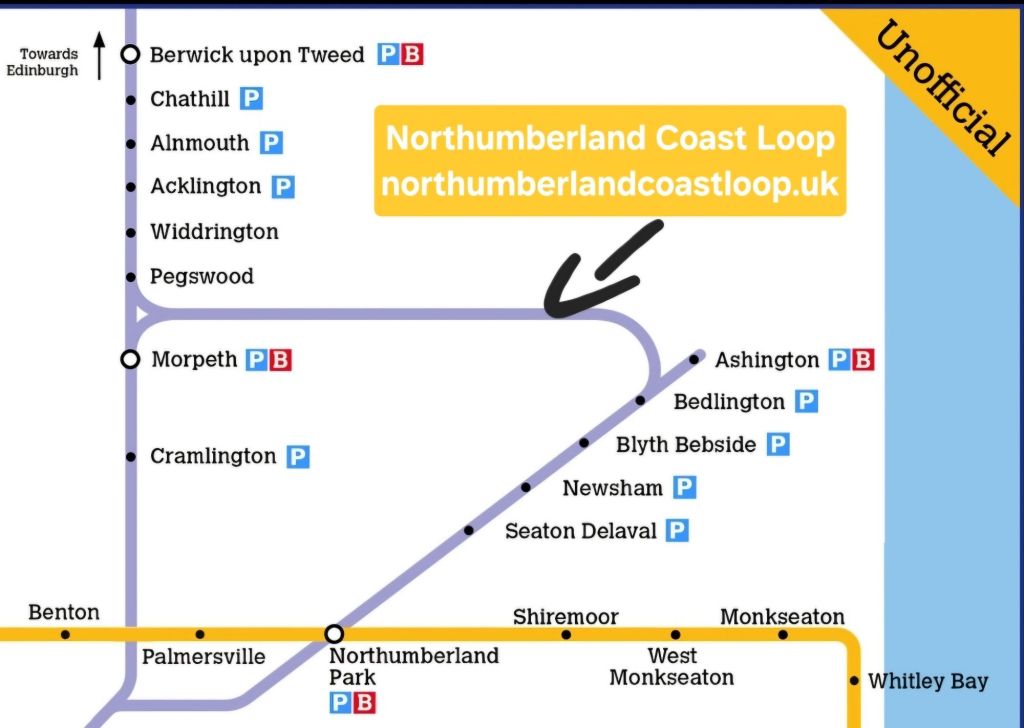
This can be achieved using an existing route that links Bedlington Junction to Morpeth North Junction, allowing a train from Newcastle Central to travel up to Bedlington, and from the perspective of the train driver, turning left off the Northumberland Line at the Bedlington Junction, headed towards Hepscott. Just after passing over the level crossing in Hepscott, another junction is reached, the left hand route, again for a train driver coming from Bedlington, takes you into Morpeth station, and then to Cramlington and Newcastle Central; but turning right takes you towards Pegswood, Alnmouth, Berwick, and Edinburgh.
This right hand route is used by a handful of rail services, mostly the North Blyth to Fort William ‘Alcan’ train, which turns around (reverses) at Bedlington after coming from Cambois, into the sidings at Bedlington, loco off, onto the other end of the train and away to Scotland.
This line is the longest of the three, at 4.8miles/7.7km, and again using the per mile cost of the Northumberland Line of £18.7m per mile, would see an overall cost of around £89.8m, but which includes the likely cost of reopening Choppington Station, but unlike the other two schemes, could be a ‘track-only’ scheme to connect the current stations on the Northumberland Line to those in North Northumberland and Scotland, and therefore could be far less expensive as a result, indeed there are strong proposals for extension of the current Newcastle – Morpeth services to Bedlington once the latter station is opened, so running additional trains via the Northumberland Coast Loop should not prove to be problematic.
Capacity limitations on the ECML (East Coast Main Line), is likely to be the major factor in limiting the number of services that could run on the present infrastructure, but again other road schemes, such as dualling of the A1 provides a useful comparison, with a £500m price tag for 13 miles of road between Morpeth and Ellingham running at a cost per mile of £38.5m per mile, more than double the per mile cost of the Northumberland Line.
Investment in the ECML to increase its capacity is a virtually guaranteed success, whereas the benefit:cost ratio (BCR) for schemes like dualling the A1 is a known flop, with a BCR for that scheme of only 0.8, meaning for every £1 invested, a return of just 80p is expected back.
A good comparison can be made between upgrading the A9 in Scotland vs upgrading the Highland Main Line, as outlined by rail engineer Gareth Dennis in one of his recent Railnatter episodes, and upgrading of the A1 in Northumberland/Scottish Borders vs upgrading of the ECML between Newcastle and Edinburgh.
Both of these road routes run through rural areas and mixed single/dual carriageway, and both are paralleled by railways; wity a key difference between them being that the ECML is double track and already wired up, compared to the Highland Main Line which is mixed single/two track and has no wires up.
Conclusion
If all of the road schemes nearby to the Northumberland Coast Loop are taken together; the A1 at £500m, the A19 roundabouts at £300m to £775m, and the Blyth Relief Road at £60m, it gives a total between £860m and £1,335m (£1.3 billion).
A final division of these sums by the Northumberland Line per mile cost of £18.7m, would result in 45miles of line, inc 15 stations if rail investment was made vs road at the bottom of the road scheme price range (£860m), and for the top range price (£1,335m), would be equivalent to 71.4miles of line, with potentially 23 stations delivered, far greater than the distance between Newcastle and Berwick.
If the extensions to the Northumberland Line to Lynemouth, Cambois (for Blyth via Ferry), and the Northumberland Coast Loop are totalled up (£71m + £101.4m + £89.8m = £262.2m), then the cost of three rail major rail schemes could still come in below the cost of upgrading just the two A19 roundabouts (at a minimum cost of £300m)
Given the huge success of the Northumberland Line since opening last year, and the long running success of the ECML between Newcastle and Berwick, perhaps the £860m to £1.3bn proposed spend on road transport schemes would be better off being spent on railways and public transport, than on dual carriageways and roundabouts?
 The Northumberland Coast Loop