
On the 6th October, the Northumberland Coast Loop petition came to a close with the support of 742 people, thank you to all who signed it!
Following the closure of the petition, I reached out to Councillor H.G.H. Sanderson, present leader of Northumberland County Council by email. I recieved a postive response that the proposal aligns with future expansion of the Northumberland Line, and that it also aligns with projects in the North East Combined Authority (NECA) transport plans; though it doesn’t seem to mention in detail what expansions of the Northumberland Line are proposed. Hopefully this can become a definitive project in coming months/years alongside other expansions such as Newbiggin-by-the-Sea etc.
I have also been in contact with my MP, Mr David Smith of the North Northumberland seat, and discussion is ongoing there too.
A third approach was made to Jason Wade of Northern Trains at the recent Railfuture North East Branch meeting on Wednesday 16th October 2024, questions being put forward by a fellow committee member as I couldn’t attend in person that evening.
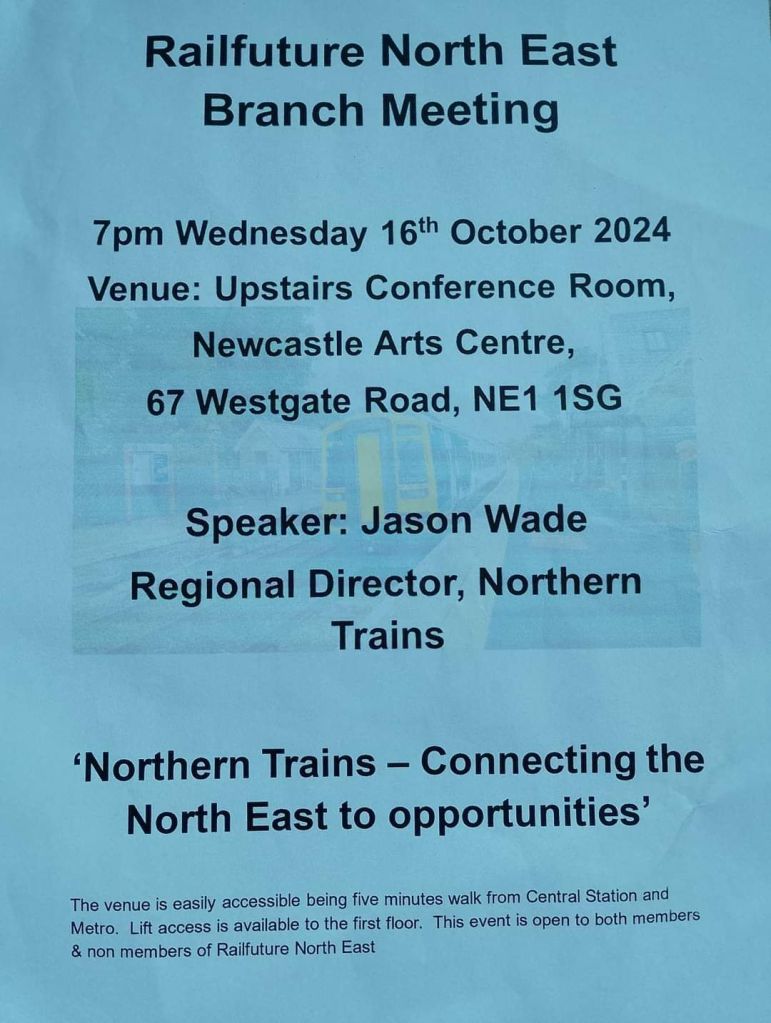
Feedback from my colleague was that the route is ‘unlikely as it misses Morpeth and Cramlington’. This might be attributed to being ‘risk averse’ with regards rail services, which I’ll explore below to offer my contention that such a route deserves a trial at the least given that the expensive element of the infrastructure is in place.
The risk of not serving Morpeth and Cramlington is understandable as both are a known and established market for passengers. The stations have never been closed, although the whole ECML itself North of Newcastle was threatened in the 1970’s and into the 1980’s with likes of the Serpell Report of 1982 proposing closures of many mainlines. Fortunately these proposed closures never happened, and the ECML has survived and thrived in years since.
In contrast, the ‘new’ stations Northumberland Line (many are on/near former stations but are essentially new) haven’t had a regular passenger service since 1964, when these stations closed, with most being entirely demolished, and the direct route from Newcastle to Pegswood via Bedlington only became possible in 1980 with the completion of the Morpeth North Curve, previously any diversions via Bedlington having to reverse at Morpeth Station.
I have previously postulated the effect of building the Morpeth North Curve as intended in 1882, and the effect that might have had on the survival of the stations. In reality though, the curve came too late to potentially have saved the stations; but with them reopening, the opportunity now exists to see a new service instituted, which as stated in many previous posts would be a massive boost to Northumberland’s connectivity as a whole.
Two routes along the Northumberland Coast?
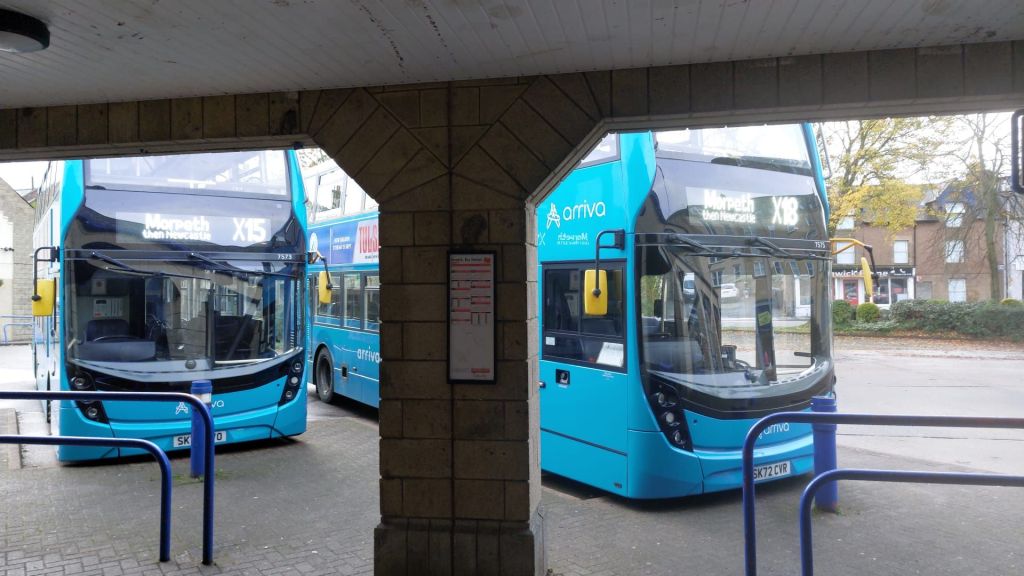
A good example of fast vs slow routes complementing one another is perhaps exemplified by the X15 and X18 buses, seen this morning side by side at Alnwick Bus Station, the X15 is the ‘fast’ bus comparatively, reaching Morpeth in 50mins from Alnwick, whereas the slow X18 takes 74min for the same trip.
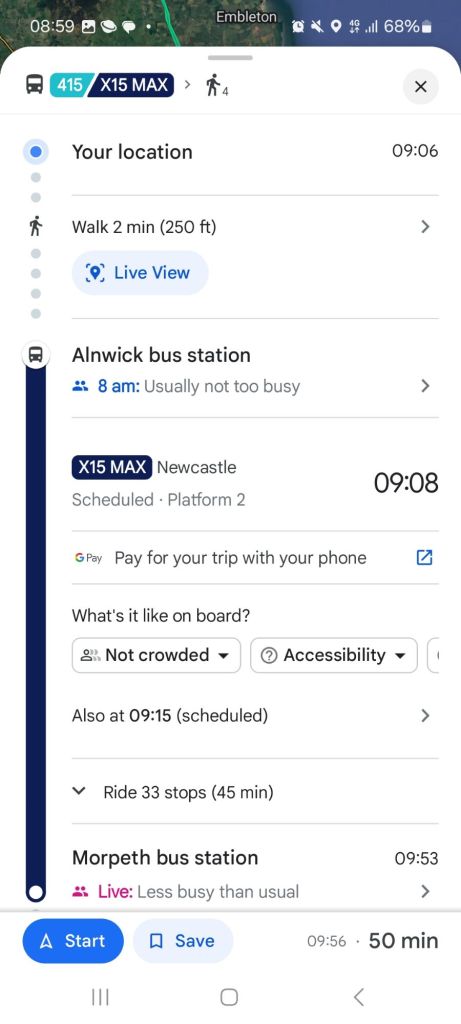
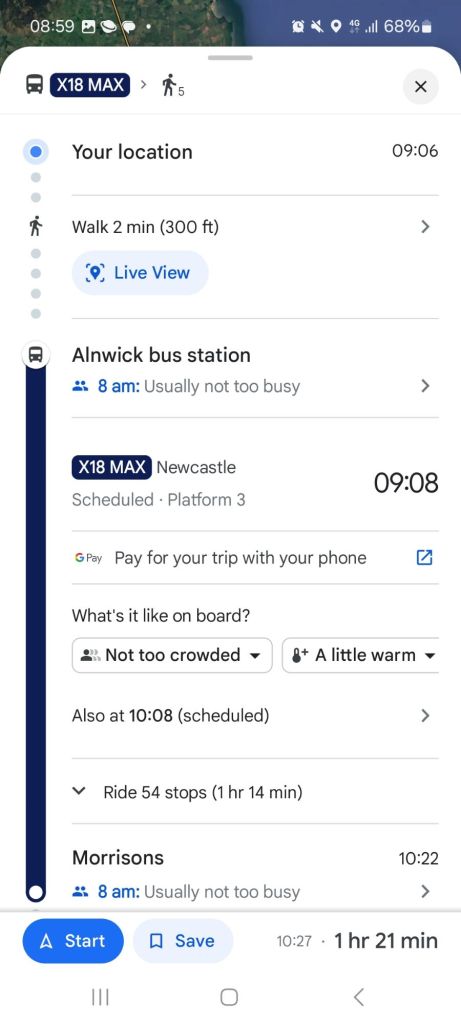
Naturally if you’re target destination is Morpeth, you’d catch the X15 for the shortest journey time, either having more time in that town itself, or being able to depart later/arrive home earlier, all else being equal; but the X15 serves fewer places (33 stops compared to 54 on the X18), while the X15 does connect smaller places such as Shilbottle, Felton and more, the slower X18 provides a through connection for the larger settlement of Amble, links to Alnmouth Station for Alnwick, Amble, and other settlements nearer the coast. It might be slower but is arguably the service that provides more connections for more people.
The Northumberland Coast Loop (N.C.L.) route proposal is very similar to the X18 concept of serving the population centres directly over end to end speed, from Berwick Upon Tweed to Newcastle Upon Tyne, the railway route via Morpeth and Cramlington is undoubtedly the faster one, but it calls at smaller settlements (Morpeth is 5th largest town in Northumberland, Cramlington 2nd)
The N.C.L. route would directly serve Bedlington (4th largest), and Blyth (largest town), while also indirectly still serving the town of Morpeth (and Ashington as the 3rd largest town) by using Pegswood Station, sited superbly between both of these settlements, and especially for Morpeth potentially more easily accessible than Morpeth Station itself. Cramlington (the town overall) would still be served quite well by using Blyth Bebside, Newsham, and Seaton Delaval stations.
In short, this route would complement the existing services on the ECML, not replace them.
The Hepscott Line, The Butterwell Line, or both?
There are two campaigns for this area of Northumberland that I feel need to be viewed side by side. Essentially, between Berwick and Widdrington, and between Bedlington and Newcastle, both routes would be identical, the middle section between Bedlington and Widdrington being the variable option, one an existing and open route, the other partially disused and requiring new sections of line to be built.
In both cases, it is important to note that neither route would go via Cramlington or Morpeth stations, and in the case of the Butterwell route, services would be further from Morpeth by also avoiding Pegswood.
The Northumberland Coast Loop would use the Hepscott Line, which is the existing and regularly used link between Bedlington, Morpeth, and Pegswood, passing through the village of Hepscott just to the south east of Morpeth itself, giving the line it’s name.
The N.C.L. proposal is for a Newcastle to Berwick via Bedlington passenger service to take the Hepscott Line to rejoin the East Coast Main Line at Morpeth North Junction (near to Pegswood Railway Viaduct). This route is regularly used by the North Blyth to Fort William Alumina trains, which change direction at Bedlington Sidings coming to/from North Blyth. This would therefore simply be using infrastructure that already exists to provide a new passenger service.
The ‘Butterwell Line‘, being advocated for by SENRUG is the name given to the collection of disused colliery lines north of Ashington, part of which ran though Butterwell Disposal Point. It has never formed a direct route north, as only formed a through route from Pegswood to Ashington for coal trains, any connection northward would need a new curve constructed near to the River Lyne, and this line is now totally disused, with the section just north of Ashington to New Moor being disused since c1999-2004 (some contradictory sources for last train over the section). This route would mean a significant investment of perhaps £50m to £100m (or indeed more) required to rebuild two junctions (that at Ashington and a new one to connect onto the ECML), as well as to bring a now long disused freight line to full passenger standards.
While this would be a useful route, and would offer Ashington a direct connection north, it would require a very substantial investment into the route to make a reality, whereas running trains via the Hepscott Line could arguably be trialled using the existing infrastructure at a fairly minimal cost to see if usage of the route would justify furtger investments in capacity.
This could be likened to the Amazon approach of one-way and two-way doors, an extract from the AWS page being below
‘Another tool we use at Amazon to assist in making high-quality, high velocity decisions is a mental model we call one-way and two-way doors. A one-way door decision is one that has significant and often irrevocable consequences—building a fulfillment or data center is an example of a decision that requires a lot of capital expenditure, planning, resources, and thus requires deep and careful analysis. A two-way door decision, on the other hand, is one that has limited and reversible consequences: A/B testing a feature on a site detail page or a mobile app is a basic but elegant example of a reversible decision.’
https://aws.amazon.com/executive-insights/content/how-amazon-defines-and-operationalizes-a-day-1-culture/#:~:text=A%20two%2Dway%20door%20decision,example%20of%20a%20reversible%20decision.
The two-way door option is using the Northumberland Coast Loop route via the Hepscott Line; it might work or it might not, but it wouldn’t take much to try it out. A low risk for potentially high reward.
The Butterwell Line would be very much a one-way door; it would be a big investment and one that couldn’t easily be backed out from once built.
If the Northumberland Coast Loop route proved itself a big success, that could open the door (pardon the pun) for the Butterwell Line, with an established market being created via Hepscott, changing the route to via Ashington if desirable could show the business case for that investment.
Let’s take a chance at trialling the N.C.L., and see what comes back? What’s to lose?
 The Northumberland Coast Loop