
This recent article from North East Bylines, a ‘Whistle-stop tour of the Stockton and Darlington‘ shows quite clearly how much of the S&D survives as a passenger carrying route, particularly the section from Shildon in the west to Eaglescliffe and towards Middlesbrough.
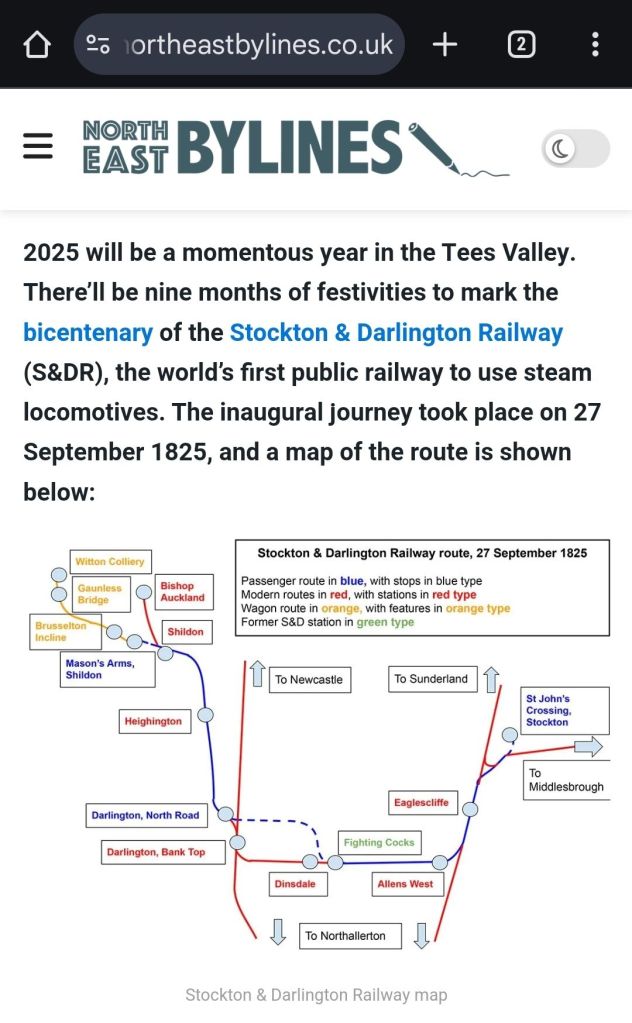
While the obvious focus of the Stockton and Darlington Railway’s 200th anniversary will be around the railway itself in the Teesside area, there is a broader opportunity to tell the story of the 200 years of railway history that precedes the S&D.
Worldwide attention will be given to this line as it is broadly viewed to be the birth of the modern railway, and was pivotal into the development of the modern industrial nations of the United Kingdom, USA, European nations such as France, Germany, Italy and many more worldwide, with UK technology often at the forefront.
Industrial heritage is also much more widely appreciated now, with the success of major venues like Beamish Museum, itself home to an 1820’s waggonway in a recreated landscape of the time is likely play a major role in Railway200, but lets also showcase the real places, let’s ‘Walk the ground’ as said by Al Murray and James Holland say on their ‘We have ways of making you talk’ podcast. Venture into the Blyth Valley, tranquil now but once an important industrial site, home to Bedlington Ironworks, step into Stephenson’s Cottage in Wylam where young George was born, walk across the Causey Arch and take a ride on the Tanfield Railway.
Let’s show the world the railways are an important part of Britain’s heritage, and that we can use them today to great effect.
Beginnings with Beaumont
The start of waggonways in the North East starts around Bedlington in c.1600, when Huntingdon Beaumont introduced the technology from his native Nottinghamshire, illustrating a development dating back thousands of years, not just 200.
Though it wasn’t hugely successful for Beaumont himself (who sadly died as a debtor in 1624), the techology was widely adopted across the North East. One hundred years after Beaumont’s death, the Tanfield Waggonway was completed in 1725 (therefore celebrating it’s own tercentenary in 2025), a full hundred years before the Stockton and Darlington.
Trevithick Genius to Tyneside
It was the Cornishman Richard Trevithick who first developed a viable steam locomotive in 1804, it showing its stuff on the 21st February on Merthyr Tramroad in Penydarren, but was not a total success due to broken rails, and reverted back to being horse drawn after the experiment.
Later in 1804, Christopher Blackett of Wylam Colliery requested Trevithick to send John Whitfield of Gateshead some drawings, a locomotive was built and demonstrated but again was limited by the track technology of the era. This locomotive is said to have started the development of Tyneside locomotives and the engineers who built them.
Waggonways, Wylam and Wrought Iron Wizardry
It was into this rich waggonway world around his birthplace of Wylam that George Stephenson, was born into, being in his early 20’s at the time of Trevithicks early experiments, and in an area full of waggonways and associated collieries, it was a superb situation for Stephenson to develop his locomotives.
Stephenson’s first locomotive, ‘The Blucher’, was built in 1814 for Killingworth Colliery, and was reputedly the first locomotive to run on flanged wheels and iron rails, 11 years before Locomotion on the Stockton and Darlington Railway.
It is important to remember that George was one of many developing locomotives and wider railways at the time, but the focus with the S&D means that he is the main focus here.
Bedlington is back again with the Birkinshaw Rail 200 years later!
The track technology could be said to have finally caught up with locomotives by 1820, when John Birkinshaw of Bedlington Ironworks developed a malleable iron rail with a wedge shape, allowing for locomotives to work without breaking the track.
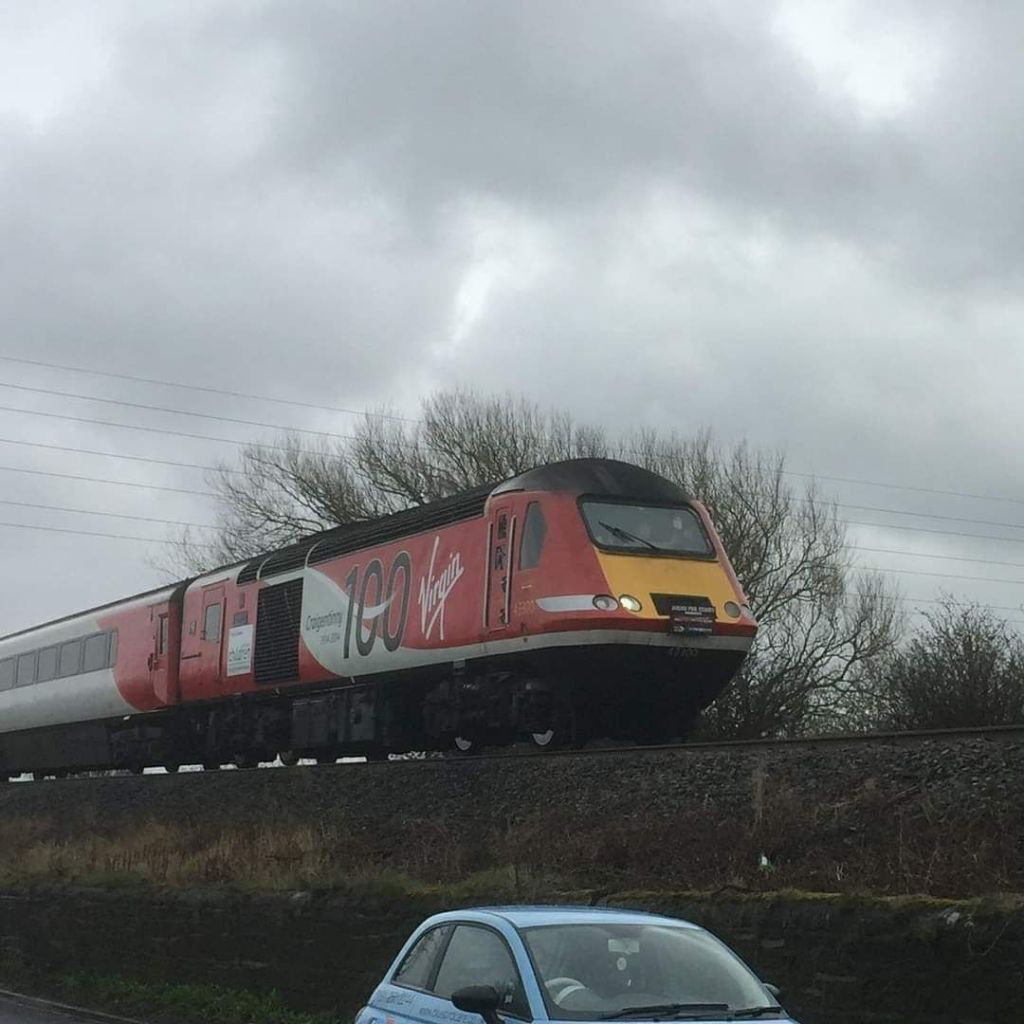
The first section of line laid with this new rail is reputed to be to Barrington Colliery to the north of Bedlington towards the River Blyth, parts of which might still be in railway use today as the Hepscott Line between Bedlington and Morpeth, which the image below shows the ‘Bound for Craigy’ railtour using back in 2017.
It could be contended therefore that any reasonable celebration of the 200th anniversary of S&DR should also include Bedlington, and the valley of the River Blyth as both the starting place for waggonway technology, as well as the later development of the Birkinshaw rail used extensively on the S&D itself, and could certainly be linked to Wylam, Killingworth and more too.
Railtours to Revive the Revolution of Railways in Britain
One fitting way to achieve this could be to use the rail network itself to showcase these sites holistically, and showing the up to date development of railways, especially pertinent given the reopening of the Northumberland Line in late 2024.
Special trains would be a fairly inexpensive but effective way to showcase railways as not just an invention of the past consigned to history, but as an effective way of cleanly and efficiently moving people and goods today.
Especially with a modern unit, and if given a dedicated route (as suggested below) the train could be branded with a Railway200 livery, and would act as a travelling advert for a railway revival with the forthcoming Great British Railways and hopefully a new golden era of rail travel.
Use the railway to showcase it’s own history.
Rolling stock
Whilst heritage rolling stock would certainly be welcome on some workings (especially steam/heritage diesel), it is envisaged that most workings would simply be a modern train, which could allow for easily running at upto 125mph on fast sections of the mainline, whereas heritage stock is typically restricted to lower speed limits.
The Route(s)
Given that these sites are only a short distance from the East Coast Main Line (ECML), special trains/railtours could easily run from the major cities along the route, Newcastle would be an obvious candidate, but also Edinburgh, York, and London could all justify special trains.
Edinburgh to Bishop Auckland via Bedlington and Eaglescliffe?
The train would simply travel down the ECML as far as Pegswood, then take the Morpeth North Curve, giving direct access towards Bedlington, and then taking the Northumberland Line route via Seaton Delaval towards Newcastle Central Station.
This would offer at least a ‘run-past’ of the Bedlington Ironworks site in the Blyth Valley between Bedlington and Blyth Bebside stations, if one or both were open, and a sufficient service provided it may allow for visitors to step off and visit the valley themselves, bringing some industrial tourism potential to Bedlington and Blyth. Similarly, there could be opportunities to visitors to also visit Dial Cottage, within easy reach of Northumberland Park station by existing bus services.
From Newcastle, these special trains could then make their way to Eaglescliffe, either via the ECML & the Stillington Line or via the Durham Coast route. From there, they could take the route via Dinsdale to Shildon, and thus traversing the major part of the S&DR by train, as well as viewing the valley where most of the rail from the railway was produced and where its design was developed.
A similar return route would offer a better view of the Blyth Valley from Bedlington Viaduct as it was on the upstream side of the bridge, but little evidence remains of the ironworks itself.
This is using the Northumberland Coast Loop route as envisaged, and shows the potential ease of this being implemented as a regular rail route, which could be important in the decades to come, with 200th anniversaries of important locomotives built at Bedlington coming up in the next couple of decades, but a regular service could allow the industrial tourism business to develop in and around Bedlington and Blyth.
Newcastle to Bishop Auckland via Bedlington and Eaglescliffe.
A probably more likely option is a ‘shuttle’ type service beginning/ending at Newcastle and Bishop Auckland and allowing interchange at several stations en-route.
From Newcastle, this route would run to Morpeth, then take the Hepscott Line towards Bedlington over Coopies Lane (recently intensively used for the Lynemouth Biomass services), and would again pass through/call at Bedlington/Blyth Bebside and return to Newcastle Central, before completing its journey towards Shildon/Bishop Auckland via Eaglescliffe.
A similar return journey would again offer a regular service.
Carlisle to Bishop Auckland via Bedlington and Eaglescliffe
A start from Carlisle could allow for a visit/pass by of George Stephenson’s birthplace at Wylam, and upon arrival, would simply follow the above Newcastle to Bishop Auckland via Bedlington and Eaglescliffe route.
This route would have the benefit of easily connecting people along the West Coast Main Line into the S&D special services.
York, London and more
Like the above service from Carlisle, special trains arriving from elsewhere in the UK would likely arrive at Newcastle, before taking the above Newcastle to Bishop Auckland via Bedlington and Eaglescliffe route.
Lets make Railway200 an opportunity to showcase the pivotal place the North East played in the development of railways from Beaumont, to Tanfield, to Killingworth, and the Stockton and Darlington, through to today with the reopening of the Northumberland Line to passengers.
 The Northumberland Coast Loop