
This article from the Northumberland Gazette discusses the upcoming decoration of a 42m high Giant Redwood being decorated at Cragside this Christmas, probably the largest Christmas tree in the UK. Given that this very popular National Trust site generates many trips year round, but especially for what is likely to be a spectacular in-person Christmas event, sustainability of transport to it should be discussed.
A feature of the decoration of this tree is the low impact, with the cleanest possible power sources to light the tree and avoiding fumes. This is very fitting with the overall ‘green energy’ ethos of Cragside, which was developed by William and Margaret Armstrong; with William being a pioneer of clean energy, and who famously advocated for renewable energy sources, quite different from many of his peers at the height of the Victorian engineering age.
William Armstrong would, if he were alive today, arguably advocate for cleaner modes of transport for visitors to access Cragside, and this is actually within reasonable reach using existing technology today, it just needs a little bit more of a cohesive plan, which I’ll outline here.
Alnmouth (for Alnwick) to reach Cragside?
Using Google Maps, a trip from a city such as Edinburgh to Cragside, using public transport as it stands could take as little as 2hrs 3mins (compared to 2hrs 8mins to drive), using the East Coast Main Line to Alnmouth Station, although this is very much like a ‘swiss cheese model’ of everything aligning up well, with a lot of variation at other journey times.
This highlights the need for a regular ‘drumbeat’ service (sometimes referred to as a ‘taktfahrplan’ or clockface schedule) on the both the East Coast Main Line and local buses to ensure trips such as this would have a consistent timing and not vary by up to an hour of additional travel time as can be seen below.
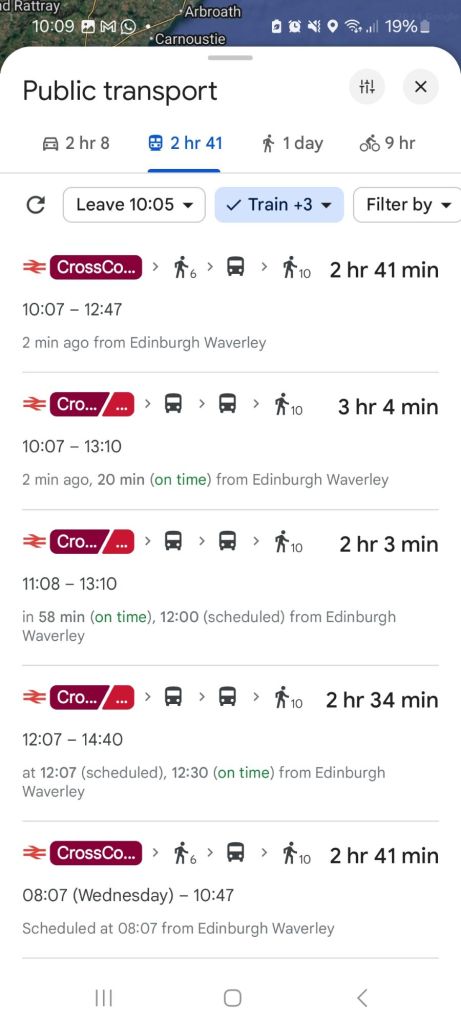
The fastest trip is selected below (2hrs 3mins overall) as perhaps the ideal route to follow (faster than driving)
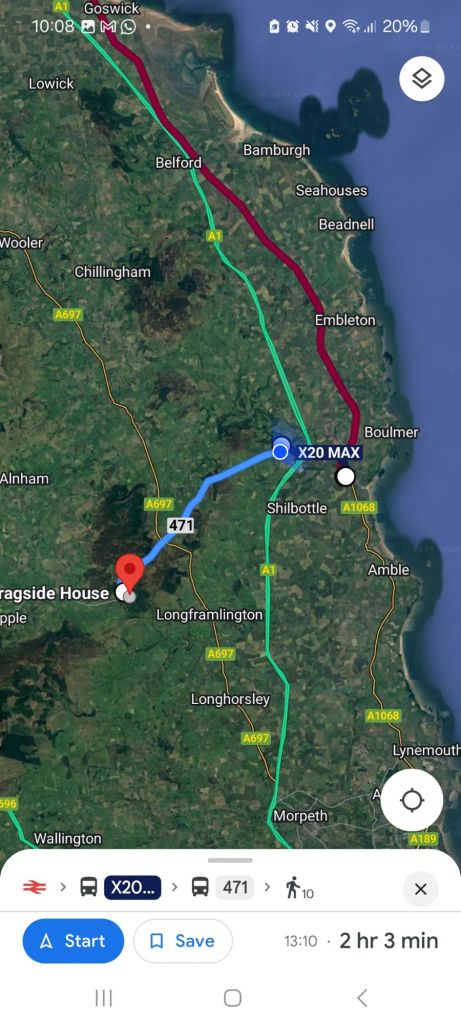
While the above is good, it could be easily be improved by developing the bus connection. At present, it would mean boarding the X20 Max to Alnwick Bus Station, then transferring to the 471 to then reach Cragside, it works but it could be better.
Alnmouth Station as an Interchange
The 471, rather than terminating in Alnwick Bus Station, could and arguably should be extended beyond Alnwick to Alnmouth Station. This would avoid the need to change buses, making it a ‘one change’ service, which improves the convenience of the service as a connection, while also having the additional benefit of better connectivity between Alnwick and Alnmouth stations, as an extended 471 could run alongside the X20 between Alnwick and Alnmouth.
This would, potentially be an extremely simple change to implement, but one that would make access to Cragside (as well as Rothbury) easier to access for distant places without use of cars, opening it up to more visitors (many people have no access to a car/unable to drive), as well as reducing issues like congestion or parking for vehicles, and would sit well with the sustainable aims of Cragside and the Armstrongs, and not far from the ‘green travel tips’ explored recently in the National Trust Magazine itself (Spring 2024).

 The Northumberland Coast Loop