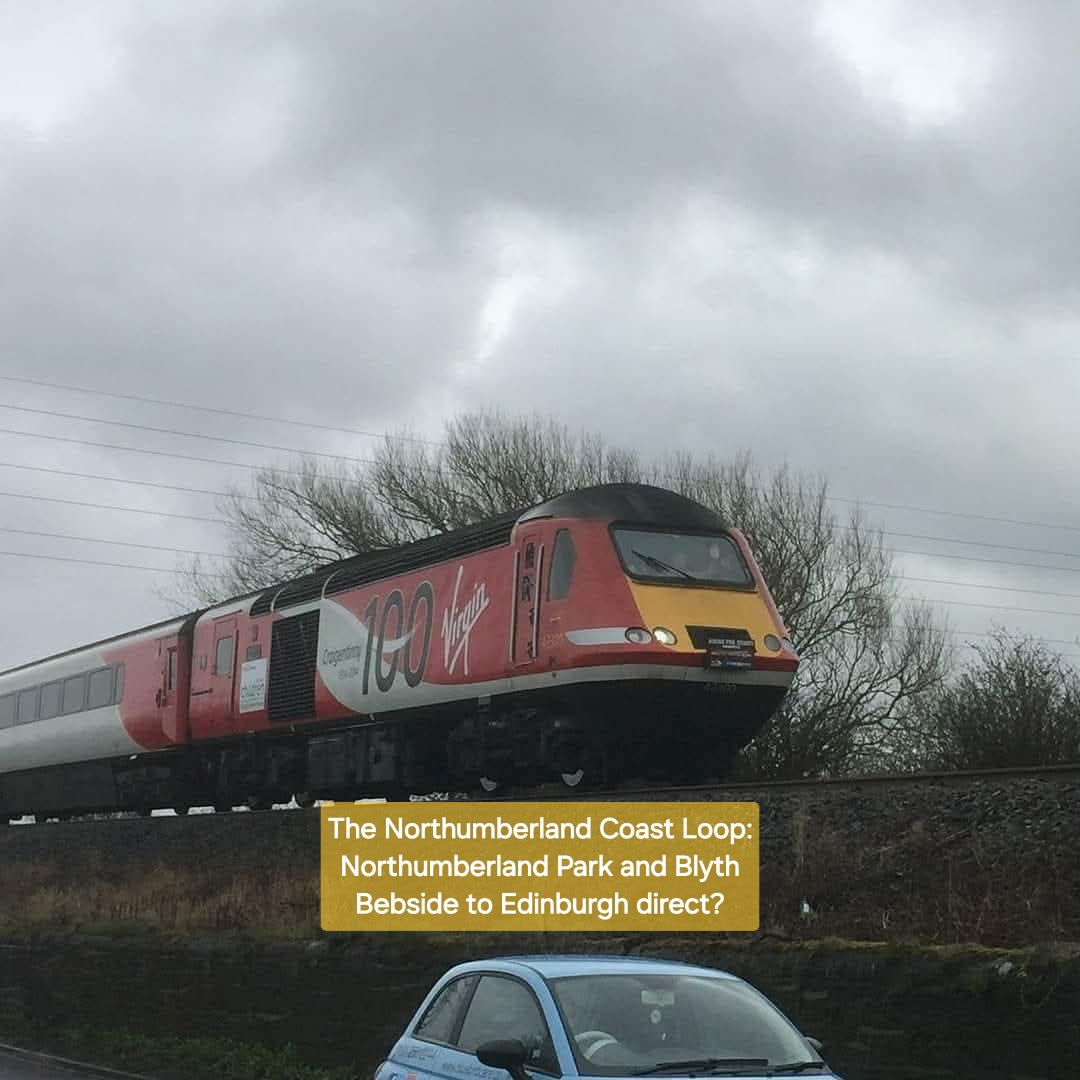
Edinburgh could be reached by rail in two hours or less from soon to open Northumberland Park, and Blyth Bebside stations by using an existing direct route via Hepscott and Pegswood. Please read below to find out more!
The Northumberland Coast Loop is a proposal to use the existing connecting line (The Hepscott Line) between the Northumberland Line at Bedlington Station, and the East Coast Main Line (ECML) at Morpeth North Junction.
This forms an alternative through route between Newcastle and Edinburgh, with a coastal loop via Blyth, Northumberland, hence the name ‘The Northumberland Coast Loop’.
This would give up to five of the six newly opened Northumberland Line stations (with the sole exception of Ashington, which is situated on a dead-ended branch to Lynemouth Power Station).
Services serving all stations are likely to be ‘within Northumberland’ local trains, operating from Newcastle to Berwick and return, but the same route could also be used for longer distance services connecting Newcastle to Edinburgh too, running a semi-fast (limited stop) service.

As can be seen on the above route diagram, each station is shown as a white dot along the line starting at Newcastle at the bottom left, and Berwick in the top right. The stations selected as semi-fast and local stops are ringed in black, with local only in plain white.
Starting with a Semi-Fast Service
The focus of this blog post is on the semi-fast service, which is perhaps the most likely service to begin on the route, due to capacity constraints for additional local services on the ECML.
The other benefit of a semi-fast service is that the number of trains per day can be lower but still viable, for example Grand Central serves stations such as Hartlepool five times per day in each direction, a similar level of service through SE Northumberland, either via an extended Great Central service to Edinburgh, or a separate operator could hopefully offer a similar service level.
Journey Times
The table below shows an estimation of journey times along the Northumberland Coast Loop for a semi-fast service, based upon known timetables for the Northumberland Line, ECML, and using the timings of the North Blyth – Fort William ‘Alcan’ freight to establish the running time between Pegswood and Bedlington.
Use of the latter goods service, as a 400t, 60mph limited freight train that pauses en-route for crew changes at Morpeth North means that timings are likely to be longer than a passenger service, meaning a properly planned passenger service might be faster than the timings set out below.
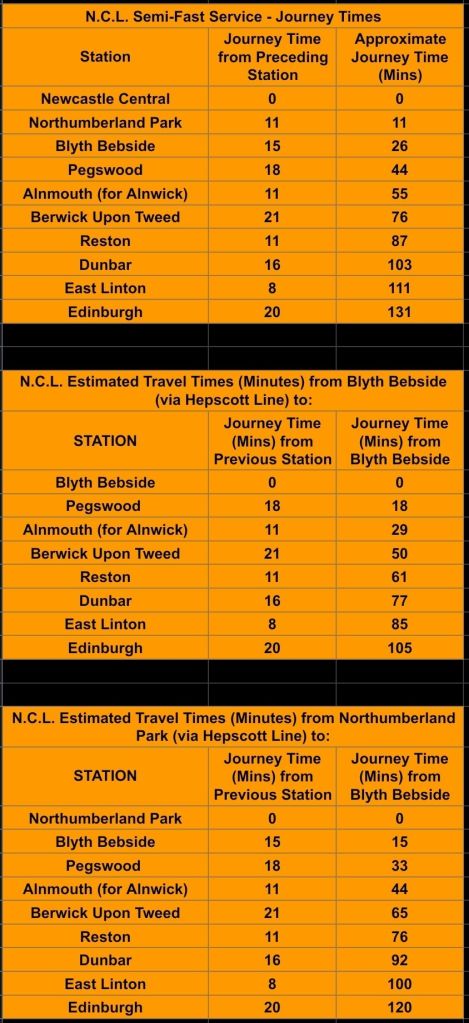
As can be seen from the above tables, a trip from Newcastle to Edinburgh via Northumberland Park and Blyth Bebside could be completed overall in around 2 hours and 11 minutes; only modestly longer than a comparable Transpennine Express service via Cramlington (shown below), which takes one hour and forty-eight minutes, meaning trip around the Northumberland Coast Loop is only around 21 minutes slower overall.
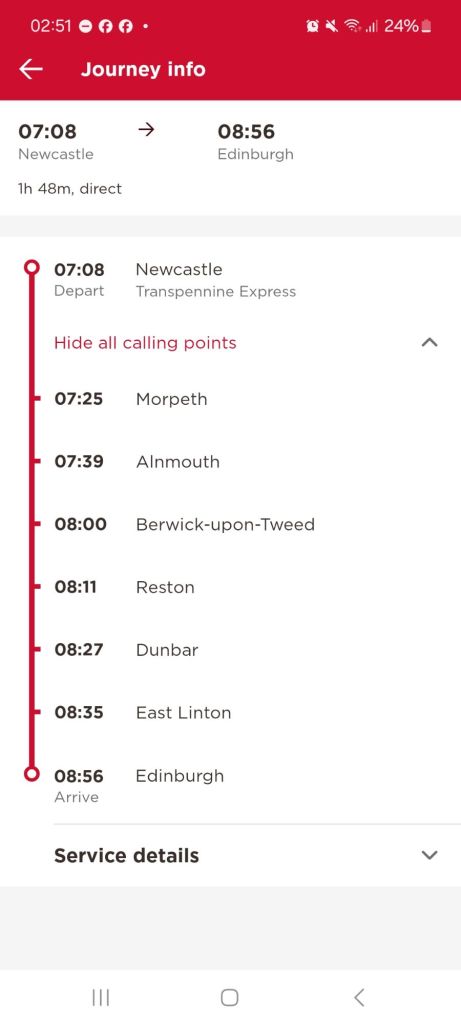
Compared to some routes such as the Durham Coast, which adds around an hour to diverted rail services, a route via Blyth Bebside would be very modest in terms of additional time for trains using that route, making it potentially attractive for commercial open access operators like Grand Central to consider extension of their North Eastern route into Scotland via Blyth, or for DfT operated services such as Transpennine Express to offer a secondary route via Blyth.
Blyth Bebside to Edinburgh could be achieved in 105 minutes (one hour, 45 min), which again compares reasonably with the above TPE service at Morpeth, which takes 1hr 31min to reach Edinburgh.
Presently, driving/taxi from Bebside Inn to Morpeth could possibly be done in 14 minutes (bearing in mind an early morning Google Maps search of the route will be far quieter traffic than during the daytime), but to catch the 07:25 from Morpeth to Edinburgh, allowing 14 minutes from Blyth would be very optimistic.
The other additional benefit to direct rail services via Blyth would be to reduce road traffic through towns such as Bedlington or Choppington, which are known to suffer from sometimes heavy congestion, so catching trains direct at Blyth Bebside could be useful to non-rail users too.


It is also possible to see how fast other connections could be, Alnmouth for example could be reached in just 29 minutes, meaning for those without a car (either non-drivers or electing to go car-free) could reach destinations such as Alnwick Castle, The Alnwick Garden, Lilidorei, Barter Books etc more more easily by reducing the first leg of the journey by road (either by driving or by taxi, the latter reducing significantly potential expenses on taxi trips).

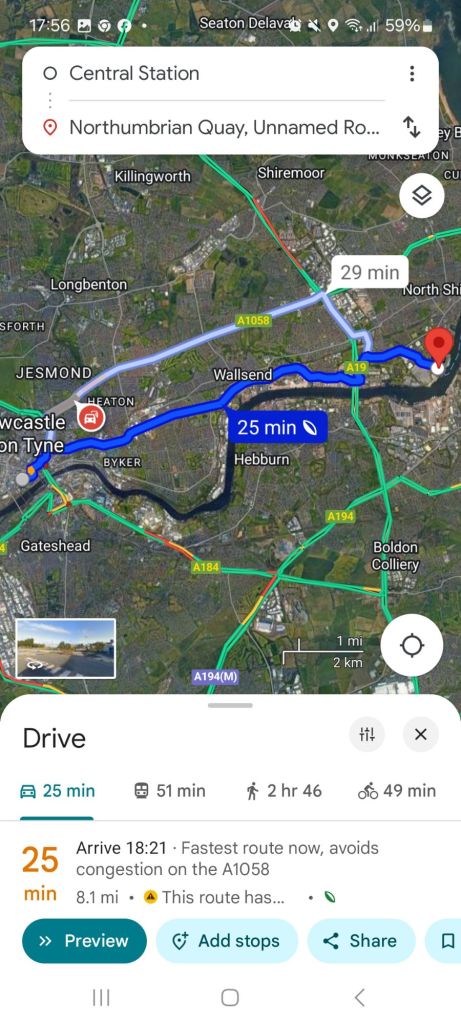
Northumberland Park to Edinburgh could be achieved in two hours flat by calculations in the above table; which could offer some savings on journey times compared to travelling into Newcastle Central station, which from a starting point such as Tynemouth could be significant, as seen below, the option to change from Metro to rail at Northumberland Park, to then travel north could offer a significant time saving, alongside transferring at a smaller, less complex station (one mainline platform compared to 12 at Newcastle Central) being potentially attractive to less confident rail users.
As can be seen from the map below, the direct Metro route from Tynemouth to Central Station passes through Northumberland Park station anyway, so a transfer between Metro and Rail there, rather than at Central Station would make a lot of sense for many North Tynesiders.

Northumberland Park could also be very well sited to offer a rail connection for DFDS Ferries between Tyneside and Continental Europe, as well as serving connections to/from Cruise ships using Port of Tyne, being closer than Central Station, and allowing a very quick bus shuttle to operate to connect both sites, being less than 5 miles apart by road, compared to eight or more for Central Station.
Cobalt Business Park, as one of the largest parks of it’s kind in the UK, could also be given added advantage by being located to a regionally/nationally served railway station alongside present access to the T&W Metro.

Long distance rail services to Northumberland Park would arguably complement the ‘prime location’ of Cobalt Business Park, and direct links to more cities, such as Edinburgh (York and even London are possible if part of a wider route such as extended GC service) would presumably help attract more businesses to the site?
Station Selection
The stations selected as the semi-fast stops, starting from Newcastle are:
Northumberland Park: As the first proposed stop after departing Newcastle, this station is only mainline one serving North Tyneside, and offering an excellent interchange with the Tyne and Wear Metro (rail and Metro will be co-located at essentially the same site), this station is an obvious one to include as a semi-fast stop.
Not only that, but it’s relatively close proximity ( to the DFDS Ferry Terminal and Cruise Terminal at Northumbrian Quay would allow those connecting to/from international ferries and cruises to connect easily to the national network, offering a near direct link from ferries and cruise ships to North Northumberland, the Scottish Borders, and Edinburgh, and compares favourably with present travel into Newcastle Central Station which takes substantially longer.

Blyth Bebside: This station has been selected due to it’s strategic location; it is one of two stations that will serve the largest town in Northumberland of Blyth.
It’s location near to the junction of the A189 Spine Road and A193 (Cowpen Road) means it is easily accessible from not only Blyth, but also large towns such as Cramlington (itself being the second largest town in Northumberland with relatively limited northbound rail service), Bedlington (fourth largest town) and via the rail, bus and road networks even areas such as Ashington, Newbiggin and further afield, making Blyth Bebside a well placed station to serve a very wide area around it.
This station would offer a few advantages over nearby Morpeth, with it’s closer proximity allowing many people to use active travel to reach the station, it also has a much less constrained site, potentially allowing for easier expansion of facilities like car parking (which if highly successful, might allow for a future direct connection to/from the A189, reducing road traffic in Bebside itself.
Pegswood: This would be the first station back on the ECML after travelling ‘around the loop’ through Blyth.
It has been chosen as the route doesn’t pass through Morpeth (the Morpeth North Curve marks the north eastern edge of Coopies Lane Industrial Estate, passing under the A196 to the east of Hepscott Care Centre and Storage 24, rejoining the ECML about ¼ mile away from Pegswood Railway Viaduct).
As an existing station sat between Morpeth and Ashington, it’s location just off the A197 Pegswood Bypass, this again is a very strategic, being easily accessed from a wide area by bus, car, or active travel (just off National Cycle Network Route 155), and if the station is enhanced in future with the simple addition of a car park, it could easily become a Pegswood Parkway. This could allow the station to serve the large rural area to the west of Morpeth, and easy access from the A197 would mean that road traffic could avoid needing to enter the town of Morpeth to reach Morpeth Station, either catching trains directly from Pegswood, or using upgraded rail/bus links to reach Morpeth.
Note that platform lengths at Northumberland Park, Blyth Bebside, and Pegswood stations may be an initial constraint, with short trains, or the use of on-train features such as selective door opening potentially being a requirement initially. In the longer term, lengthening platforms could be considered to resolve this fully and allow maximum length trains to service these stops.
Alnmouth (for Alnwick [and Amble]): Alnmouth station is already a well established hub for the middle of Northumberland, with both Alnwick and Amble within relatively easy reach by bus or even walking cycling from these two towns. Therefore N.C.L. services would reasonably stop at this station to allow connection to these two towns and the surrounding area. Both towns are also popular tourism destinations for residents in SE Northumberland, with travel also common in the opposite direction for events, such as those at Blyth Battery, the Tall Ships etc drawing people into areas such as Blyth from a great distance.
Berwick-Upon-Tweed: As with Alnmouth, it is again a known hub for North Northumberland, and offers connections between the port towns of Blyth and Berwick.
As with Alnwick and Amble, Berwick is a popular ‘day out’ venue, but also for short holidays at the nearby Haven caravan site (as is Haggerston Castle between Berwick and Alnmouth), and direct rail connections could make Berwick, as well as these two sites much easier to reach.
The Scottish Stations of Reston, Dunbar, and East Linton: Again these have been selected as already commonly served stations by operators such as TPE, so a basing the N.C.L. service with a similar stopping pattern would allow direct links between these places too.
People Power to Push for Passenger Services
If you live near to one of the stations mentioned above, please reach out to your local MP and mention the Northumberland Coast Loop in your email/letter. With 742 signatures on our recent petition, hopefully some of you may also take the time to write to your MP in support of the route? The more who write, the more action will hopefully be seen!
For Northumberland/North Tyneside, please find below which MP covers each station on the route.
David Smith MP covers the three ECML stations at Berwick Upon Tweed, Alnmouth, and Pegswood. I have, as a constituent, already raised this route with him, but if you also live in the constituency, please also send him an email.
Ian Lavery MP covers Blyth Bebside, as well as Ashington, Bedlington, and Newsham stations. Although I am now a former constituent, now represented by David Smith above, I reached out to Ian by email, and received a very welcome response, even though he is not obliged to do so; so if you do live in his constituency, please send him a letter/email in support of the route.
Emma Foody MP covers Northumberland Park, as well as Seaton Delaval, and Cramlington stations, so please reach out to her and send a letter/email in support of the route.
Northumberland County Councillor Elections 2025.
With time for the NCC elections fast approaching in May 2025, please also reach out to your local county councillor candidates to seek their support for the route too.
Kim McGuinness, North East Mayor
As mayor of the North East, please also reach out to Kim McGuinness by letter/email in support of the Northumberland Coast Loop.
 The Northumberland Coast Loop
One thought on “Edinburgh by direct train from Blyth Bebside and Northumberland Park?”